
Judge, 1918-10-05 · page 9 of 32
Judge — October 5, 1918 — page 9: what you’re looking at
What you’re looking at
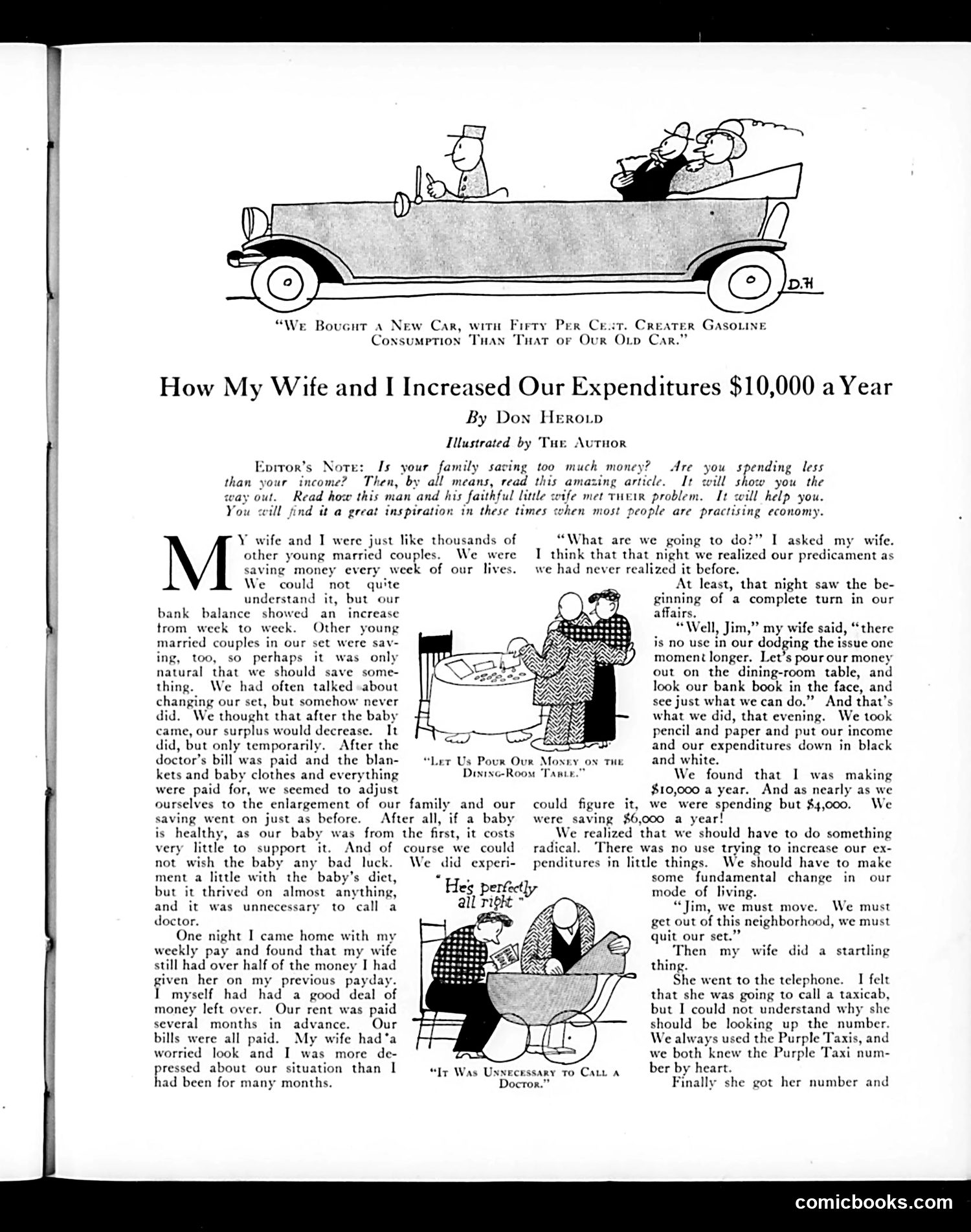
This 1920s satirical article mocks the irresponsibility of wealthy couples who overspend despite earning substantial incomes. The narrator and his wife earn $10,000 annually but, alarmed by their $6,000 yearly savings, decide they must spend more lavishly to avoid "hoarding" money. The cartoons illustrate their solution: they buy a gas-guzzling car (the opening cartoon shows a massive vehicle consuming 50% more fuel), move to a wealthier neighborhood, and adopt an extravagant lifestyle. The wife's phone call at the article's end hints she's arranging even more expensive indulgences. **The satire targets**: 1920s consumer culture and status anxiety among the upwardly mobile middle class, who equated visible spending with respectability and believed saving money was somehow unpatriotic or unbecoming. The Editor's note sardonically frames this as "inspiration" for economizing families—the opposite of its actual message—adding another layer of ironic commentary on excessive consumption during an era when most people practiced genuine thrift.
📄 Transcribed text from this page (OCR, searchable)
Machine-transcribed from the original scan — historical spelling and the odd misread are preserved.
“We Boucut a New Car, with Fiery Per Cet. Creater Gasouiy Consumption Tuan Tuat or Our Otp Car.” How My Wife and I Increased Our Expenditures $10,000 a Year By Don Heroup Illustrated by Tur Autuor : Is your family s Eprror’s Not ng than your income? Y wife and I were just like thousands of other young married couples. We were saving money every week of our liv We could not quite understand it, but our bank balance showed an_ increase trom week to week. Other young married couples in our set were sav- ing, too, so perhaps it was only natural that we should save some- thing. We had often talked about changing our set, but somehow never did. We thought that after the baby came, our surplus would decrease. It did, but only temporarily. After the doctor’s bill was paid and the blan- kets and baby clothes and everything were paid for, we seemed to adjust ourselves to the enlargement of our family and our saving went on just as before. After all, if a baby is healthy, as our baby was from the first, it costs very little to support it. And of course we could not wish the baby any bad luck. We did experi- ment a little with the baby’s diet, « ‘ but it thrived on almost anything, Hes perfectly and it was unnecessary to call a all right doctor. an, One night I came home with my weekly pay and found that my wife still had over half of the money I had given her on my previous payday. I myself had had a good deal of money left over. Our rent was paid several months in advance. Our bills were all paid. My wife had‘a worried look and I was more de- pressed about our situation than | had been for many months. Then, by all means, read this amazing article. Read how this man and his faithful little ind it a great inspiration in these times when most people are practising economy. “Let Us Pour Our Moxry on THe Dixixc-Room Taste.” “Ir Was Unnecessary To Catt a Doctor.” F Are you spending less It will show you the It will help you. too much money? tfe met THEIR problem. “What are we going to do?” I asked my wife. I think that that night we realized our predicament as we had never realized it before. At least, that night saw the be- ginning of a complete turn in our affairs. “Well, Jim,” my wife said, “there is no use in our dodging the issue one moment longer. Let’s pour our money out on the dining-room table, and look our bank book in the face, and see just what we can do.” And that’s what we did, that evening. We took pencil and paper and put our income and our expenditures down in black and white. We found that I was making $10,000 a year. And as nearly as we could figure it, we were spending but $4,000. We were saving $6,000 a year! We realized that we should have to do something radical. There was no use trying to increase our ex- penditures in little things. We should have to make some fundamental change in our mode of living. “Jim, we must move. We must get out of this neighborhood, we must quit our set.” Then my wife did a startling thing. She went to the telephone. | felt that she was going to call a taxicab, but I could not understand why she should be looking up the number. We always used the Purple Taxis, and we both knew the Purple Taxi num- ber by heart. ‘inally she got her number and comicbooks.com