
Judge, 1918-10-05 · page 22 of 32
Judge — October 5, 1918 — page 22: what you’re looking at
What you’re looking at
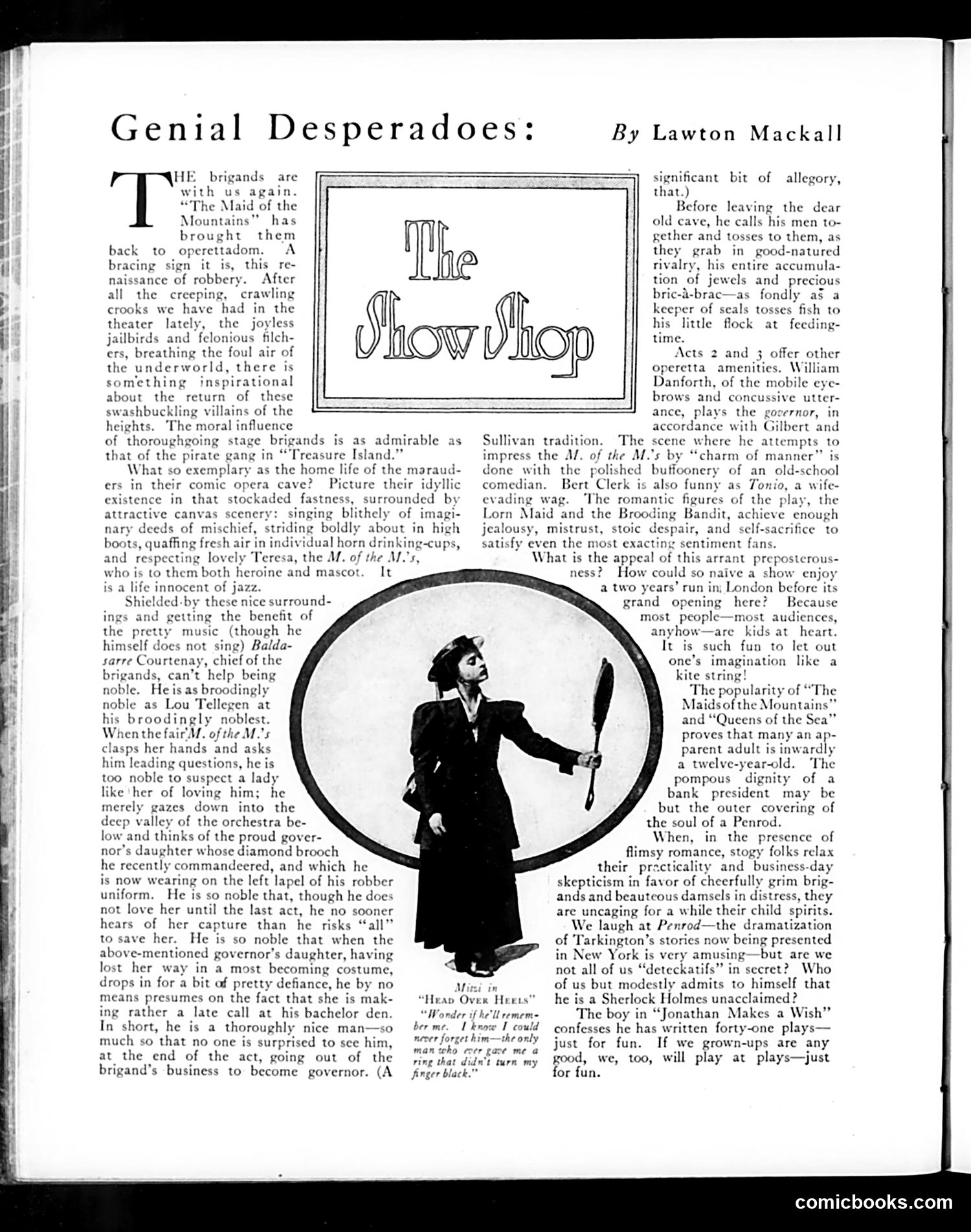
This is Lawton Mackall's review of an operetta called "The Maid of the Mountains," praising its return to cheerful, romantic villainy after recent theater offerings featuring grim, realistic criminals. **The satire's point:** Mackall argues that stage brigands—romanticized, noble bandits who sing prettily and respect women—are morally superior to the depressing, naturalistic "crooks" that have lately dominated American theater. The brigand chief Baldassarre Courtenay is so nobly virtuous he ultimately abandons crime to become governor. **The joke:** Mackall is gently mocking both the operetta's naive sentimentality *and* audiences who prefer escapist fantasy to serious drama. He acknowledges the show's appeal is fundamentally childish—letting imagination run free like a kite string—yet finds this charming rather than contemptible. The circular illustration shows a man in formal dress striking a theatrical pose, likely depicting a lead character.
📄 Transcribed text from this page (OCR, searchable)
Machine-transcribed from the original scan — historical spelling and the odd misread are preserved.
Genial Desperadoes: By Lawton Mackall brigands are with us again. “The Maid of the Mountains” has brought them operettadom. A bracing sign it is, this re- naissance of robbery. After . | the creeping, crawling crooks we have had in the 4 theater lately, the joyless | jailbirds and felonious filch- ers, breathing the foul air of the underworld, there is ] something inspirational back to significant bit of that.) Before leaving the dear old cave, he calls his men to- gether and tosses to them, as they grab in good-natured rivalry, his entire accumula- us bric-i-brac—as fondly a3 a keeper of seals tosses fish to his little flock at feeding- time. Acts 2 and 3 offer other operetta amenities. William Danforth, of the mobile eye- allegory, tion of jewels and prec about the return of brows and concussive utter- eax) these lL swashbuckling villains of the heights. The moral influence of thorougt g stage brigands is as admirable as that of the pirate gang in “Treasure Island.” What so exemplary as the home life of the maraud- ers in their comic opera cave? Picture their idyl existence in that stockaded fastness, surrounded by attractive canvas scenery: singing blithely of imagi- nary deeds of mischief, striding boldly about in high boots, quaffing fresh air in individual horn drinking-cups, and respecting lovely Teresa, the M. of the M.’ who is to them both heroine and mascot. It is a life innocent of jazz. Shielded-by these nice surround- ings and getting the benefit of the pretty music (though he himself does not sing) Balda- sarre Courtenay, chief of the brigands, can’t help being noble. He is as broodingly noble as Lou Tellegen at his broodingly noblest. When the fair'M. of the M.'s clasps her hands and asks him leading questions, he is too noble to suspect a lady like ‘her of loving him; he merely gazes down into the deep valley of the orchestra be- low and thinks of the proud gover- nor’s daughter whose diamond brooch he recently commandeered, and which he is now wearing on the left lapel of his robber uniform. He is so noble that, though he does ; not love her until the last act, he no sooner hears of her capture than he risks “all” to save her. He is so noble that when the above-mentioned governor’s daughter, having lost her way in a most becoming costume, goir ic 5 ing rather a late call at his bachelor den. In short, he is a thoroughly nice man—so much so that no one is surprised to sce him, at the end of the act, going out of the brigand’s business to become governor. (A ber me. -j means presumes on the fact that she is mak- y drops in for a bit af pretty defiance, he by no Mitsi i “Heao Over Heer “Wonder if he'll remem= I know I could never forget man iho ever ring that didn’t turn my finger black. ance, plays the governor, in accordance with Gilbert and The scene where he attempts to impress the A/. 0 M.’s by “charm of manner” is done with the hed buffoonery of an old-school comedian. Bert Clerk is also funny as Tonio, a wif evading wag. The romantic figures of the play, the Lorn Maid and the Brooding Bandit, achieve enough jealousy, mistrust, stoic despair, and self-sacrifice to satisfy even the most exacting sentiment fans. What is the appeal of this arrant: preposterous- ness? How could so naive a show enjoy a two years’ run in; London before its Sullivan traditior grand opening here? Because most people—most audiences, anyhow—are kids at heart. It is such fun to let out one’s imagination like a kite string! The popularity of “The Maidsof the Mountains” and “Queens of the Sea” proves that many an ap- parent adult is inwardly a twelve-year-old. The pompous dignity of a bank president. may be but the outer covering of the soul of a Penrod. When, in the presence of flimsy romance, stogy folks relax their practicality and business-day skepticism in favor of cheerfully grim brig- ands and beauteous damsels in distress, they are uncaging for a while their child spirits. We laugh at Penrod—the dramatization of Tarkington’s stories now being presented in New York is very amusing—but are we not all of us “deteckatifs” in secret? Who jn of us but modestly admits to himself that ” he is a Sherlock Holmes unacclaimed? The boy in “Jonathan Makes a Wish” confesses he has written forty-one plays— just for fun. If we grown-ups are any good, we, too, will play at plays—just for fun. im—the only gave me a comicbooks.com