
Judge, 1918-10-05 · page 10 of 32
Judge — October 5, 1918 — page 10: what you’re looking at
What you’re looking at
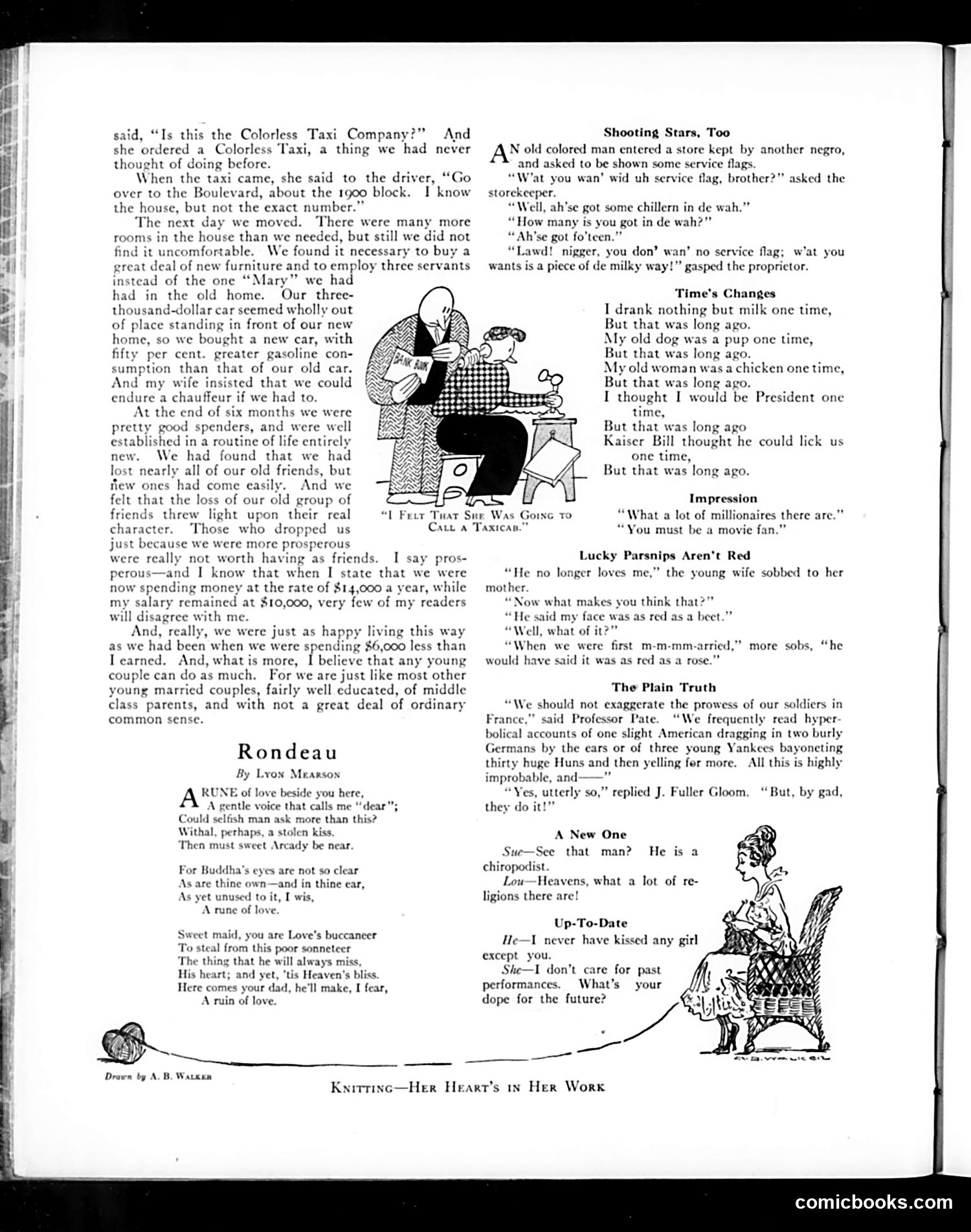
This page contains multiple brief satirical pieces typical of Judge's format: **Main narrative** (top left): A humorous story about a couple who move to an expensive neighborhood and spiral into debt—spending $14,000 annually on a $10,000 salary. The satire targets middle-class aspirational spending and the social pressure to maintain appearances through consumption. **"Rondeau"** (poem): A romantic verse with a dark twist—the narrator's father will "make a ruin of love," poking fun at courtship obstacles. **Small humor pieces** (right column): - "Shooting Stars, Too": A dialect joke about a Black man with fourteen children seeking a WWI service flag; the punchline relies on crude racial stereotypes common to the era. - "Time's Changes": Nostalgic observations (drinking milk, Kaiser Bill's defeat) referencing WWI's recent conclusion. - "Lucky Parsnips Aren't Red" & "The Plain Truth": Brief romantic/marital jokes. **Visual elements**: Pen-and-ink illustrations by A.B. Walker accompany pieces, including a couple and a woman knitting. The page reflects early 20th-century American middle-class anxieties and attitudes, including period-typical racist humor.
📄 Transcribed text from this page (OCR, searchable)
Machine-transcribed from the original scan — historical spelling and the odd misread are preserved.
said, “Is this the Colorless Taxi Company?” And she ordered a Colorless Taxi, a thing we had never thought of doing before. When the taxi came, she said to the driver, “Go over to the Boulevard, about the 1900 block. I know the house, but not the exact number.” he next day we moved. There were many more rooms in the house than we needed, but still we did not find it uncomfortable. We found it necessary to buy a great deal of new furniture and to employ three servants instead of the one “Mary” we had had in the old home. Our three- thousand-dollar car seemed wholly out of place standing in front of our new home, so we bought a new car, with fifty per cent. greater gasoline con- sumption than that of our old car. And my wife insisted that we could endure a chauffeur if we had to. At the end of six months we were pretty good spenders, and were well established in a routine of life entirely new. We had found that we had lost nearly all of our old friends, but few ones had come easily. And we felt that the loss of our old group of friends threw light upon their real character. Those who dropped us just because we were more prosperous were really not worth having as friends. I say pros- perous—and I know that when I state that we were now spending money at the rate of $14,000 a year, while my salary remained at $10,000, very few of my readers will disagree with me. And, really, we were just as happy living this way as we had been when we were spending $6,000 less than ITearned. And, what is more, I believe that any young couple can do as much. For we are just like most other young married couples, fairly well educated, of middle class parents, and with not a great deal of ordinary common sense. Rondeau By Lvox Mearsox RUNE of love beside you here, A gentle voice that calls me “dear”; Id selfish man ask more than this? Withal, perhaps, a stolen kiss Then must sweet Arcady be near. For Buddha’s eyes are not so clear As are thine own—and in thine ear, As yet unused to it, I wis, A rune of love. Sweet maid, you are Love's buccaneer To steal from this poor sonneteer The thing that he will always miss, His heart; and yet, ‘tis Heaven's bliss. Here comes your dad, he'll make, I fear, A ruin of love. oe \ KAN Drawn by A.B. Watkun “L Feor Tuat Sur Was C€ Catt a Taxican.” Knitrinc—Her Heart’s 1s Her Work Shooting Stars, Too N old colored man entered a store kept by another negro, and asked to be shown some service flags. “W'at you wan’ wid uh service flag, brother?” asked the storekeeper. “Well, ah’se got some chillern in de wah.” “How many is you got in de wah “ Ah’se got fo'teen.” “Lawd! nigger, you don’ wan’ no service flag; w’at you wants is a piece of de milky ” gasped the proprictor. Time's Changes I drank nothing but milk one time, But that was long ago. My old dog was a pup one time, But that was long ago. My old woman wasa chicken one time, But that was long ago. I thought I would be President one time, But that was long ago Kaiser Bill thought he could lick us one time, But that was long ago. Impression “What a lot of millionaires there are.” “You must be a movie fan.” Lucky Parsnips Aren't Red “He no longer loves me,” the young wife sobbed to her mother. “Now what makes you think that? “He said my face was as red as a beet.” “Well, what of it?” “When we were first. m-m-mm-arried,” more sobs, “he would have said it was as red as a rose.” The Plain Truth “We should not exaggerate the prowess of our soldiers in France,” said Professor Pate. “We frequently read hyper bolical accounts of one slight American dragging in two burly Germans by the ears or of three young Yankees bayoneting thirty huge Huns and then yelling fer more. All this is highly improbable, and ——” “Yes, utterly so,” replied J. Fuller they do it!” iloom. “But, by gad, A New One Sue—See that man? He is a chiropodist. ho Lou—Heavens, what a lot of re- x ligions there are! Up-To-Date He—I never have kissed any girl except you. She—I don’t care for past performances. What's your dope for the future? — — comicbooks.com