
A complete issue · 36 pages · 1918
Judge — July 13, 1918
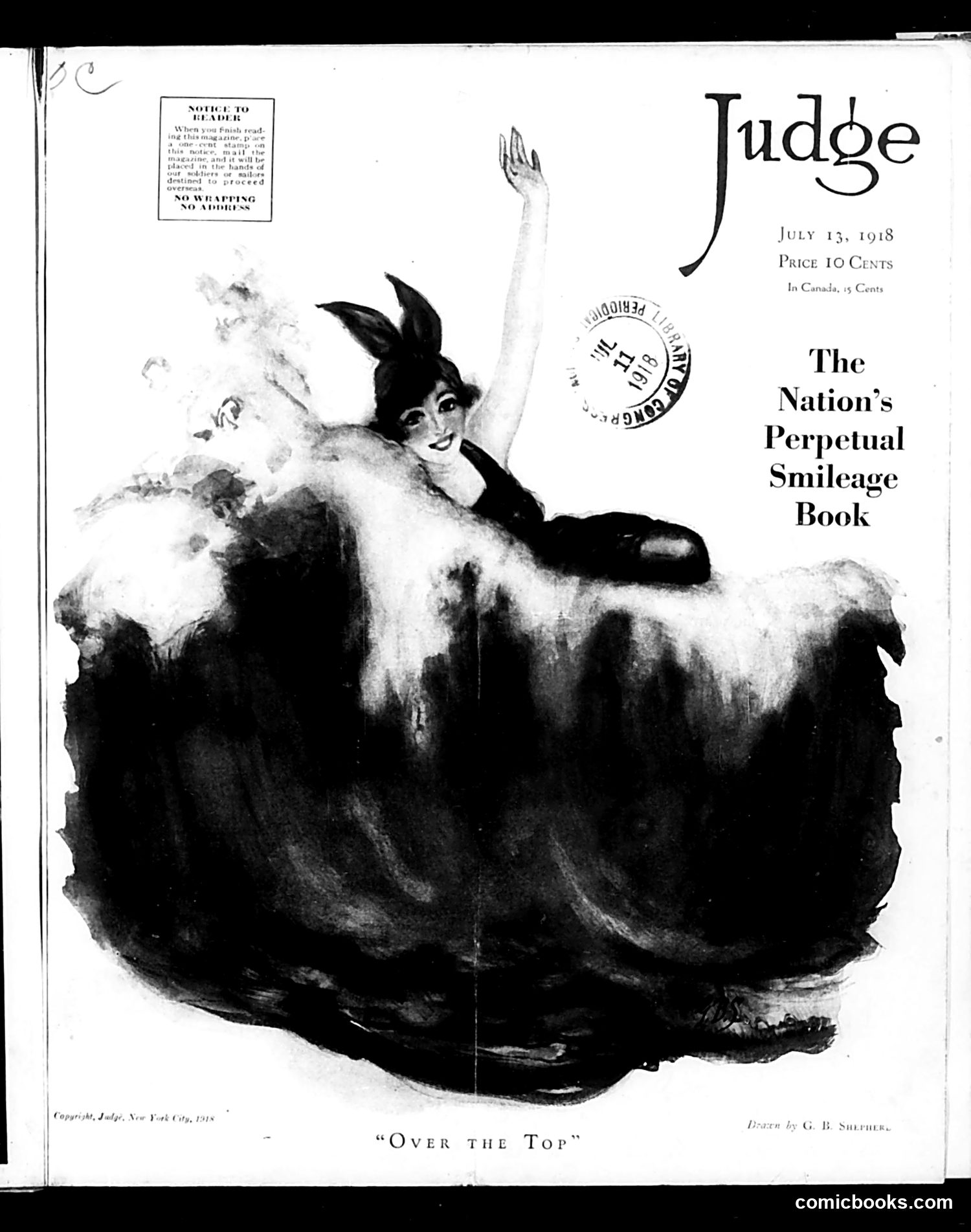
This cover illustrates the phrase "over the top," a WWI term for soldiers charging from trenches into enemy fire. The illustration shows a stylized female figure with rabbit ears, emerging triumphantly from dark, churning waters or smoke—likely representing the chaos of battle. Published in July 1918, near WWI's end, this appears to celebrate American military momentum or morale. The "Nation's Perpetual Smileage Book" subtitle suggests the magazine aims to boost public spirits during the war effort through humor and patriotic imagery. The rabbit ears may reference luck or resilience, common wartime symbols. The confident pose and bright upper figure contrasts sharply with the dark, turbulent forms below—visually reinforcing optimism amid conflict.
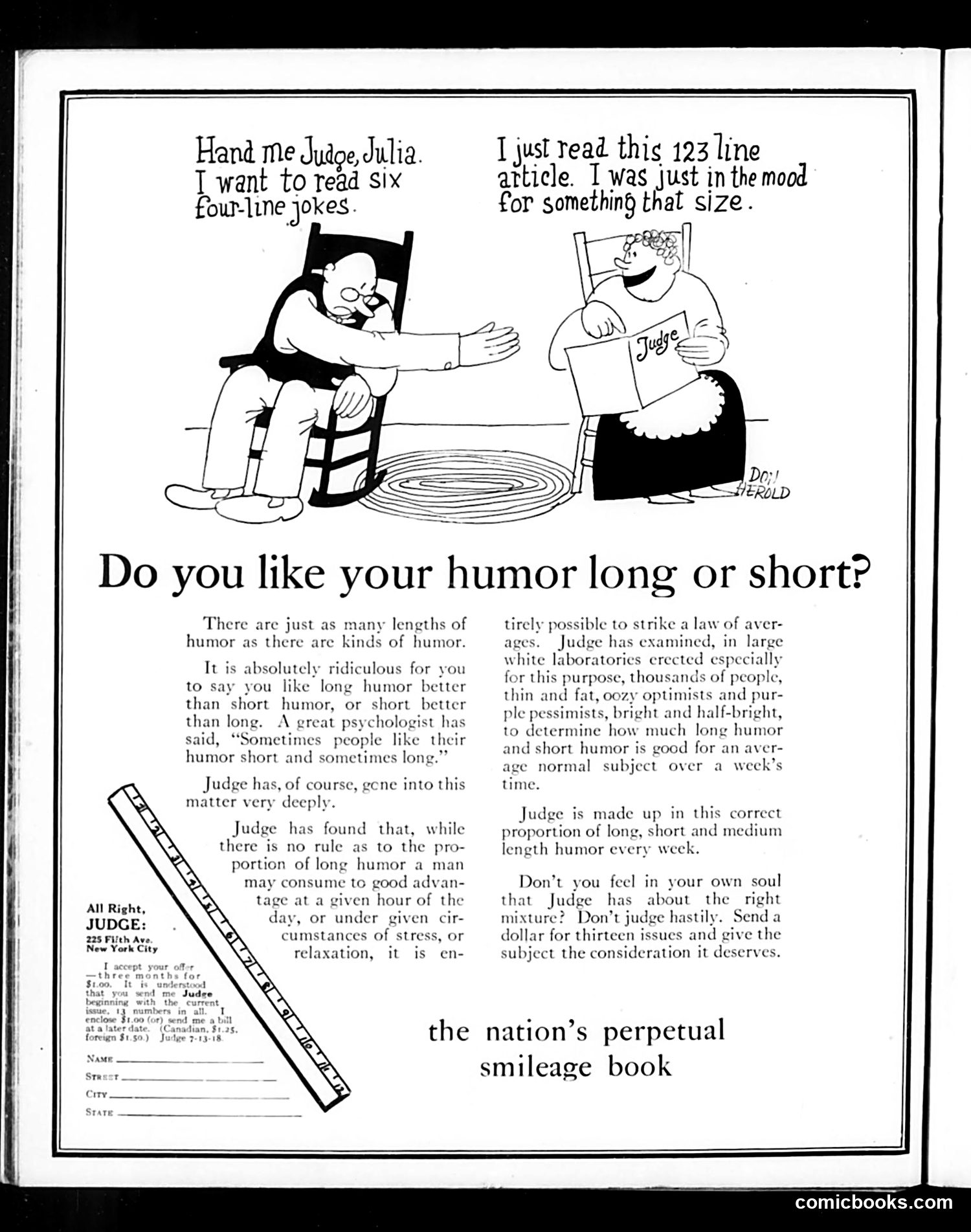
This page from *Judge* magazine features a cartoon and article about humor preferences. The cartoon shows two people exchanging reading material—one asking for "six four-line jokes" while the other offers a "123 line article," illustrating different tastes in humor length. The accompanying article argues that humor comes in various lengths, and that neither long nor short humor is objectively superior. It references "Judge" (the magazine itself, personified) conducting pseudo-scientific research with "white laboratories" to determine optimal humor length for different ages and circumstances. The page includes a subscription offer at bottom left. The satire gently mocks both rigid preferences for specific humor formats and the magazine's self-promotional claims about having scientifically determined the "correct" humor mixture. It's primarily humorous commentary on reader preferences rather than political satire.
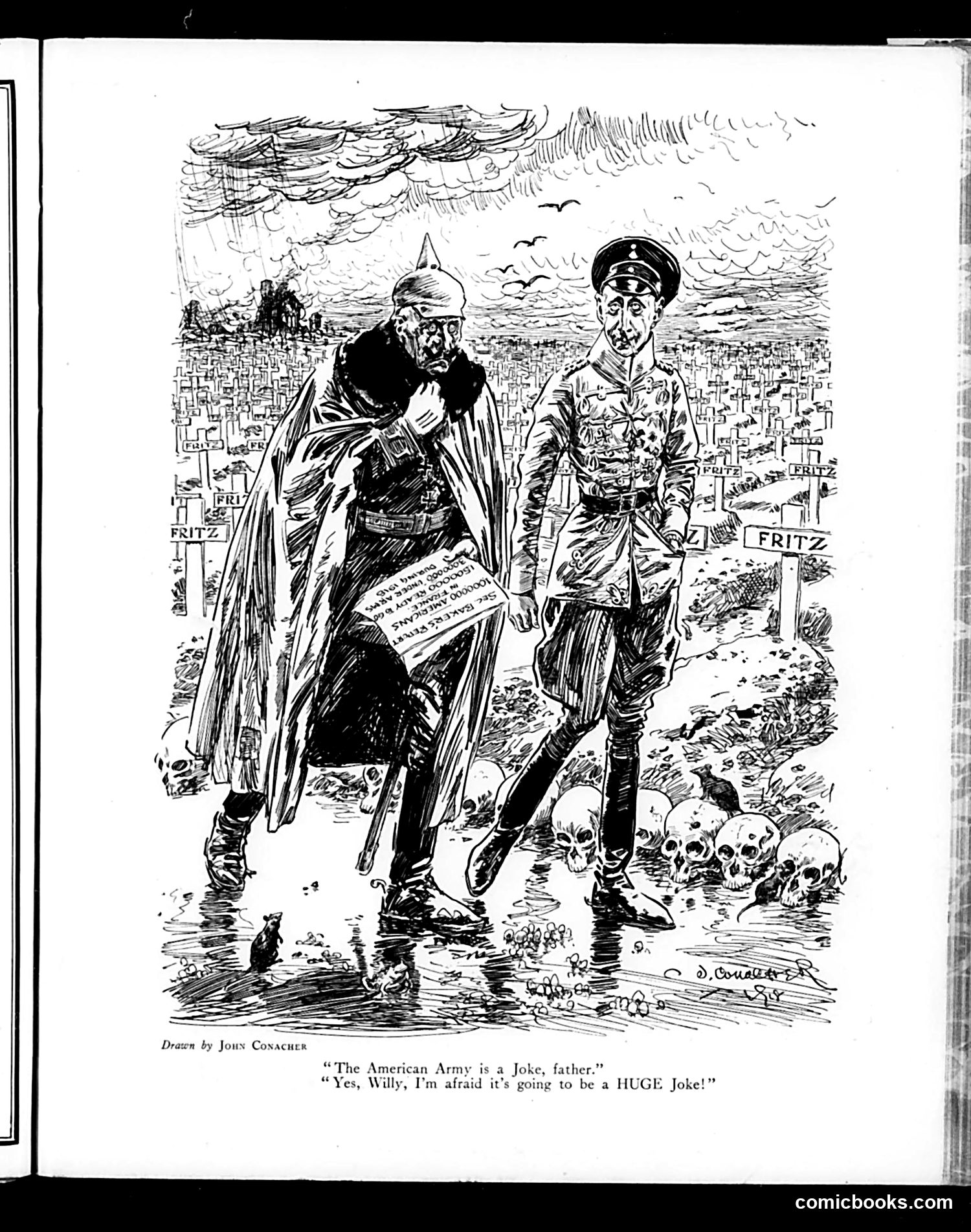
This John Conacher cartoon from *Judge* magazine depicts two German military figures (identifiable by their spiked Prussian helmets and uniforms) walking through a cemetery. One wears a cape and appears elderly or skeletal; the other is a uniformed officer. They're examining a gravestone marked "FRITZ," surrounded by skulls. The dialogue—"The American Army is a Joke, father" / "Yes, Willy, I'm afraid it's going to be a HUGE Joke!"—is darkly ironic satire. The German figures are dismissing American military strength, but the surrounding graveyard and skulls suggest their own devastating losses. The cartoon mocks German confidence while warning that American involvement would prove catastrophically costly for Germany. This likely dates to World War I era, when the U.S. was still neutral or newly involved.
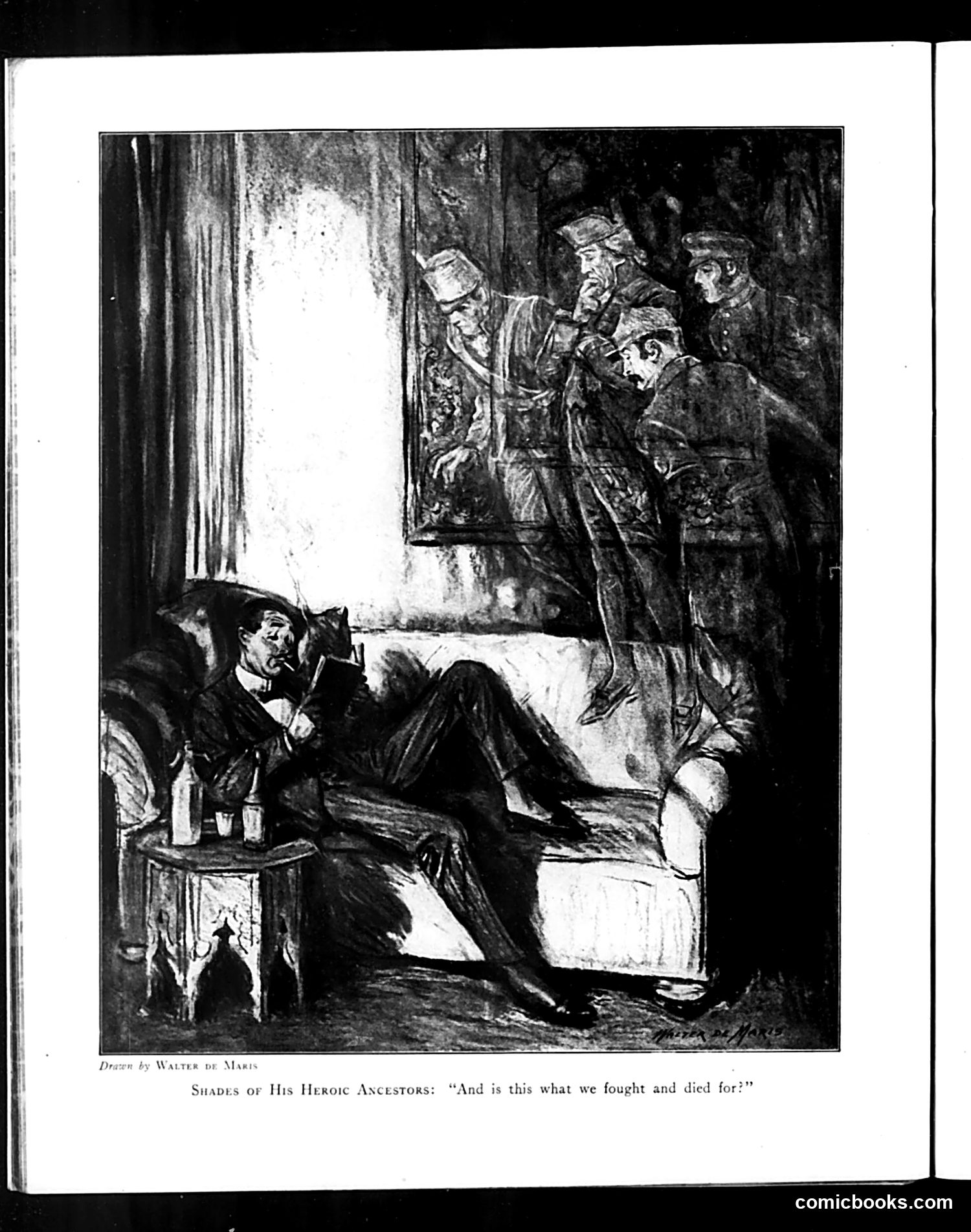
This cartoon by Walter de Maris depicts a man reclining in bed, apparently ill or hungover, visited by ghostly figures of military ancestors appearing at a window or doorway. The apparitions—rendered as stern-faced soldiers in historical uniforms—confront him with the accusatory question: "And is this what we fought and died for?" The satire criticizes a contemporary figure (identity unclear from image alone) for failing to live up to his family's martial legacy. The cartoon suggests moral or physical degeneracy—the protagonist's weakened state contrasts sharply with his ancestors' strength and sacrifice. This represents a common Judge magazine theme: mocking the decline of American character or patriotic duty among privileged elites.
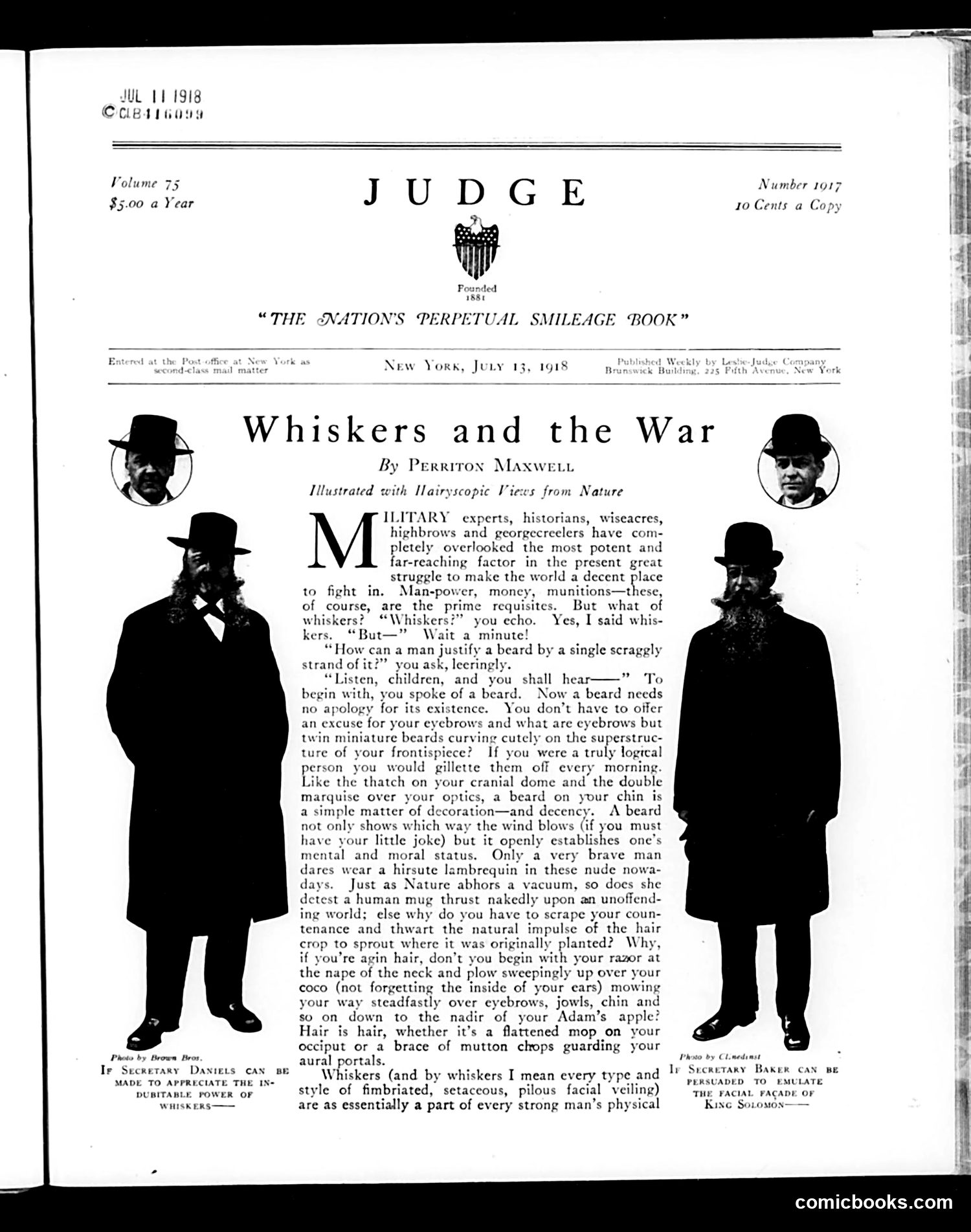
This satirical article by Perriton Maxwell uses facial hair as an extended metaphor for masculinity and patriotism during World War I. The piece humorously argues that beards are essential to a man's physical and moral status—a jab at contemporary masculinity standards during wartime. The captions identify two figures: Secretary Daniels (Navy Secretary Josephus Daniels) and Secretary Baker (War Secretary Newton Baker), both depicted with prominent facial hair. The satire suggests these officials could "appreciate the indisputable power of whiskers," implying that strong leadership requires masculine presentation. The underlying joke appears to be commentary on how wartime leadership and national strength were culturally linked to traditional masculine imagery—beards symbolizing virility and authority needed to conduct the war effort.
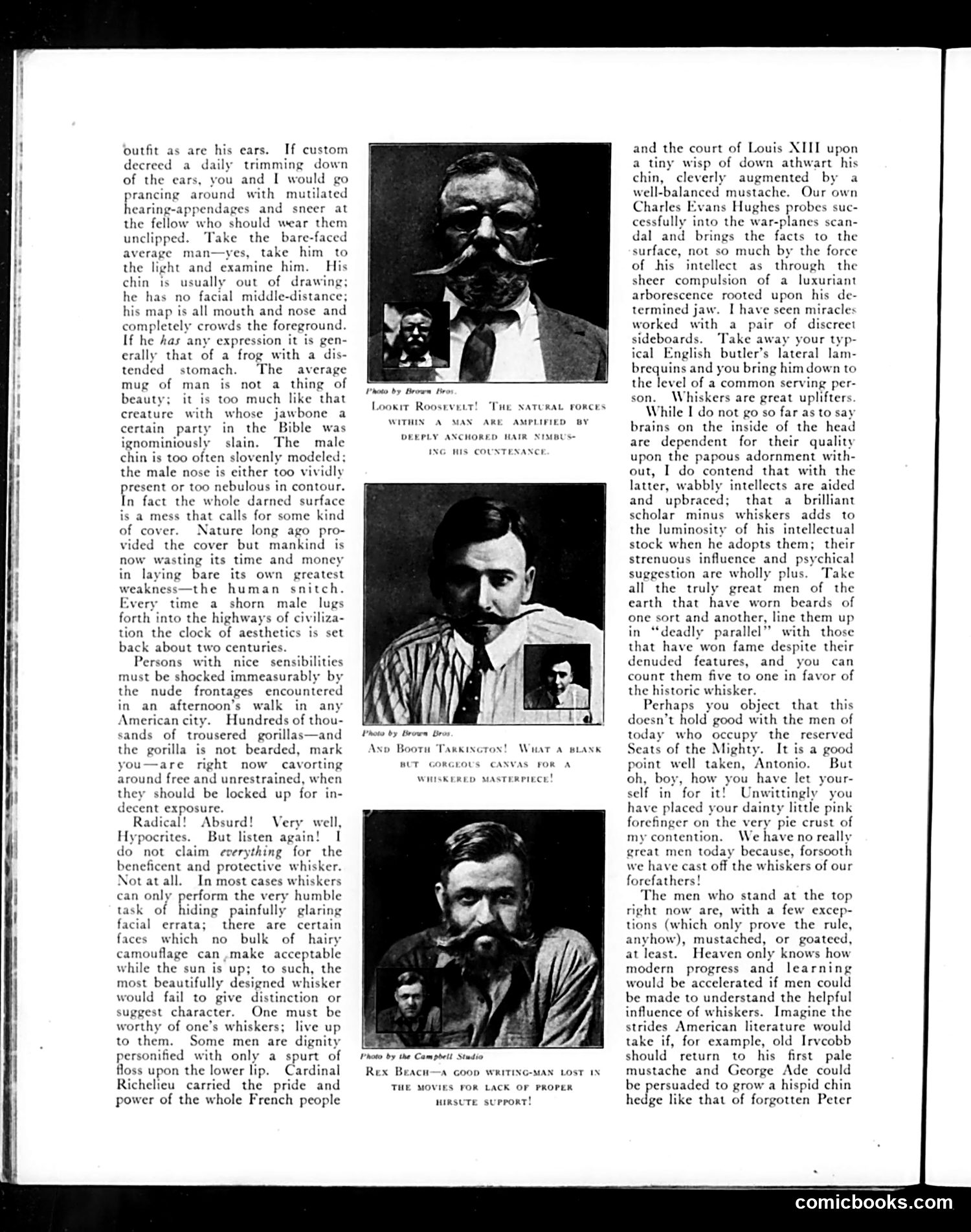
This page discusses **facial hair as a marker of character and masculinity**. The text argues that whiskers are essential to great men, claiming that removing them diminishes intellectual authority. It references historical figures like Cardinal Richelieu and suggests modern men lack the beards worn by their forefathers. The three photographs show men with different facial hair styles, apparently illustrating the article's point about whiskers' importance. The satire appears to mock **contemporary anxieties about masculinity** and changing grooming standards. The overwrought rhetoric—claiming civilization itself depends on beards—satirizes those who resist modern fashion trends. The reference to "Radicals" suggests this reflects broader cultural debates about progress versus tradition, though the specific historical moment remains unclear from this page alone.
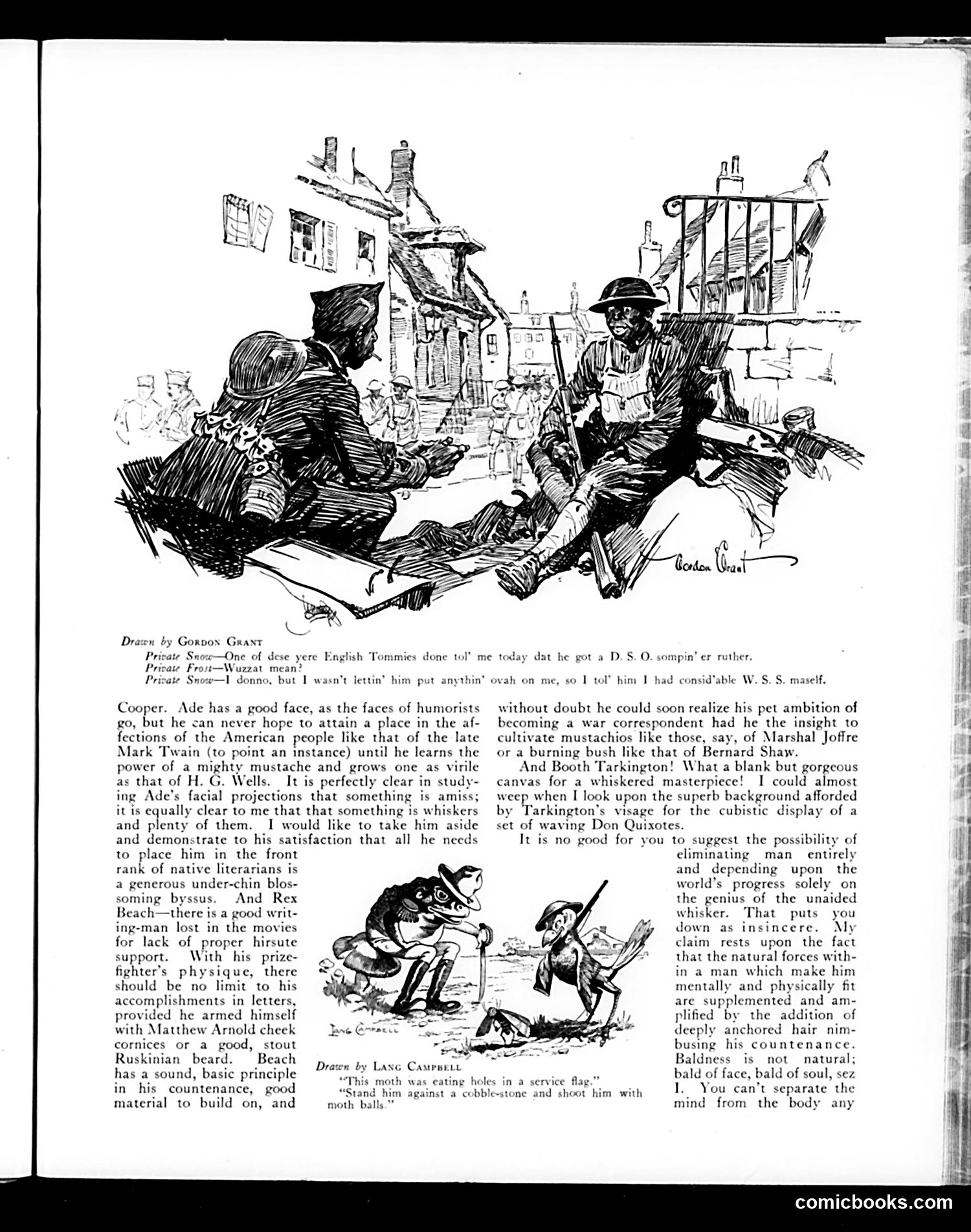
This Judge magazine page contains two satirical pieces: **Top Cartoon (Gorman Grant):** Two American soldiers discuss military terminology. "Private Fross" asks what "D.S.O." means; "Private Snow" admits ignorance but mentions he has "considerable W.S.S. maself"—likely referencing military honors and war bonds/savings stamps. **Text Essay (below):** The author humorously argues that American writers—specifically George Ade, Rex Beach, and Booth Tarkington—lack proper literary stature because they don't sport impressive facial hair like Mark Twain, H.G. Wells, or French Marshal Joffre. The satire mocks the era's association of masculine authority and intellectual credibility with elaborate beards and mustaches. The author absurdly claims that simply growing facial hair would elevate these writers' accomplishments and public standing—a tongue-in-cheek commentary on how superficial presentation affected contemporary respect for artists.
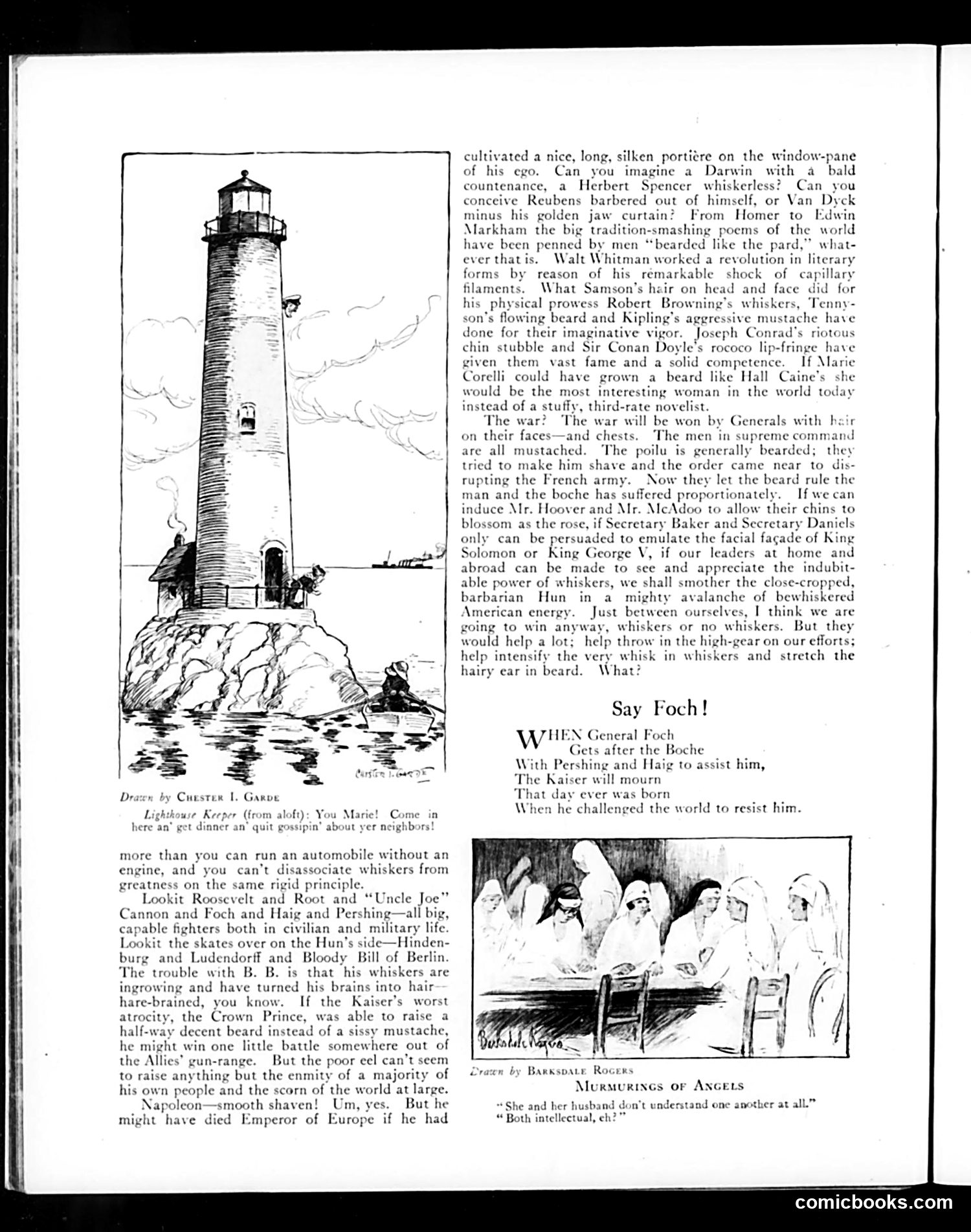
This is a WWI-era satirical article arguing that facial hair—beards and mustaches—correlates with greatness and military prowess. The writer claims historical figures like Darwin, Whitman, Browning, and Kipling owed their genius to their beards, and that Allied generals (Foch, Pershing, Haig) are winning because they're bearded, while German leaders (the Kaiser, Crown Prince, Hindenburg) are weaker due to insufficient facial hair. The satire mocks nationalist propaganda and pseudo-scientific reasoning popular during WWI. It mockingly suggests American officials like Hoover and Secretary of War Baker should grow beards to help win the war—absurd logic presented earnestly. The lighthouse illustration and "Murmuringings of Angels" cartoon appear unrelated vignettes. This reflects how WWI combatants used any available argument—however ridiculous—to boost morale and mock enemies.
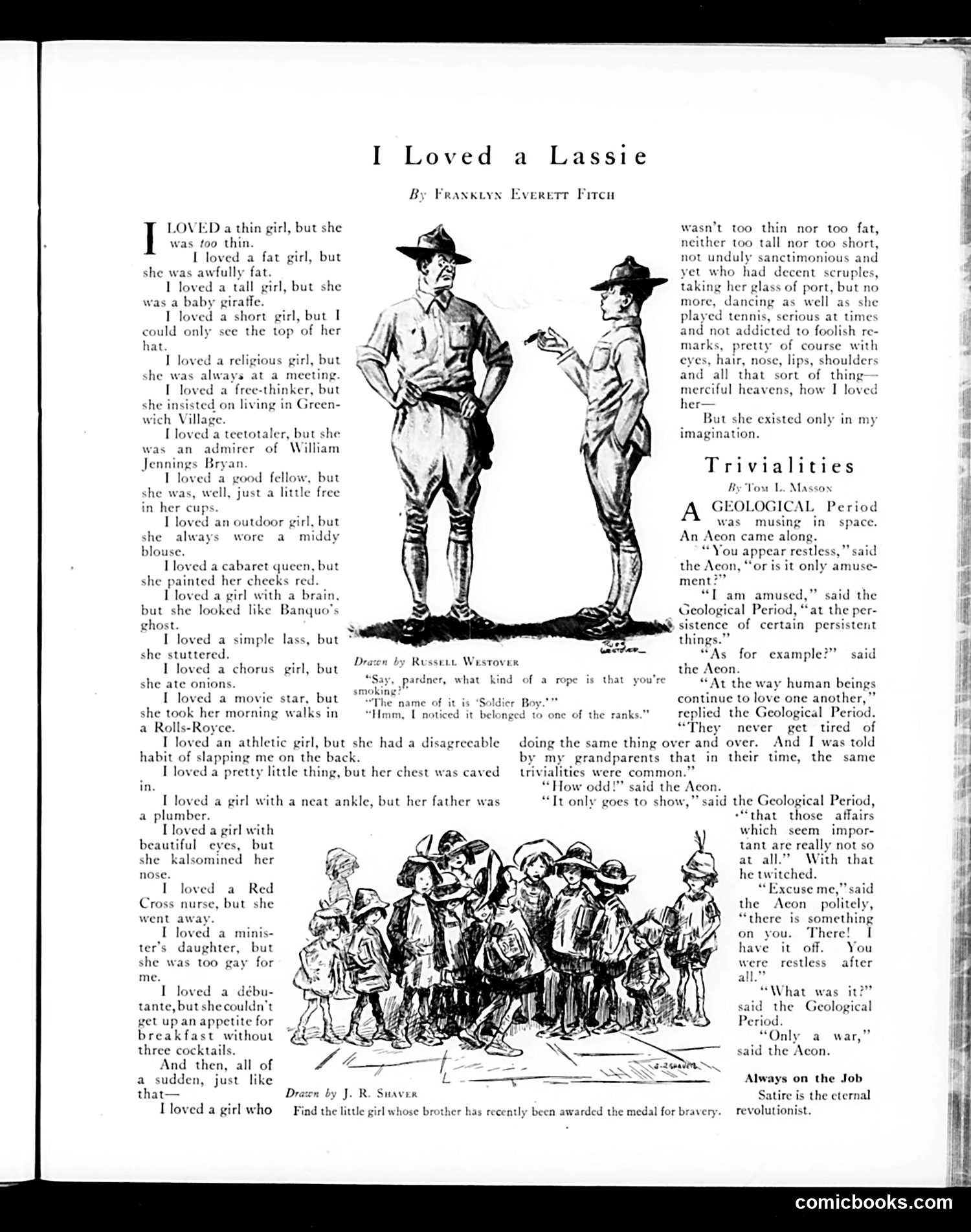
This humorous piece by Franklyn Everett Fitch catalogs the narrator's serial romantic failures: each girl he loved had some fatal flaw. The joke is that *every* type of woman—thin, fat, tall, short, religious, bohemian, teetotaling, drinking, athletic, modest—proves incompatible with him. The punchline reveals the deeper satire: the "perfect" woman he finally imagines exists "only in my imagination"—she's a fantasy compromise that balances every contradictory expectation men place on women. The accompanying illustration shows soldiers discussing a rope called "Soldier Boy," likely an in-joke about wartime materiel or military slang. Below, "Trivialities" offers cosmic perspective: an Aeon (geological age) finds humans amusing for repeatedly loving each other despite knowing it's futile—suggesting romantic disappointment is eternal and universal, reduced to trivial repetition across millennia. A "war" eventually interrupts even cosmic boredom. The satire targets both male romantic unrealism and the impossible standards imposed on women.
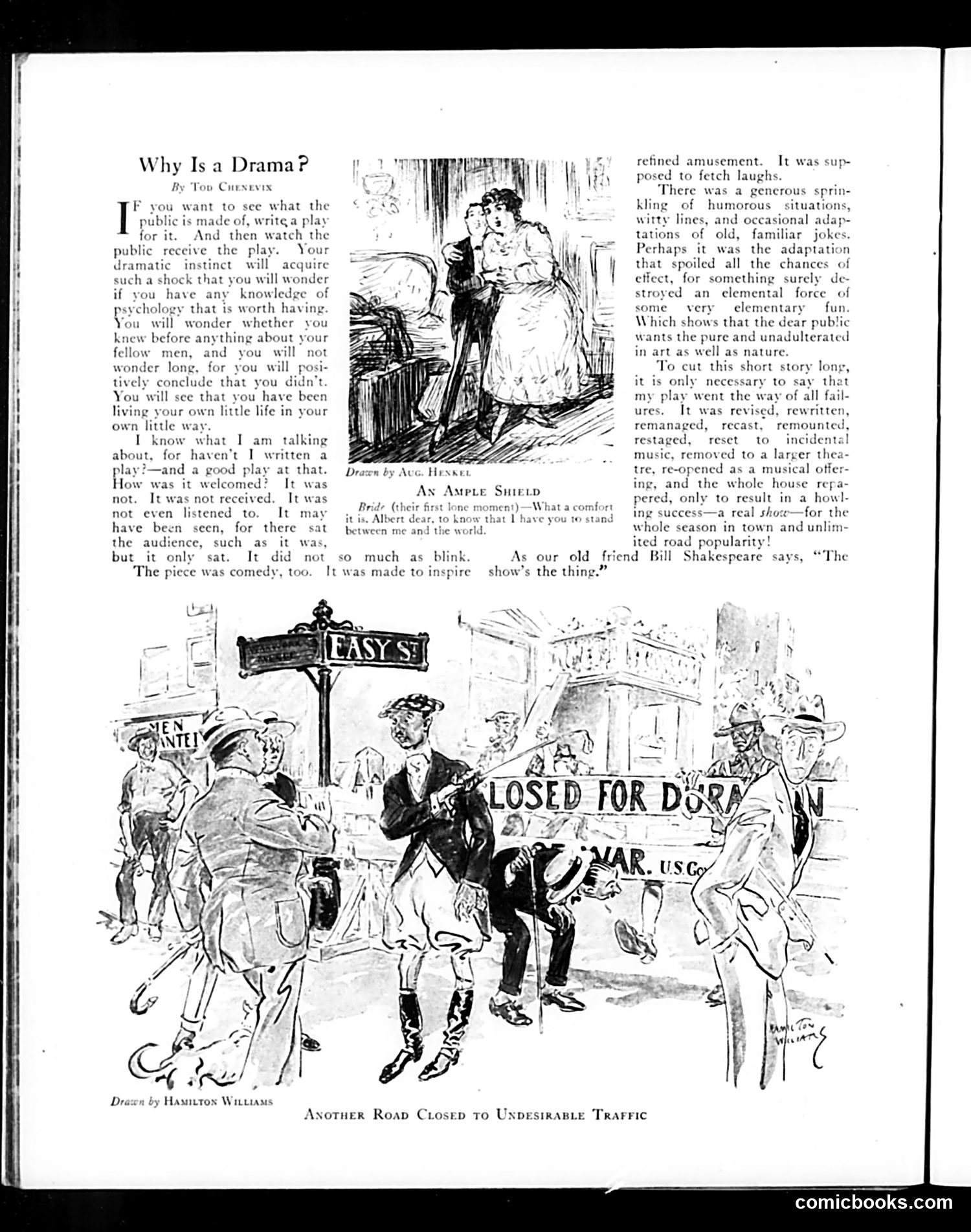
**Top Section:** An essay by Too Cheevix discusses why his play failed. The author explains he wrote a drama expecting public appreciation, but it received no genuine reception—the audience merely "sat" without responding. He then revised and reworked it extensively until it became a musical that finally achieved "real show" success and touring popularity. **Bottom Cartoon:** Titled "Another Road Closed to Undesirable Traffic," this depicts a street scene where a sign reads "ROAD CLOSED FOR DURATION" (referencing wartime restrictions). Figures are redirected by authorities away from the closed thoroughfare. The satire appears to mock wartime road closures or traffic restrictions—likely WWI-era measures presented as protecting against "undesirable" movement, with the cartoon suggesting bureaucratic overreach or public inconvenience from such policies. Both pieces employ humor about obstacles—theatrical failure above, governmental restrictions below—reflecting early 20th-century American concerns about both entertainment industry viability and wartime government control.
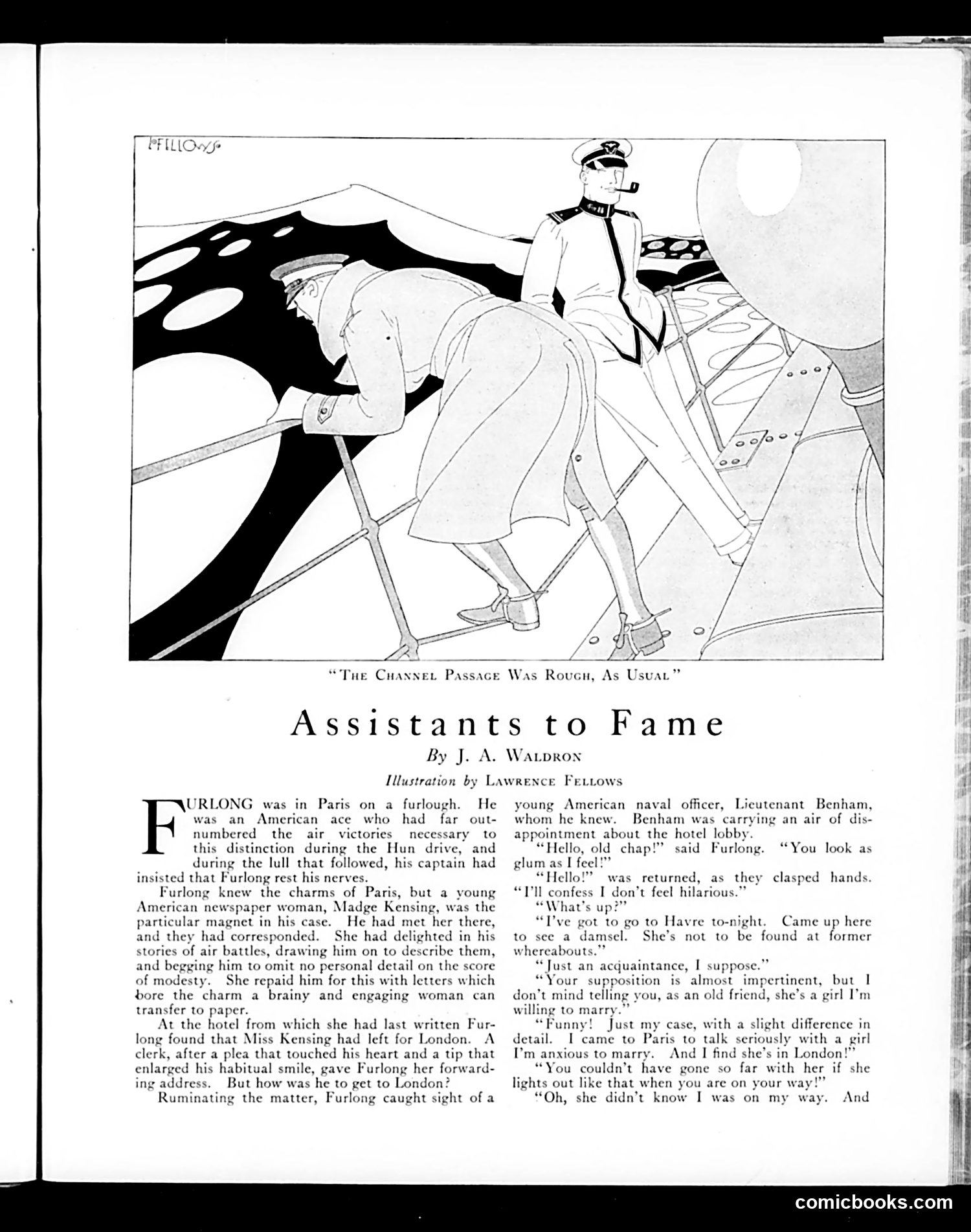
This is a romantic short story illustrated with a single panel, not political satire. The cartoon shows two American military officers—Furlong (an ace pilot) and Lieutenant Benham (naval officer)—meeting in a Paris hotel lobby during or shortly after World War I (references to "Hun drive" and air victories). The humor is situational comedy: both men are pursuing women who've left town—Furlong chasing a newspaper correspondent to London, Benham pursuing a damsel to Le Havre. They bond over their shared romantic predicament, with Benham making a wisecrack about Furlong's girlfriend "lighting out" on him. The illustration depicts the "rough" English Channel crossing mentioned in the caption. The story explores post-war romance and military life, targeting Judge's audience with light comedic drama rather than social commentary.
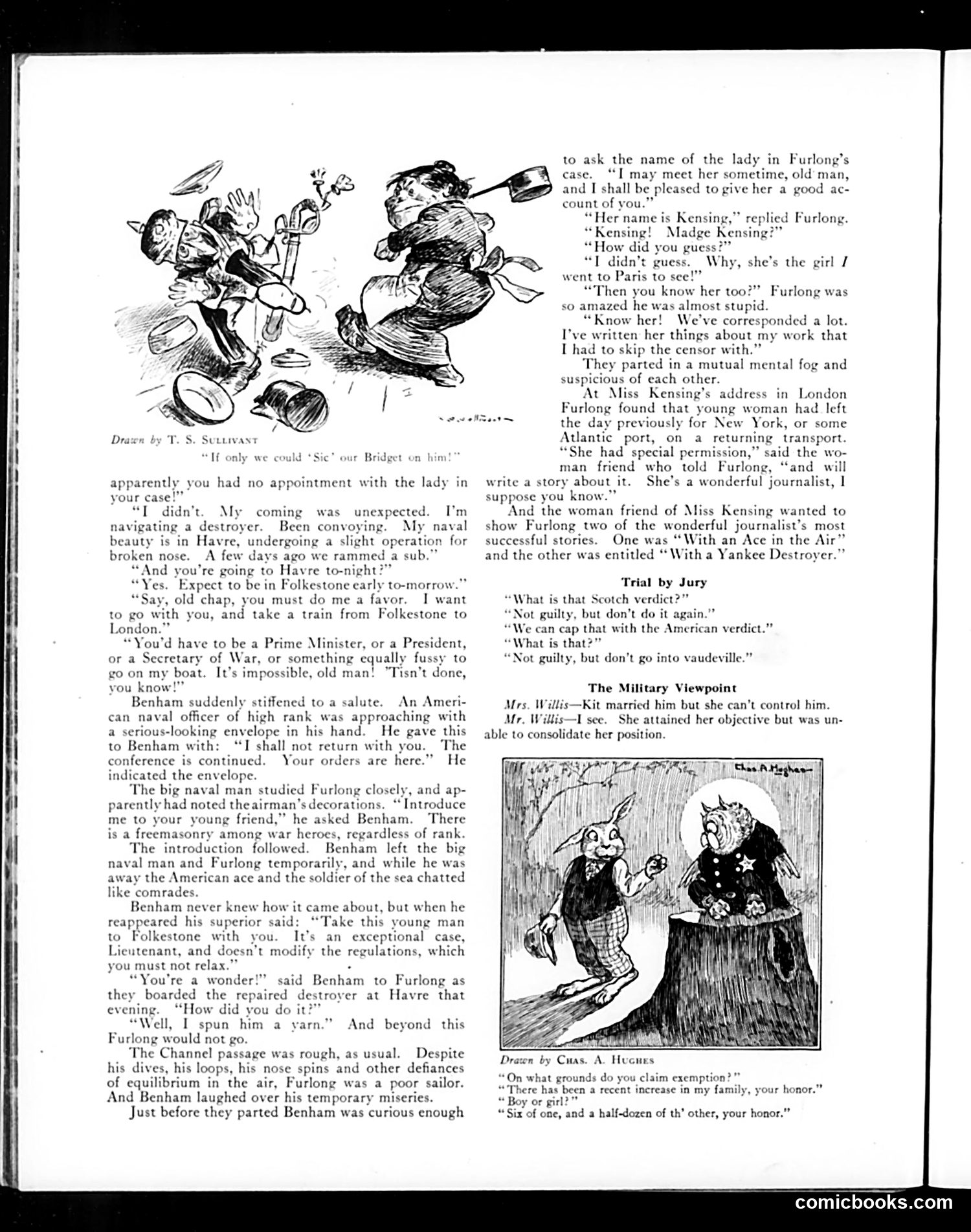
This page contains a WWI-era romantic comedy about three military officers (an American naval pilot named Furlong, a British naval lieutenant named Benham, and an unnamed American naval officer) who discover they've all been secretly corresponding with the same woman—Miss Madge Kensing, a journalist. The main cartoon (top left) illustrates the chaos of their discovery. The satire hinges on the absurdity of wartime romance: Miss Kensing has apparently written success stories about each man's exploits ("With an Ace in the Air," "With a Yankee Destroyer"), unbeknownst to them, and has now departed for New York, leaving all three confused and suspicious of one another. The smaller cartoons below mock military bureaucracy and legal systems: one jokes about verdicts that sound lenient but carry hidden warnings, and another satirizes military jargon—describing a marriage as a military campaign where the wife "attained her objective but was unable to consolidate her position." The humor targets both romantic entanglement and wartime institutional pomposity.
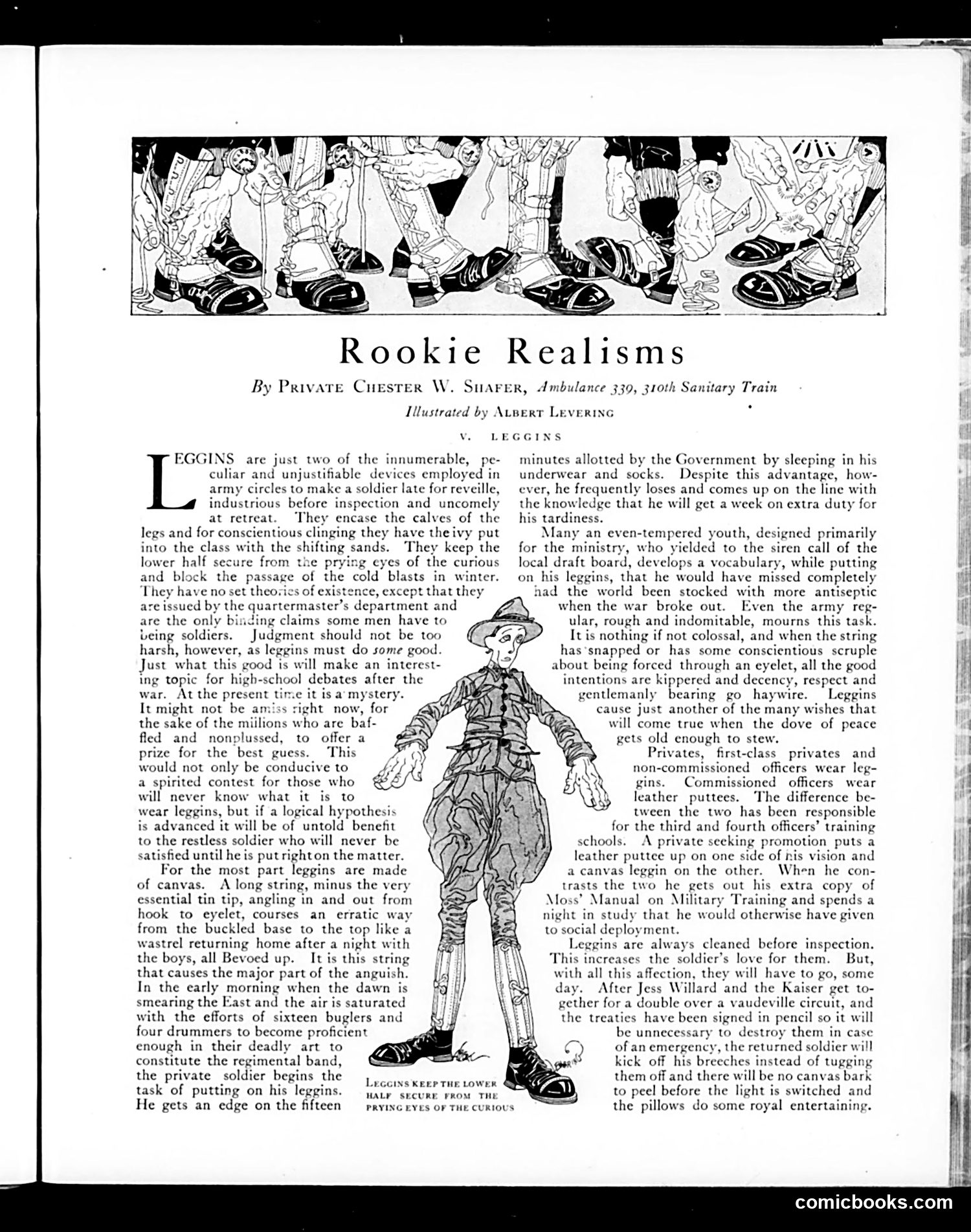
This WWI-era humor piece by Private Chester W. Shafer satirizes military leg wrappings ("leggins" or puttees)—canvas strips soldiers wound around their lower legs from ankle to knee. The illustration shows soldiers struggling with this tedious task. The satire targets the absurdity of army regulations: leggins serve unclear purposes, take excessive time to put on correctly during early morning drills, cause frustration that transforms even gentle recruits into profane soldiers, and create ridiculous distinctions between ranks (privates wear canvas leggins; commissioned officers wear leather puttees). Shafer mocks how this minor equipment difference supposedly influences officer training and promotion prospects. The piece captures soldiers' bewilderment at military inefficiency—a common trope in WWI satire—while affectionately poking fun at army life's petty frustrations and paradoxes. The cartoon emphasizes soldiers' exasperation with this "unjustifiable device."
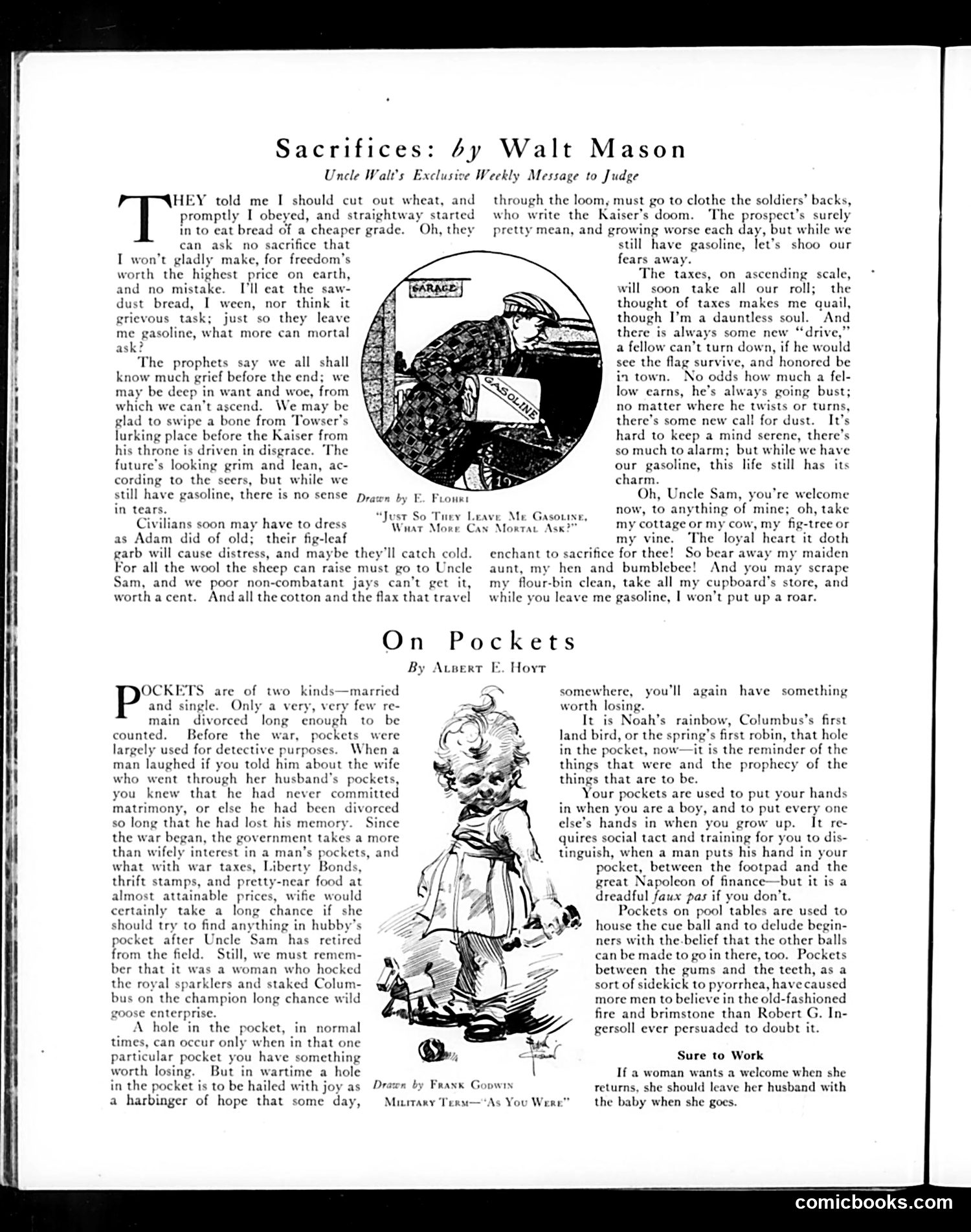
**"Sacrifices" by Walt Mason** is a WWI-era patriotic poem satirizing civilian complaints during wartime rationing. The speaker ironically claims willingness to sacrifice almost everything—wheat bread, clothing, money through taxes and war bonds—but draws the line at gasoline, repeatedly insisting "just so they leave me gasoline, what more can mortal ask?" The satire targets the hypocrisy of those who pose as patriotic while protecting their own comforts. **"On Pockets" by Albert E. Hoyt** is a humorous essay comparing pre-war and wartime pockets. Before the war, finding money in a husband's pocket was a wives' joke; now government taxation, Liberty Bonds, and thrift stamps have emptied everyone's pockets so completely that a hole becomes fortunate—it can't lose what isn't there. The piece uses lighthearted observation to comment on wartime financial hardship and government fiscal demands on civilians.
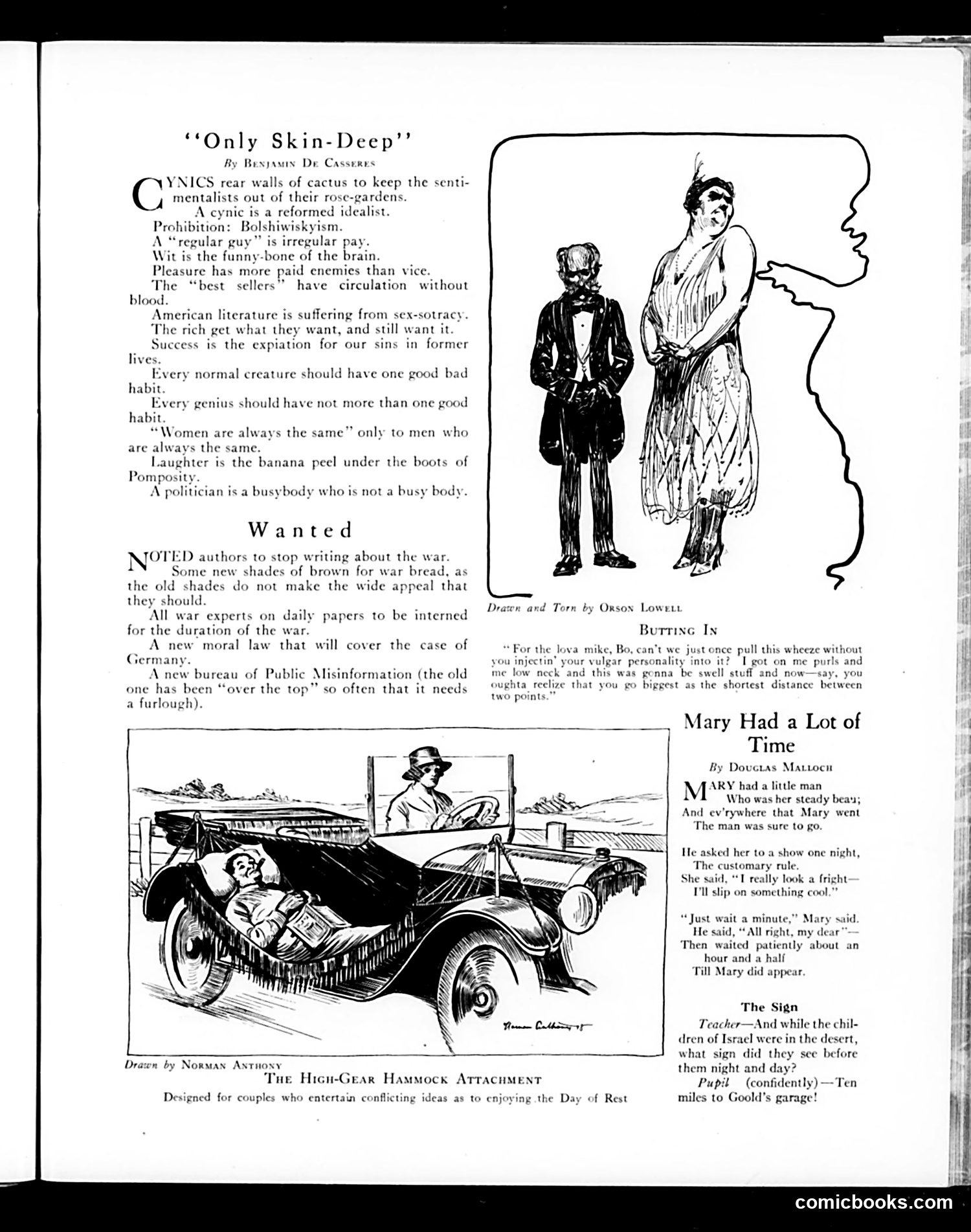
This page contains several brief satirical pieces typical of Judge's style: **"Only Skin-Deep"** is a collection of cynical aphorisms by Benjamin De Casseres attacking sentimentality, Prohibition ("Bolshiviskiyism"), and American culture generally. The references to "sex-sotracy" and "best sellers" without "blood" mock contemporary literature and commerce. **"Wanted"** satirizes WWI-era concerns: the plea to stop war writing, the call to intern "war experts" from newspapers, and the jab at "Public Misinformation" all critique wartime propaganda and jingoism. **"The High-Gear Hammock Attachment"** cartoon jokes about marital conflict during leisure time—a visual gag about couples with incompatible ideas trying to rest together. The remaining pieces—"Butting In," "Mary Had a Lot of Time," and "The Sign"—are light domestic and school humor with no apparent political content. The overall tone reflects post-WWI satirical skepticism toward authority and contemporary social pretension.
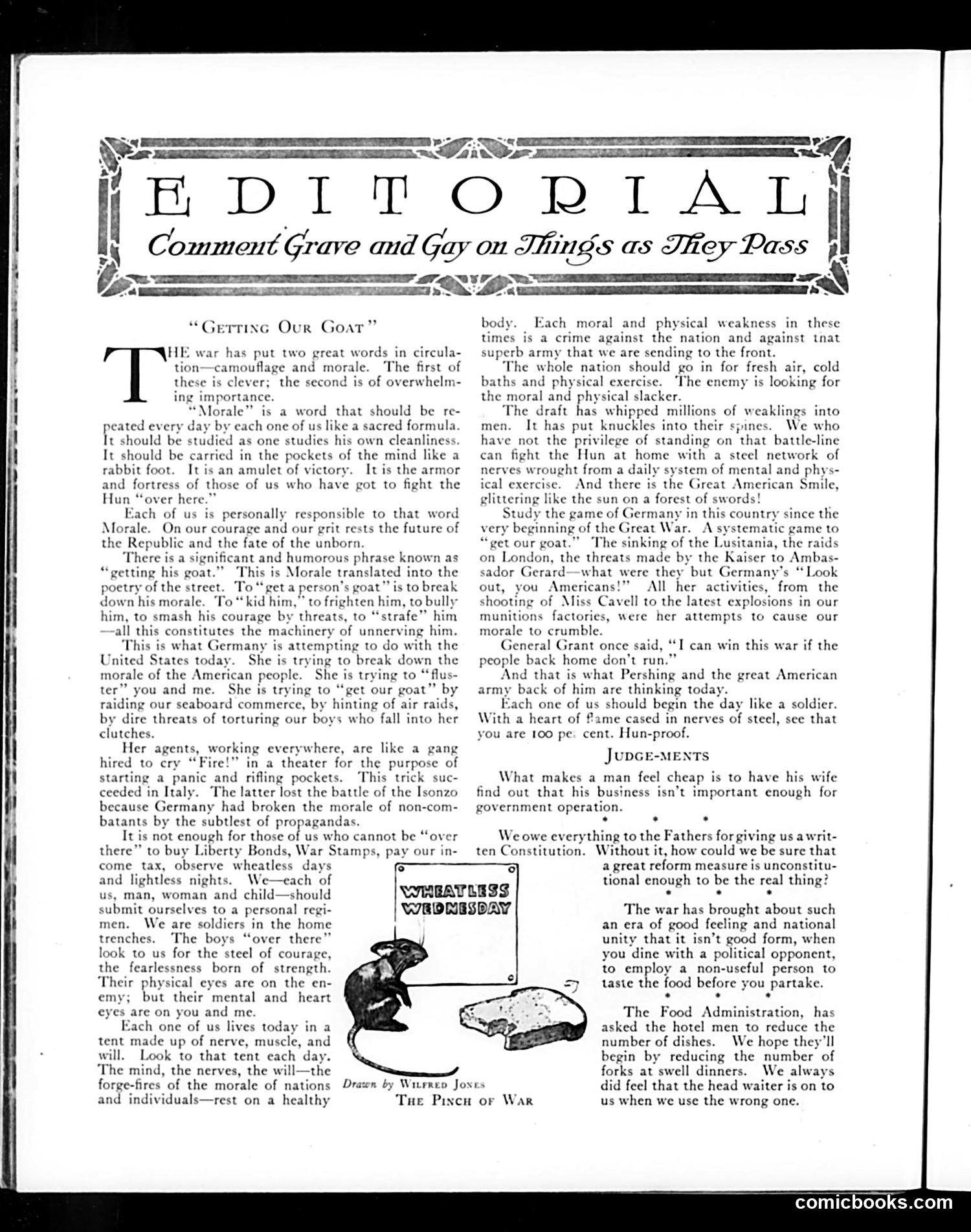
This editorial page from *Judge* magazine addresses American home-front morale during World War I. The main article argues that Germany's strategy is psychological warfare—to "get our goat" (break American resolve) through attacks on the Lusitania, threats to civilians, and propaganda spread by German agents. The cartoon by Wilfred Jones depicts a rabbit labeled "Wheatless Wednesday," showing how civilian rationing and sacrifice are weaponized morale-building. The editorial frames personal discipline—cold baths, exercise, avoiding physical weakness—as patriotic duty and defense against enemy demoralization. The piece appeals to Americans on the home front to maintain emotional and physical strength, comparing themselves to soldiers in "trenches." References to "the Hun," the Kaiser, and Germany's systematic campaign reflect anti-German sentiment prevalent in American propaganda during the war.
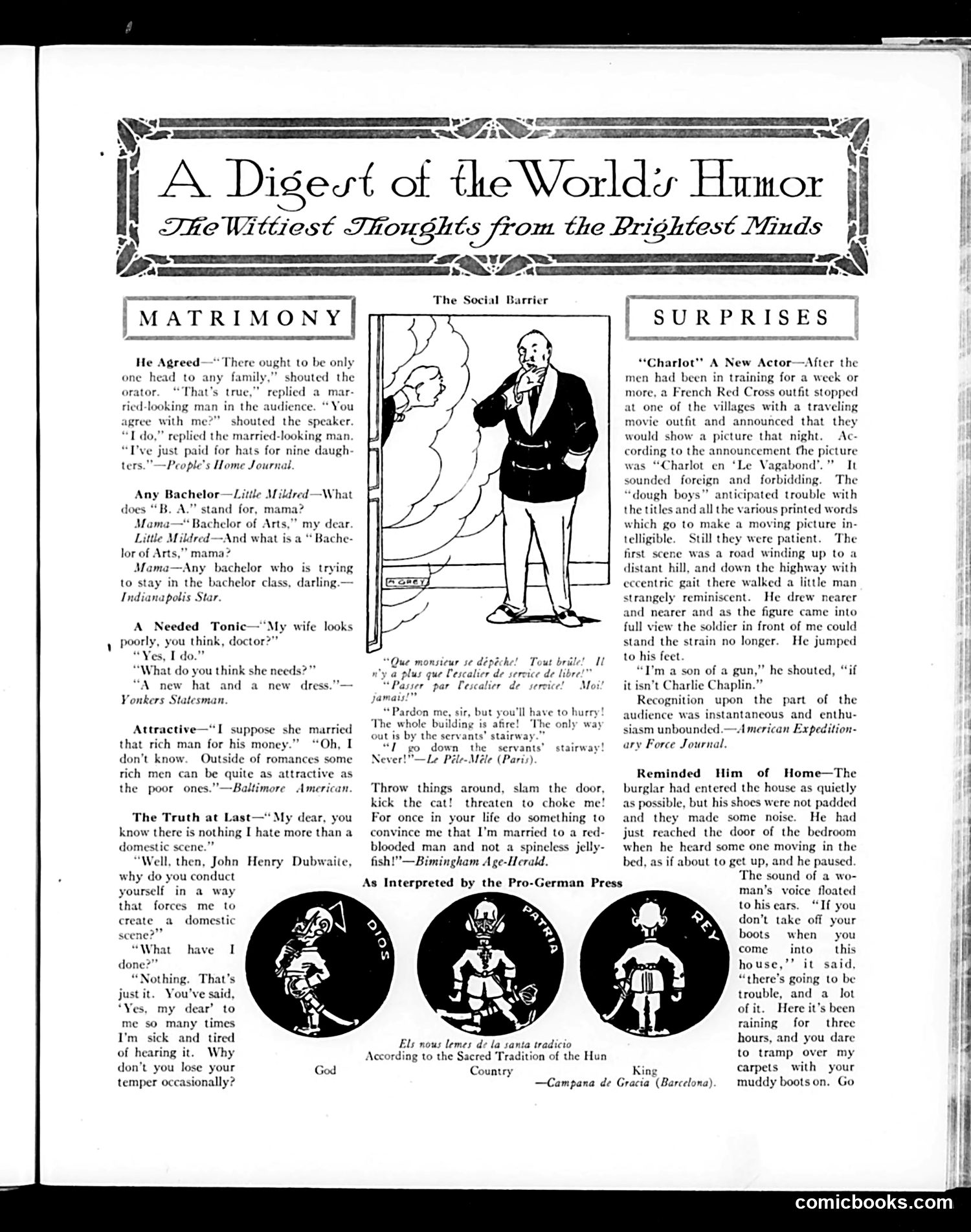
This page from *Judge* magazine presents early 20th-century American humor on marriage, social hierarchy, and wartime attitudes. The **matrimony section** satirizes marriage through domestic complaints—husbands paying for daughters' hats, wives demanding new dresses, and a wife begging her husband to lose his temper occasionally. The humor relies on period stereotypes about nagging wives and henpecked husbands. The **"Social Barrier" cartoon** mocks French class rigidity: during a fire, a gentleman must use the servants' stairway but refuses on principle, showing Continental snobbishness as absurd. The **Pro-German Press section** appears to be WWI-era propaganda satire, depicting how German sources interpreted European traditions as justifying militarism (referencing "the Hun"). The **"Charlot" surprise** describes American soldiers recognizing Charlie Chaplin in a French film titled "The Vagabond"—reflecting how Chaplin's physical comedy transcended language barriers during wartime. The final anecdote humorously suggests domestic nagging is so universal it even feels "like home" to a burglar—dark humor about inescapable marriage complaints.
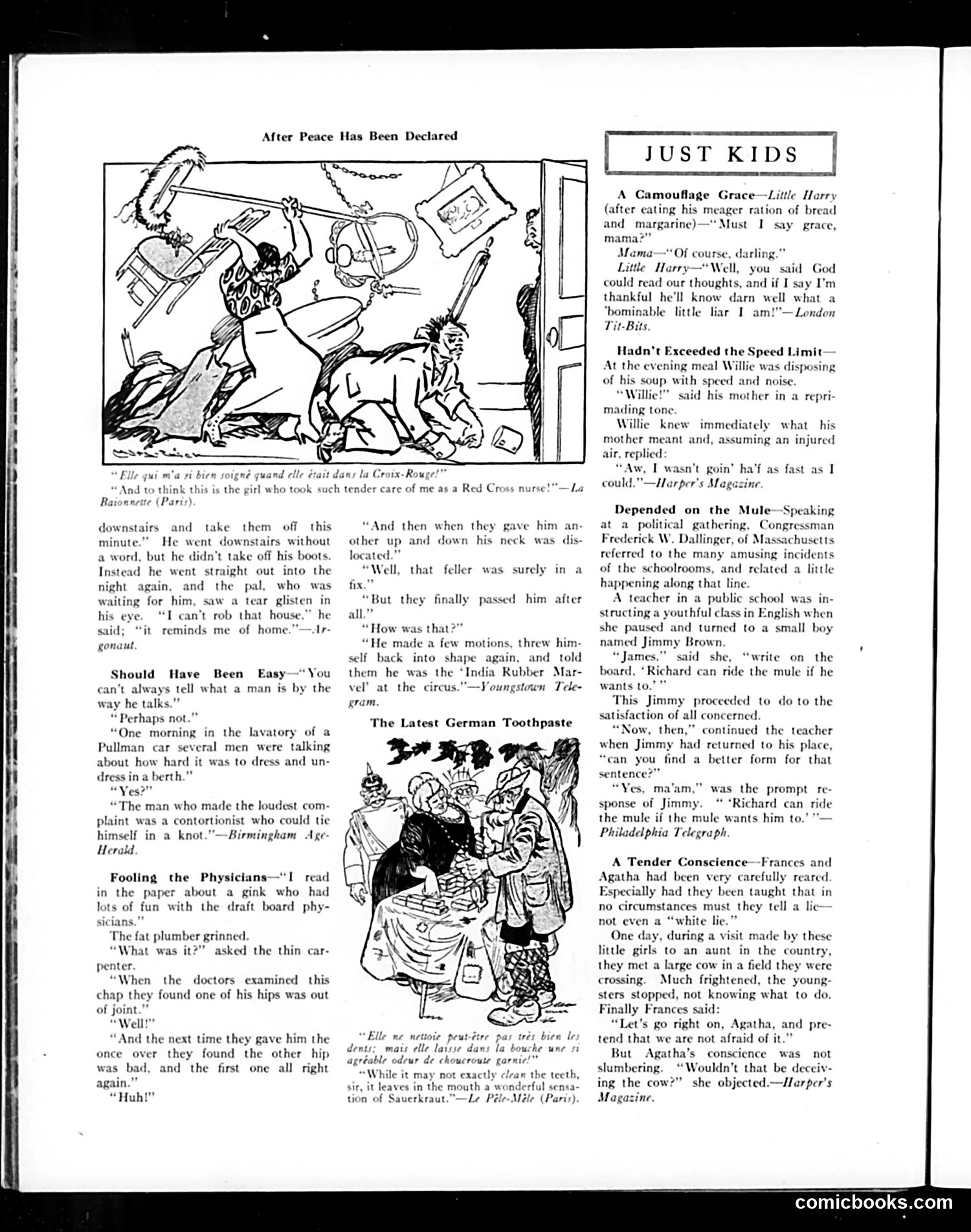
This page from Judge contains several humorous anecdotes and one political cartoon, all post-WWI in nature (indicated by the header "After Peace Has Been Declared"). **The main cartoon** depicts soldiers or civilians in chaotic domestic situations, likely satirizing the adjustment to peacetime after World War I—the disruption soldiers faced returning to normal life. **The anecdotes** include: - A story about a man who won't rob a house because it reminds him of home - A joke about a contortionist complaining loudest about berth space - "Fooling the Physicians"—a humorous tale of a contortionist who tricks WWI draft board physicians by appearing injured, then revealing himself as the "India Rubber Marvel" circus performer - "The Latest German Toothpaste"—anti-German satire mocking sauerkraut odor (reflecting post-war anti-German sentiment) - A section titled "Just Kids" with children's jokes and witticisms The content reflects early 1920s American attitudes: lingering anti-German sentiment, adjustment to post-war civilian life, and genteel humor targeting children's innocent observations about grace, table manners, and truth-telling.
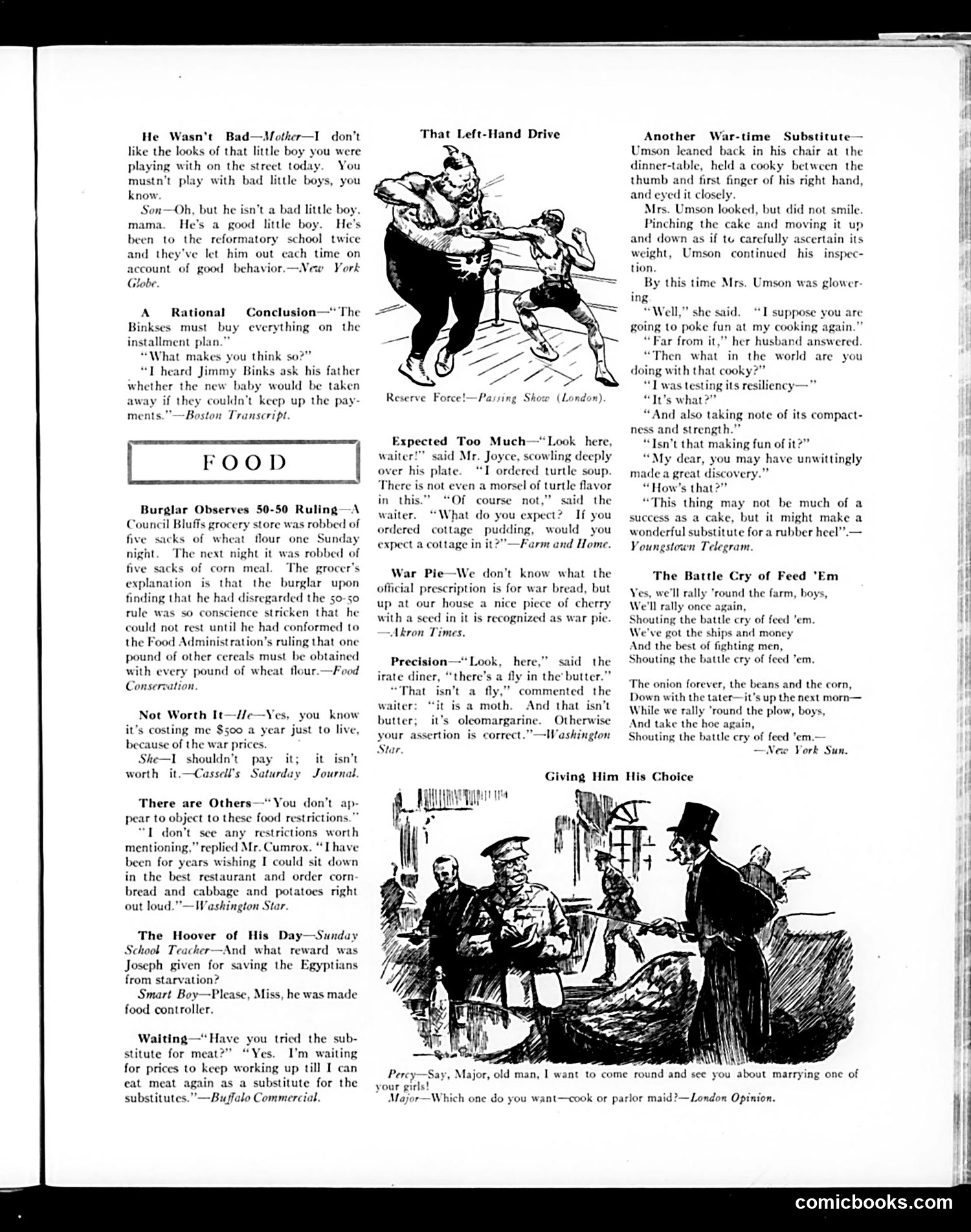
This Judge magazine page satirizes **World War I-era food rationing and substitutes**. The "FOOD" section contains multiple jokes about wartime scarcity: - **Food Administration references**: The U.S. Food Administration under Herbert Hoover enforced rationing rules (the "50-50 ruling" requiring certain grain ratios). The burglar joke mocks this bureaucratic rigidity. - **"Hoover" pun**: Calling the food controller "the Hoover of his day" references Hoover's administration of food supplies before becoming president. - **Substitute foods**: Multiple jokes target poor-quality wartime substitutes—turtle soup without turtle, butter that's actually oleomargarine, even a rubber heel as cake substitute. Americans resented these inferior replacements. - **Inflation complaint**: One joke notes meat prices rose so high that eating the substitute *to afford real meat again* became absurd. The cartoons mock both food scarcity hardships and government rationing bureaucracy, capturing civilian frustration with WWI economic restrictions.
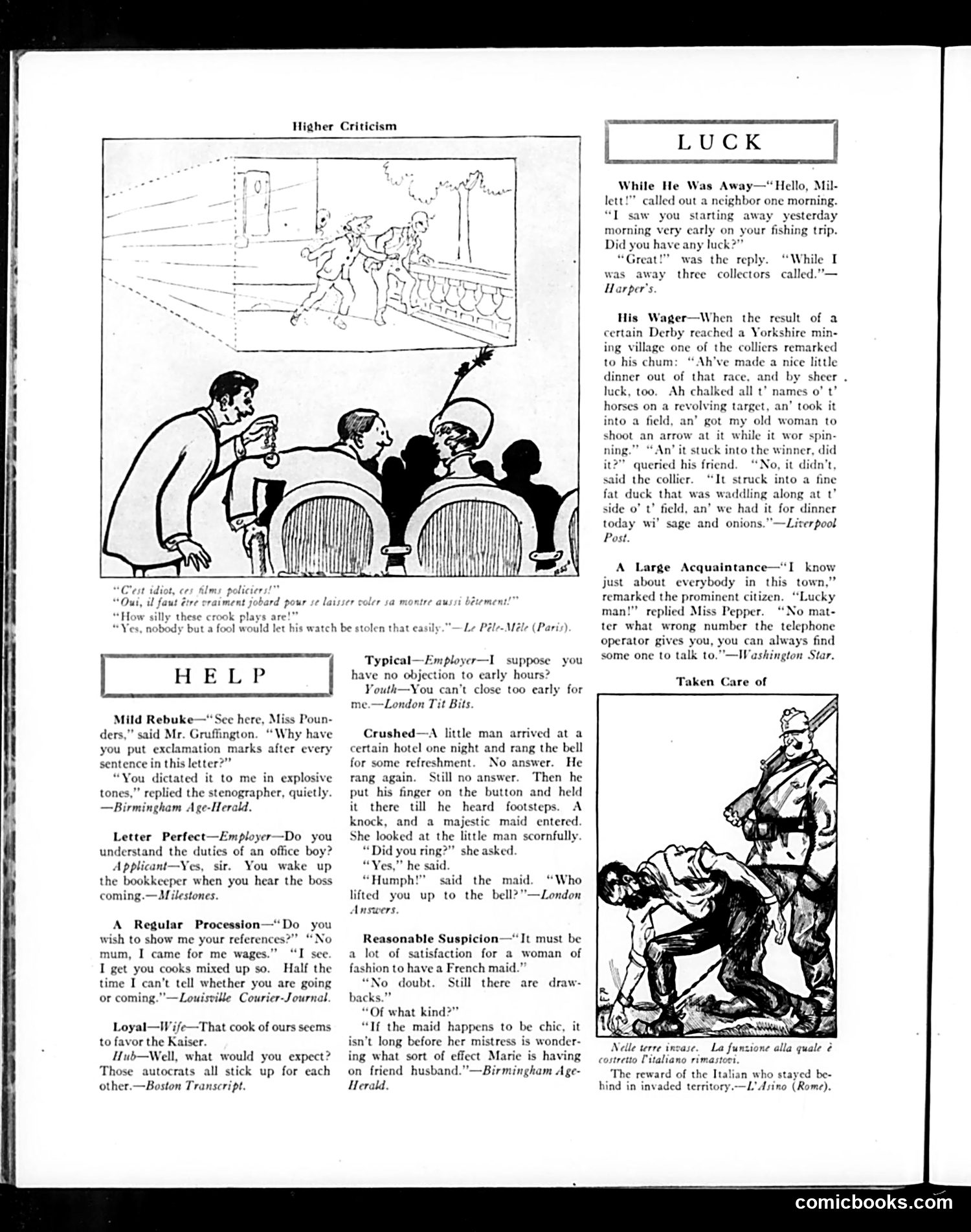
This page collects brief humorous anecdotes from *Judge*, a satirical weekly. The content reflects early 20th-century workplace and domestic comedy: **"Higher Criticism"** (top cartoon) depicts a theater scene where critics debate a play's merits—likely satirizing overwrought literary analysis of the era. **"Help" and "Luck"** sections contain short jokes about office dynamics, servants, and social pretension typical of *Judge*'s humor. Notable themes include: - Stenographers and employers (labor relations) - Servants' perceived disloyalty ("autocrats") - Class anxiety (references to French maids and "fashion") - Working-class wit (the Yorkshire miner's hunting story) **"Taken Care of"** (bottom) appears to reference Italian wartime experience, though context is unclear—possibly WWI-related. The humor relies on servant-employer tensions, workplace absurdities, and class commentary that would have resonated with *Judge*'s middle-class American audience circa 1910s-1920s.
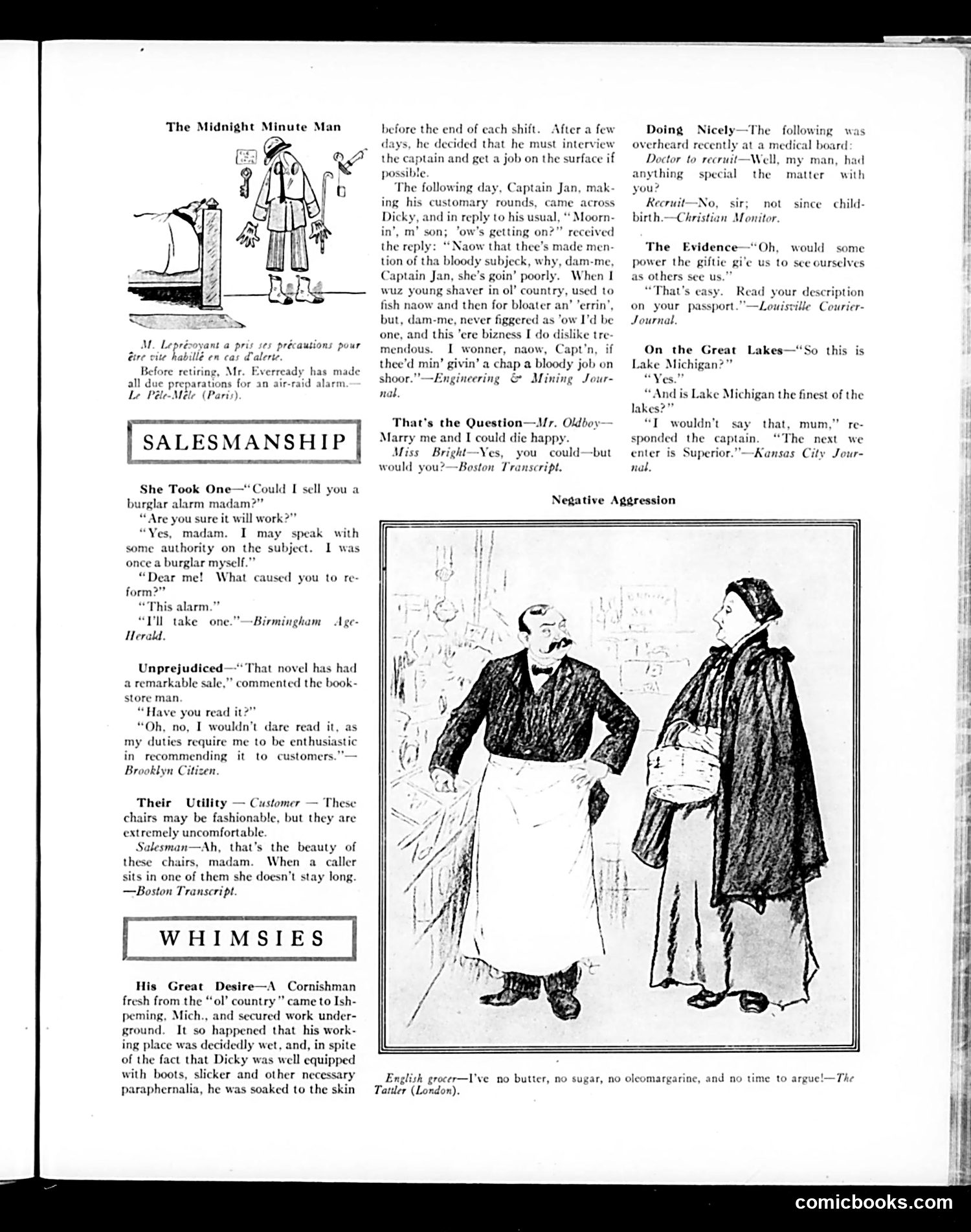
This page contains multiple brief humorous anecdotes and one cartoon, typical of Judge's satirical format. **"The Midnight Minute Man"** (top left): A cartoon about air-raid preparedness, likely referencing WWI-era civilian defense concerns. The figure illustrates someone taking precautions before bed. **"Negative Aggression"** (main cartoon): Shows two men in what appears to be a grocer's shop during wartime rationing. The English grocer lists unavailable items—butter, sugar, oleomargarine—with no time to argue. This satirizes the scarcity and frustration of rationing, likely WWI-era Britain, where shortages were common and grocers faced customer complaints. **Scattered anecdotes** use ironic humor: a reformed burglar selling burglar alarms; a bookstore clerk refusing to read novels he recommends; uncomfortable chairs designed to discourage lingering visitors. These mock salesmanship tactics and consumer culture. The page reflects early 20th-century American satirical humor targeting business practices, wartime inconveniences, and social absurdities.
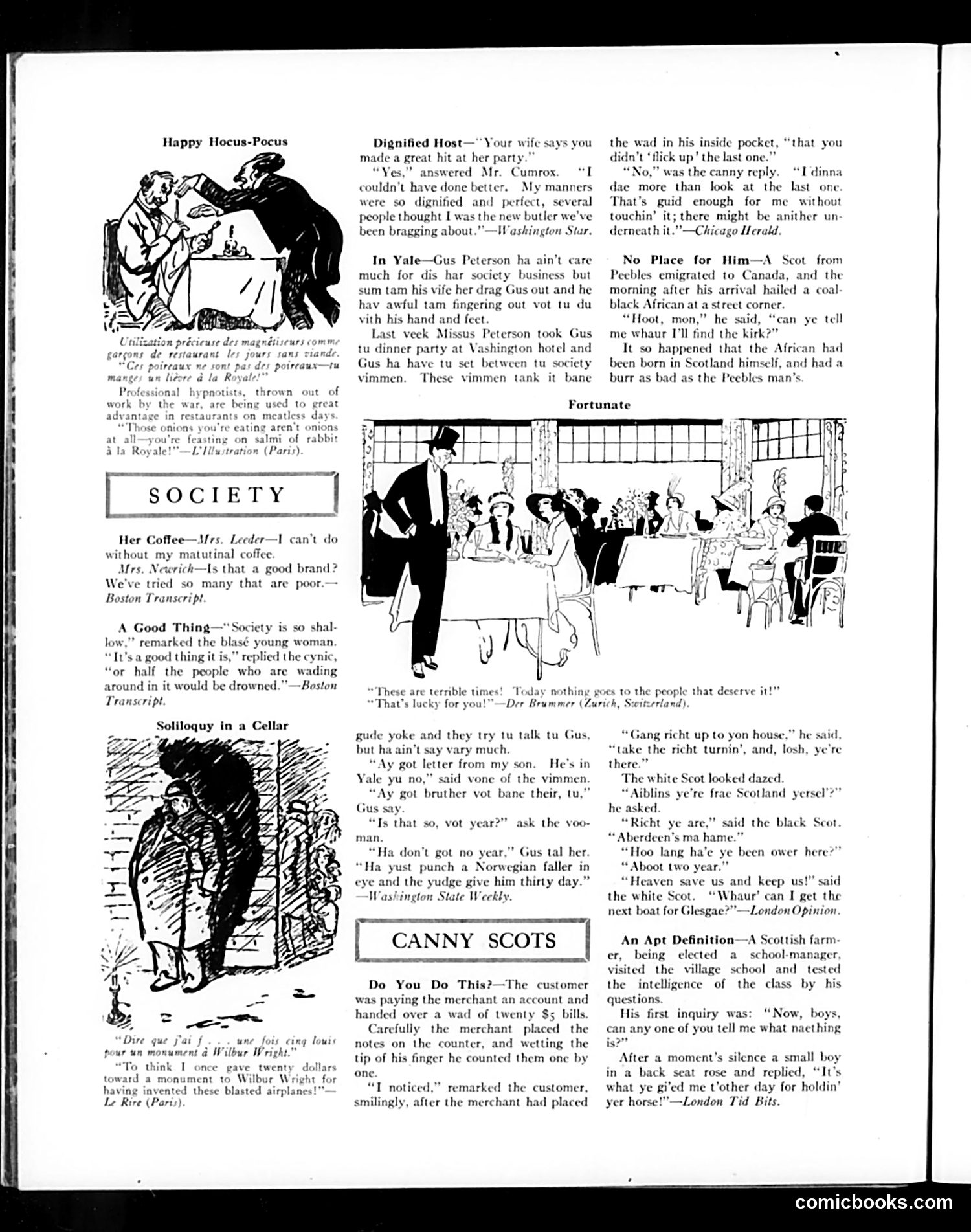
This page collects brief humorous anecdotes grouped by theme. The "Society" section mocks upper-class pretension—a host so concerned with appearing dignified that guests mistake him for the new butler; wealthy women obsessing over coffee brands. "Canny Scots" features ethnic humor typical of the era, depicting Scottish and Norwegian immigrants with exaggerated dialects. A Scottish farmer's son punches a Norwegian in a fight; two Scottish immigrants meet in Canada, one Black and one white, both with thick accents, creating comedy from the absurdity of encountering a fellow Scot abroad. The "Fortunate" cartoon shows a formal dinner scene where a host appears to have committed some transgression—the caption suggests he avoided consequences through luck. Throughout, the humor relies on class anxiety, ethnic stereotypes with phonetic dialect spelling, and observational comedy about human nature. These were common comedic conventions in early 20th-century American satirical magazines, though the ethnic caricatures would be considered offensive today.
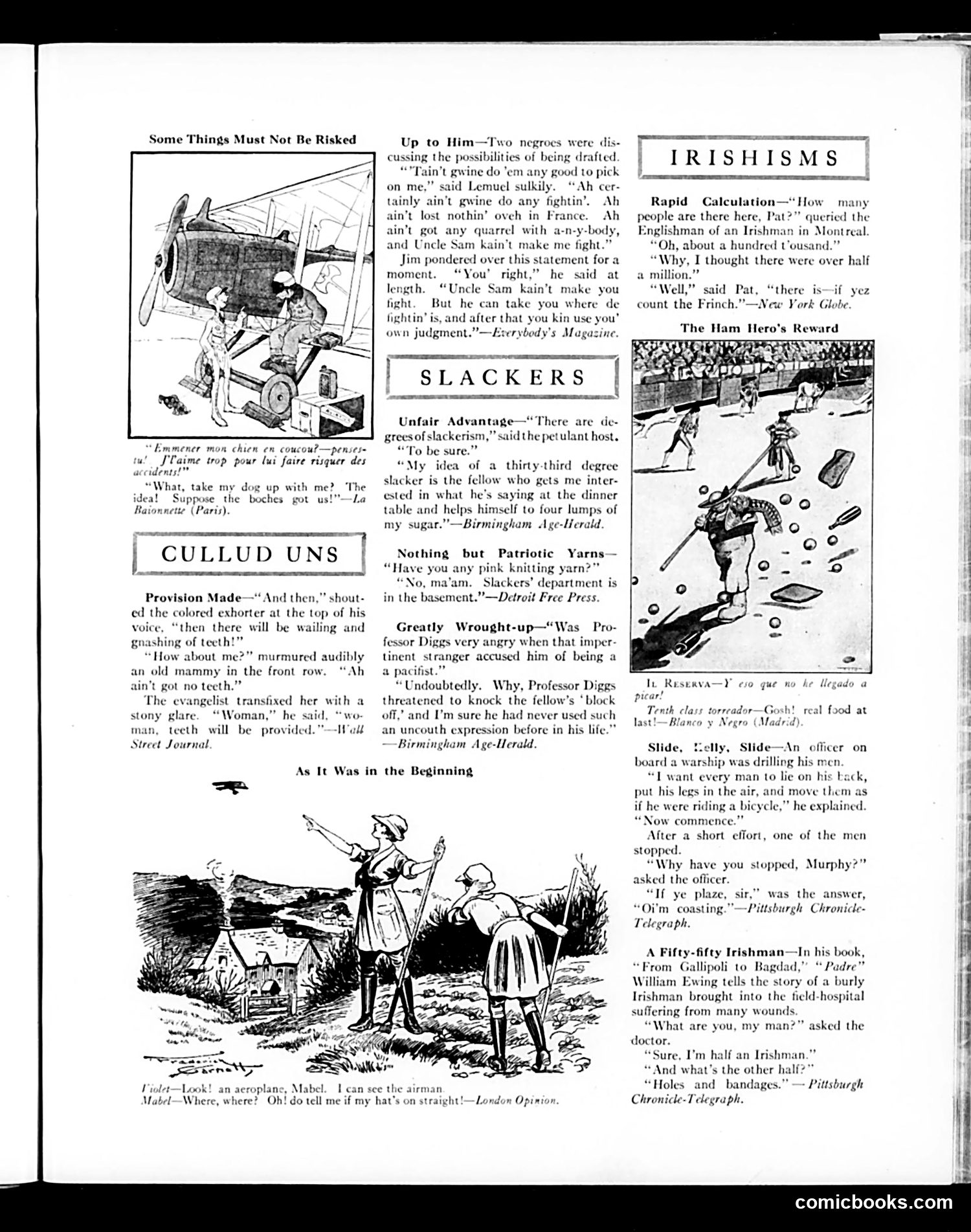
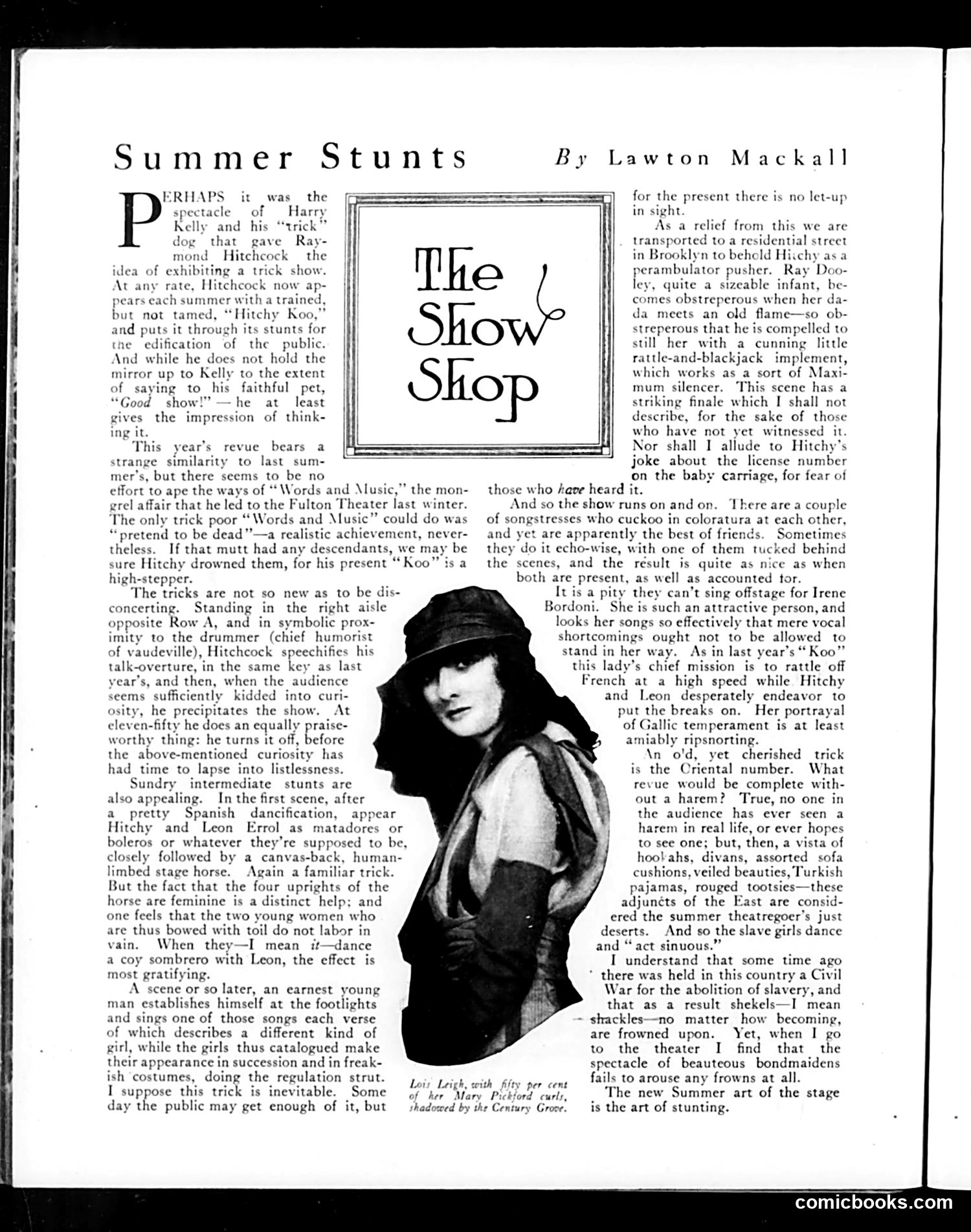
This is a theatrical review by Lawton Mackall critiquing Raymond Hitchcock's revue "Hitchy Koo" at an unnamed Broadway venue. The article describes various performance acts, including trained dogs, Spanish dances, romantic scenes, and an "Oriental number" featuring a harem scene. The central photograph shows Lois Leigh in costume for the production. Mackall's tone is lighthearted and gossipy—he praises Irene Bordoni's attractiveness while noting her vocal limitations, and he amusedly discusses the show's recurring gimmicks and formulaic nature (comparing it unfavorably to a previous Hitchcock production called "Words and Music"). The satire is gentle: Mackall suggests the show recycles familiar theatrical tricks annually but remains entertaining because Hitchcock knows when to end acts before audiences lose interest. The "stunt" focus suggests vaudeville-style variety entertainment rather than sophisticated drama.
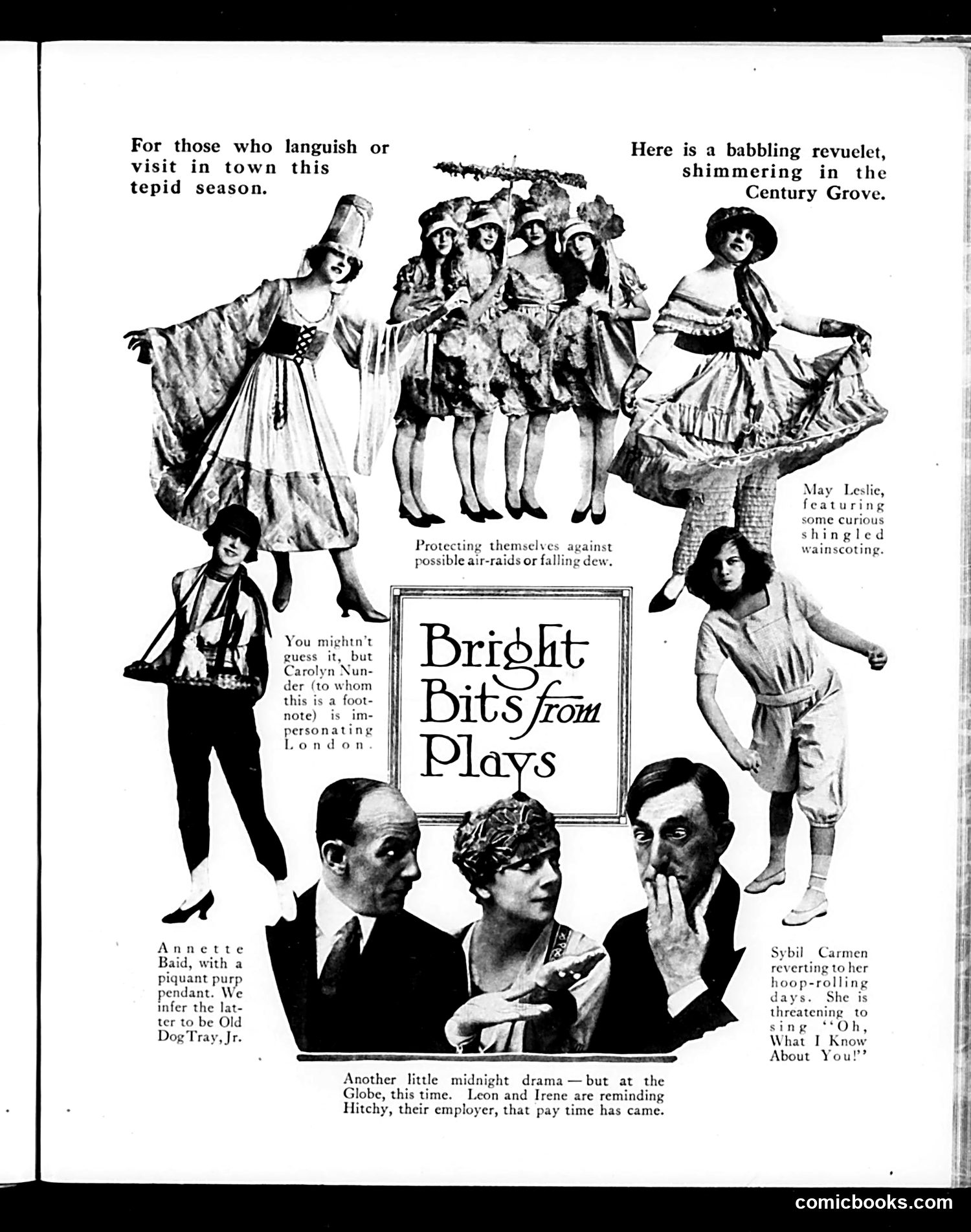
This is a theatrical gossip/review column featuring humorous commentary on London stage productions. The page mocks various theatrical performers and their roles: - Women in elaborate costumes are shown "protecting themselves against possible air-raids or falling dew" — likely satirizing overwrought Edwardian or post-WWI theatrical fashion and melodrama. - Named performers (May Leslie, Sybil Carmen, Annette Baid, Carolyn Nunder) are depicted in their stage roles, with sarcastic descriptions of their acts. - A lower panel shows what "appears to be" a domestic comedy scene at "the Globe" theater, where employees Leon and Irene demand wages from their employer "Hitchy." The satire targets theatrical pretension and absurdity — both the elaborate costumes and the simple domestic plots treated as serious drama. Judge uses humor to comment on contemporary theater's mixed quality during what was likely the 1910s-1920s theatrical season.
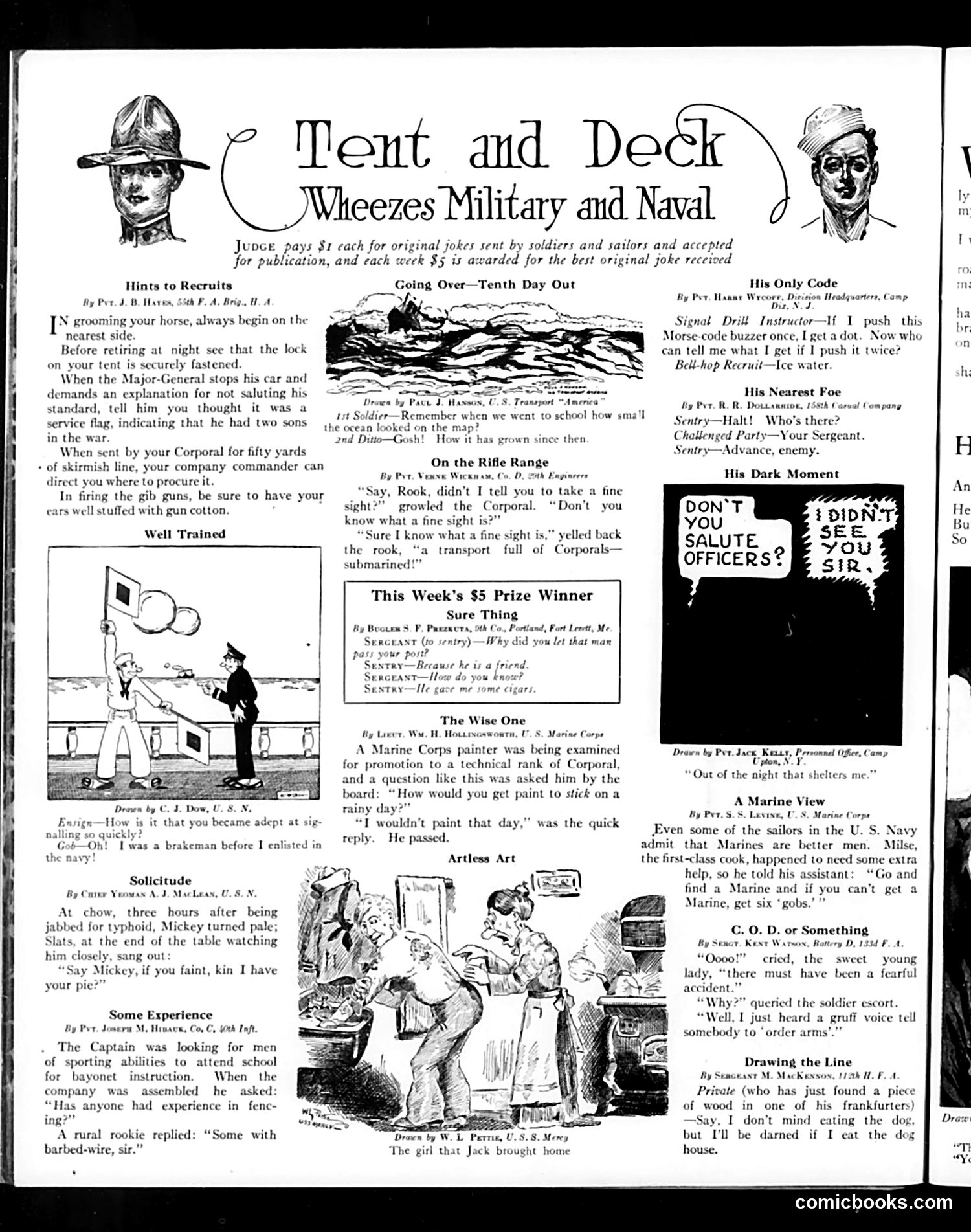
This is a humor page from *Judge* magazine featuring jokes contributed by soldiers and sailors during World War I. The magazine paid $1 per accepted joke and $5 weekly for the best submission. The cartoons and jokes mock military life and recruit inexperience. Recurring themes include: - **Recruit ignorance**: A rookie confusing a service flag with a saluting requirement; soldiers unfamiliar with military terminology misinterpreting orders (searching for "skirmish line"). - **Officer-recruit friction**: The "Dark Moment" cartoon shows a soldier failing to salute an officer, claiming he "didn't see" him—inverting the expected power dynamic. - **Interservice rivalry**: A joke contrasts Marines favorably to Navy sailors ("gobs"). - **Wordplay and misunderstanding**: Signal operators confusing Morse code dots with "ice water"; a painter answering sensibly that he wouldn't paint in rain. The humor reflects soldiers' experiences navigating military hierarchy, incomprehensible orders, and absurdities of military life during wartime.
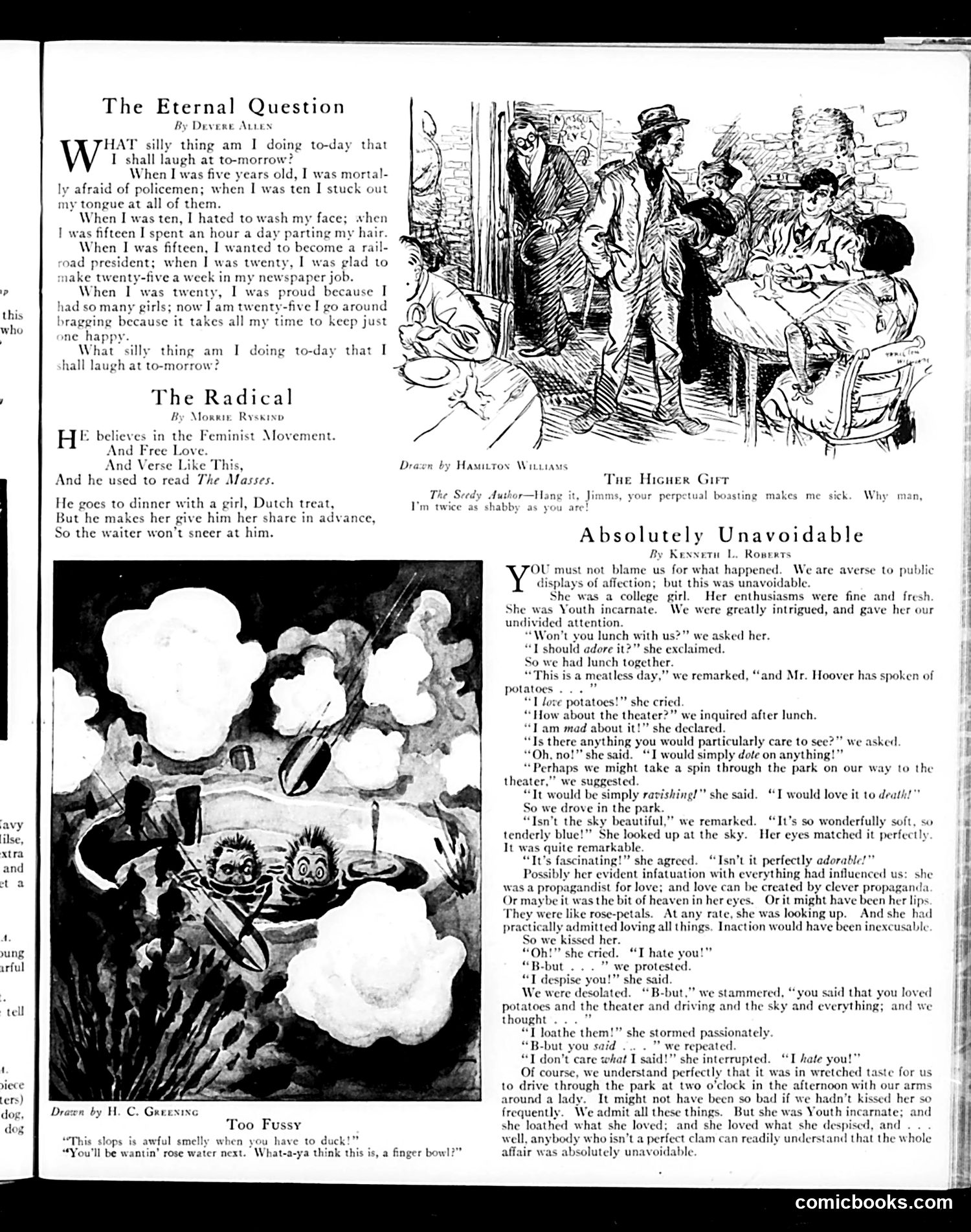
This page contains three satirical pieces mocking early-20th-century social attitudes and romantic conventions: **"The Eternal Question"** ridicules the narrator's shifting values across life stages—fearing police as a child, then mocking them; obsessing over appearance, then romance. The joke: we laugh at our past selves while remaining oblivious to future embarrassment. **"The Radical"** skewers a hypocritical socialist/feminist man who espouses progressive ideals (Feminist Movement, Free Love, *The Masses*) but exploits his date by making her pay her share first, avoiding the waiter's judgment. The satire exposes performative radicalism masking selfishness. **"Absolutely Unavoidable"** depicts two men seducing a college girl by exploiting her enthusiasm for everything—she claims to "adore" and "dote on" activities indiscriminately. After kissing her, she abruptly declares she hates them. The story satirizes both her mercurial emotionalism and their predatory behavior, framed as inevitable ("unavoidable"). The title is deeply ironic; the piece mocks male entitlement while also stereotyping young women as irrational.
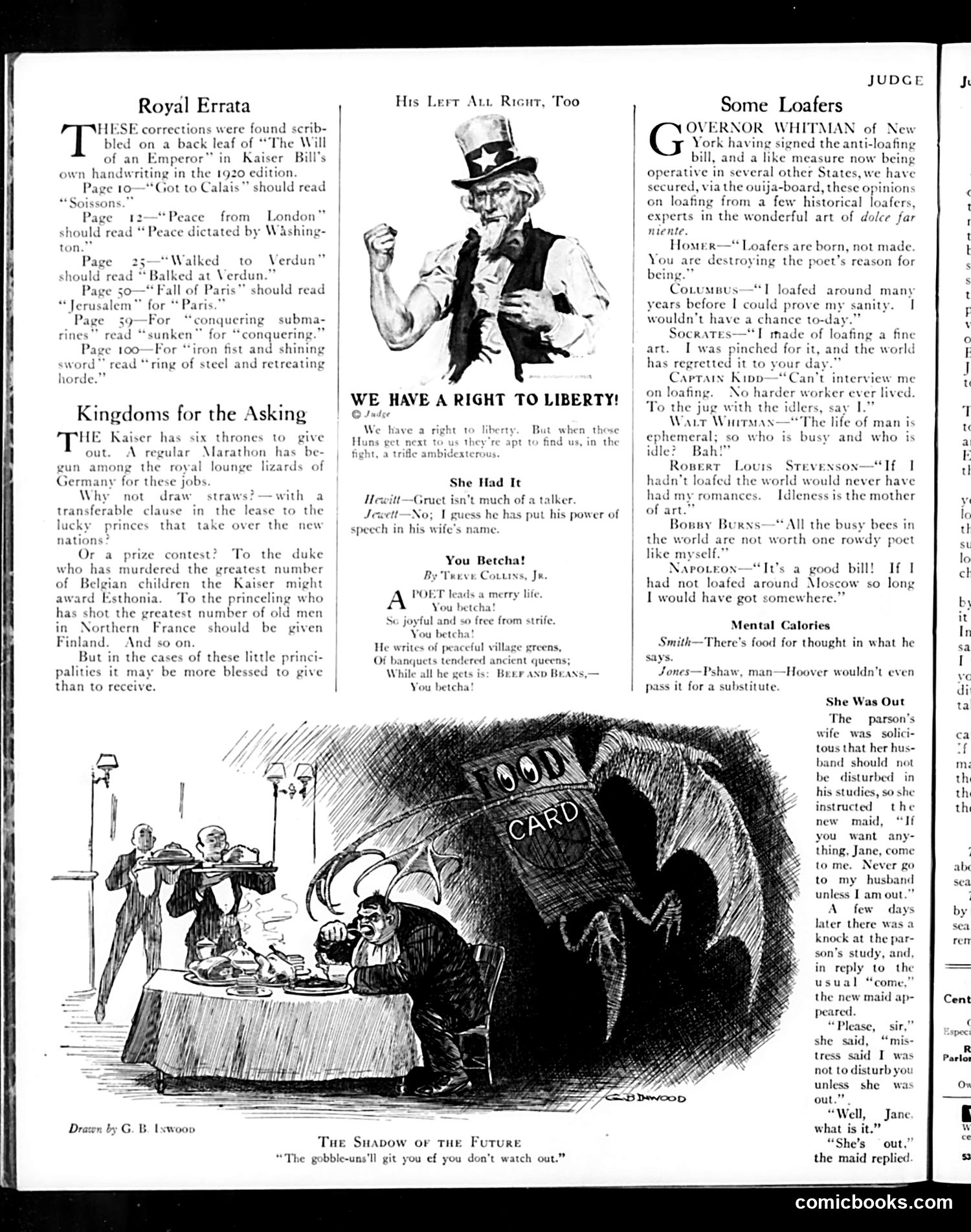
This page contains three distinct satirical pieces: **"Royal Errata"** mocks Kaiser Wilhelm II by presenting fake "corrections" he allegedly made to a 1920 edition of a book about an emperor. The "corrections" rewrite German military defeats as victories—changing "Walked to Verdun" to "Balked at Verdun," "conquering submarines" to "sunken," and "iron fist" to "ring of steel and retreating horde." The satire ridicules Wilhelm's denial of German wartime failures. **"Kingdoms for the Asking"** sarcastically proposes the Kaiser distribute European thrones as prizes for atrocities—awarding Estonia to whoever murdered the most Belgian children, Finland to whoever killed the most French elderly. This bitter joke references documented German brutality during WWI. **"Some Loafers"** humorously quotes historical figures (Homer, Socrates, Napoleon, Stevenson) defending idleness after Governor Whitman signed an anti-loafing bill. It's lighthearted social commentary on work culture. The lower cartoon "Shadow of the Future" shows an ominous figure looming over a dinner table—likely representing economic anxiety or threat post-WWI.
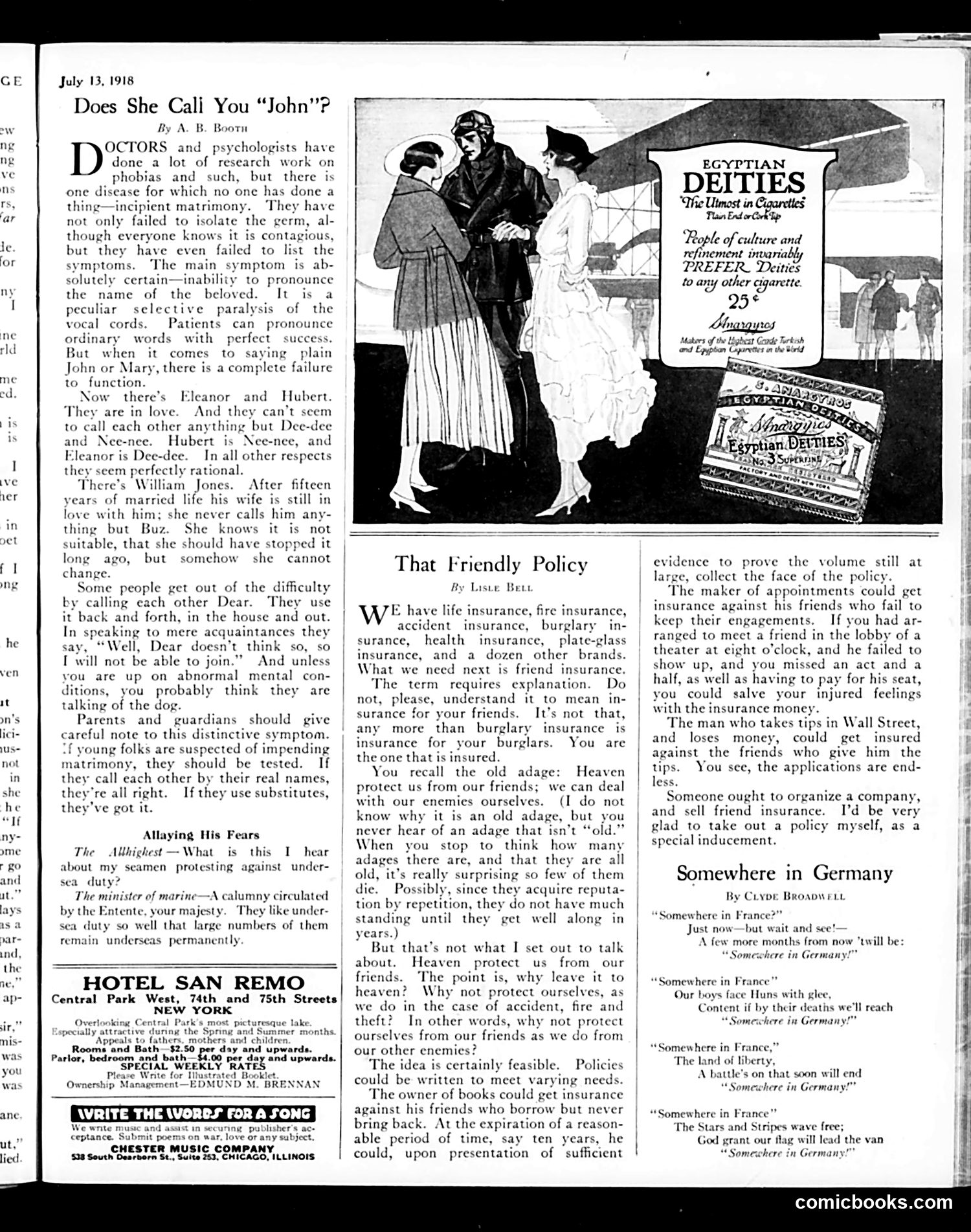
## Main Article: "Does She Call You 'John'?" The article satirizes a supposed psychological condition afflicting couples in love: their inability to pronounce their partner's actual name. Instead of calling each other by real names like "John" or "Mary," afflicted couples resort to nicknames ("Dee-dee," "Nee-nee," "Buz"). The piece humorously frames this as a diagnosable symptom of "incipient matrimony" (impending marriage), suggesting parents should test young couples by listening to how they address each other—if they use substitutes, marriage is imminent. The satire gently mocks sentimental courtship behavior and romantic eccentricity. ## Secondary Articles "That Friendly Policy" proposes humorous insurance against unreliable friends, playing on insurance industry proliferation. "Somewhere in Germany" appears to be wartime patriotic verse (given the 1918 date during WWI). The page also contains period advertising for hotels and cigarettes, typical of Judge's commercial content.
This page is primarily **advertisements for Broadway theaters and shows** (typical of Judge's era), interspersed with brief theater reviews and satirical items. The notable satirical content includes: **"Some Experience"** — A racist joke about a Black man registering for military service, using dialect ("sah") to mock his speech. He claims combat experience being "shot at twice," reflecting WWI-era attitudes. **"Disgraced"** — A brief marital joke: a wife is embarrassed because her drunk husband John heckled a Shakespeare recitation at a charity bazaar, shouting "Author, author!" The page also advertises **Judge magazine itself** as providing "welcome relaxation for war-strung nerves" to soldiers and sailors, promoting mail subscriptions to troops during World War I. The theatrical reviews catalog contemporary Broadway productions with brief, pun-laden descriptions—typical Judge humor of the 1918 period.
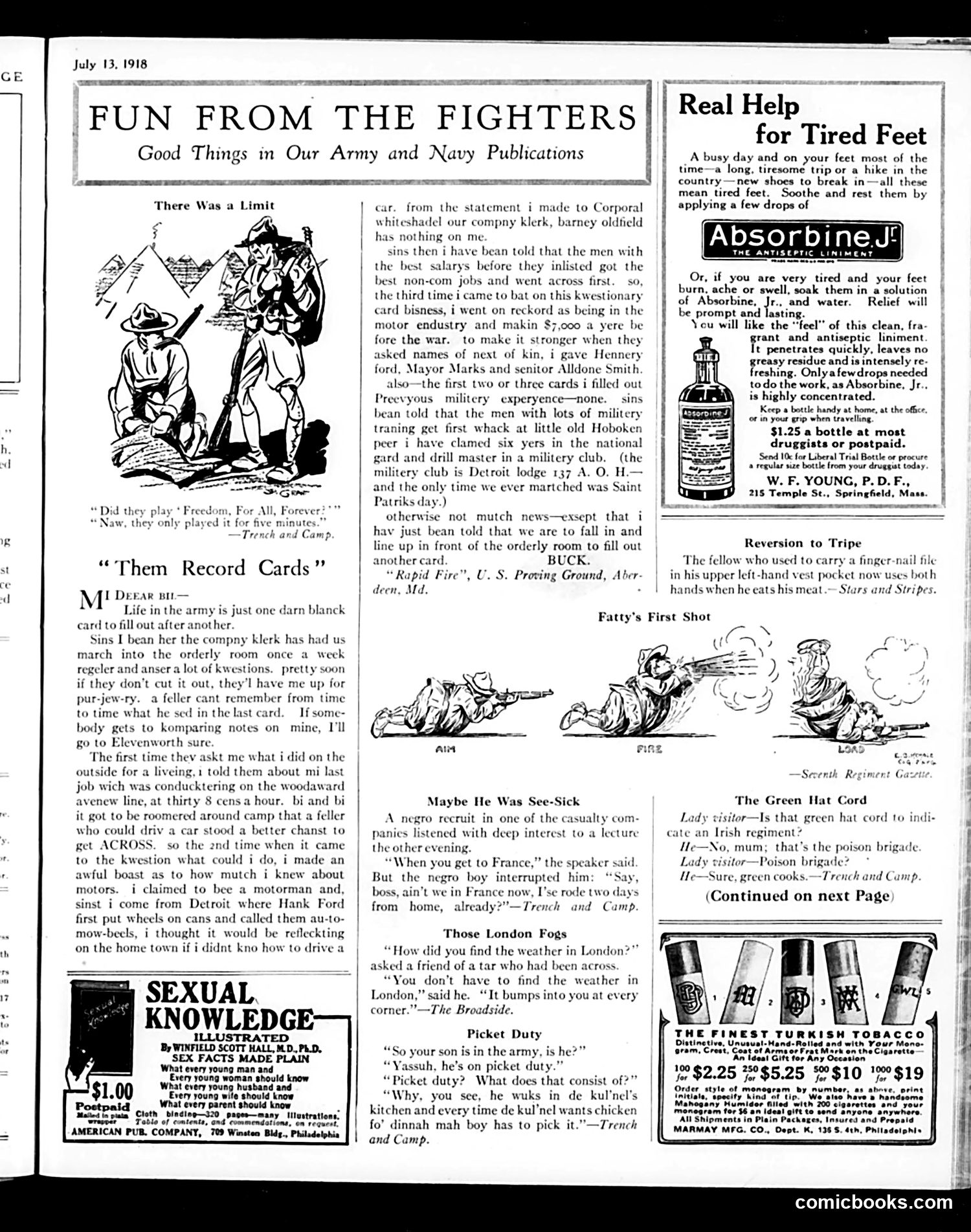
This July 1918 page from *Judge* magazine contains WWI-era military humor aimed at American soldiers and sailors. **"Them Record Cards"** is the main feature—a satirical monologue by a soldier named Buck complaining about repetitive army paperwork. The joke: each time he fills out identical questionnaires about his civilian job, he exaggerates more outrageously (claiming $7,000 yearly salary, naming Henry Ford and mayors as references) to seem more valuable for military assignments. The humor mocks both the army's bureaucratic inefficiency and soldiers' creative dishonesty to secure better positions. The smaller jokes mock military life's absurdities: a recruit's confusion about geography ("ain't we in France now?"), London's famous fog being inescapable, and "picket duty" referring to kitchen work picking chicken for officers. The page also includes period advertisements (Absorbine for foot pain) and a book advertisement about sexual knowledge—reflective of 1918 concerns about soldiers' health and morality. All humor reflects soldiers' real frustrations with army administration and deployment during the final year of World War I.
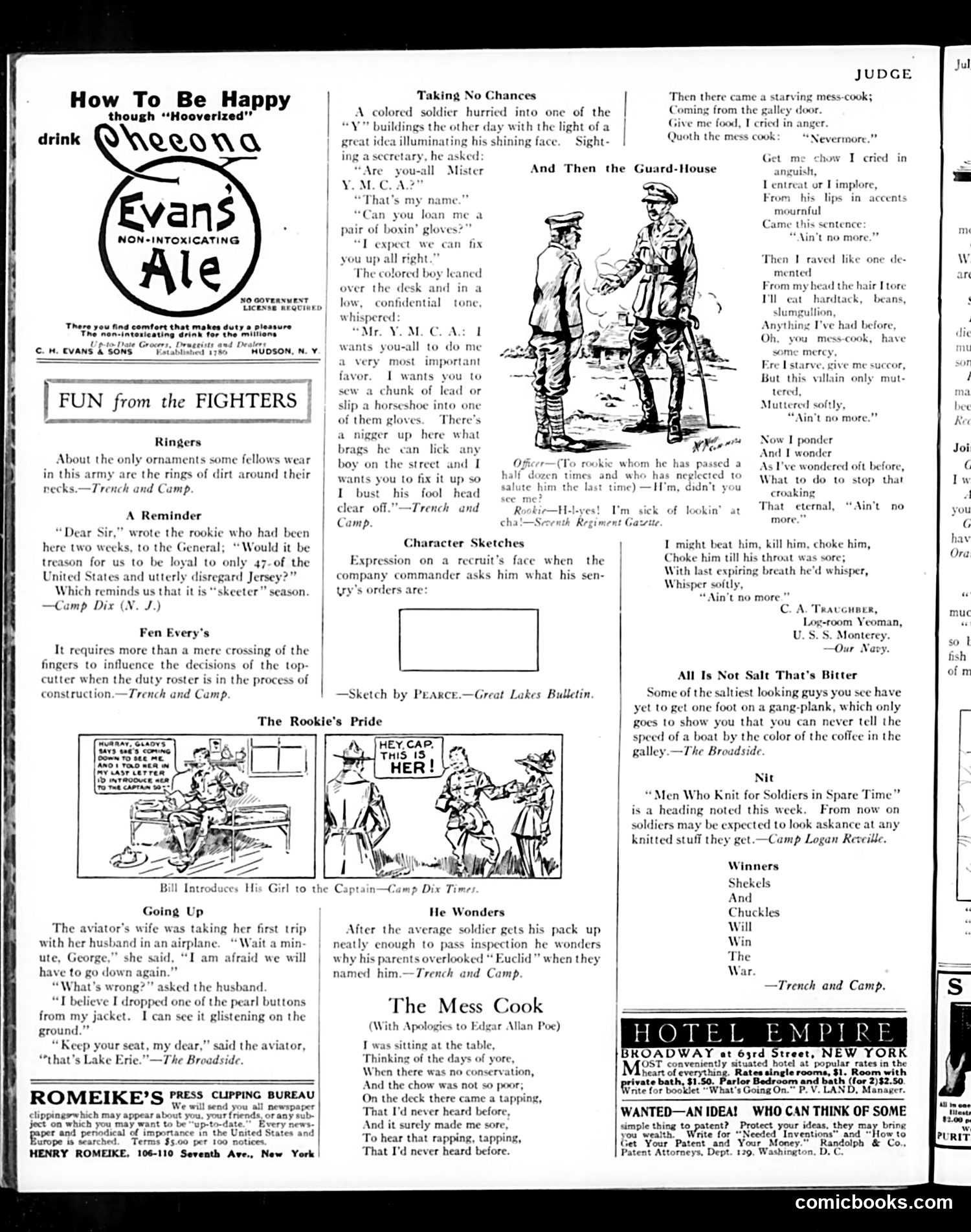
This page from **Judge** (a WWI-era satirical magazine) uses humor to address soldier life and wartime conditions: **Main Content:** - **"Hooverized" ale advertisement**: References Herbert Hoover's food-conservation program during WWI, joking about drinking non-intoxicating beer as patriotic duty - **"Fun from the Fighters"**: Short jokes mocking military life—dirty uniforms, rookie confusion, duty roster politics - **"The Mess Cook" (Poe parody)**: A soldier frustrated with poor rations mimics Edgar Allan Poe's "The Raven," with the cook repeatedly answering "Nevermore" and "Ain't no more" to food requests—satirizing both bad army food and literary pretension - **"The Rookie's Pride"**: Comic strip showing soldiers' mishaps and naïveté **Social Context:** Aimed at servicemen and civilians, these pieces provided dark humor about military hardships—food shortages, strict discipline, inspection anxiety—normalizing complaint through comedy during wartime sacrifice.
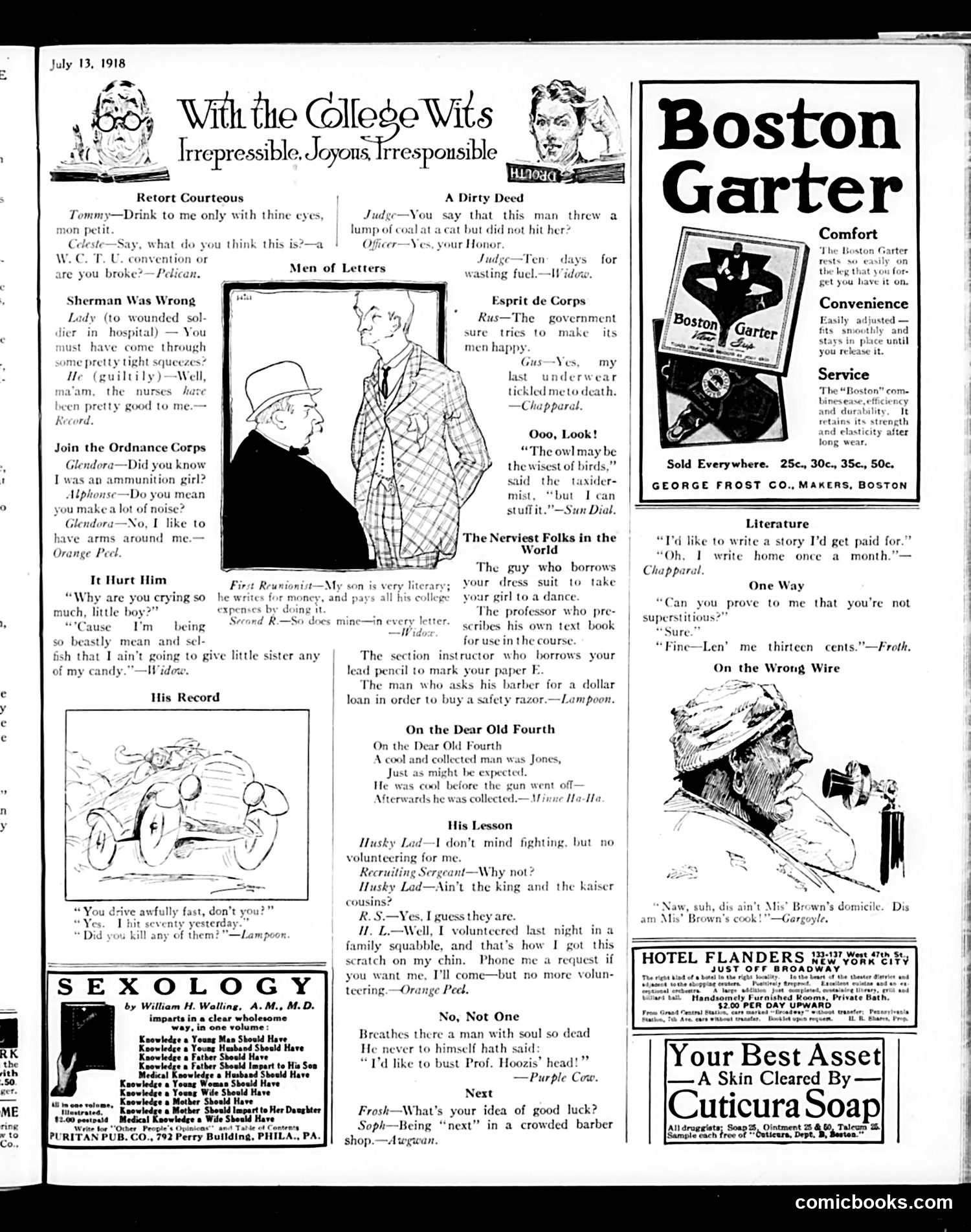
This page from the satirical magazine **Judge** contains humor columns, jokes, and advertisements typical of WWI-era American magazines. ## Key Content: **"With the College Wits"** features brief humorous exchanges mocking college life and student behavior—borrowing money, lending textbooks, asking for loans. **"Men of Letters"** includes jokes about writers, including one about a man who borrows a dress suit to take a girl to a dance, and another about a professor who requires students to buy his own textbook. **War-Related Humor**: Several jokes reference WWI context—mentions of "wasting fuel," ordnance corps work, and volunteering for military service. One joke plays on the fact that the German Kaiser and British King were cousins. **Advertisements** dominate the right side: Boston Garter hosiery, Hotel Flanders, Cuticura Soap, and a "Sexology" book. The satire targets predictable targets: absent-minded professors, scheming students, petty bureaucrats—standard magazine fodder. The WWI references ground these jokes in 1918 specifically.
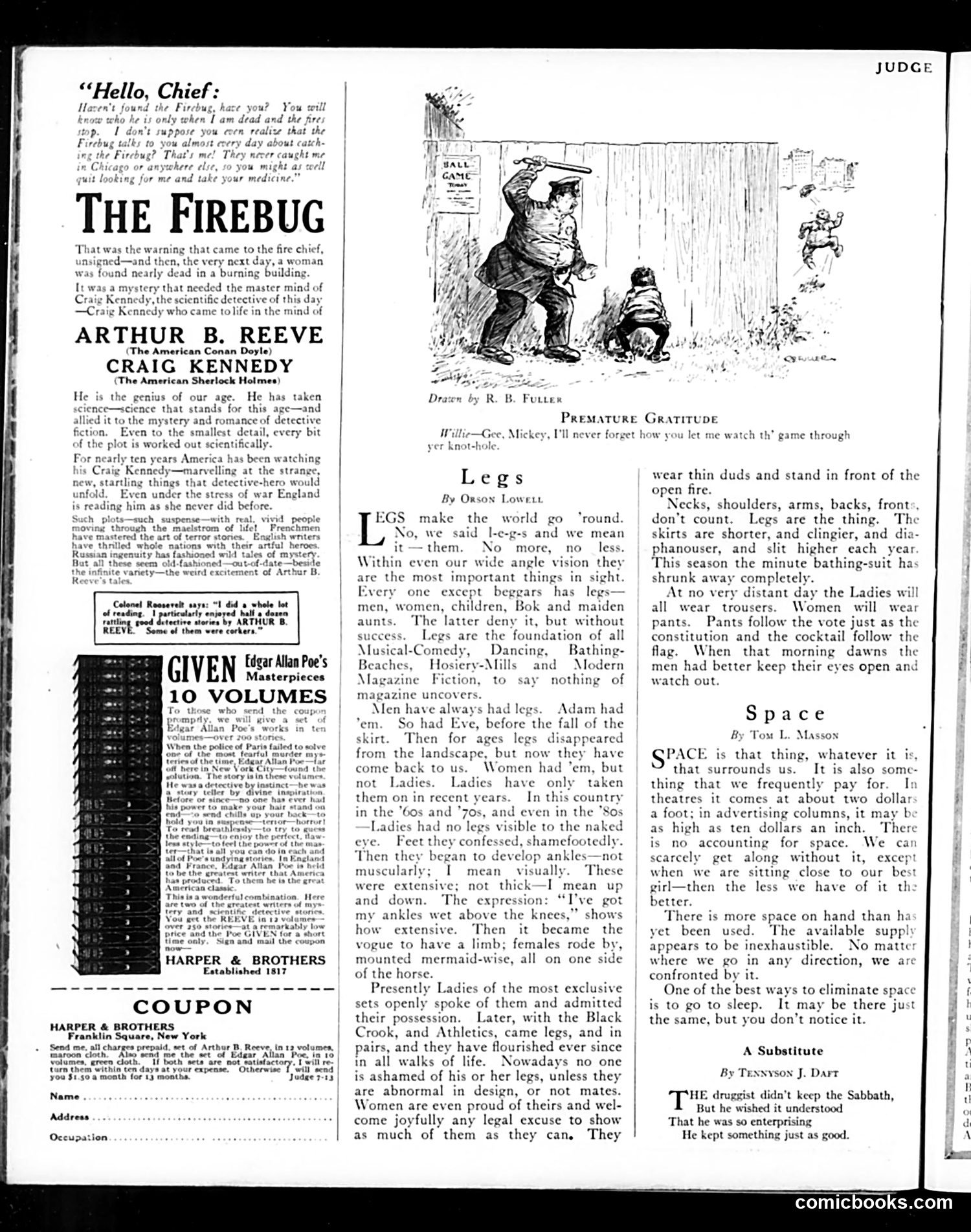
This page from *Judge* magazine features **advertising and short fiction rather than political cartoons**. The main content includes: **"The Firebug"** — A serialized detective story by Arthur B. Reeve featuring Craig Kennedy, "The American Sherlock Holmes." The accompanying illustration shows Kennedy investigating a crime scene. This was popular pulp fiction of the era. **"Legs"** by Orson Lowell — A humorous essay satirizing the cultural obsession with women's legs. It traces how women's legs gradually became visible and fashionable—from Victorian times when "Ladies" hid them completely, through the gradual reveal of ankles, to the modern era (early 1920s) where shorter, clinging skirts made legs openly displayed. The satire mocks both the absurdity of Victorian prudishness and the contemporary fixation on female legwear. **The small illustration** labeled "Premature Gratitude" shows a nostalgic man recalling letting a child watch a baseball game—unrelated social commentary. The page is primarily **commercial**, featuring a Harper & Brothers coupon selling collected works of Arthur B. Reeve and Edgar Allan Poe.
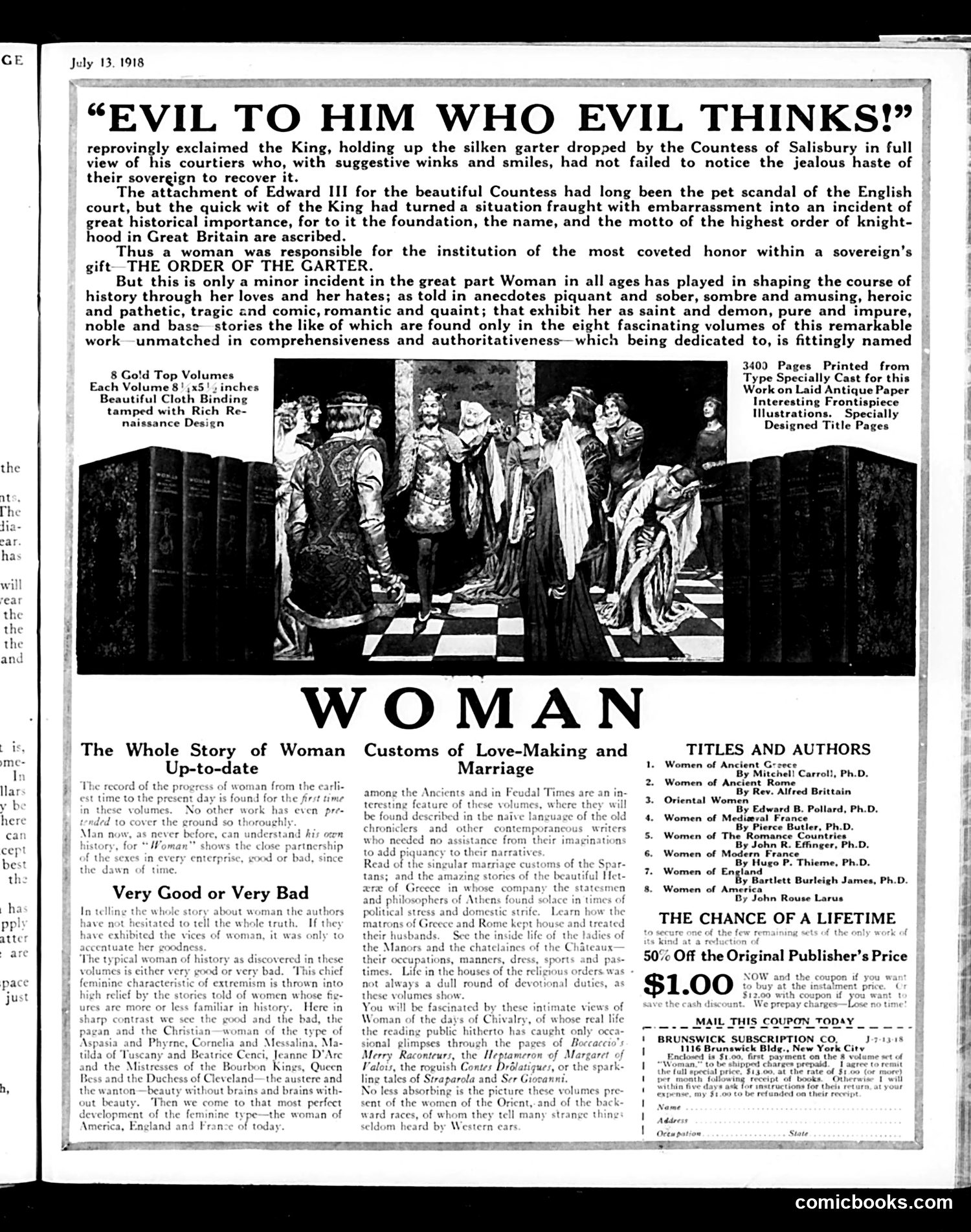
This page is primarily **advertising for an eight-volume encyclopedia set titled "Woman,"** not a political cartoon. The ad uses a historical anecdote as its hook. The opening text references **King Edward III and the Countess of Salisbury**, recounting a legend where the King retrieved her dropped garter in public. The phrase "Evil to him who evil thinks"—the motto of the Order of the Garter—frames this as the origin of Britain's highest chivalric order, supposedly founded due to a woman's influence. The ad then pivots to a broader cultural argument: that women throughout history have shaped civilization through their "loves and hates," presented as both saint and demon. The accompanying illustrations show medieval court scenes suggesting romantic intrigue and drama. This is fundamentally **promotional material capitalizing on period fascination with women's historical roles**—marketed as an authoritative, comprehensive work covering women across different cultures and eras. The 1918 date places this as women's suffrage movements were active, making such historical compilations commercially timely.
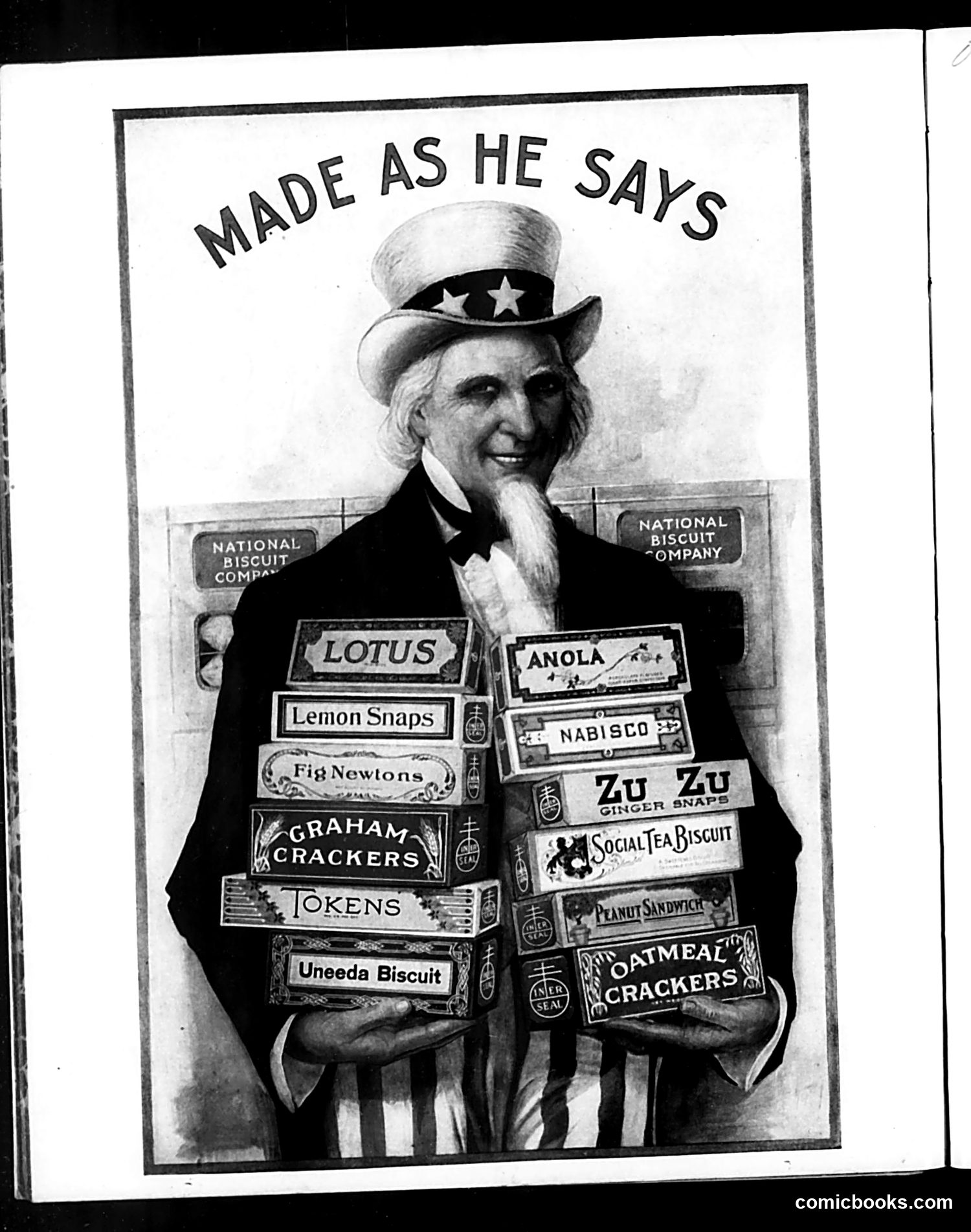
This is a National Biscuit Company advertisement featuring Uncle Sam (identifiable by his star-emblazoned top hat and patriotic attire) holding stacks of their various cracker and biscuit products. The caption "MADE AS HE SAYS" suggests Uncle Sam endorses these American-made goods. The advertisement lists popular National Biscuit products including Lotus, Lemon Snaps, Fig Newtons, Graham Crackers, Tokens, Uneeda Biscuits, Anola, Nabisco, Zu Zu Ginger Snaps, Social Tea Biscuit, Peanut Sandwich, and Oatmeal Crackers. This patriotic branding—using Uncle Sam as pitchman—was typical early 20th-century marketing, conflating consumer products with American nationalism and quality. The "made as he says" phrasing implies these goods are made according to Uncle Sam's (and by extension, America's) high standards.