
Judge, 1918-07-13 · page 18 of 36
Judge — July 13, 1918 — page 18: what you’re looking at
What you’re looking at
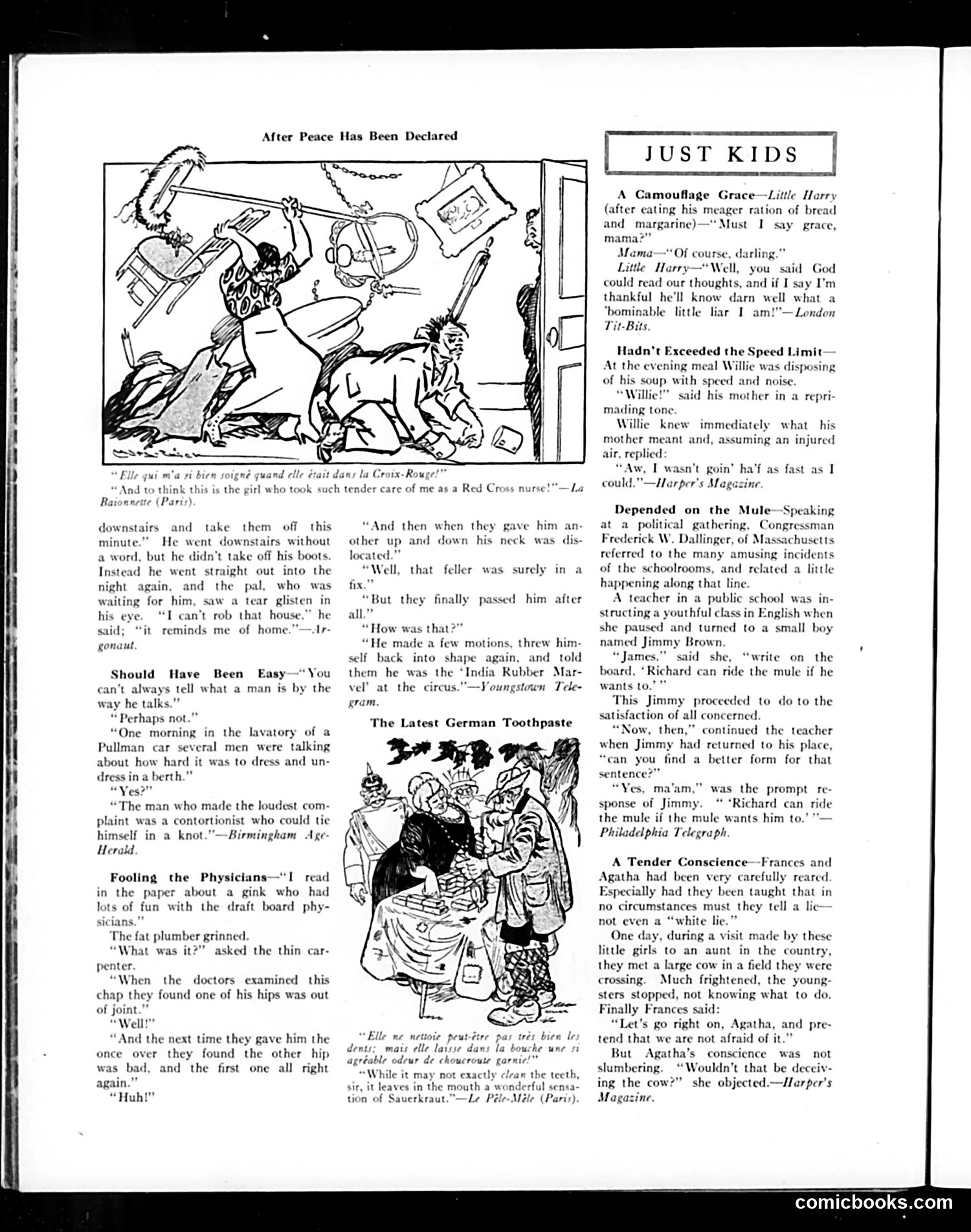
This page from Judge contains several humorous anecdotes and one political cartoon, all post-WWI in nature (indicated by the header "After Peace Has Been Declared"). **The main cartoon** depicts soldiers or civilians in chaotic domestic situations, likely satirizing the adjustment to peacetime after World War I—the disruption soldiers faced returning to normal life. **The anecdotes** include: - A story about a man who won't rob a house because it reminds him of home - A joke about a contortionist complaining loudest about berth space - "Fooling the Physicians"—a humorous tale of a contortionist who tricks WWI draft board physicians by appearing injured, then revealing himself as the "India Rubber Marvel" circus performer - "The Latest German Toothpaste"—anti-German satire mocking sauerkraut odor (reflecting post-war anti-German sentiment) - A section titled "Just Kids" with children's jokes and witticisms The content reflects early 1920s American attitudes: lingering anti-German sentiment, adjustment to post-war civilian life, and genteel humor targeting children's innocent observations about grace, table manners, and truth-telling.
📄 Transcribed text from this page (OCR, searchable)
Machine-transcribed from the original scan — historical spelling and the odd misread are preserved.
After Peace Has Been Declared i m'a si bien s J ell “ And to think this is the girl who took s and take them off this minute.” He went downstairs without a word, but he didn't take off his boots. Instead he went straight out into the night again, and the pal, who was waiting for him, saw a tear glisten in “T can’t rob that house.” he reminds me of home.”—Alr- downstairs his eye said; “it gonaut Should Have Been Easy— You can’t always tell what a man is by the way he talks.” “Perhaps not.” “One morning in the lavatory Pullman car several men were about how hard it was to dress and un- dress in a berth.” Yes?” “The man who made the loudest com- plaint was a contortionist who could tie himself in a knot."—Birmingham Age- Herald. Fooling the Physicians—I read in the paper about a gink who had lots of fun with the draft board phy- sicians.” The fat plumber grinned. “What was it?” asked the thin car- penter “When the doctors examined this chap they found one of his hips was out of joint.” “Well!” “And the next time they gave him the once over they found the other hip was bad, and the first one all right again.” “Huh!” la Croix-Rouge!” tender care of me as a Red Cross n “And then when they gave him an- other up and down his neck was dis- located.” “Well, that feller was surely in a fix.” “But they finally passed him after all.” “How was that?” “He made a few motions, threw him- self back into shape again, and told them he was the ‘India Rubber Mar- vel’ at the circus."—Youngstown Tele- gram The Latest German Toothpaste mais elle laisse da le odeur de choucroute go dents “While it may ni sir, it leaves in the tion of Sauerkraut exactly clean the teeth, uth a wonderful sensa- —Le Péle-Méle (Paris) JUST KIDS A Camouflage Grace—Little Harry (after eating his meager ration of bread and margarine)—‘Must I say grace, mama? Mama—* Of course, darling.” Little Harry—“Well, you said God could read our thoughts, and if I say I'm thankful he'll know n well what a ‘bominable little liar I am!"—London Tit-Bits. Hadn't Exceeded the Speed Limit At the evening meal Willie was disposing of his soup with speed and noise. “Willie!” said his mother in a repri- mading tone. Willie knew immediately what his mother meant and, assuming an injured air, replied: w, I wasn't goin’ ha’f as fast as I could.” —Harper’s Magazine Depended on the Mule—Speaking at a political gathering, Congressman Frederick W. Dallinger, of Massachusetts referred to the many amusing incidents of the schoolrooms, and related a little happening along that line. A teacher a public school was in- structing a youthful class in English when she paused and turned to a small boy named Jimmy Brown said she, “write on the board. ‘Richard can ride the mule if he wants to.”’ This Jimmy proceeded to do to the satisfaction of all concerned. Now, then,” continued the teacher when Jimmy had returned to his place, “can you find a better form for that sentence?” “Yes, ma‘am,” was the prompt re- sponse of Jimmy. “ ‘Richard can ride the mule if the mule wants him to.’ "— Philadelphia Telegraph. A Tender Conscience—Frances and Agatha had been very carefully reared Especially had they been taught that in no circumstances must they tell a lie- not even a ‘white lie. One day, during a visit made by these little girls to an aunt in the country, they met a large cow in a field they were crossing. Much frightened, the young- sters stopped, not knowing what to do. Finally Frances said: “Let’s go right on, i tend that we are not afraid of it.” But Agatha’s conscience was not slumbering. “‘Wouldn’t that be deceiv- ing the cow?” she objected.—Harper's gatha