
Judge, 1918-07-13 · page 14 of 36
Judge — July 13, 1918 — page 14: what you’re looking at
What you’re looking at
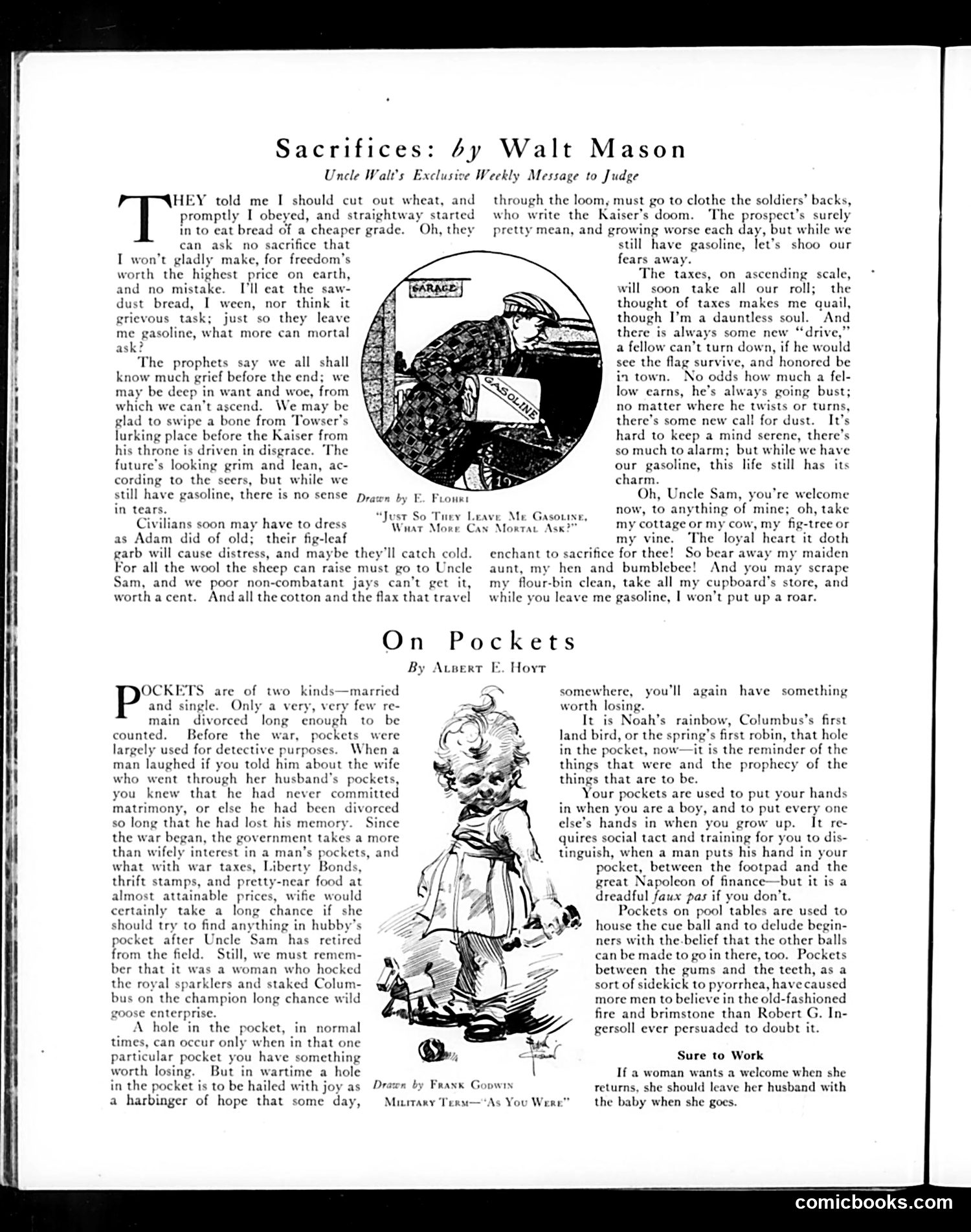
**"Sacrifices" by Walt Mason** is a WWI-era patriotic poem satirizing civilian complaints during wartime rationing. The speaker ironically claims willingness to sacrifice almost everything—wheat bread, clothing, money through taxes and war bonds—but draws the line at gasoline, repeatedly insisting "just so they leave me gasoline, what more can mortal ask?" The satire targets the hypocrisy of those who pose as patriotic while protecting their own comforts. **"On Pockets" by Albert E. Hoyt** is a humorous essay comparing pre-war and wartime pockets. Before the war, finding money in a husband's pocket was a wives' joke; now government taxation, Liberty Bonds, and thrift stamps have emptied everyone's pockets so completely that a hole becomes fortunate—it can't lose what isn't there. The piece uses lighthearted observation to comment on wartime financial hardship and government fiscal demands on civilians.
📄 Transcribed text from this page (OCR, searchable)
Machine-transcribed from the original scan — historical spelling and the odd misread are preserved.
Sacrifices: by Walt Mason Uncle Walt's Exclusive Weekly Message to Judge HEY told me I should cut out wheat, and promptly I obeyed, and straightway started Oh, they in to eat bread of a cheaper grade. can ask no sacrifice that I won't gladly make, for freedom’s worth the highest price on earth, and no mistake. I'll eat the saw- dust bread, I ween, nor think it grievous task; just so they leave me gasoline, what more can mortal ask The prophets say we all shall know much grief before the end; we may be deep in want and woe, from which we can’t ascend. We may be glad to swipe a bone from Towser's lurking place before the Kaiser from his throne is driven in disgrace. The future’s looking grim and lean, ac- cording to the seers, but while we still have gasoline, there is no sense in tears. Civilians soon may have to dress as Adam did of old; their fig-leaf garb will cause distress, and maybe they'll catch cold. heep can raise must go to Uncle aunt, my hen and bumblebee! can’t get it, worth acent. And all the cotton and the flax that travel For all the wool the s Sam, and we poor non-combatant ja On OCKETS are of two kinds—married and single. Only a very, very few re- main divorced long enough to be counted. Before the war, pockets were largely used for detective purposes. When a man laughed if you told him about the wife who went through her husband's pockets, you knew that he had never committed matrimony, or else he had been divorced so long that he had lost his memory. Since the war began, the government takes a more than wifely interest in a man’s pockets, and what with war taxes, Liberty Bonds, thrift stamps, and pretty-near food at almost attainable prices, wifie would certainly take a long chance if she should try to find anything in hubby’s pocket after Uncle Sam has retired from the field. Still, we must remem- ber that it was a woman who hocked the royal sparklers and staked Colum bus on the champion long chance wild goose enterprise. A hole in the pocket, in normal times, can occur only when in that one particular pocket you have something worth losing. But in wartime a hole in the pocket is to be hailed with joy as Drawn by ARY Teru— ‘A: a harbinger of hope that some day, Mu ‘Just So Tuey Leave Me Gasouixe, Wwat More Cay Mortar Asx?” through the loom, must go to clothe the soldiers’ backs, who write the Kaiser’s doom. The prospect’s surely pretty mean, and growing worse each day, but while we still have gasoline, let’s shoo our fears away. The taxes, on ascending scale, will soon take all our roll; the thought of taxes makes me quail, though I’m a dauntless soul. And there is always some new “drive,” a fellow can’t turn down, if he would see the flag survive, and honored be in town. No odds how much a fel- low earns, he’s always going bust; no matter where he twists or turns, there's some new cal! for dust. It’s hard to keep a mind serene, there’s so much to alarm; but while we have our gasoline, this life still has its charm. Oh, Uncle Sam, you're welcome now, to anything of mine; oh, take my cottage or my cow, my fig-tree or my vine. The loyal heart it doth enchant to sacrifice for thee! So bear away my maiden And you may scrape my flour-bin clean, take all my cupboard’s store, and while you leave me gasoline, | won't put up a roar. Fronkt Pockets Atsert E. Hoyt somewhere, you'll again have something worth losing. It is Noah’s rainbow, Columbus’s first land bird, or the spring’s first robin, that hole in the pocket, now—it is the reminder of the things that were and the prophecy of the things that are to be. Your pockets are used to put your hands in when you are a boy, and to put every one else’s hands in when you grow up. It re- quires social tact and training for you to dis- tinguish, when a man puts his hand in your pocket, between the footpad and the great Napoleon of finance—but it is a dreadful faux pas if you don’t. Pockets on pool tables are used to ~~ house the cue ball and to delude begin- ners with the-belief that the other balls can be made to go in there, too. Pockets between the gums and the teeth, as a sort of sidekick to pyorrhea, have caused more men to believe in the old-fashioned fire and brimstone than Robert G. In- gersoll ever persuaded to doubt it. Sure to Work If a woman wants a welcome when she returns, she should leave her husband with the baby when she goes. Frank Goow1n s You Were” comicbooks.com