
Judge, 1918-07-13 · page 24 of 36
Judge — July 13, 1918 — page 24: what you’re looking at
What you’re looking at
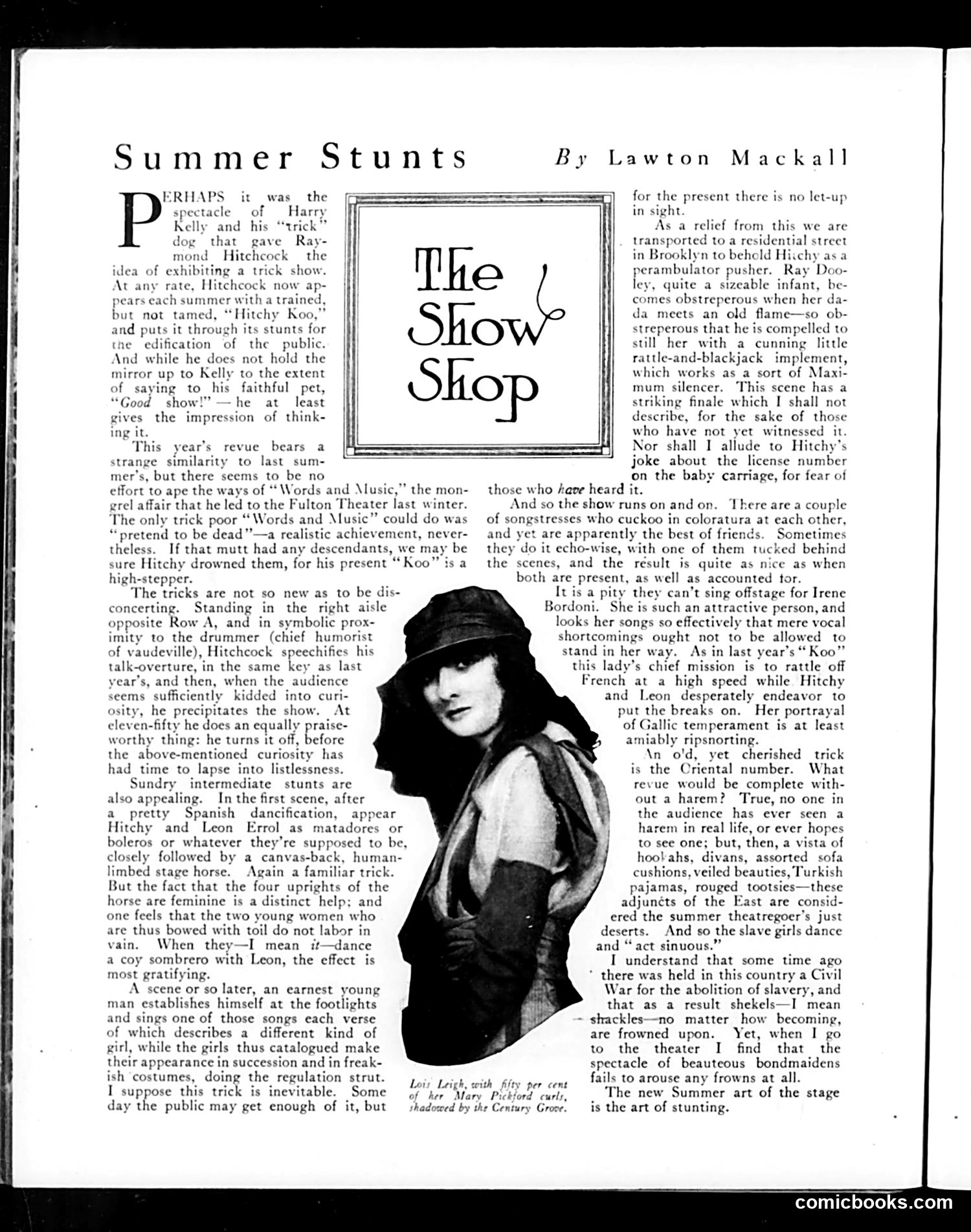
This is a theatrical review by Lawton Mackall critiquing Raymond Hitchcock's revue "Hitchy Koo" at an unnamed Broadway venue. The article describes various performance acts, including trained dogs, Spanish dances, romantic scenes, and an "Oriental number" featuring a harem scene. The central photograph shows Lois Leigh in costume for the production. Mackall's tone is lighthearted and gossipy—he praises Irene Bordoni's attractiveness while noting her vocal limitations, and he amusedly discusses the show's recurring gimmicks and formulaic nature (comparing it unfavorably to a previous Hitchcock production called "Words and Music"). The satire is gentle: Mackall suggests the show recycles familiar theatrical tricks annually but remains entertaining because Hitchcock knows when to end acts before audiences lose interest. The "stunt" focus suggests vaudeville-style variety entertainment rather than sophisticated drama.
📄 Transcribed text from this page (OCR, searchable)
Machine-transcribed from the original scan — historical spelling and the odd misread are preserved.
Mackall Lawton Summer Stunts By ERHAPS it was the spectacle of — Harry Kelly and his “trick” dog that gave Ray- mond Hitchcock — the idea of exhibiting a trick show. At any rate, Hitchcock now ap- pears each summer with a trained, but not tamed, “Hitchy Koo,” and puts it through its stunts for the edification of the public. And while he does not hold the mirror up to Kelly to the extent of saying to his faithful pet, “Good show!” —he at least gives the impression of think- for the present there is no let-up in sight. As a relief from this we are transported to a residential street in Brooklyn to behold Hiichy as a perambulator pusher. Ray Doo- ley, quite a sizeable infant, be- comes obstreperous when her da- da meets an old flame—so ob- streperous that he is compelled to sull her with a cunning little rattle-and-blackjack implement, which works as a sort of Maxi- mum silencer. This scene has a striking finale which I shall not describe, for the sake of those who have not yet witnessed it. Nor shall I allude to Hitchy’s joke about the license number on the baby carriage, for fear of those who have heard it. And so the show runs on and on. There are a couple of songstresses who cuckoo in coloratura at each other, “pretend to be dead"—a realistic achievement, never- and yet are apparently the best of friends. Sometimes theles: If that mutt had any descendants, we may be _ they do it echo-wise, with one of them tucked behind sure Hitchy drowned them, for his present “Koo” isa the scenes, and the result is quite as nice as when both are present, as well as accounted tor. It is a pity they can’t sing offstage for Irene Bordoni. She is such an attractive person, and looks her songs so effectively that mere vocal shortcomings ought not to be allowed to stand in her way. As in last year’s “Koo” this lady’s chief mission is to rattle off French at a high speed while Hitchy and Leon desperately endeavor to put the breaks on. Her portrayal of Gallic temperament is at least amiably ripsnorting. \n o'd, yet cherished trick is the Criental number. What revue would be complete with- out a harem? True, no one in the audience has ever seen a harem in real life, or ever hopes to see one; but, then, a vista of hoolahs, divans, assorted sofa cushions, veiled beauties, Turkish ing it. This year’s revue bears a strange similarity to last sum- mer’s, but there seems to be no effort to ape the ways of “Words and Music,” the mon- grel affair that he led to the Fulton Theater last winter. The only trick poor “Words and Music” could do was high stepper. The tricks are not so new as to be dis- concerting. Standing in the right aisle opposite Row A, and in symbolic prox- imity to the drummer (chief humorist of vaudeville), Hitchcock speechifies his talk-overture, in the same key as last year’s, and then, when the audience seems sufficiently kidded into curi- osity, he precipitates the show. At cleven-fifty he does an equally praise- worthy thing: he turns it off, before the above-mentioned curiosity has had time to lapse into listlessness. Sundry intermediate stunts are also appealing. In the first scene, after a_ pretty Spanish dancification, appear Hitchy and Leon Errol as matadores or boleros or whatever they’re supposed to be, closely followed by a canvas-back, human- limbed stage horse. Again a familiar trick. But the fact that the four uprights of the horse are feminine is a distinct help; and one feels that the two young women who deserts. pajamas, rouged tootsies—these adjunéts of the East are consid- ered the summer theatregoer’s just And so the slave girls dance are thus bowed with toil do not labor in vain. When they—I mean it—dance a coy sombrero with Leon, the effect is most gratifying. A scene or so later, an earnest young man establishes himself at the footlights and sings one of those songs each verse f which describes a different kind of girl, while the girls thus catalogued make their appearance in succession and in freak- ish costumes, doing the regulation strut. I suppose this trick is inevitable. Some day the public may get enough of it, but and “act sinuous.” I understand that some time ago there was held in this country a Civil War for the abolition of slavery, and that as a result shekels—I mean shackles—no matter how becoming, are frowned upon. Yet, when I go to the theater I find that the spectacle of beauteous bondmaidens fails to arouse any frowns at all. The new Summer art of the stage is the art of stunting. y per cent kford curls, shadowed by the Century Groce. comicbooks.com