
Judge, 1918-07-13 · page 20 of 36
Judge — July 13, 1918 — page 20: what you’re looking at
What you’re looking at
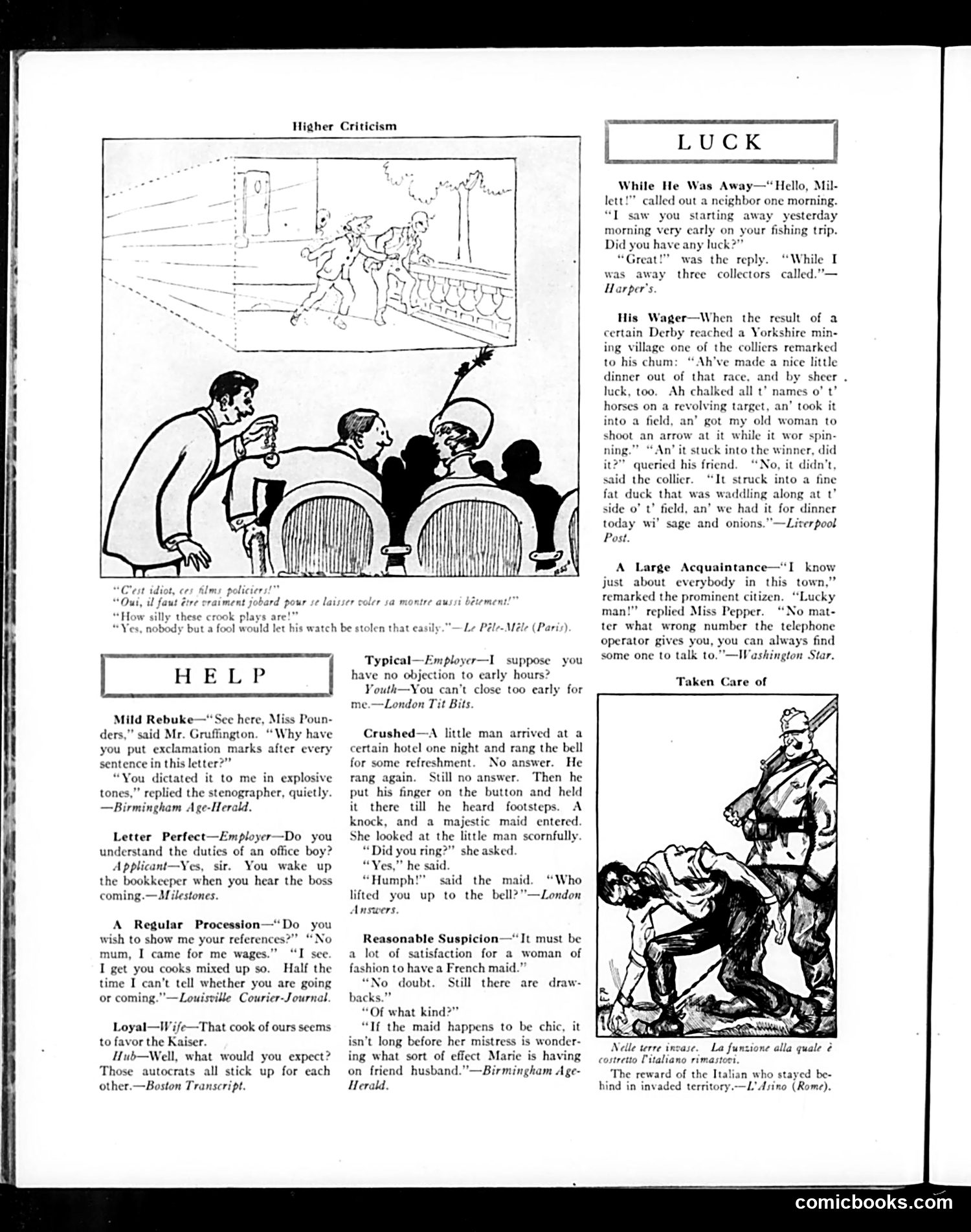
This page collects brief humorous anecdotes from *Judge*, a satirical weekly. The content reflects early 20th-century workplace and domestic comedy: **"Higher Criticism"** (top cartoon) depicts a theater scene where critics debate a play's merits—likely satirizing overwrought literary analysis of the era. **"Help" and "Luck"** sections contain short jokes about office dynamics, servants, and social pretension typical of *Judge*'s humor. Notable themes include: - Stenographers and employers (labor relations) - Servants' perceived disloyalty ("autocrats") - Class anxiety (references to French maids and "fashion") - Working-class wit (the Yorkshire miner's hunting story) **"Taken Care of"** (bottom) appears to reference Italian wartime experience, though context is unclear—possibly WWI-related. The humor relies on servant-employer tensions, workplace absurdities, and class commentary that would have resonated with *Judge*'s middle-class American audience circa 1910s-1920s.
📄 Transcribed text from this page (OCR, searchable)
Machine-transcribed from the original scan — historical spelling and the odd misread are preserved.
Higher Criticism silly these crook plays ar »body but a fool would let his watch be stolen that easily.” HELP Mild Rebuke—" See here, Miss Poun- ders,” said Mr. Gruffington. “Why have you put exclamation marks after every sentence in this letter?” “You dictated it to me in explosiv tones,” replied the stenographer, quietly —Birmingham Age-Herald. Letter Perfect—Employer—Do you understand the duties of an office boy? Applicant—Yes, sir. You wake up the bookkeeper when you hear the boss coming.—Milestones. A Regular Procession—*Do you wish to show me your references?” “No mum, I came for me wages.” “I I get you cooks mixed up so. Half the time I can’t tell whether you are going or coming.” —Louisville Courier-Journal. Loyal—W ife—That cook of ours seems to favor the Kai: Hub—Well, what would you expect? Those autocrats all stick up for each other.—Boston Transcript. Le Péle-Méle (Paris) ployer—I_ suppose have no objection to early hours? Youth—You can't close too early for me.—London Tit Bits. you Crushed—A little man arrived at a certain hotel one night and rang the bell for some refreshment. No answer. He rang again. Still no answer. Then he put his finger on the button and held it there till he heard footsteps. A knock, and a majestic maid entered. She looked at the little man scornfully. “Did you ring?” she asked. “Yes,” he said. “Humph!” said the maid. “Who lifted you up to the bell?”—London Answers. Reasonable Suspicion—* It must be a lot of satisfaction for a woman of fashion to have a French mai “No doubt. Still there are backs.” “Of what kind?” “If the maid happens to be chic, it isn’t long before her mistress is wonder- ing what sort of effect Marie is having on friend husband.”—Birmingham Age- Herald. draw- = While He Was Away—“ Hello, Mil- lett!” called out a neighbor one morning. “I saw you starting away yesterday morning very ¢ on your fishing trip. Did you have any luck?” “Great!” was the reply. was away three collectors Harper's. LUCK “While I called.”— His Wager—When the result of a certain Derby reached a Yorkshire min- ing village one of the colliers remarked to his chum: “Ah’ve made a nice little dinner out of that race, and by sheer . luck, too. Ah chalked all t’ names o’ t’ horses on a revolving target, an’ took it into a field, an’ got my old woman to shoot an arrow at it while it wor spin- ning. n’ it stuck into the winner, did it?” queried his friend. ‘No, it didn’t, said the collier. “It struck into a fine fat duck that was waddling along at t’ side o’ t’ field, an’ we had it for dinner today wi’ sage and onions.”—Literpool Post. A Large Acquaintance—‘I know just about everybody in this town,” remarked the prominent citizen. “Lucky man!” replied Miss Pepper. ‘No mat- ter what wrong number the telephone operator gives you, you can always find some one to talk to.”"—IWashington Star. Taken Care of Nelle terre incase. La funsione alla quale é costretto Vitaliano rimastovi. ‘The reward of the Italian who stayed be- hind in invaded territory.—L’Asino (Rome). comicbooks.com