
A complete issue · 36 pages · 1918
Judge — May 11, 1918
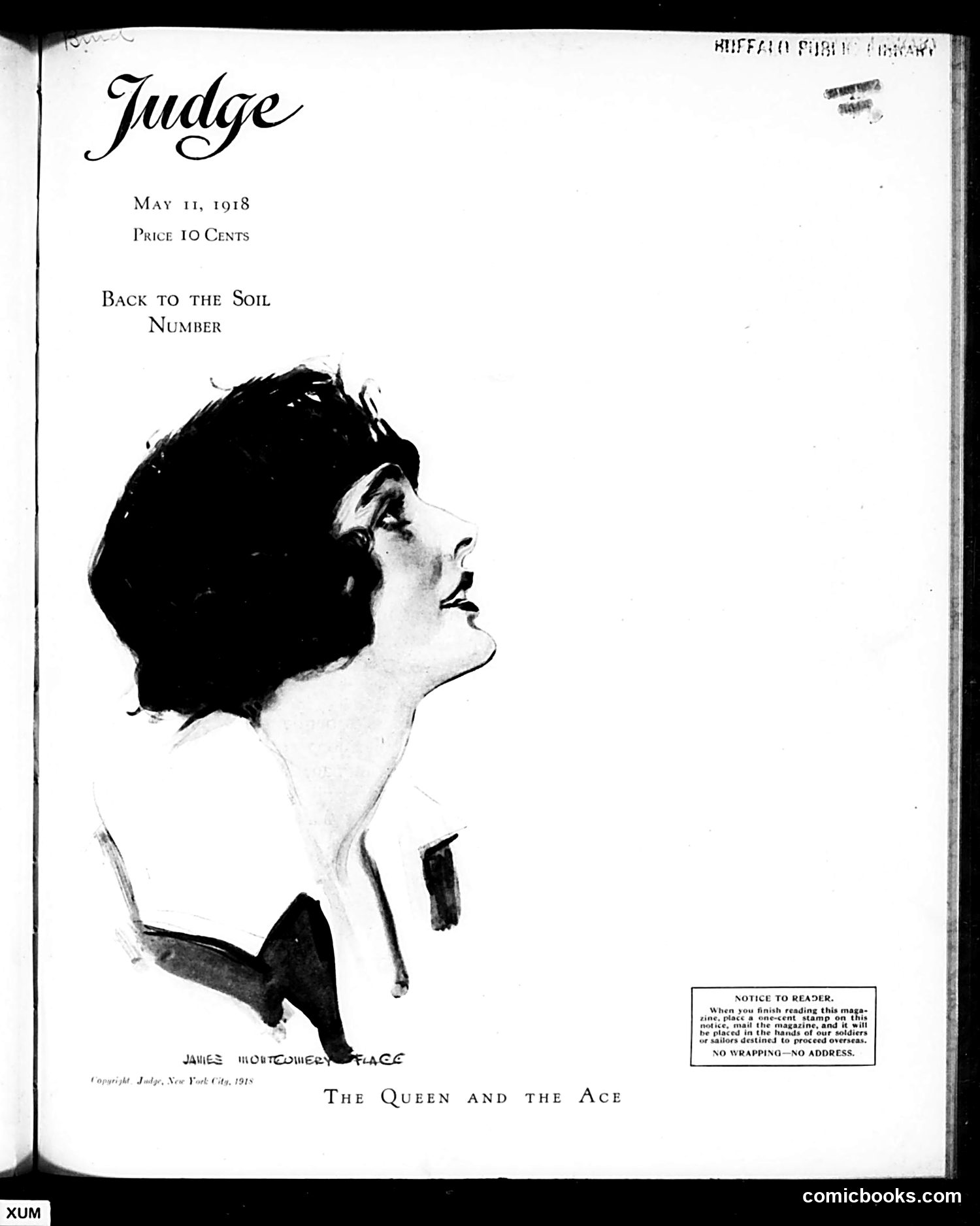
This illustration, credited to James Montgomery Flagg, depicts a stylized female profile titled "The Queen and the Ace." Given the May 1918 date (late World War I), this likely references American wartime themes, though the specific identity remains unclear from the image alone. The profile drawing employs Art Deco or modernist styling typical of Flagg's work. The accompanying "Notice to Reader" indicates this was a military-related publication distributed to soldiers overseas, suggesting the "Queen" may represent America, patriotic ideals, or a symbolic feminine figure meant to inspire servicemen. Without additional context from the magazine's contents, the precise satirical or political meaning is uncertain.
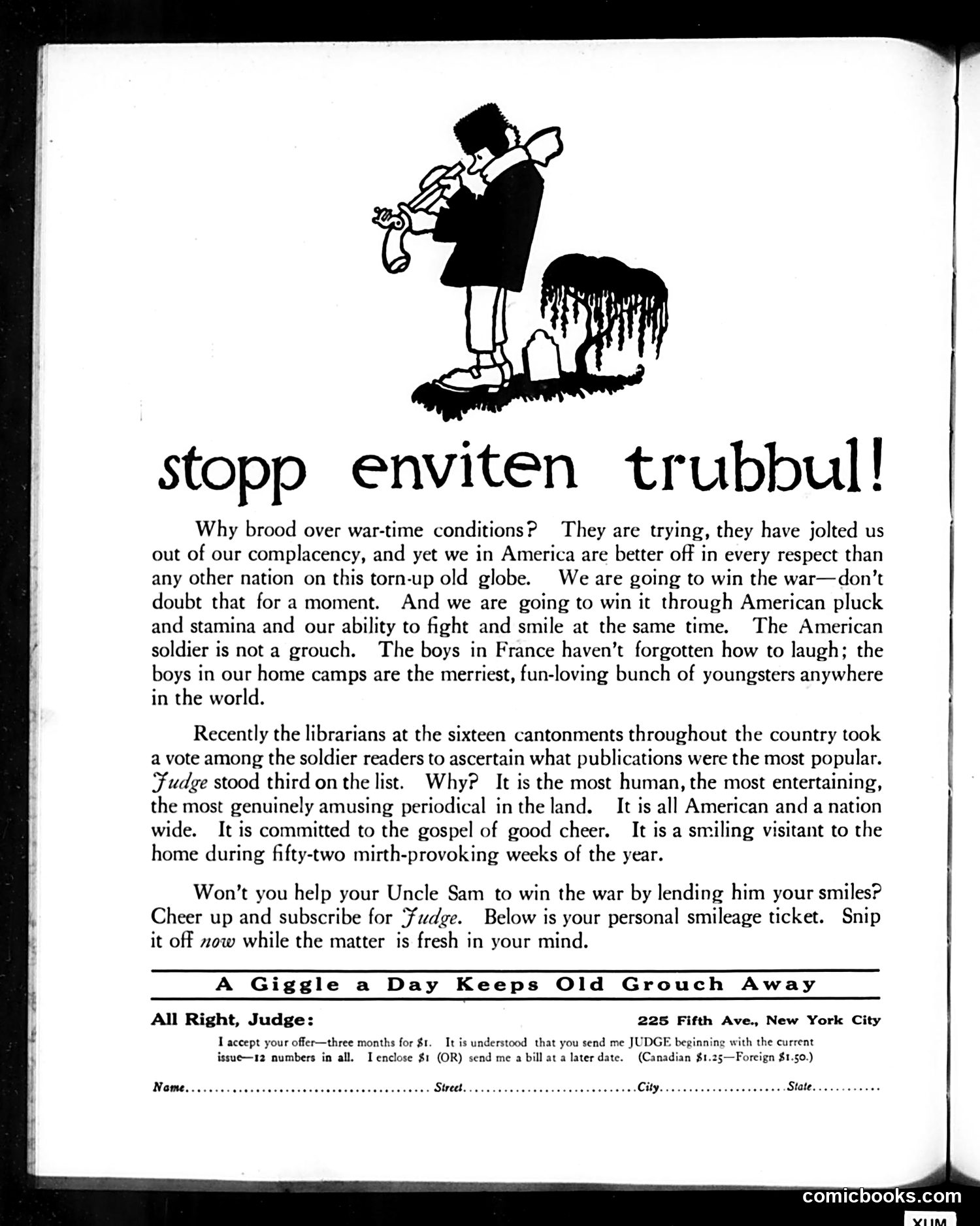
This is primarily **wartime propaganda advertising** rather than political satire. The cartoon shows a man (representing Uncle Sam or American authority) conducting an orchestra or band, with the tagline "stopp enviten trubbul!" (stop inviting trouble—likely dialectal spelling for humorous effect). The text argues Americans shouldn't complain about wartime hardships, claiming American soldiers are resilient and maintaining morale. It promotes *Judge* magazine's popularity among servicemen at sixteen cantonments, claiming it ranked third in soldier readership. The advertisement attempts to boost *Judge* subscriptions by appealing to patriotism—"help your Uncle Sam win the war by lending him your smiles"—positioning humor as a patriotic duty. This reflects WWI-era messaging encouraging civilian support for troops through entertainment and morale-boosting publications.
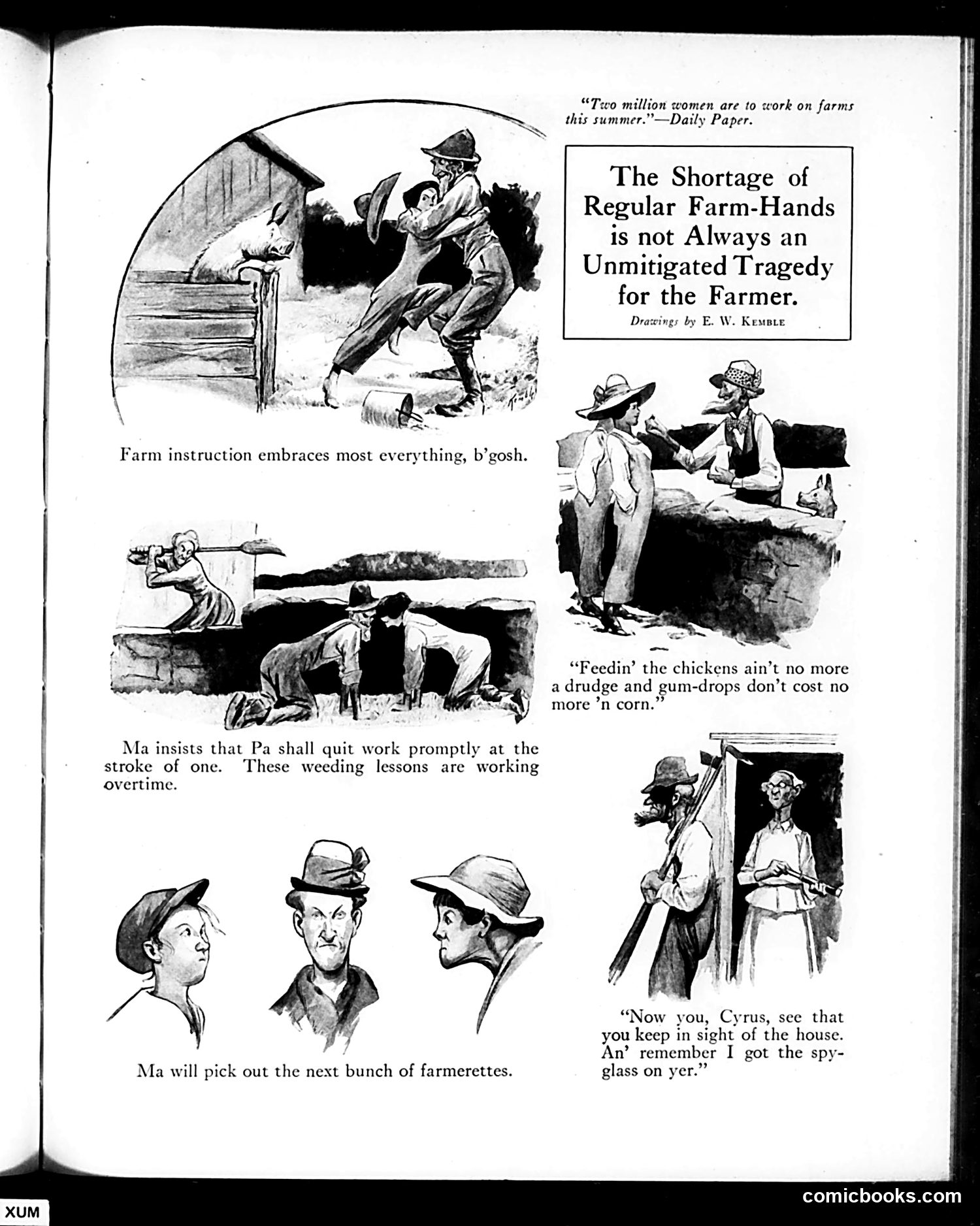
This satirical piece addresses the WWI-era farm labor shortage. The headline quotes a daily paper reporting two million women would work farms that summer, then argues this shortage isn't entirely bad for farmers. The cartoons humorously depict farm life's harsh realities: Ma forcing Pa to work on strict schedules ("weeding lessons are working overtime"), the minimal cost of chicken feed, and Ma monitoring hired help (Cyrus) to ensure he stays visible—suggesting farm workers needed close supervision or had tendency to shirk. The satire cuts two ways: it mocks farmers' difficulties managing labor while also poking fun at rural life's demands and the domineering role of farm wives in enforcing discipline. The drawings by E.W. Kemble emphasize rustic, folksy characters facing practical wartime challenges.
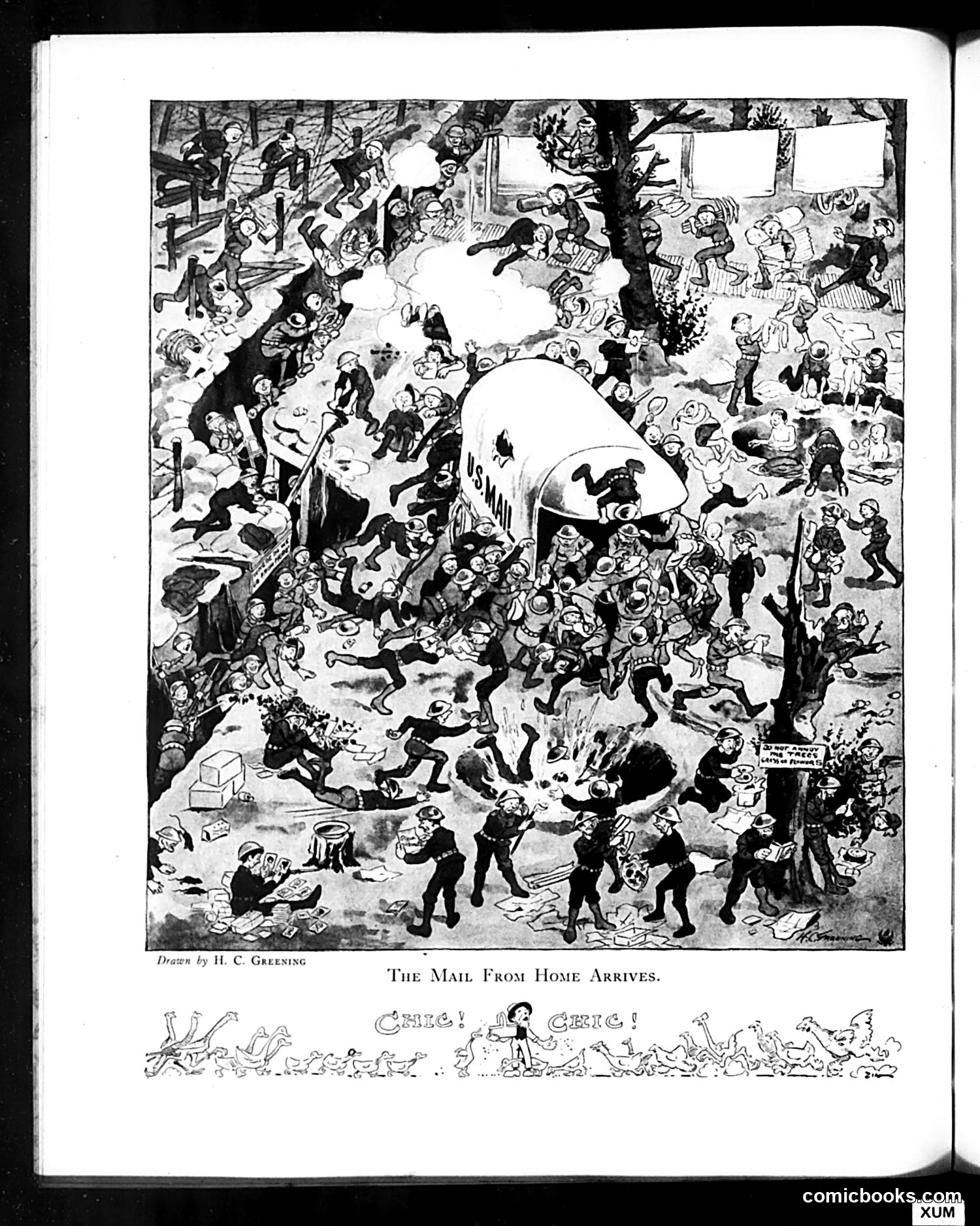
This cartoon by H.C. Greening depicts chaotic pandemonium as mail delivery causes celebratory mayhem. The central image shows a large mail sack or delivery vehicle surrounded by dozens of figures in various states of excitement—some running, fighting, celebrating, or reaching upward. The scene appears to satirize the desperation or intense anticipation surrounding mail delivery, possibly referencing soldiers receiving correspondence from home during wartime (suggested by the caption's emphasis on "home"). The bottom contains what appears to be a decorative footer with text reading "Craze! Geig!" (meaning unclear from OCR). The overall tone mocks how eagerly and chaotically people competed for their letters—depicting mail delivery as a madcap, almost violent event rather than routine correspondence.
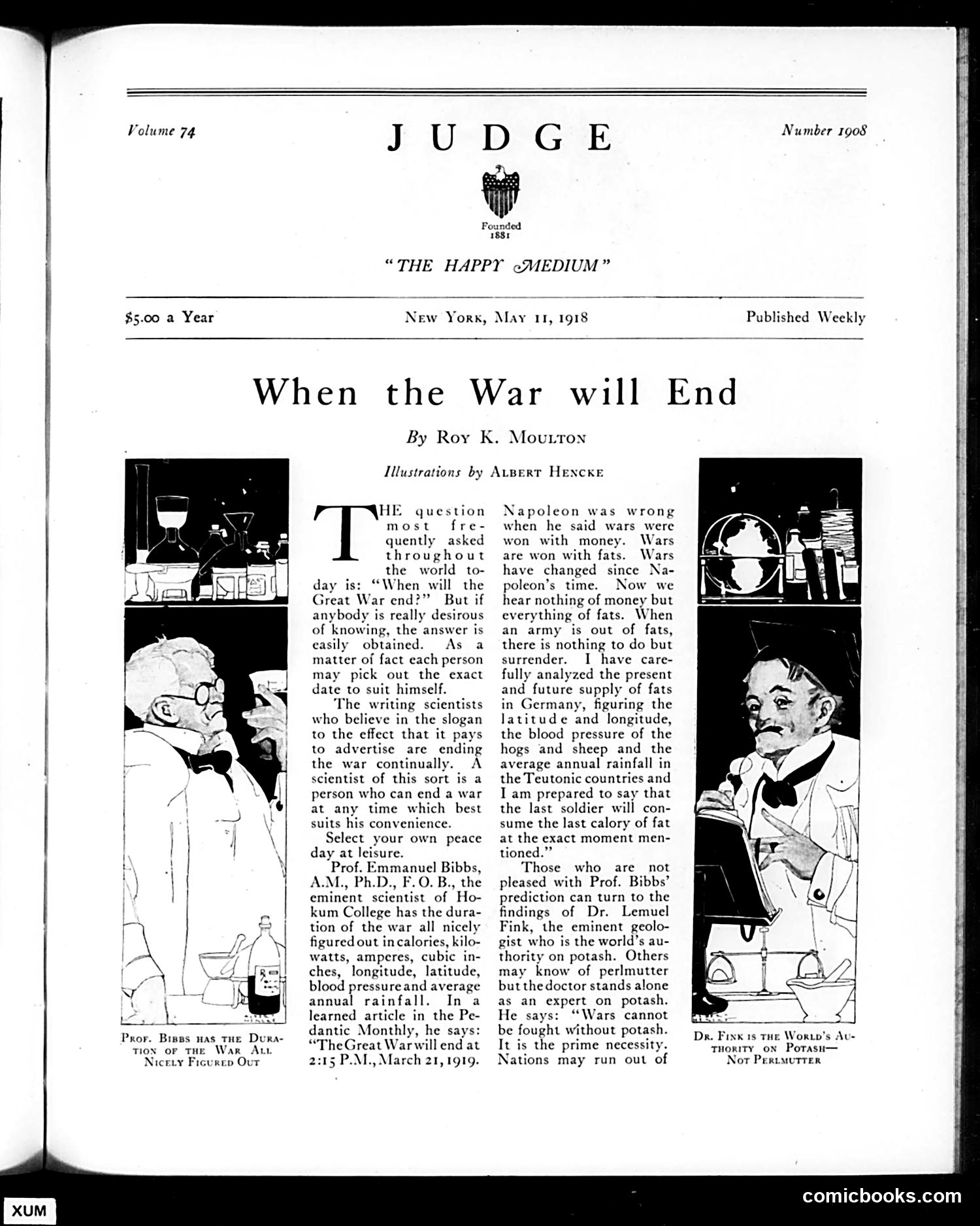
This satirical article by Roy K. Moulton, illustrated by Albert Hencke, mocks scientific predictions about when World War I will end. The piece critiques Prof. Emmanuel Bibbs, who claims to have calculated the exact war end-date (March 21, 1919) using mathematical analysis of fats, potash, and other resources. The cartoons show Bibbs as a befuddled academic making absurdly specific predictions based on obscure data like "blood pressure of hogs" and "average annual rainfall." Dr. Lemuel Fink counters that potash—not complex calculations—determines war duration. The satire ridicules wartime pseudo-scientific "certainty" about unknowable outcomes. Published while WWI raged, it captures public frustration with experts claiming to predict an unpredictable conflict.
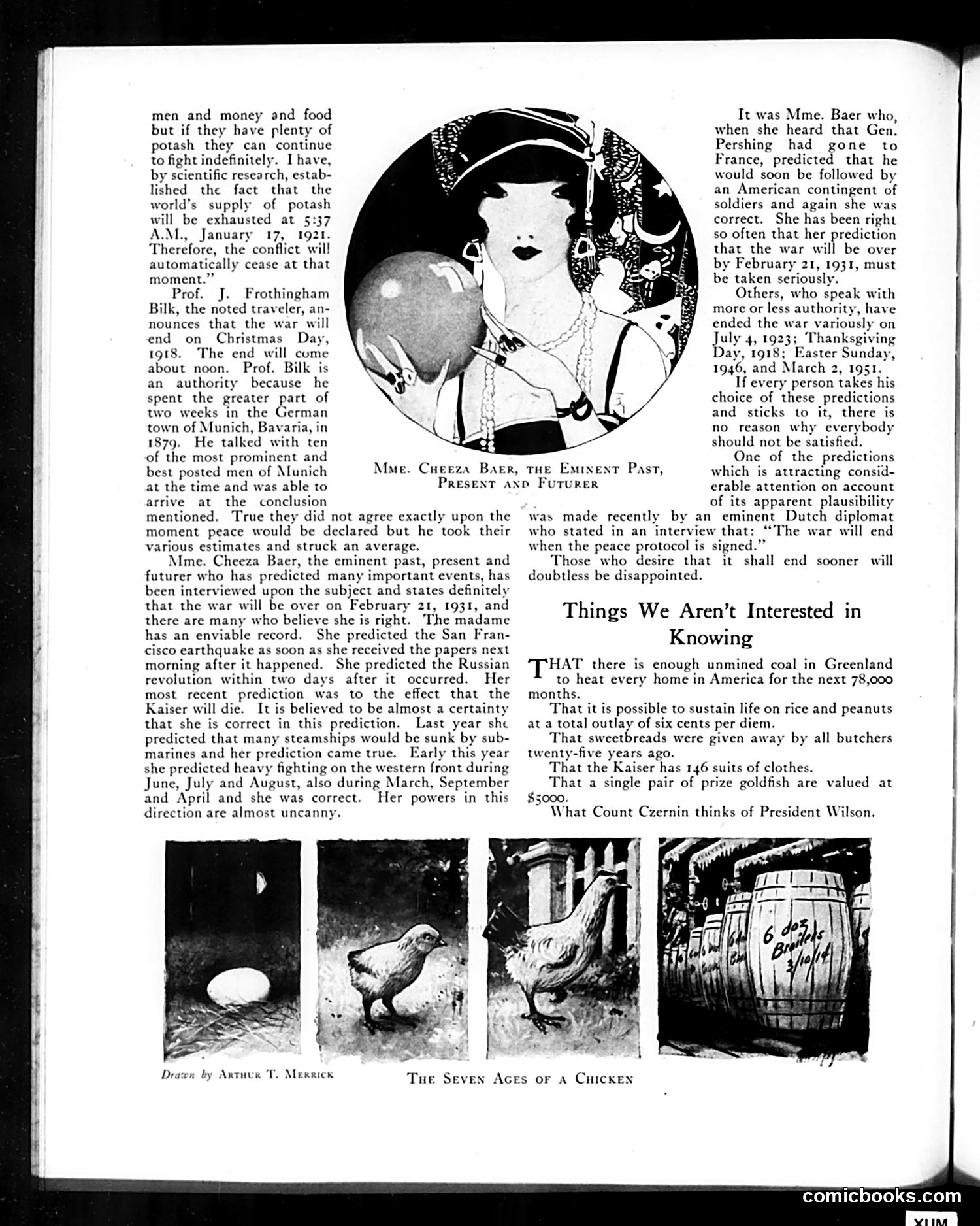
**Main Content:** This page features **Mme. Cheeza Baer**, a famous fortune teller of the era, whose predictions about WWI's end date are discussed. The article notes she predicted the war would end by February 21, 1931, and credits her with accurately forecasting the Russian Revolution and submarine warfare. **The Satire:** The text humorously undermines her credibility by listing her failed predictions (various dates from 1918-1951), suggesting her "gift" is unreliable despite occasional accuracy. The heading "Things We Aren't Interested in Knowing" mockingly introduces trivial facts. **Lower Section:** "The Seven Ages of a Chicken" by Arthur T. Merrick presents a humorous visual progression of a chicken's life stages, likely satirizing pretentious philosophical frameworks. The overall tone is lighthearted social commentary on superstition and popular culture.
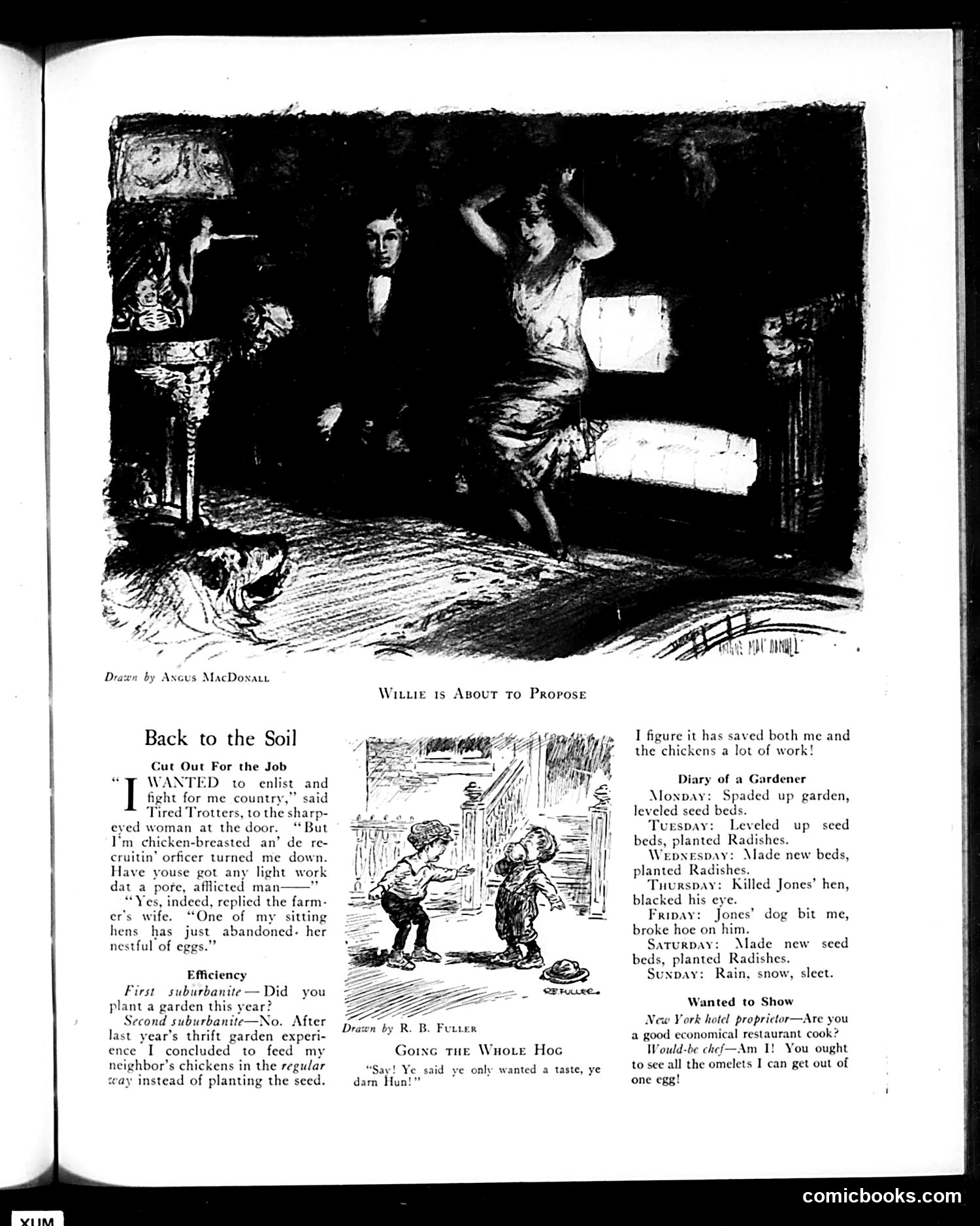
This page contains WWI-era humor satirizing the "Back to the Soil" movement—a patriotic campaign encouraging Americans to increase agricultural production while men fought in the war. **"Cut Out for the Job"**: A rejected military recruit offers himself as a farmhand, only to be assigned to sit on abandoned eggs. The joke mocks both his unfitness and the desperation of wartime labor shortages. **"Efficiency"**: A suburbanite explains he abandoned gardening to feed his neighbor's chickens instead, claiming this "saved work." The satire targets naive urban dwellers whose thrift-garden experiments failed—they'd produce more by simply letting chickens eat the seed. **"Going the Whole Hog"**: A pig complains the farmer promised only "a taste," not full consumption—dark humor about resource allocation during wartime rationing. **"Diary of a Gardener"**: Lists mundane garden tasks ending with accidental violence (killing the neighbor's hen, broken tools), satirizing the chaotic reality versus romantic ideals of rural life. All target the gap between patriotic agricultural propaganda and messy practical reality.
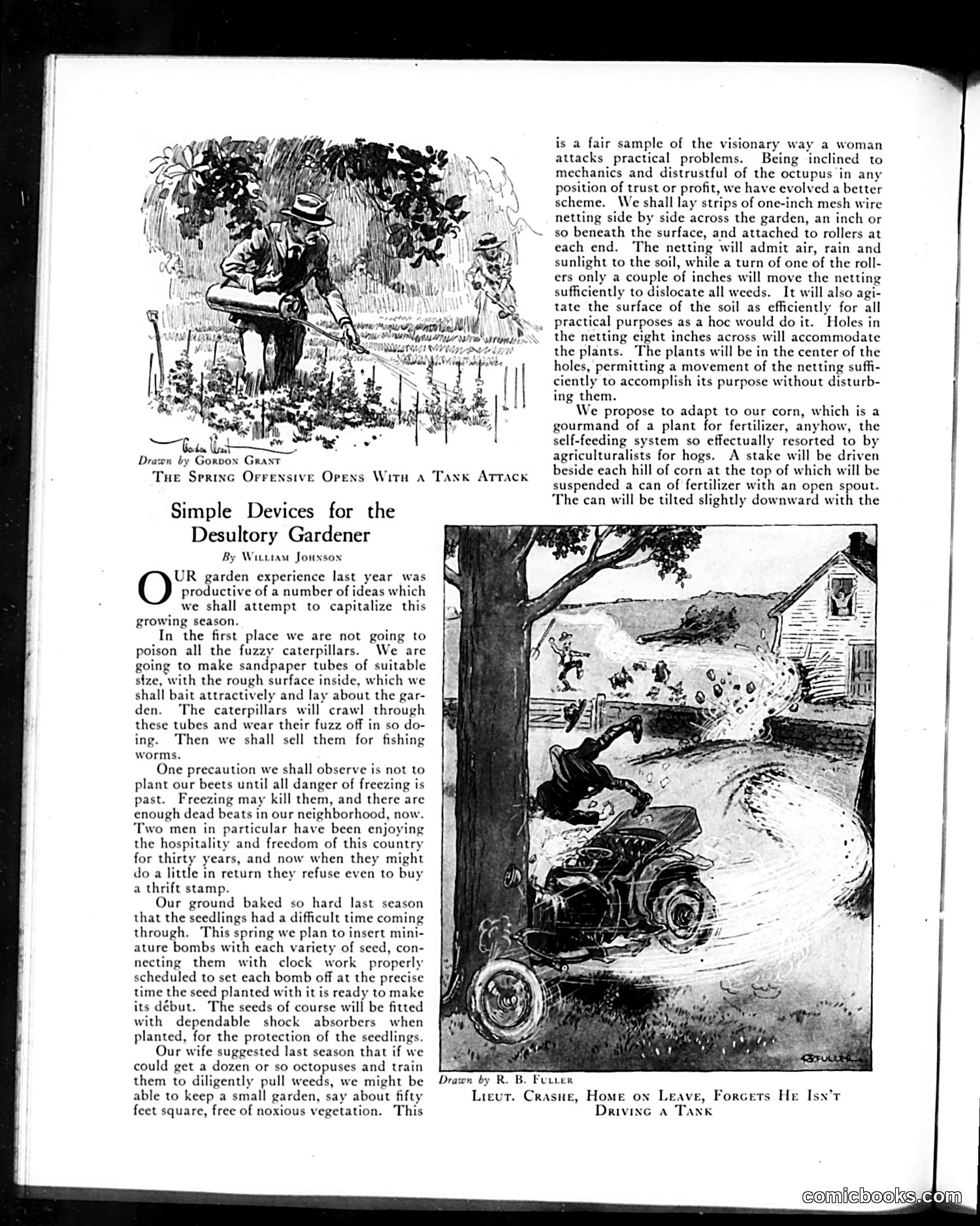
This page contains two separate pieces of WWI-era satire: **"The Spring Offensive Opens With a Tank Attack"** (top illustration by Gordon Grant): References the actual tank warfare beginning on the Western Front. The cartoon depicts soldiers operating an early tank in combat—a topical reference to new military technology dramatically changing warfare in 1917-1918. **"Simple Devices for the Desultory Gardener"** (main article by William Johnson): Humorous pseudo-serious gardening advice that's actually satirizing American wartime shortages and economic conditions. The author proposes absurd solutions (miniature bombs to help seeds germinate, octopuses pulling weeds) while making sarcastic digs at "dead beats" refusing to buy thrift stamps and freeloaders exploiting American hospitality during wartime. **"Lieut. Crashe, Home on Leave, Forgets He Isn't Driving a Tank"** (bottom illustration by R.B. Fuller): Shows a soldier on leave recklessly driving a car like a military tank—satirizing how WWI combat experiences have affected soldiers' civilian behavior. The page collectively mocks both wartime military life and home-front attitudes during America's involvement in World War I.
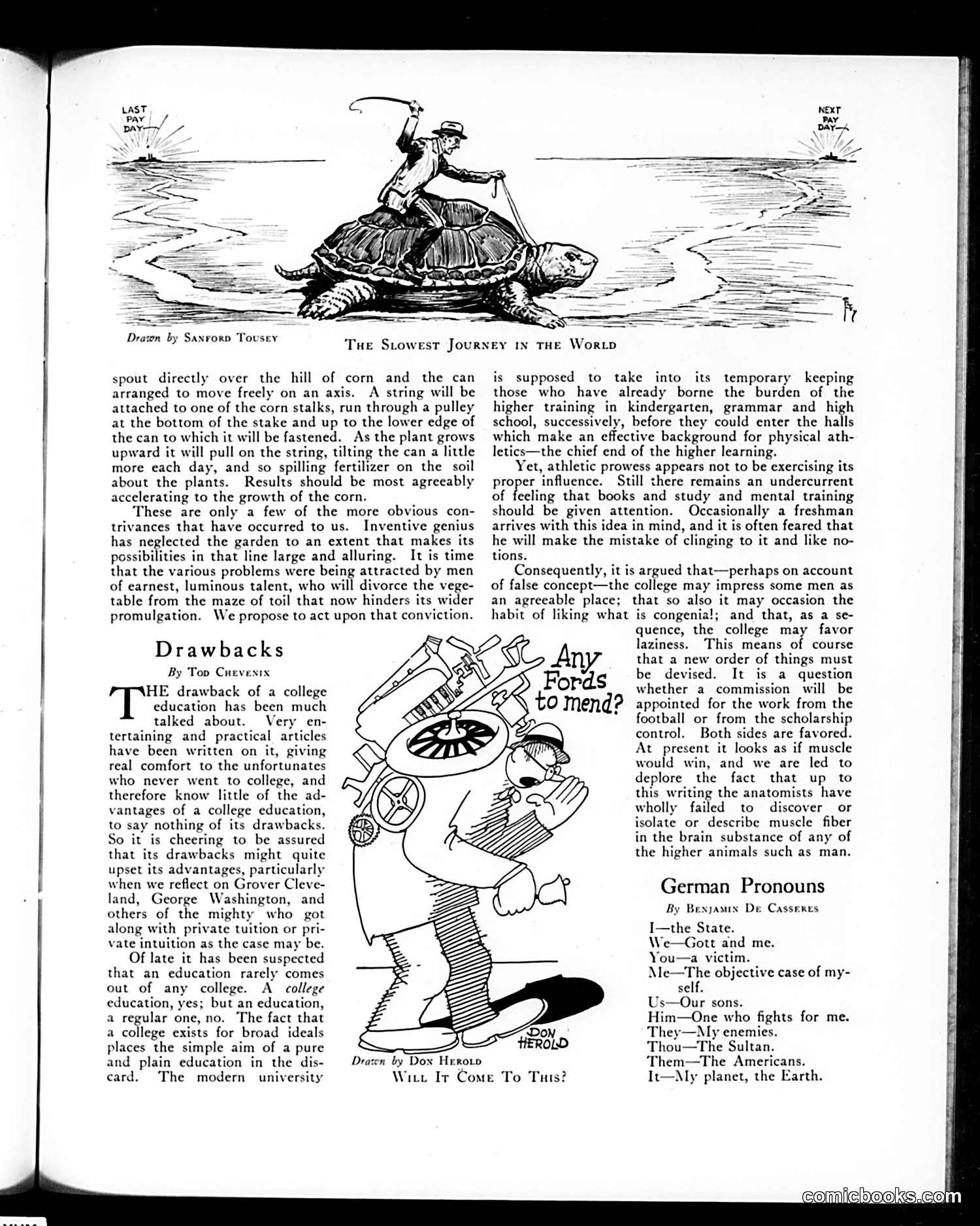
**Top Cartoon ("The Slowest Journey in the World"):** A satirical drawing by Sanford Tousey depicts a man riding a giant turtle, titled ironically given the turtle's reputation for slowness. This appears to be visual humor about impractical or absurdly slow transportation—likely mocking either an invention, technology, or lifestyle choice contemporary to the publication. **"Drawbacks" Essay:** By Top Chevenis, this critiques American college education. The author argues colleges have abandoned genuine education for "broad ideals" and athletic training, suggesting higher learning prioritizes sports over intellectual development. The piece notes that some students arrive wanting actual study but risk being discouraged by institutional emphasis on athletics rather than academics. **"Will It Come To This?" Cartoon:** A mechanical/robotic figure by Dos Herold, likely satirizing industrial automation or technological over-reliance, though the specific reference is unclear without additional context. **"German Pronouns":** Benjamin De Casseres's humorous redefinition of pronouns reflects post-WWI American attitudes toward Germany, characterizing German leadership and identity in darkly satirical terms.
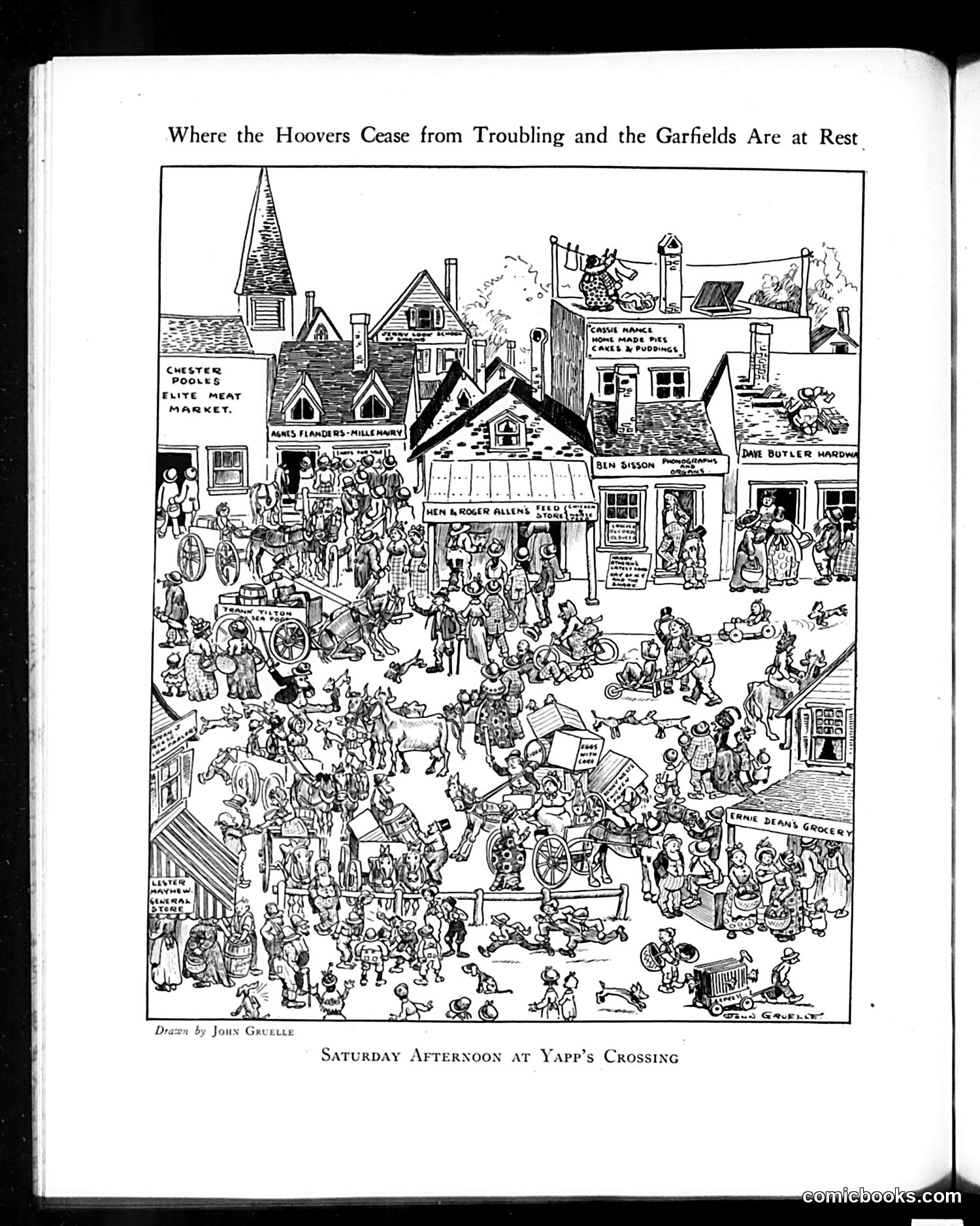
This illustration satirizes small-town American life, depicting a crowded public square on a Saturday afternoon. The title's reference to "Hoovers" and "Garfields" likely alludes to prominent families or local figures (possibly named Hoover and Garfield, or evoking those surnames' associations). The busy street scene shows numerous townspeople, children, bicycles, wagons, and dogs gathered around various storefronts including Chester Pools, a meat market, and other local businesses. The satire appears to mock the chaos, social disorder, and noise of small-town public life—presenting it as a place where prominent citizens can't find peace or rest, hence the ironic biblical-sounding title. The crowded, anarchic composition emphasizes the relentless activity and commotion of everyday community life.
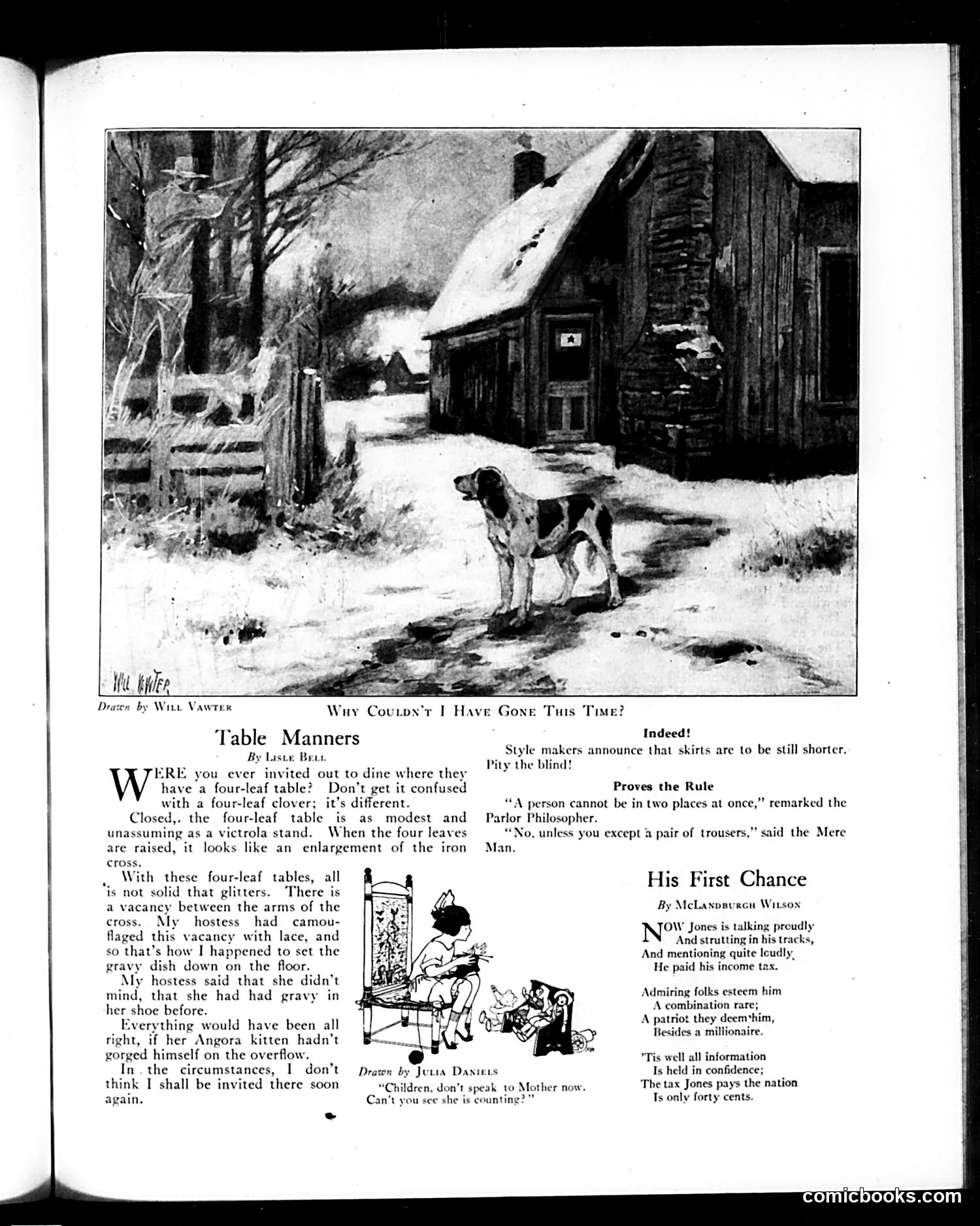
**"Why Couldn't I Have Gone This Time?"** (top cartoon by Will Vawter): A dog stands in a snowy farmyard, apparently left behind while others went out. The title suggests the dog's frustrated perspective on being excluded from an outing—a humorous anthropomorphization playing on pets' feelings of abandonment. **"Table Manners"** (Lisle Bell): A satirical essay about the social embarrassment of dining etiquette. The author describes a "four-leaf table" with hidden gaps disguised by lace. When he places a gravy dish in one of these gaps, it falls to the floor. His hostess claims she's experienced this before (even had gravy in her shoe), but the author assumes he won't be invited back—mocking both pretentious furniture design and forced politeness about social mishaps. **"His First Chance"** (McLandburgh Wilson): Political satire on income tax evasion or avoidance. Jones brags loudly about paying taxes, earning admiration as a "patriot" and "millionaire." The punchline reveals his actual payment is only forty cents—exposing the gap between public patriotic performance and actual financial contribution.
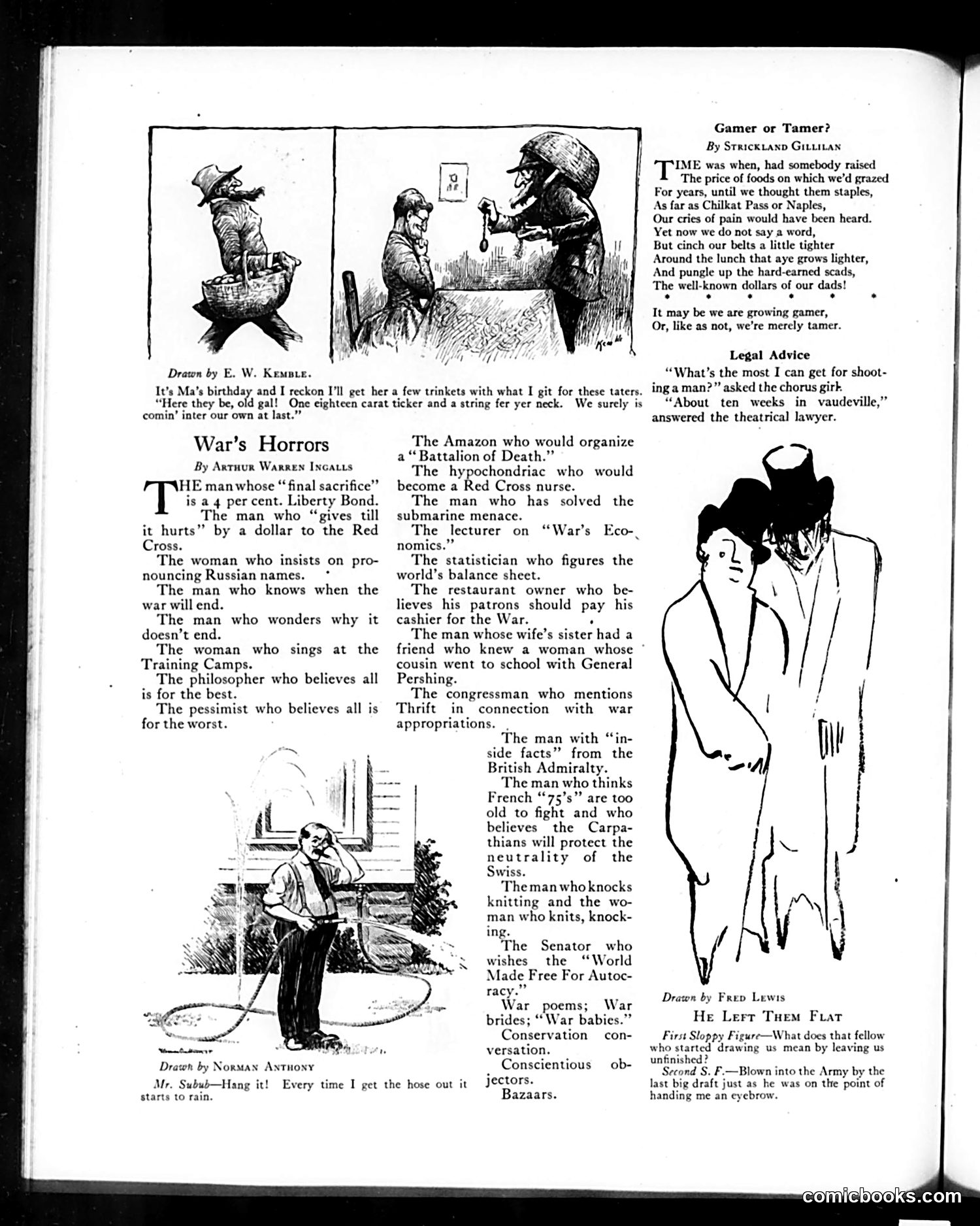
This page satirizes American responses to World War I (likely 1917-1918). **"War's Horrors"** by Arthur Warren Ingalls is a caustic list mocking various types of people and their superficial or hypocritical war efforts: those who make minimal financial sacrifices (4% Liberty Bonds, dollar Red Cross donations), armchair strategists claiming to know when the war will end, women adopting Russian names to seem sophisticated, and people profiting from war talk. It includes jabs at pacifists ("conscientious objectors") and those with tenuous connections to military leadership (the woman whose cousin knew someone who attended school with General Pershing). **"Gamer or Tamer?"** questions whether Americans are becoming brave or merely accepting wartime inflation and food rationing without protest. The cartoons and brief jokes reflect Judge's satirical stance: mocking home-front pretense, war profiteering, and the gap between grand patriotic rhetoric and actual sacrifice. The context assumes readers recognized contemporary war debates and social posturing around the conflict.
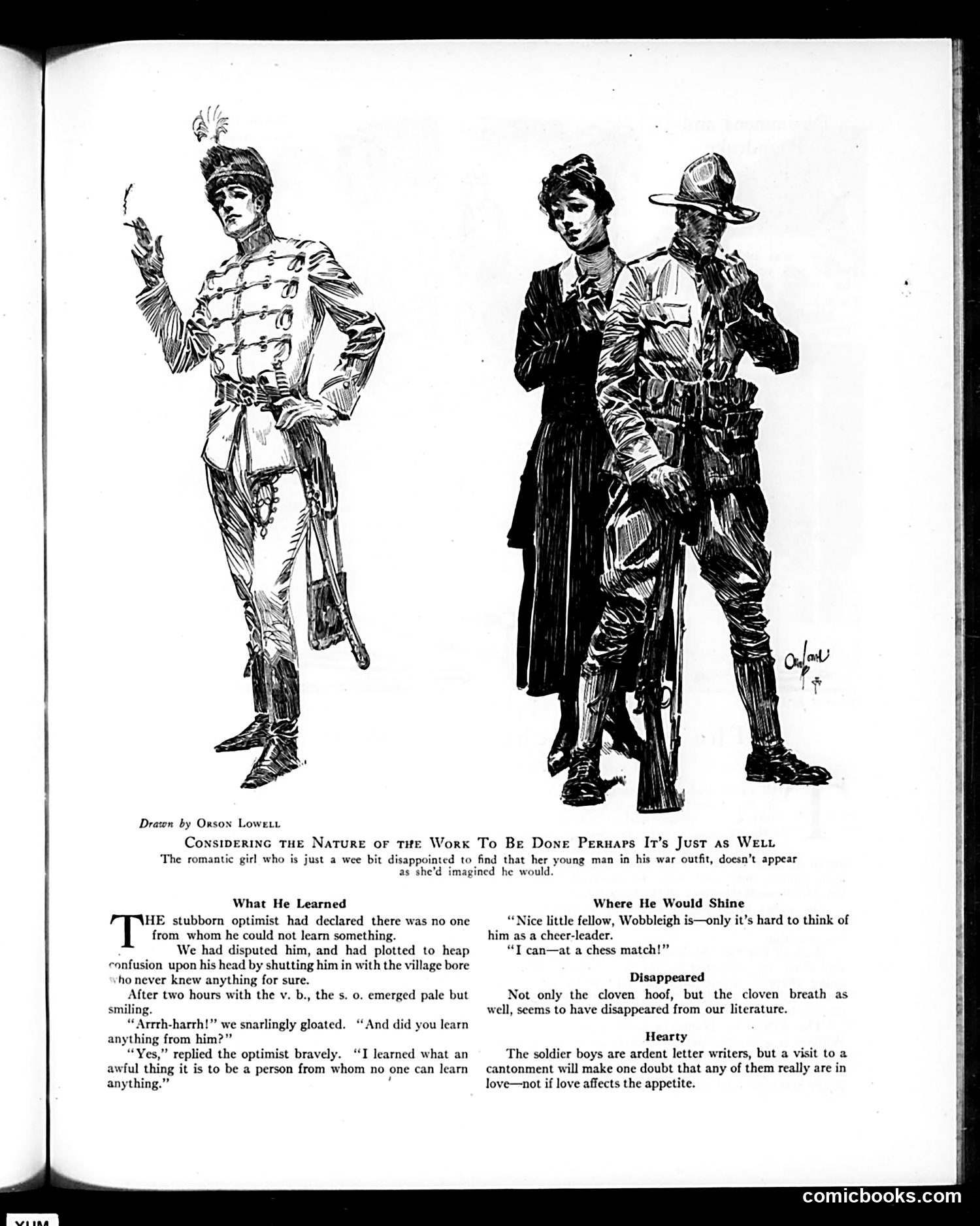
This page contains **three separate humorous sketches** from WWI-era America, drawn by Orson Lowell: 1. **Top illustration**: Shows a young woman disappointed that her soldier boyfriend in uniform doesn't match her romantic imagination—satirizing the gap between wartime idealization and reality. 2. **"What He Learned"**: Mocks an overly optimistic man who claims he can learn from anyone. When locked with a village bore, he learns only that some people are hopeless—a joke about false optimism and the existence of truly ignorant people. 3. **"Where He Would Shine"** and **"Disappeared"**: Brief, punchy jokes about a socially awkward man (Wobbleigh) who'd excel at chess, and commentary that "devilish" characters have vanished from literature. 4. **"Hearty"**: Observes that soldier boys write love letters enthusiastically but eat heartily at camps—implying their appetite for food exceeds their romantic devotion, a light jab at young soldiers' priorities. The page reflects **typical Judge magazine humor**: domestic observations, character studies, and gentle satire about wartime life and human nature.
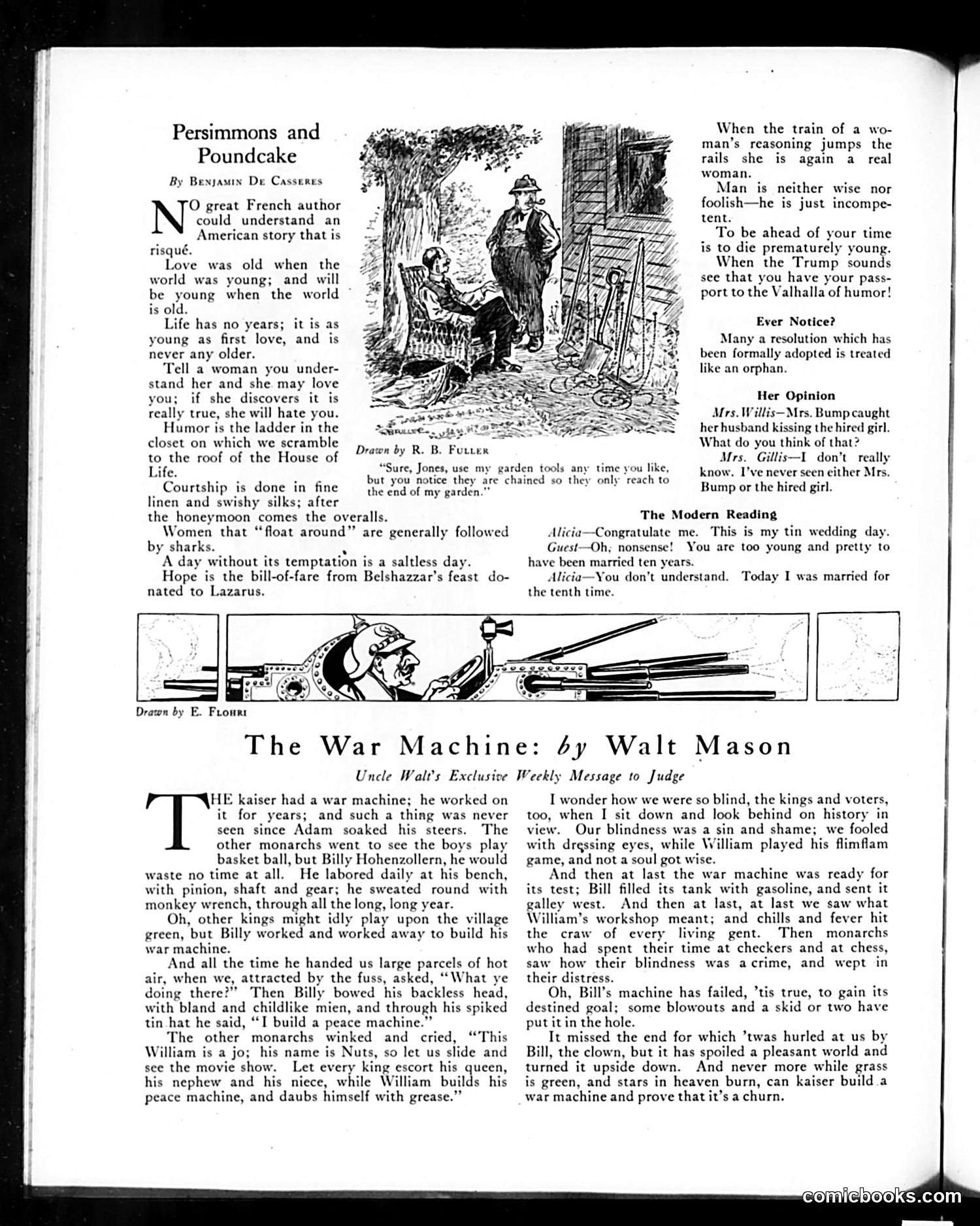
This page contains satirical commentary on early 20th-century themes, likely from WWI era: **"The War Machine" by Walt Mason** (main feature) appears to be an allegory about Kaiser Wilhelm II of Germany. The poem describes how Wilhelm secretly built a "war machine" while other European monarchs dismissed him, claiming it was a "peace machine." The narrative criticizes the blindness of world leaders and voters who didn't recognize Germany's military buildup as a threat. When the machine finally "tested," it caused devastation ("chills and fever hit the craw of every living gent"). The ending—that the machine "has failed"—suggests this was written after Germany's defeat in WWI, offering retrospective commentary on how obvious the danger should have been. **Other content** includes witty aphorisms by Benjamin De Casseres mocking relationships and human nature, plus brief humorous anecdotes about marriages and social observations—typical of Judge's satirical humor aimed at American middle-class readers. The overall tone is one of moral superiority: "We told you so."
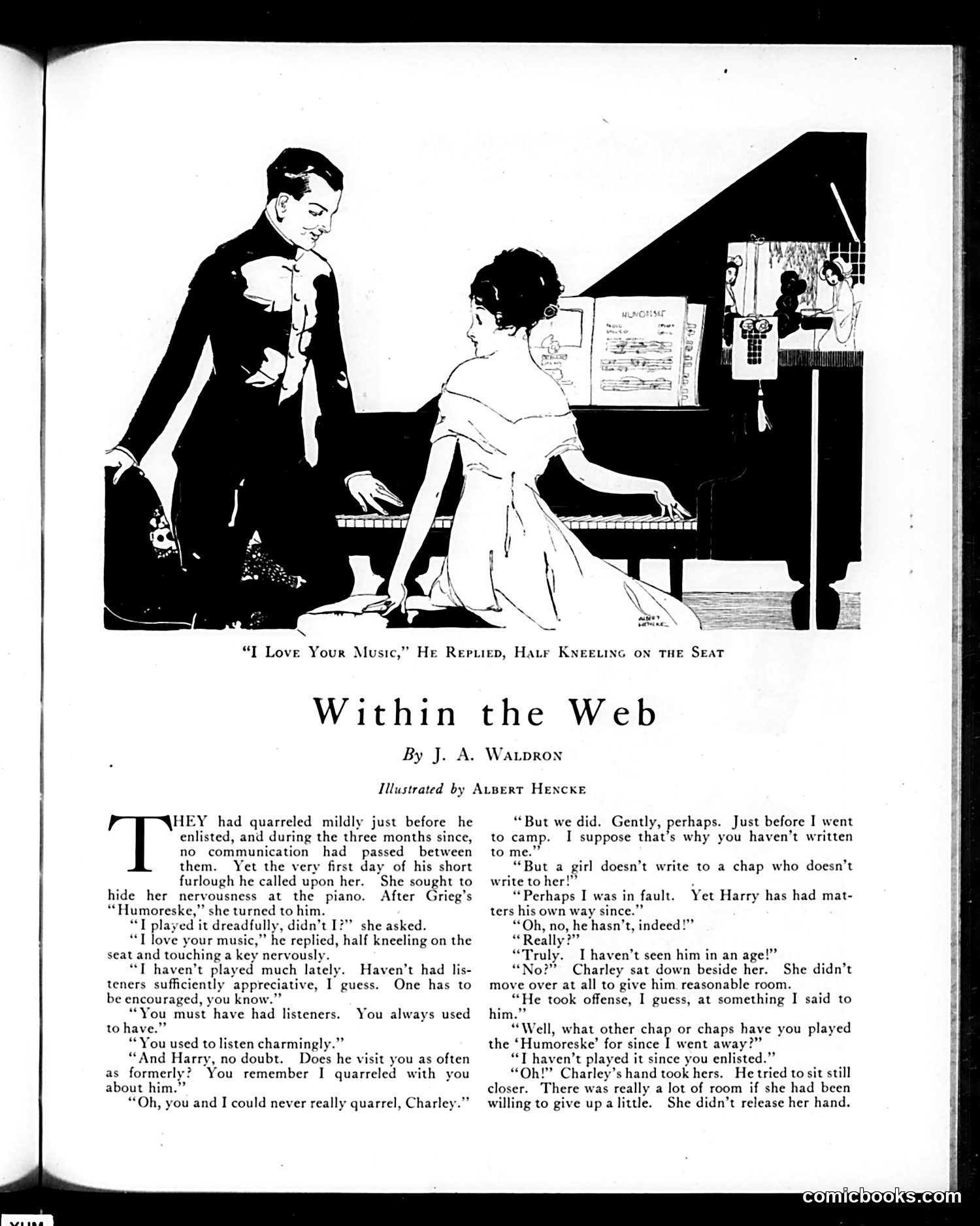
This is a romantic short story illustration, not political satire. It depicts a reconciliation between two estranged lovers: Charley (a soldier on furlough) and an unnamed woman. The narrative shows Charley visiting the woman after three months of silence following their pre-enlistment quarrel. Through dialogue at the piano, they work through misunderstandings—she didn't write because he didn't; a rival named Harry was never actually a threat. The "web" of the title refers to the emotional entanglement keeping them apart, now being unwoven through music and confession. The illustration captures the intimate moment when Charley half-kneels on the piano bench, declaring his love for her music (and implicitly, for her). This appears to be a sentimental wartime romance story typical of Judge magazine's lighter content, rather than social or political commentary.
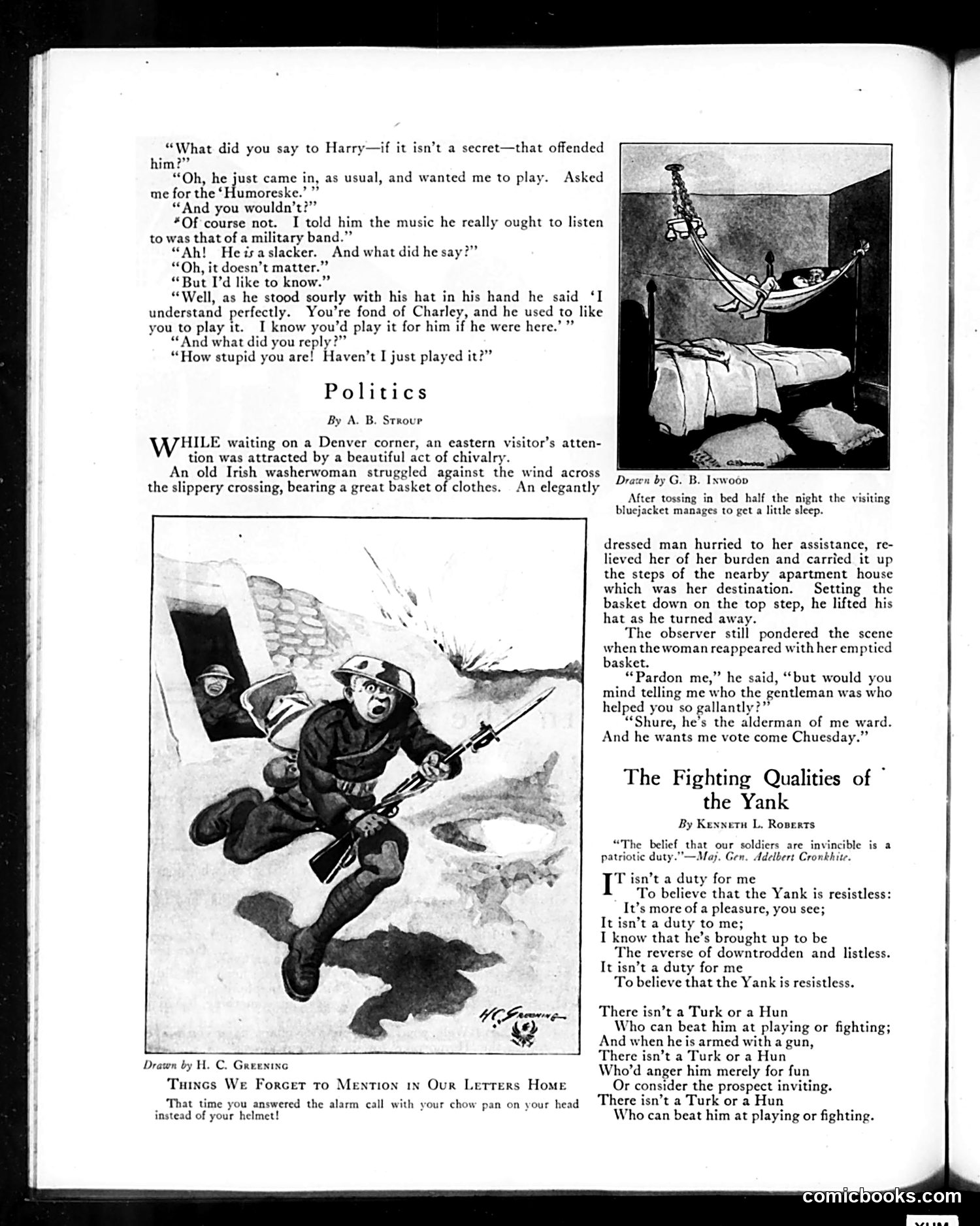
This page contains three distinct pieces from Judge magazine (likely WWI-era, given references to "Turks" and "Huns"): **"Politics"** (top): A satirical anecdote about machine politics. An elegantly dressed alderman helps an Irish washerwoman carry her laundry—a performative act of chivalry designed to secure her vote in the upcoming election ("Chuesday"). The joke mocks how politicians use visible charity to manipulate working-class voters, reducing democracy to transactional favors. **Military cartoons** (middle/right): Two illustrations depicting soldiers' experiences—one forgetting proper military protocol, another a sailor struggling to sleep. These appear to be humorous observations of military life rather than political satire. **"The Fighting Qualities of the Yank"** (bottom): A patriotic poem insisting American soldiers are unbeatable against foreign enemies ("Turk or Hun"). The text quotes a general claiming belief in soldiers' invincibility is a "patriotic duty"—the poem ironically agrees while questioning whether blind faith is actually necessary.
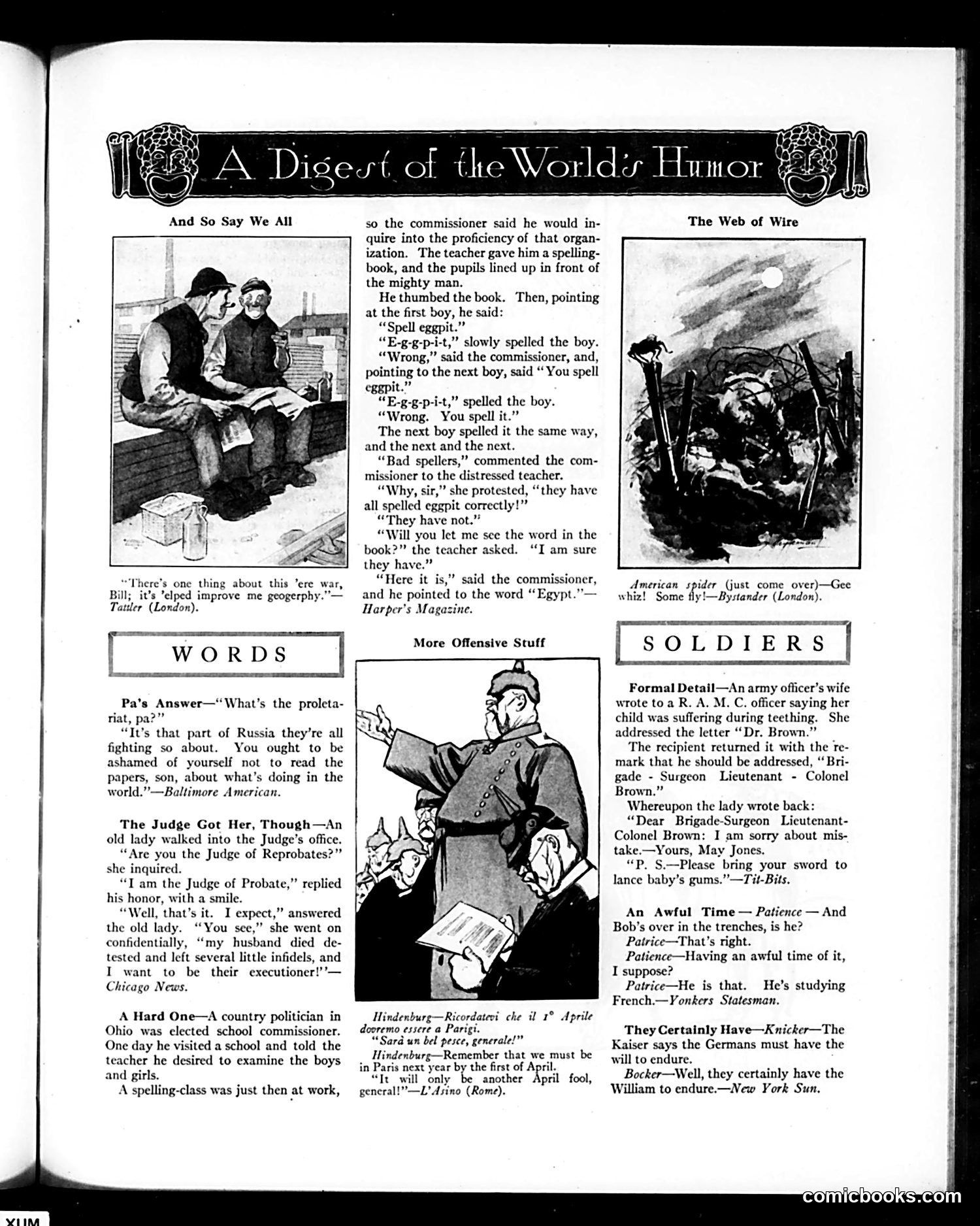
This page from *Judge* magazine contains several brief satirical pieces from WWI era: **"A Hard One"** mocks an incompetent Ohio school commissioner who humiliates himself by insisting students misspelled "Egypt" as "eggpit"—revealing his own illiteracy rather than theirs. **The Hindenburg cartoon** (Italian source) jokes darkly that German general Hindenburg's boast about reaching Paris by April 1st will make him "an April fool." **"Soldiers" section** includes British and American military humor: an officer's wife comically over-addresses a letter with excessive military titles; a joke about a soldier studying French in trenches; and a pun on "Kaiser/will" regarding German endurance. **"More Offensive Stuff"** contains wordplay about proletariat and a judge's office mix-up. The page reflects typical WWI-era magazine humor—slapstick, puns, and gentle mockery of military bureaucracy and incompetence.
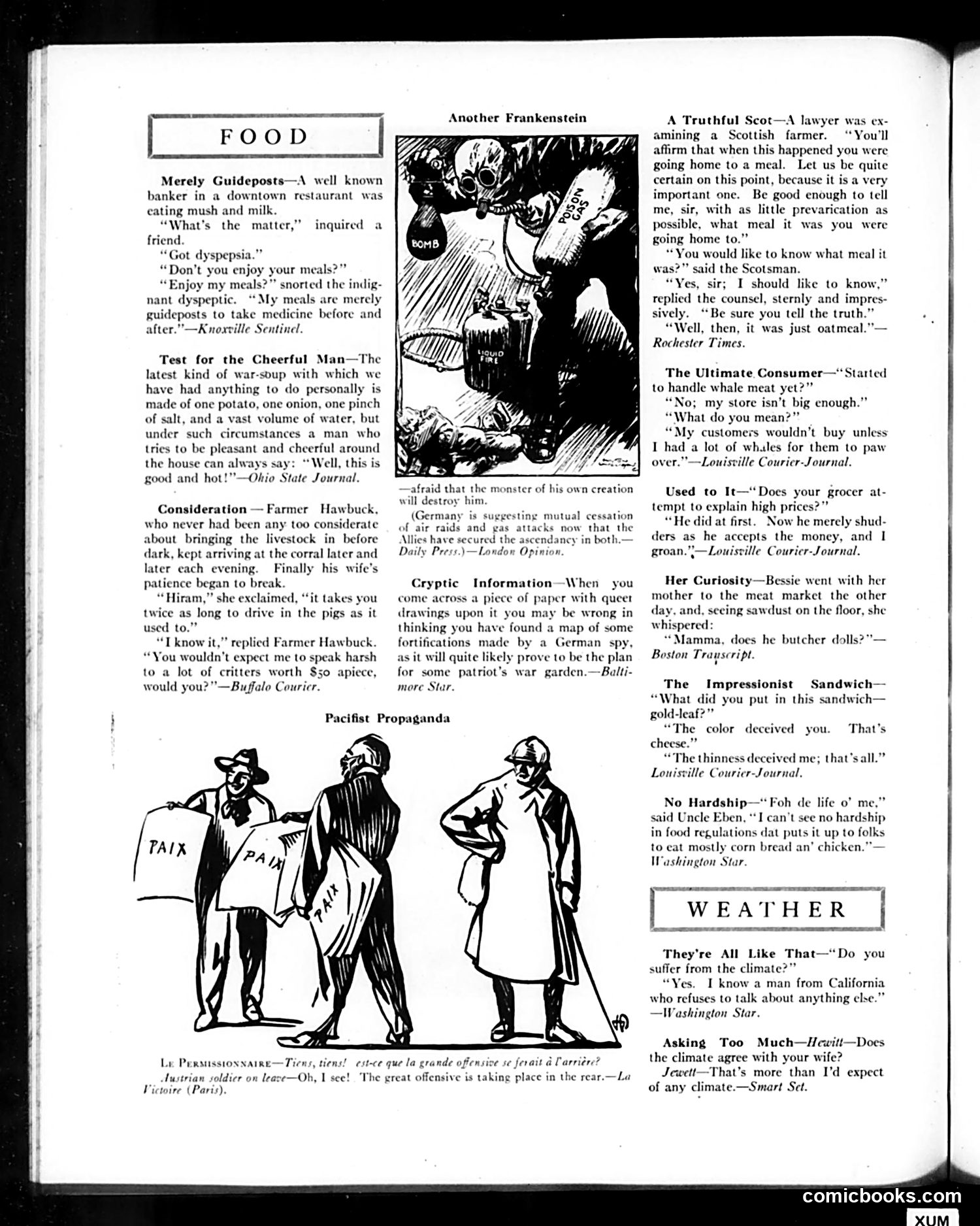
This page contains WWI-era satirical content. The central cartoon, "Pacifist Propaganda," depicts three figures labeled "PAIX" (French for "peace"). An Austrian soldier observes that "the great offensive is taking place in the rear"—satirizing peace advocates as cowards shirking from actual combat. The adjacent cartoon, "Another Frankenstein," shows Germany as a monster destroying itself, referencing Germany's own creation. The caption notes Germany is now suggesting mutual cessation of air raids and gas attacks, implying they do so only from weakness, not principle. The page's humor sections mock food rationing and scarcity during wartime: jokes about dyspepsia, war-soup, whale meat shortages, and thin sandwiches. These reflect genuine WWI hardships. Throughout, Judge employs biting satire against pacifists, Germans, and food profiteering while laughing at civilians' adaptation to wartime deprivation.
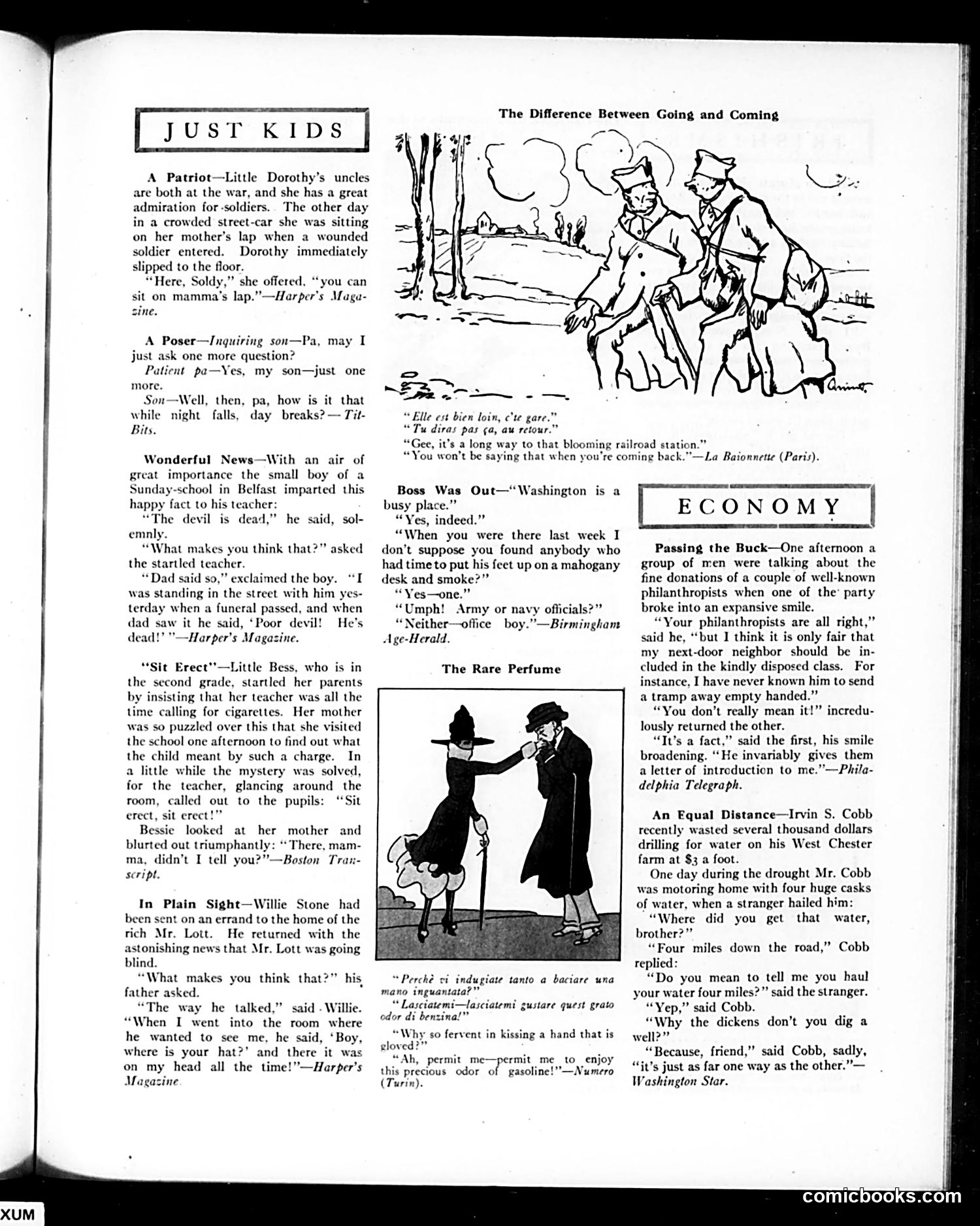
This page from Judge contains humor anecdotes and cartoons typical of early 20th-century American satire. The main content includes: **"Just Kids" section**: Short humorous stories about children, including one where a girl offers her seat to a wounded soldier (WWI-era patriotism), another about a child mishearing "sit erect" as "cigarettes," and wordplay jokes. **"The Difference Between Going and Coming" cartoon**: Shows soldiers departing versus returning from war, with the caption implying soldiers won't complain about distance when coming *home*—commentary on wartime sacrifice and homecoming. **"Economy" section**: Satirical anecdotes mocking philanthropy and wealthy figures. One story jokes that a neighbor "gives" tramps letters of introduction to the narrator—passing responsibility rather than genuine help. Another features humorist Irvin S. Cobb drilling unsuccessfully for water. **"The Rare Perfume" cartoon**: A flirtatious scene about kissing a gloved hand, with the twist being attraction to gasoline smell—likely satirizing newfound automobile culture. The humor relies on wordplay, irony, and social observation typical of Judge's satirical approach.
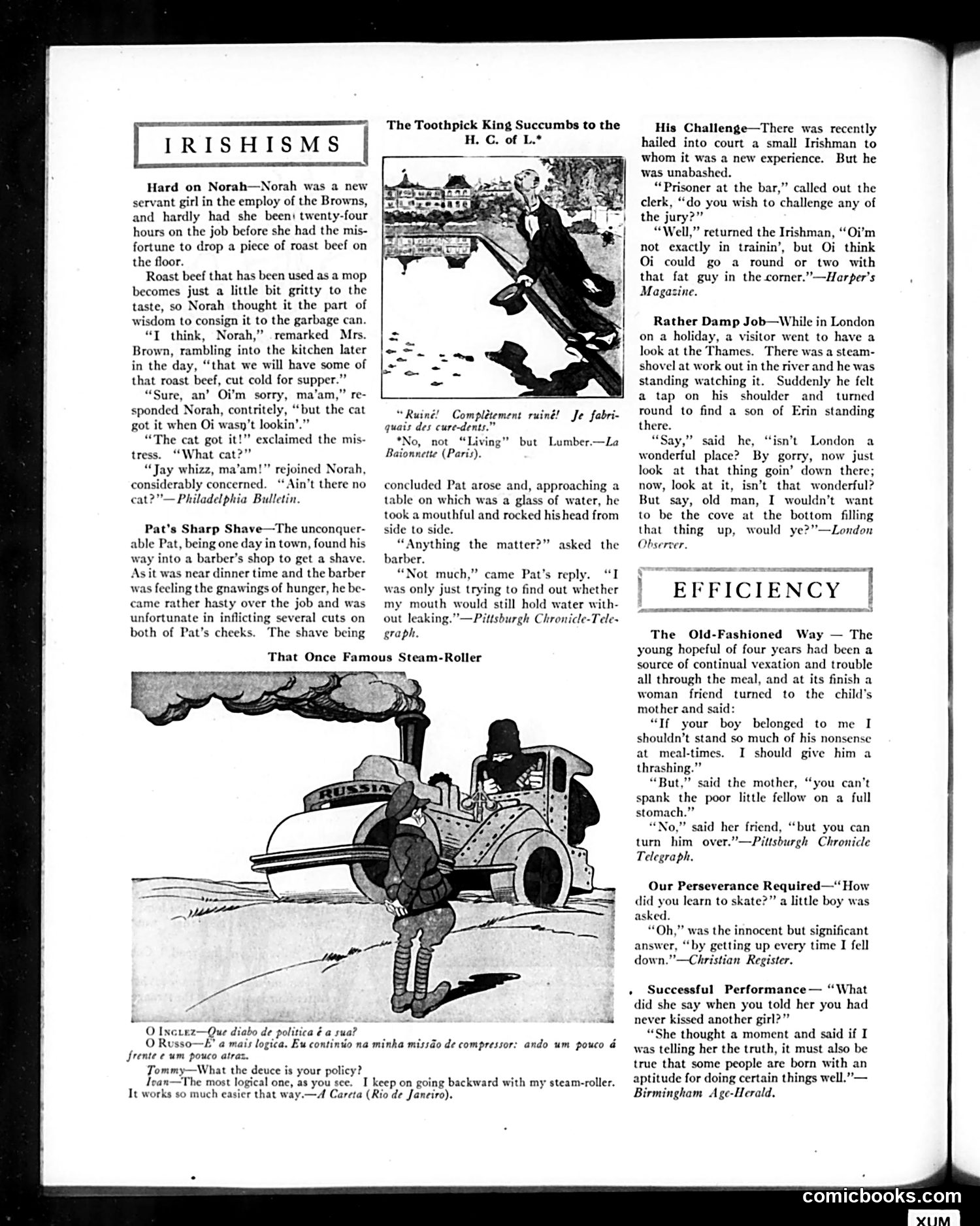
This page from Judge contains several brief humorous anecdotes stereotyping Irish immigrants, organized under "IRISHISMS." The jokes exploit Irish-American dialect and supposed Irish character traits popular in early 20th-century American humor. **Main content:** - "Hard on Norah" mocks an Irish servant girl's logic (blaming a non-existent cat for missing roast beef) - "Pat's Sharp Shave" plays on an Irishman using water to test if his mouth still holds water after a barber's cuts - "His Challenge" depicts an Irish courtroom figure offering to fight a juror - "Rather Damp Job" features an Irishman commenting on Thames dredging work The cartoons and brief anecdotes in the "EFFICIENCY" section are unrelated. This page reflects period attitudes treating Irish immigrants as comedic subjects through dialect humor and ethnic stereotyping—now recognized as offensive.
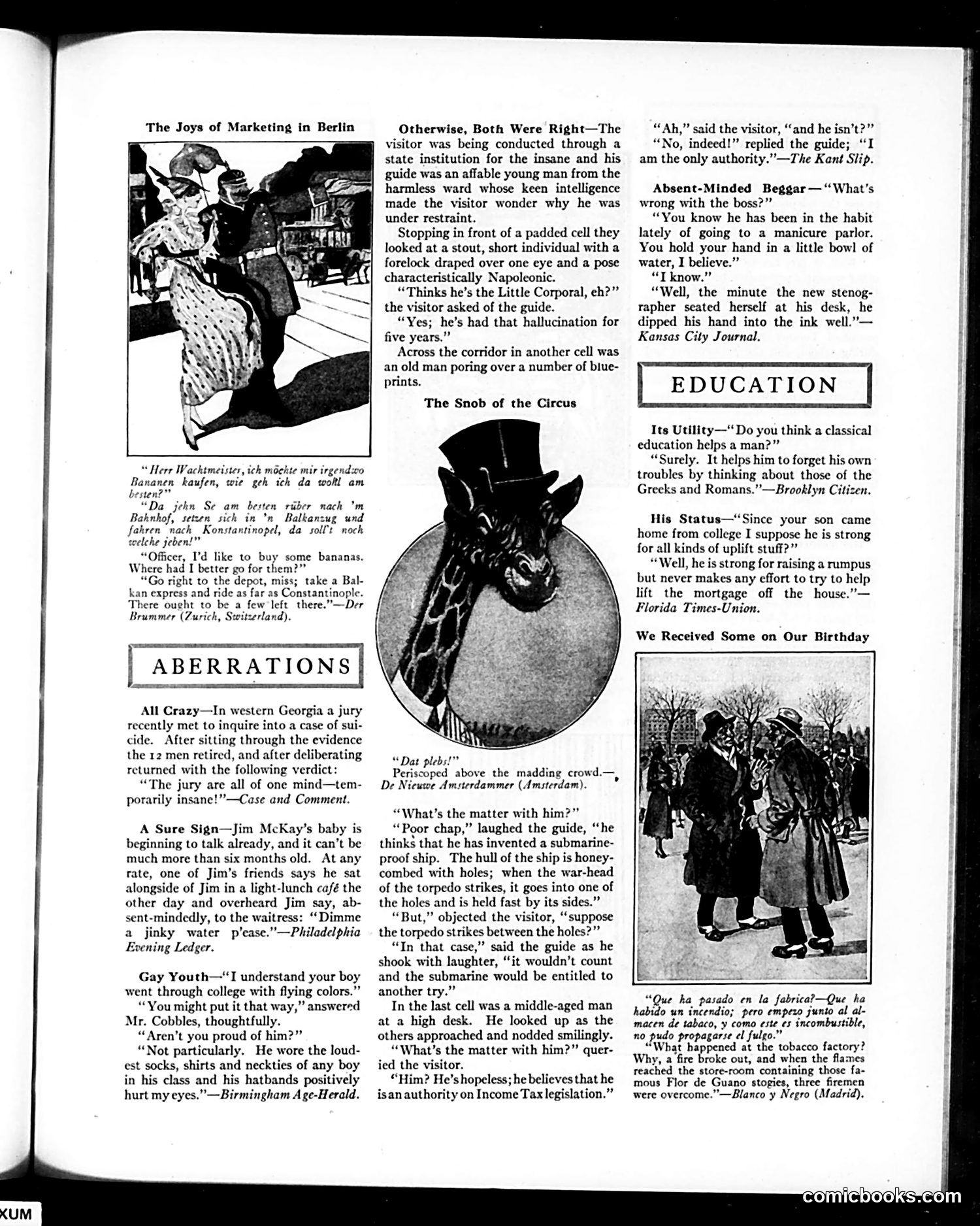
This page contains several satirical humor pieces mocking contemporary absurdities: **"The Joys of Marketing in Berlin"** depicts post-WWI economic chaos—a woman asking where to buy bananas is told to travel to Constantinople because they're so scarce in Berlin, reflecting severe food shortages in defeated Germany. **"The Snob of the Circus"** shows a giraffe's elevated posture captioned in Dutch, satirizing pretentiousness. **"Aberrations"** collects brief jokes about human folly: a jury declaring themselves "temporarily insane," a baby mimicking his father's diction, and a father embarrassed by his son's loud college fashion choices. **The asylum section** satirizes institutional logic—patients with delusions (Napoleon obsession, submarine invention) are deemed "crazy," while the tour guide ironically claims exclusive authority on Income Tax law, implying he's the truly delusional one. This critiques bureaucratic absurdity and taxation complexity. **"Absent-Minded Beggar"** humorously describes a boss confusing a manicure water bowl with his office inkwell after visiting a manicure parlor—poking fun at men unfamiliar with beauty services. The page reflects 1920s-era preoccupations: post-war hardship, tax frustration, and social anxieties.
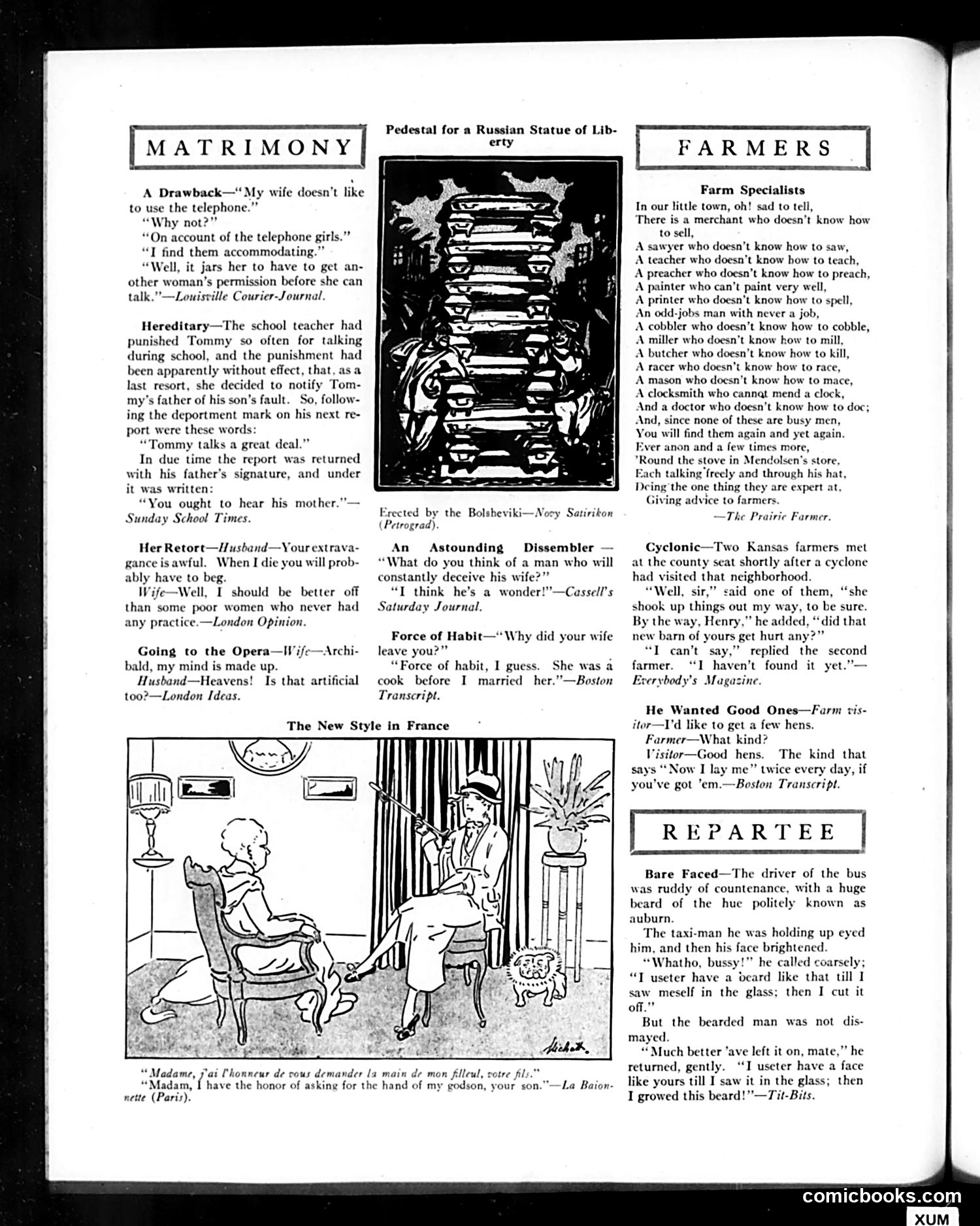
This page from Judge contains brief humorous anecdotes and one political cartoon, typical of early 20th-century American satirical magazines. **The main cartoon** depicts a Russian revolutionary monument—a crude, stacked pedestal credited to "the Bolsheviki" (Bolsheviks). The satire mocks the Soviet regime's artistic and architectural output as primitive and poorly constructed, reflecting Western anti-communist sentiment during the Russian Revolution era. **The text items** are lighthearted domestic and social jokes: wives objecting to telephone operators' presence in calls; children inheriting talkative habits from parents; women's spending habits; and rural/farmer humor about incompetent professionals who gather to dispense unwanted advice despite their own failures. The "Farm Specialists" poem satirizes rural communities where every tradesman is incompetent yet freely advises farmers—poking fun at small-town pretension and gossip culture. The British "Repartee" items showcase working-class wit about beards and appearances, typical of that publication's humor. Overall, the page reflects early 1900s attitudes toward technology (telephones), gender dynamics, Soviet Russia, and rural American society.
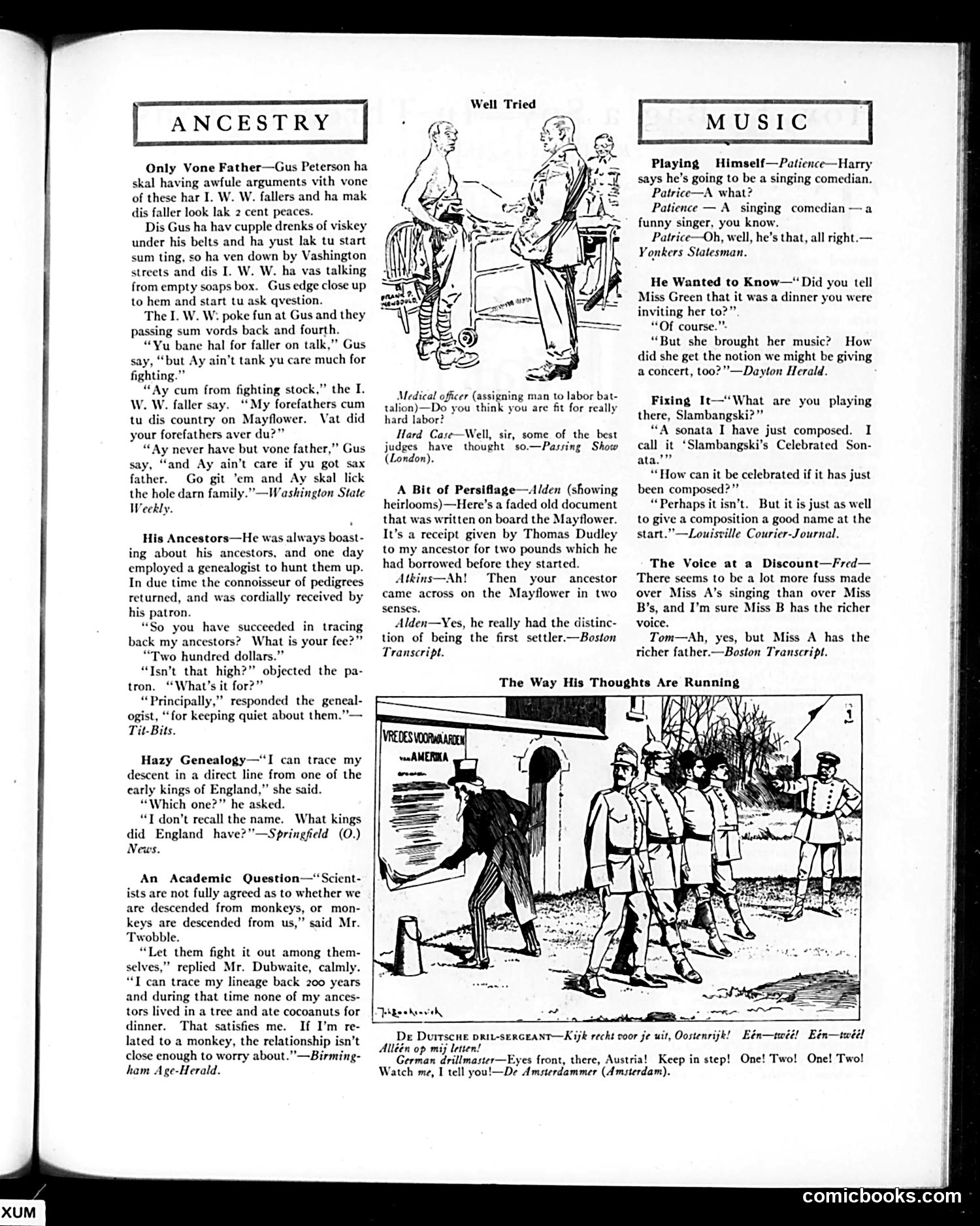
This page from Judge (a major American satirical weekly) contains three sections: **ANCESTRY** features ethnic humor typical of early-20th-century publications. A story in exaggerated Swedish dialect depicts working-class immigrant "Gus Peterson" debating an I.W.W. (Industrial Workers of the World—a radical labor union) organizer about ancestry. The joke mocks both the immigrant's broken English and the radical's boasts about Mayflower ancestry. Other ancestry anecdotes ridicule pretentious genealogy claims. **THE WAY HIS THOUGHTS ARE RUNNING** shows a cartoon of a drill sergeant barking orders at soldiers, with caption text in Dutch, mocking military incompetence or foreign military drill. **MUSIC** section contains brief jokes about aspiring singers and composers, satirizing pretension in entertainment and the economic advantages of having wealthy parents over talent. The humor reflects class anxieties, immigrant stereotypes, and skepticism toward both radical labor movements and social climbing—common Judge targets of this era.
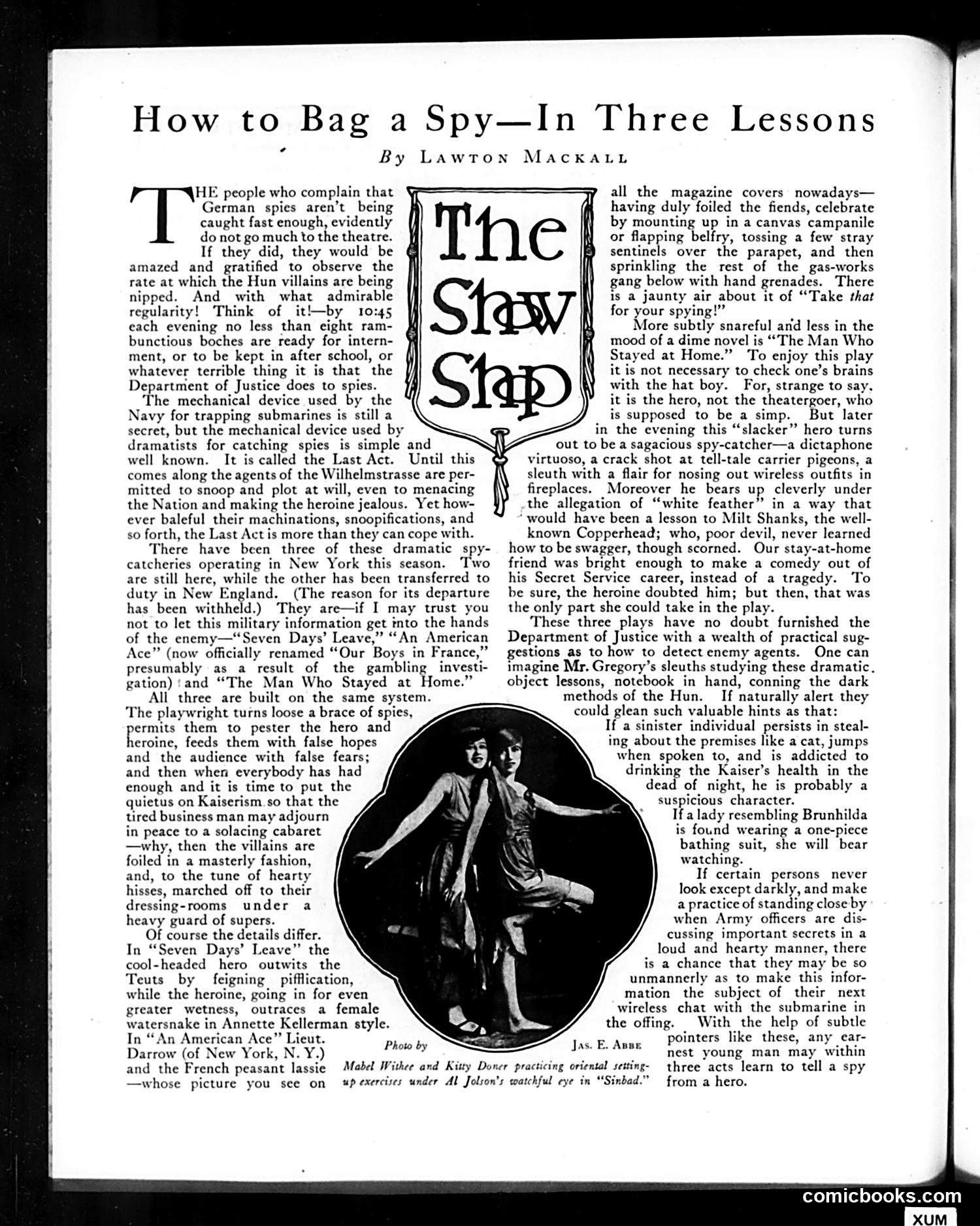
This article satirizes three popular Broadway plays—*Seven Days' Leave*, *An American Ace*, and *The Man Who Stayed at Home*—that capitalize on wartime anxiety by depicting German spy capture. The author mocks how these theatrical productions follow an identical formula: German agents ("Huns," "Boches") menace the hero and heroine throughout acts one and two, then get dramatically foiled and arrested in the final act. The satire targets both the predictable mechanics of these melodramas and American audiences' appetite for reassurance that enemy spies are being efficiently neutralized. The accompanying photo shows actors Mabel Withee and Kitty Doner rehearsing combat choreography under Al Jolson's supervision, illustrating the elaborate action sequences these plays featured. The piece gently ridicules how tired businessmen could leave the theater assured that Kaiserism faced no real threat from actual espionage.
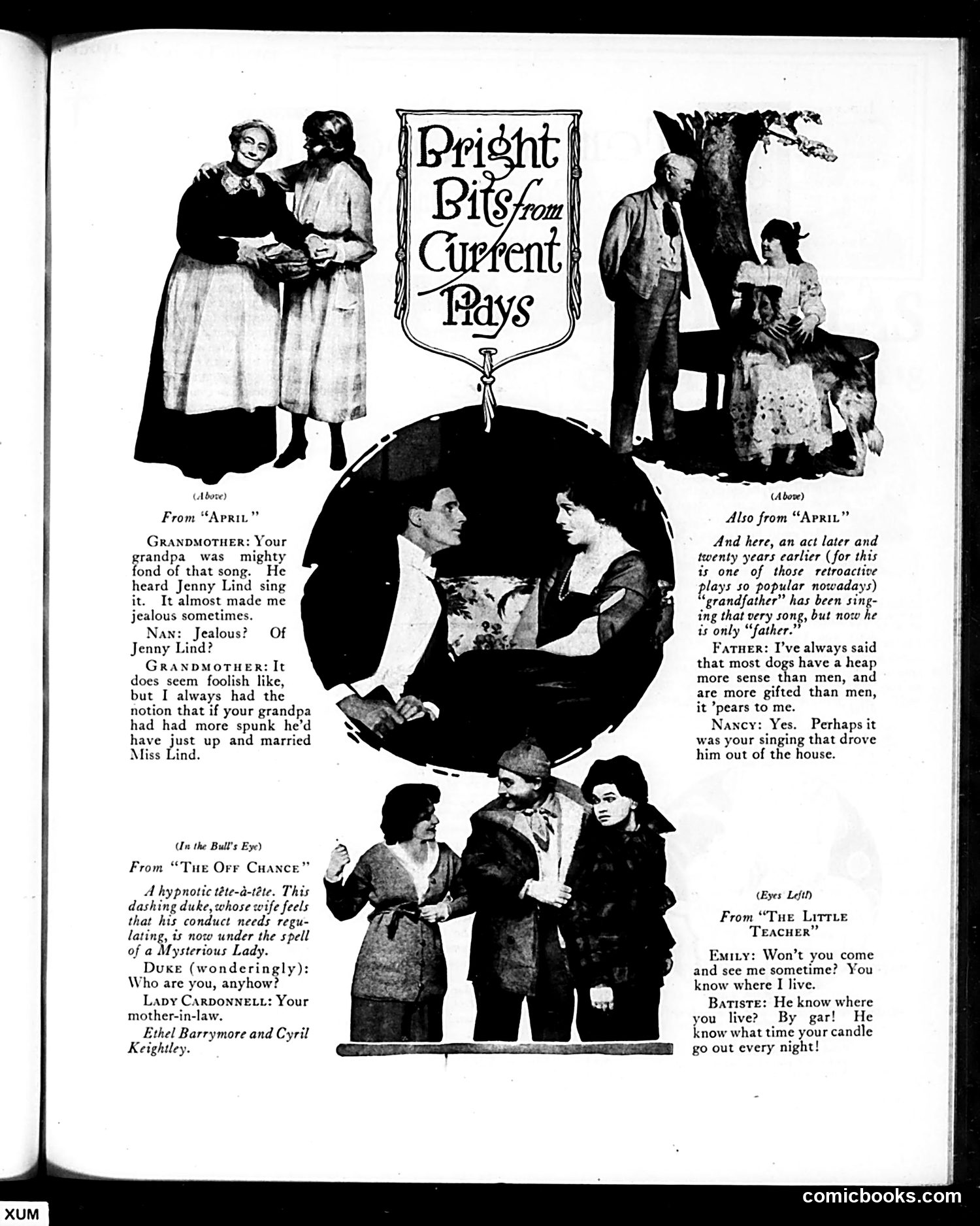
This page excerpts comedic dialogue from contemporary stage productions, likely from early 1900s theater. The content centers on romantic and domestic humor: **"April"** features a grandmother recalling Jenny Lind (a famous 19th-century singer), joking she was jealous of the entertainer's appeal to her grandfather. A later scene shows the "grandfather" character as a younger "father," now blamed for singing badly enough to drive the family dog away—inverting the earlier romantic nostalgia. **"The Odd Chance"** depicts a hypnotized duke under a "mysterious lady's" spell, who is revealed to be his mother-in-law—playing on the stock joke of interfering in-laws. **"The Little Teacher"** presents a flirtation where a male character admits to monitoring a woman's evening routine in detail, framed as knowing "what time your candle go out"—implying surveillance presented as humor, reflecting period attitudes toward courtship. The satire targets sentimental theater conventions and domestic relationship dynamics popular in contemporary plays.
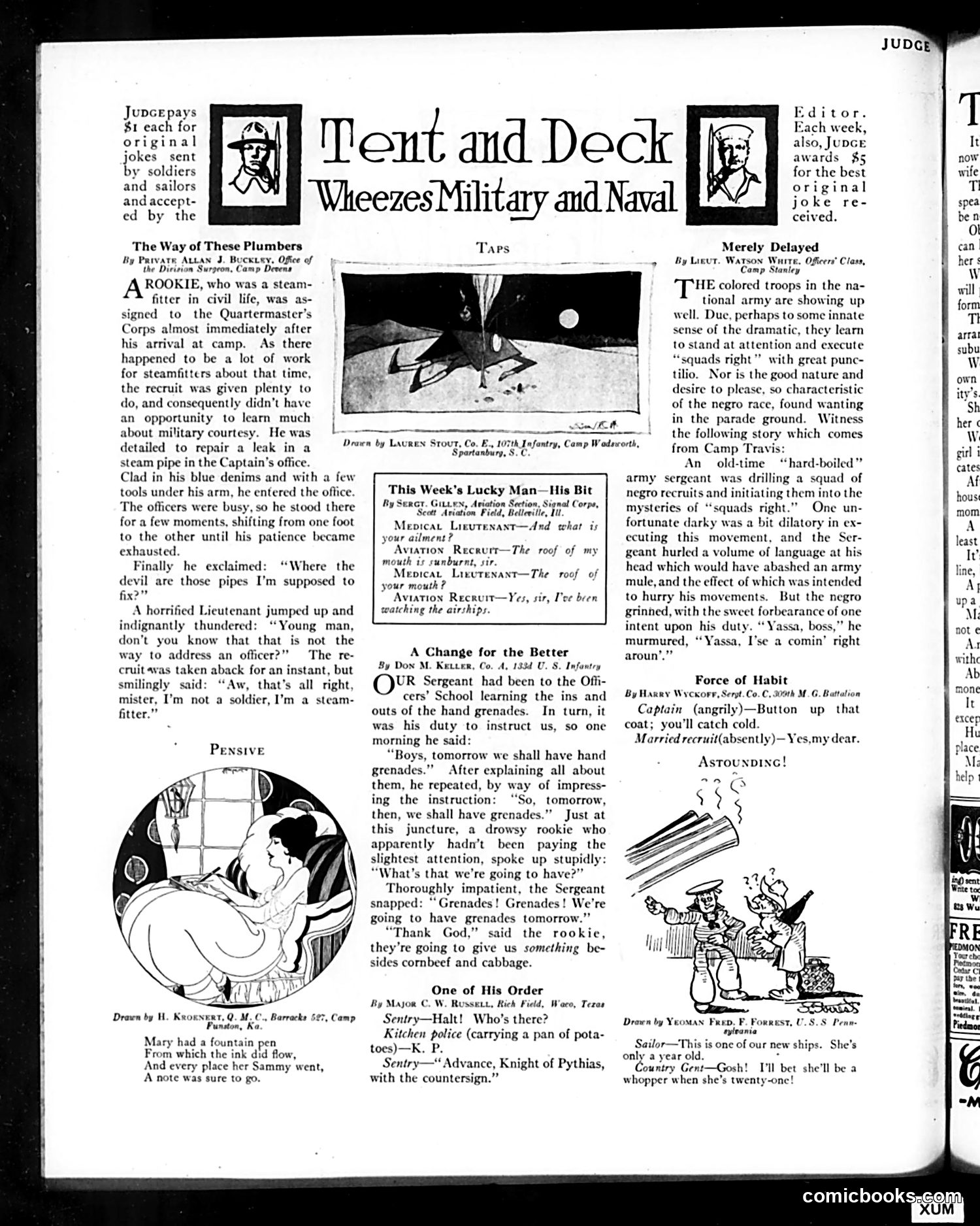
This page from *Judge* magazine contains military humor from World War I era, featuring jokes submitted by soldiers. The cartoons satirize military life and training. **"The Way of These Plumbers"** mocks a rookie steamfitter who, accustomed to civilian work, addresses a Captain disrespectfully about missing pipes. When confronted about his rudeness, he dismisses military protocol, claiming "I'm a steamfitter, not a soldier"—the joke being his obliviousness to military hierarchy. **"Merely Delayed"** uses racial stereotypes common to the period, praising Black soldiers' discipline while attributing it to innate dramatic sense—a backhanded compliment reflecting contemporary prejudices. The remaining jokes play on military misunderstandings: an aviator's "sunburned roof of mouth" from watching planes, a sergeant's repetition about hand grenades misheard as food, and a sentry mistaking "K.P." (kitchen police) for a fraternal order. The humor relies on military life's absurdities and confusion between civilian and military culture.
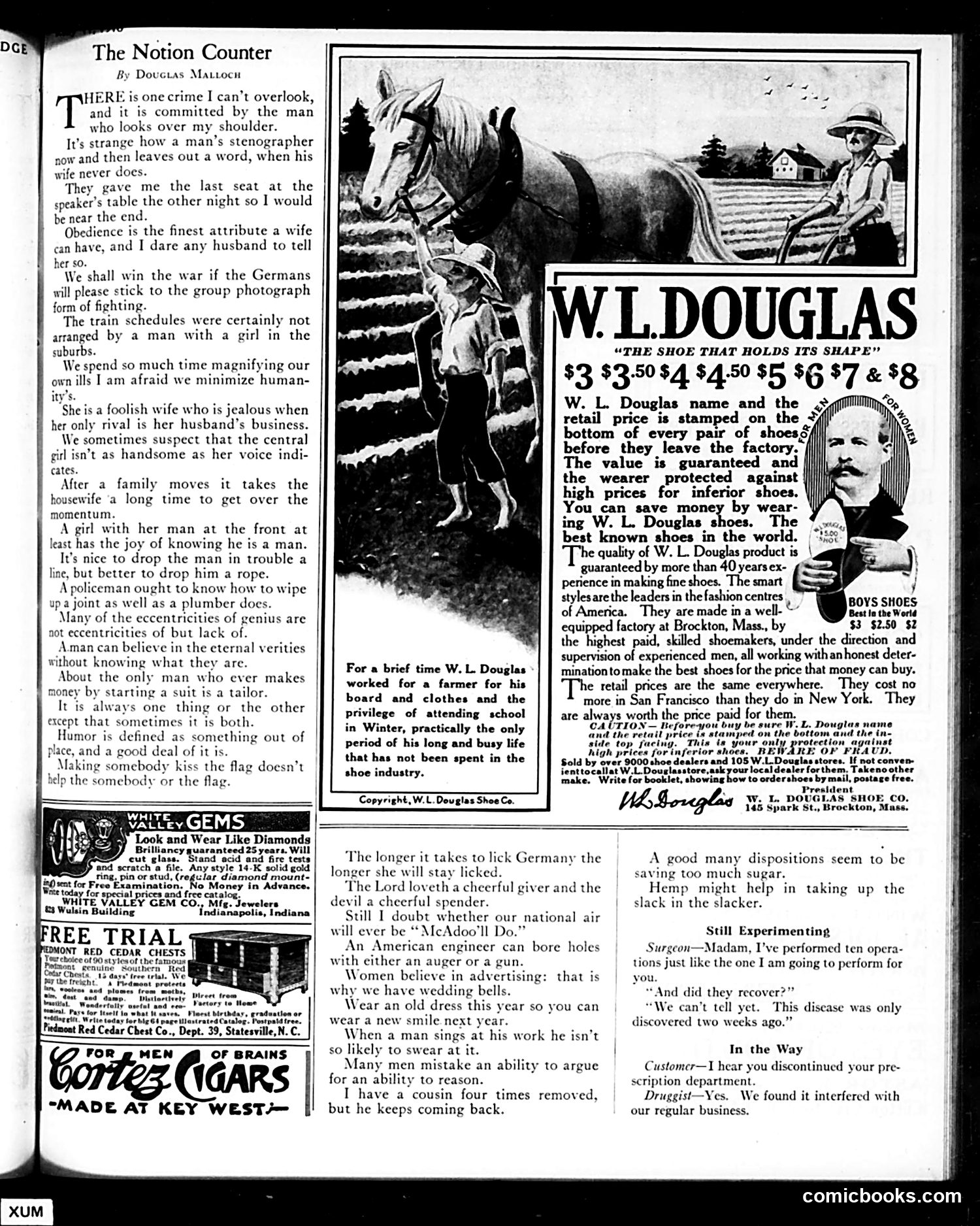
This page is primarily **advertising**, dominated by a W.L. Douglas shoe company advertisement featuring an illustration of a farmer with a plow horse and a portrait of company founder W.L. Douglas. The left column contains "The Notion Counter," a **humorous essay by Dovetas Mattoon** offering satirical observations on everyday life. The observations are cynical quips about marriage, war, and human nature—typical of Judge magazine's style. Notable themes include: wives' obedience as an "attribute," skepticism about winning WWI if "Germans stick to group photograph form of fighting," and social commentary on jealousy, ambition, and pretense. The cartoon/illustration shows a rural worker, fitting the Douglas shoe advertisement's narrative about the founder's humble agricultural origins. The remaining advertisements (White Valley Gems, Cortez Cigars, Free Trial offer) are typical period commercial content. **Historical context**: This appears from the WWI era (reference to "winning the war"), when Judge regularly mixed satirical social commentary with commercial content.
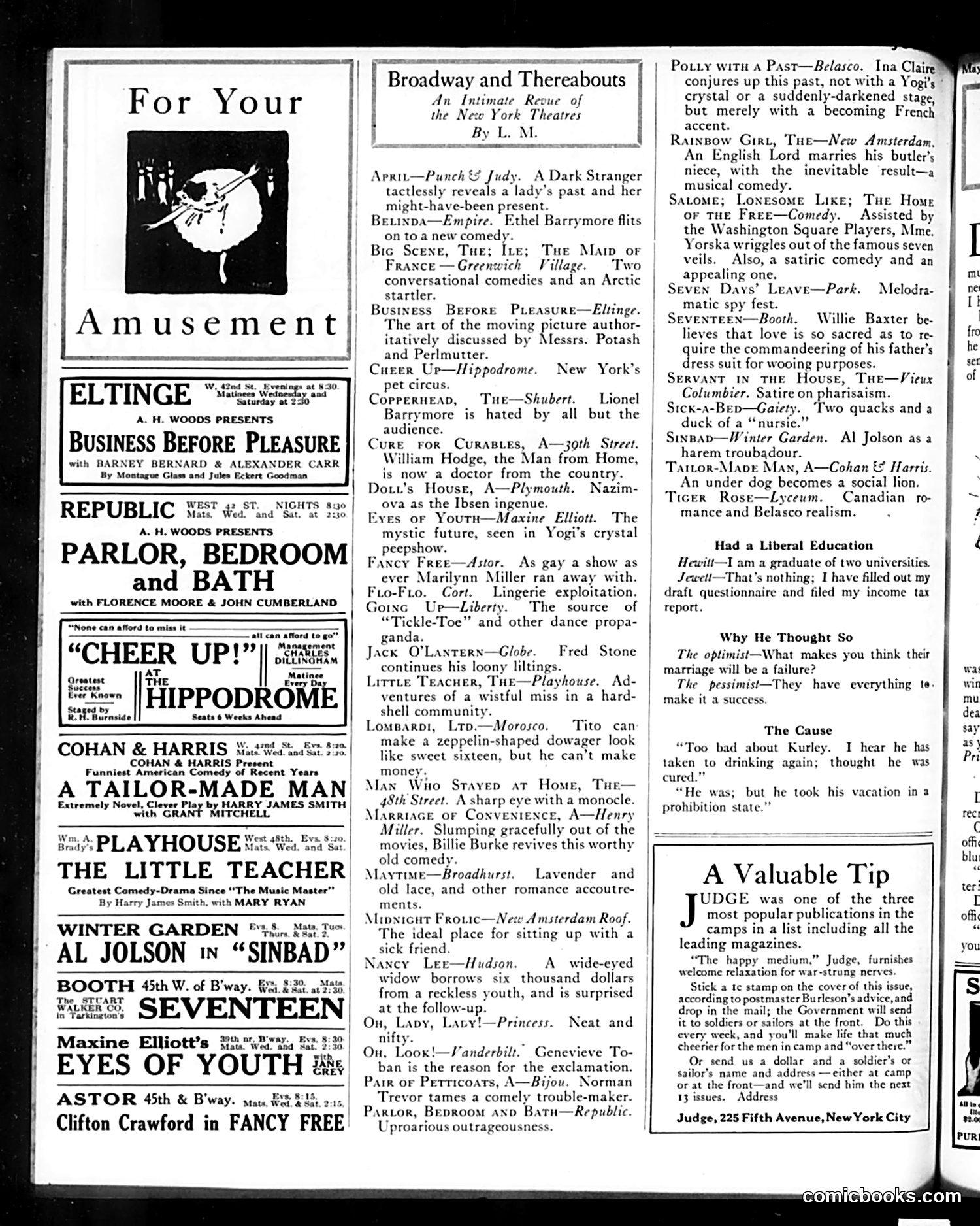
This page is primarily **theatrical advertising and reviews**, not political cartooning. It consists of: **Left side:** Theater advertisements for Broadway productions (Business Before Pleasure, Parlor Bedroom and Bath, etc.) with a small decorative illustration of a dancing figure at the top. **Right side:** "Broadway and Thereabouts"—a theatrical column reviewing current New York stage productions with brief, dismissive summaries of each show's plot. The tone is gossipy and sardonic; for example, *Lombardi Ltd.* gets praise for its set designer but the jab: "he can't make money." **Context for modern readers:** This page documents early 1920s Broadway entertainment. The reviews assume readers recognize the actors (Ethel Barrymore, Al Jolson, etc.). Terms like "monocle" and "zeppelin-shaped dowager" reflect period fashion and social satire. The page shows how Judge mixed highbrow humor with popular entertainment coverage.
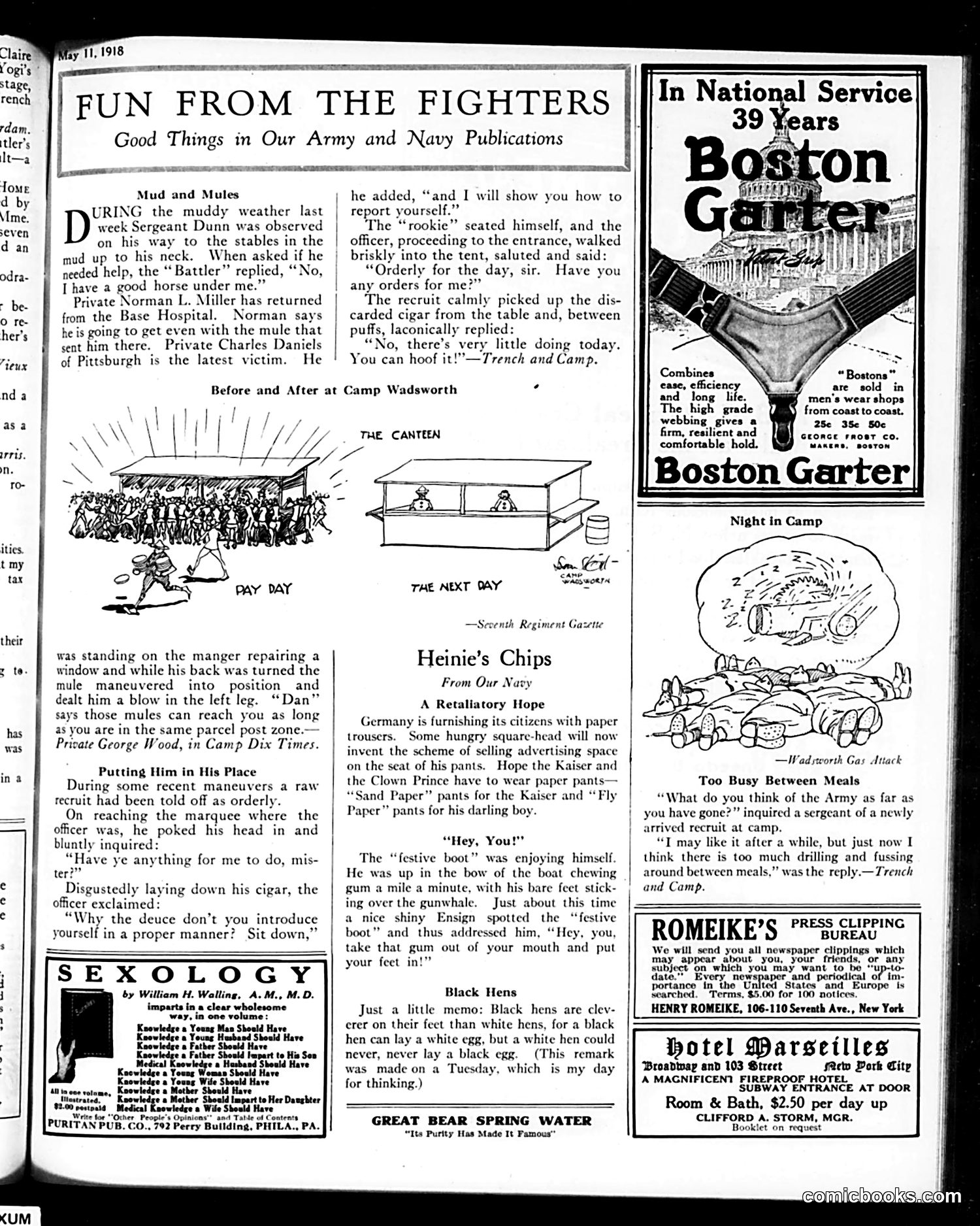
This page collects humorous anecdotes from American Army and Navy publications during World War I. The cartoons and stories depict soldier life with light satire: **"Mud and Mules"** mocks camp hazards—soldiers getting stuck in mud and kicked by ornery mules, treating military inconvenience as comedy. **"Putting Him in His Place"** satirizes military hierarchy. A raw recruit rudely addresses an officer informally ("mister?"), so the officer deliberately humiliates him by having him formally report to an empty tent, then mocking his own authority by lounging and ordering the recruit to leave—inverting rank as a prank. **"Heinie's Chips"** makes crude propaganda jokes about Germans ("square-head," references to the Kaiser), suggesting Germans wear paper trousers and mocking their desperation. **"Black Hens"** offers a nonsensical joke playing on egg-laying logic. Overall, this reflects 1918 wartime entertainment: workplace humor mixed with anti-German mockery meant to boost morale and entertain troops through relatable military absurdities.
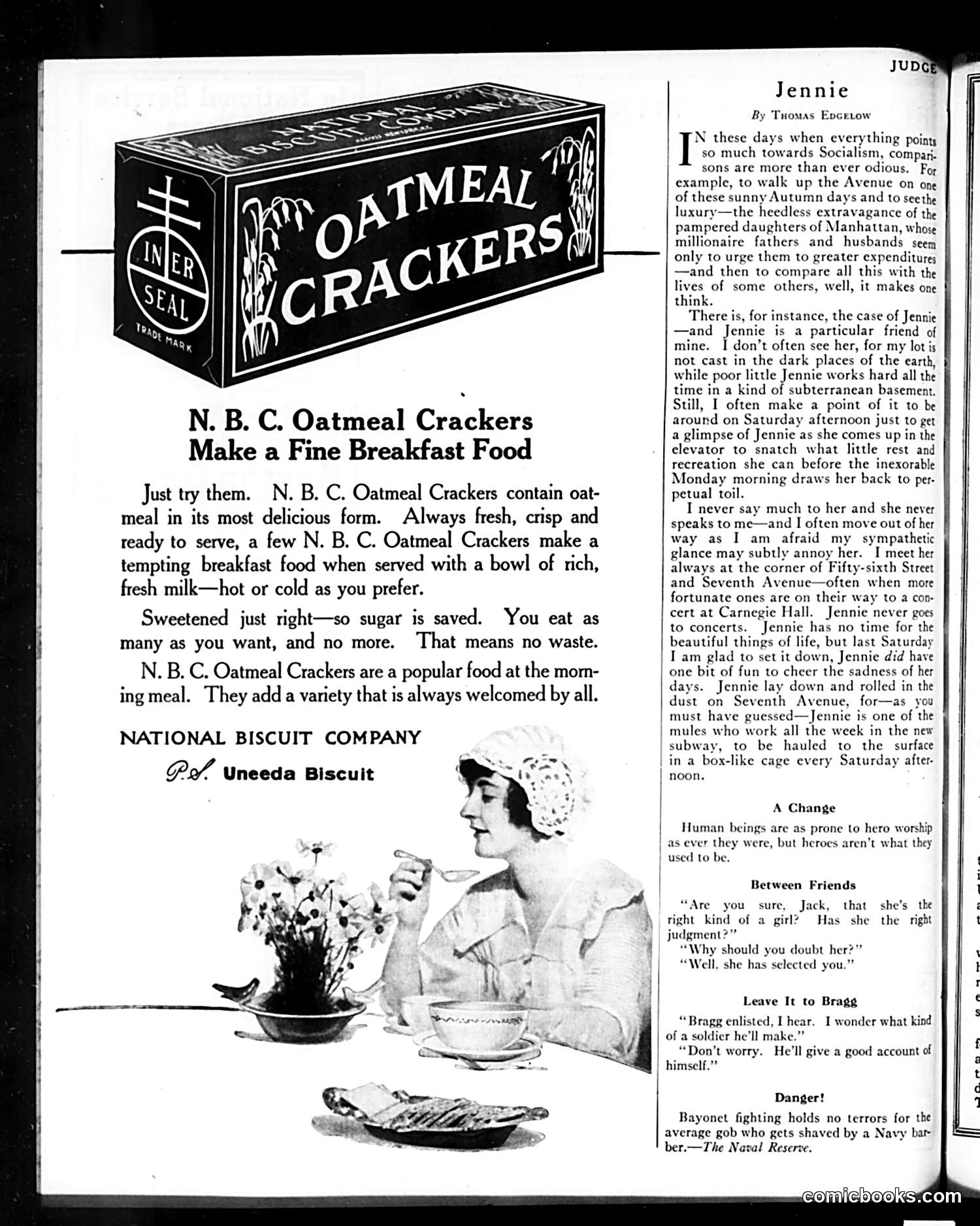
This page is primarily **advertising** with a small fictional story and several brief humor columns. The main feature is a story called "Jennie" by Thomas Egelbow, which uses social satire. The narrator describes encountering a working-class woman named Jennie at the corner of 56th and 7th Avenue in Manhattan. The twist ending reveals Jennie is actually a **mule working in the newly-constructed subway system**, hauled to the surface weekly in a cage. The satire critiques **wealth inequality**: the narrator contrasts Manhattan's pampered millionaires' daughters with Jennie's grueling labor, positioning the story as commentary on Socialism and class disparity. The surprise that "Jennie" is a mule serves as dark humor—the narrator's pity for an overworked woman is redirected to an overworked animal, amplifying the degradation of labor conditions. The page also contains brief joke columns (Between Friends, Leave It to Bragg, Danger!) with generic humor unrelated to current events, plus large **N.B.C. Oatmeal Crackers** and Uneeda Biscuit advertisements.
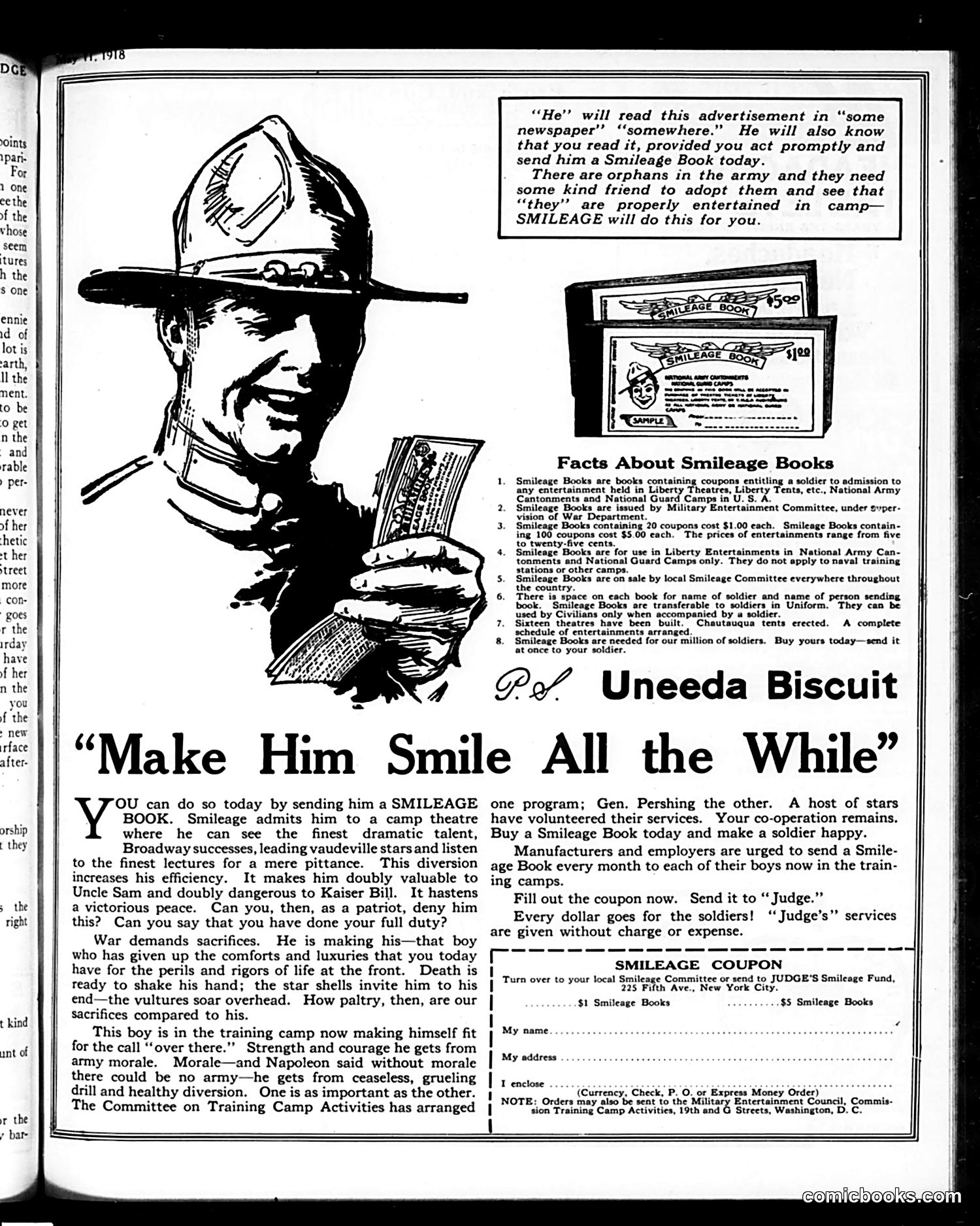
This page is primarily a **patriotic advertisement**, not satire. It promotes "Smileage Books"—coupon booklets funding entertainment for soldiers in training camps during World War I. The image shows a soldier in military uniform holding the booklet. The advertisement appeals to civilian patriotism by arguing that morale entertainment is essential to military readiness. It references "Kaiser Bill" (Germany's Kaiser Wilhelm II) and "over there" (the European front), establishing the WWI context. The appeal is emotional: soldiers have sacrificed comfort and face death; civilians should reciprocate by purchasing these books ($1 or $5) to provide theater, vaudeville, and lectures. The ad claims entertainment increases soldier efficiency and hastens "a victorious peace." **Uneeda Biscuit** (a real brand) sponsors this patriotic message, leveraging wartime sentiment for corporate goodwill. This represents typical WWI-era corporate-patriotic marketing, where companies demonstrated loyalty by funding soldiers' morale initiatives.
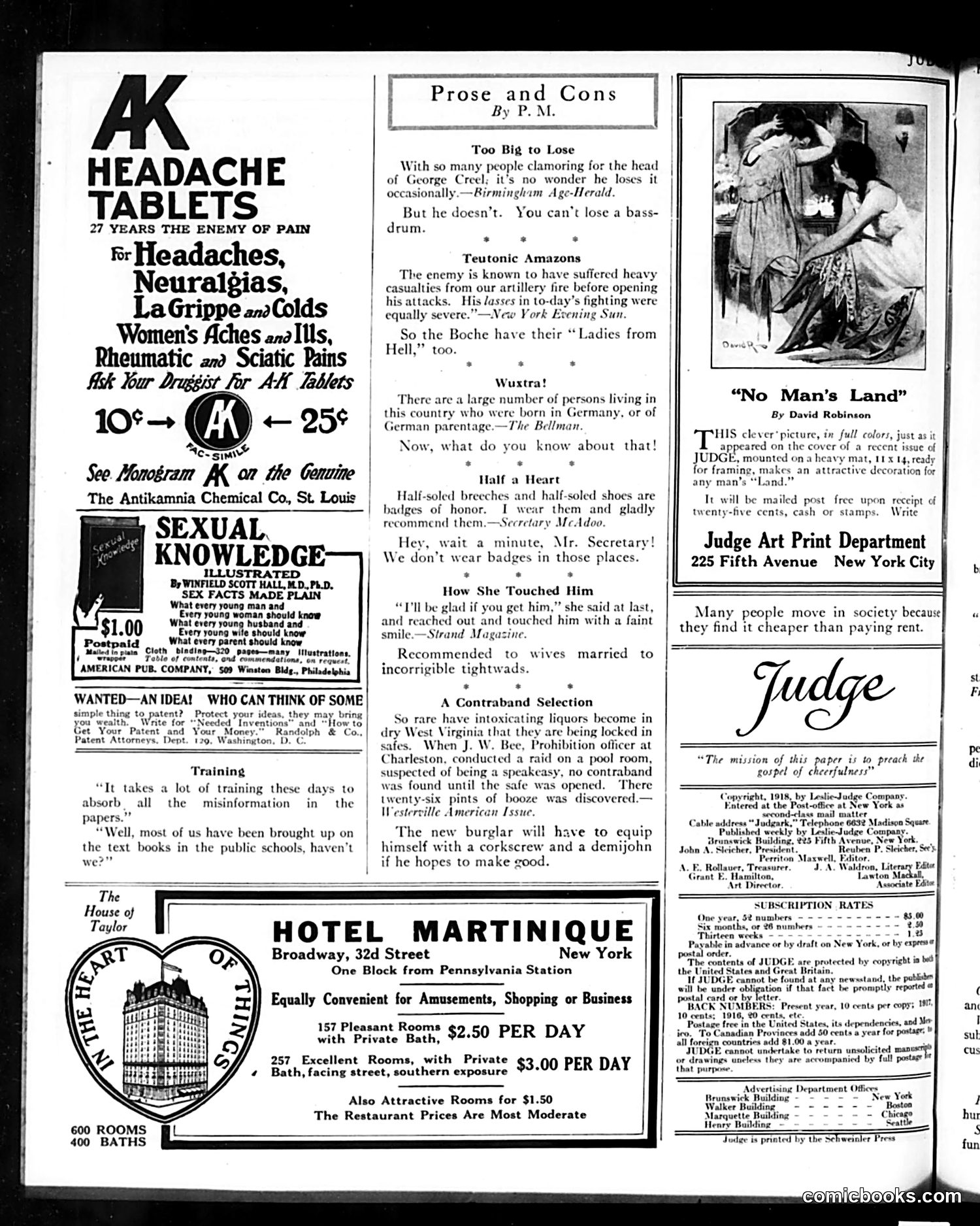
This appears primarily as an **advertising and miscellaneous content page** rather than a satirical editorial spread. However, the "Prose and Cons" column contains brief topical jokes about WWI-era figures and policies: **Key References:** - **George Creel** (head of war propaganda): Mocked for "losing his head" while managing the government's messaging—the bass-drum joke implies he's loud and impossible to actually lose. - **Prohibition in West Virginia**: Satirizes the difficulty of enforcing alcohol bans when bootleggers hide liquor in safes. - **German immigrants** ("the Boche," "Ladies from Hell"): References to both enemy forces and domestic concerns about German-heritage Americans. **Main Joke Pattern:** These are punchy one-liners exploiting double meanings or absurdities in contemporary news reports—typical of the magazine's satirical style. The page is otherwise dominated by period advertisements (headache tablets, patent services, hotels) with one illustration labeled "No Man's Land" (available as a print).
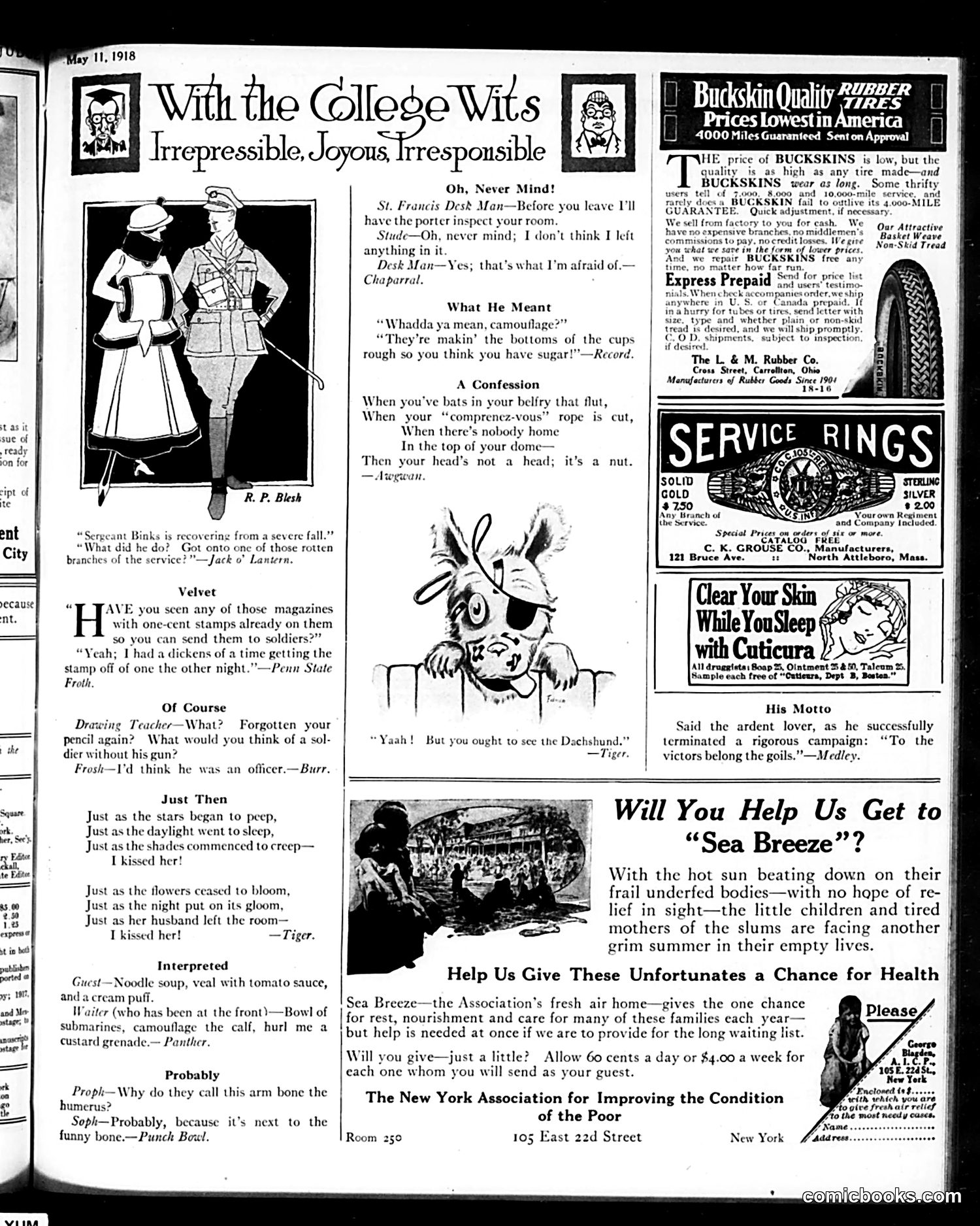
This page collects humorous short jokes from college humor magazines, reflecting WWI-era campus life. Key themes include: **Military references**: Multiple jokes mock military terminology and officer incompetence ("a soldier without his gun" = an officer). A waiter translates menu items using war slang ("submarines" for dishes, "camouflage," "custard grenade"). **College pranks**: Jokes about stamp-stealing, forgotten pencils, and romantic encounters in dorm rooms—typical undergraduate mischief. **War-adjacent humor**: A "Dachshund" joke likely mocks German culture (dachshunds = Germany), common during WWI. References to "bats in your belfry" (crazy talk). The page mostly advertises Buckskin tires and the "Sea Breeze" charitable home for poor children—suggesting Judge mixed entertainment with public welfare appeals. The college humor sections were filler content showcasing wit from various universities' student publications.
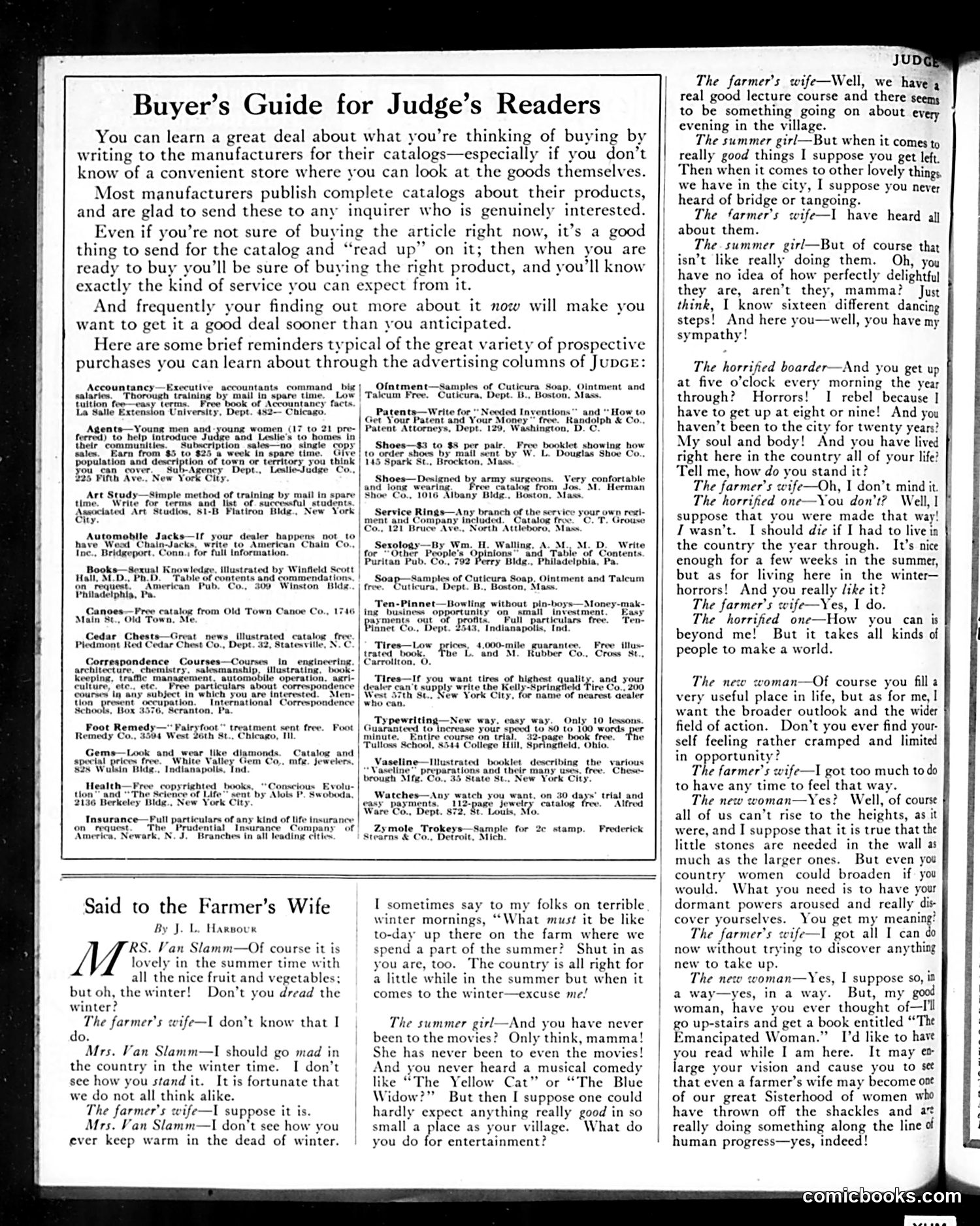
This page is primarily a dense advertising directory ("Buyer's Guide for Judge's Readers") with an adjacent editorial piece titled "Said to the Farmer's Wife" by J.L. Harbour. The advertisements promote correspondence courses, mail-order goods (shoes, canoes, automobile equipment), and services (insurance, accountancy training, jewelry). The editorial advice below encourages readers—particularly rural audiences implied by the "farmer's wife" framing—to request manufacturer catalogs before purchasing, positioning mail-order shopping as practical consumer education. The satire is subtle: the pairing suggests Judge's readers (presumably urban, sophisticated magazine subscribers) are amused by dispensing practical shopping advice to simple country folk. The "farmer's wife" dialogue gently mocks rural anxieties about city life and limited entertainment options, while the wife expresses contentment with simple country pleasures, inverting typical city-dweller superiority.
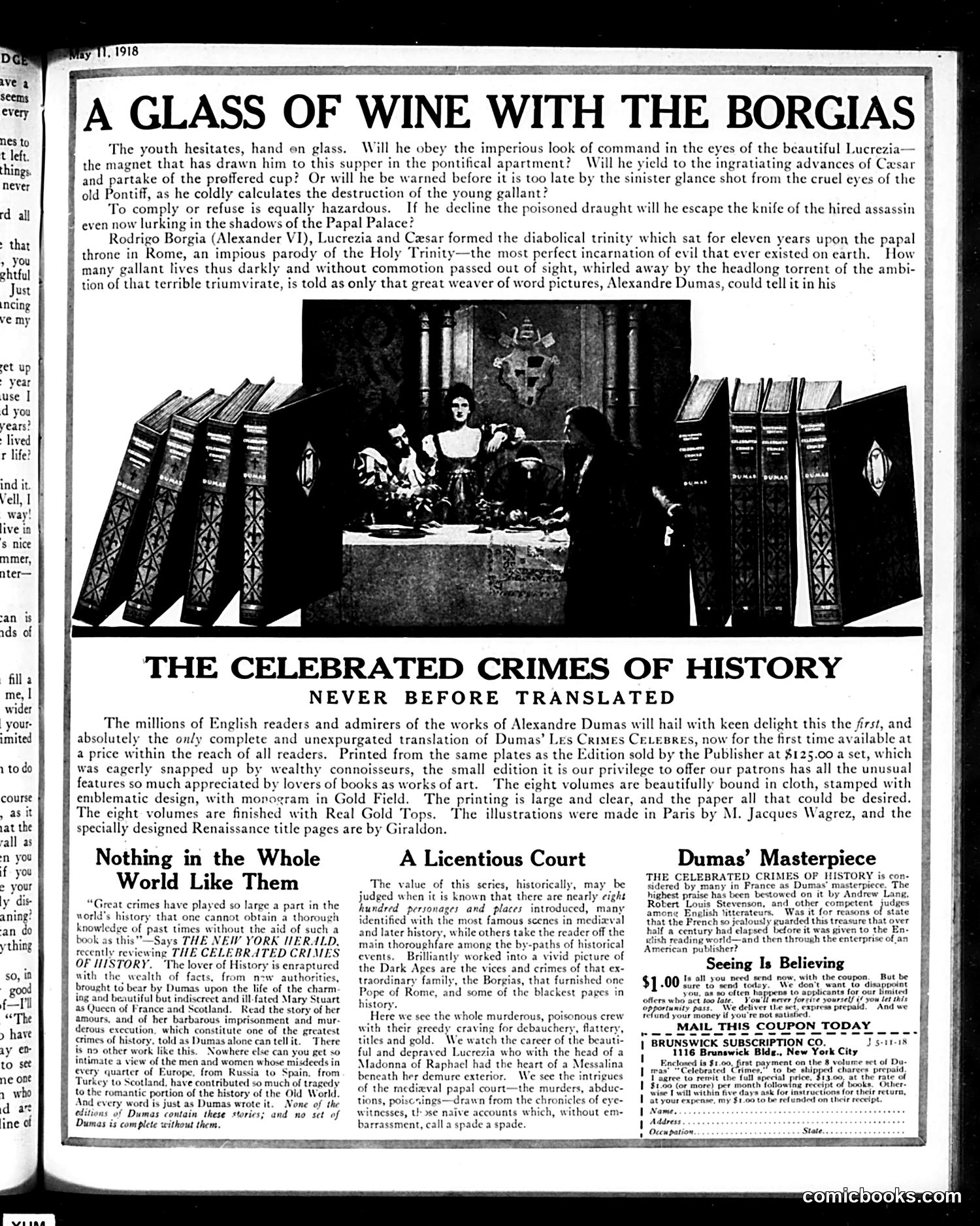
This 1918 page is primarily **advertising for Alexandre Dumas' *Celebrated Crimes of History***, a multi-volume translation of historical crime narratives. The header illustration depicts a scene from the Borgias era—a young man hesitating to drink poisoned wine offered by the beautiful Lucrezia Borgia while her father Pope Alexander VI and brother Cesare watch coldly. The advertisement frames the Borgias (Pope Alexander VI, Lucrezia, and Cesare) as the ultimate historical villains—a "diabolical trinity" embodying pure evil during their 11-year control of the papal throne. The copy emphasizes this as Dumas' masterwork, previously available only in an expensive $125 set but now offered at affordable prices to ordinary readers. The satire is implicit: early 20th-century American audiences could appreciate the irony of depicting Renaissance papal corruption as entertainment, contrasting religious authority with poisoning, assassination, and debauchery. The page positions *true crime* as intellectual, artistic reading material.
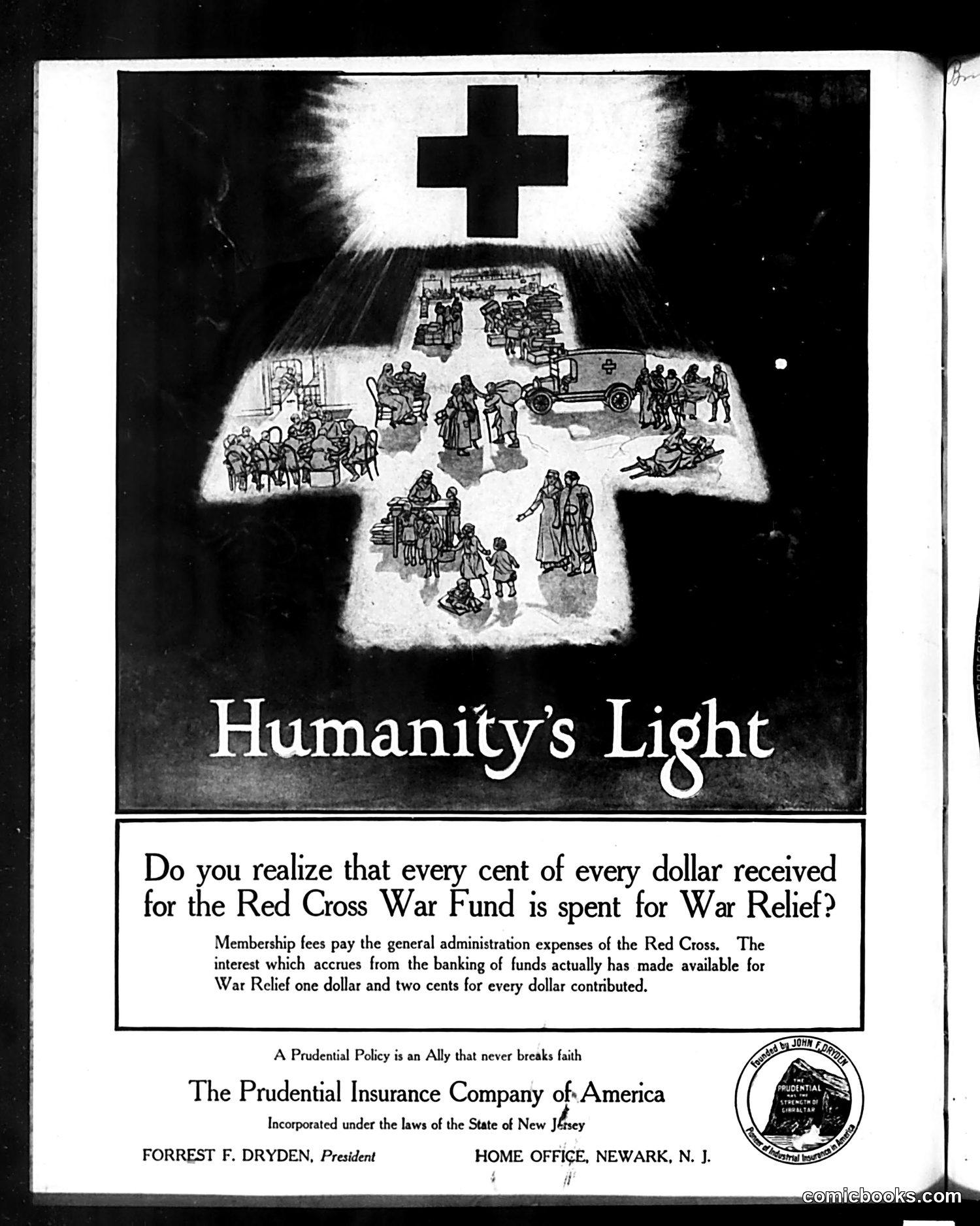
This is a **Red Cross fundraising advertisement** disguised as public-service messaging, sponsored by Prudential Insurance. The image depicts a large cross with light rays illuminating various scenes of humanitarian aid—people, vehicles, and relief work—meant to inspire donor confidence. The text claims that **every cent** of Red Cross War Fund donations goes directly to relief (not administration), and that banking interest has actually *increased* donated funds by creating an extra $1.02 per dollar contributed. This appears designed to counter skepticism about charitable overhead during World War I. By emphasizing financial efficiency and invoking religious imagery ("Humanity's Light"), Prudential positions itself as trustworthy alongside the Red Cross, implying that choosing Prudential insurance similarly demonstrates reliability and moral commitment. The advertisement essentially leverages patriotic wartime sentiment to market insurance products.