
Judge, 1918-05-11 · page 22 of 36
Judge — May 11, 1918 — page 22: what you’re looking at
What you’re looking at
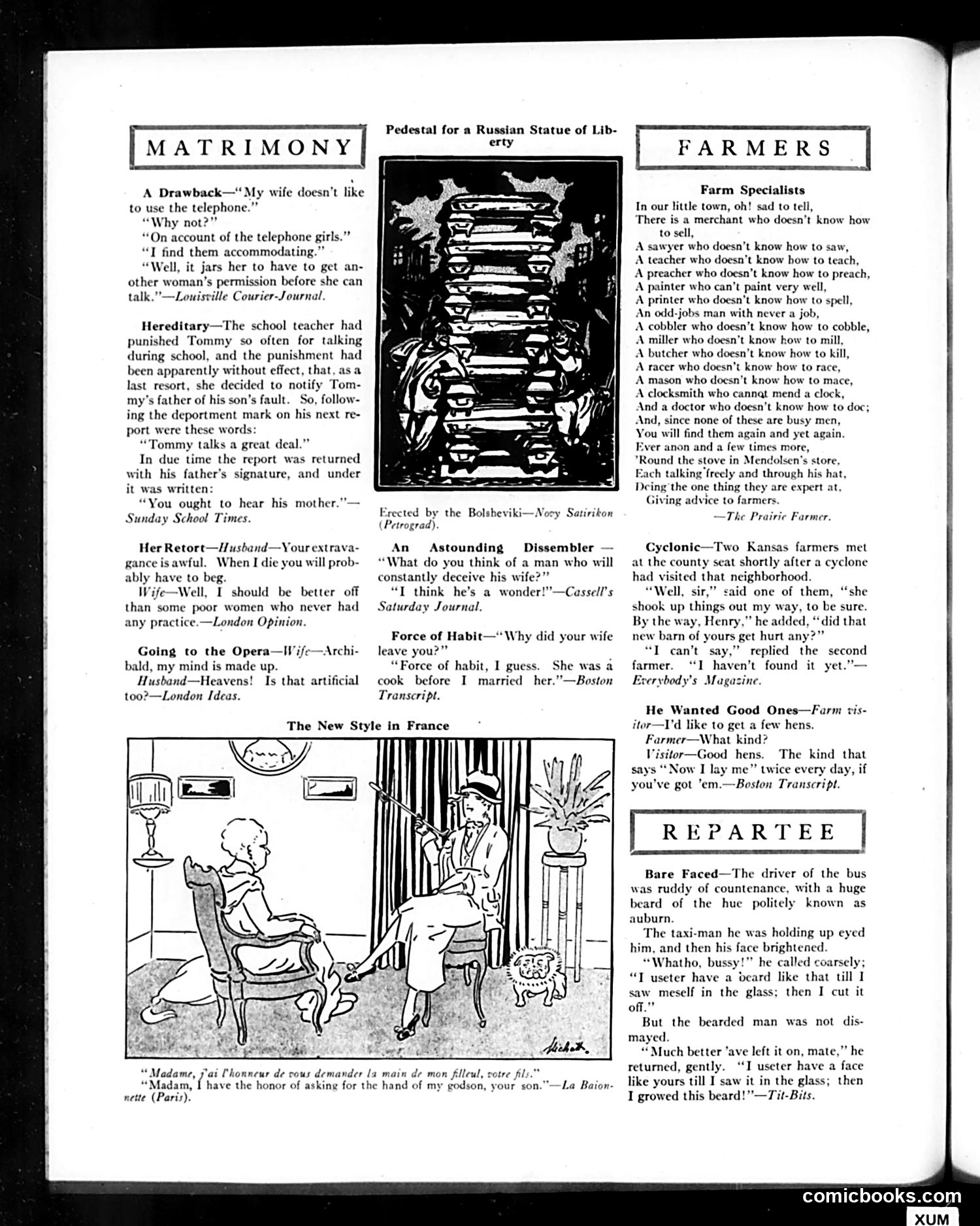
This page from Judge contains brief humorous anecdotes and one political cartoon, typical of early 20th-century American satirical magazines. **The main cartoon** depicts a Russian revolutionary monument—a crude, stacked pedestal credited to "the Bolsheviki" (Bolsheviks). The satire mocks the Soviet regime's artistic and architectural output as primitive and poorly constructed, reflecting Western anti-communist sentiment during the Russian Revolution era. **The text items** are lighthearted domestic and social jokes: wives objecting to telephone operators' presence in calls; children inheriting talkative habits from parents; women's spending habits; and rural/farmer humor about incompetent professionals who gather to dispense unwanted advice despite their own failures. The "Farm Specialists" poem satirizes rural communities where every tradesman is incompetent yet freely advises farmers—poking fun at small-town pretension and gossip culture. The British "Repartee" items showcase working-class wit about beards and appearances, typical of that publication's humor. Overall, the page reflects early 1900s attitudes toward technology (telephones), gender dynamics, Soviet Russia, and rural American society.
📄 Transcribed text from this page (OCR, searchable)
Machine-transcribed from the original scan — historical spelling and the odd misread are preserved.
A Drawback—‘‘ My wife doesn’t like to use the telephone.”” “Why not?” “On account of the telephone girls.” “T find them accommodating.” “Well, it jars her to have to get an- other woman’s permission before she can talk.” —Louisville Courier-Journal. Hereditary—The school teacher had punished Tommy so often for talking during school, and the punishment had been apparently without effect, that, as a last resort, she decided to notify Tom- my’s father of his son’s fault. So, follow- ing the deportment mark on his next re- port were these words: “Tommy talks a great deal.” In due time the report was returned with his father’s signature, and under it was written: “You ought to hear his mother.”— Sunday School Times. Her Retort—Husband—Your extrava- gance isawful. When I di ably have to beg. you will prob- Wife—Well, I should be better off than some poor women who never had any practice.—London Opinion. Going to the Opera—W ife—Archi- bald, my mind is made up. Husband—Heavens! Is that artificial too?—London Ideas. “Madame, j'ai Chonneur de cous demander la main de mon filleul, votre fils.” have the honor of asking for the hand of my “Madam, I nette (Paris). Pedestal for a Russian Statue of Lib- Erected by the Bolsheviki—Nory Satirikon (Petrograd). An Astounding Dissembler — “What do you think of a man who will constantly deceive his wife?” “TI think he’s a wonde Saturday Journal. ’—Cassell’s Force of Habit—‘ Why did your wife leave you?” “Force of habit, I guess. cook before I married her. Transcript. She was a —Boston son, your son.” La Baion- Farm Specialists In our little town, oh! sad to tell, There is a merchant who doesn’t know how to sell, A sawyer who doesn’t know how to saw, A teacher who doesn’t know how to teach, A preacher who doesn’t know how to preach, A painter who can’t paint very well, A printer who doesn’t know how to spell, An odd-jobs man with never a job, A cobbler who doesn’t know how to cobble, A miller who doesn’t know how to mill, A butcher who doesn’t know how to kill, A racer who doesn’t know how to race, A mason who doesn’t know how to mace, A clocksmith who cannat mend a clock, And a doctor who doesn’t know how to doc; And, since none of these are busy men, You will find them again and yet again. Ever anon and a few times more, "Round the stove in Mendolsen’s store, Each talking freely and through his hat, Deing the one thing they are expert at, Giving advice to farmers. —The Prairie Farmer. Cyclonic—Two Kansas farmers met at the county seat shortly after a cyclone had visited that neighborhood. “Well, si aid one of them, ‘she shook up things out my way, to be sure. By the way, Henry,” he added, ‘did that new barn of yours get hurt any?” “I can’t say,” replied the second farmer. “I haven’t found it yet.”— Exerybody’s Magazine. He Wanted Good Ones—Farm vis- itor—I'd like to get a few hens. armer—What kind? Visitor—Good hens. The kind that says “Now I lay me” twice every day, if you've got ’em.—Boston Transcript. | REPARTEE of the bus with a huge known as Bare Faced—The driv was ruddy of countenan beard of the hue polite auburn. The taxi-man he was holding up eyed him, and then his face brightened. “Whatho, bussy!” he called coarsely; “T useter have a beard like that till I f in the glass; then I cut it mayed. “Much better ‘ave left it on, mate,” he returned, gently. “‘I useter have a face like yours till I saw it in the glass; then I growed this beard!" —Tit-Bits. comicbooks.com