
Judge, 1918-05-11 · page 19 of 36
Judge — May 11, 1918 — page 19: what you’re looking at
What you’re looking at
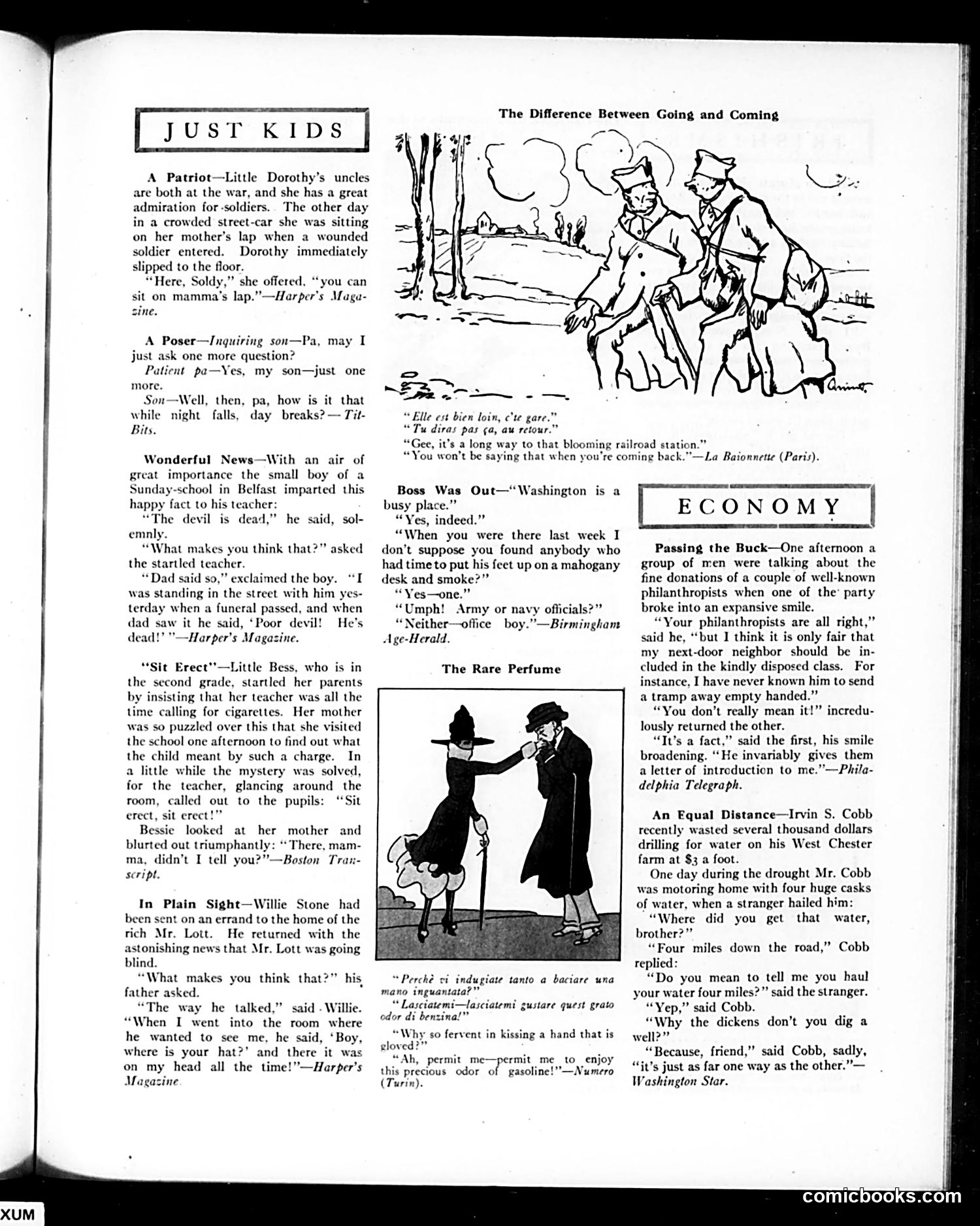
This page from Judge contains humor anecdotes and cartoons typical of early 20th-century American satire. The main content includes: **"Just Kids" section**: Short humorous stories about children, including one where a girl offers her seat to a wounded soldier (WWI-era patriotism), another about a child mishearing "sit erect" as "cigarettes," and wordplay jokes. **"The Difference Between Going and Coming" cartoon**: Shows soldiers departing versus returning from war, with the caption implying soldiers won't complain about distance when coming *home*—commentary on wartime sacrifice and homecoming. **"Economy" section**: Satirical anecdotes mocking philanthropy and wealthy figures. One story jokes that a neighbor "gives" tramps letters of introduction to the narrator—passing responsibility rather than genuine help. Another features humorist Irvin S. Cobb drilling unsuccessfully for water. **"The Rare Perfume" cartoon**: A flirtatious scene about kissing a gloved hand, with the twist being attraction to gasoline smell—likely satirizing newfound automobile culture. The humor relies on wordplay, irony, and social observation typical of Judge's satirical approach.
📄 Transcribed text from this page (OCR, searchable)
Machine-transcribed from the original scan — historical spelling and the odd misread are preserved.
JUST KIDS A Patriot—Little Dorothy’s uncles are both at the war, and she has a great admiration for-soldiers. The other day in a crowded street-car she was sitting on her mother’s lap when a wounded soldier entered. Dorothy immediately slipped to the floor. “Here, Soldy,” she offered, “you can sit on mamma's lap.""—Harper'’s Maga- sine. A Poser—Inqguiring son—Pa, may I just one more question? Patient pa—Yes, my son—just one more. Son—Well, then, pa, how is it that while night falls, day breaks? — Tit- Bits. Wonderful News—With an air of great importance the small boy of a Sunday-school in Belfast imparted this happy fact to his teacher: “The devil is dead,” emnl. “What makes the startled te: “Dad said so, “I was standing in the street with him yes- terday when a funeral passed, and when dad saw it he said, ‘Poor devil! He's dead!’ "—Harper’s Magazine. he said, sol- you think that?” asked “Sit Erect’’—Little Bess, who is in the second grade, startled her parents by insisting that her teacher was all the time ing for cigarettes. Her mother was so puzzled over this that she visited the school one afternoon to find out what the child meant by such a charge. In a little while the mystery was solved, for the teacher, glancing around the room, called out to the pupils: “Sit erect!” looked at her blurted out triumphantly ma, didn’t I tell you?” script. mother and There, mam- —Boston Tran- In Plain Sight—Willie Stone had been sent on an errand to the home of the rich Mr. Lott. He returned with the astonishing news that Mr. Lott was going blind. “What makes you think that?” his father asked, ; The way he talked,” said - Willie. “When I went into the room where he wanted to see me, he said, ‘Boy, where is your hat?’ and there it was on my head all the time!”—Harper’s Magazine > PPB. Elle est bien loin, ete gare.” “Tu diras pas ¢a, au retour.” “Gee, it’s a long way to that blooming railroad station.” “You won't be saying that when you're coming back.” Boss Was Out—‘Washington is a busy pla: “Yes, indeed.” “When you were there last week I don’t suppose you found anybody who had time to put his feet up on a mahogany desk and smoke?” “Yes—one.” “Umph! Army or navy officials?” “Neither—office boy.”—Birmingham Age-Herald. The Rare Perfume “Perché vi indugiate tanto a baciare una mano inguantata?” “ Lasciatemi—lasciatemi gustare quest grato odor di benzina!” “Why so fervent in kissing a hand that is gloved?” “Ah, permit me—permit me to. enjoy this precious odor of gasoline!""—Numero (Turin). The Difference Between Going and Coming a Baionnette (Paris). ECONOMY Passing the Buck—One afternoon a group of men were talking about the fine donations of a couple of well-known philanthropists when one of the’ party broke into an expansive smile. “Your philanthropists are all right,” said he, “but I think it is only fair that my next-door neighbor should be in- cluded in the kindly disposed class. For instance, I have never known him to send a tramp away empty handed.” “You don’t really mean it!” incredu- lously returned the other. “It’s a fact,” said the first, his smile broadening. ‘He invariably gives them a letter of introduction to me.""—Phila- delphia Telegraph. An Equal Distance—Irvin S. Cobb recently wasted several thousand dollars drilling for water on his West Chester farm at $3 a foot. One day during the drought Mr. Cobb was motoring home with four huge casks of water, when a stranger hailed him: “Where did you get that water, brother?” “Four miles down the road,” Cobb replied: “Do you mean to tell me you haul your water four miles?” said the stranger. “Yep,” said Cobb. “Why the dickens don’t you dig a well?” “Because, friend,” said Cobb, sadly, “it’s just as far one way as the other.”— Washington Star.