
Judge, 1918-05-11 · page 8 of 36
Judge — May 11, 1918 — page 8: what you’re looking at
What you’re looking at
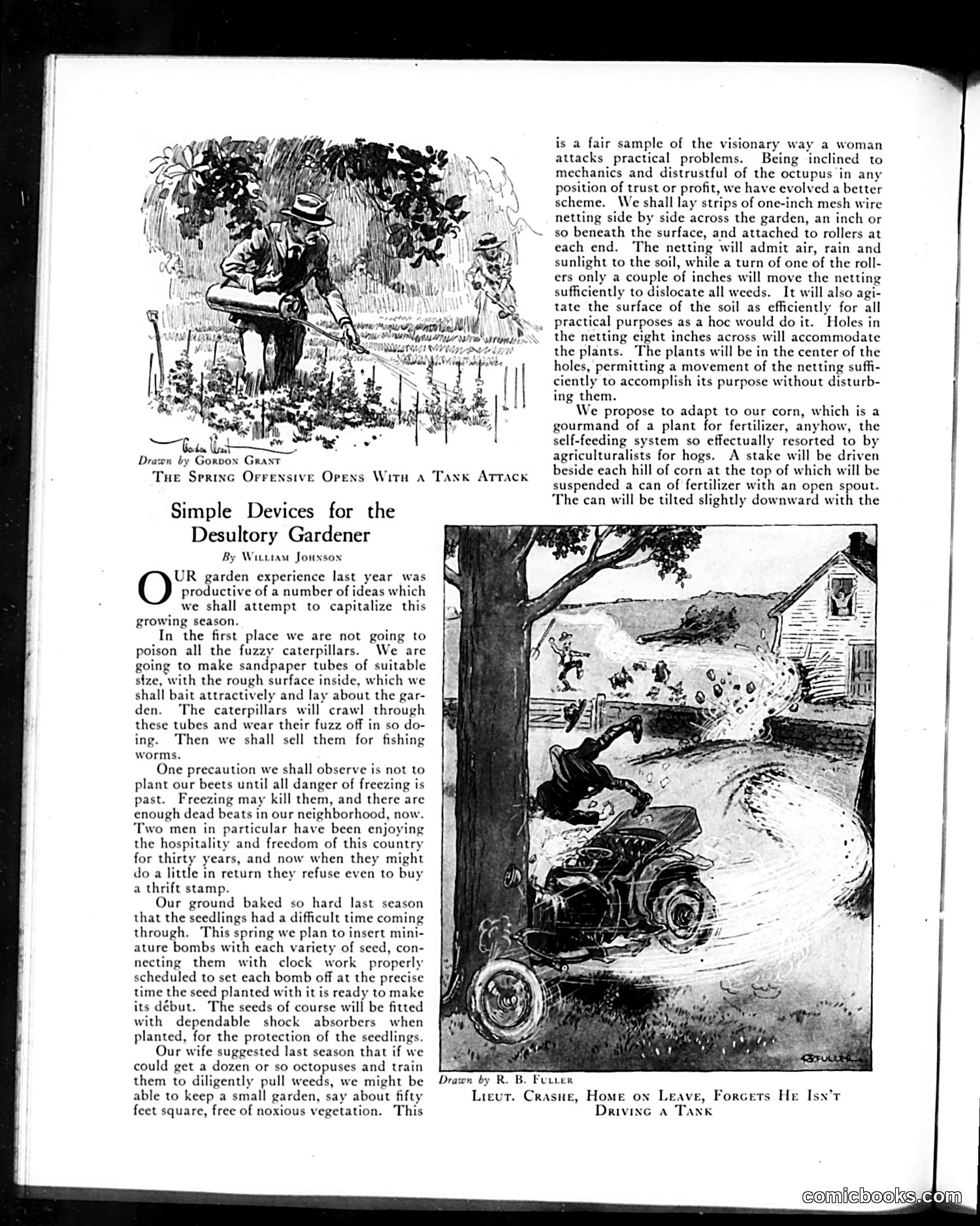
This page contains two separate pieces of WWI-era satire: **"The Spring Offensive Opens With a Tank Attack"** (top illustration by Gordon Grant): References the actual tank warfare beginning on the Western Front. The cartoon depicts soldiers operating an early tank in combat—a topical reference to new military technology dramatically changing warfare in 1917-1918. **"Simple Devices for the Desultory Gardener"** (main article by William Johnson): Humorous pseudo-serious gardening advice that's actually satirizing American wartime shortages and economic conditions. The author proposes absurd solutions (miniature bombs to help seeds germinate, octopuses pulling weeds) while making sarcastic digs at "dead beats" refusing to buy thrift stamps and freeloaders exploiting American hospitality during wartime. **"Lieut. Crashe, Home on Leave, Forgets He Isn't Driving a Tank"** (bottom illustration by R.B. Fuller): Shows a soldier on leave recklessly driving a car like a military tank—satirizing how WWI combat experiences have affected soldiers' civilian behavior. The page collectively mocks both wartime military life and home-front attitudes during America's involvement in World War I.
📄 Transcribed text from this page (OCR, searchable)
Machine-transcribed from the original scan — historical spelling and the odd misread are preserved.
Drawn by Gorvox Grant Tue Sprinc Orrensive Opens Witn a Tank Attack Simple Devices for the Desultory Gardener By Wiuttas Jonxsox UR garden experience last year was productive of a number of ideas which we shall attempt to capitalize this growing season. In the first place we are not going to poison all the fuzzy caterpillars. We are going to make sandpaper tubes of suitable size, with the rough surface inside, which we shall bait attractively and lay about the gar- den. The caterpillars will crawl through these tubes and wear their fuzz off in so do- ing. Then we shall sell them for fishing worms. One precaution we shall observe is not to plant our beets until all danger of freezing is past. Freezing may kill them, and there are enough dead beats in our neighborhood, now. Two men in particular have been enjoying the hospitality and freedom of this country for thirty years, and now when they might do a little in return they refuse even to buy a thrift stamp. Our ground baked so hard last season that the seedlings had a difficult time coming through. This spring we plan to insert mini- ature bombs with each variety of seed, con- necting them with clock work properly scheduled to set each bomb off at the precise time the seed planted with it is ready to make its début. The seeds of course will be fitted with dependable shock absorbers when planted, for the protection of the seedlings. Our wife suggested last season that if we could get a dozen or so octopuses and train them to diligently pull weeds, we might be able to keep a small garden, say about fifty feet square, free of noxious vegetation. This Drawn by is a fair sample of the visionary way a woman attacks practical problems. Being inclined to mechanics and distrustful of the octupus in any position of trust or profit, we have evolved a better scheme. We shall lay strips of one-inch mesh wire netting side by side across the garden, an inch or so beneath the surface, and attached to rollers at each end. The netting will admit air, rain and sunlight to the soil, while a turn of one of the roll- ers only a couple of inches will move the netting sufficiently to dislocate all weeds. It will also agi- tate the surface of the soil as efficiently for all practical purposes as a hoc would do it. Holes in the netting eight inches across will accommodate the plants. The plants will be in the center of the holes, permitting a movement of the netting suffi- ciently to accomplish its purpose without disturb- ing them. We propose to adapt to our corn, which is a gourmand of a plant for fertilizer, anyhow, the self-feeding system so effectually resorted to by agriculturalists for hogs. A stake will be driven beside each hill of corn at the top of which will be suspended a can of fertilizer with an open spout. The can will be tilted slightly downward with the R. B. Fucrer Lieut. Crasne, Home on Leave Daivinc a Tax comichoo!