
Judge, 1918-05-11 · page 24 of 36
Judge — May 11, 1918 — page 24: what you’re looking at
What you’re looking at
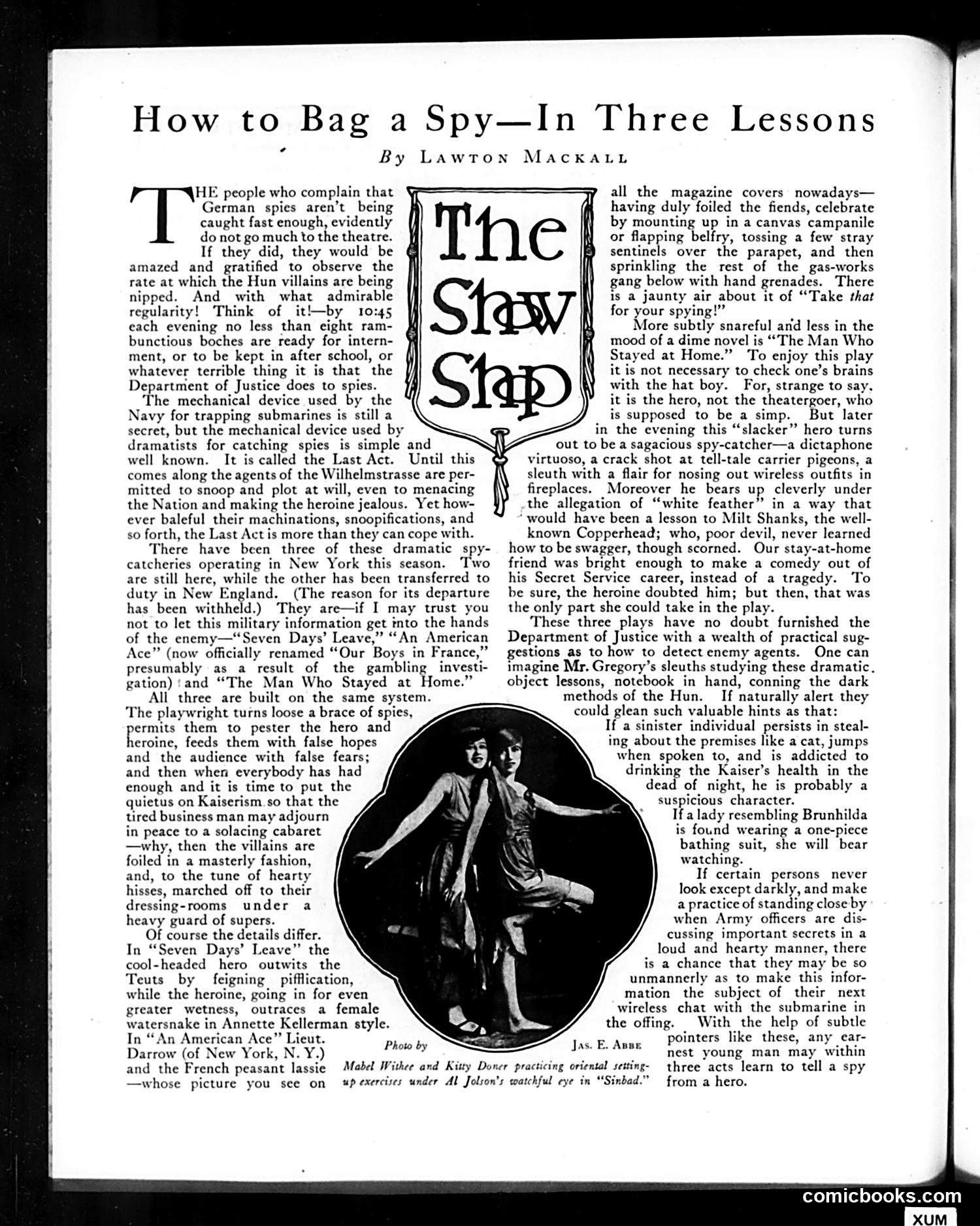
This article satirizes three popular Broadway plays—*Seven Days' Leave*, *An American Ace*, and *The Man Who Stayed at Home*—that capitalize on wartime anxiety by depicting German spy capture. The author mocks how these theatrical productions follow an identical formula: German agents ("Huns," "Boches") menace the hero and heroine throughout acts one and two, then get dramatically foiled and arrested in the final act. The satire targets both the predictable mechanics of these melodramas and American audiences' appetite for reassurance that enemy spies are being efficiently neutralized. The accompanying photo shows actors Mabel Withee and Kitty Doner rehearsing combat choreography under Al Jolson's supervision, illustrating the elaborate action sequences these plays featured. The piece gently ridicules how tired businessmen could leave the theater assured that Kaiserism faced no real threat from actual espionage.
📄 Transcribed text from this page (OCR, searchable)
Machine-transcribed from the original scan — historical spelling and the odd misread are preserved.
How to Bag a Spy—In Three Lessons By Lawton HE people who complain that German spies aren’t being caught fast enough, evidently do not go much to the theatre. If they did, they would be amazed and gratified to observe the rate at which the Hun villains are being nipped. And with what admirable regularity! Think of it!—by 10:45 each evening no less than eight ram- bunctious boches are ready for intern- ment, or to be kept in after school, or whatever terrible thing it is that the Department of Justice does to spies. The mechanical device used by the Navy for trapping submarines is still a secret, but the mechanical device used by dramatists for catching spies is simple and well known. It is called the Last Act. Until this comes along the agents of the Wilhelmstrasse are per- mitted to snoop and plot at will, even to menacing the Nation and making the heroine jealous. Yet how- ever baleful their machinations, snoopifications, and so forth, the Last Act is more than they can cope with. There have been three of these dramatic spy- catcheries operating in New York this season. Two are still here, while the other has been transferred to duty in New England. (The reason for its departure has been withheld.) They are—if I may trust you not to let this military information get into the hands of the enemy—‘Seven Days’ Leave,” “An American Ace” (now officially renamed “Our Boys in France,” presumably as a result of the gambling investi- gation) ‘and “The Man Who Stayed at Home.” All three are built on the same system. The playwright turns loose a brace of spies, ermits them to pester the hero and eroine, feeds them with false hopes and the audience with false fears; and then when everybody has had enough and it is time to put the quietus on Kaiserism.so that the tired business man may adjourn in peace to a solacing cabaret —why, then the villains are foiled in a masterly fashion, and, to the tune of hearty hisses, marched off to their dressing-rooms under a heavy guard of supers. Of course the details differ. In “Seven Days’ Leave” the cool-headed hero outwits the Teuts by feigning pifflication, while the heroine, going in for even greater wetness, outraces a female watersnake in Annette Kellerman style. In “An American Ace” Lieut. Photo by Darrow (of New York, N. Y.) 7 and the French peasant lassie —whose picture you see on Mabel Withee and Kitty Doner practicing oriental setting- up exercises under Al Jolson’s watchful eye in “Sinbad.” MacKALL all the magazine covers nowadays— having duly foiled the fiends, celebrate by mounting up in a canvas campanile or flapping belfry, tossing a few stray sentinels over the parapet, and then sprinkling the rest of the gas-works gang below with hand grenades. There is a jaunty air about it of “Take that for your spying!” More subtly snareful and less in the mood of a dime novel is “The Man Who Stayed at Home.” To enjoy this play it is not necessary to check one’s brains with the hat boy. For, strange to say, it is the hero, not the theatergoer, who is supposed to be a simp. But later in the evening this “slacker” hero turns out to be a sagacious spy-catcher—a dictaphone virtuoso, a crack shot at tell-tale carrier pigeons, a sleuth with a flair for nosing out wireless outfits in fireplaces. Moreover he bears up cleverly under the allegation of “white feather” in a way that ‘would have been a lesson to Milt Shanks, the well- known Copperhead; who, poor devil, never learned how to be swagger, though scorned. Our stay-at-home friend was bright enough to make a comedy out of his Secret Service career, instead of a tragedy. To be sure, the heroine doubted him; but then, that was the only part she could take in the play. These three plays have no doubt furnished the Department of Justice with a wealth of practical sug- gestions as to how to detect enemy agents. One can imagine Mr. Gregory’s sleuths studying these dramatic. object lessons, notebook in hand, conning the dark methods of the Hun. If naturally alert they could glean such valuable hints as that: If a sinister individual persists in steal- ing about the premises like a cat, jumps when spoken to, and is addicted to drinking the Kaiser’s health in the dead of night, he is probably a suspicious character. If a lady resembling Brunhilda is found wearing a one-piece bathing suit, she will bear watching. If certain persons never look except darkly, and make a practice of standing close by when Army officers are dis- cussing important secrets in a loud and hearty manner, there is a chance that they may be so unmannerly as to make this infor- mation the subject of their next wireless chat with the submarine in the offing. With the help of subtle pointers like these, any ear- nest young man may within three acts learn to tell a spy from a hero. Jas. E. Anse comicbooks.com