
Judge, 1918-05-11 · page 9 of 36
Judge — May 11, 1918 — page 9: what you’re looking at
What you’re looking at
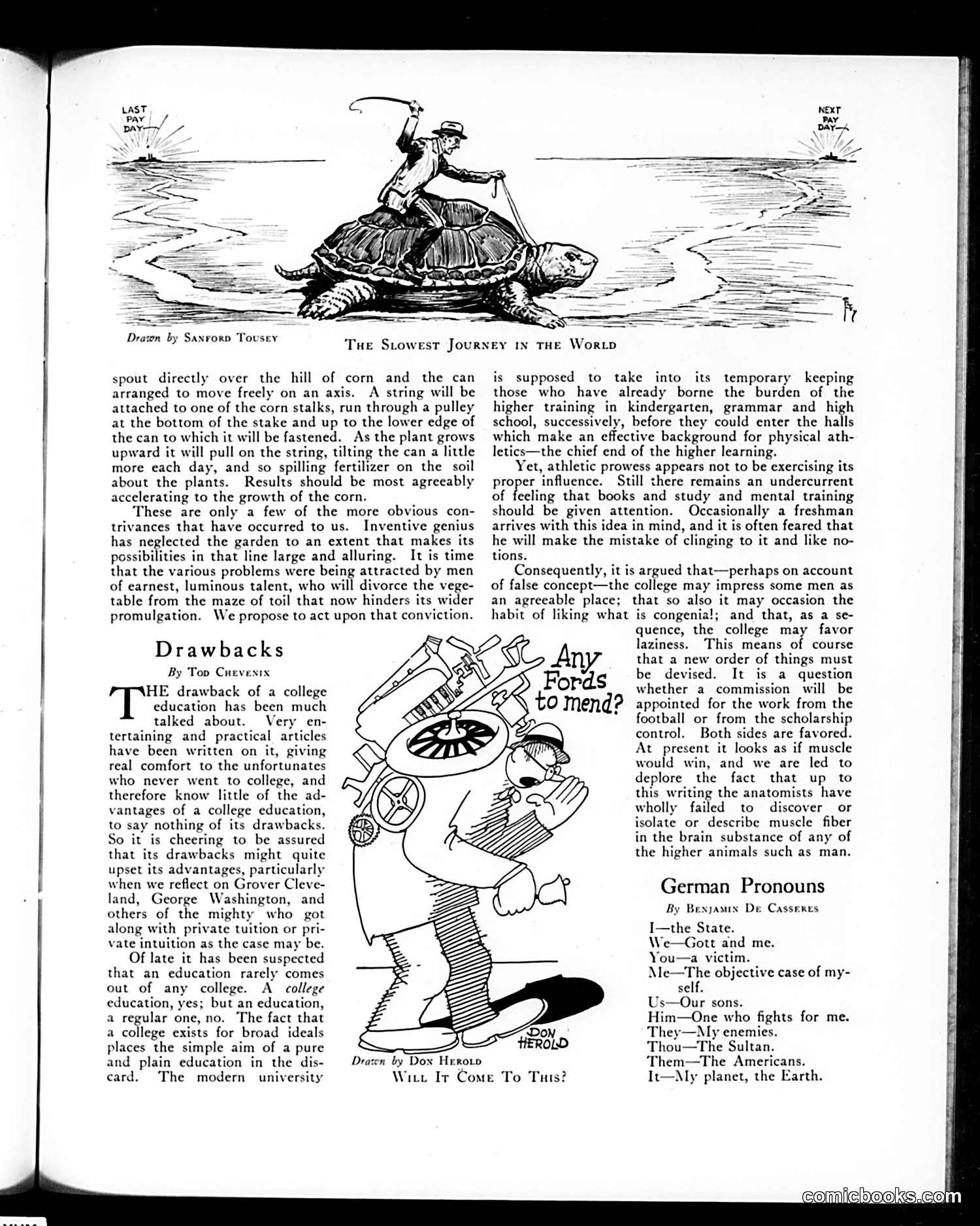
**Top Cartoon ("The Slowest Journey in the World"):** A satirical drawing by Sanford Tousey depicts a man riding a giant turtle, titled ironically given the turtle's reputation for slowness. This appears to be visual humor about impractical or absurdly slow transportation—likely mocking either an invention, technology, or lifestyle choice contemporary to the publication. **"Drawbacks" Essay:** By Top Chevenis, this critiques American college education. The author argues colleges have abandoned genuine education for "broad ideals" and athletic training, suggesting higher learning prioritizes sports over intellectual development. The piece notes that some students arrive wanting actual study but risk being discouraged by institutional emphasis on athletics rather than academics. **"Will It Come To This?" Cartoon:** A mechanical/robotic figure by Dos Herold, likely satirizing industrial automation or technological over-reliance, though the specific reference is unclear without additional context. **"German Pronouns":** Benjamin De Casseres's humorous redefinition of pronouns reflects post-WWI American attitudes toward Germany, characterizing German leadership and identity in darkly satirical terms.
📄 Transcribed text from this page (OCR, searchable)
Machine-transcribed from the original scan — historical spelling and the odd misread are preserved.
ee Drawn by Saxrorv Tovsey spout directly over the hill of corn and the can arranged to move freely on an axis. A string will be attached to one of the corn stalks, run through a pulley at the bottom of the stake and up to the lower edge of the can to which it will be fastened. As the plant grows upward it will pull on the string, tilting the can a little more each day, and so spilling fertilizer on the soil about the plants. Results should be most agreeably accelerating to the growth of the corn. These are only a few of the more obvious con- trivances that have occurred to us. Inventive genius has neglected the garden to an extent that makes its possibilities in that line large and alluring. It is time that the various problems were being attracted by men of earnest, luminous talent, who will divorce the vege- table from the maze of toil that now hinders its wider promulgation. We propose to act upon that conviction. Drawbacks By Top Cueventx HE drawback of a college | education has been much talked about. Very en- tertaining and practical articles have been written on it, giving real comfort to the unfortunates who never went to college, and therefore know little of the ad- vantages of a college education, to say nothing of its drawbacks. So it is cheering to be assured that its drawbacks might quite upset its advantages, particularly when we reflect on Grover Cleve- land, George Washington, and others of the mighty who got along with private tuition or pri- vate intuition as the case may be. Of late it has been suspected that an education rarely comes out of any college. A college education, yes; but an education, a regular one, no. The fact that a college exists for broad ideals places the simple aim of a pure and plain education in the dis- card. The modern university Drazen by Dox Heroro Witt It Come To Tuts? Tue Stowest Journey tn THE WorLD is supposed to take into its temporary keeping those who have already borne the burden of the higher training in kindergarten, grammar and high school, successively, before they could enter the halls which make an effective background for physical ath- letics—the chief end of the higher learning. Yet, athletic prowess appears not to be exercising its proper influence. Still there remains an undercurrent of feeling that books and study and mental training should be given attention. Occasionally a freshman arrives with this idea in mind, and it is often feared that he will make the mistake of clinging to it and like no- tions. Consequently, it is argued that—perhaps on account of false concept—the college may impress some men as an agreeable place; that so also it may occasion the habit of liking what is congenia!; and that, as a se- quence, the college may favor laziness. This means of course that a new order of things must be devised. It is a question whether a commission will be O\ to mend? appointed for the work from the * football or from the scholarship control. Both sides are favored. At present it looks as if muscle would win, and we are led to deplore the fact that up to this writing the anatomists have wholly failed to discover or isolate or describe muscle fiber in the brain substance of any of the higher animals such as man. German Pronouns By Bexsamtx De Casseres I—the State. We—Gott and me. You—a victim. Me—The objective case of my- self. Us—Our sons. Him—One who fights for me. They—My enemies. Thou—The Sultan. Them—The Americans. It—My planet, the Earth.