
A complete issue · 36 pages · 1918
Judge — March 9, 1918
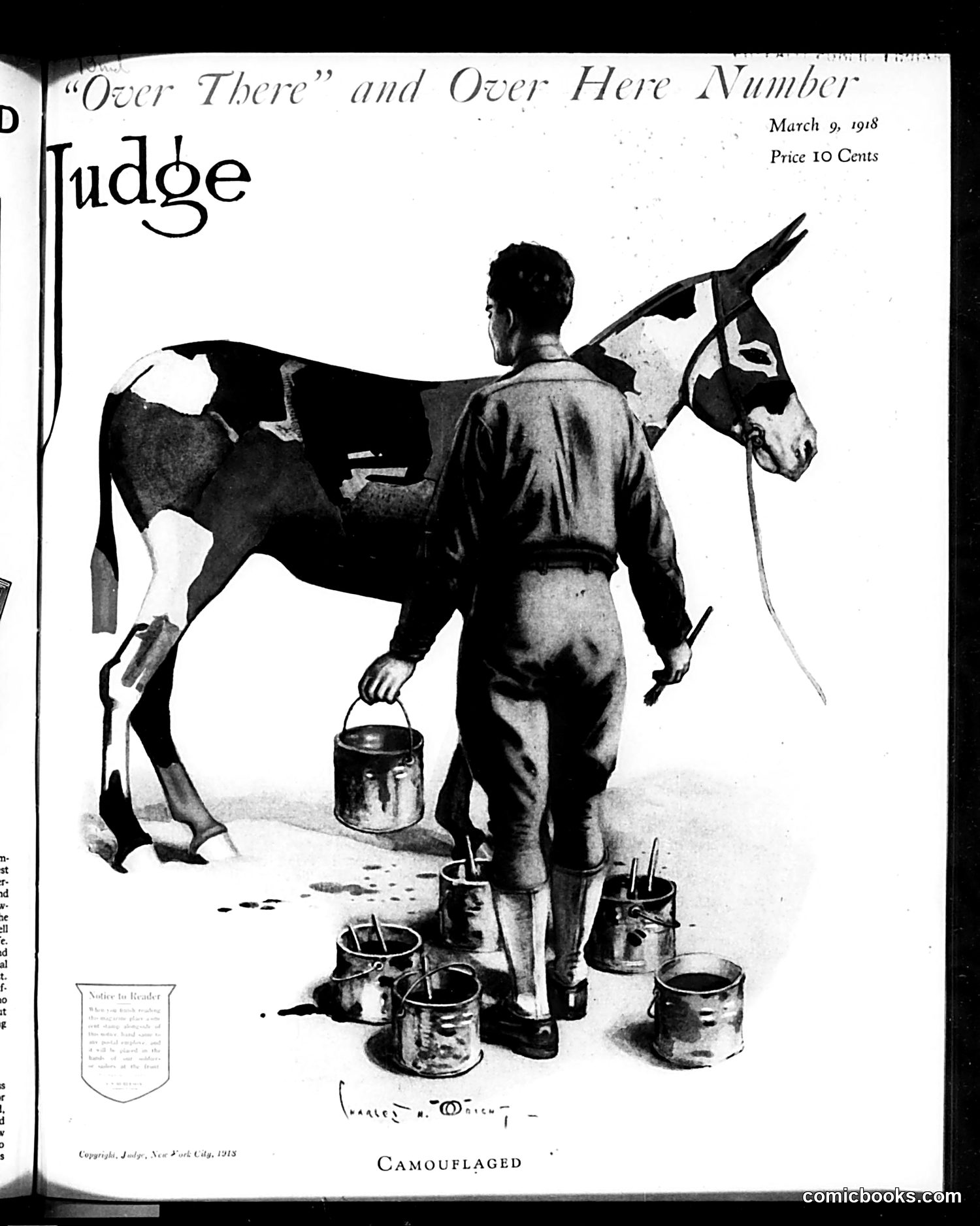
This WWI-era cartoon satirizes military camouflage efforts. A shirtless soldier paints a cow with camouflage patterns using buckets of paint, attempting to disguise the animal for military purposes—likely for transport or supply lines near the front. The satire targets the absurdity of over-applying camouflage logic: while camouflage helps soldiers and equipment blend into landscapes, painting a live cow serves no practical purpose. The joke mocks either excessive military enthusiasm for camouflage techniques or bureaucratic inefficiency during wartime. The title "Camouflaged" (French military term recently adopted by English speakers) emphasizes how the concept had become fashionable but sometimes foolishly applied. This reflects 1918 American attitudes toward contemporary warfare innovations.
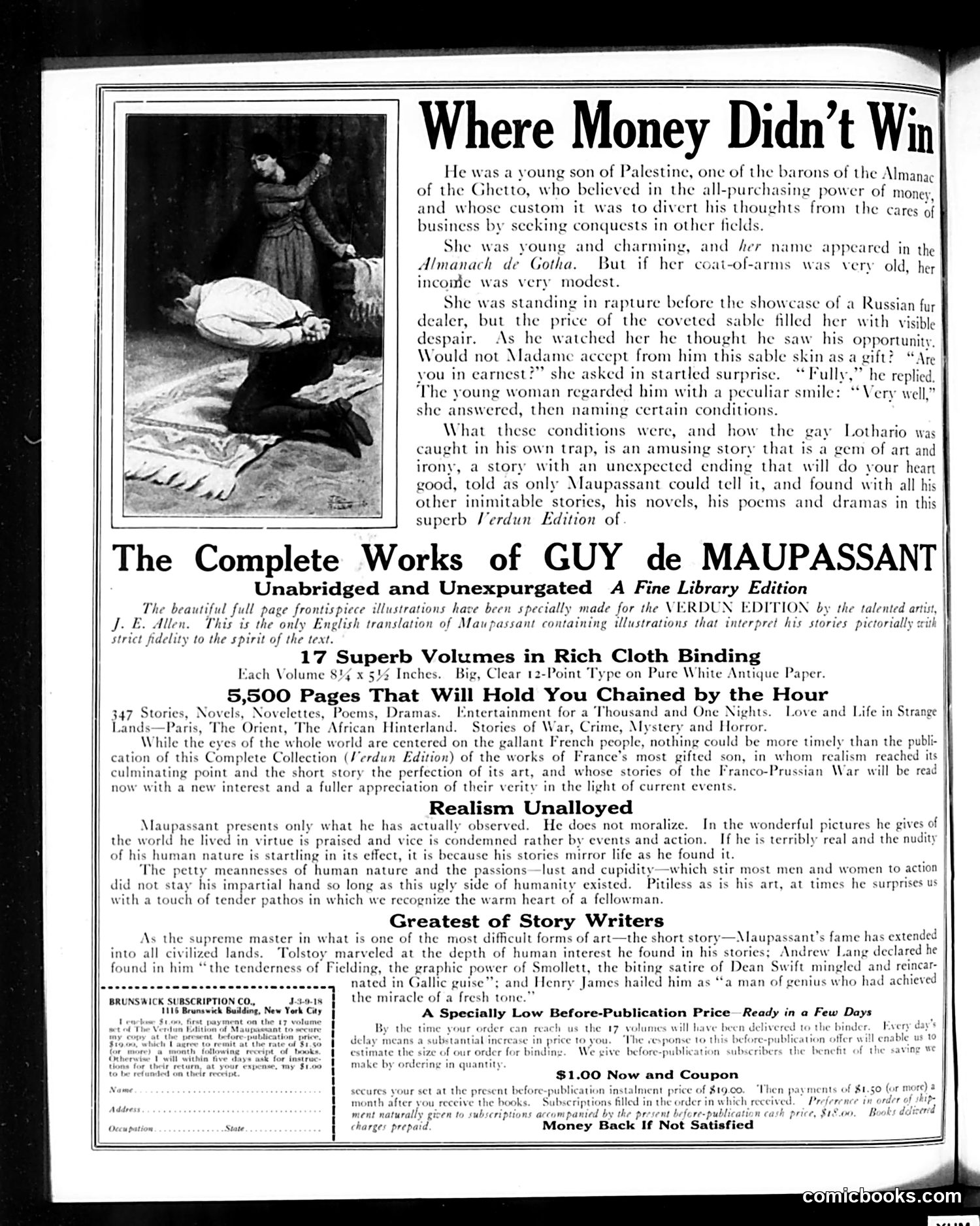
This page is primarily **advertising**, not satire or political commentary. It promotes "The Complete Works of Guy de Maupassant"—a 17-volume collection of the French writer's stories, novels, and plays. The illustration shows a scene from one of Maupassant's stories titled "Where Money Didn't Win," depicting a young Palestinian nobleman attempting to purchase a Russian sable fur from a woman by offering it as a gift. The narrative describes how his attempt fails when she sets unexpected conditions, ultimately outwitting him. The advertisement emphasizes Maupassant's reputation as a realist writer celebrated for depicting human nature, passion, and social observation. It highlights this as a specially illustrated Verdin Edition and offers a low introductory price of $1.00 with a coupon.
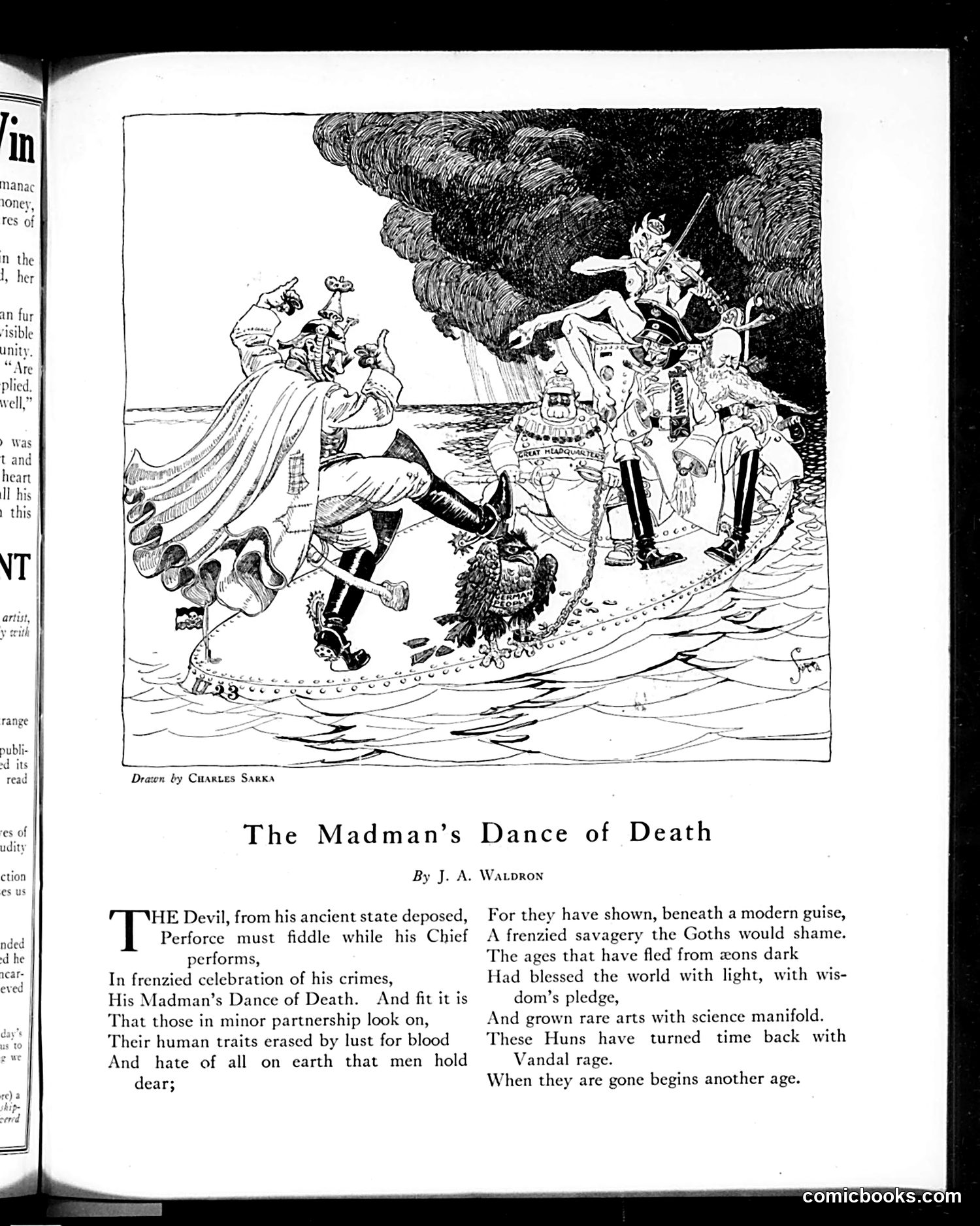
This satirical poem and illustration by Charles Sarka depicts a demonic figure conducting a "Dance of Death" with various grotesque characters. The verse criticizes modern civilization, suggesting that contemporary society—despite claims of progress through science and reason—has merely masked ancient barbarism under a modern veneer. The poem specifically references "Huns" turning back time "with Vandal rage," likely alluding to Germanic militarism and World War I destruction. The satire argues that claims of enlightenment and civilization are hollow; humanity has regressed to primitive savagery. The Devil conducts this macabre dance, implying that modern warfare and societal collapse represent a return to chaos and destruction beneath the facade of progress.
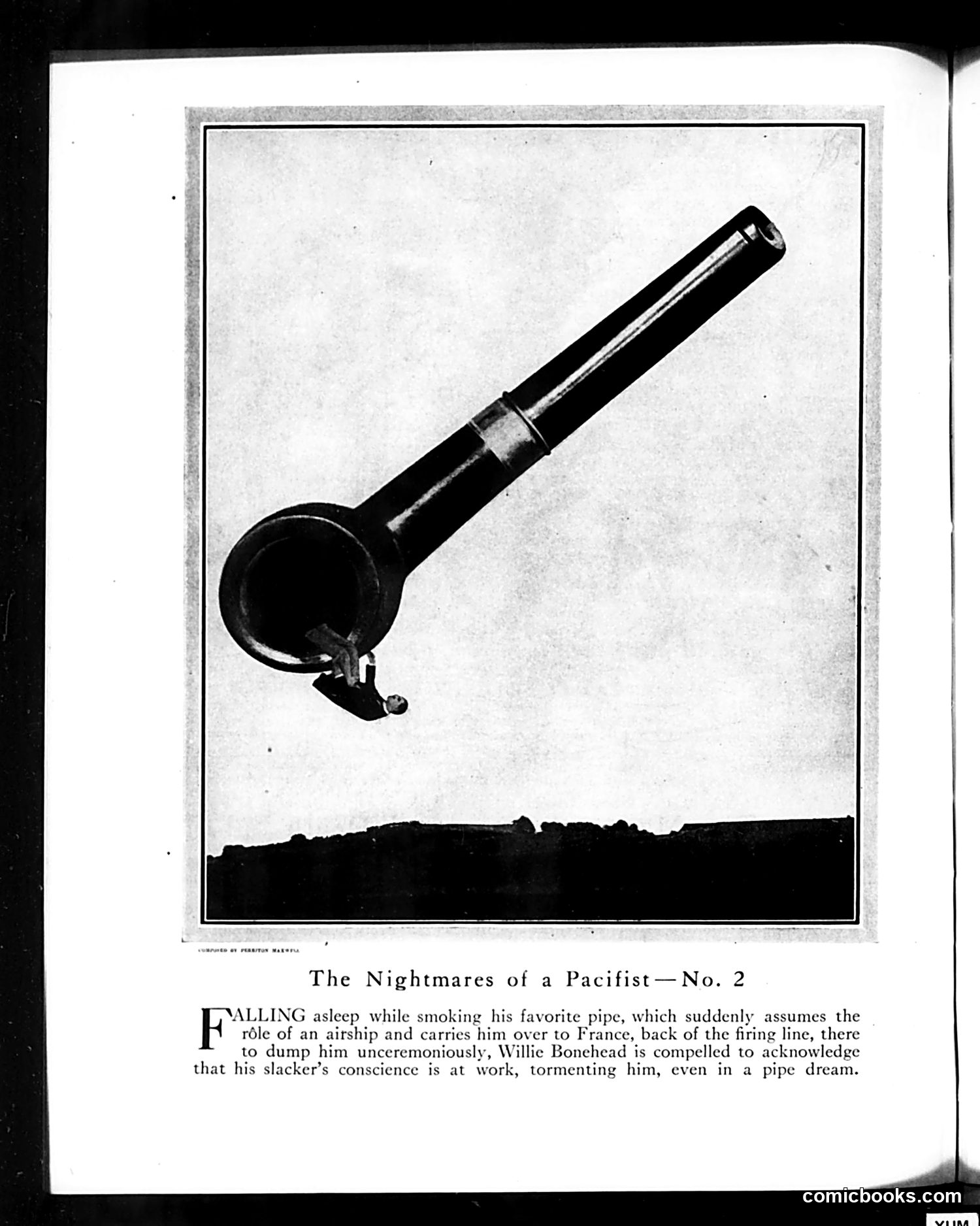
This is part of a series satirizing pacifists during World War I. The image shows a large pipe transformed into an airship dropping bombs. The caption describes Willie Bonehead (a generic everyman name) falling asleep while smoking, then dreaming his pipe becomes a warship that carries him over France behind enemy lines to dump him unceremoniously. The joke targets pacifists' anxieties about war—suggesting their peaceful desires are naive fantasy. The pipe-as-weapon imagery implies pacifists' avoidance of military conflict is absurd and dangerous. The satire mocks pacifists for what Judge's editors viewed as cowardly or treasonous opposition to American military involvement, a common theme in WWI-era propaganda.
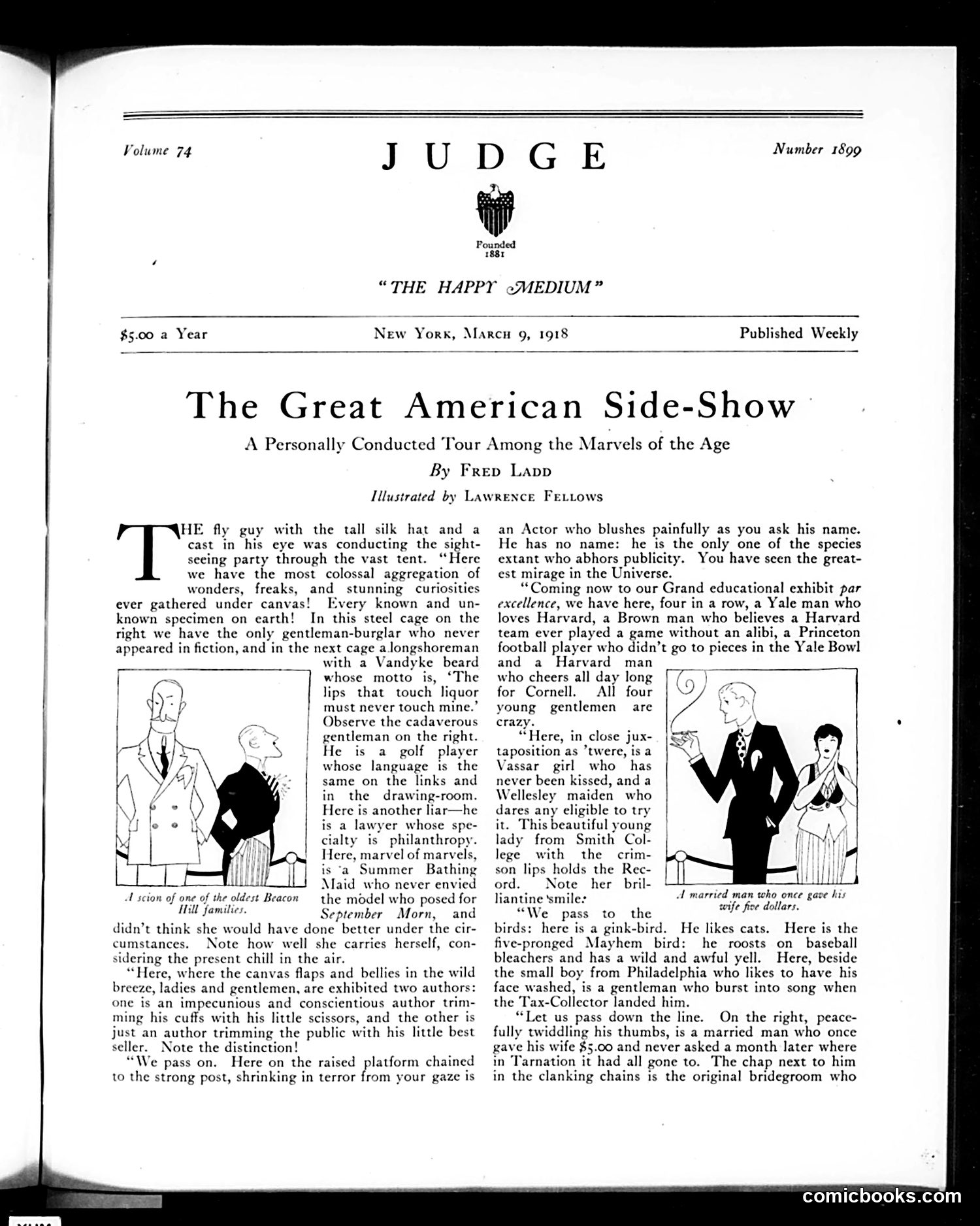
This satirical article critiques American social types and institutions through carnival metaphors. The illustrations lampoon pretentious figures: a gentleman-burglar, a lawyer disguising philanthropy as specialty, and trim-fingered authors posing as public benefactors. The text mocks Ivy League culture, mentioning Harvard loyalists, Princeton football fans, and Cornell cheerleaders as superficial status-seekers. It ridicules a "Vassar girl" and "Smith College" women as shallow celebrities, a "gink-bird" (possibly slang for an undesirable type), and a "Tax-Collector" who sings loudly. Published during World War I, the piece appears to satirize American upper-class vanity and hypocrisy—their performative charity, intellectual pretensions, and collegiate tribalism—presenting society itself as a circus of affectation.
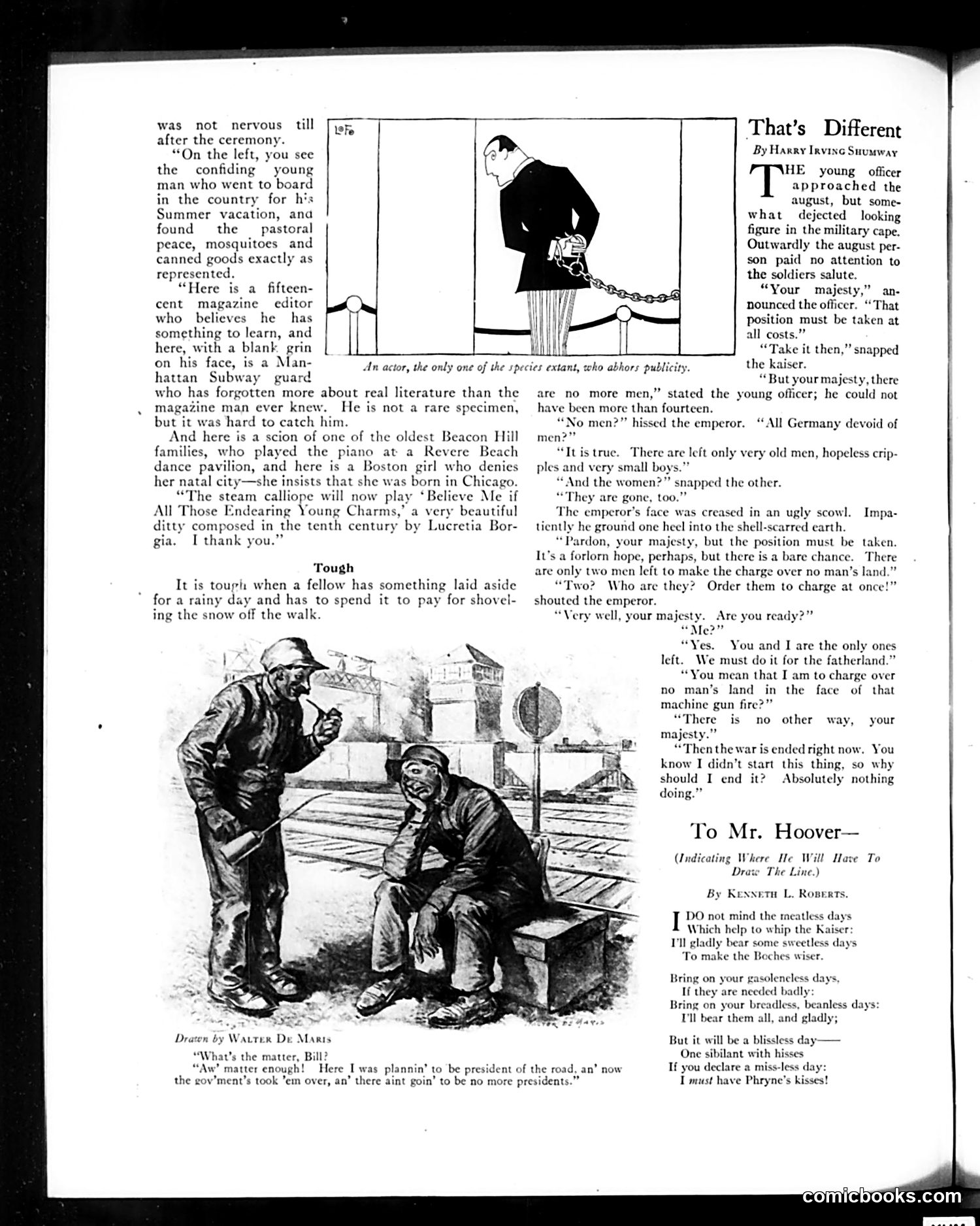
The top cartoon "That's Different" by Harry Irving Shumway depicts a military interaction during what appears to be World War I. A young officer refuses to salute an emperor figure, claiming his position must be maintained "at all costs." The emperor responds sarcastically that only two men remain to defend the land, yet the officer still refuses to compromise military protocol. The satire criticizes rigid military hierarchy and formality—even when facing defeat, the officer prioritizes etiquette over practical military necessity. This likely mocks German military's famous rigid adherence to protocol. Below, "Tough" by Walter De Maris shows working men discussing financial hardship, reflecting post-war economic struggles. The "To Mr. Hoover" poem references President Herbert Hoover's role in wartime food administration.
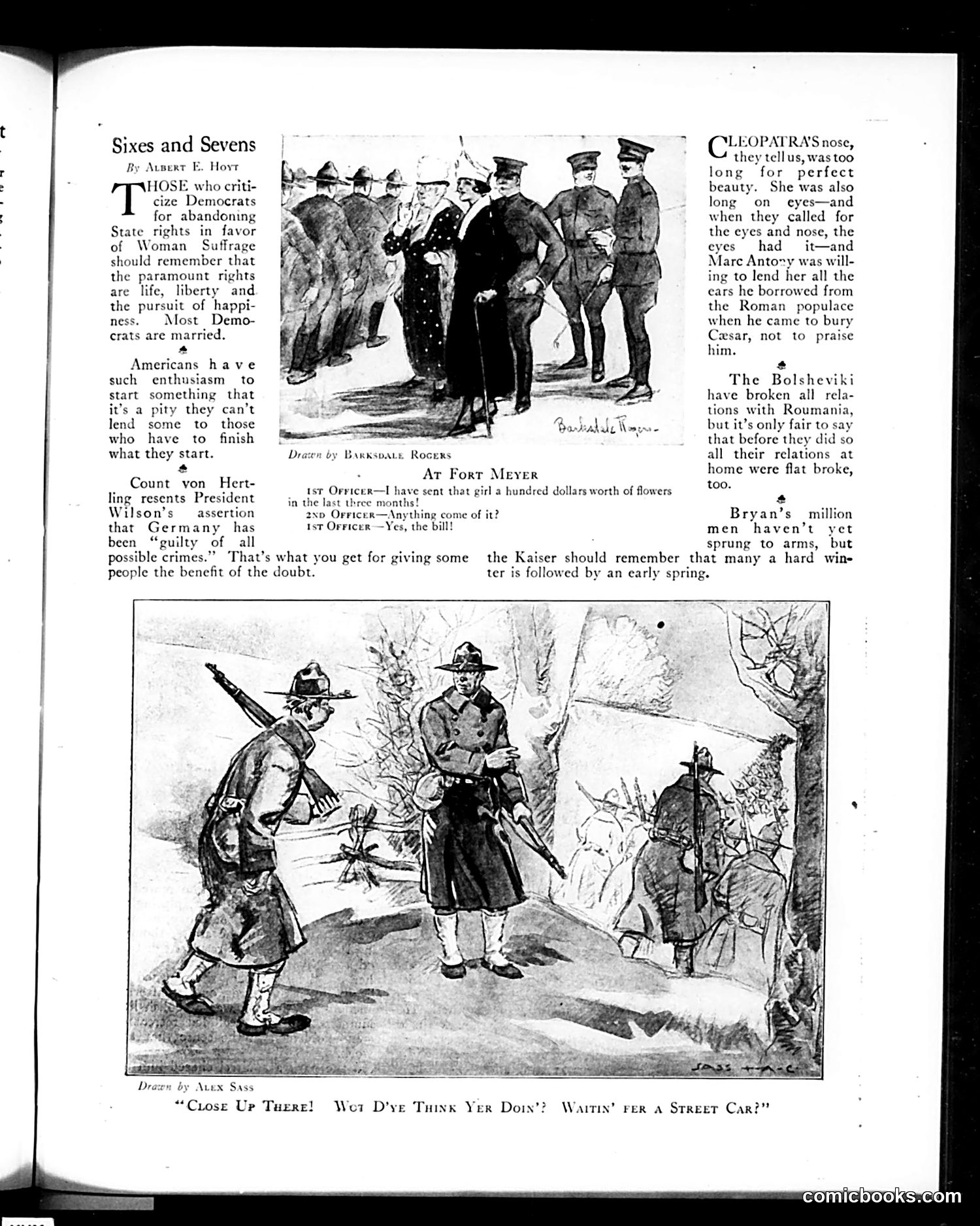
This page contains political commentary and military humor from the World War I era (likely 1917-18). **Top cartoon** ("At Fort Meyer"): Two officers discuss one sending expensive flowers to a woman—the punchline being he only received a bill, satirizing romantic futility. **Bottom cartoon** (by Alex Sass): Shows soldiers in a trench. The caption's dialect humor ("Close Up There! Wot D'ye Think Yer Doin'? Waitin' fer a Street Car?") mocks soldiers waiting idly under fire—suggesting incompetence or cowardice. **Text commentary** addresses: - **Woman Suffrage**: Defends Democratic support, noting married Democrats benefit from life/liberty/happiness - **Count von Hertling/Germany**: Mocks German resentment of Wilson calling Germany "guilty of all possible crimes" - **Bolsheviks/Russia**: Dark humor about broken relations with Romania and domestic collapse - **Bryan's army**: References William Jennings Bryan's failed recruitment of volunteer soldiers The page reflects American wartime anxieties and satirizes both military inefficiency and diplomatic tensions.
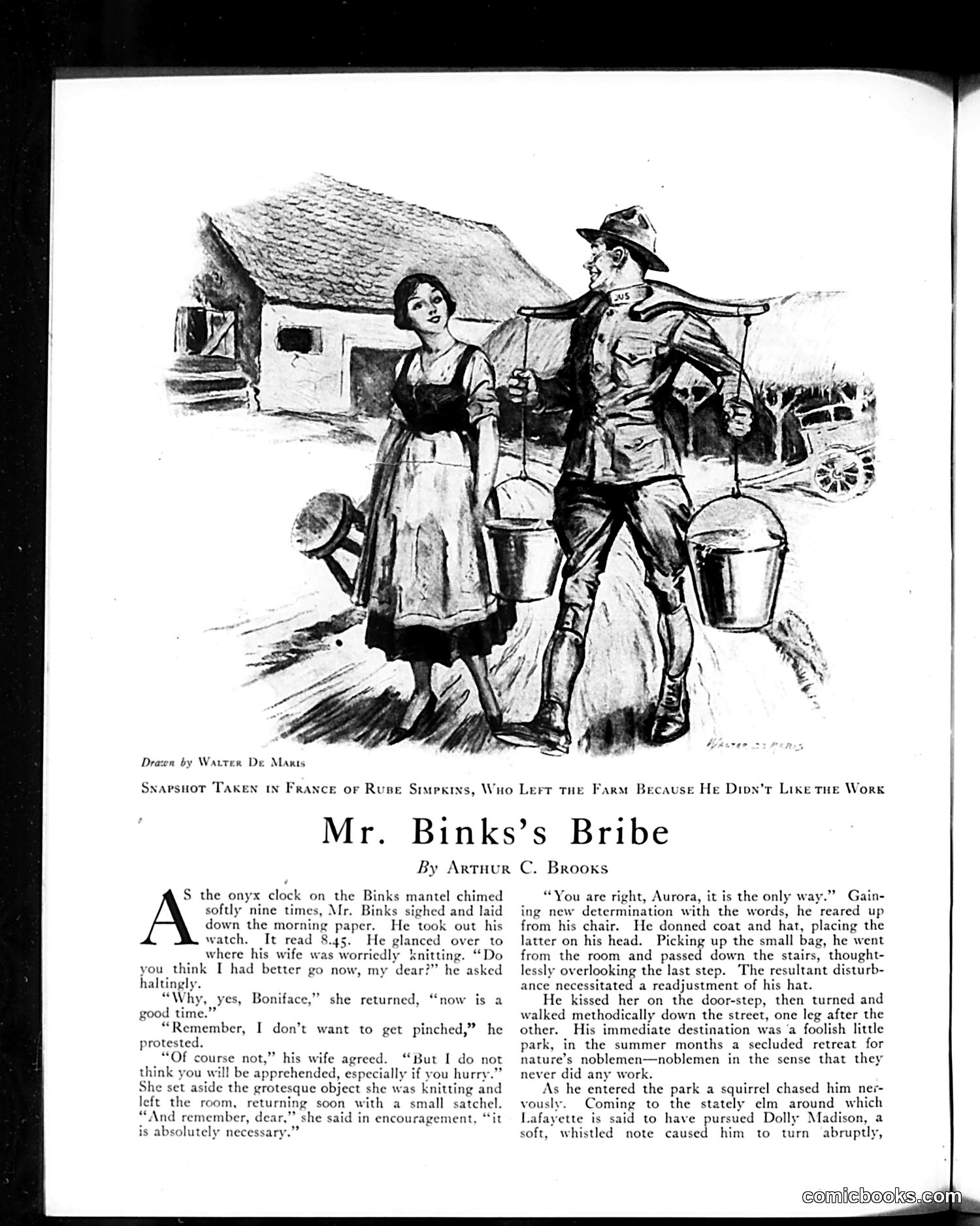
This is a humorous domestic fiction piece, not political satire. The story depicts Mr. Binks and his wife Aurora discussing a secretive errand early in the morning. His wife gives him a small bag and warns him not to "get pinched" (arrested). He then heads to a park—described as a refuge for "nature's noblemen" who "never did any work." The satire appears to target lazy, unemployed men who loaf in parks rather than work. The title's reference to a "bribe" likely suggests Binks is attempting some form of minor corruption or improper conduct. The illustration shows a soldier or military figure with a woman in period dress, possibly referencing a separate anecdote about "Rube Simpkins" leaving farm work. The humor lies in the conspiratorial tone between spouses regarding clearly questionable activity treated as mundane domestic routine.
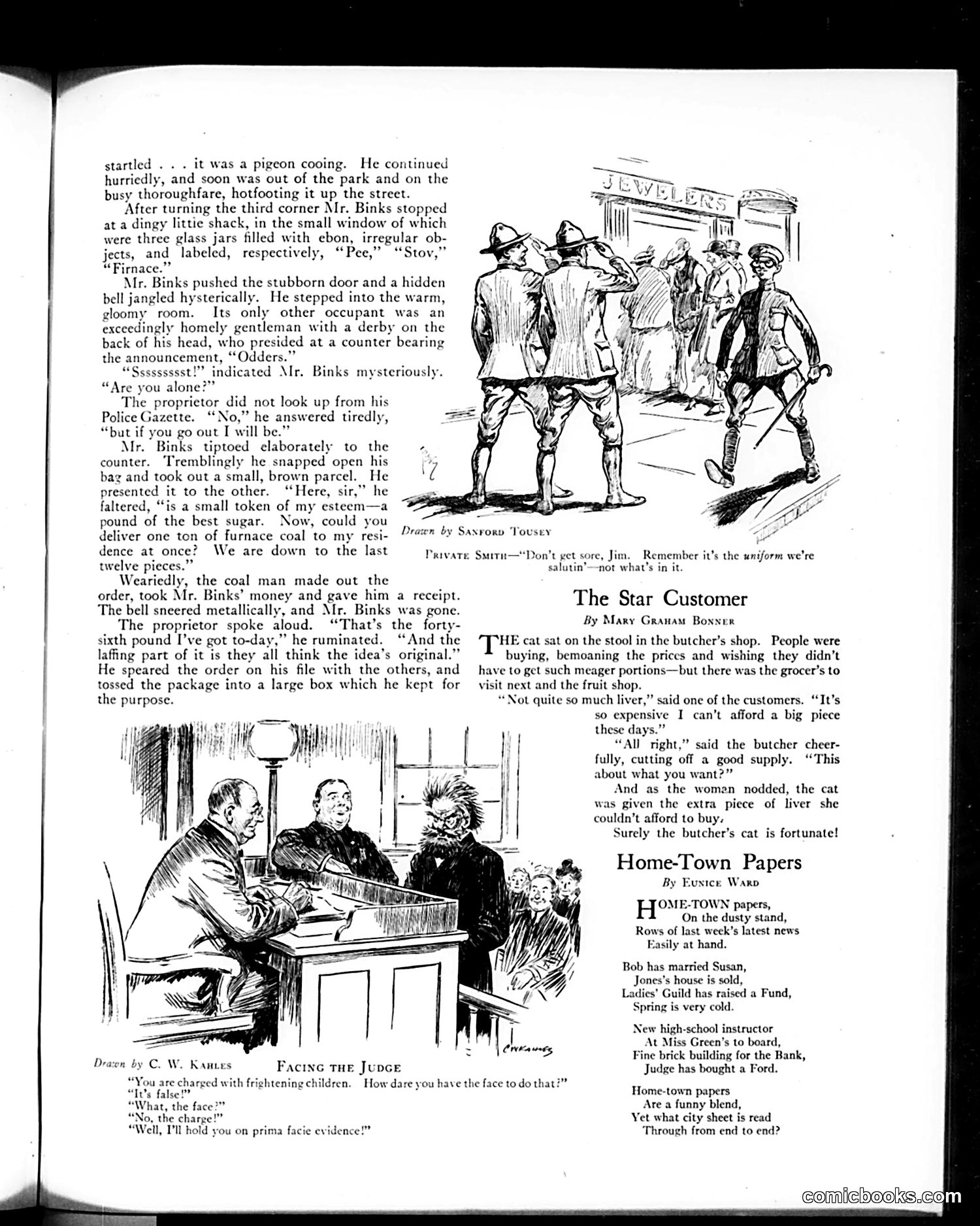
This page contains three satirical pieces reflecting early 20th-century American life: **"The Coal Man Bribe"**: Mr. Binks repeatedly visits a coal dealer, each time offering a pound of sugar as a "token of esteem" to secure fuel delivery. The proprietor reveals this is the forty-sixth such bribe that day—everyone thinks they're being original with this scheme. The satire targets widespread petty corruption and how people rationalized bribing essential service providers during what appears to be a fuel shortage or scarcity period. **"Facing the Judge"**: A crude political cartoon about courtroom injustice, where someone charged with "frightening children" is held on "prima facie evidence" despite denying it—satirizing unfair judicial proceedings. **"The Star Customer"**: A brief story about a butcher's cat receiving scraps that poor customers cannot afford, highlighting economic hardship and class disparities in food access. **"Home-Town Papers"**: A poem mocking small-town newspapers for recycled content (marriages, property sales, local purchases like Judge magazine's mention of "Judge has bought a Ford").
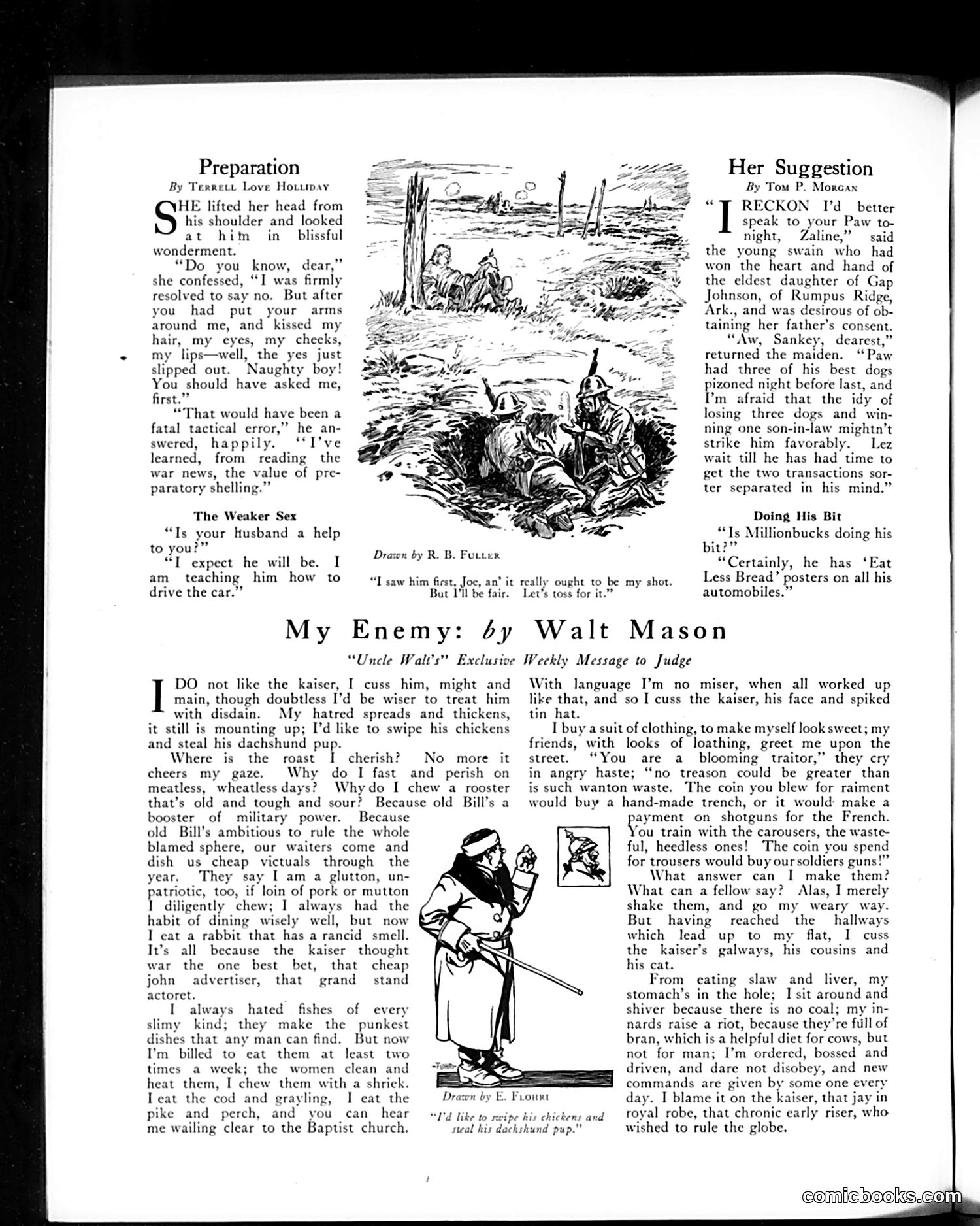
This page contains three humorous short pieces reflecting WWI-era American concerns: **"Preparation"** uses military jargon as romantic innuendo—a man justifies kissing a woman without permission by citing "preparatory shelling" from war news, treating courtship as military strategy. **"Her Suggestion"** is rural American humor where a girl advises her suitor to delay proposing to her father because he recently poisoned three dogs; she fears he won't distinguish between losing dogs and gaining a son-in-law. **"My Enemy" by Walt Mason** is the main piece—a patriotic complaint about wartime food rationing and sacrifices. The speaker resents being forced to eat unpalatable foods (old roosters, fish) and criticized for buying new clothes while soldiers need supplies. He directs his frustration at Kaiser Wilhelm II, blaming him for America's hardships. The illustration shows a scrawny, resentful man. This reflects genuine civilian resentment over WWI rationing policies and patriotic pressure to conserve resources for the war effort.
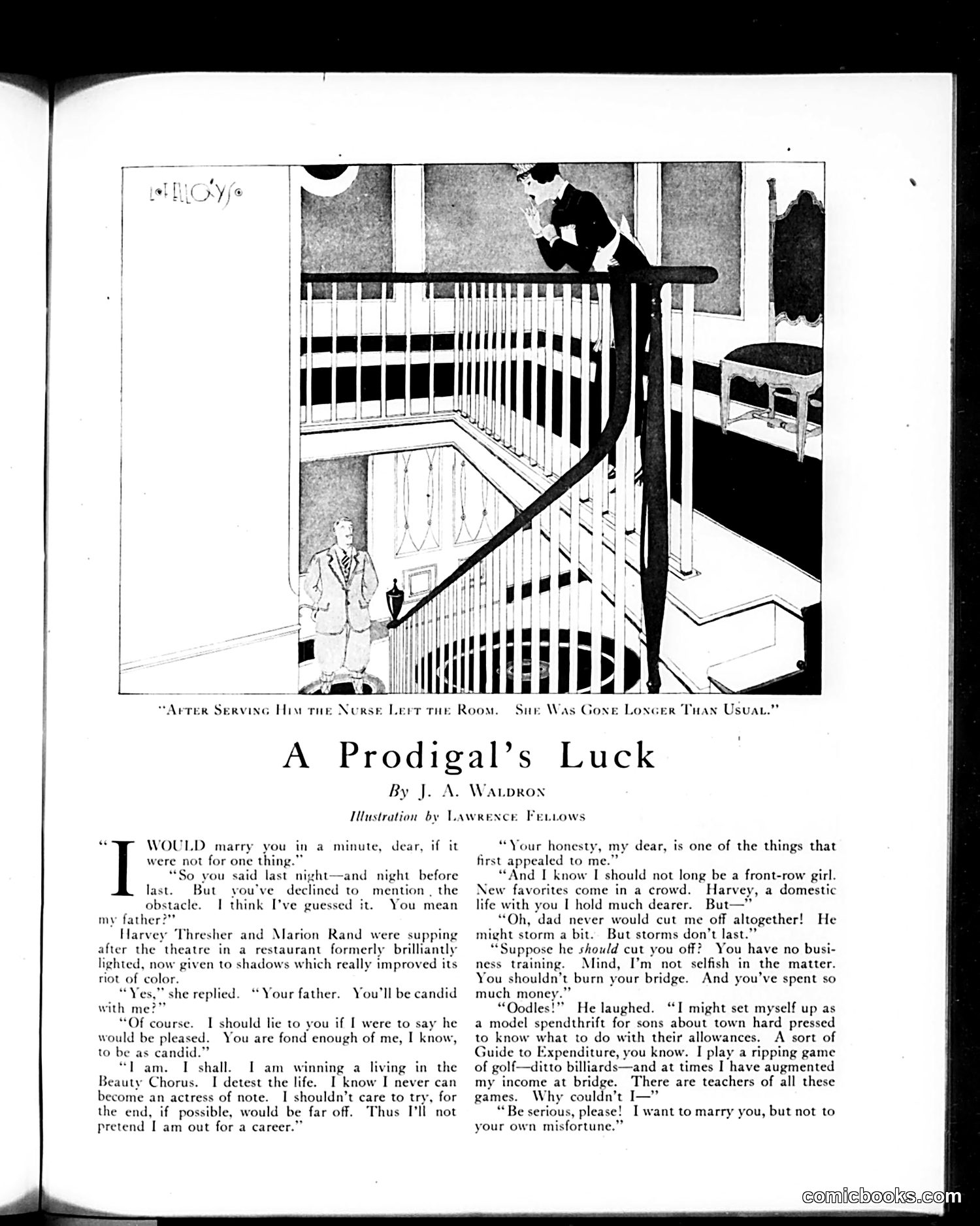
This is a short story (not a political cartoon) by J.A. Waldron, illustrated by Lawrence Fellows. It depicts a marriage proposal scene between Harvey Thresher and Marion Rand, a chorus girl, in a dimly-lit restaurant. The satirical premise concerns class anxiety and marital prospects in early 20th-century America: Marion worries that Harvey's father will disapprove of her modest theatrical background and lack of business training. Harvey dismisses financial concerns, boasting he can support them through gambling at golf and bridge, and by becoming a "model spendthrift"—a self-aware joke about teaching other wealthy young men how to squander allowances. The humor targets wealthy idle young men dependent on family money, their frivolous pursuits (cards, golf), and their assumed ability to marry "down" socially without consequence. Marion's caution about "burning bridges" with her father suggests the story will explore whether Harvey's confidence proves justified or foolish.
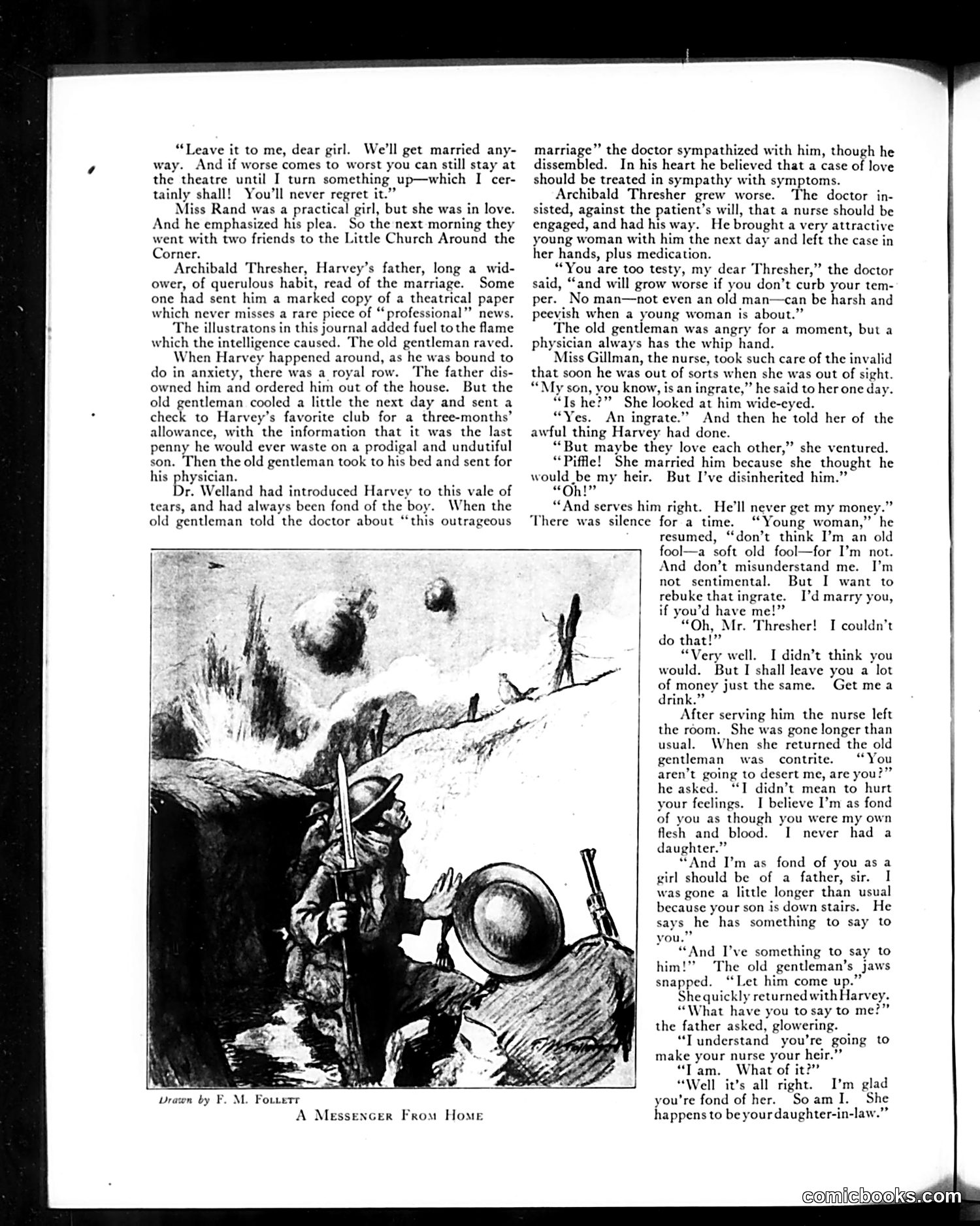
This story-illustration depicts a domestic reconciliation plot common to early 20th-century sentimental fiction. The narrative involves: **The situation**: Young actor Harvey Thresher marries actress Miss Rand against his wealthy father Archibald's wishes. The father, initially enraged and disinheriting his son, falls ill. **The scheme**: A sympathetic doctor arranges for an attractive nurse, Miss Gillman, to care for the old man. The nurse skillfully manipulates the situation—the father grows emotionally attached and even proposes marriage (or at least promises her money), while she secretly facilitates reconciliation with Harvey. **The satire**: Judge satirizes both the predictable melodrama of theatrical romance and the transparency of the nurse's social climbing. The "messenger from home" appears to be Miss Gillman, whose careful emotional engineering accomplishes what direct confrontation couldn't: softening the father's heart through romantic attachment rather than genuine forgiveness. The illustration by F.M. Follett shows a figure in period dress, likely representing the scheme's dramatic moment.
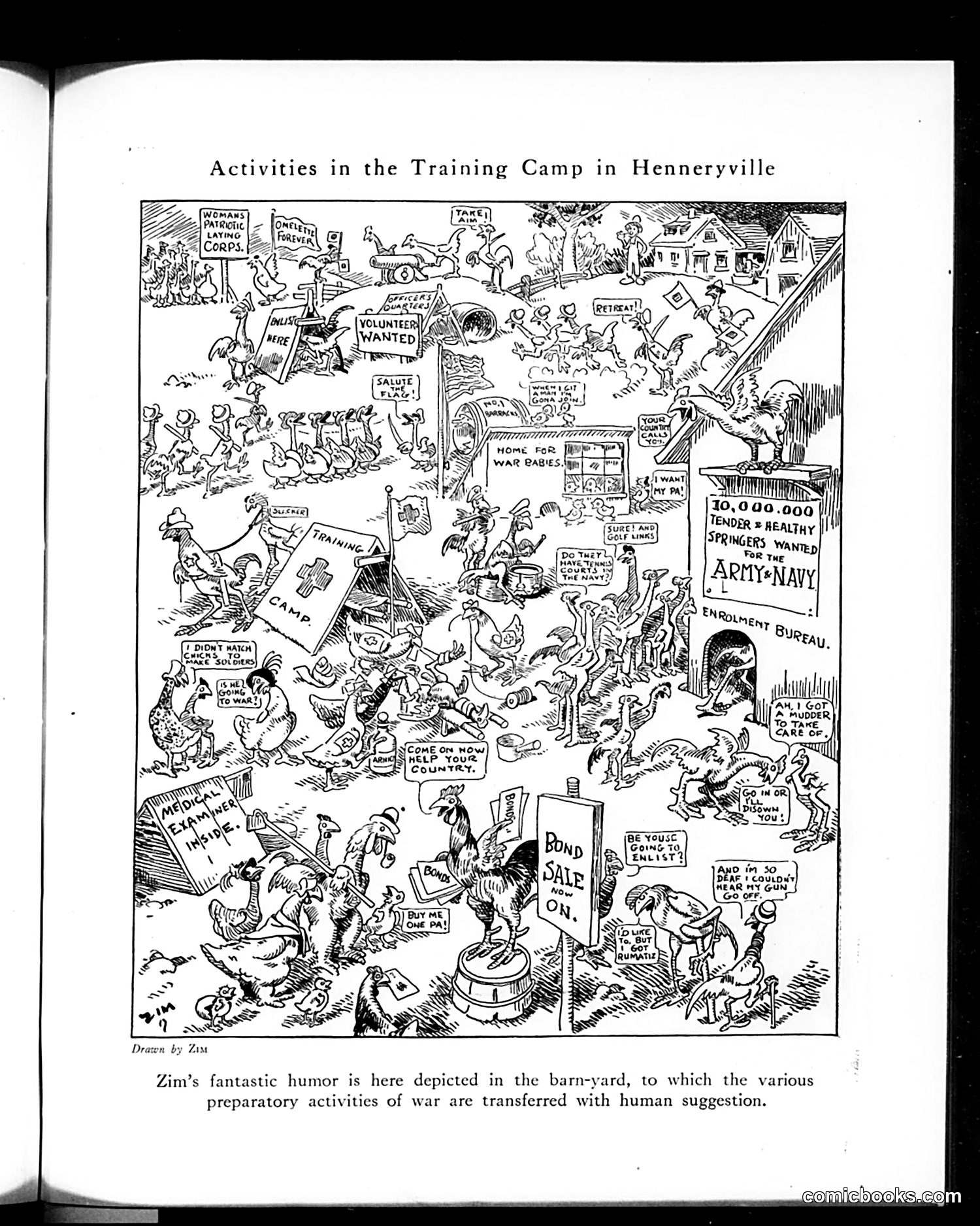
This page features a single satirical cartoon by artist "Zim" that humorously depicts World War I military preparation activities using barnyard animals and farm settings. The cartoon replaces human soldiers and military structures with chickens, roosters, and other farm creatures performing equivalent war-preparation tasks. Visible references include recruitment signs ("Volunteers Wanted"), war bonds sales, a "Home for War Babies," training activities, and patriotic appeals ("Help Your Country"). The satire works by treating serious wartime mobilization—conscription, fundraising, care for war dependents—as absurd farm operations. The joke appears to mock the sometimes-chaotic nature of wartime preparation and recruitment efforts by reducing them to barnyard chaos. This reflects the skeptical, critical humor *Judge* magazine often directed at government and military organization during the WWI era.
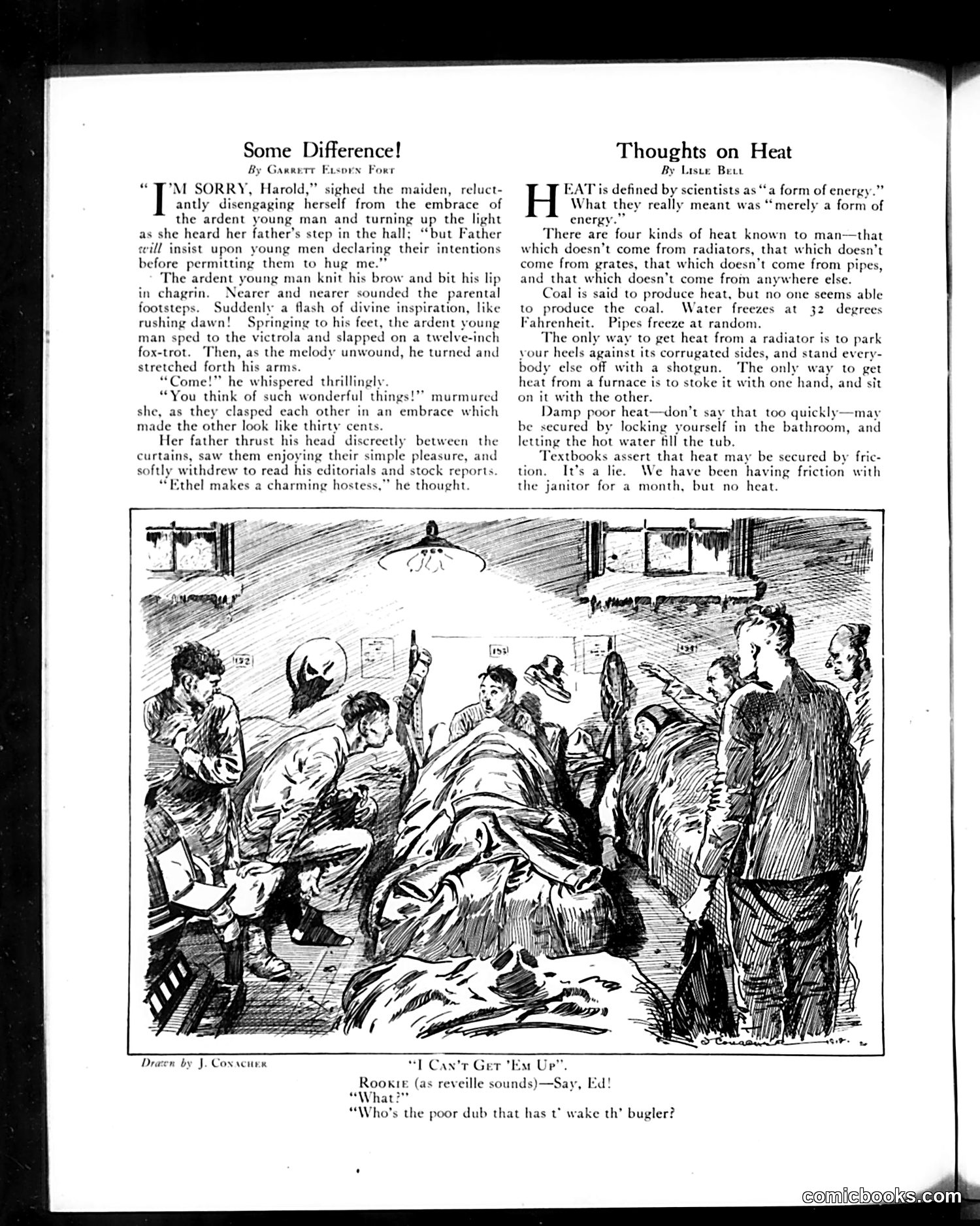
**"Some Difference!"** satirizes dating customs and parental authority. A young couple embrace when interrupted by her father's footsteps. The man cleverly pivots to dancing (to a victrola/record player) instead of "hugging," framing it as innocent entertainment. The father, satisfied the couple is merely dancing, withdraws. The joke: dancing together was socially acceptable where embracing wasn't—a thin distinction that exposed the absurdity of rigid Victorian-era courtship rules enforcing declarations of intent. **"Thoughts on Heat"** is humorous social commentary about heating systems in American homes. The author mocks the scientific definition of heat while cataloging the frustrating reality: radiators, grates, and pipes rarely produce actual warmth. The piece concludes with dry wit about friction and an uncooperative janitor, resonating with readers struggling through cold winters dependent on inadequate building heating. **Bottom cartoon** depicts military life's absurdity: a recruit questions who has to wake the bugler—if bugles signal wake-up, who wakes the bugler?
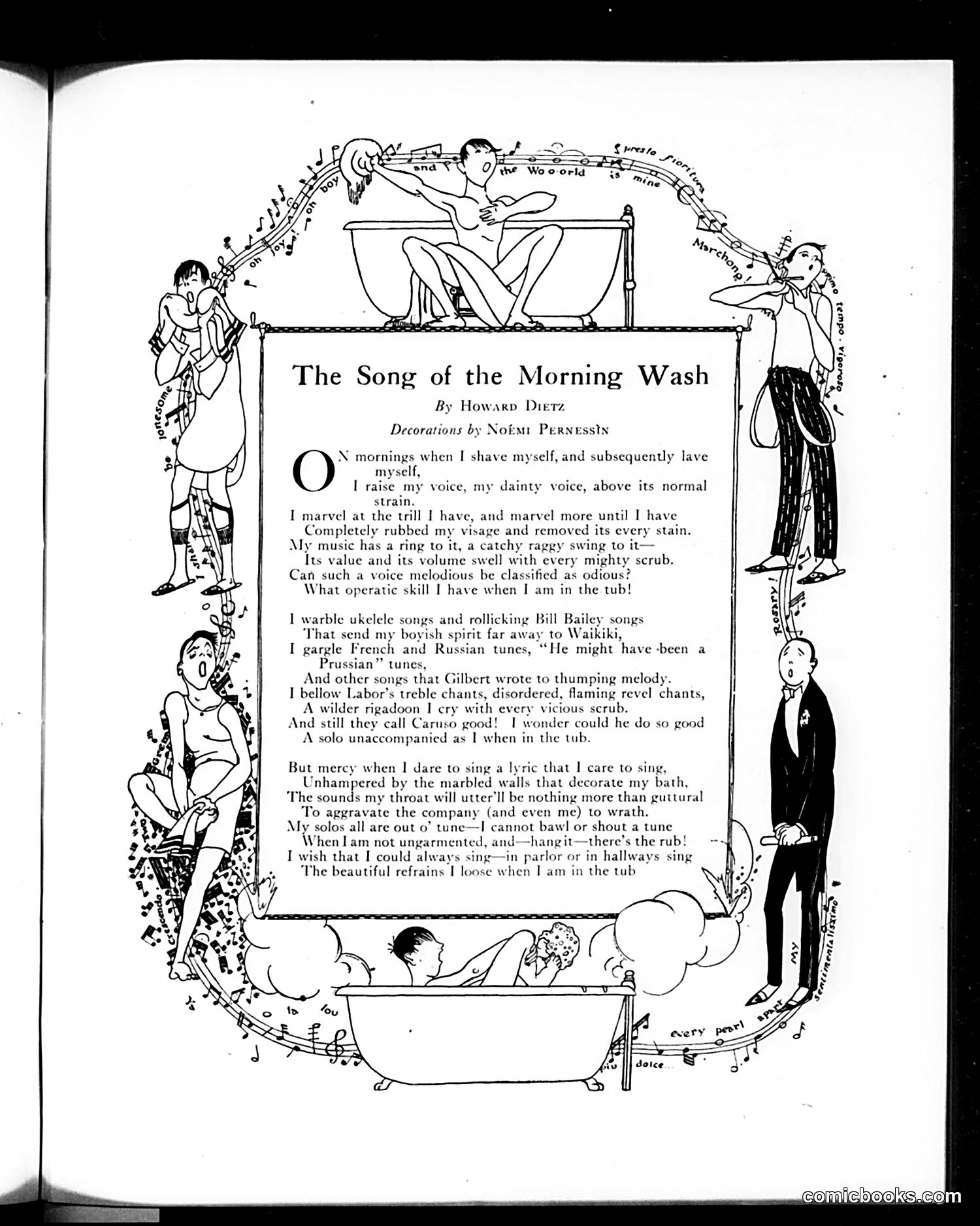
This is a humorous poem by Howard Dietz (with decorative illustrations by Noëmi Pernessís) celebrating the phenomenon of enthusiastic bathroom singing. The joke hinges on a common, relatable experience: people sing beautifully and confidently while bathing alone, but sound terrible when attempting the same songs clothed and in company. The poem references real performers and composers—Enrico Caruso (famous opera singer), Bill Bailey (likely the vaudeville performer), and Gilbert (W.S. Gilbert of Gilbert & Sullivan)—to humorously exaggerate the narrator's imagined operatic talent. The ironic payoff: the narrator possesses "operatic skill" only when naked in the bathtub, and loses all musical ability upon getting dressed. The satire gently mocks human vanity and self-delusion—our tendency to overestimate our talents in private while craving public validation.
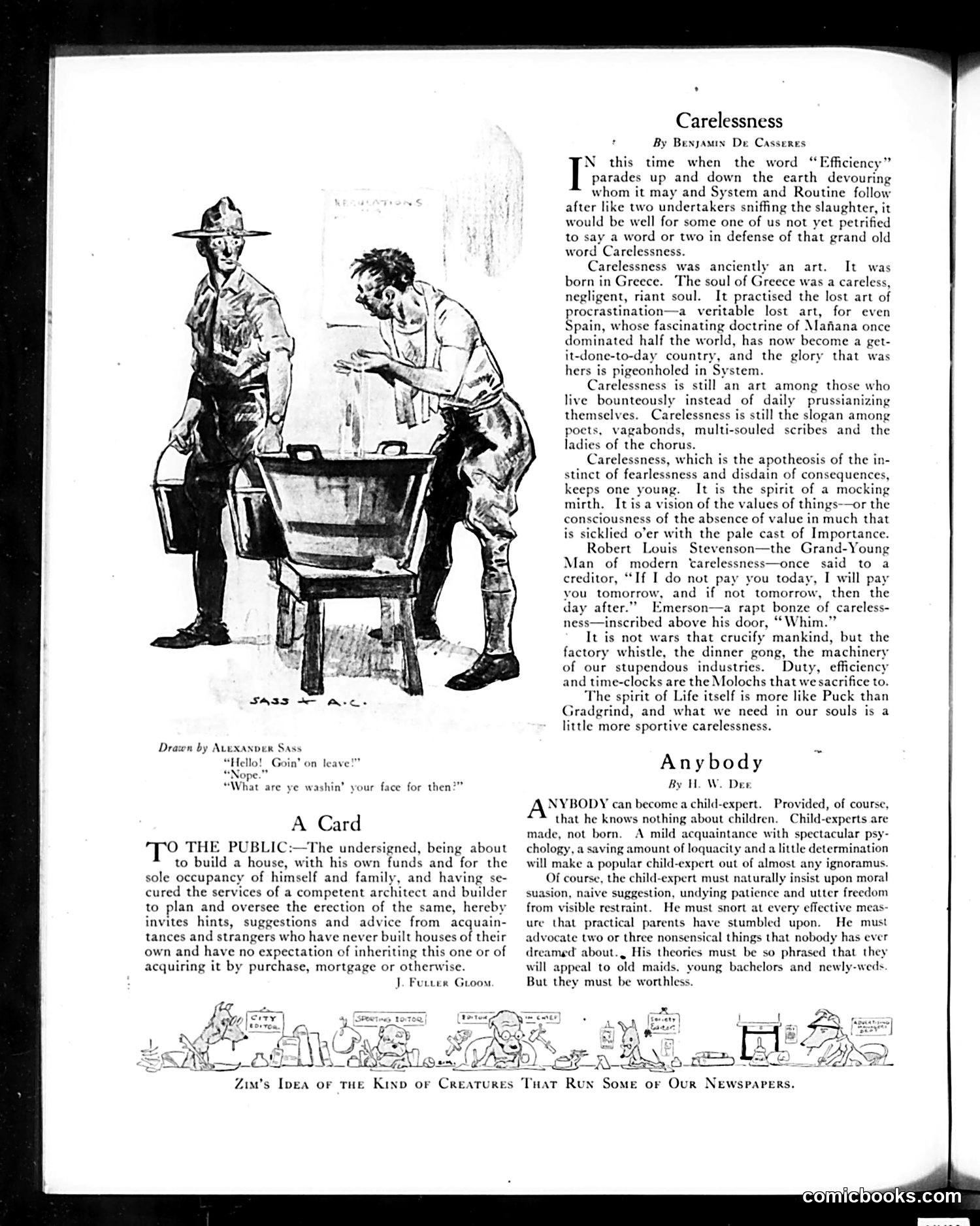
**The Cartoon (by Alexander Sass):** Two soldiers are shown at a barrel or tub. One asks the other, "Hello! Goin' on leave?" The second replies "Nope," then when asked why he's washing his face, the implication is he's preparing for something other than leave—likely his own death or execution. This is WWI-era dark humor about soldier mortality. **"A Card" Section:** J. Fuller Gloom satirizes people who offer unsolicited advice about home-building despite having no expertise or stake in the outcome. It mocks the presumption of armchair critics. **"Carelessness" Essay:** De Casseres defends carelessness as a lost art, contrasting it with modern obsessions with "Efficiency" and "System." He argues carelessness—embodied in figures like Emerson and Stevenson—represents youthful creativity and freedom, whereas modern industrial society demands rigid duty and time-clocks. **"Anybody" Section:** Der mocks self-proclaimed child-experts who lack actual parenting experience but prescribe fashionable psychological theories. The satire suggests such experts are worthless despite their appeal to unmarried audiences.
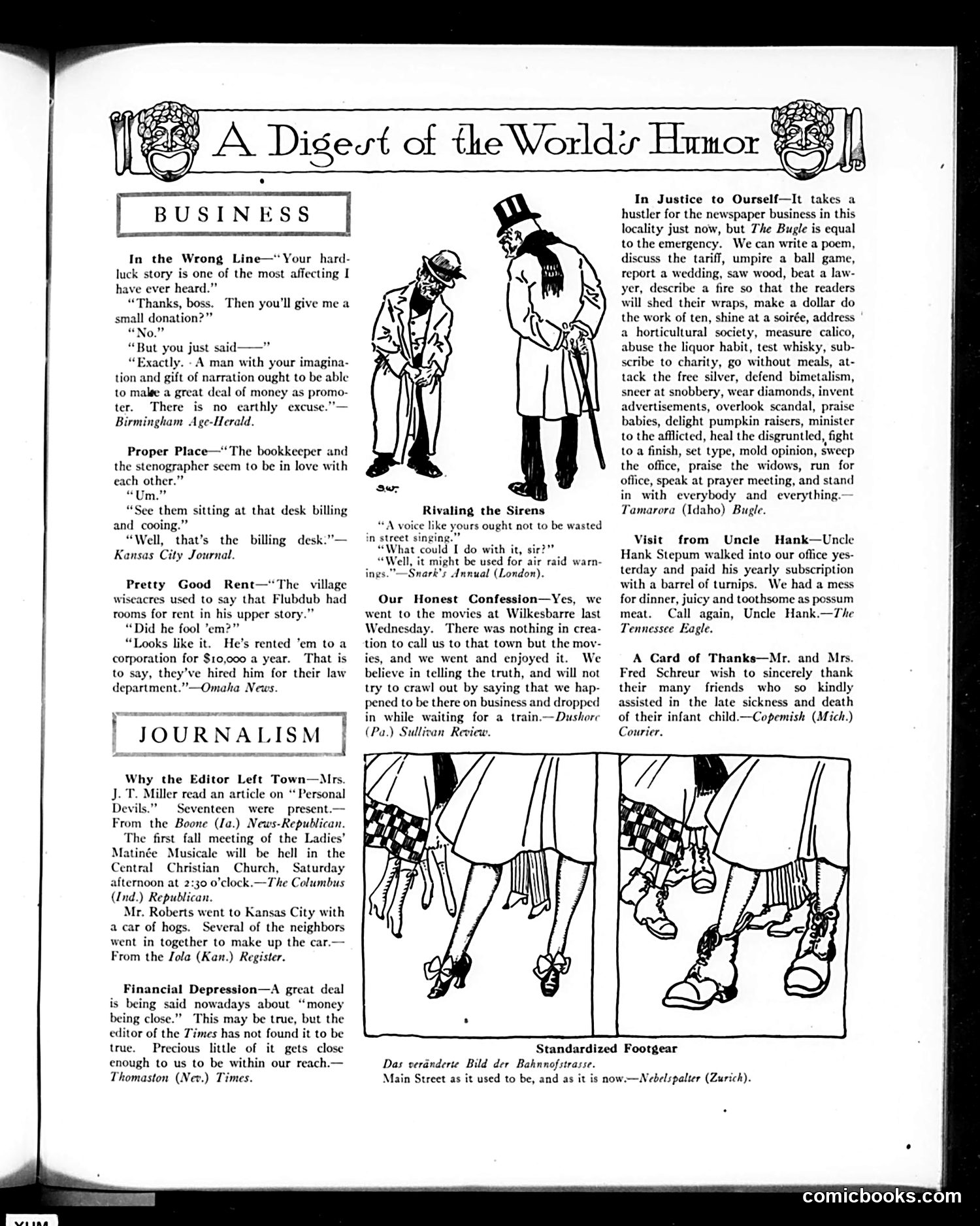
This page from *Judge* magazine collects humorous anecdotes satirizing American small-town newspapers and business practices, circa early 20th century. The **Business** section mocks workplace dynamics: a con artist with a sob story should become a promoter; office romance at the "billing desk" (pun on "cooing"); and a man renting his brain to a law firm for $10,000/year despite having none. The **Journalism** section ridicules newspaper editors' incompetence and typos—printing that a church meeting "will be hell," that neighbors "made up the car" (submitted a car of hogs), and the editor's complaint that money never comes "close enough to us." The **Standardized Footgear** cartoon shows women's feet in increasingly uniform, standardized shoes—captioned in German, satirizing modern industrial standardization replacing individual style. The overall message: small-town papers are amateurish, editors are pompous buffoons, and modern society is losing individuality to standardization. These are gentle, nostalgic jabs at American provincial life.
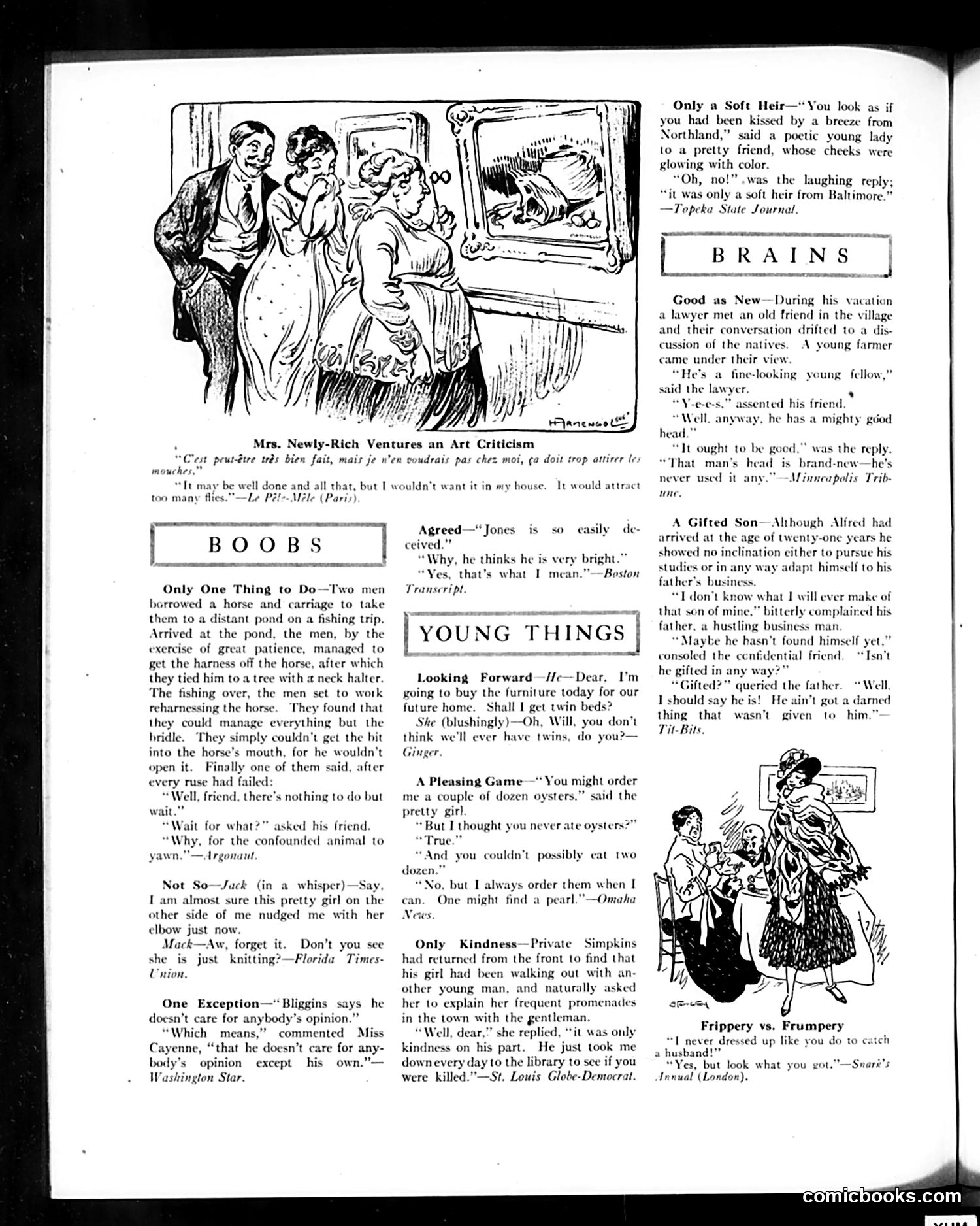
This page contains humorous short anecdotes typical of early 20th-century satirical magazines, organized under category headings. **Main cartoon** (top): "Mrs. Newly-Rich Ventures an Art Criticism" depicts a socially ambitious woman dismissing a well-executed artwork because it might "attract too many flies"—satirizing the pretentious, superficial art criticism of newly wealthy people who lack genuine taste or knowledge. **Recurring themes across the jokes:** - **Social climbing/class anxiety**: The "newly-rich" woman's gauche aesthetic judgment - **Gender stereotypes**: Women's illogical thinking ("twins" from twin beds), materialism (oyster-hunting for pearls), and manipulation - **Male foolishness**: The horse story mocks men's incompetence; "Jack" misreads social cues - **Romance/courtship**: Several jokes feature young couples with misunderstandings or deceptions **"Only Kindness"** offers darker humor: a soldier's girlfriend claims she walked with another man "only" to check the casualty lists daily—seemingly touching but tinged with wartime anxiety. The humor relies on exaggeration of personality flaws and social awkwardness rather than topical political references.
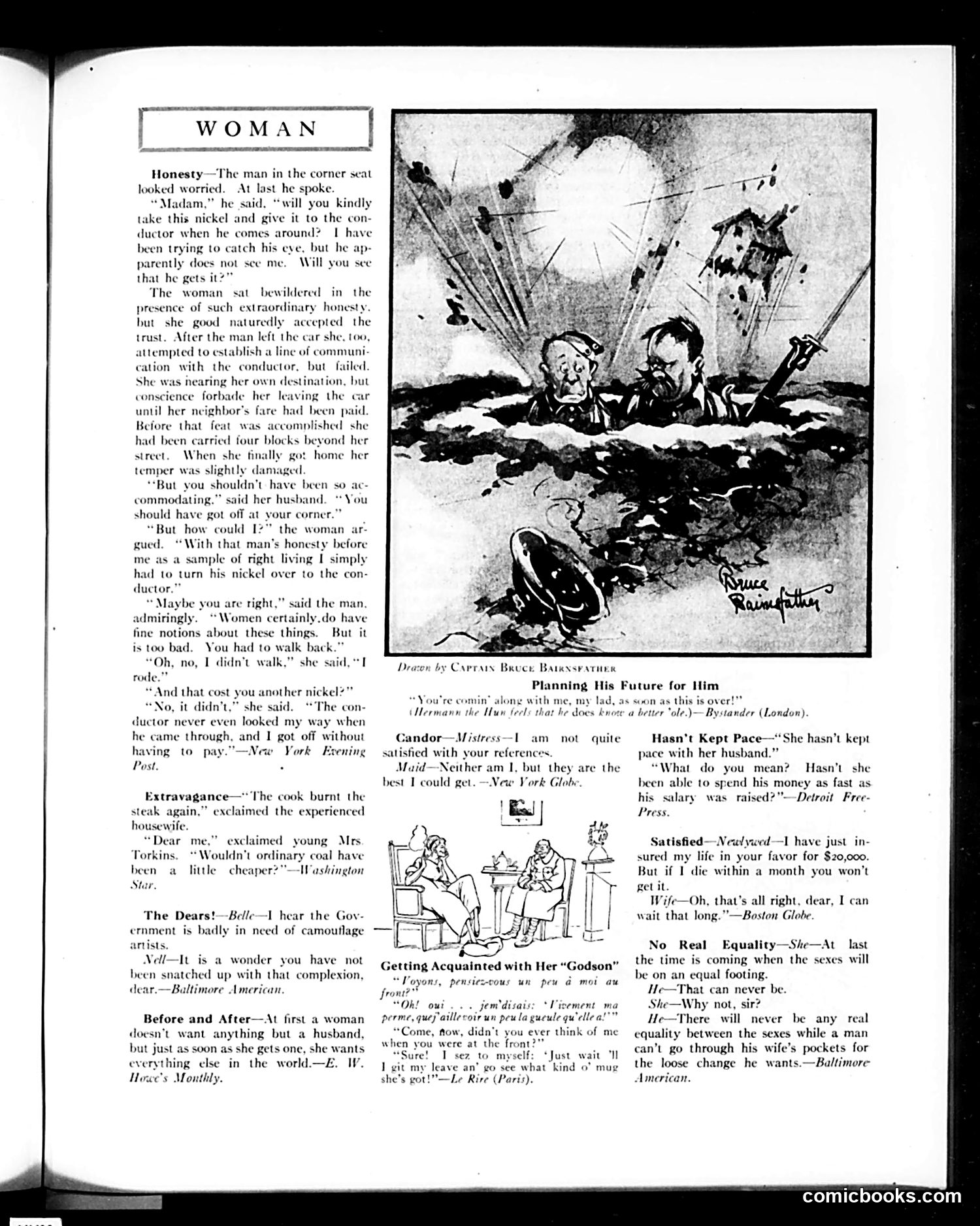
This page from *Judge* contains several short satirical pieces mocking contemporary social attitudes, primarily around marriage, gender roles, and human nature. **"Honesty"** ridicules excessive moral scrupulousness. A man's obsessive honesty—insisting a woman deliver his nickel fare—causes her to miss her stop by four blocks. The joke: his virtue becomes impractical and costly to others, yet she feels obligated to honor his example. **Other brief jokes** mock common marital complaints: wives spending husbands' money faster than salaries increase; newlyweds' financial arrangements; gender inequality (a man wanting to raid his wife's pockets for change). **"Planning His Future for Him"** (the cartoon) depicts soldiers in WWI trenches, with dialogue suggesting a soldier's eagerness to return home to see his girlfriend—a period reference to wartime romance. The page reflects early 20th-century *Judge* humor: middle-class domestic situations treated with light cynicism about marriage, money, and the persistent gaps between romantic ideals and practical reality.
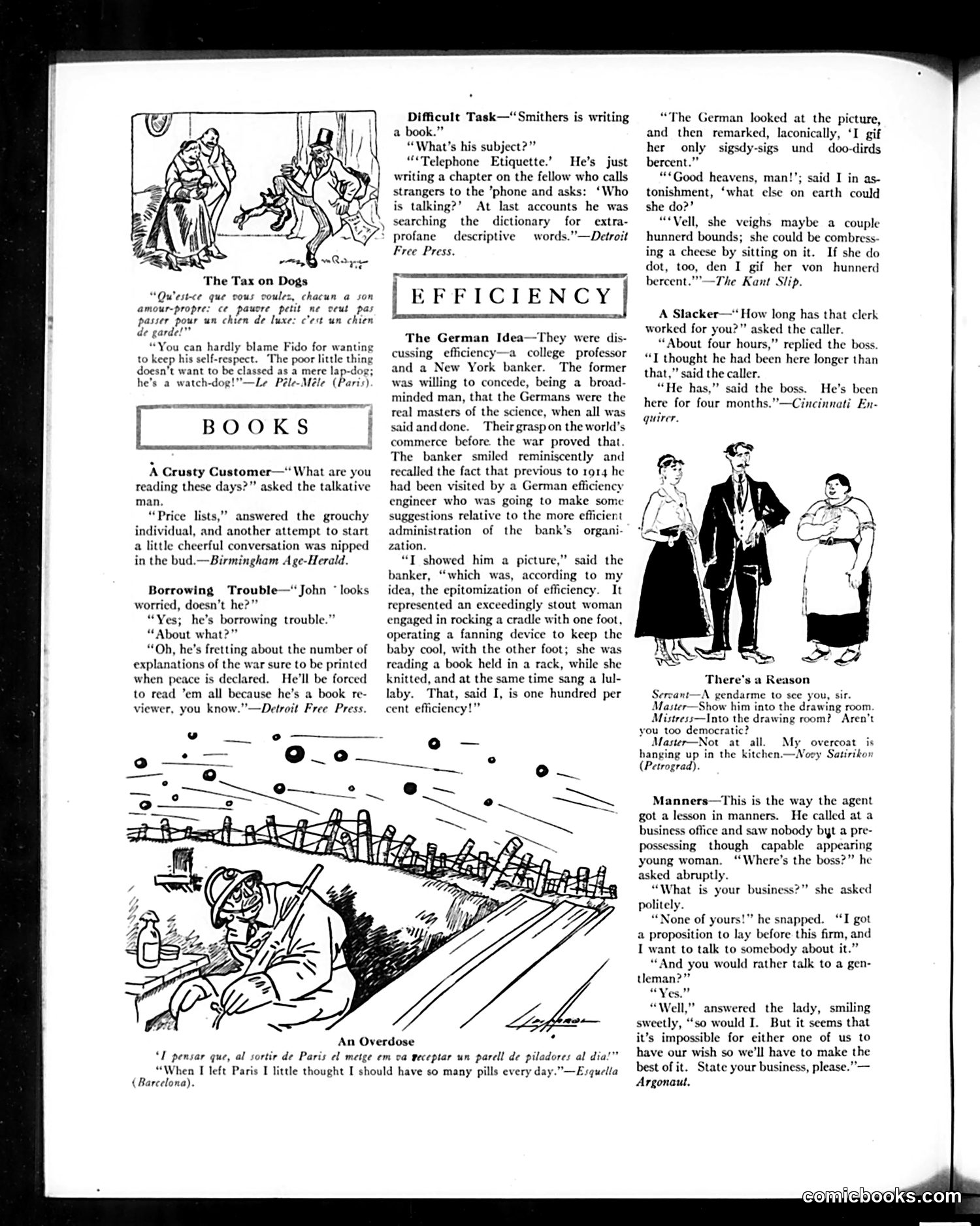
This page collects brief satirical humor pieces and cartoons typical of early 20th-century Judge magazine. **"The Tax on Dogs"** mocks a French dog tax by showing a small dog refusing to accept "lap-dog" status—it wants recognition as a "watch-dog" to maintain self-respect and avoid higher taxes. **"The German Idea"** satirizes German efficiency obsession (relevant during or after WWI). A banker describes showing a German efficiency engineer a picture of an impossibly multitasking obese woman as the height of efficiency. The German, unmoved, suggests she could still compress cheese by sitting on it—deadpan mockery of German literal-mindedness and relentless optimization. **"A Slacker"** jokes about a clerk's anxiety over future war-history books he'll be forced to read as a book reviewer—topical WWI humor. **Other pieces** include mild office and social etiquette humor common to the era. The cartoons and jokes reflect 1910s-1920s preoccupations: war anxieties, German stereotypes, class distinctions, and workplace dynamics.
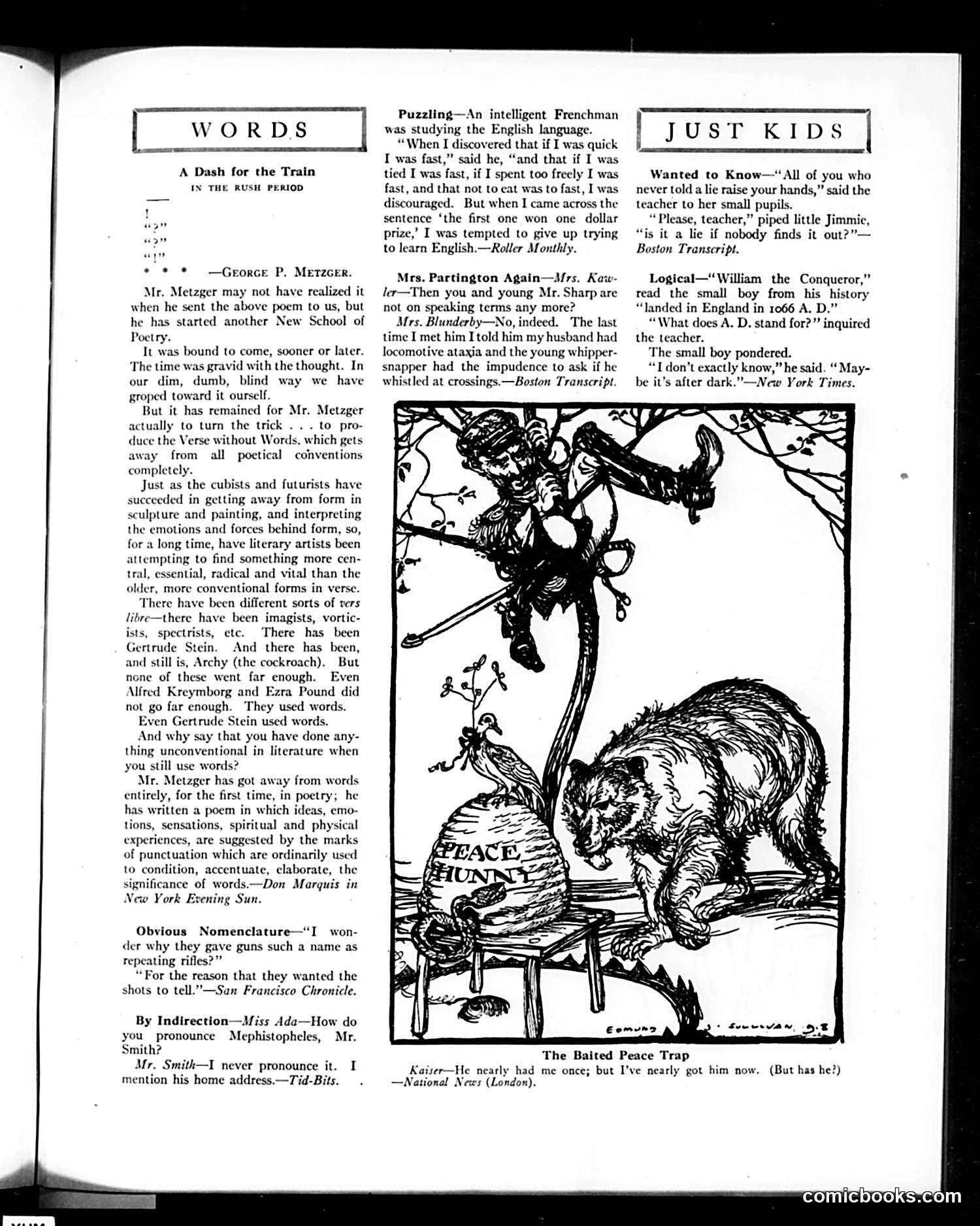
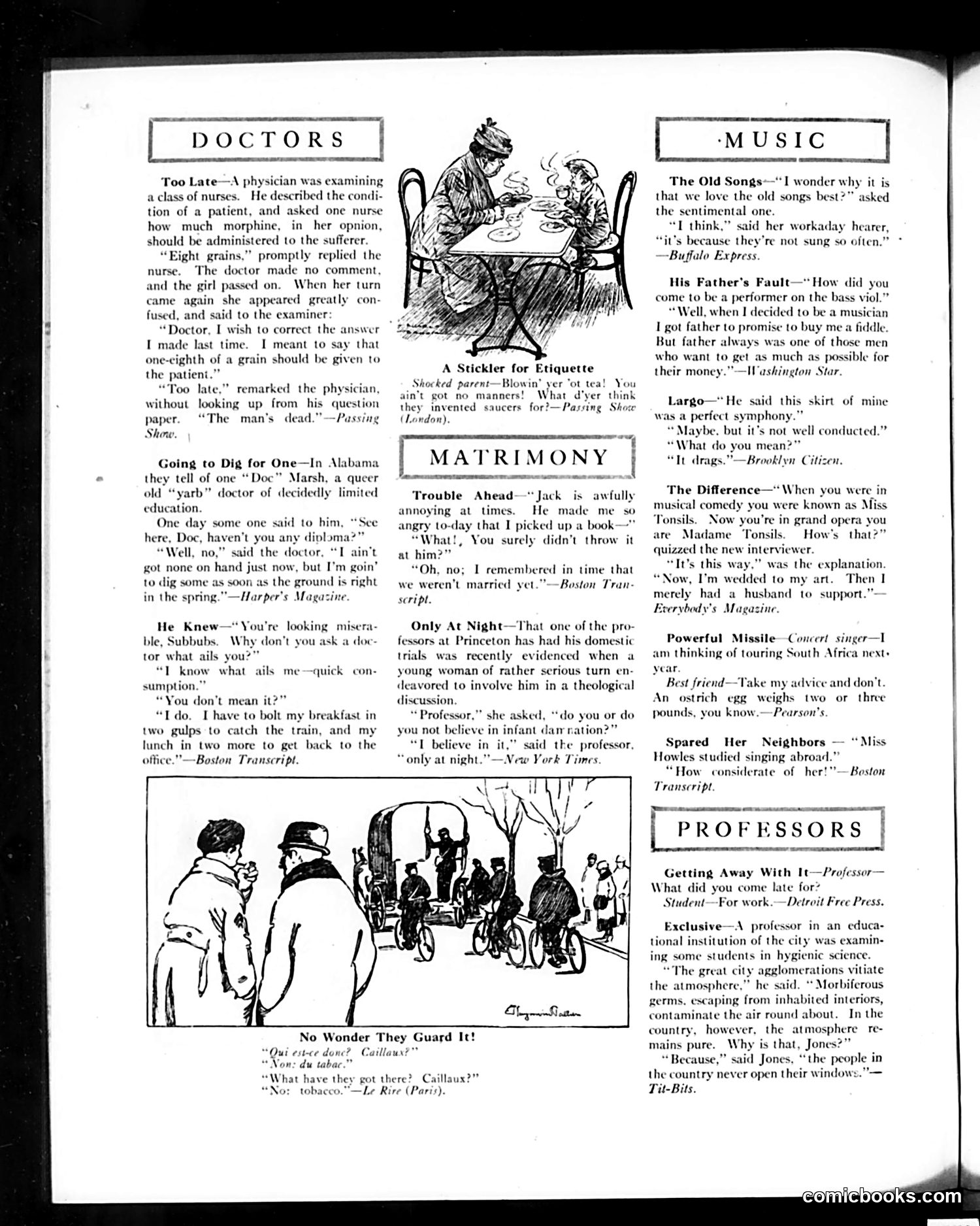
This page collects brief satirical anecdotes organized by profession. The humor relies on period-specific anxieties and social commentary: **DOCTORS section**: Jokes about medical incompetence and quack practitioners. The "Doc Marsh" anecdote mocks rural, unlicensed healers; the morphine dosing error satirizes careless examination standards. These reflect early-20th-century concerns about medical professionalization and patient safety. **MATRIMONY section**: Domestic humor centering on marital discord and theological disagreement. The Princeton professor joke likely references contemporary debates about religious education. The tone treats wives as bothersome rather than partners. **MUSIC section**: Snide remarks about female performers (the "Tonsils" joke reduces singers to physical parts) and touring dangers (the ostrich-egg reference mocks South African conditions as exotic/primitive). **PROFESSORS section**: Academic mockery focusing on eccentric pedantry and environmental hygiene theories. Overall, the page reflects *Judge*'s characteristic class-conscious, male-centered satire targeting professional pretension and domestic tension while assuming readers' shared prejudices about gender, geography, and expertise.
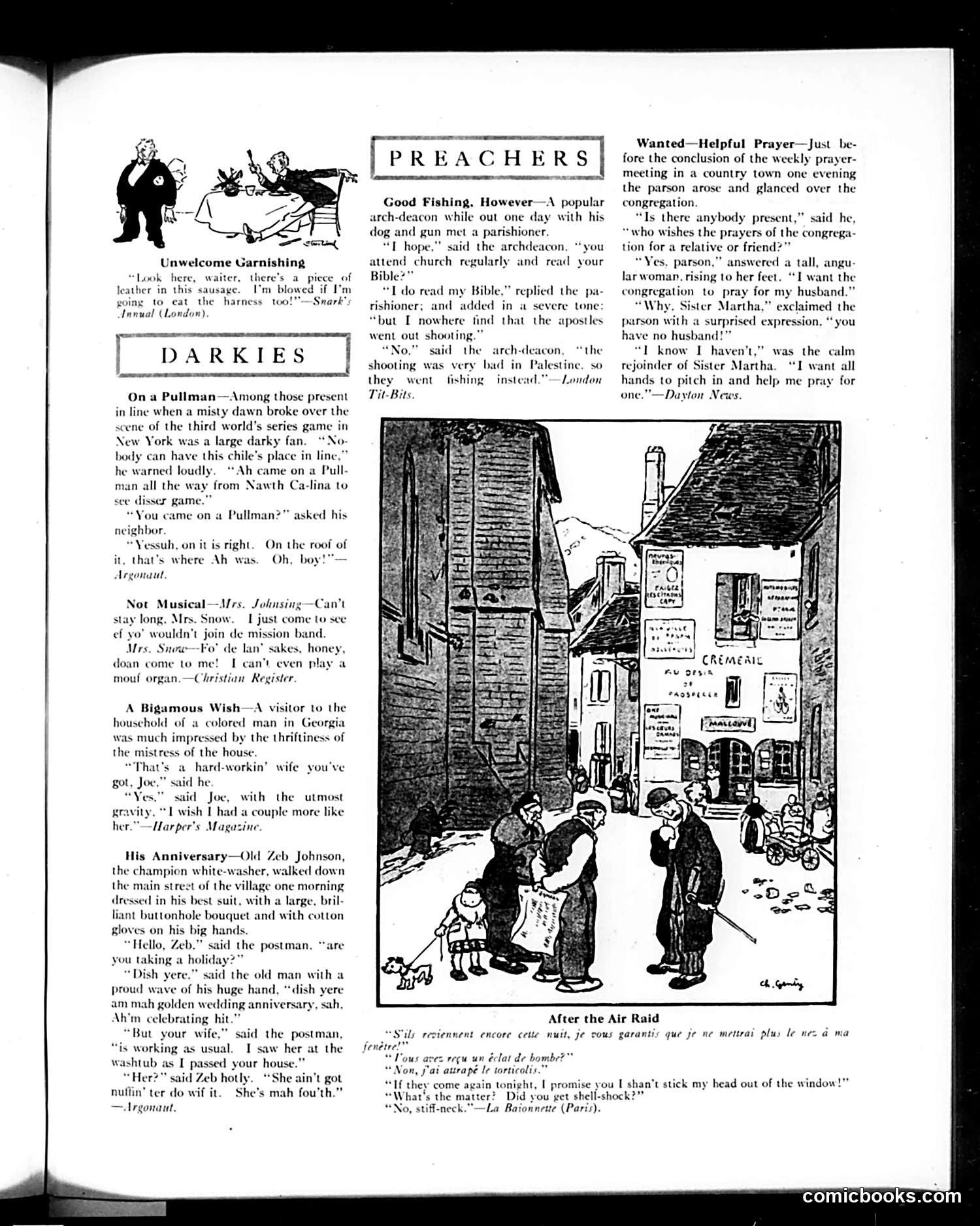
This page collects brief humorous anecdotes organized under section headers. The content reflects early-20th-century American attitudes, particularly toward race. The "Darkies" section contains racist jokes using exaggerated dialect and stereotypes about Black Americans. One anecdote mocks a Black baseball fan who traveled on a Pullman train's roof (referencing segregation and inferior accommodations). Another depicts a Black man with multiple wives, playing on degrading stereotypes about Black family structure. Other sections ("Preachers," "Good Fishing") present gentler humor about clergy and wordplay. "After the Air Raid" features French dialogue about WWI bombing raids, with a punchline about neck stiffness rather than shell shock. The cartoon illustration depicts a European street scene, likely French, showing civilians and damaged buildings—consistent with the air raid content. The overall page represents Judge's satirical style: mixing social commentary with period humor, though much content relies on now-offensive racial caricature and dialect that was considered acceptable entertainment at the time.
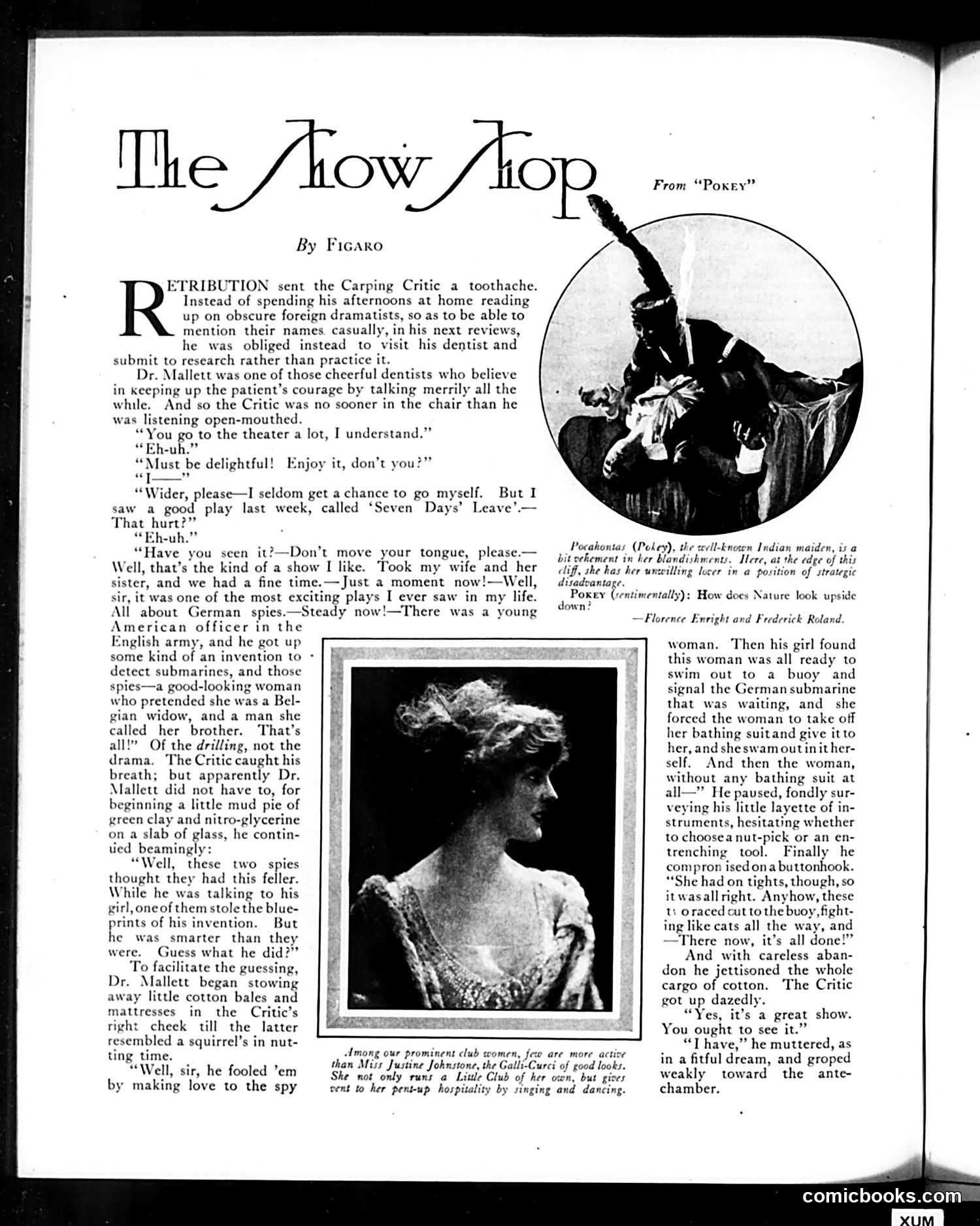
This humorous piece satirizes theater critics who pretend to sophisticated taste. A pompous drama critic visits his dentist with a toothache; Dr. Mallett, an enthusiastic talker, describes an exciting play he recently saw—a WWI spy thriller called "Seven Days' Leave" involving German spies, a fake Belgian widow, submarine detection, and patriotic heroics. The satire works on two levels: First, the critic is forced to listen passively (mouth open in the dentist's chair) rather than pontificate, reversing his usual role. Second, Dr. Mallett's breathless summary of this pulpy, melodramatic war play—full of romantic intrigue, stunts, and patriotic derring-do—implicitly mocks critics who claim superiority over popular entertainment. The dentist enjoyed it genuinely; the critic will likely dismiss it as lowbrow, despite finding it thrilling. The secondary image of "Pocahontas" references the popular "Pokey" theatrical character, adding to the page's focus on entertainment and performance.
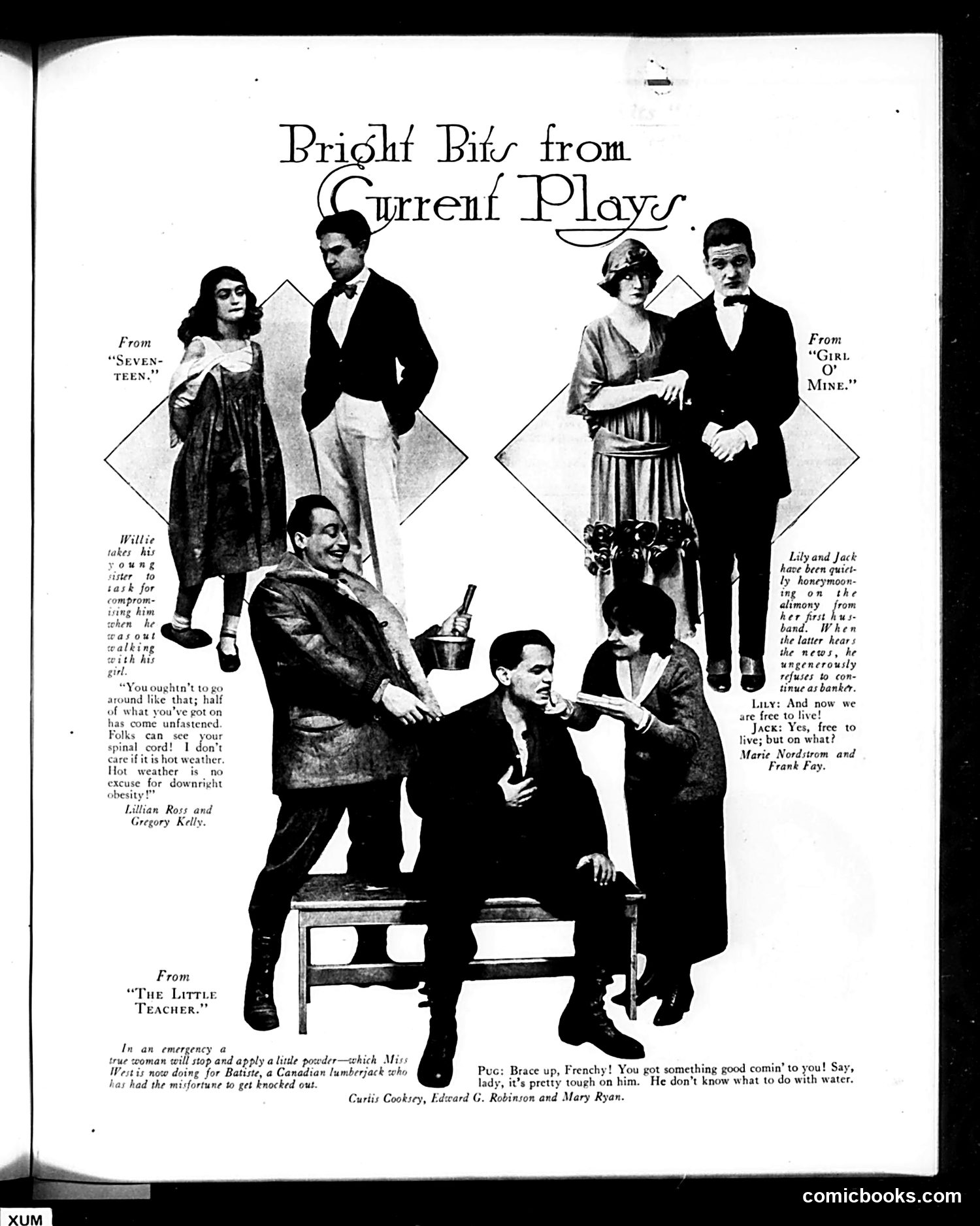
This page showcases comedic scenes from contemporary theatrical productions, featuring photographs with accompanying dialogue and commentary. The content mocks social conventions and relationship dynamics of the era. The upper vignettes satirize modern marriage and gender relations: one scene ridicules a woman's revealing dress ("folks can see your spinal cord"), while another jokes about alimony—a woman (Lily) and her new husband (Jack) celebrate freedom after divorce, only to realize they lack financial support without her ex-husband's continued payments. The lower scene from "The Little Teacher" depicts slapstick humor involving a "Canadian lumberjack" named Bathe who's been knocked out, with a woman applying powder as emergency first aid. The dialogue plays on cultural stereotypes about men unfamiliar with civilized customs ("He don't know what to do with water"). Overall, the page reflects 1920s theatrical humor emphasizing physical comedy, marital discord, and period-specific anxieties about changing social roles.
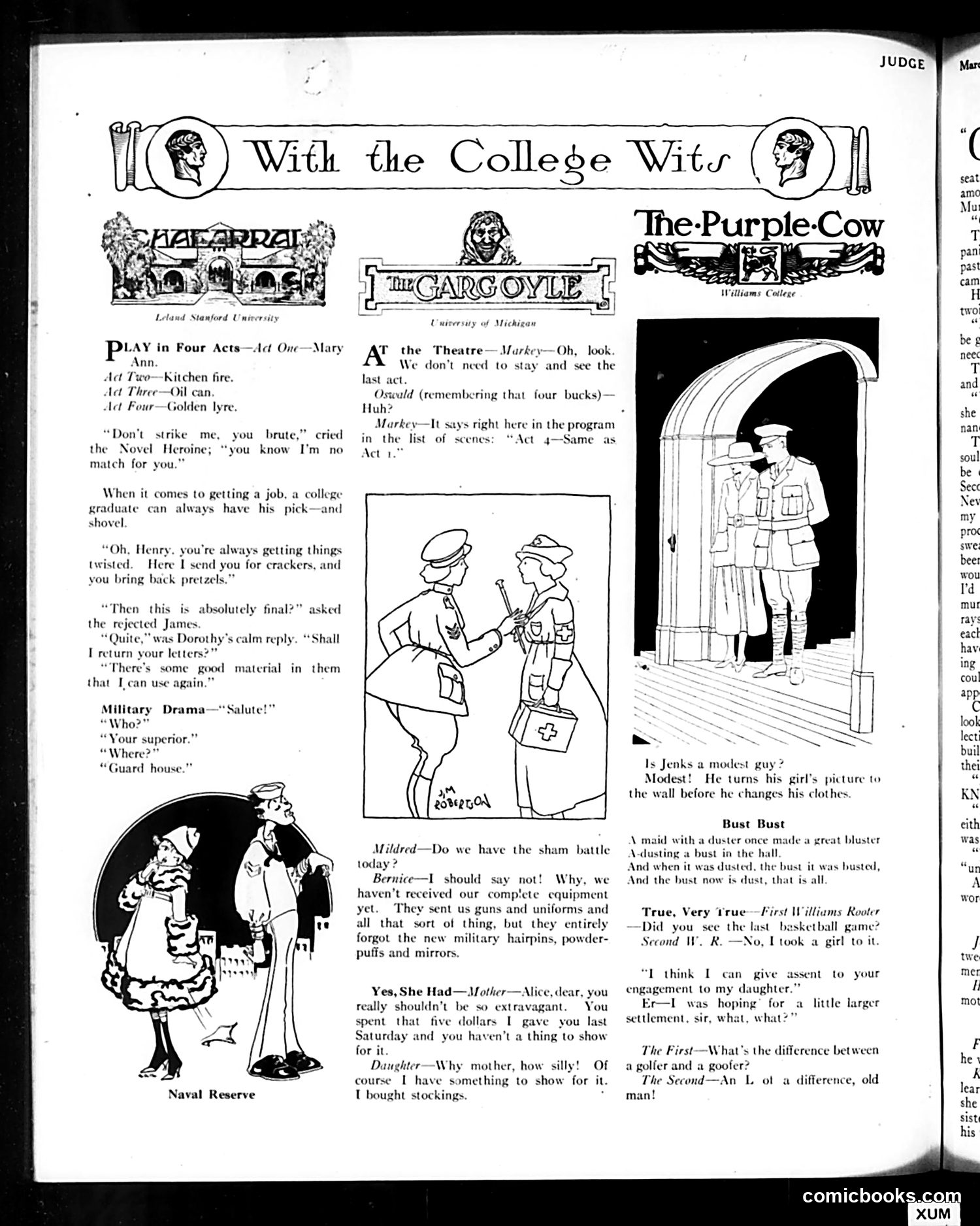
This page collects satirical sketches about college life and military preparedness, likely from WWI-era America (given references to military uniforms, "Naval Reserve," and "sham battle"). The humor targets: 1. **College romance absurdities**: A rejected suitor claims love letters contain "good material" he can reuse elsewhere; a couple argues over mixed-up grocery items. 2. **Women in military**: Female soldiers complain they received guns and uniforms but forgot "military hairpins, powder-puffs and mirrors"—mocking the novelty and perceived unsuitability of women in armed service. 3. **Modest vanity**: A man so concerned with propriety he hides his girlfriend's photo before undressing. 4. **General wordplay**: Puns about "goofer" vs. "golfer" and a poem about dusting a bust. The cartoons use gentle ridicule of contemporary social anxieties: wartime gender roles, courtship conventions, and the awkwardness of modernizing military traditions.
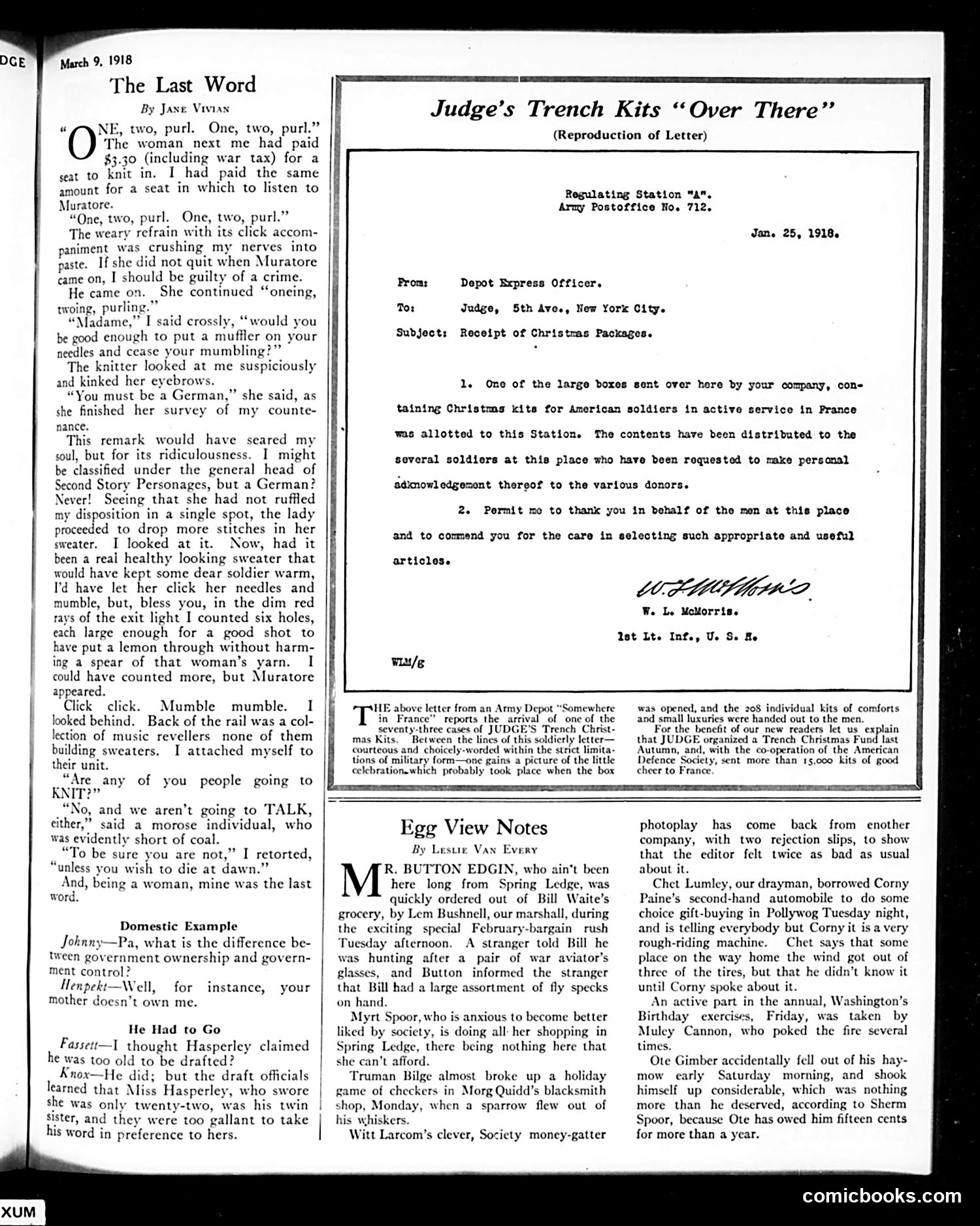
**"The Last Word"** satirizes a woman knitting at an opera, her clicking needles distracting the narrator. When he complains, she accuses him of being German—a serious insult in 1918, during WWI. The joke mocks both her patriotic presumption and her poor knitting (he notices six large holes in her sweater). The final irony: despite his complaints, she gets the last word, reinforcing a gender stereotype about women's stubbornness. **"Judge's Trench Kits"** reproduces a letter thanking Judge magazine for sending Christmas care packages to American soldiers in France. The accompanying text explains Judge organized a charitable campaign distributing 208 individual comfort kits to troops overseas. This documents the magazine's patriotic wartime effort and celebrates home-front support for soldiers—a morale-boosting feature for American readers worried about their relatives in combat.
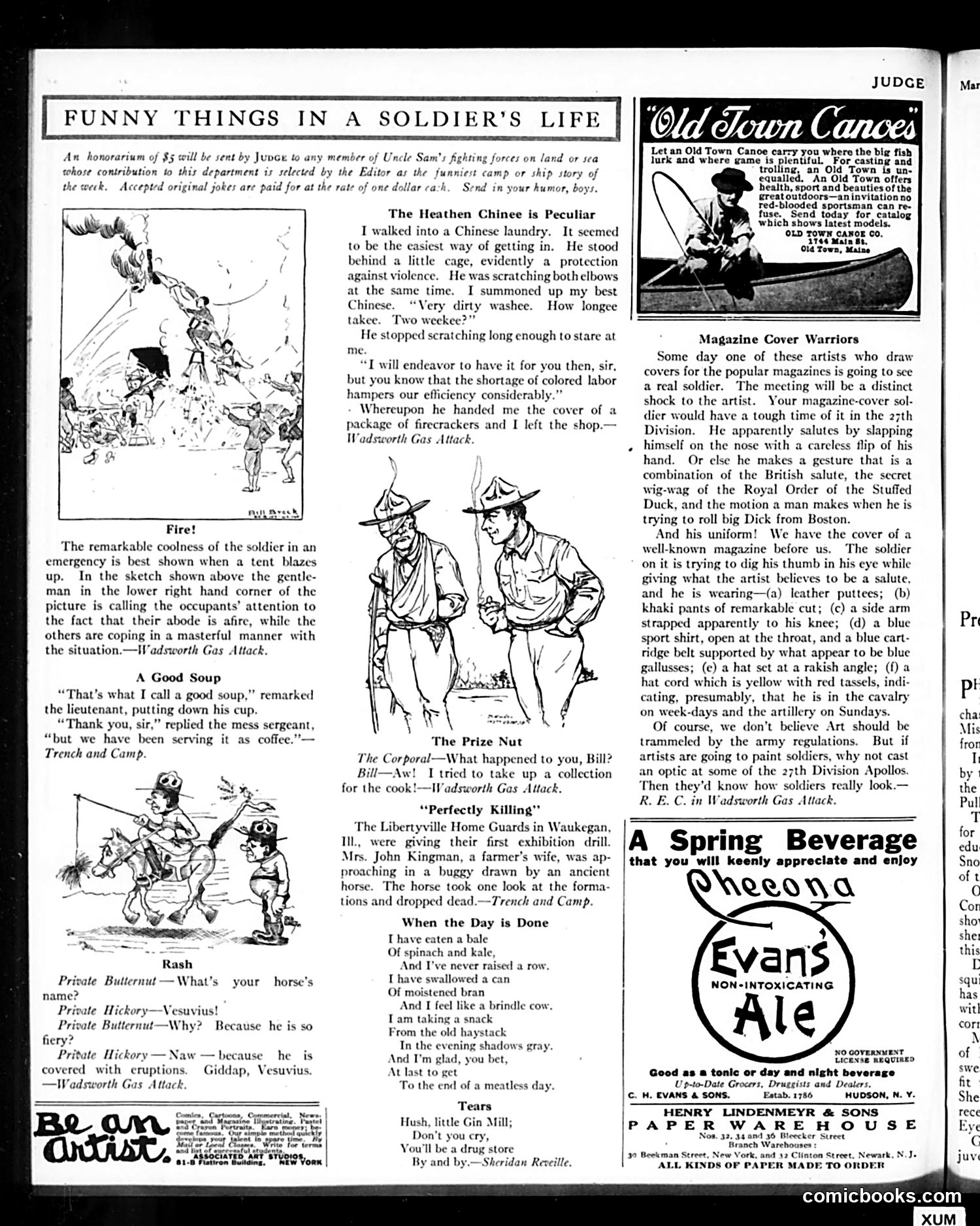
This page collects humorous anecdotes from American soldiers during World War I, submitted to *Judge* magazine's contest for camp humor. The cartoons illustrate comic military scenarios: a soldier calmly announcing a tent fire while others panic; jokes about horse names and Army soup served as coffee. The satirical commentary criticizes magazine illustrators who depict soldiers unrealistically—their salutes are absurdly theatrical (mixing British and made-up gestures) and their uniforms fantastical. Real soldiers, the author insists, look nothing like these romanticized cover images. A secondary jab appears in "Tears," mocking Prohibition-era establishments: a "gin mill" (illegal bar) will become a legitimate drugstore—a dark joke about how drugstores sold alcohol as "medicine" to circumvent Prohibition laws. The page overall celebrates authentic soldier experience against sentimentalized popular culture depictions.
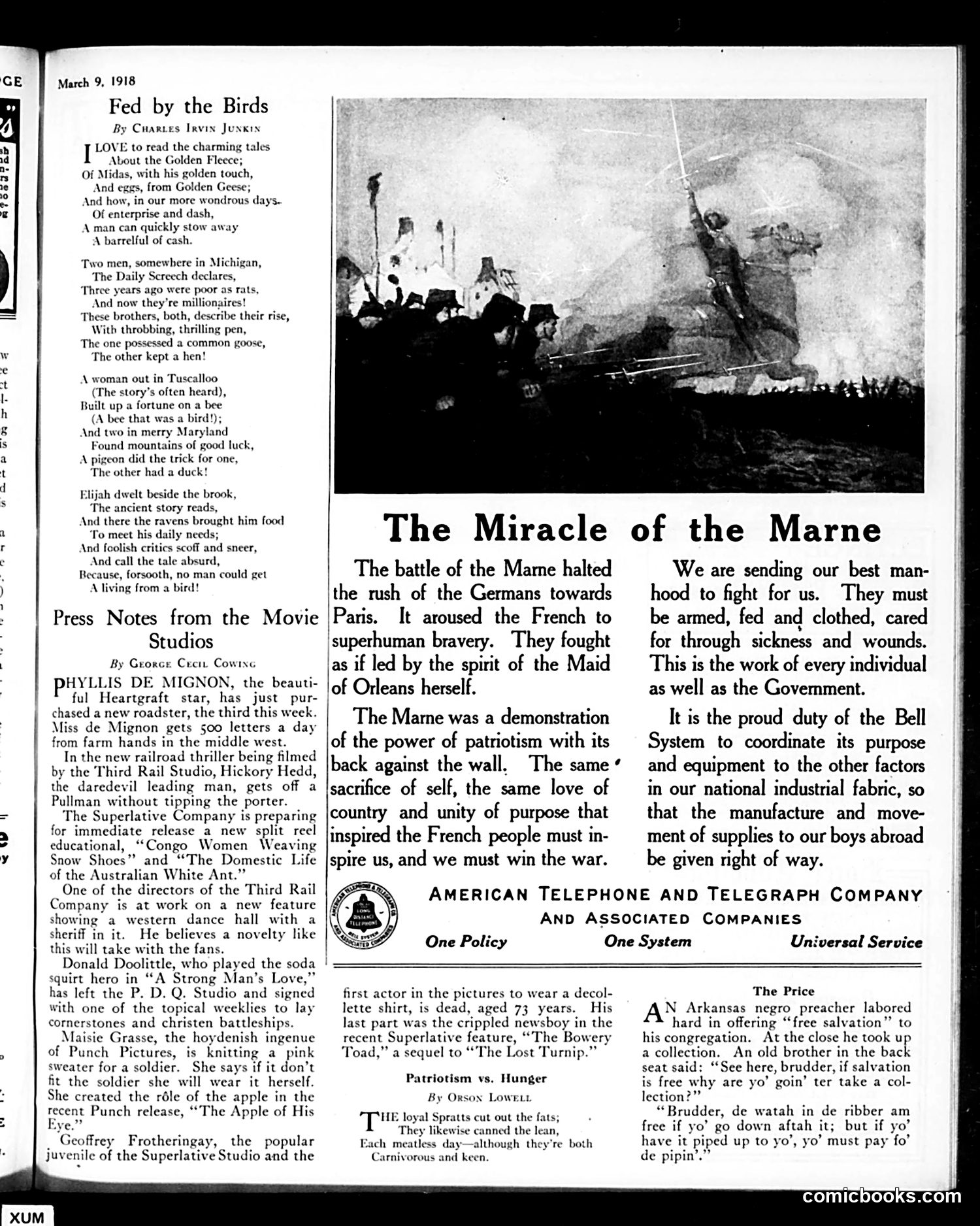
This page from *Judge* (March 9, 1918) satirizes Americans growing wealthy during World War I while soldiers fight abroad. The poem "Fed by the Birds" mocks the implausible success stories circulating in newspapers—men becoming millionaires from raising geese, hens, pigeons, and ducks. The satire suggests these tales are as fantastical as biblical miracles, yet people believe them. The adjacent advertisement from American Telephone & Telegraph Company shifts tone dramatically, presenting patriotic messaging about sending "our best manhood" to war and the company's "proud duty" to support the war effort through coordinated industrial production. The juxtaposition is pointed: while corporations claim patriotic sacrifice, ordinary Americans are actually profiting wildly from wartime conditions. The "birds" metaphor implies these fortunes are easy, almost magical—yet real soldiers are dying. The satire criticizes both the gullibility of readers and the unseemly wealth accumulation during national crisis.
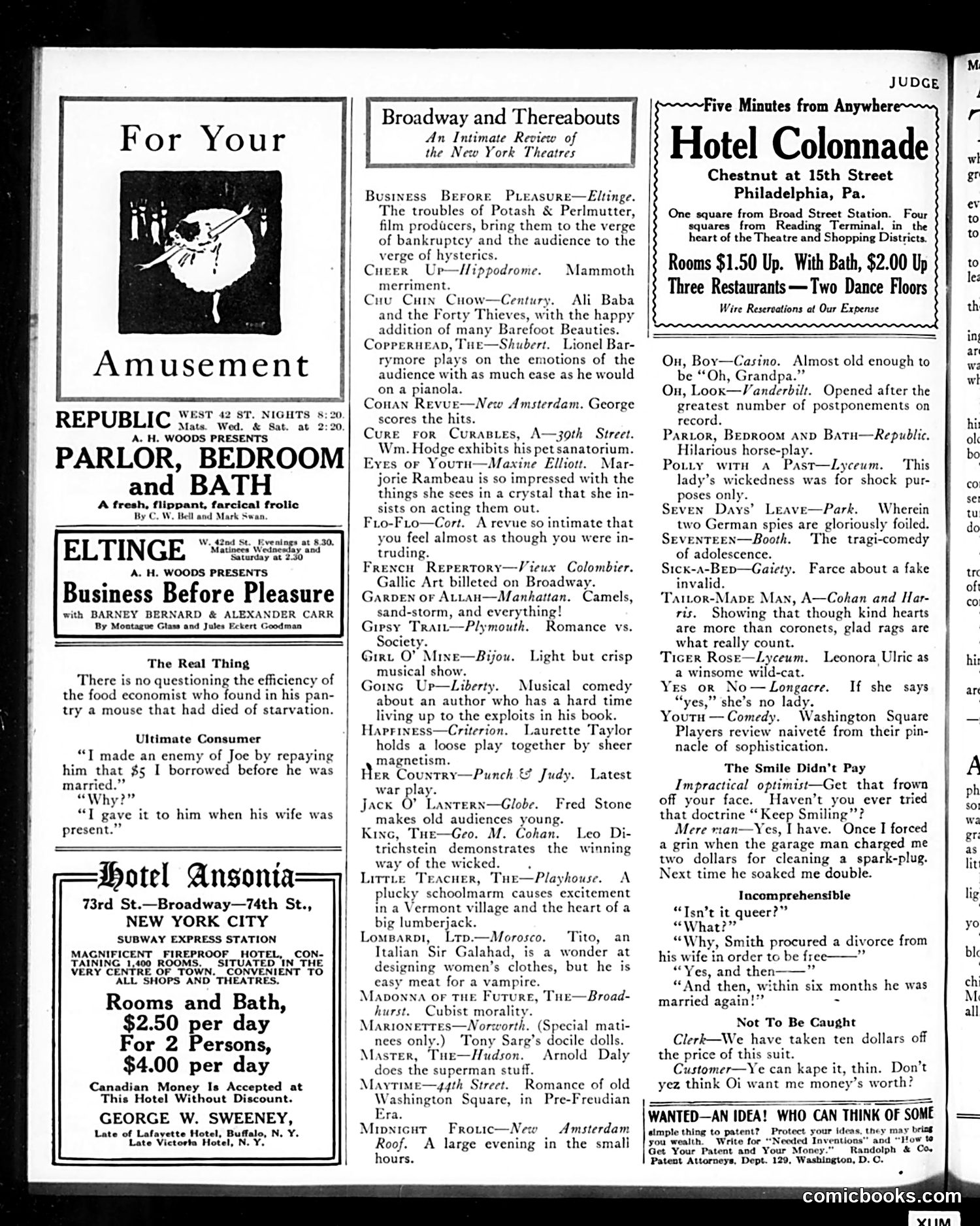
This page is primarily **advertisements and theater reviews**, not political satire. The left side features hotel and show ads; the right side reviews Broadway productions. The small humor pieces ("Ultimate Consumer," "The Smile Didn't Pay," etc.) are domestic jokes reflecting early 20th-century attitudes. One mocks marriage economics: a man created an enemy by repaying a pre-marital debt in front of the borrower's new wife—the joke being that wives disapprove of husbands' old obligations. Another satirizes penny-pinching ("Keep smiling" doctrine of consumer optimism fails when actual costs arise). The theater reviews are straightforward capsule critiques of current Broadway shows, mentioning performers like Lionel Barrymore and Fred Stone. Notable titles include "Parlor, Bedroom and Bath" (a farce), "Business Before Pleasure" (about film producers Potash & Perlmutter), and various musicals. The page reflects 1910s-1920s New York entertainment and hospitality—when Judge magazine served urban audiences seeking cultural guidance and hotel recommendations.
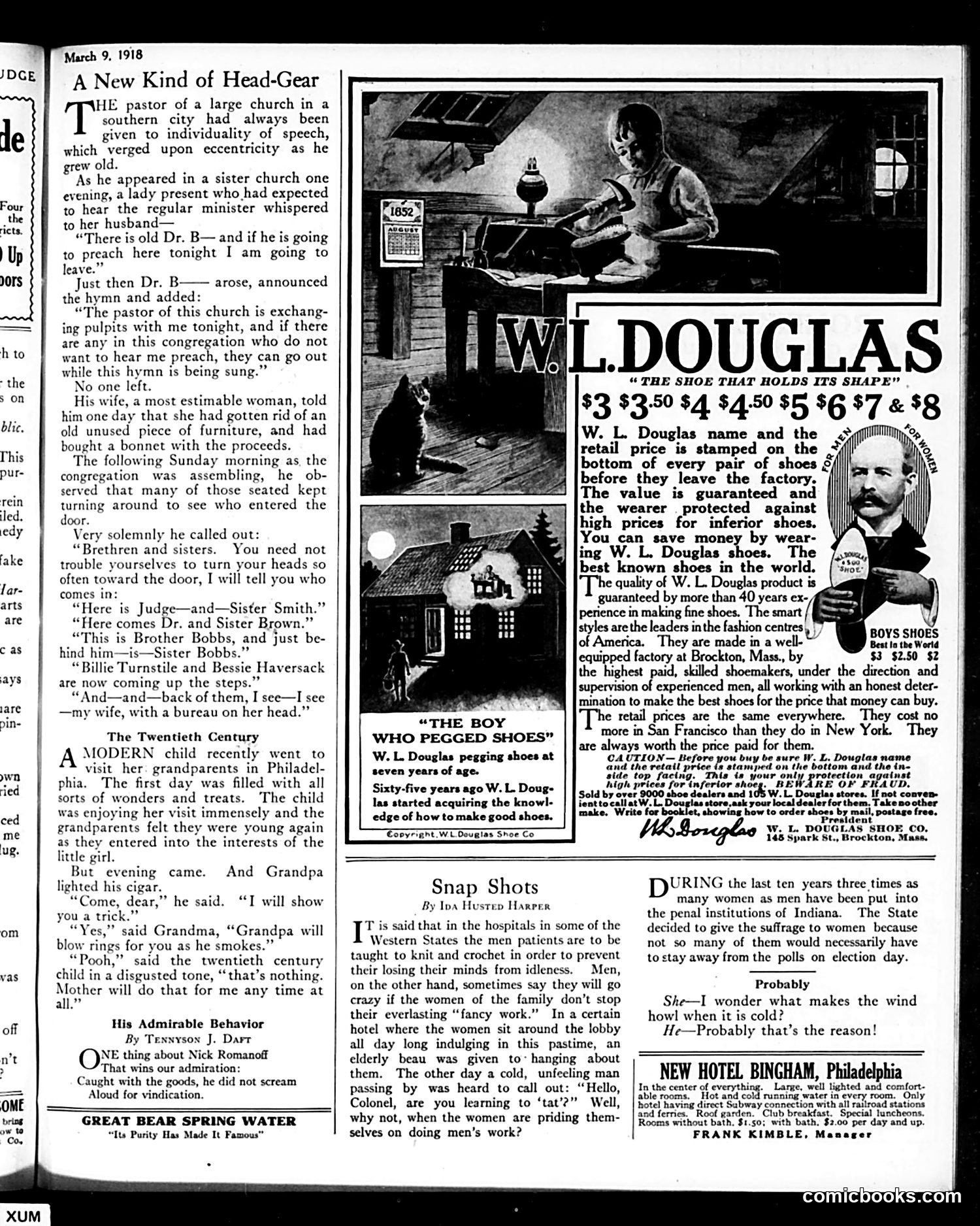
This page contains three distinct pieces: **"A New Kind of Head-Gear"** (top left) is a humorous anecdote about an eccentric elderly pastor who publicly announces each congregant entering his church, culminating in announcing his wife arrived "with a bureau on her head"—a joke about her new bonnet, implying it's absurdly large. **"The Twentieth Century"** (middle left) contrasts old and new generations: a grandfather offers to blow cigar smoke rings as entertainment, but his visiting grandchild dismissively says "Mother will do that for me any time"—satirizing modern mothers as chain-smokers, a progressive-era joke about changing social norms. **"His Admirable Behavior"** (bottom left) appears to reference "Romanoff" (likely a Russian figure, possibly related to WWI-era news), praising someone for accepting consequences without complaint. The **dominant content** is a W.L. Douglas shoe advertisement featuring imagery of shoe-making and the company founder, typical of Judge's commercial pages from this era.
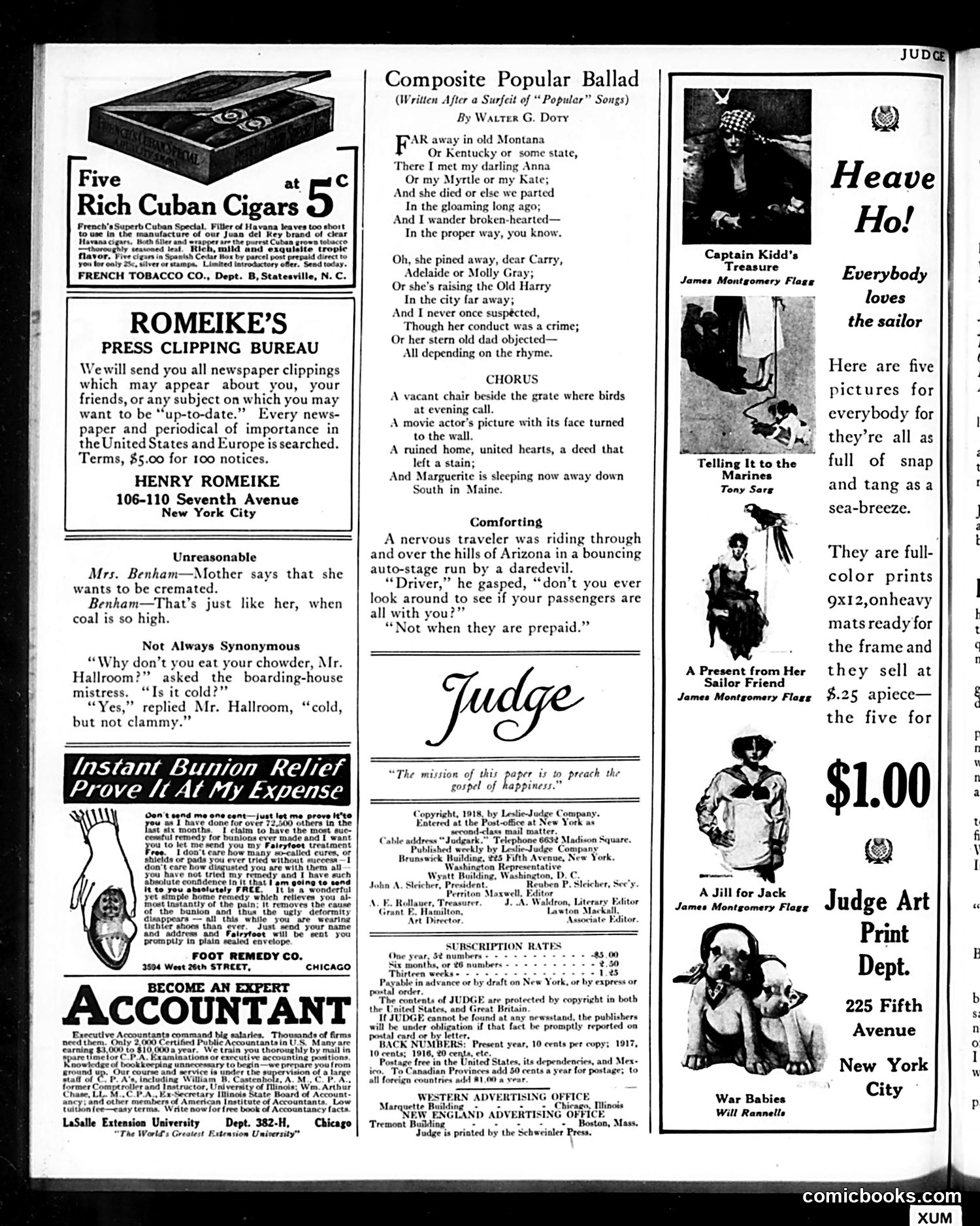
This page from Judge (a 1918 satirical magazine) contains primarily **advertising and light humor rather than political cartoons**. The main satirical content is **"Composite Popular Ballad"** by Walter G. Dory—a parody mocking sentimental popular songs of the era. It ridicules the formulaic, clichéd nature of early 20th-century "sad love songs" by deliberately mixing incompatible plot elements: the narrator meets girls with interchangeable names (Anna, Myrtle, Kate, Carry, Adelaide, Molly Gray, Marguerite), their fates vary arbitrarily ("she died or else we parted...all depending on the rhyme"), and locations are absurdly mismatched (characters from Montana/Kentucky mysteriously end up "down South in Maine"). The satire targets how these songs recycled identical emotional tropes—broken hearts, vacant chairs, ruined homes—regardless of narrative coherence. The humor works for modern readers: it's mockery of formulaic sentimentality, a timeless target. The remaining page content consists of period advertisements (cigars, press clipping services, bunion remedies, accounting courses) and short joke items.
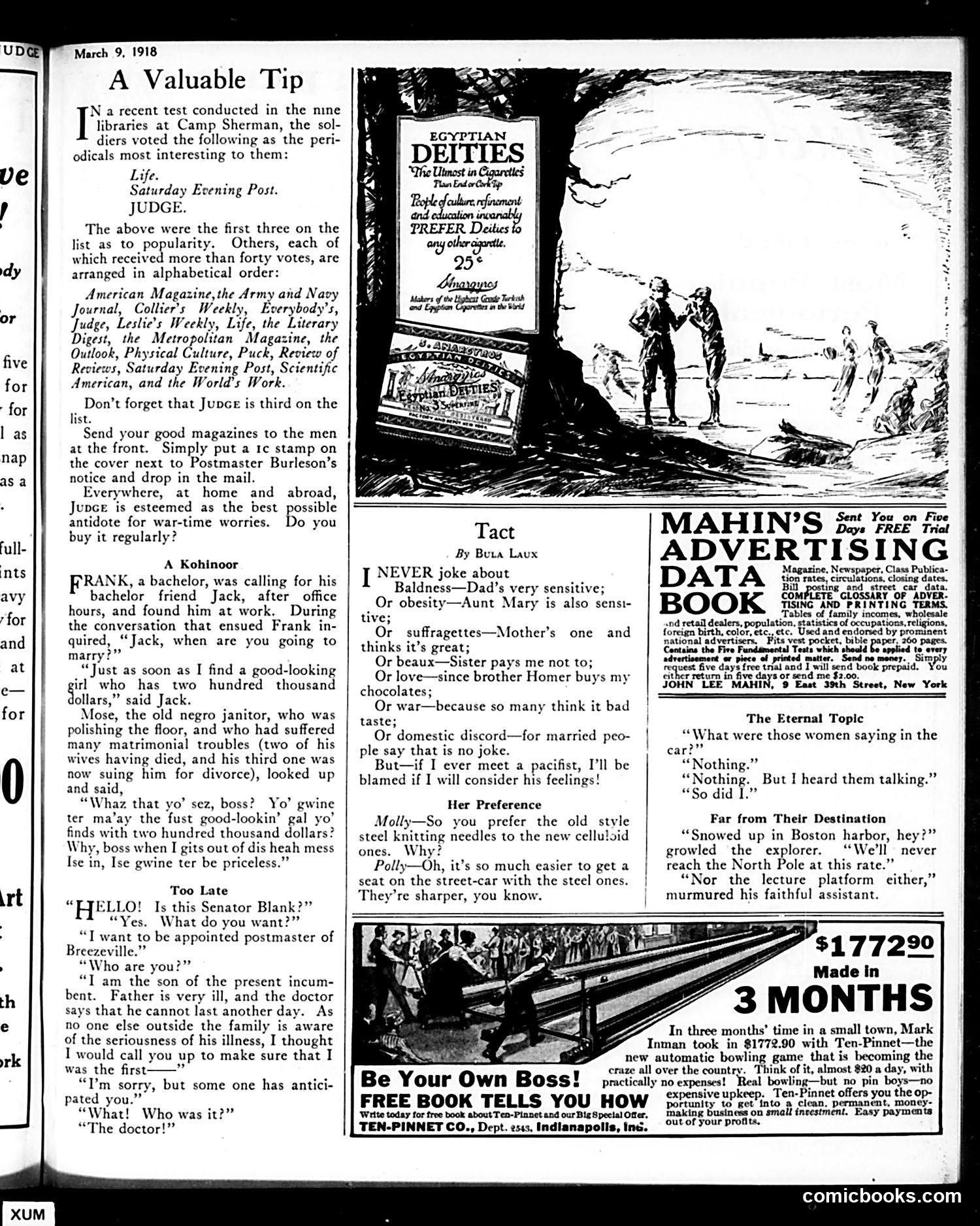
This page primarily contains **humorous anecdotes and advertising**, not political cartoons. The main content includes: 1. **"A Valuable Tip"** — a self-promotional piece noting that *Judge* ranked third in popularity among soldiers at Camp Sherman during World War I, encouraging readers to send magazines to troops. 2. **Three brief humor pieces**: - "A Kohinoor": A racist joke featuring "Mose, the old negro janitor" making a pun about being "priceless" after divorce troubles - "Too Late": A joke about someone trying to secure a postmaster position before his ailing father dies - "Tact": A satirical piece listing social taboos one mustn't joke about, ending with pacifists as fair game (reflecting WWI-era hostility toward anti-war sentiment) The page reflects 1918 attitudes: wartime patriotism, casual racism in entertainment, and social satire aimed at contemporary customs and manners rather than political figures.
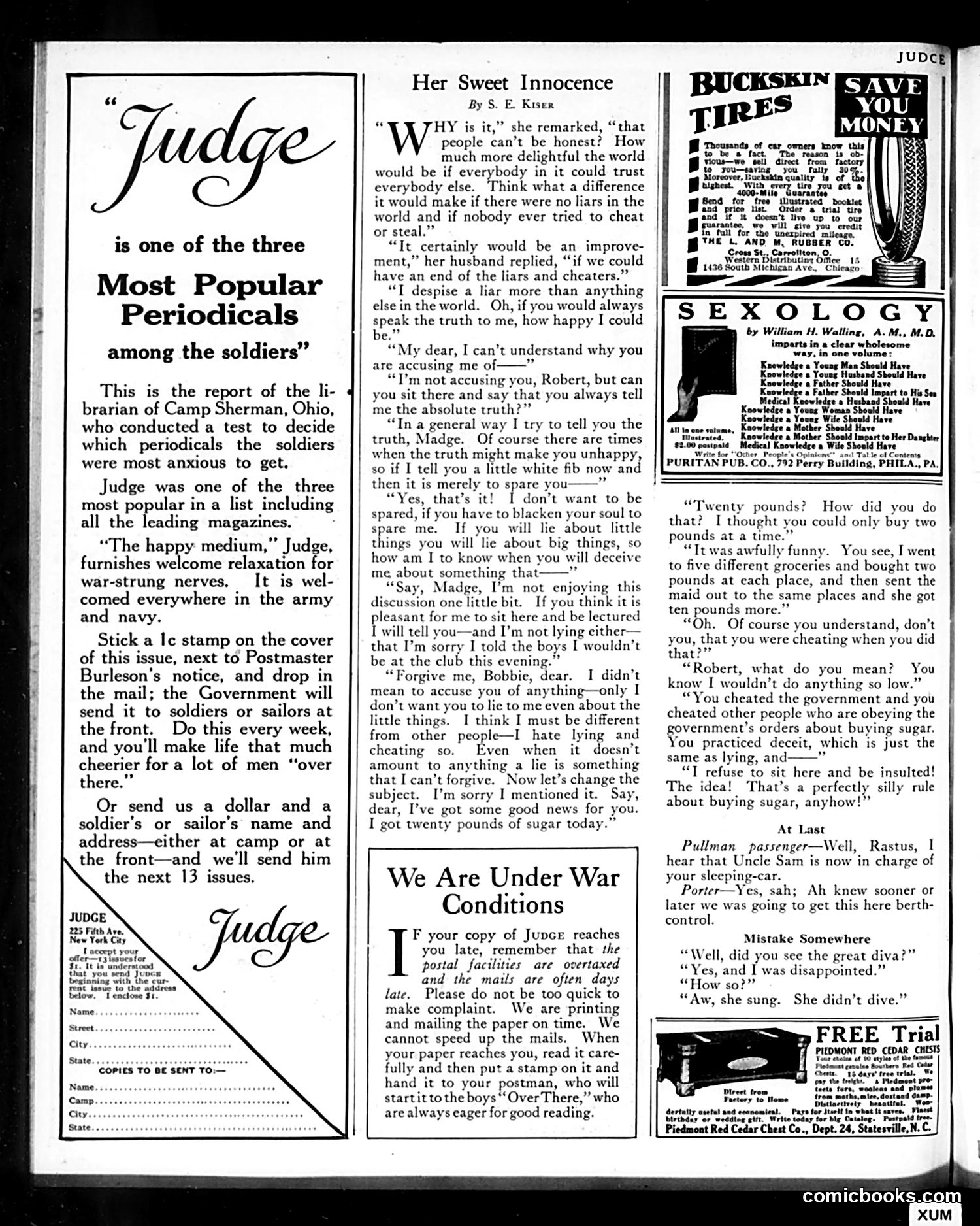
This page contains three distinct elements: **Left side:** An advertisement for *Judge* magazine itself, promoting it as one of three most popular periodicals among WWI soldiers. It encourages readers to mail copies to soldiers "over there" (at the front), emphasizing the magazine's role in boosting morale for "war-strung nerves." **Center:** A short story titled "Her Sweet Innocence" depicting a wife lecturing her husband about honesty and lying. The irony—apparent to contemporary readers—is that she's a hypocrite: she demands absolute truth while he admits to "white lies," yet she overlooks his confession that he lied to their friends about attending the club. The satire critiques naive moralism and selective ethics. **Right side:** Notices explaining mail delays during wartime and advertisements for unrelated products (Buckskin Tires, Sexology book). The page reflects WWI-era concerns: supporting troops, managing wartime postal disruptions, and examining American social values through gentle domestic comedy.
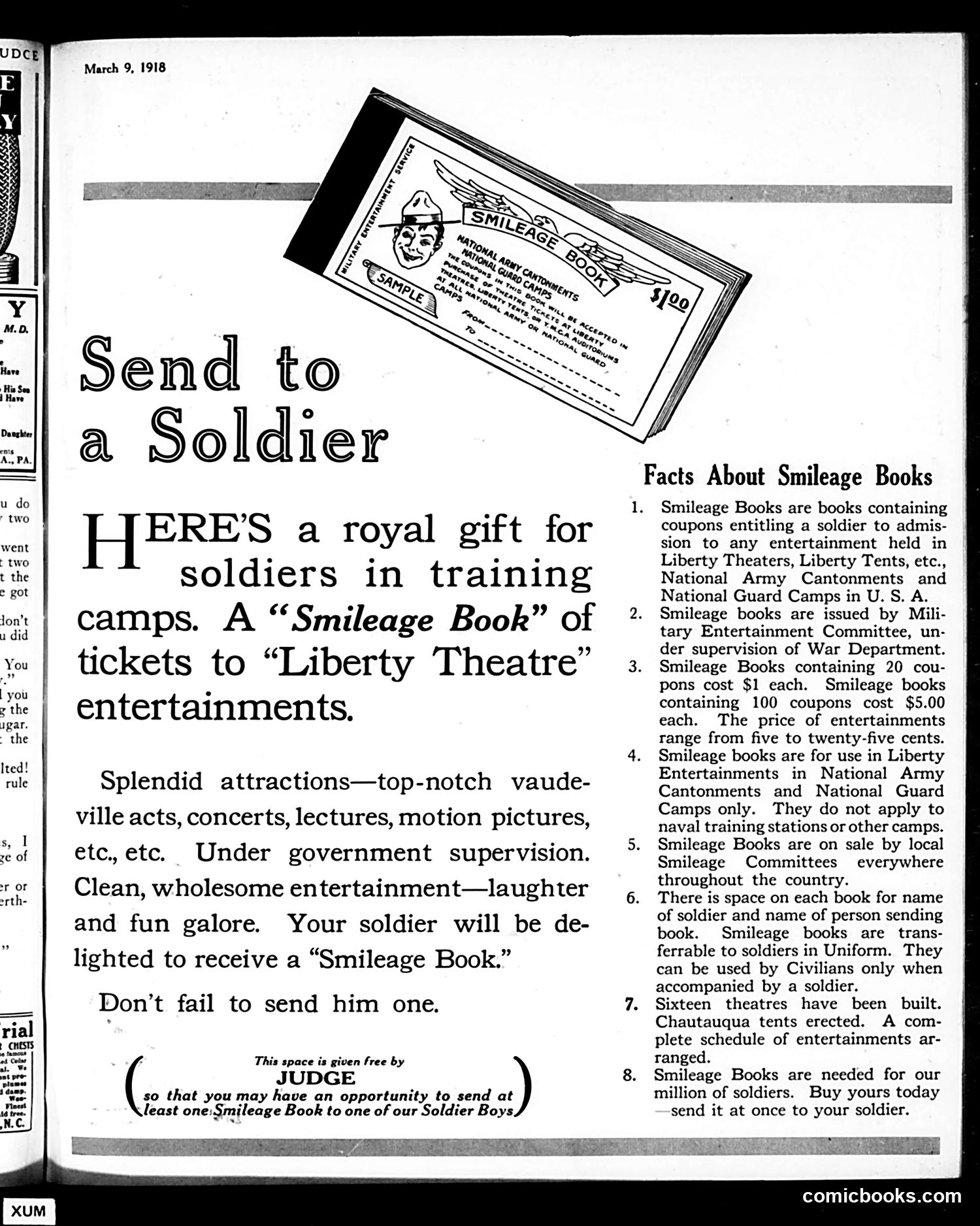
This is primarily a **wartime public service advertisement**, not satire. During World War I, the U.S. military established "Smileage Books"—coupon booklets for entertainment at Liberty Theaters and camps to boost soldier morale. Judge magazine donates this advertising space to encourage civilians to purchase and send these books to soldiers in training. The product cost $1 (20 coupons) or $5 (100 coupons), with individual entertainments ranging from five to twenty-five cents. The "joke" in the title—playing on "mileage"—suggests soldiers would get "smiles per mile" from the entertainment. The detailed facts acknowledge this was a government-supervised program addressing soldier welfare during wartime mobilization. No political satire or caricature appears here; it's straightforward patriotic messaging encouraging home-front support.
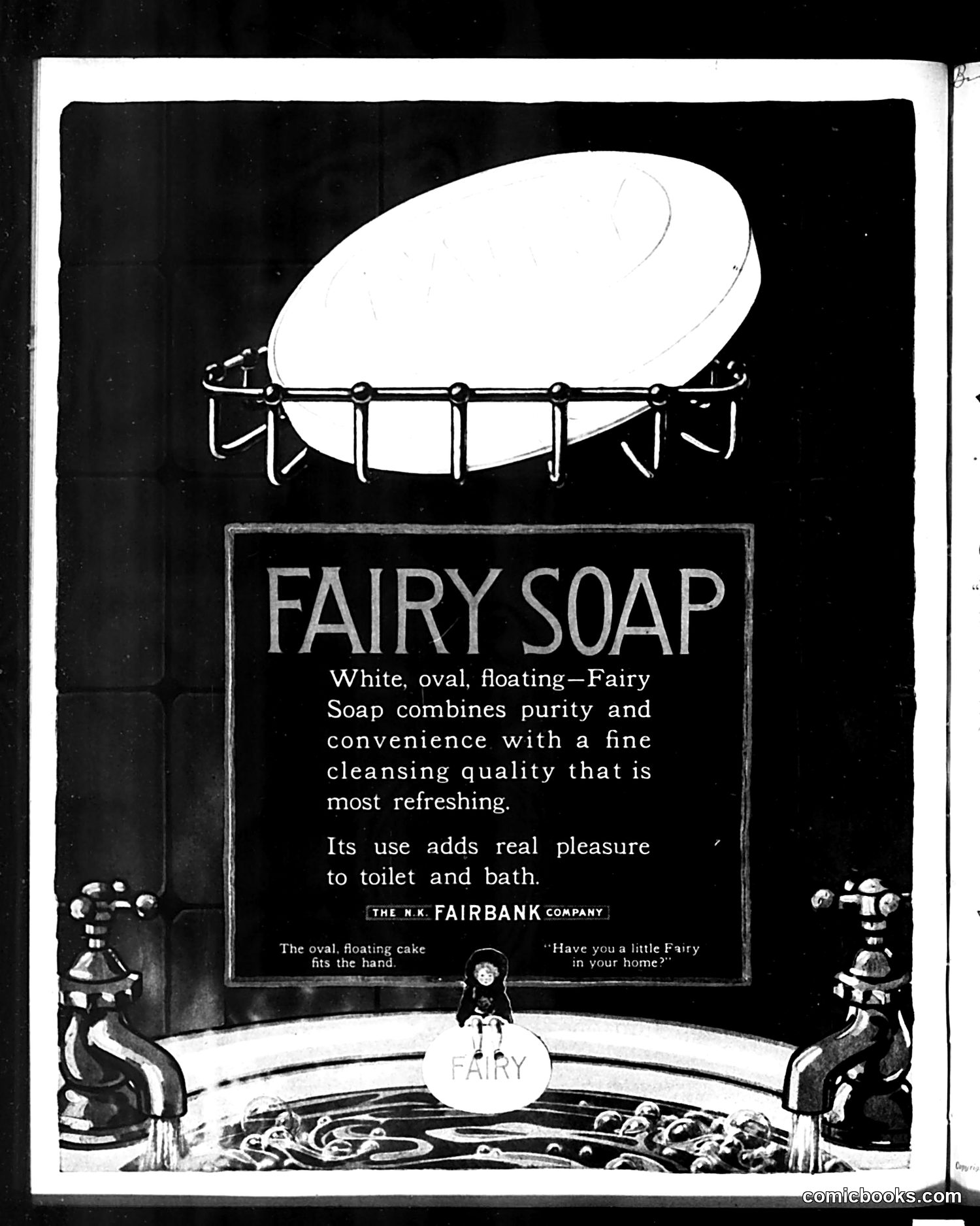
This is a **soap advertisement**, not a political cartoon. It promotes Fairy Soap by the N.K. Fairbank Company, emphasizing the product's practical benefits: it's white, oval-shaped, and floats in water for convenience. The ad highlights "purity" and "fine cleansing quality." The page features decorative design elements—ornamental fixtures and a doll figure labeled "Fairy"—typical of early 20th-century advertising aesthetics. The tagline "Have you a little Fairy in your home?" uses the product's name playfully to encourage purchase. There is no satire or political content here. Judge magazine included paid advertisements alongside its satirical content, and this is purely commercial messaging aimed at domestic consumers.