
Judge, 1918-03-09 · page 21 of 36
Judge — March 9, 1918 — page 21: what you’re looking at
A restored page from Judge, 1918-03-09. Page through the whole issue in the reader above.
📄 Transcribed text from this page (OCR, searchable)
Machine-transcribed from the original scan — historical spelling and the odd misread are preserved.
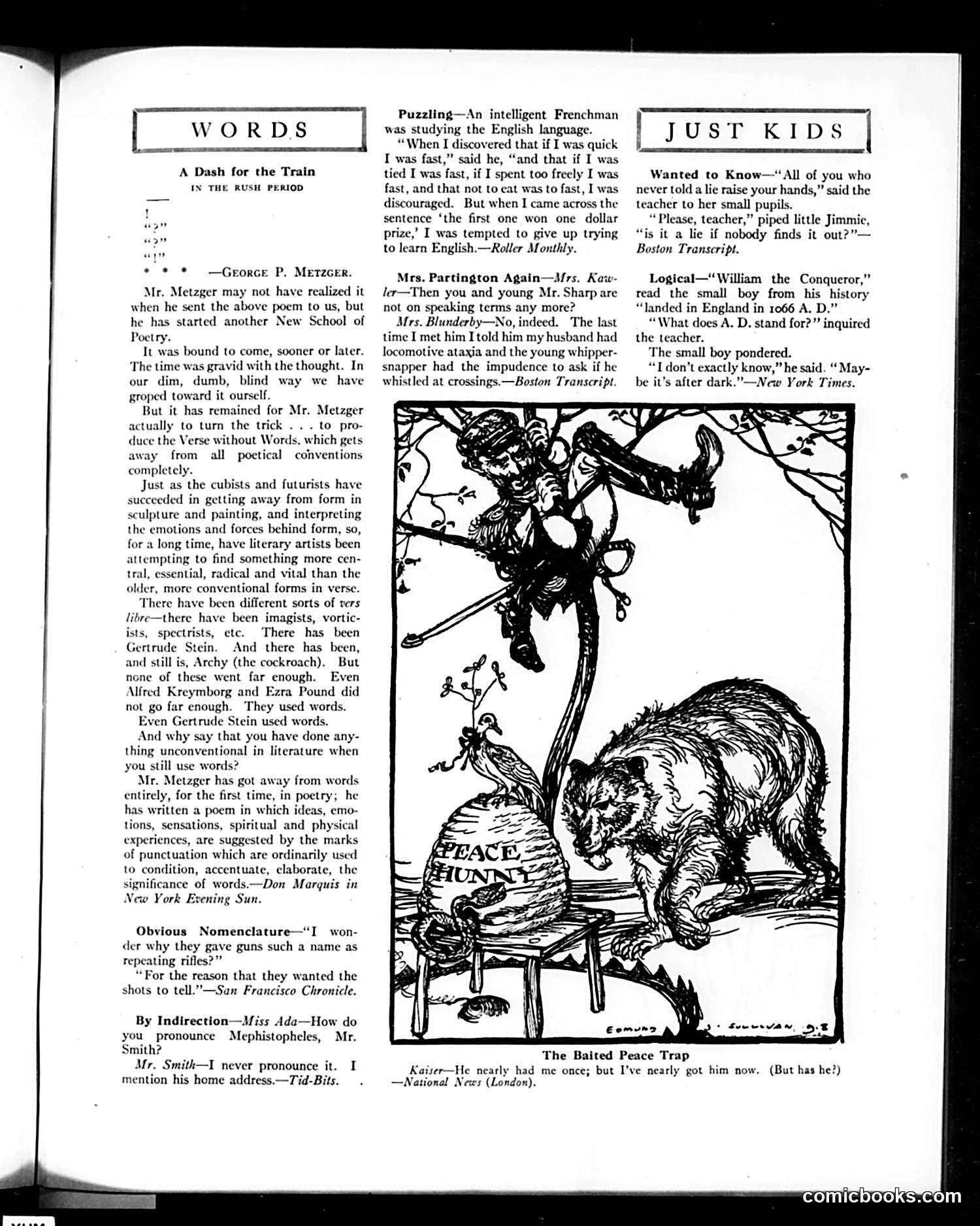
| WORDS A Dash for the Train IN THE RUSH PERIOD * * * —Georce P. Merzcer. Mr. Metzger may not have realized it when he sent the above poem to us, but he has started another New School of Poetry. It was bound to come, sooner or later. The time was gravid with the thought. In our dim, dumb, blind way we have groped toward it ourself. But it has remained for Mr. Metzger actually to turn the trick . . . to pro- duce the Verse without Words, which gets away from all poetical conventions completely. Just as the cubists and futurists have succeeded in getting away from form in sculpture and painting, and interpreting the emotions and forces behind form, so, for a long time, have literary artists been attempting to find something more cen- tral, essential, radical and vital than the older, more conventional forms in verse. There have been different sorts of vers libre—there have been imagists, vortic- ists, spectrists, etc. There has been Gertrude Stein. And there has been, and still is, Archy (the cockroach). But none of these went far enough. Even Alfred Kreymborg and Ezra Pound did not go far enough. They used words. Even Gertrude Stein used words. And why say that you have done any- thing unconventional in literature when you still use words? Mr. Metzger has got away from words entirely, for the first time, in poetry; he has written a poem in which ideas, emo- tions, sensations, spiritual and physical experiences, are suggested by the marks of punctuation which are ordinarily used to condition, accentuate, elaborate, the significance of words.—Don Marquis in New York Evening Sun. Obvious Nomenclature—“I won- der why they gave guns such a name as repeating rifles?” “For the reason that they wanted the shots to tell.”"—San Francisco Chronicle. By Indirection—Miss Ada—How do you pronounce Mephistopheles, Mr. Smith? Mr. Smith—I never pronounce it. I mention his home address.—Tid-Bits. Puzzling—An intelligent Frenchman was studying the English language. | J UST “When I discovered that if I was quick} I was fast,” said he, “and that if I was tied I was fast, if I spent too freely I was fast, and that not to cat was to fast, I was discouraged. But when I came across the sentence ‘the first one won one dollar prize,’ I was tempted to give up trying to learn English.—Roller Monthly. KIDS Wanted to Know—“All of you who never told a lie raise your hands,” said the teacher to her small pupils. “Please, teacher,” piped little Jimmie, “is it a lie if nobody finds it out?”— Boston Transcript. Logical—“ William the Conqueror,” read the small boy from his history “landed in England in 1066 A. D.” “What does A. D. stand for?” inquired the teacher. The small boy pondered. “T don’t exactly know,” he said. “‘May- be it’s after dark.” —New York Times. Mrs. Partington Again—Mrs. Kaw- ter—Then you and young Mr. Sharp are not on speaking terms any more? Mrs. Blunderby—No, indeed. The last time I met him I told him my husband had locomotive ataxia and the young whipper- snapper had the impudence to ask if he whistled at crossings.—Boston Transcript. The Baited Peace Trap Kaiser—He nearly had me once; but I’ve nearly got him now. (But has he?) —National News (London).