
Judge, 1918-03-09 · page 16 of 36
Judge — March 9, 1918 — page 16: what you’re looking at
What you’re looking at
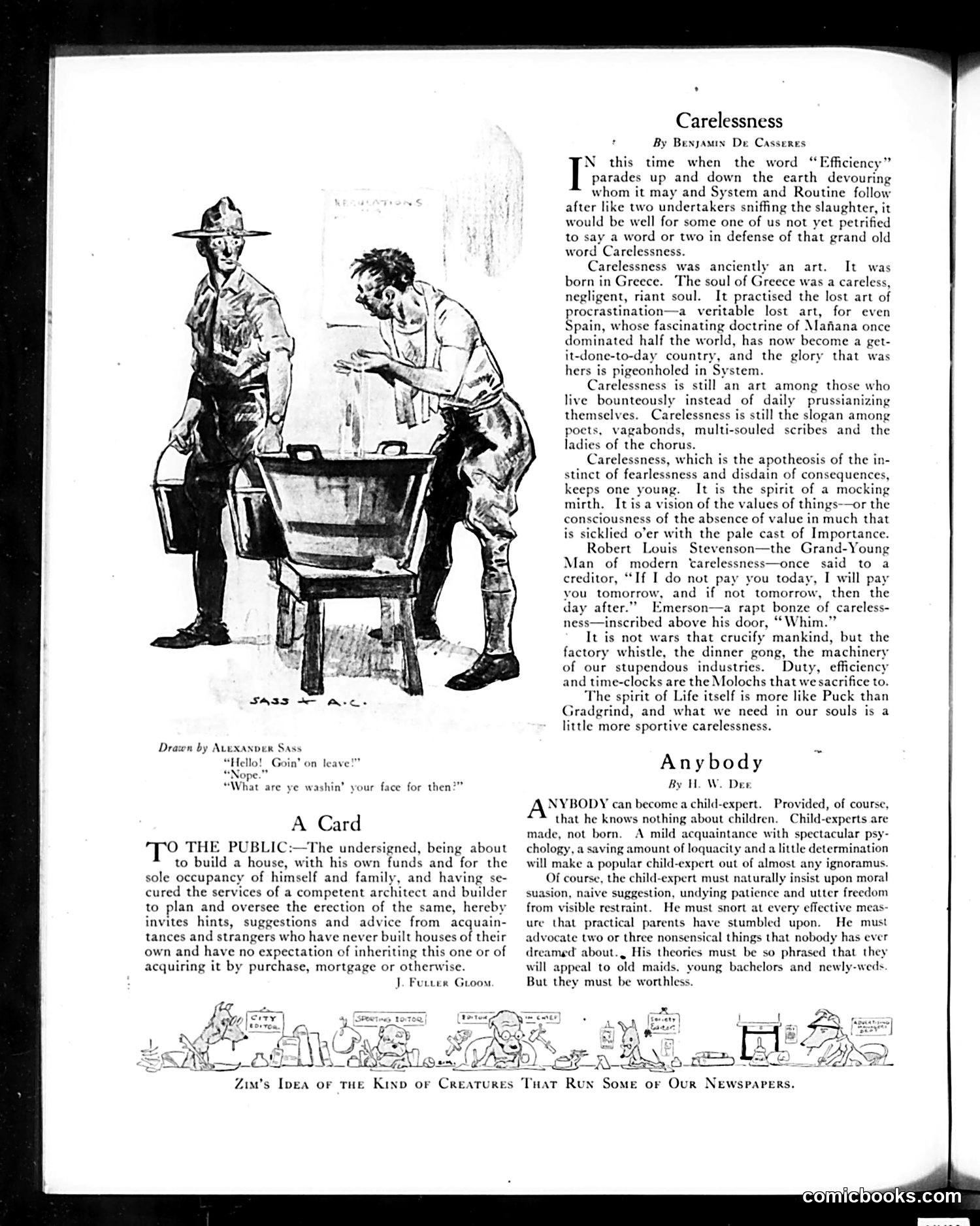
**The Cartoon (by Alexander Sass):** Two soldiers are shown at a barrel or tub. One asks the other, "Hello! Goin' on leave?" The second replies "Nope," then when asked why he's washing his face, the implication is he's preparing for something other than leave—likely his own death or execution. This is WWI-era dark humor about soldier mortality. **"A Card" Section:** J. Fuller Gloom satirizes people who offer unsolicited advice about home-building despite having no expertise or stake in the outcome. It mocks the presumption of armchair critics. **"Carelessness" Essay:** De Casseres defends carelessness as a lost art, contrasting it with modern obsessions with "Efficiency" and "System." He argues carelessness—embodied in figures like Emerson and Stevenson—represents youthful creativity and freedom, whereas modern industrial society demands rigid duty and time-clocks. **"Anybody" Section:** Der mocks self-proclaimed child-experts who lack actual parenting experience but prescribe fashionable psychological theories. The satire suggests such experts are worthless despite their appeal to unmarried audiences.
📄 Transcribed text from this page (OCR, searchable)
Machine-transcribed from the original scan — historical spelling and the odd misread are preserved.
Dravon by Avexanpen Sass “Hello! Goin’ on leave!” Nope.” . What are ye washin’ your face for then?” A Card ‘O THE PUBLIC:—The undersigned, being about to build a house, with his own funds and for the sole occupancy of himself and family, and having se- cured the services of a competent architect and builder to plan and oversee the erection of the same, hereby invites hints, suggestions and advice from acquain- tances and strangers who have never built houses of their own and have no expectation of inheriting this one or of acquiring it by purchase, mortgage or otherwise. J. Futter Groom t FACS 4 Zim’s [pea or THE Kino or Creatures 1\ Lo lt ‘Tuat Rus Some or Carelessness : By Bexyasixy De Casseres this time when the word “Efficiency” parades up and down the earth devouring whom it may and System and Routine follow after like two undertakers sniffing the slaughter, it would be well for some one of us not yet petrified to say a word or two in defense of that grand old word Carclessness. Carelessness was anciently an art. It was born in Greece. The soul of Greece was a careless, negligent, riant soul. It practised the lost art of procrastination veritable lost art, for even Spain, whose fascinating doctrine of Mafana once dominated half the world, has now become a get- it-done-to-day country, and the glory that was hers is pigeonholed in System. Carelessness is still an art among those who live bounteously instead of daily prussianizing themselves. Carelessness is still the slogan among pocts, vagabonds, multi-souled scribes and the ladies of the choru Carelessness, which is the apotheosis of the in- stinct of fearlessness and disdain of consequences, keeps one young. It is the spirit of a mocking mirth. It is a vision of the values of things—or the consciousness of the absence of value in much that is sicklied o’er with the pale cast of Importance. Robert Louis Stevenson—the Grand-Young Man of modern ‘arelessness—once said to a creditor, “If I do not pay you today, I will pay you tomorrow, and if not tomorrow, then the day afte Emerson—a rapt bonze of careless- ness—inscribed above his door, “Whim.” s not wars that crucify mankind, but the factory whistle, the dinner gong, the machinery of our stupendous industries. Duty, efficiency and time-clocks are the Molochs that we sacrifice to. The spirit of Life itself is more like Puck than Gradgrind, and what we need in our souls is a little more sportive carelessness. Anybody By H.W. Des ANYBopY can become a child-expert. Provided, of course, that he knows nothing about children. Child-experts are made, not born. A mild acquaintance with spectacular psy chology, a saving amount of loquacity and a little determination will make a popular child-expert out of almost any ignoramus Of course, the child-expert must naturally insist upon moral suasion, naive suggestion, undying patience and utter freedom from visible restraint. He must snort at every effective meas- ure that practical parents have stumbled upon. He must advocate two or three nonsensical things that nobody has ever dreamed about., His theories must be so phrased that they will appeal to old maids, young bachelors and newly-weds But they must be worthless. Jur NewspaPers.