
Judge, 1918-03-09 · page 12 of 36
Judge — March 9, 1918 — page 12: what you’re looking at
What you’re looking at
This story-illustration depicts a domestic reconciliation plot common to early 20th-century sentimental fiction. The narrative involves: **The situation**: Young actor Harvey Thresher marries actress Miss Rand against his wealthy father Archibald's wishes. The father, initially enraged and disinheriting his son, falls ill. **The scheme**: A sympathetic doctor arranges for an attractive nurse, Miss Gillman, to care for the old man. The nurse skillfully manipulates the situation—the father grows emotionally attached and even proposes marriage (or at least promises her money), while she secretly facilitates reconciliation with Harvey. **The satire**: Judge satirizes both the predictable melodrama of theatrical romance and the transparency of the nurse's social climbing. The "messenger from home" appears to be Miss Gillman, whose careful emotional engineering accomplishes what direct confrontation couldn't: softening the father's heart through romantic attachment rather than genuine forgiveness. The illustration by F.M. Follett shows a figure in period dress, likely representing the scheme's dramatic moment.
📄 Transcribed text from this page (OCR, searchable)
Machine-transcribed from the original scan — historical spelling and the odd misread are preserved.
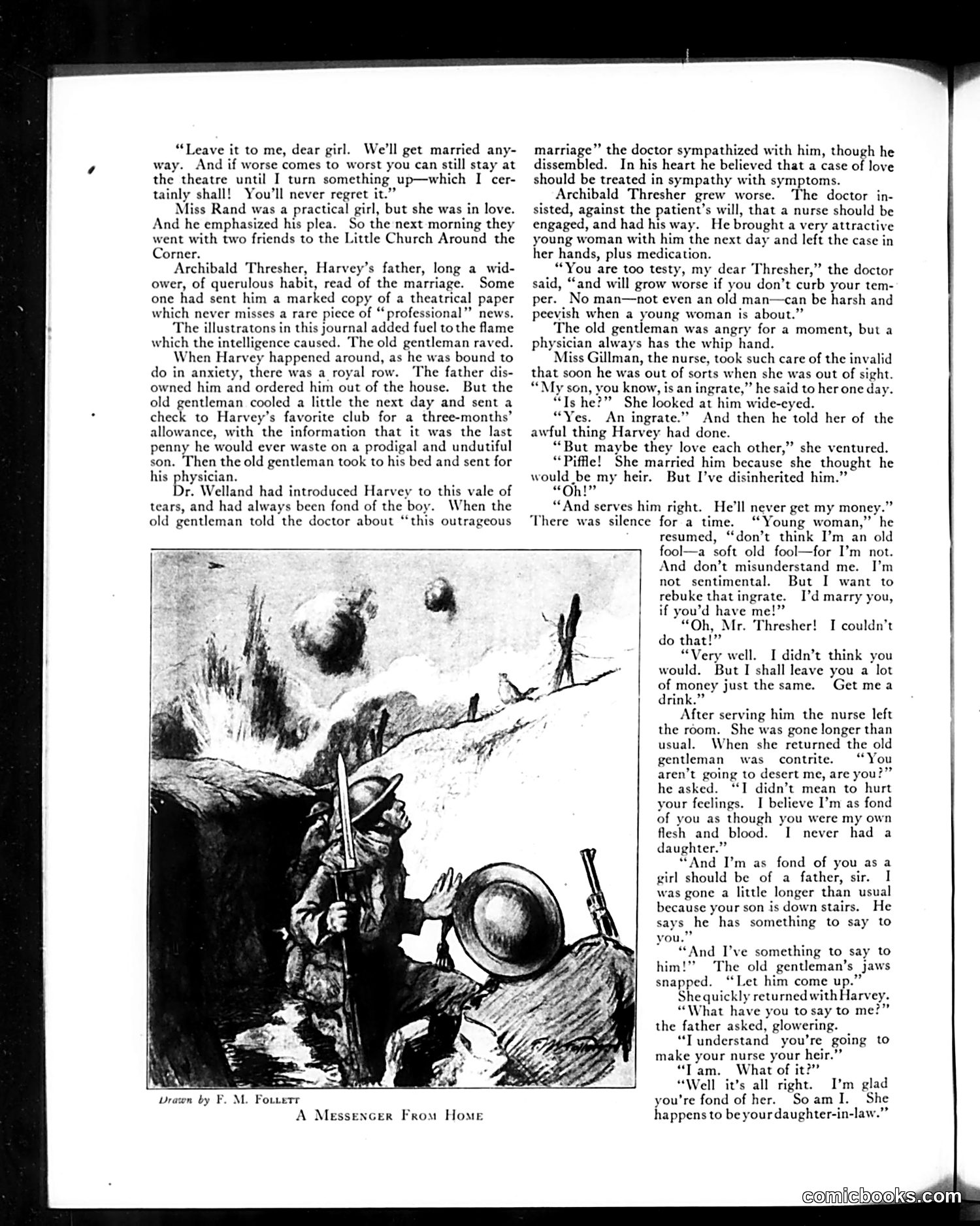
“Leave it to me, dear girl. We'll get married any- way. And if worse comes to worst you can still stay at the theatre until I turn something up—which I cer- tainly shall! You'll never regret it.” Miss Rand was a practical girl, but she was in love. And he emphasized his plea. So the next morning they went with two friends to the Little Church Around the Corner. Archibald Thresher, Harvey’s father, long a wid- ower, of querulous habit, read of the marriage. Some one had sent him a marked copy of a theatrical paper which never misses a rare piece of “professional” new The illustratons in this journal added fuel tothe flame which the intelligence caused. The old gentleman raved. When Harvey happened around, as he was bound to do in anxiety, there was a royal row. The father dis- owned him and ordered him out of the house. But the old gentleman cooled a little the next day and sent a check to Harvey's favorite club for a three-months’ allowance, with the information that it was the last penny he would ever waste on a prodigal and undutiful son. Then the old gentleman took to his bed and sent for his physician. Dr. Welland had introduced Harvey to this vale of tears, and had always been fond of the boy. When the old gentleman told the doctor about ‘this outrageous marriage” the doctor sympathized with him, though he dissembled. In his heart he believed that a case of love should be treated in sympathy with symptoms. Archibald Thresher grew worse. The doctor in- sisted, against the patient’s will, that a nurse should be engaged, and had his way. He brought a very attractive young woman with him the next day and left the case in her hands, plus medication. “You are too testy, my dear Thresher,” the doctor said, “and will grow worse if you don’t curb your tem- per. No man—not even an old man—can be harsh and peevish when a young woman is about.” The old gentleman was angry for a moment, but a phy n_ always has the whip hand. Miss Gillman, the nurse, took such care of the invalid that soon he was out of sorts when she was out of sight. “My son, you know, is an ingrate,” he said to her one day. “Ts he?” She looked at him wide-eyed. “Yes. An ingrate.” And then he told her of the awful thing Harvey had done. “But maybe they love each other,” she ventured. “Piffle! She married him because she thought he would be my heir. But I’ve disinherited him.” “Oh!” “And serves him right. He'll never get my money.” There was silence for a time. ‘Young woman,” he resumed, “don’t think I’m an old fool—a soft old fool—for I’m not. And don’t misunderstand me. I’m not sentimental. But I want to rebuke that ingrate. I’d marry you, if you’d have me!” “Oh, Mr. Thresher! do that!” “Very well. I didn’t think you would. But I shall leave you a lot of money just the same. Get mea drink.” After serving him the nurse left the room. She was gone longer than usual. When she returned the old gentleman was contrite. “You aren’t going to desert me, are you?” he asked. ‘I didn’t mean to hurt your feelings. I believe I’m as fond of you as though you were my own flesh and blood. I never had a daughter.” “And I’m as fond of you as a girl should be of a father, sir. I was gone a little longer than usual because your son is down stairs. He says he has something to say to you.” “And I’ve something to say to him!” The old gentleman’s jaws snapped. ‘Let him come up.” She quickly returned with Harvey “What have you to say to me?” the father asked, glowering. “Tunderstand you're going to make your nurse your heir.” “Tam. What of it?” “Well it’s all right. I’m glad I couldn’t M. Fouverr A MessenGer From Home Drawn by F you're fond of her. SoamI. She happens to be yourdaughter-in-law.”