
Judge, 1918-03-09 · page 20 of 36
Judge — March 9, 1918 — page 20: what you’re looking at
What you’re looking at
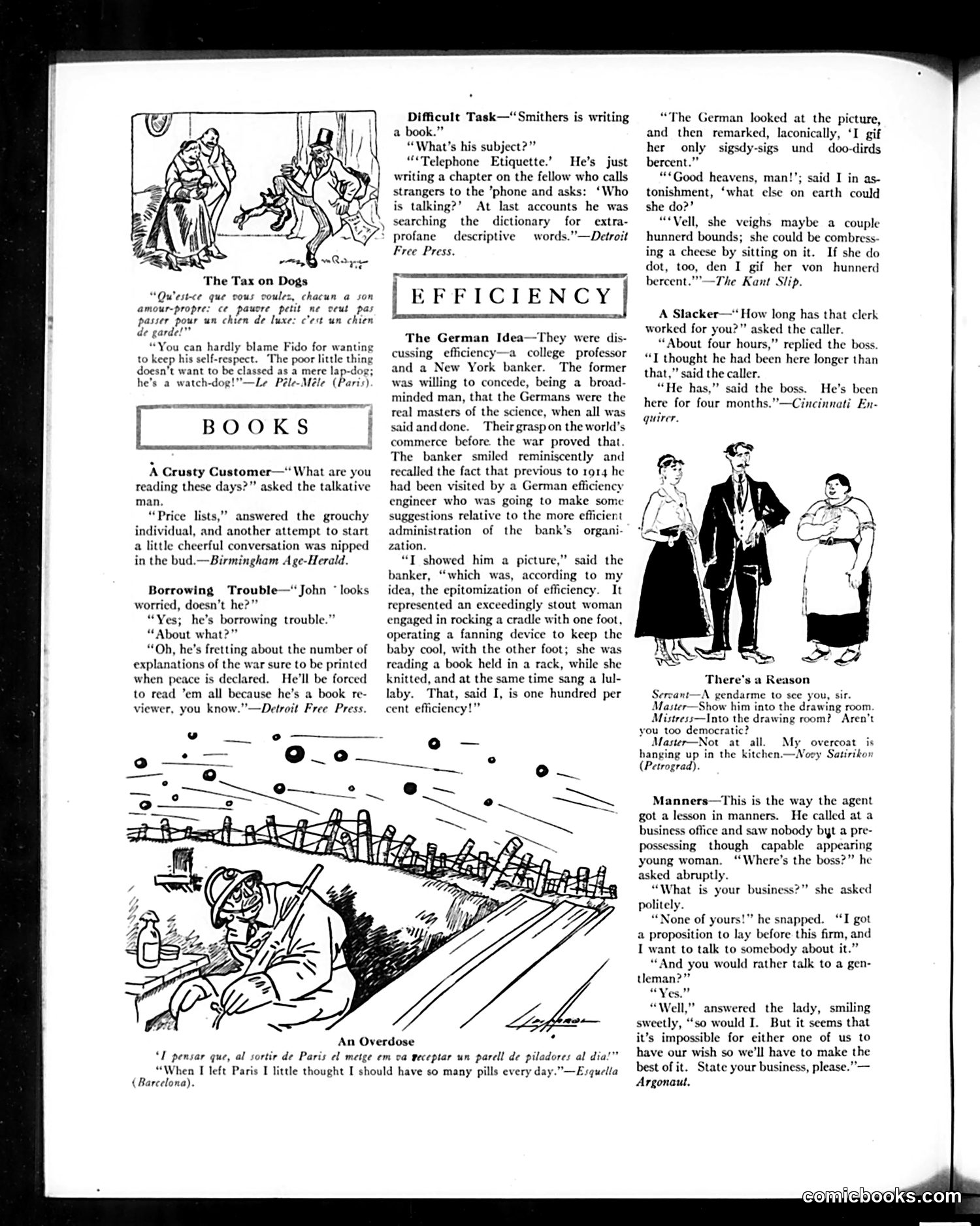
This page collects brief satirical humor pieces and cartoons typical of early 20th-century Judge magazine. **"The Tax on Dogs"** mocks a French dog tax by showing a small dog refusing to accept "lap-dog" status—it wants recognition as a "watch-dog" to maintain self-respect and avoid higher taxes. **"The German Idea"** satirizes German efficiency obsession (relevant during or after WWI). A banker describes showing a German efficiency engineer a picture of an impossibly multitasking obese woman as the height of efficiency. The German, unmoved, suggests she could still compress cheese by sitting on it—deadpan mockery of German literal-mindedness and relentless optimization. **"A Slacker"** jokes about a clerk's anxiety over future war-history books he'll be forced to read as a book reviewer—topical WWI humor. **Other pieces** include mild office and social etiquette humor common to the era. The cartoons and jokes reflect 1910s-1920s preoccupations: war anxieties, German stereotypes, class distinctions, and workplace dynamics.
📄 Transcribed text from this page (OCR, searchable)
Machine-transcribed from the original scan — historical spelling and the odd misread are preserved.
The Tax on Dogs “Questce que cous coule:, chacun @ son amour-propre: ce paucre petit ne veut pas passer pour un chien de luxe: c'est un chien “You can hardly blame Fido for wanting to keep his self-respect. ‘The poor little thing doesn’t want to be classed as a mere lap-dog; he’s a watch-dog!"—Le Péle-Méle (Paris) BOOKS i A Crusty Customer—* What are you reading these days?” asked the talkative man. “Price lists,” answered the grouchy individual, and another attempt to start a little cheerful conversation was nipped in the bud.—Birmingham A ge-Herald. Borrowing Trouble—“ John * looks worried, doesn’t he?” “Yes; he’s borrowing trouble. “About what?” “Oh, he’s fretting about the number of explanations of the war sure to be printed when peace is declared. He'll be forced to read ‘em all because he’s a book re- viewer, you know.”—Detroit Free Press. > profane Difficult Task—‘‘Smithers is writing a book.” “What’s his subject?” ““Telephone Etiquette.’ He’s just writing a chapter on the fellow who calls strangers to the ’phone and asks: ‘Who is talking?’ At last accounts he was searching the dictionary for extra- descriptive — words.” —Detroit Free Press. | EFFICIENCY | The German Idea—They were dis- cussing efficiency—a college professor and a New York banker. The former was willing to concede, being a broad- minded man, that the Germans were the real masters of the science, when all was saidanddone. Their grasp on the world’s commerce before. the war proved that The banker smiled reminiscently and recalled the fact that previous to 1914 he had been visited by a German efficiency engineer who was going to make som suggestions relative to the more efficient administration of the bank’s organi- zation. “T showed him a picture,” said the banker, “which was, according to my idea, the epitomization of efficiency. It represented an exceedingly stout woman engaged in rocking a cradle with one foot, operating a fanning device to keep the baby cool, with the other foot; she was reading a book held in a rack, while she knitted, and at the same time sang a lul- laby. That, said I, is one hundred per cent efficiency!” An Overdose “I pensar que, al sortir de Paris el metge em ca veceptar un parell de piladores al dia!” “When I left Paris I little thought I should have so many pills every day.”—Esquella (Barcelona). “The German looked at the picture, and then remarked, laconically, ‘I gif her only sigsdy-sigs und doo-dirds bercent.”” “*Good heavens, man!’; said I in as- tonishment, ‘what else on earth could she do?’ “*Vell, she veighs maybe a couple hunnerd bounds; she could be combress- ing a cheese by sitting on it. If she do dot, too, den I gif her von hunnerd bercent.""—The Kant Slip. A Slacker—* How long has that clerk worked for you?” asked the caller. “About four hours,” replied the boss. “T thought he had been here longer than that,” said the caller. “He has,” said the boss. He's been here for four months.” —Cincinnati En- quirer. A i ‘ There's a Reason Sercant—A gendarme to sce you, sir. Master—Show him into the drawing room Mistress—Into the drawing room? Aren't you too democratic? Master—Not at all. My overcoat is hanging up in the kitchen.—Nooy Satirikor (Petrograd). Manners—This is the way the agent got a lesson in manners. He called at a business office and saw nobody byt a pre- possessing though capable appearing young woman. “Where's the boss?” he asked abruptly. “What is your business?” she asked politely. ‘one of yours!” he snapped. “TI got a proposition to lay before this firm, and I want to talk to somebody about it.” “And you would rather talk to a gen- tleman?” “Well,” answered the lady, smiling sweetly, “so would I. But it seems that it’s impossible for cither one of us to have our wish so we'll have to make the best of it. State your business, please.” — Argonaut.