
Judge, 1918-03-09 · page 11 of 36
Judge — March 9, 1918 — page 11: what you’re looking at
What you’re looking at
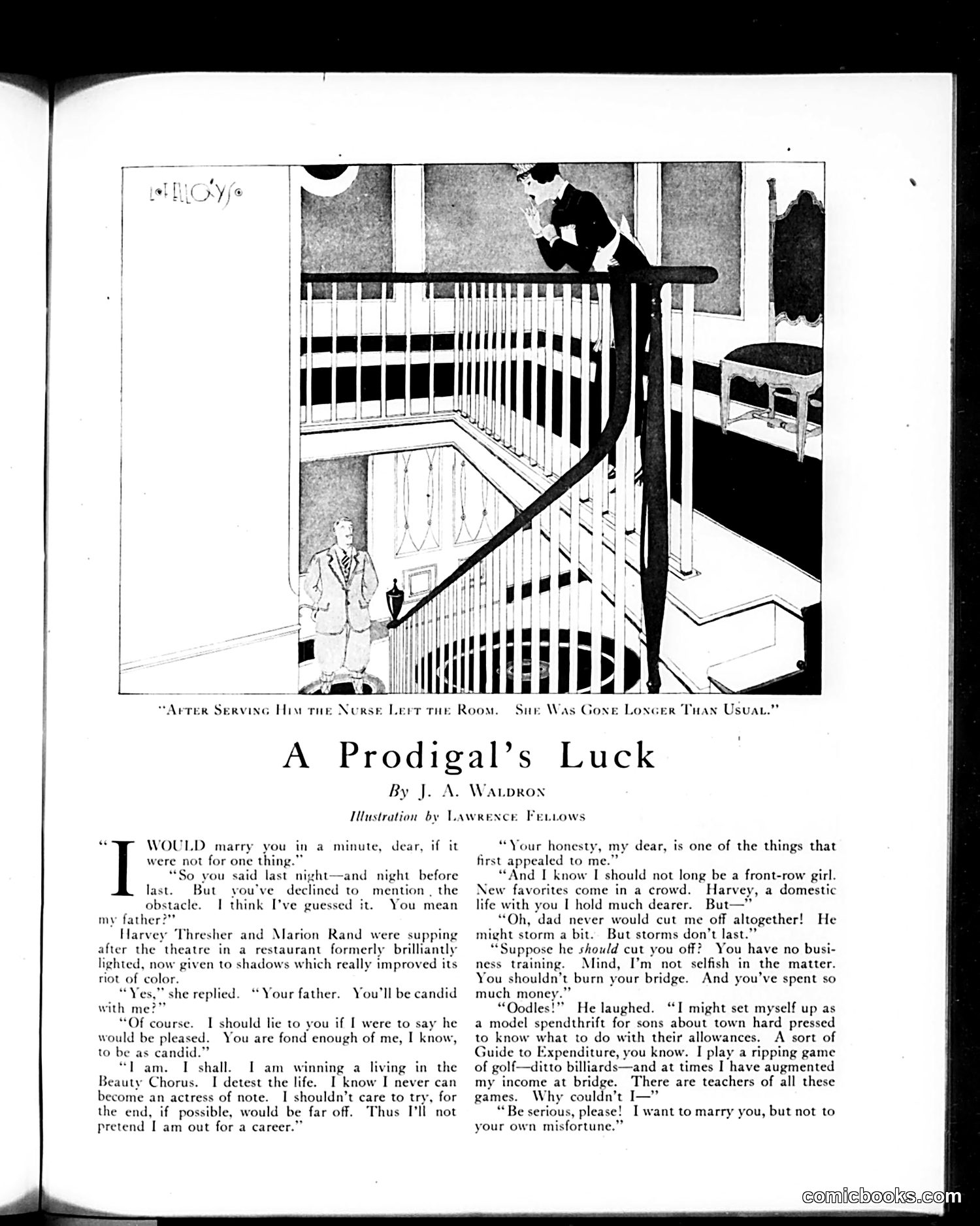
This is a short story (not a political cartoon) by J.A. Waldron, illustrated by Lawrence Fellows. It depicts a marriage proposal scene between Harvey Thresher and Marion Rand, a chorus girl, in a dimly-lit restaurant. The satirical premise concerns class anxiety and marital prospects in early 20th-century America: Marion worries that Harvey's father will disapprove of her modest theatrical background and lack of business training. Harvey dismisses financial concerns, boasting he can support them through gambling at golf and bridge, and by becoming a "model spendthrift"—a self-aware joke about teaching other wealthy young men how to squander allowances. The humor targets wealthy idle young men dependent on family money, their frivolous pursuits (cards, golf), and their assumed ability to marry "down" socially without consequence. Marion's caution about "burning bridges" with her father suggests the story will explore whether Harvey's confidence proves justified or foolish.
📄 Transcribed text from this page (OCR, searchable)
Machine-transcribed from the original scan — historical spelling and the odd misread are preserved.
milli cl “Arrer Servine Him tig Nurse Lert tie Re hii "tty iN nT ; 90m. Sure Was Goxe Loxcer Tuan Usuat.” A Prodigal’s Luck By J. Mlustration by WOULD marry minute, dear, if it were not for one t . So you said last ni last. But you've declined to obstacle. | think I’ve guessed i my father?” Harvey ‘Thresher and Marion Rand were supping after the theatre in a restaurant formerly brilliandy lighted, now given to shadows which really improved its riot of color. “Yes,” she replied with me?” “Of course. would be pleased. to be as candid.” “Tam. I shall. I am winning a living in the Beauty Chorus. I detest the life. I know I never can become an actress of note. I shouldn’t care to try, for the end, if possible, would be far off. Thus I'll not pretend I am out for a career.” you ina ht—and night before mention , the You mean “Your father. You'll be candid I should lie to you if I were to say he You are fond enough of me, I know, A. Watprox Lawrence Fe.tows “Your honesty, my dear, is one of the things that first appealed to me.” nd I know I should not long be a front-row girl. New favorites come in a crowd. Harvey, a domestic life with you I hold much dearer. But—” “Oh, dad never would cut me off altogether! He might storm a bit. But storms don’t last.” “Suppose he should cut you off? You have no busi- ness training. Mind, I’m not selfish in the matter. You shouldn't, burn your bridge. And you've spent so much money. “Oodles!” He laughed. “I might set myself up as a model spendthrift for sons about town hard pressed to know what to do with their allowances. A sort of Guide to Expenditure, you know. I play a ripping game of golf—ditto billiards—and at times I have augmented my income at bridge. There are teachers of all these s. Why couldn’t I—” tious, please! I want to marry you, but not to your own misfortune.” comichooks.coyy)