
A complete issue · 32 pages · 1917
Judge — January 6, 1917
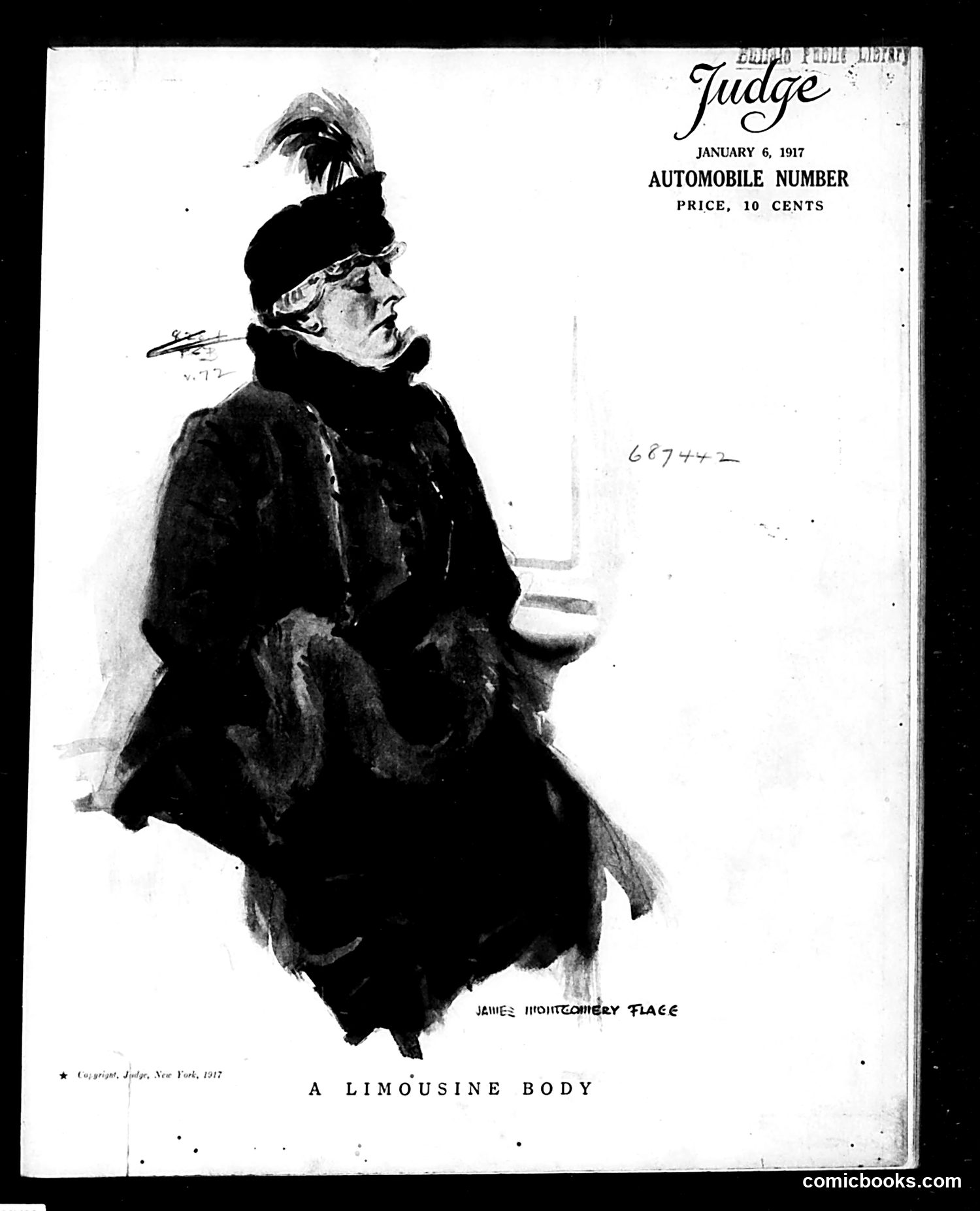
This cover features an illustration credited to James Montgomery Flagg depicting a woman in an elaborate, expensive fur coat and feathered hat—the height of luxury fashion. The title "A Limousine Body" is a pun: it refers both to the woman's fashionable "body" (outfit) and to automobile limousine bodies, fitting the issue's "Automobile Number" theme. The satire likely mocks wealthy women's extravagant spending on fashion during World War I, when resources were increasingly rationed. The opulent clothing and accessories represent conspicuous consumption at a time when such excess was becoming socially controversial. The limousine reference adds commentary on class privilege and automobile culture among the wealthy elite.
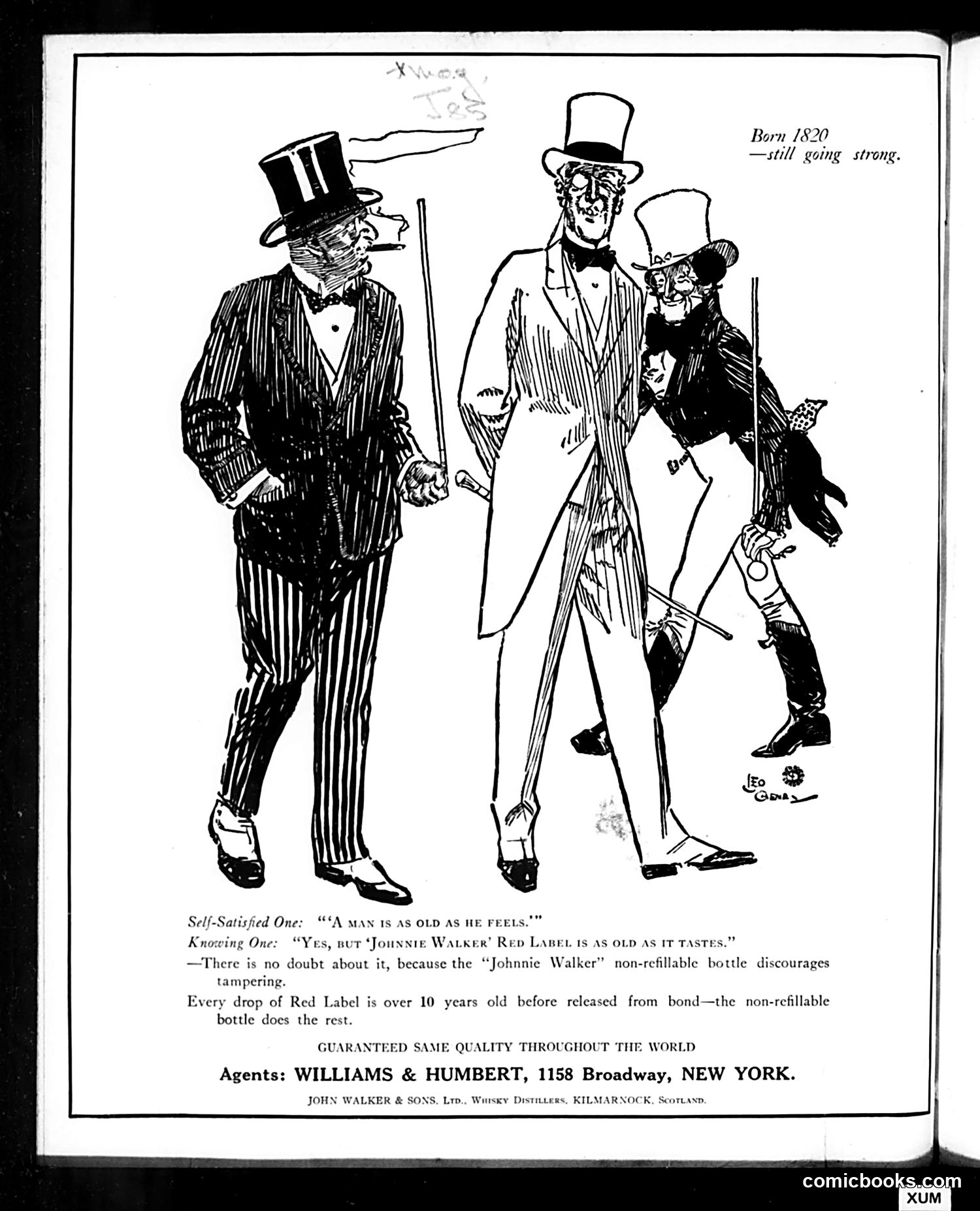
This is primarily a **whisky advertisement** rather than political satire. It features three caricatured gentlemen in top hats—a common advertising format of the era—illustrating the slogan "A man is as old as he feels" versus "Johnnie Walker Red Label is as old as it tastes." The joke centers on the product's quality: Johnnie Walker's non-refillable bottle design prevents tampering, ensuring consistent taste. The advertisement claims that even 10-year-old Red Label maintains its quality throughout distribution worldwide. The "Born 1820—still going strong" notation in the upper right references the whisky brand's founding date, suggesting timeless reliability. This is commercial messaging, not social or political commentary.
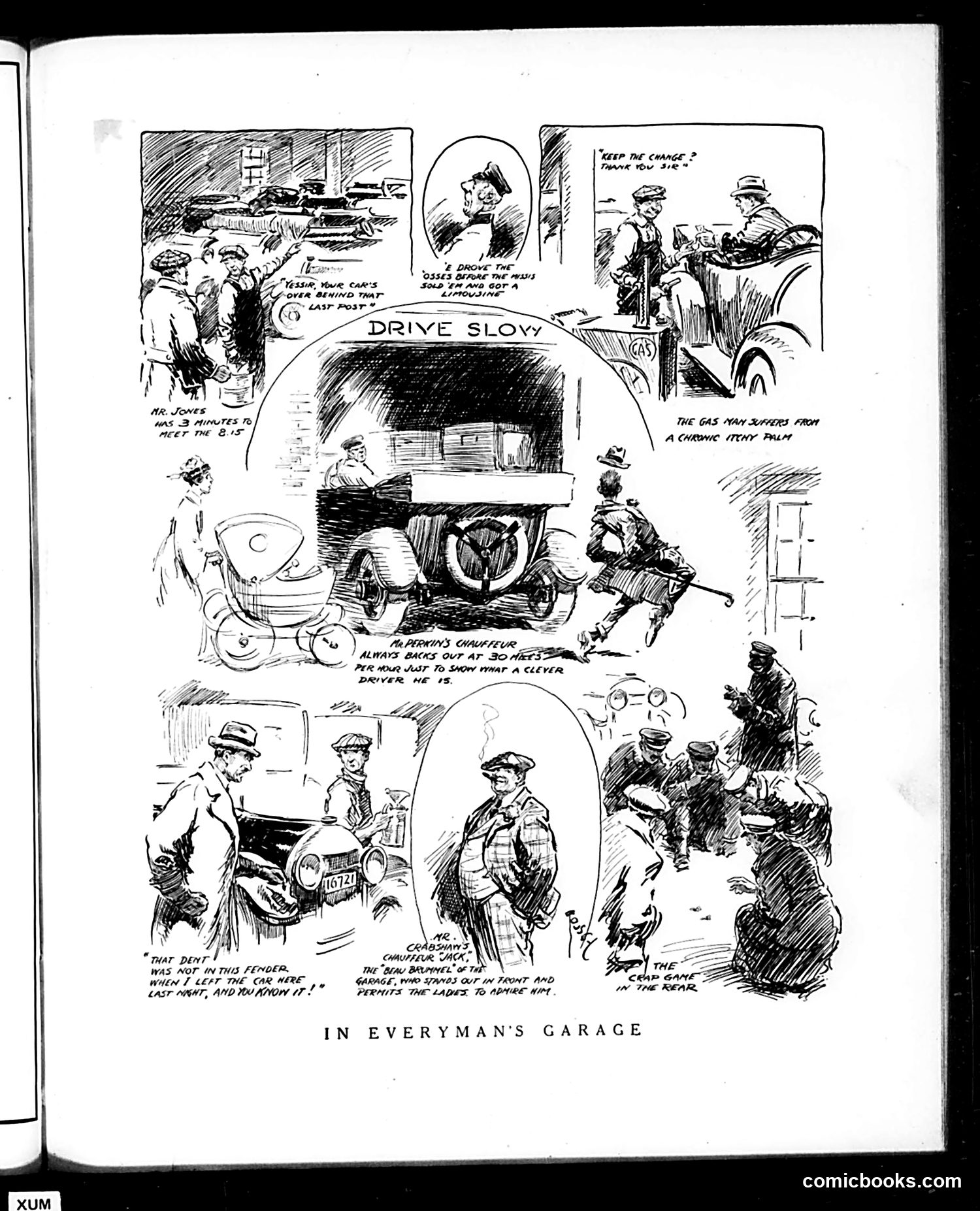
This cartoon satirizes common automobile mishaps and the diverse characters who encounter them. The central panel shows a car being driven slowly, with various vignettes depicting typical garage and roadside incidents: a man complaining about a dent in his fender, someone attempting to fix a mechanical issue, a chauffeur working on the vehicle, and others dealing with flat tires and repairs. The satire targets the universal frustrations of early automobile ownership—breakdowns, damage, and the need for repairs—affecting drivers across social classes, from wealthy owners to working-class mechanics. The title "In Everyman's Garage" emphasizes that car troubles are democratic: everyone experiences them. The humor derives from the relatable, everyday nature of these automotive problems in an era when automobiles were still relatively new and unreliable.
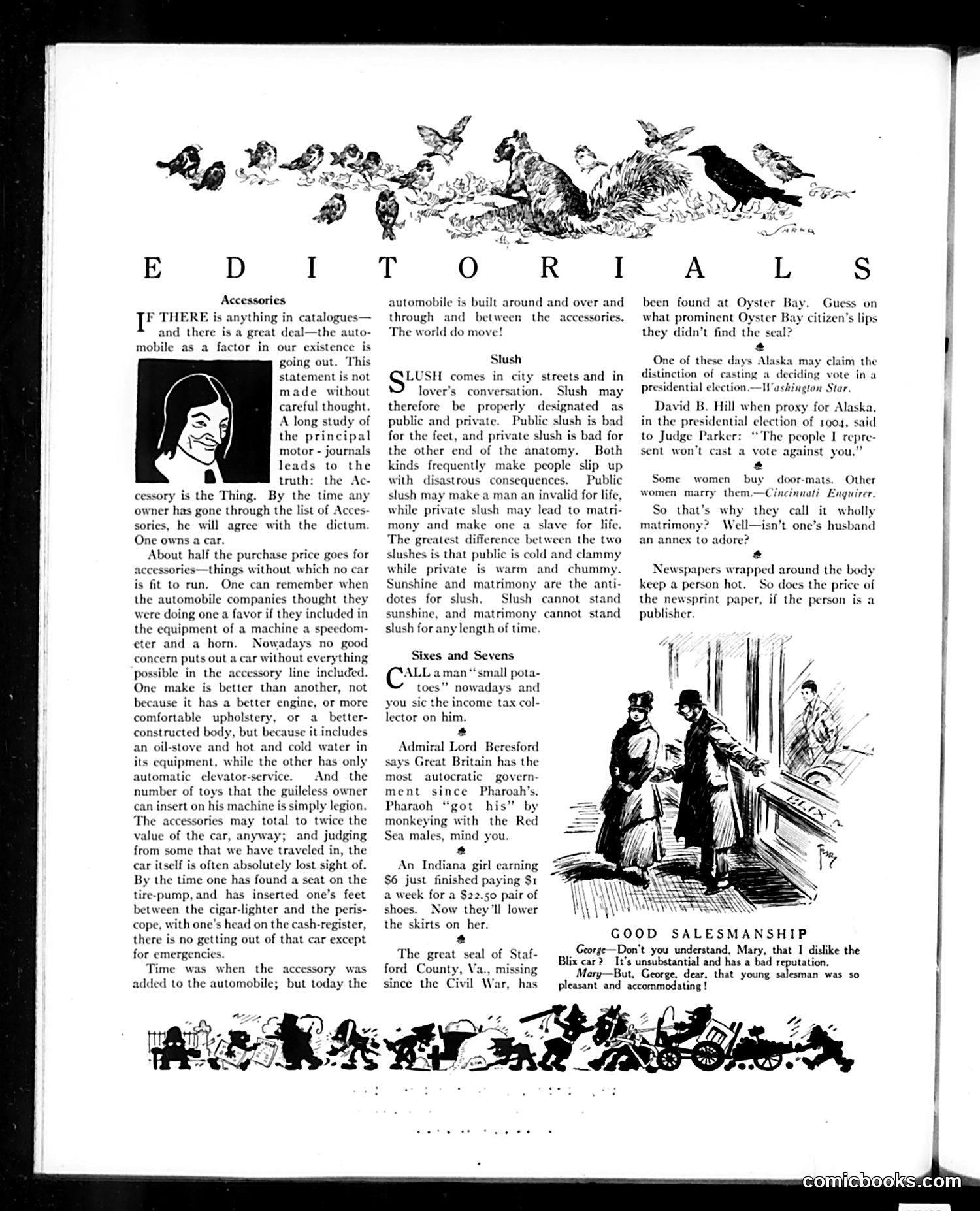
This page presents humorous social commentary rather than political cartoons. The main articles mock contemporary manners and consumer culture: **"Slush"** satirizes both public and private rudeness—public slush (mud) makes people slip dangerously, while private slush (marital discord) enslaves people. The joke plays on the dual meaning. **"Sixes and Sevens"** references the phrase "at sixes and sevens" (confused/disorganized). It mocks a man calling himself a "small potatoes" taxpayer while complaining about income tax. The small cartoon labeled **"Good Salesmanship"** shows two figures discussing a car's reputation. The humor appears to be about deceptive sales tactics or inflated claims about used automobiles. These pieces target early 20th-century American consumer anxieties and social pretension rather than specific politicians or events.
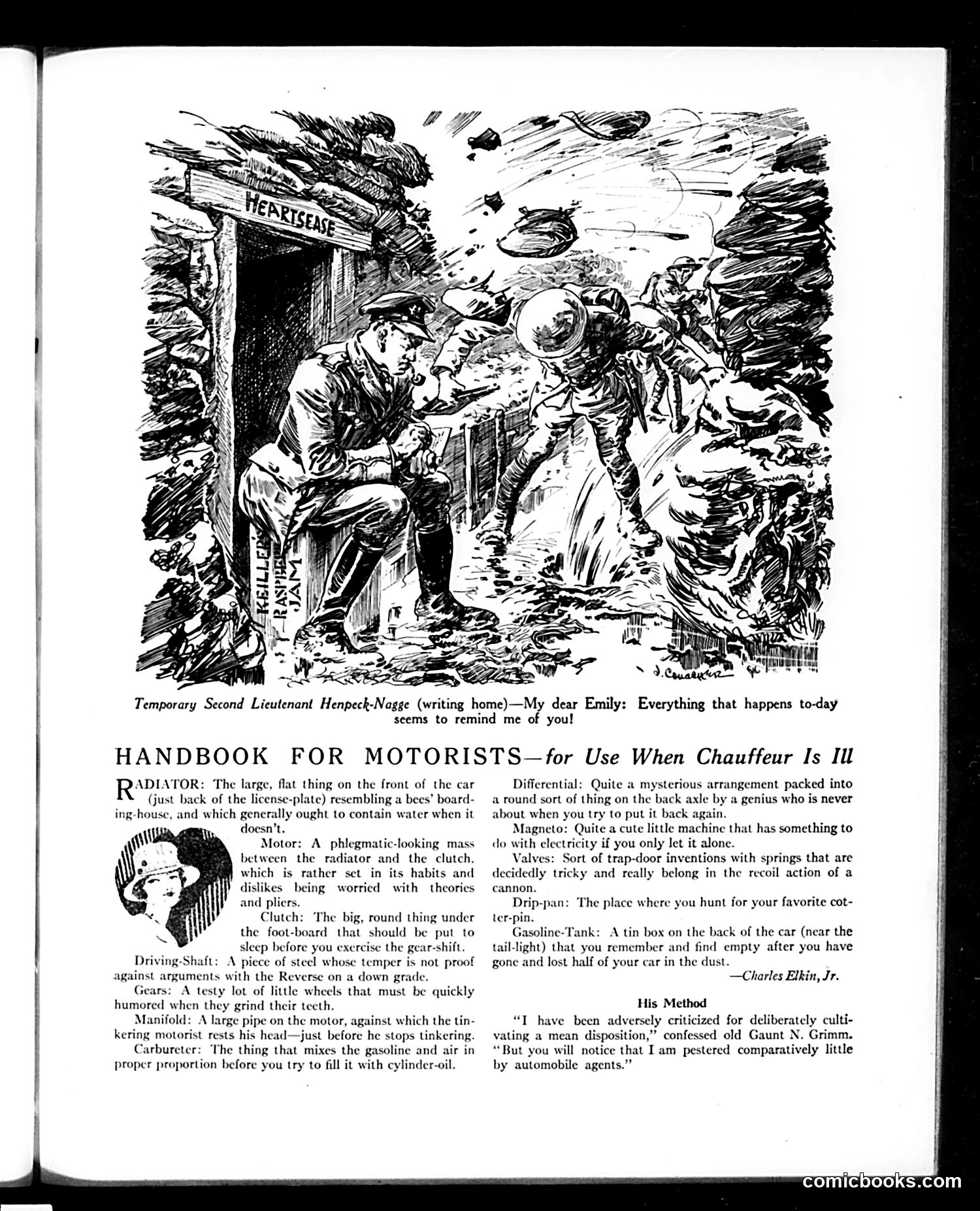
The main illustration depicts a soldier writing home from a WWI trench, captioned "Temporary Second Lieutenant Henpeck-Nagge" writing to "Emily." The cartoon satirizes how wartime experiences make soldiers nostalgic—everything reminds him of his wife back home, even amid combat chaos. Below is a humorous "Handbook for Motorists—for Use When Chauffeur Is Ill," defining car parts with tongue-in-cheek definitions. Terms like "Motor," "Radiator," and "Gasoline-Tank" are explained as if the average driver knows nothing about automobiles, satirizing early 1900s motorists' mechanical ignorance. The final section quotes Gaunt N. Grimm defending his deliberately mean disposition, suggesting satirical commentary on unpleasant personalities or management styles. The overall tone mocks both wartime sentimentality and automobiles' complexity for average users.
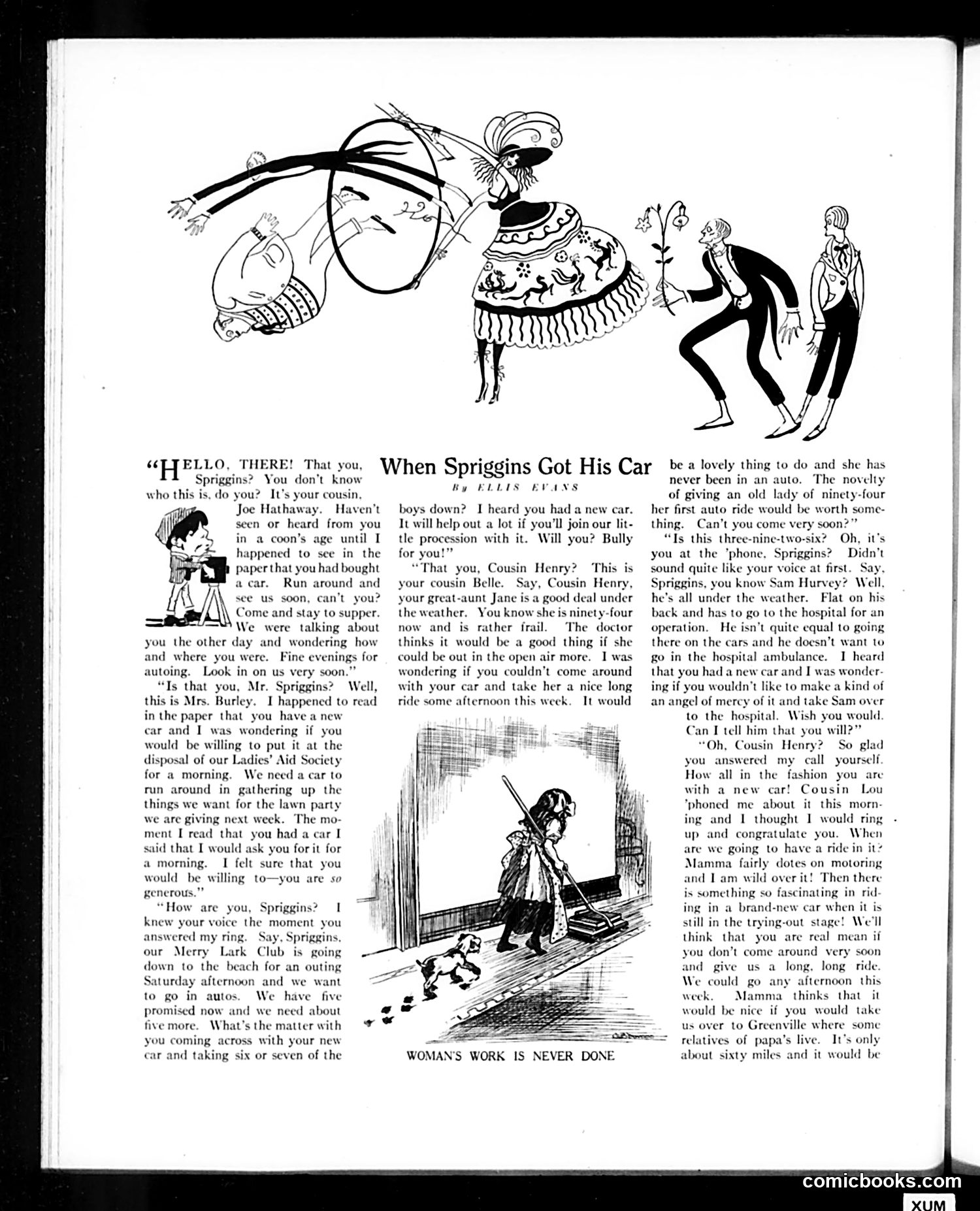
This satirical story by Ellis Evans ridicules the social expectations that immediately descend upon someone who acquires a new automobile. The cartoon shows Spriggins being besieged by requests from relatives and acquaintances—each claiming legitimate need (Ladies' Aid Society fundraising, elderly aunt's health, hospitalized friend, social club outings, family joyrides)—the moment word spreads that he owns a car. The humor lies in the relentless, presumptuous demands placed on him and the transparent self-interest disguised as reasonable requests. The caption "Woman's Work Is Never Done" extends the satire: while ostensibly about women's charitable duties, it actually mocks how quickly new possessions become communal property through social pressure. The story captures early-20th-century automobile culture, when cars were still novel luxuries and owning one apparently obligated owners to become free taxi services for their entire social circle.
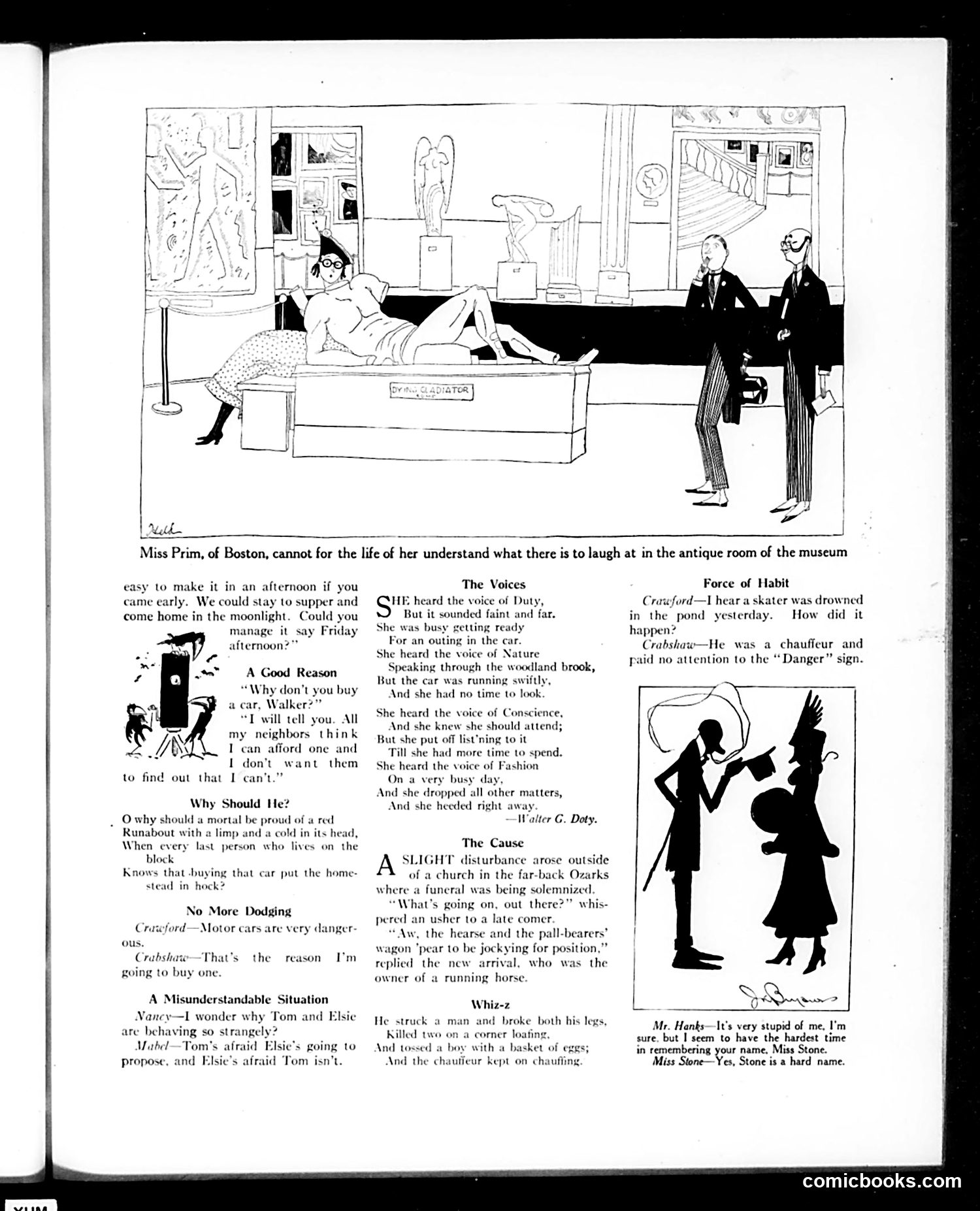
This *Judge* magazine page satirizes early automobile culture (likely 1910s-1920s). The main cartoon shows "Miss Prim of Boston"—a prim, proper woman—lounging on a museum display case, bewildering museum visitors. The joke: she finds nothing amusing about classical sculptures because she's distracted by modern social concerns (automobiles, dating etiquette). The surrounding vignettes mock car ownership anxiety: neighbors' jealousy over affording vehicles, the irony of buying dangerous cars to avoid them, and social confusion about courtship in the car era. "The Cause" and "Force of Habit" darkly satirize automobile deaths—a reckless driver kills multiple people; a drowned skater ignored warning signs because he was habituated to ignoring traffic dangers. The overall message: rapid automobile adoption has created social anxiety, moral distraction, and tragic consequences. The satire mocks both Victorian propriety (Miss Prim) and modern car culture's dangers and status-consciousness.
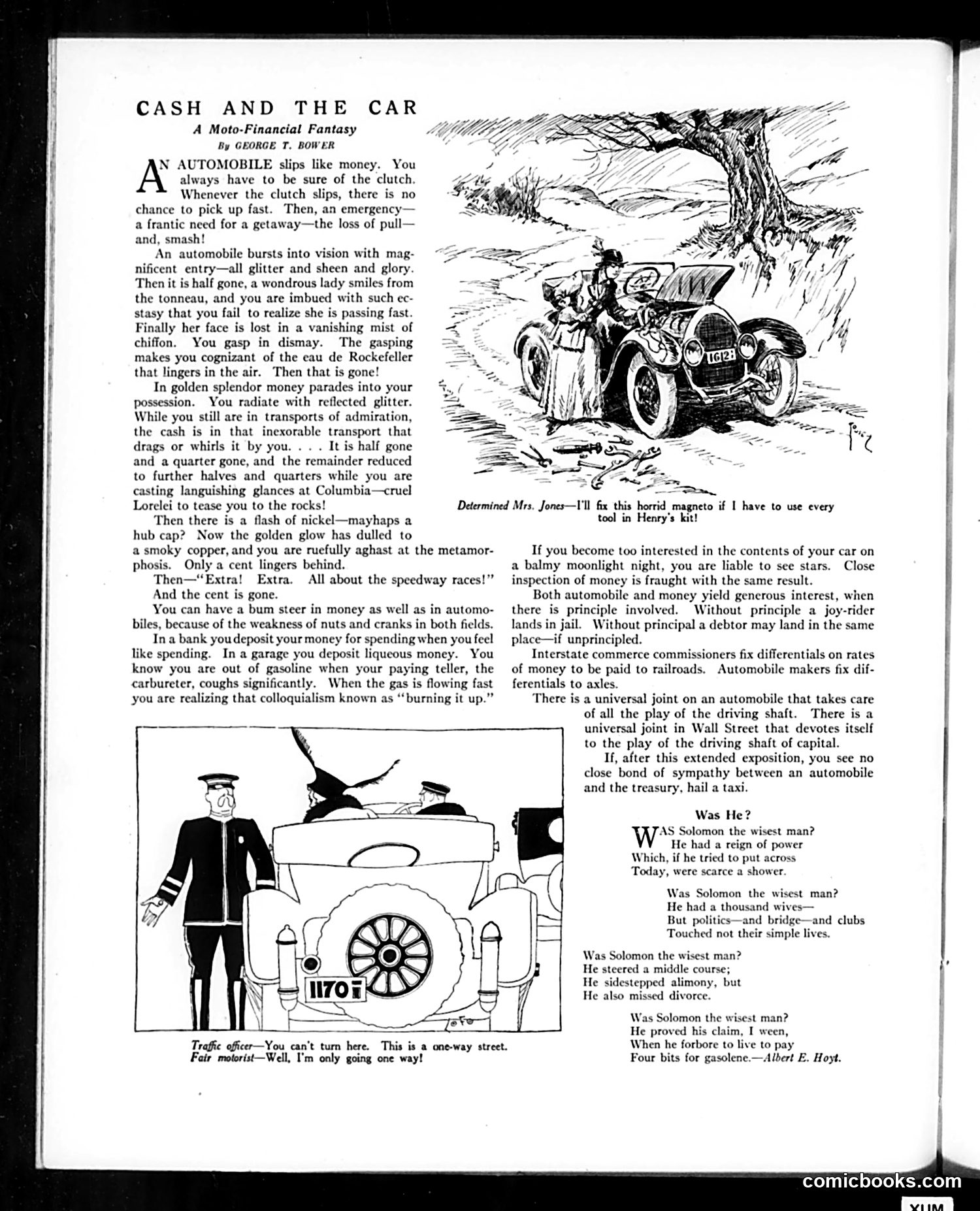
This satirical piece compares money and automobiles as parallel systems of waste and loss. Bower's extended metaphor suggests both are inherently unstable: a car's clutch slips like money slips away; both vanish quickly despite initial glamour. The "wondrous lady" represents temptation; the "eau de Rockefeller" references conspicuous wealth. The cartoon criticizes financial recklessness—money deposited in banks versus "liqueous money" (gasoline) burned in cars. References to "joy-riders" landing in jail and unprincipled debtors suggest moral critique of frivolous spending. The bottom cartoon depicts a motorist arguing with a traffic officer about a one-way street—a simple joke about literal versus directional interpretation. The closing poem mocks Solomon's wisdom as outdated, suggesting modern complications (alimony, bridge clubs, gasoline costs) have made ancient wisdom irrelevant—likely social commentary on changing 1920s America, including references to divorce and modern expenses.
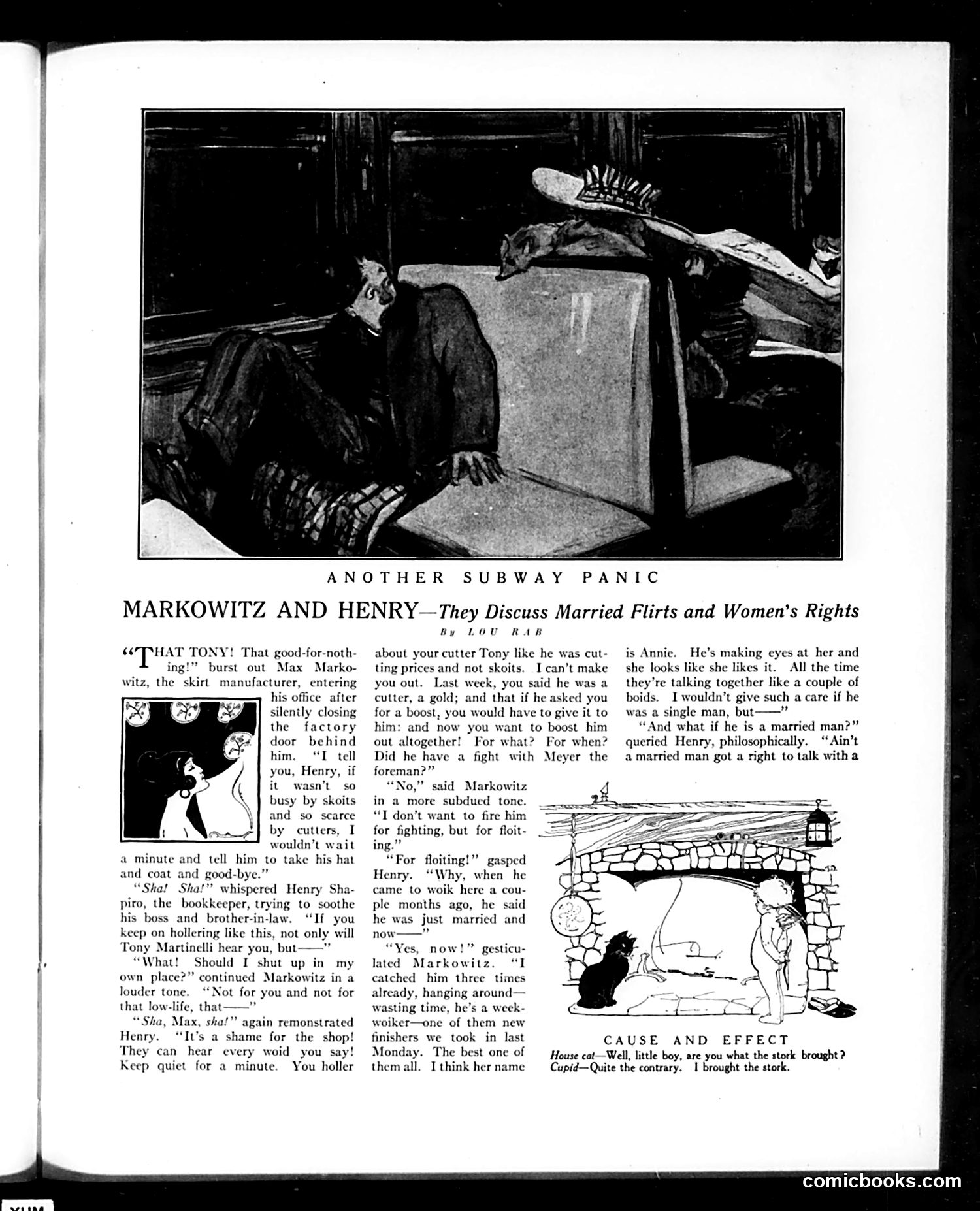
This satirical piece depicts two Jewish immigrant factory owners debating workplace morality. Max Markowitz wants to fire his cutter Tony for flirting with Annie, a female finisher, claiming Tony is married and thus shouldn't be "floiting" (flirting). Henry Shapiro, the bookkeeper, questions whether a married man has no right to casual conversation, sarcastically defending Tony's behavior. The satire targets early 20th-century attitudes about gender and marriage: Markowitz's possessive concern about a female worker's interactions, assumptions about married men's conduct, and the comic tension between Old World morality and modern workplace realities. The Yiddish-inflected dialogue ("skoits," "boids") marks these as working-class Jewish characters, a common stereotype in Judge magazine. The subsidiary "Cause and Effect" cartoon makes a crude joke about sexual responsibility.
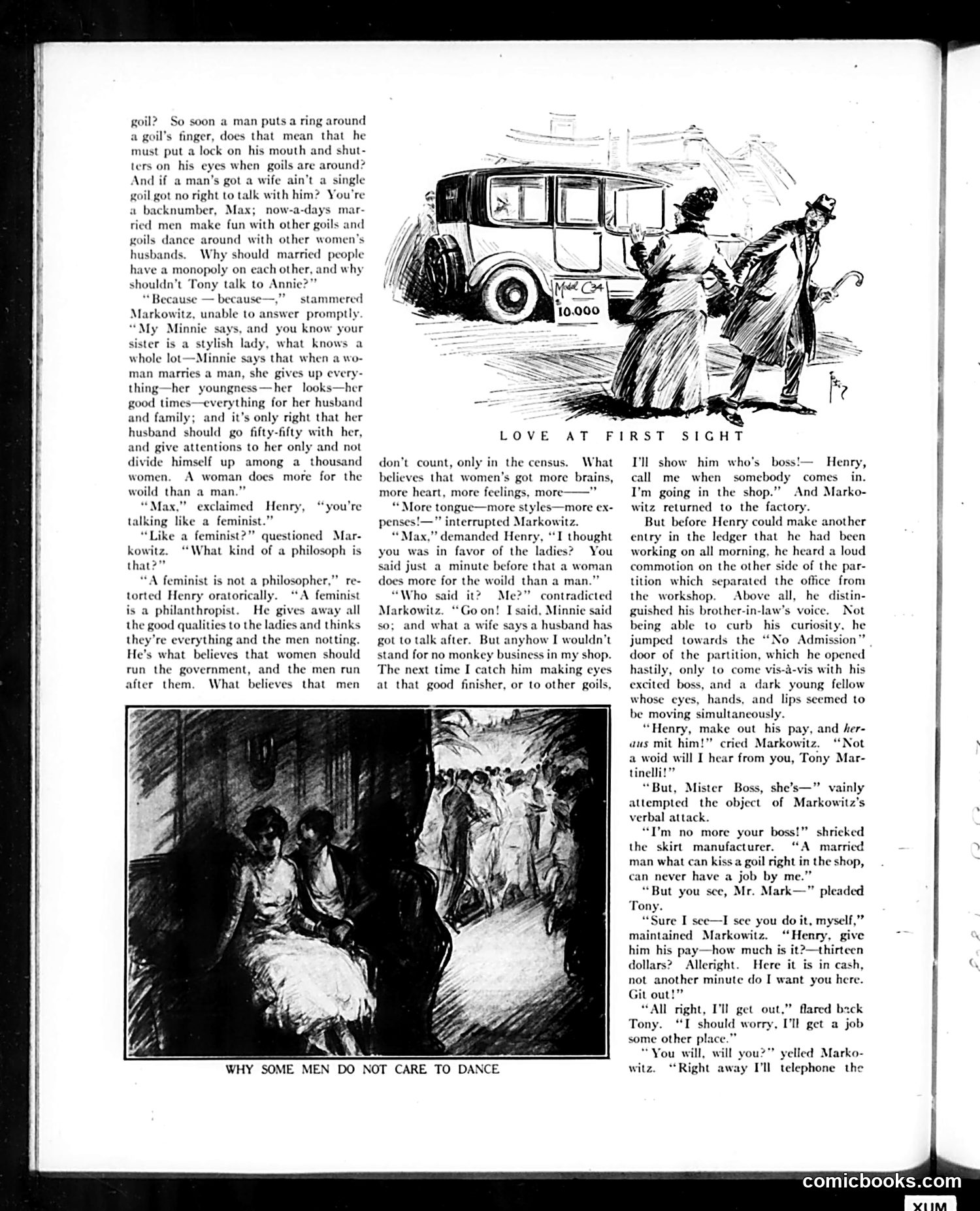
This page satirizes marriage and workplace morality in early 20th-century America through a dialogue between two characters: Henry (a factory owner) and Markowitz (his brother-in-law, a skirt manufacturer). **The Satire:** Henry champions "feminist" ideals—claiming women deserve equality, more brains, more feelings—while Markowitz initially defends traditional marriage exclusivity. However, Markowitz is exposed as a hypocrite: he lectures about wives "giving up everything" for husbands, yet fires his employee Tony for flirting with a female worker in his own shop, contradicting his stated feminist principles. **The Joke:** The cartoon mocks men who espouse progressive ideas about women's rights while enforcing strict, contradictory rules. Markowitz represents the inconsistent modernizer—he celebrates women's superiority in theory but demands control and propriety in practice. His angry reaction to Tony's kiss reveals his true conservative values beneath the rhetorical feminism. The bottom illustration "Why Some Men Do Not Care to Dance" (caption only visible) likely continues this theme of marital constraint.
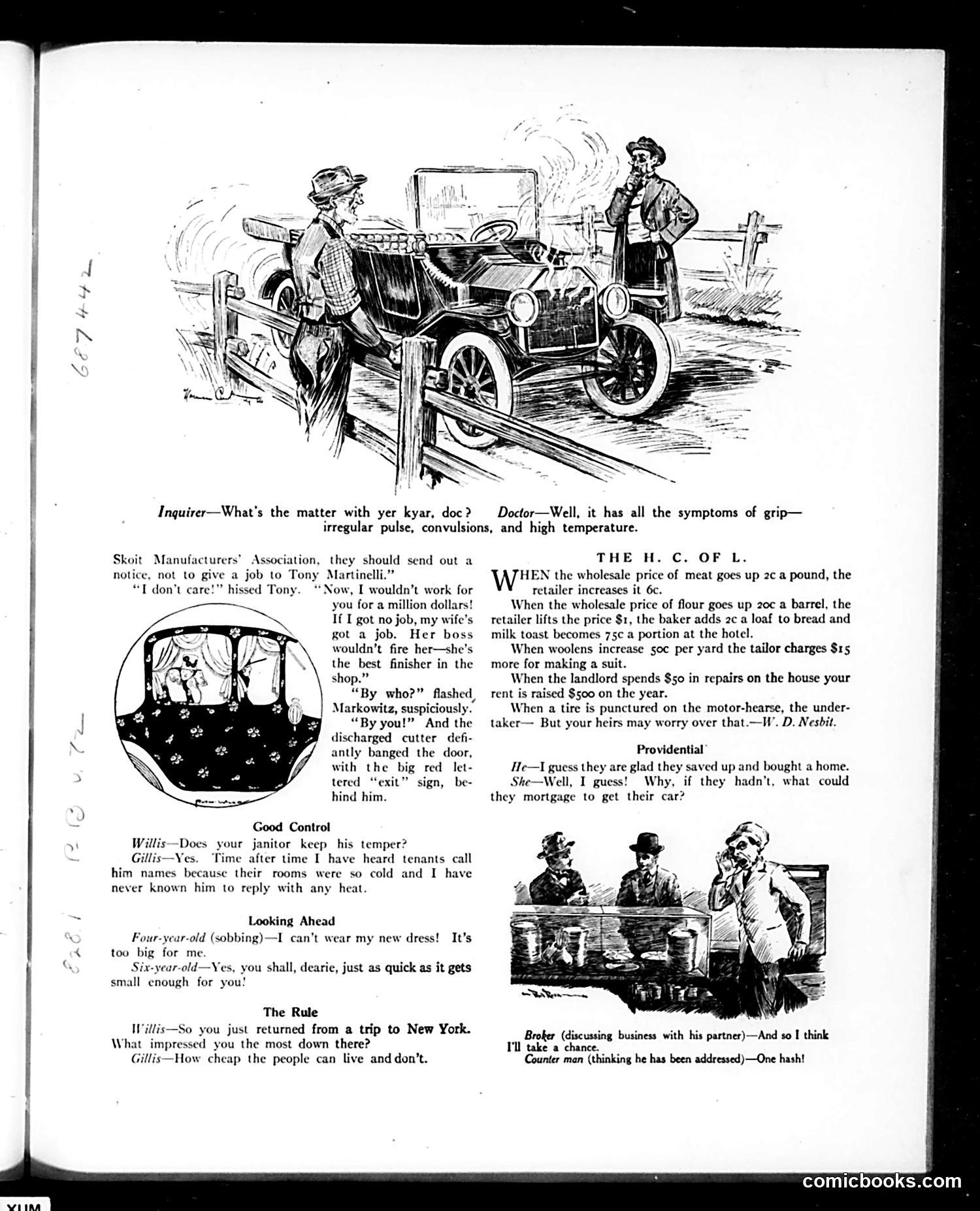
This page contains several satirical pieces reflecting early 20th-century American concerns: **"The H.C. of L."** (High Cost of Living) is the main feature—a pointed critique of inflation and retailer profiteering. The joke: when wholesale prices rise modestly, retailers mark them up disproportionately. The final line darkly jokes that even undertakers exploit crises. This reflects genuine public frustration with price gouging during a period of economic instability. **Other vignettes** mock social attitudes: a discharged factory worker stands up to his boss; a janitor's patience is praised; a child grows into her dress; and New Yorkers live cheaply yet spend extravagantly. **"Providential"** satirizes consumer debt culture—the punchline being that people now mortgage homes specifically to buy cars, inverting traditional values of home-ownership as stability. The automobile sketch at top appears to show a doctor diagnosing a car's mechanical problems using medical language ("grip"), a common contemporary comparison treating machines anthropomorphically.
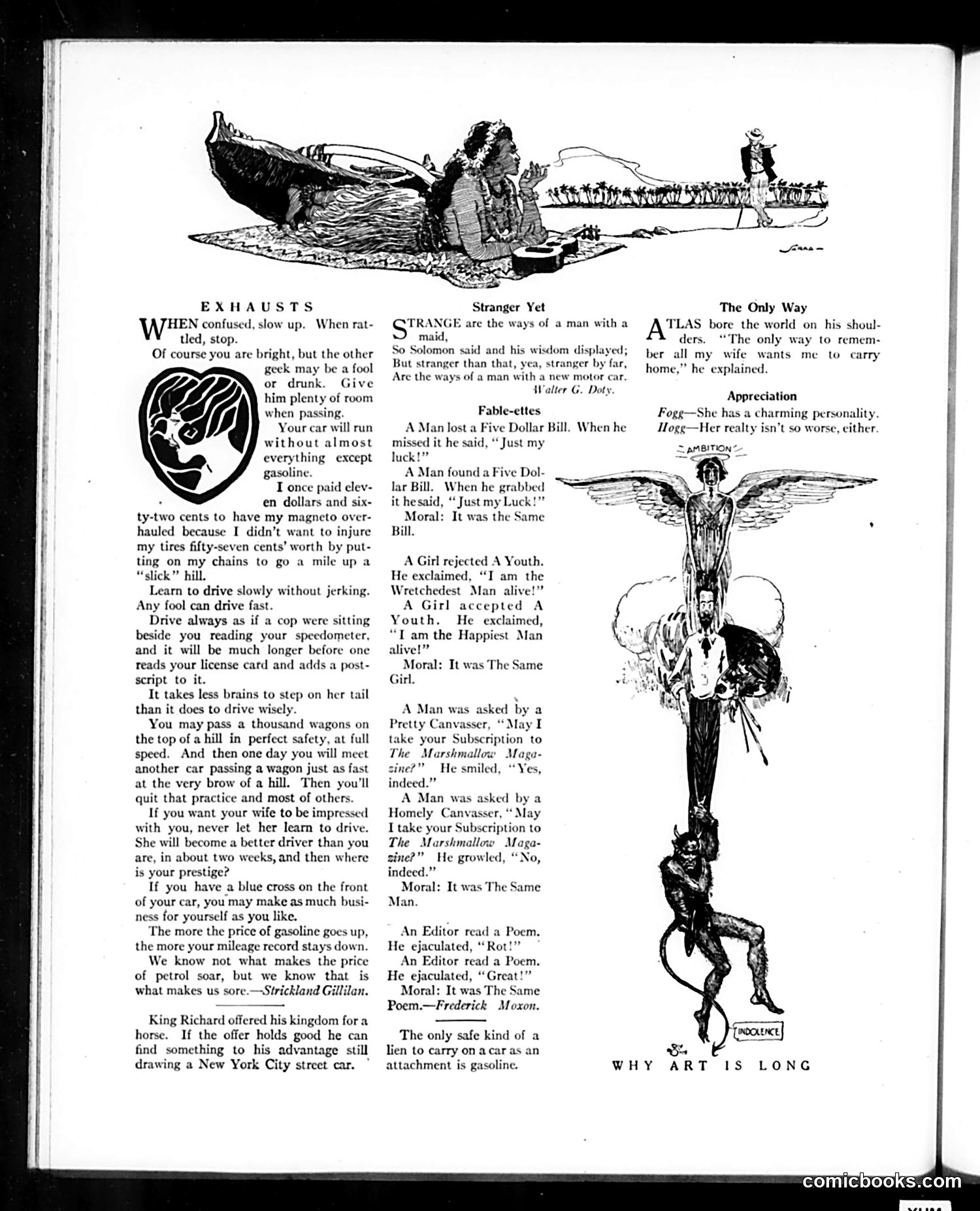
This page from *Judge* magazine consists primarily of **humorous motoring advice and brief satirical fables**, rather than political cartoons. The main section, "EXHAUSTS," offers tongue-in-cheek driving tips mocking early automobile culture—warning against reckless driving while poking fun at motorists' vanity and obsession with their vehicles. References like the "blue cross" (likely an ambulance marker) and complaints about gasoline prices anchor this in the early automotive era. The "Fable-ettes" section uses repetitive joke structures to satirize human nature: a man's luck remains unchanged whether he loses or finds money; a girl is the same person whether accepting or rejecting a suitor; a poem's quality depends on who reads it, not the poem itself. These mock traditional moral tales. Minor jokes include a gibe at King Richard for preferring streetcars to horses—absurd given the "modern" automobile age. The artwork—a winged figure and driving scenes—illustrates automotive themes rather than specific political targets. The page satirizes *motoring culture itself* and universal human folly, not particular politicians or events.
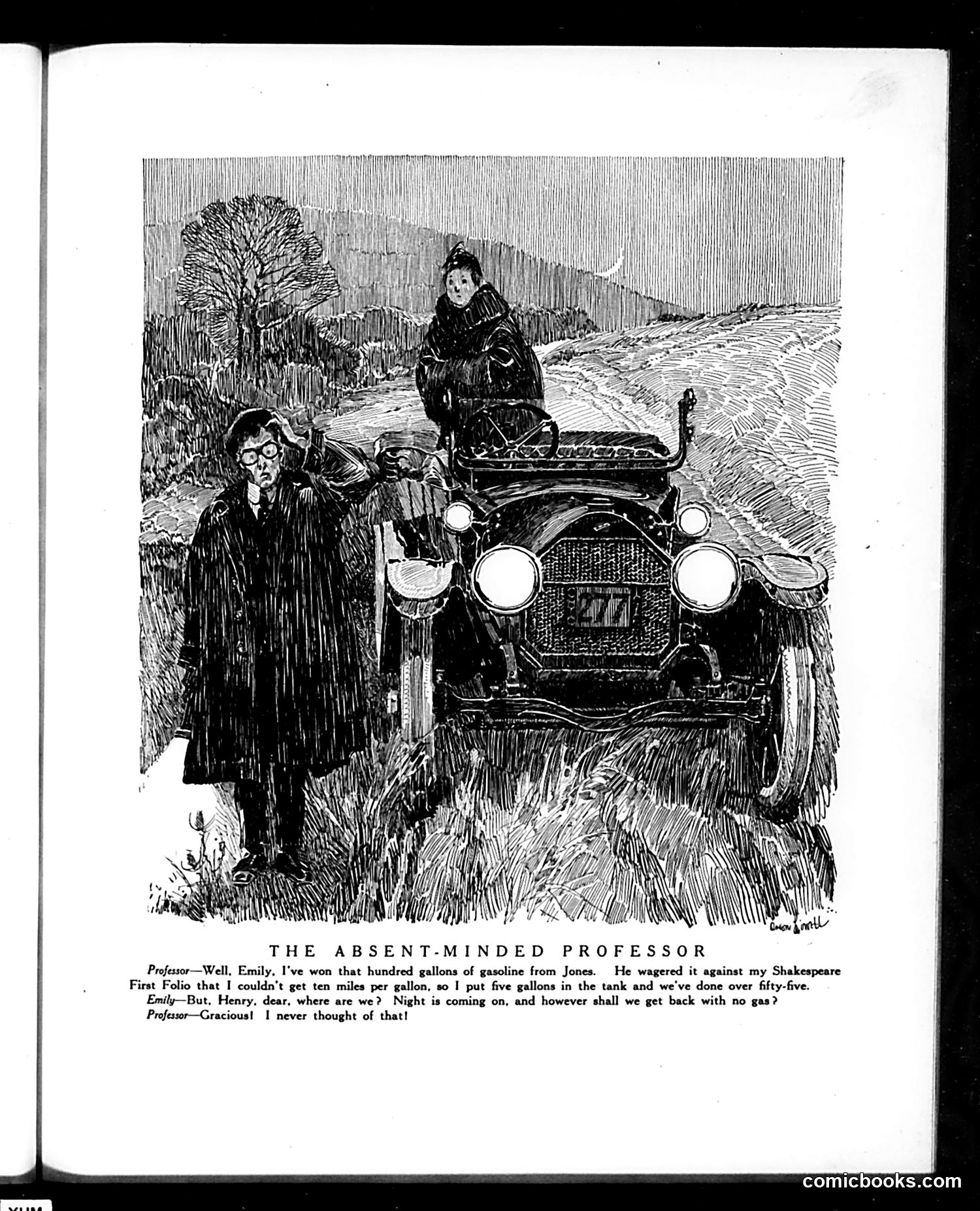
This cartoon satirizes the absent-minded academic—a stock character obsessed with intellectual pursuits while lacking practical sense. A professorial figure has won a bet against Jones by achieving exceptional fuel efficiency (55+ miles on 5 gallons), wagering his prized Shakespeare First Folio. However, his absent-mindedness emerges immediately: he's driven so far into the countryside that night is falling and the car has nearly run out of gas, with no way to return home. The joke relies on the contrast between his scholarly cleverness (winning the wager through mechanical efficiency) and his complete obliviousness to real-world consequences. His wife Emily's worried question about getting back underscores his impracticality. The cartoon reflects early 20th-century anxieties about automobiles and pokes fun at ivory-tower academics disconnected from everyday concerns.
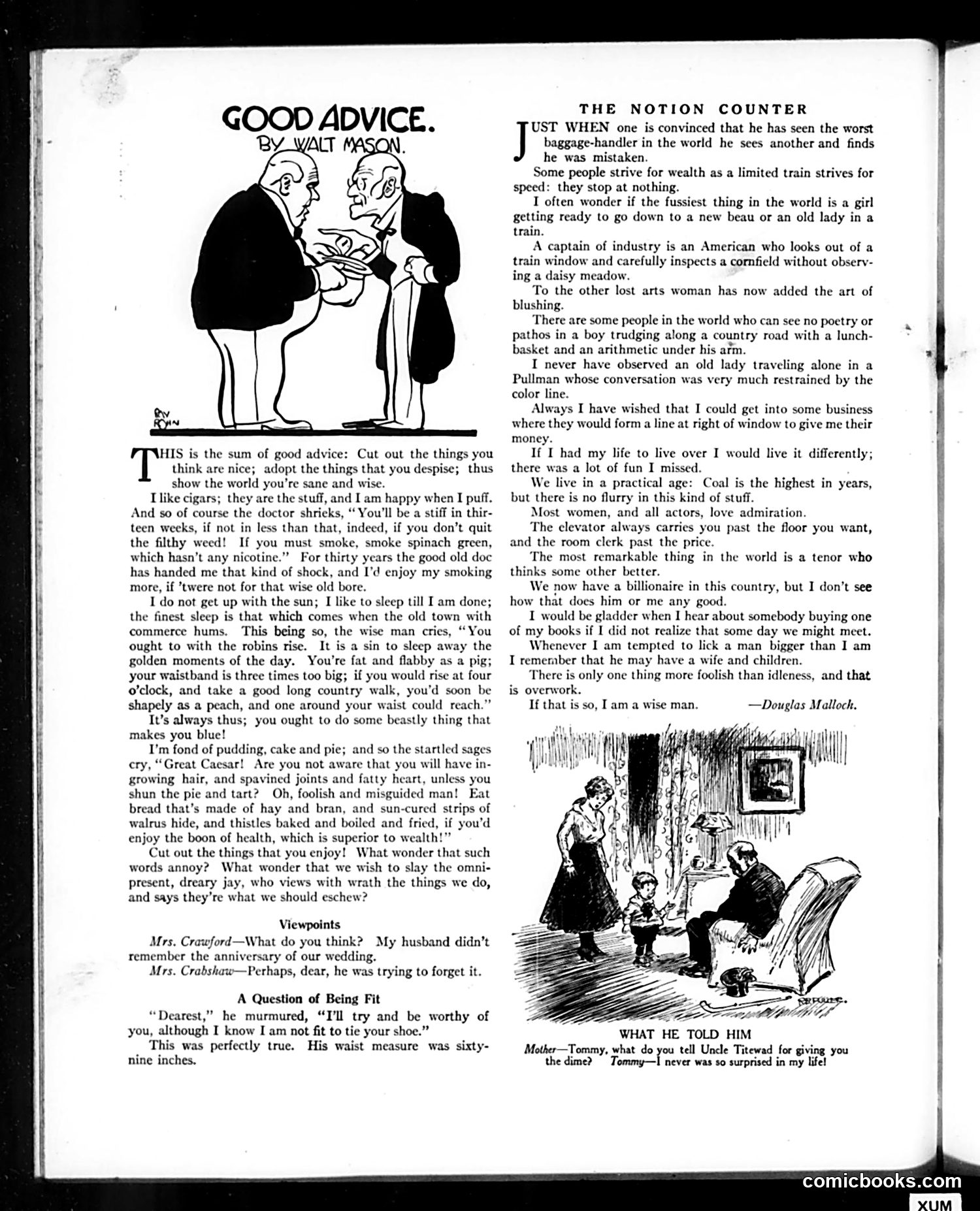
**"Good Advice" by Walt Mason** satirizes the ubiquitous social pressure to abandon pleasure in pursuit of health and morality. The cartoon depicts two men—one offering sanctimonious advice while the other listens resignedly. Mason's accompanying verses mock the relentless hectoring of doctors, reformers, and killjoys who demand people quit smoking, rise early, exercise, and avoid rich foods. The satire targets the gap between preaching virtue and actually living: people are constantly told to eliminate what brings them joy for supposedly greater wellbeing, yet these warnings ring hollow and joyless. **"The Notion Counter"** is a brief humor column offering sardonic observations about contemporary American life—incompetent workers, social pretension, romantic disappointment, and class dynamics. **"What He Told Him"** is a simple domestic joke about a child revealing an uncle's generous gift to his mother, undermining the surprise. The page represents early 20th-century American satirical humor: skeptical of self-improvement rhetoric and social moralizing, with gentle mockery of everyday frustrations.
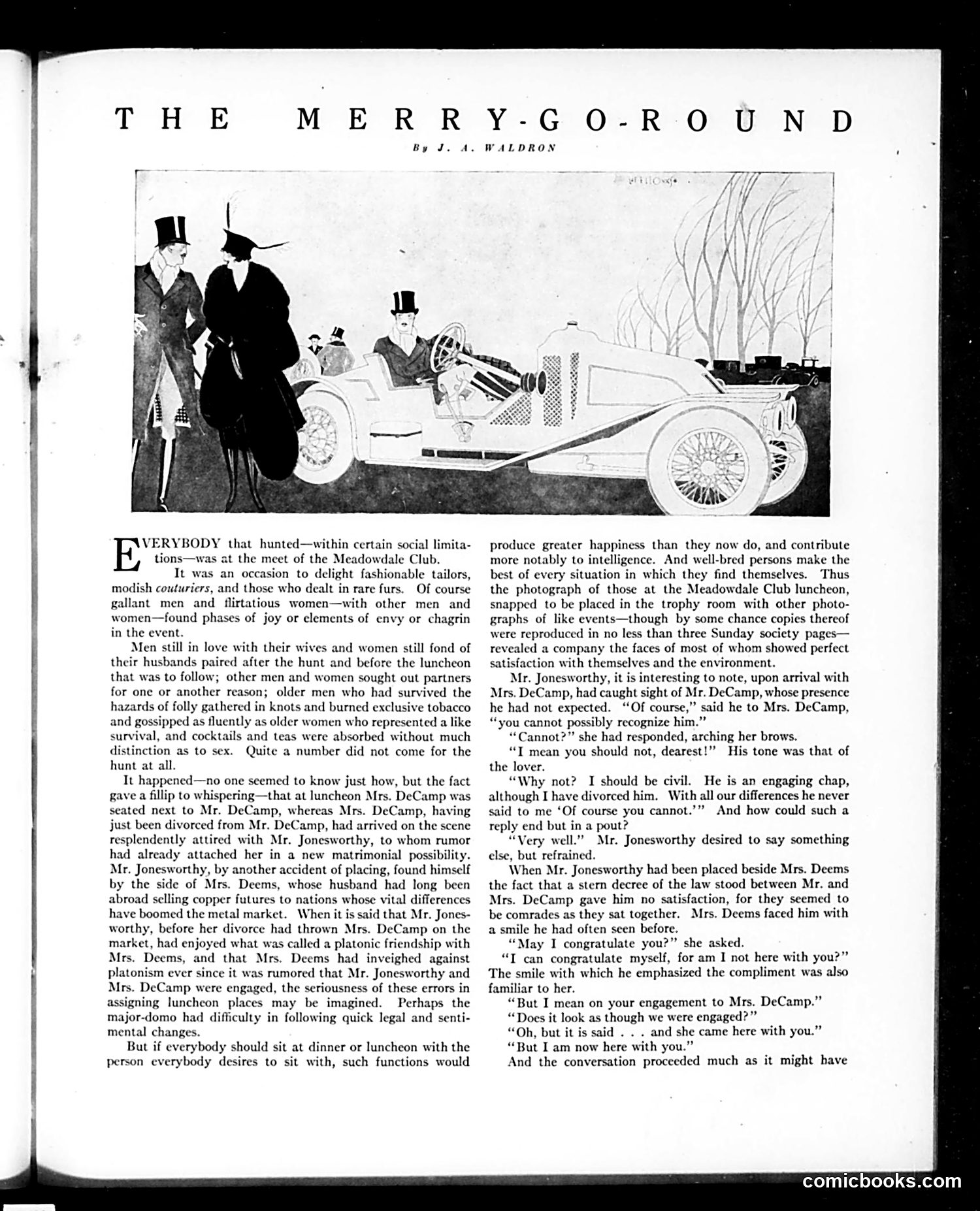
This satirical story depicts the social chaos of a country club hunt luncheon seating arrangement. The humor centers on awkward romantic entanglements among wealthy socialites: Mrs. DeCamp, recently divorced, arrives with her new suitor Mr. Jonesworthy—only to be seated at lunch next to her ex-husband. Jonesworthy himself sits beside Mrs. Deems, with whom he'd previously had a "platonic friendship" that Mrs. Deems resented. The satire mocks the pretense of high society: despite these explosive romantic conflicts, everyone maintains perfect composure for the society photographer. The illustrations show well-dressed figures and racing cars typical of Jazz Age leisure. The story suggests that upper-class people prioritize appearances and propriety over genuine feeling, going through motions of civility while harboring jealousy and desire beneath the surface—hence the "merry-go-round" of romantic musical chairs.
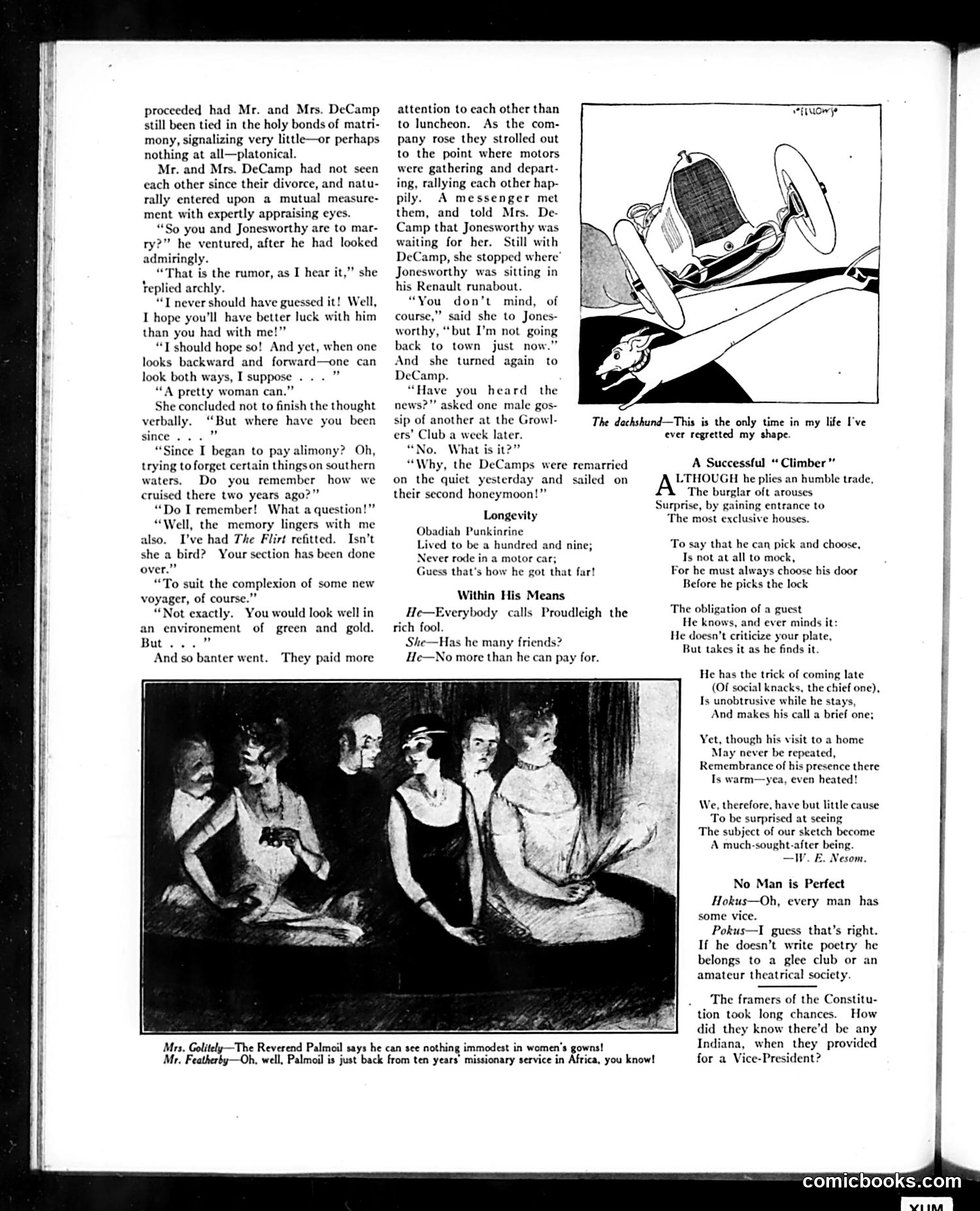
This page contains several satirical pieces typical of early 20th-century humor magazines: **Main Story (top):** A comedic narrative about divorced Mr. and Mrs. DeCamp who encounter each other at a social gathering. The humor centers on their flirtation and witty banter—they later remarry and sail on a "second honeymoon," suggesting rekindled romance after separation. **Bottom Cartoon:** Depicts a social gathering, with a caption joke about Reverend Palmoll, recently returned from ten years as a missionary in Africa, supposedly unable to see anything "immodest" in women's fashions—satirizing how missionary work might desensitize one to social conventions. **Verse Pieces:** Include humorous observations on wealth ("Within His Means"), a mock-heroic poem about a burglar as an ideal guest (ironic social commentary), and wordplay about American politics and human nature. **Overall Context:** This reflects Judge's style of satirizing American social conventions, gender relations, and domestic life through light comedy rather than harsh critique.
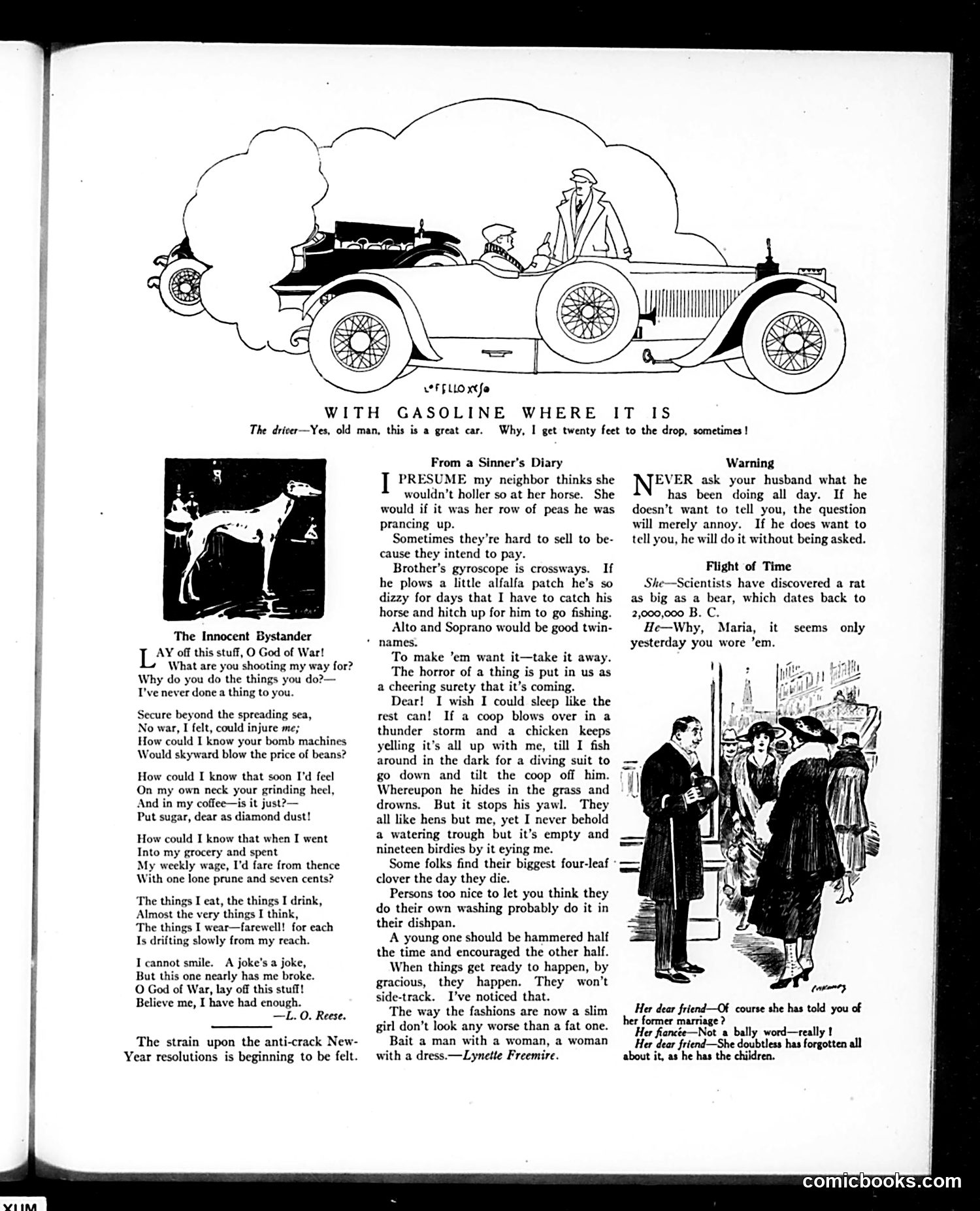
This page contains satirical commentary on World War I's economic impact on American civilians. The top cartoon shows a motorist bragging about his car's gasoline efficiency while producing massive exhaust clouds—likely mocking both automotive boasting and fuel concerns during wartime rationing. The main poem "The Innocent Bystander" (attributed to L. O. Reese) is the page's centerpiece. It expresses bitter complaint from a non-combatant about how the war has devastated his domestic life: inflated food prices (beans, sugar becoming expensive as "diamond dust"), depleted grocery purchases ("one lone prune and seven cents"), and pervasive anxiety. The speaker protests his suffering despite being geographically distant from combat, sarcastically addressing "God of War." The remaining sections—"From a Sinner's Diary," "Warning," and "Flight of Time"—are humorous domestic observations unrelated to war, offering comic relief on marriage, fashion, and relationships. Overall, the page reflects Judge magazine's use of satire to critique both wartime hardship and everyday American absurdities.
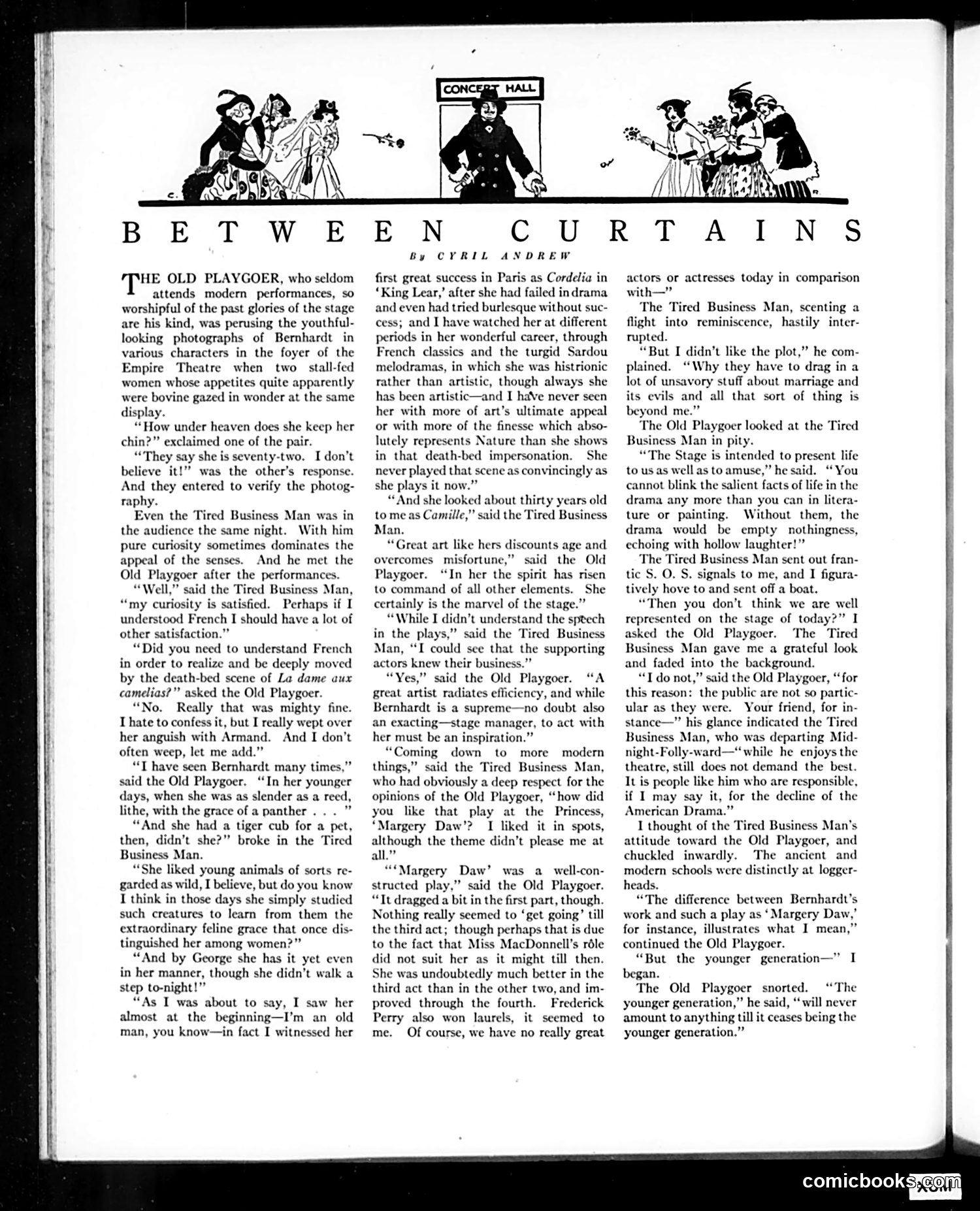
This is a theatrical essay by Cyril Andrew, not a political cartoon. The page features a decorative header showing theater scenes and discusses Sarah Bernhardt's legendary acting career. The piece contrasts two audience members: an "Old Playgoer" (an elderly theater devotee) and the "Tired Business Man" (a recurring Judge character representing the modern, pragmatic everyman). Their conversation celebrates Bernhardt's aging artistry—particularly her recent performance in *La Dame aux Camélias*—while debating whether modern theater matches classical standards. The satire gently mocks the Tired Business Man's middlebrow taste and his inability to appreciate French dialogue, contrasting his superficial curiosity with the Old Playgoer's deep reverence for theatrical tradition. The underlying joke: true art transcends age and language; great performers inspire even philistines to weep genuinely.
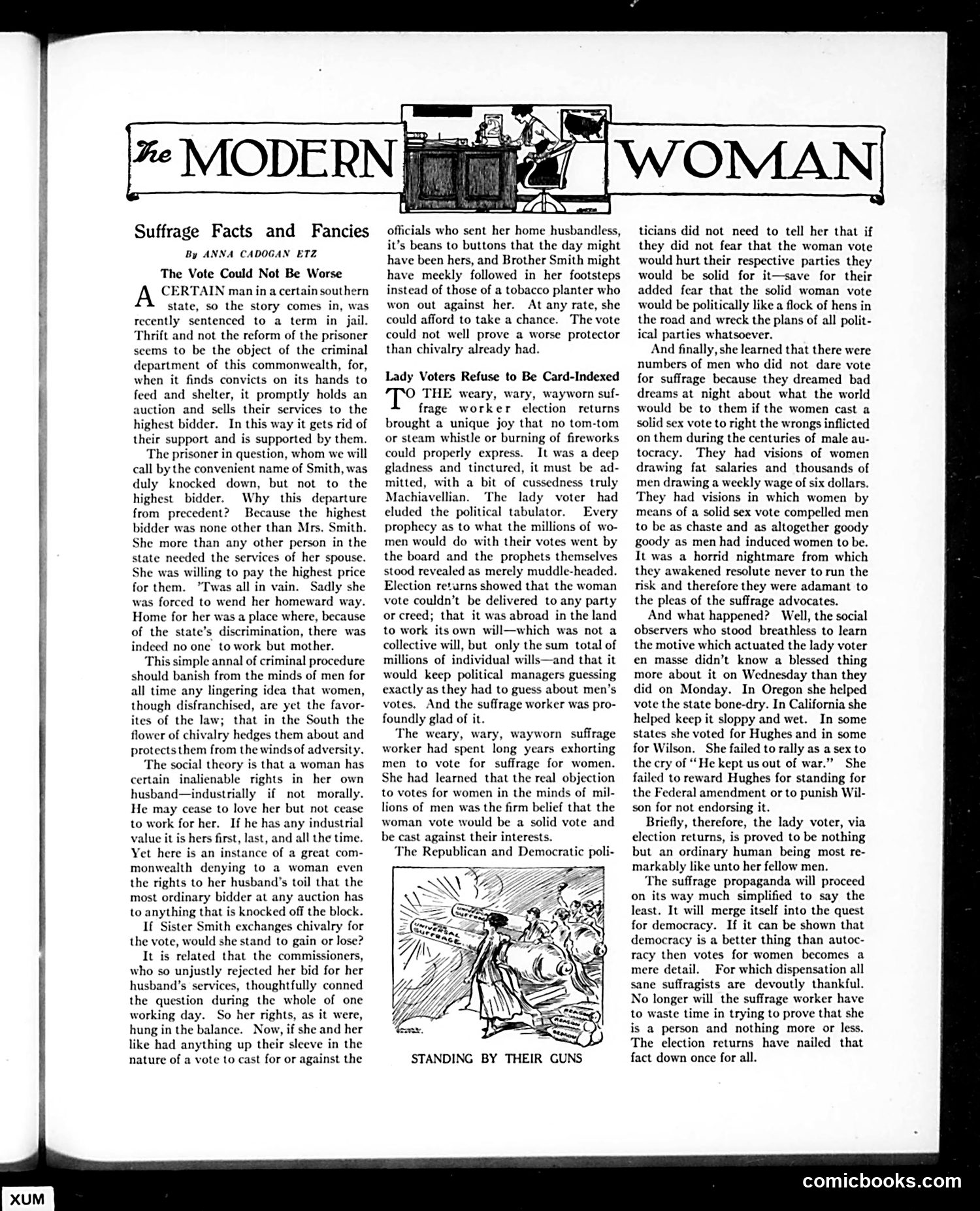
This Judge magazine page presents pro-suffrage arguments through satire. The main article, "Suffrage Facts and Fancies" by Anna Cadogan Etz, uses two anecdotes to counter anti-suffrage claims: **First story**: Mrs. Smith, a prisoner's wife, cannot bid for her husband's labor when the state auctions convict services—despite having the highest offer. The satire argues this proves women lack legal rights and chivalry doesn't protect them, making suffrage a logical necessity rather than a loss. **Second story**: Politicians predicted women voters would form a "solid vote" for one party. Election returns proved women vote individually, like men. The author celebrates this as voters "eluding the political tabulator"—women won't be manipulated as a bloc. The **cartoon caption "Standing By Their Guns"** (image shows armed women) likely reinforces that women are serious political participants. The overall message: suffrage doesn't harm women; lack of suffrage demonstrably does. Women's voting autonomy benefits democracy.
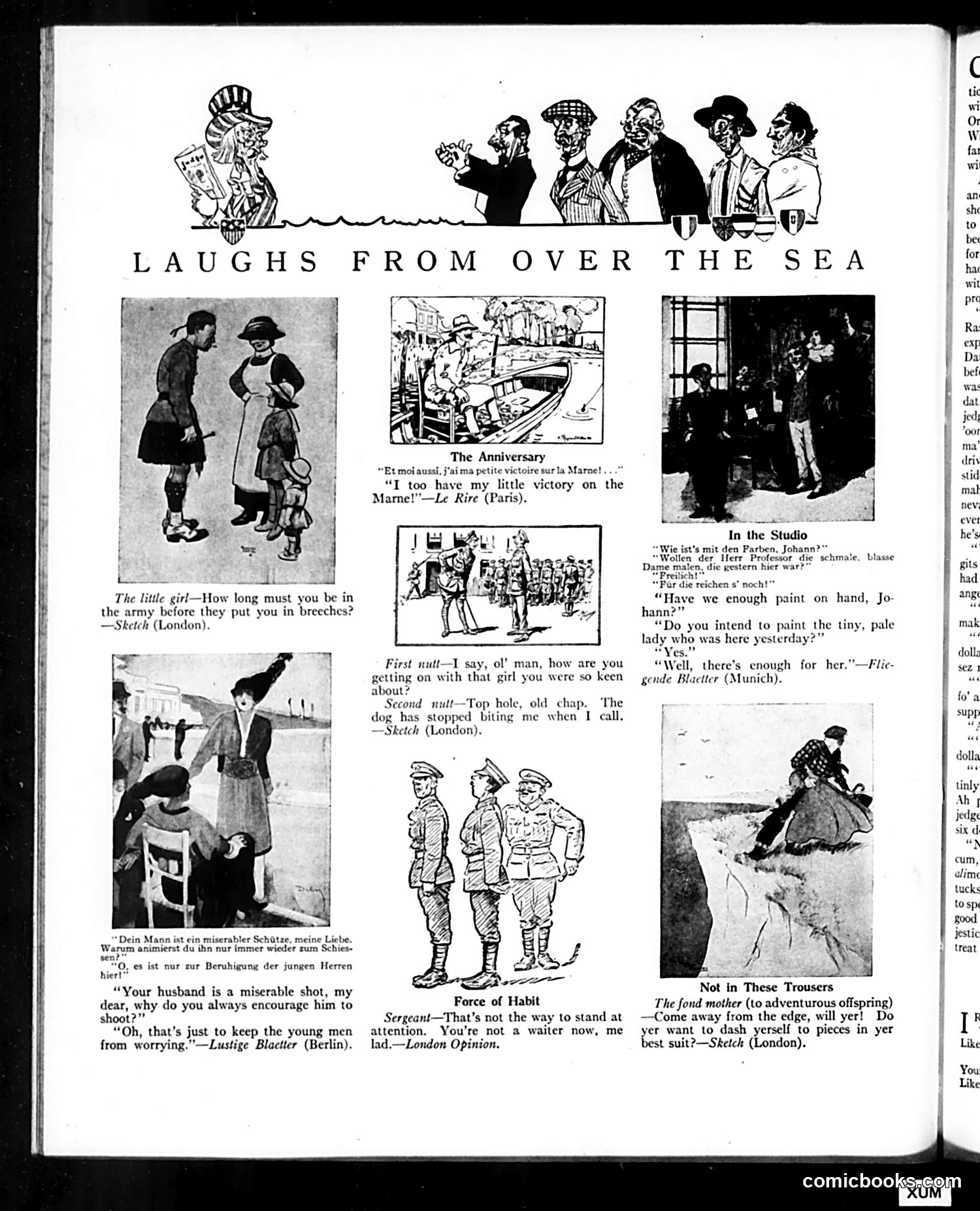
This page collects humorous cartoons and jokes from European satirical publications (German, French, and British) during what appears to be World War I era, based on references to "the Marne" (a major WWI battle). The cartoons use gentle domestic and military humor: a wife encouraging her poor-shot husband to practice (keeping young men occupied), a soldier unlearning waiter habits, a painter discussing a pale female subject, and a mother protecting her child from danger in expensive clothes. The page demonstrates how Allied nations' humor publications shared similar comedic sensibilities during wartime—focusing on everyday absurdities rather than propaganda. The international sourcing (Sketch, Lustige Blätter, Le Rire) suggests Judge was showcasing how different countries' satire magazines found common ground in universal human situations: marital dynamics, military adjustment, artistic pretension, and parenting anxieties.
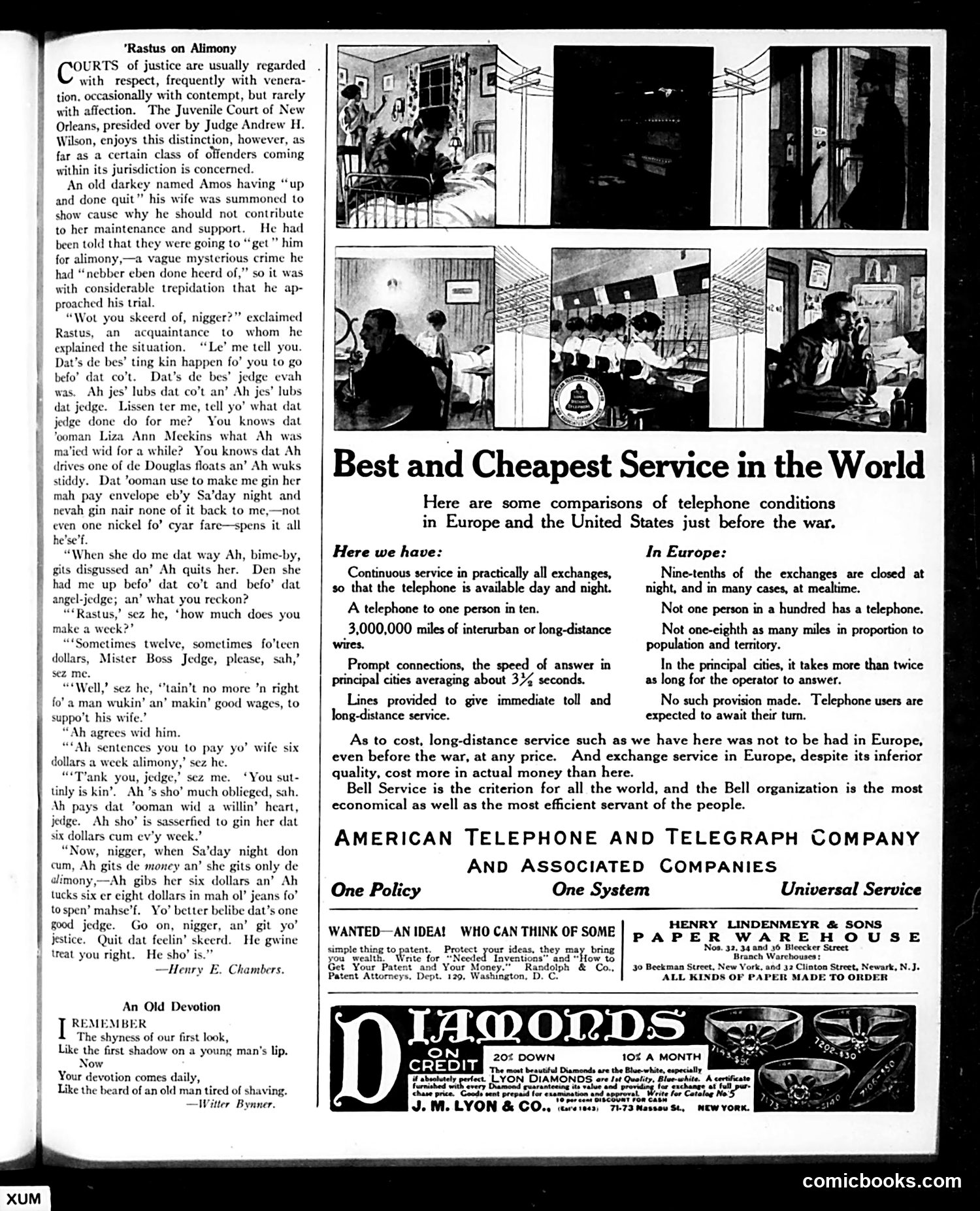
This is a satirical dialect story using deeply offensive racial caricature typical of early 20th-century American humor. The narrative features a Black man named Rastus praising Judge Andrew H. Wilson of New Orleans's Juvenile Court for an alimony ruling. The satire targets not the judge but the situation itself: Rastus celebrates being ordered to pay his ex-wife $6 weekly alimony, then reveals he actually pockets most of his earnings anyway—making the court order functionally useless. The "joke" is that Rastus considers this a victory because it allows him to appear compliant while evading support obligations. The piece also includes advertisements for telephone and jewelry services, and a brief poem "An Old Devotion." The page reflects period attitudes about both race and family law, presenting the protagonist's evasion of spousal support as amusing rather than problematic.
This page is primarily **advertising with some satirical poetry** rather than political cartoons. The main content is "Truth, Via Short Line"—a collection of rhyming aphorisms mocking American business culture and social hypocrisy. The verses critique: - **Self-made men** taking undue credit - **Consumer culture** and materialism ("all he believes is dollar signs") - **Economic inequality** (mortgaging homes for machines, then lacking gas money) - **Gender dynamics** (women's limited rights, unequal labor) - **Modern anxieties** (high cost of living, war, speed dangers) The satire is gentle, observational humor about early 20th-century American life—poking fun at pretension, greed, and social contradictions rather than targeting specific political figures. The surrounding **advertisements** (Buckskin tires, Dunlop golf balls, business books) represent the magazine's commercial content, typical for publications of this era.
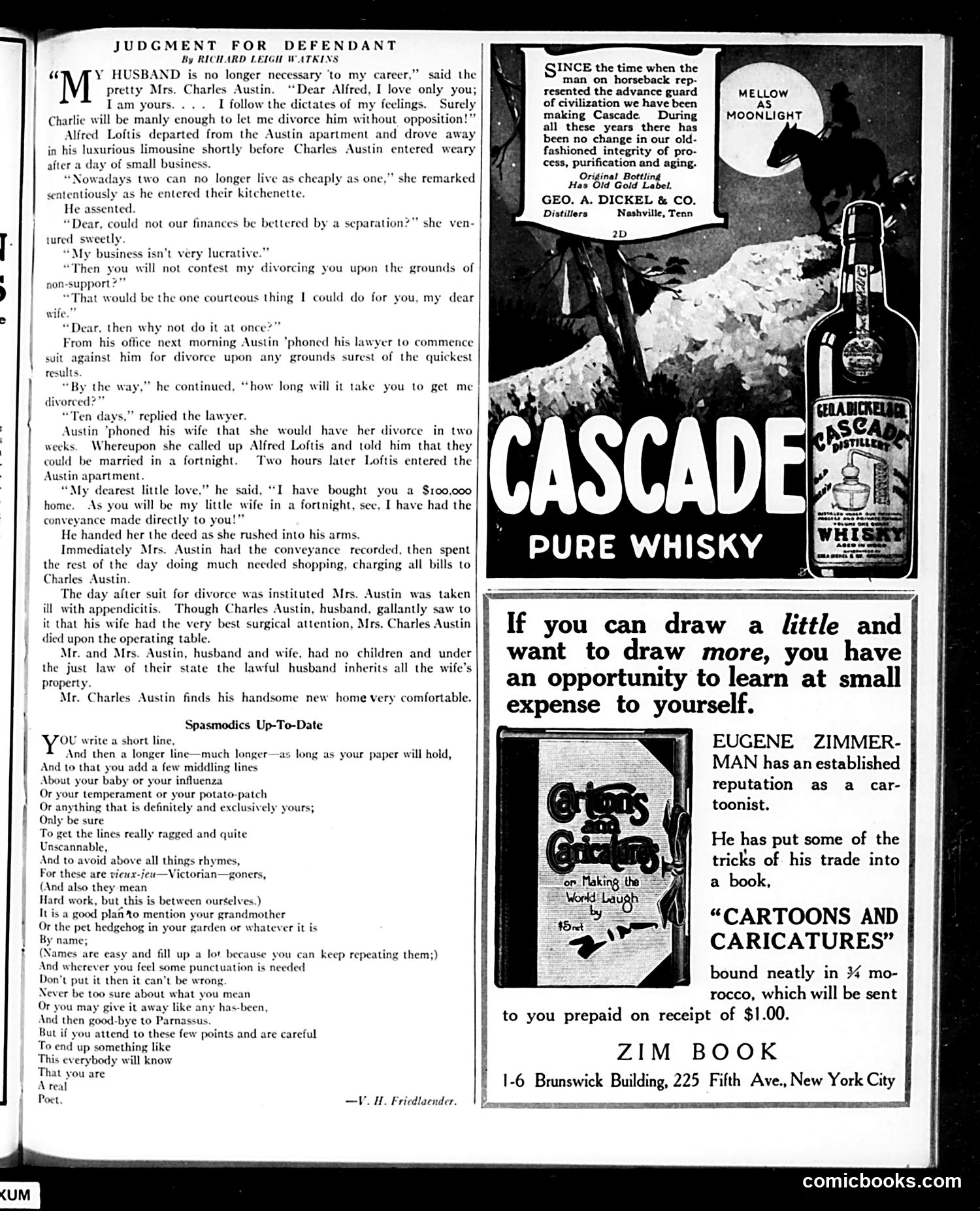
This story satirizes early-20th-century divorce law and marital opportunism. Mrs. Austin manipulates her husband Charles into divorcing her by feigning financial hardship, then immediately accepts a $100,000 home from her lover Alfred Loftis—property she quickly registers in her name. When she dies from appendicitis shortly after, Charles (still legally her husband) inherits everything under state law, leaving the scheming lover with nothing. The satire mocks both the wife's transparent gold-digging and the legal system's loopholes. The title "Judgment for Defendant" suggests Charles, the apparent victim, ultimately wins through inheritance rather than his own cleverness—a darkly ironic twist on matrimonial "justice." The page also includes unrelated advertising (Cascade Whiskey, Eugene Zimmerman's cartoon book) and a poem mocking modernist "free verse" poetry as pretentious nonsense.
This page is primarily **advertisements and humorous anecdotes**, not political cartoons. The top illustration shows a fashionably dressed woman and advertises Carbona cleaning fluid—the joke being that elegant clothing requires spotless maintenance. The "Stories with Smiles" section contains brief, domestic humor pieces typical of early 20th-century magazines: - A boy's honesty about his father's inability to convincingly lie - A wife's "strong will" controlling her husband's smoking (plays on gender power dynamics) - Jokes about a vain businessman crediting his success to "pluck" (willpower) - A well-read man who quotes pretentiously but incomprehensibly - Superstitions about thirteen at dinner These anecdotes reflect period attitudes: wives as domestic managers of husbands, children's candid observations, and social pretension as humor fodder. The "sympathy" story fragment suggests ironic kinship. The remaining space features hotel and music lesson advertisements. This is **light entertainment and consumer marketing**, not satire of political issues.
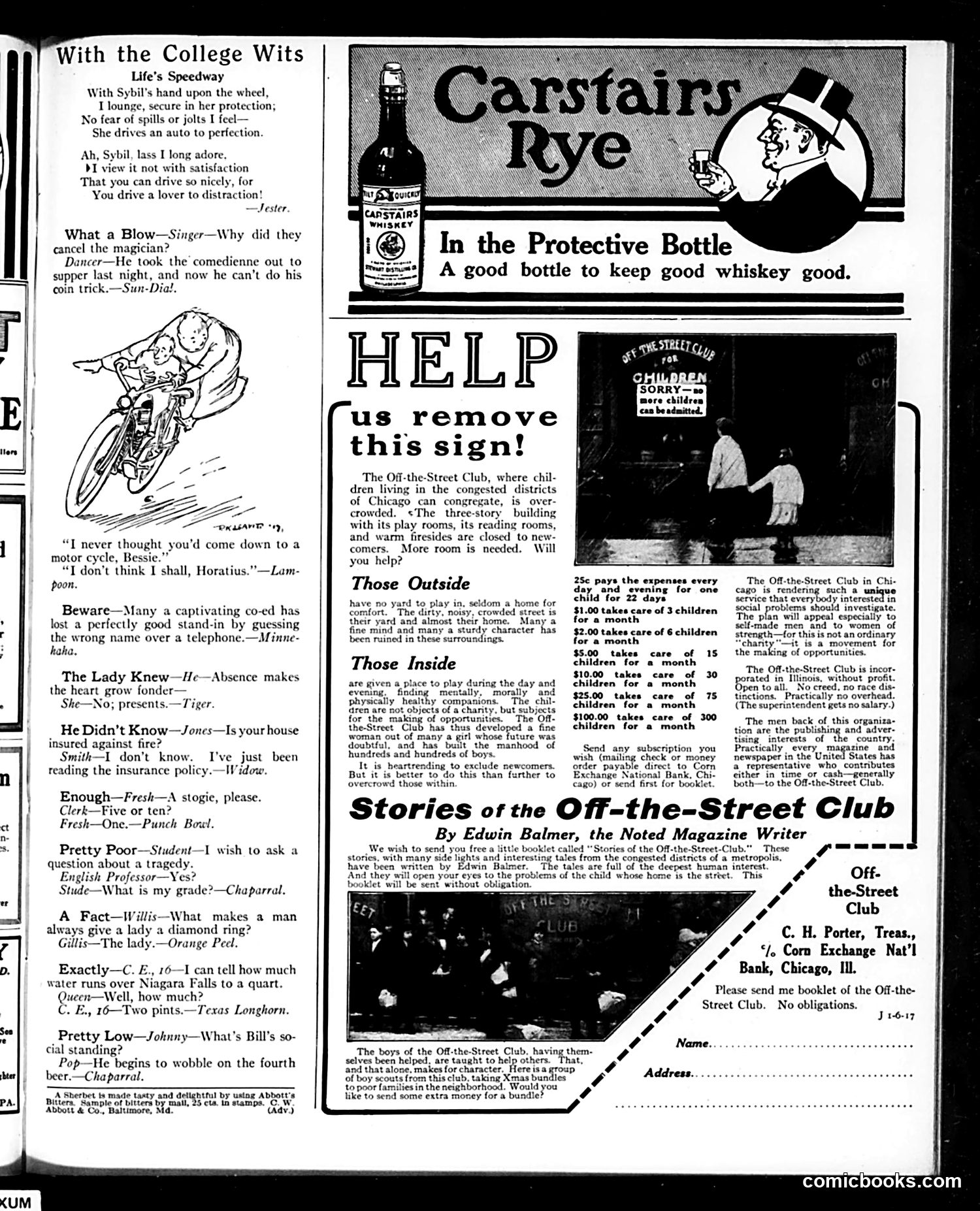
This page combines humor columns with a serious charitable appeal. The top section features "College Wits"—brief jokes from college publications about romantic mishaps, automobile driving, and everyday predicaments. These are light satire targeting young people's romantic pretensions and modern anxieties (cars, phones, insurance). The dominant content is an earnest fundraising appeal for the **Off-the-Street Club**, a real Chicago social service organization providing safe indoor spaces for children in poor neighborhoods. The contrast is stark: frivolous college humor above, urgent social advocacy below. The appeal emphasizes opportunity-building over charity, noting the facility is overcrowded. It lists specific costs for caring for children and notes backing from publishing/media interests—establishing credibility among Judge's educated readership. The juxtaposition itself carries meaning: Judge presents both entertainment and moral responsibility, suggesting educated readers should support such institutions.
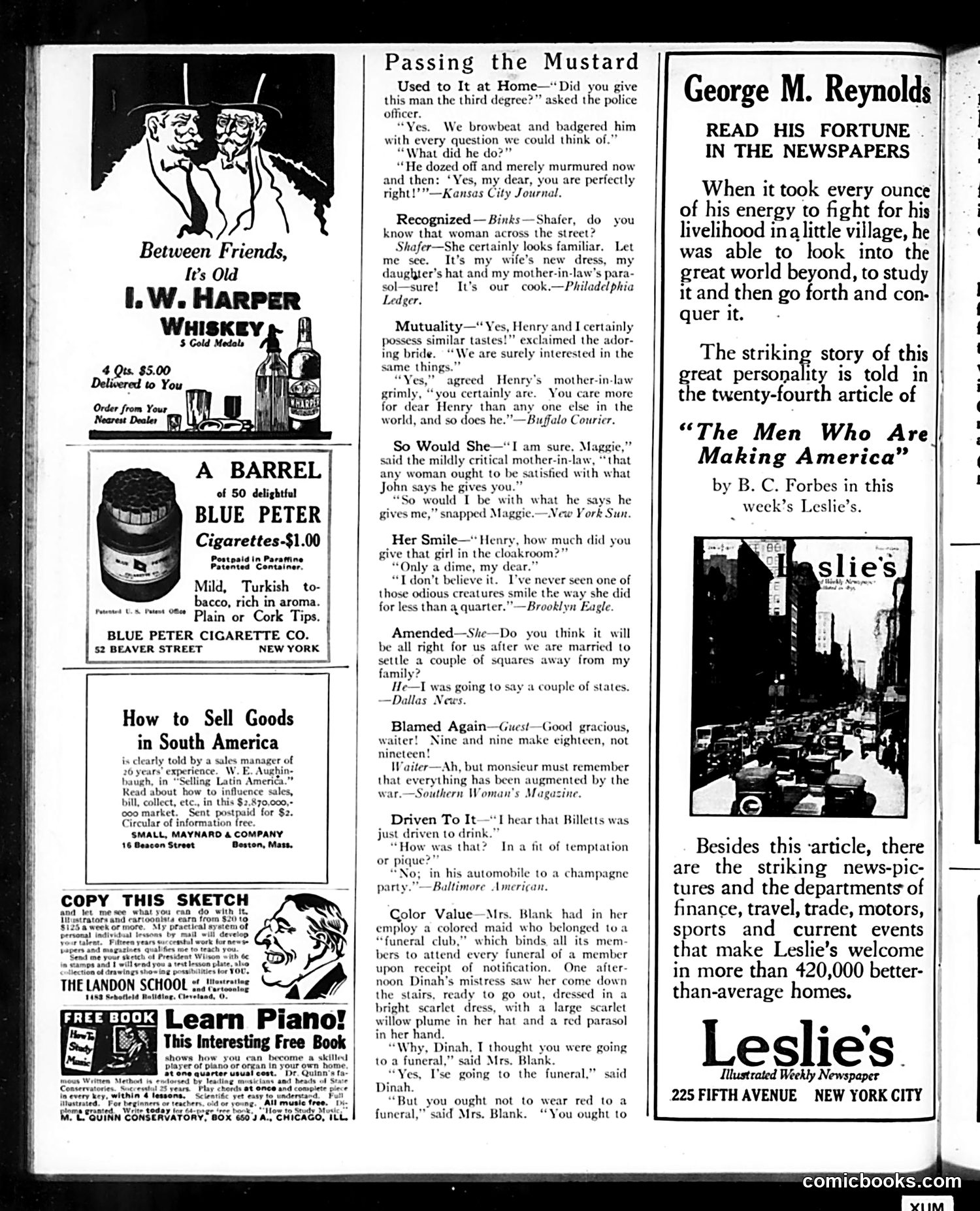
This page collects brief comic anecdotes mocking domestic life and marital dynamics. The title piece satirizes henpecked husbands: a man interrogated by police reveals nothing because he's "used to" constant questioning from his wife at home—he simply nods agreement, as he does with her. The humor targets submissive married men and domineering wives. Other jokes follow similar themes: wives criticizing husbands' generosity, mothers-in-law meddling, wives correcting arithmetic. One piece mocks a Black maid wearing bright red to a funeral, playing on period racial stereotypes about "taste" and propriety. The common thread: wives/women exert control over husbands/men through nagging, criticism, and scrutiny. The satire punches at masculine vulnerability within marriage rather than celebrating it—these are cautionary tales for male readers about loss of independence after marriage. The page also contains period advertisements unrelated to the humor.
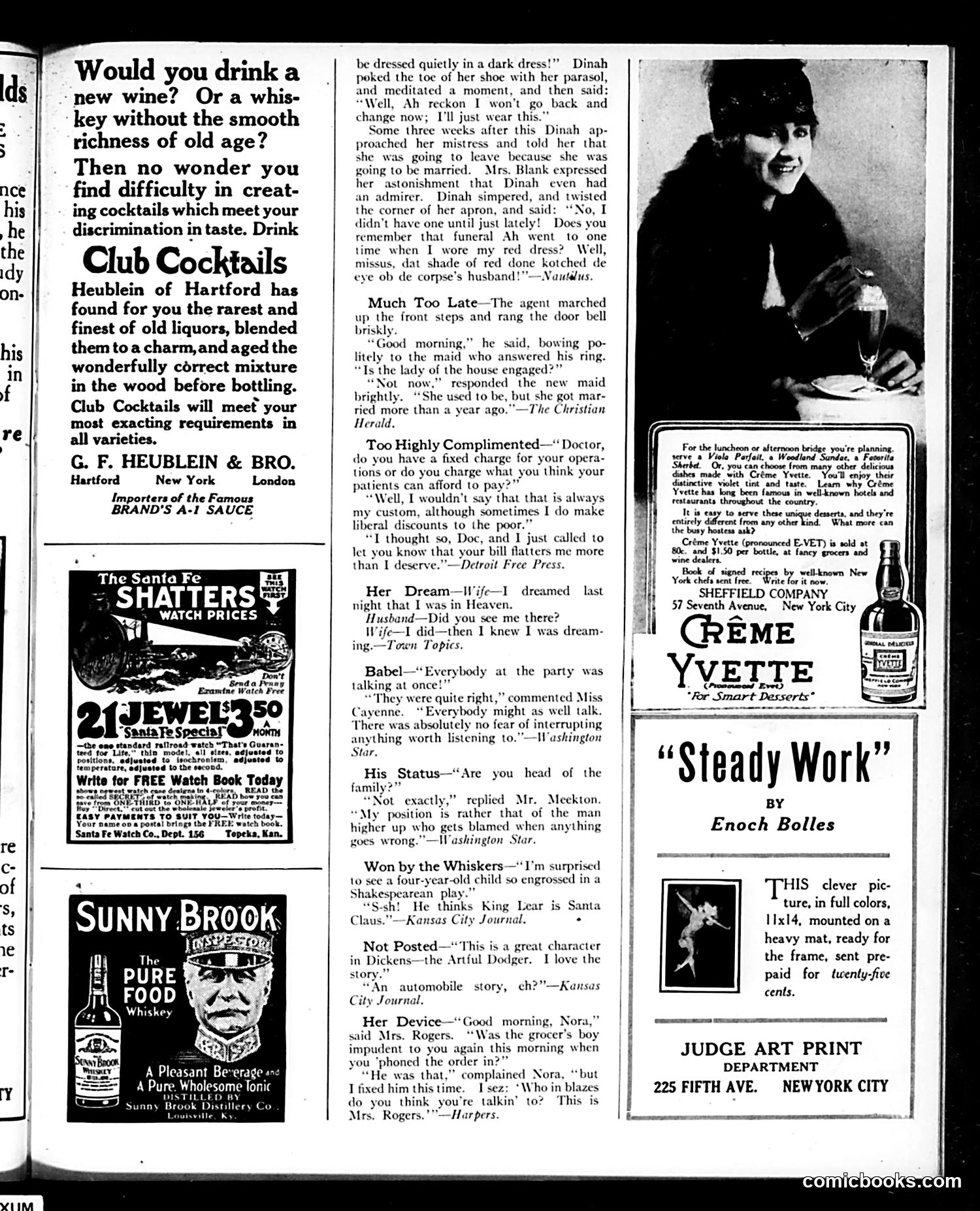
This page is primarily **advertising and humor content**, not a political cartoon. The ads promote luxury products: Club Cocktails (spirits), watches, and whiskey—typical early 20th-century Judge magazine fare. The humor section contains several brief anecdotes satirizing social situations: - A domestic story about a Black servant named Dinah wearing a red dress to a funeral where it catches a widower's eye—reflecting the racist stereotypes common in era publications - Jokes about marriage, doctors overcharging patients, and marital dynamics - A child mistaking King Lear for Santa Claus The "Steady Work" art print advertisement appears on the right. **The satire targets** workplace hierarchies, doctor's fees, marriage complications, and social pretension—gentle, non-political humor aimed at middle/upper-class readers. The page reflects Judge's focus on lifestyle, consumption, and domestic comedy rather than hard political satire.
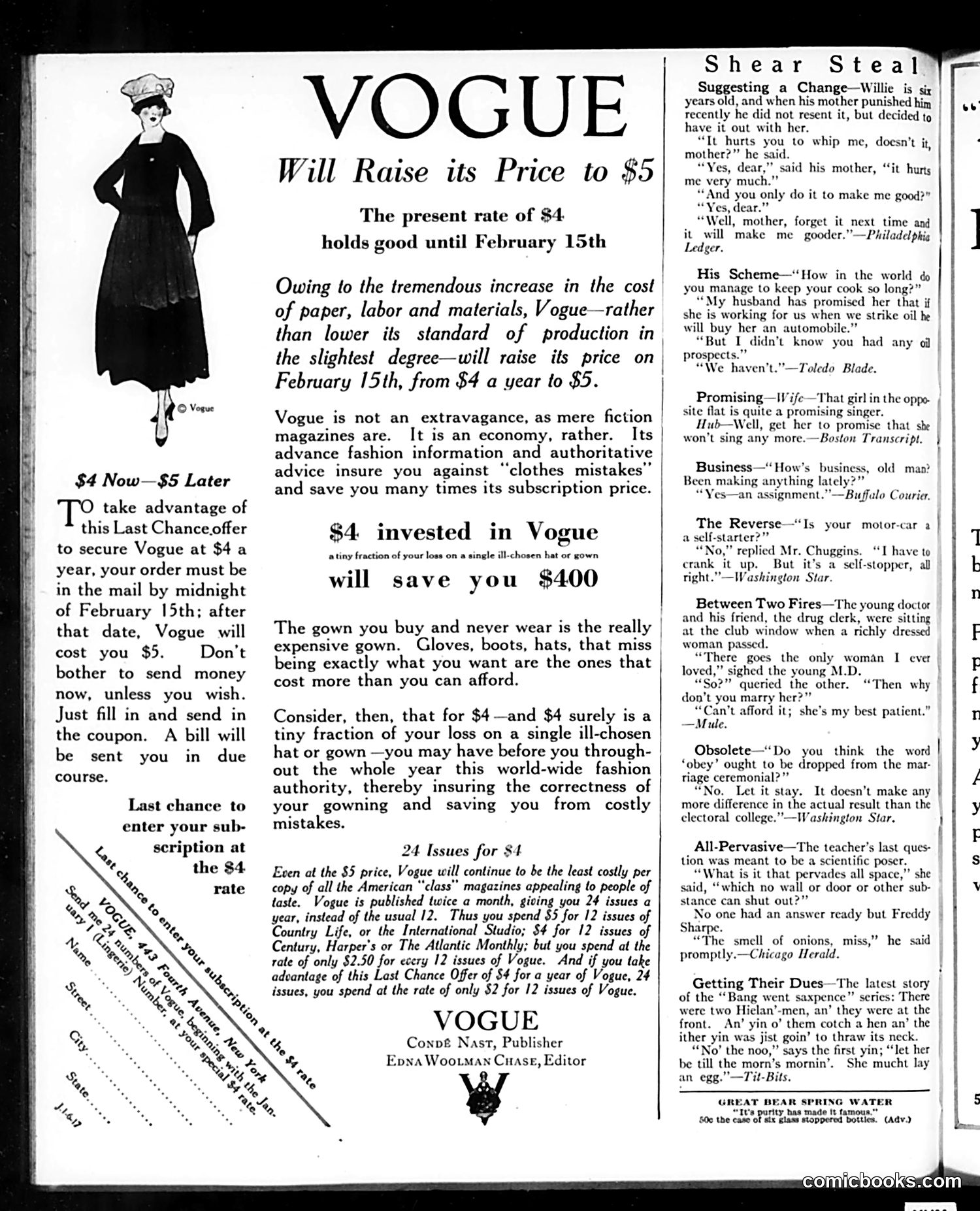
This page is primarily **advertising for Vogue magazine**, not a political cartoon. The bulk of the content announces a subscription price increase from $4 to $5 annually, effective February 15th. The advertisement argues this price hike is justified because Vogue provides fashion authority that saves readers money by preventing costly clothing mistakes—claiming a $4 subscription saves $400 in avoided wardrobe errors. It emphasizes Vogue publishes 24 issues yearly (twice monthly), making it cheaper per-issue than competitors like *Country Life* or *Harper's*. The right column contains brief humor pieces typical of Judge's satirical content—witty anecdotes about everyday life (a child negotiating punishment, a husband's oil-strike fantasy to retain household help, etc.). These are unrelated to the advertisement and represent the magazine's standard comedic filler. **There are no significant political references or caricatures on this page.** It's essentially a vintage advertising specimen combined with period humor content.
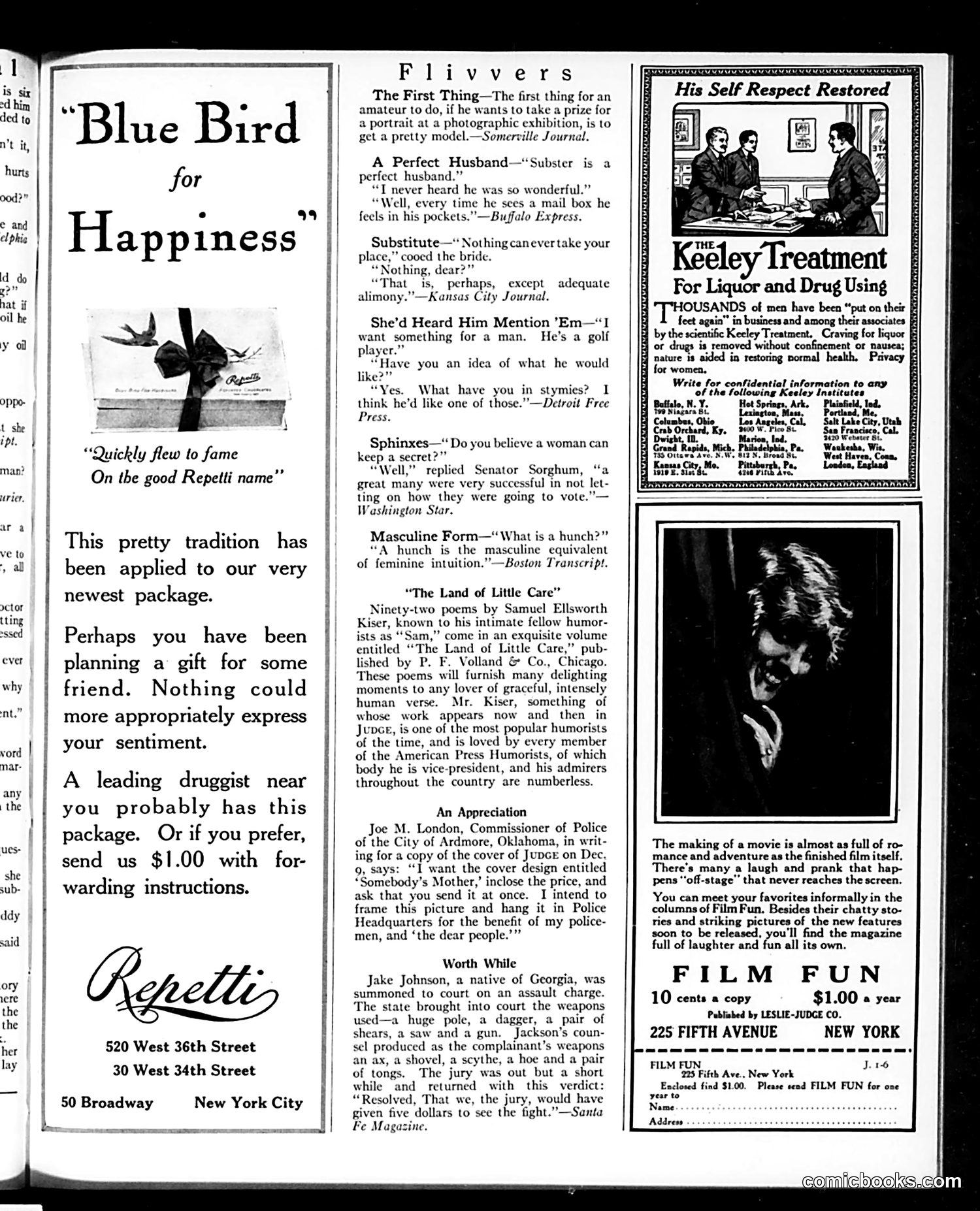
This page is primarily **advertising**, not political satire. The left side features a Repetti brand advertisement for a "Blue Bird for Happiness" package—likely a perfume or cosmetic product. The ad references a "pretty tradition" associated with the Repetti name and encourages purchasing as a gift. The right side contains miscellaneous **filler content**: short humorous quips about marriage, golf, and politics ("Flivvers" section); book promotion for Samuel Ellsworth Kiser's poetry; and advertisements for the Keeley Institute (a real treatment center for alcohol/drug addiction) and Film Fun magazine. The political humor is light and formulaic—a Senator's comment about women keeping secrets and voter suppression—typical period satire. There are no identifiable caricatures or significant political commentary. This appears to be a standard **magazine interior page** mixing commerce with humor and literary promotion.
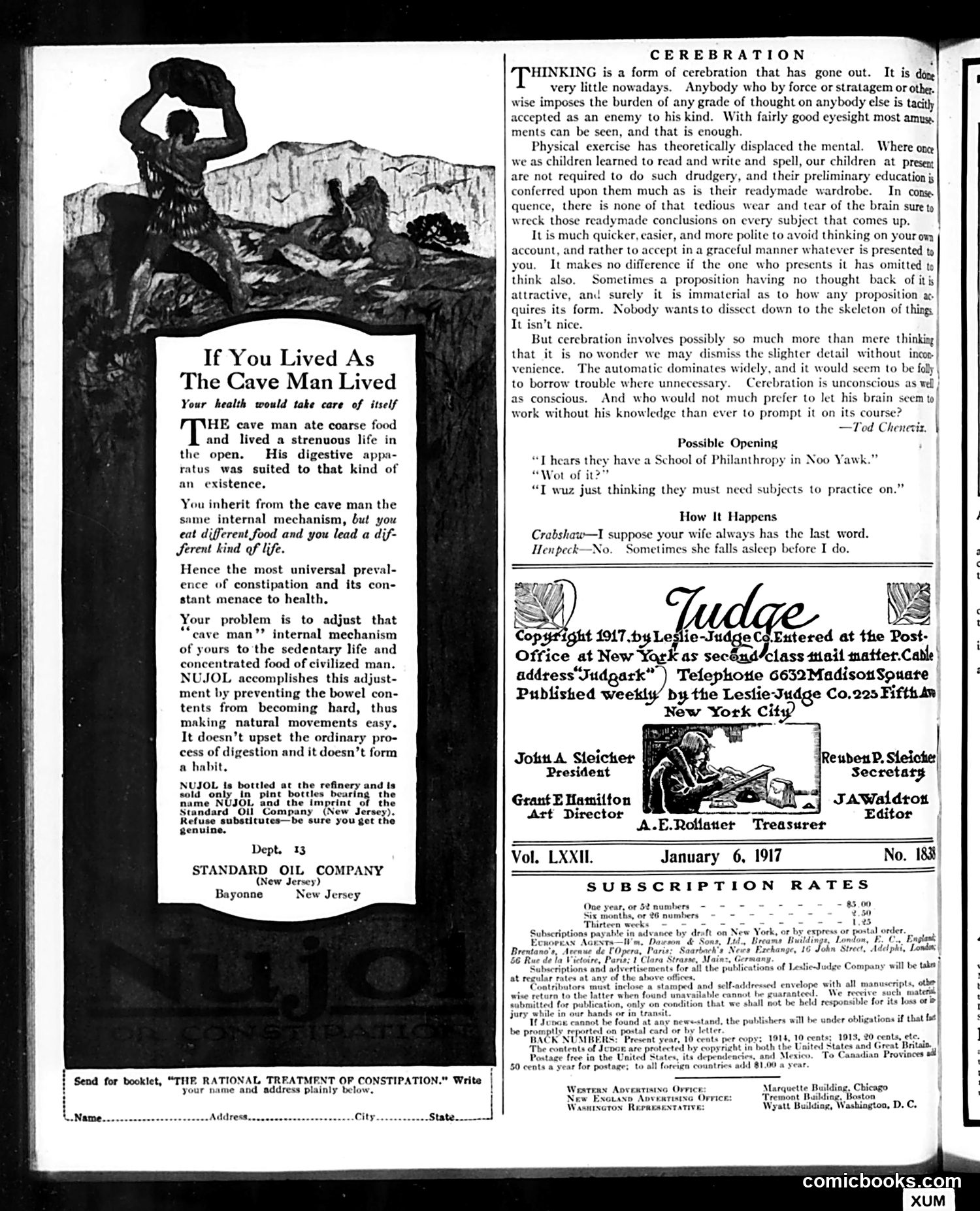
The main content is a Standard Oil advertisement disguised as a health article—a common early advertising format. The headline "If You Lived As The Cave Man Lived" hooks readers with an evolutionary argument: modern sedentary life and refined food cause digestive problems that our "cave man" bodies weren't designed for. The solution? NUJOL, a laxative oil product, presented as a scientific remedy for this civilizational mismatch. The surrounding satirical pieces are brief humor: "Possible Opening" jokes about needing "subjects to practice on" at a new Philanthropy school (dark commentary on charity work), while "How It Happens" is domestic humor about wives having the last word. This represents early 20th-century advertising colonizing magazine space through pseudo-scientific health claims—a pattern that persisted for decades.
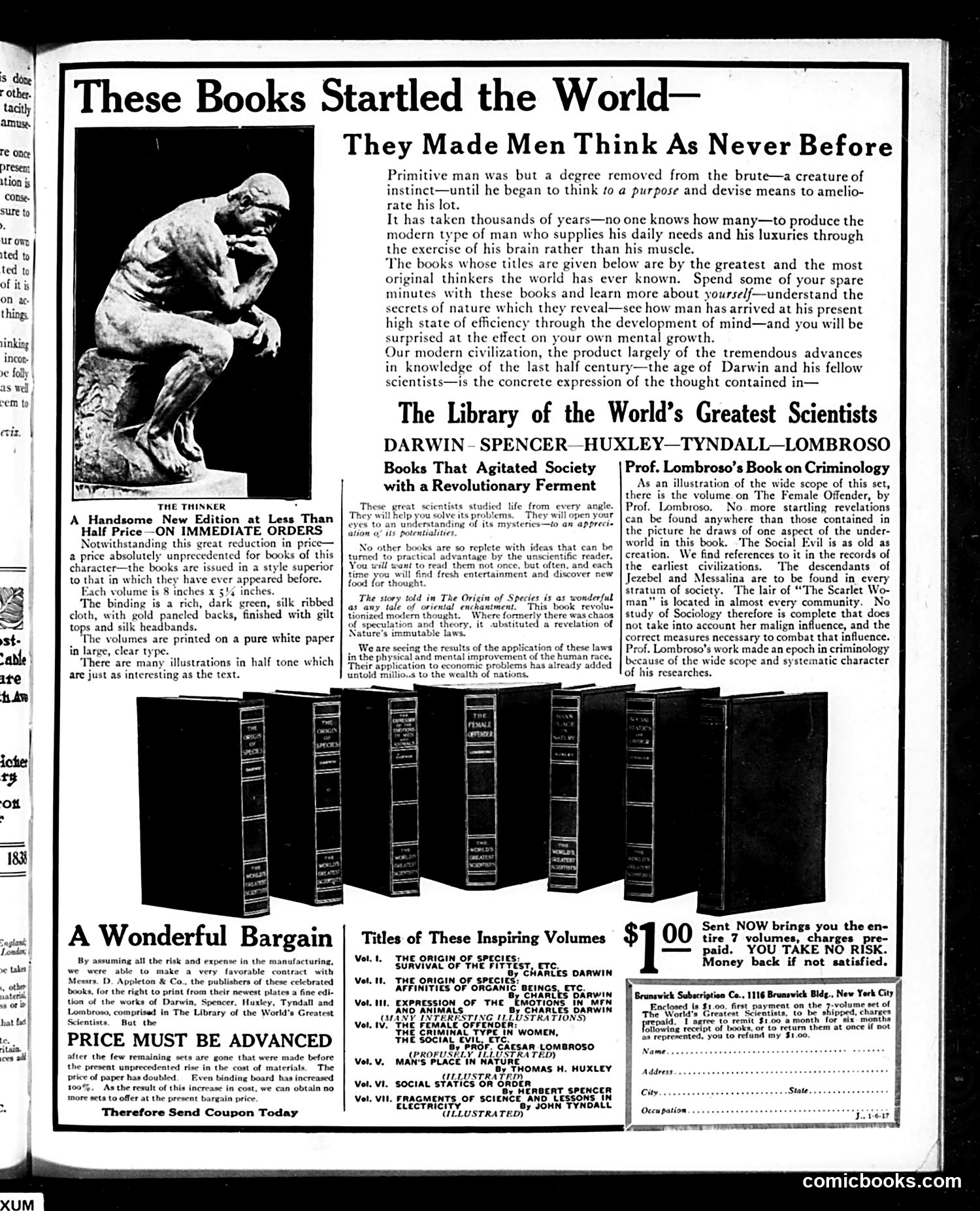
This is primarily a **book advertisement**, not a political cartoon. It promotes a mail-order collection of scientific works by Darwin, Spencer, Huxley, Tyndall, and Lombroso—figures central to 19th-century evolutionary and social theory. The image of "The Thinker" (Rodin's sculpture) symbolizes intellectual advancement. The ad's rhetoric reflects **early 1900s popular scientism**: these books supposedly elevated humanity from "brutish" instinct to rational thought and "modern civilization." **What's notable historically**: The inclusion of Lombroso's criminology—particularly volumes on "The Female Offender" and "Criminal Type in Women"—reveals how evolutionary theory was weaponized to justify pseudoscientific classifications of human "types" and deviance, often targeting women and marginalized groups. The urgency ("Price Must Be Advanced") and bargain framing are classic direct-mail sales tactics. For modern readers, this reveals how scientific authority was marketed and commercialized to validate social hierarchies.
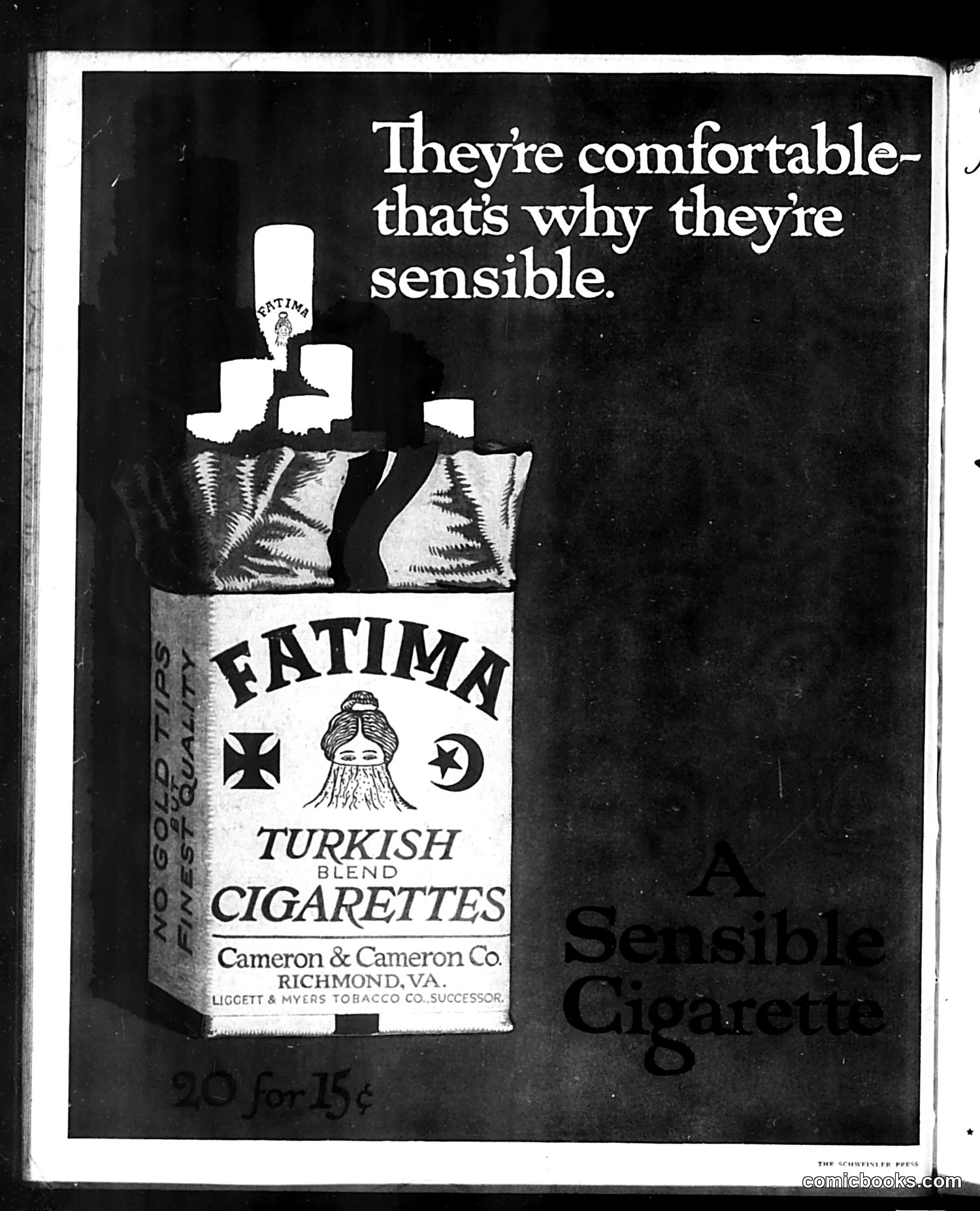
This is a **cigarette advertisement**, not political satire. It promotes Fatima Turkish Blend cigarettes, made by Cameron & Cameron Co. of Richmond, Virginia. The ad uses a marketing appeal rather than humor: the tagline "They're comfortable—that's why they're sensible" attempts to make smoking seem like a rational, practical choice. The price "20 for 15¢" indicates this is a vintage ad, likely early-to-mid 20th century. The decorative imagery on the pack (a bearded figure, crescent moon, and cross) references the Turkish tobacco blend's exotic appeal—a common marketing strategy of the era that traded on orientalist imagery to suggest quality and sophistication. This represents pre-health-warning advertising when cigarettes were marketed as wholesome consumer goods.