
Judge, 1917-01-06 · page 25 of 32
Judge — January 6, 1917 — page 25: what you’re looking at
What you’re looking at
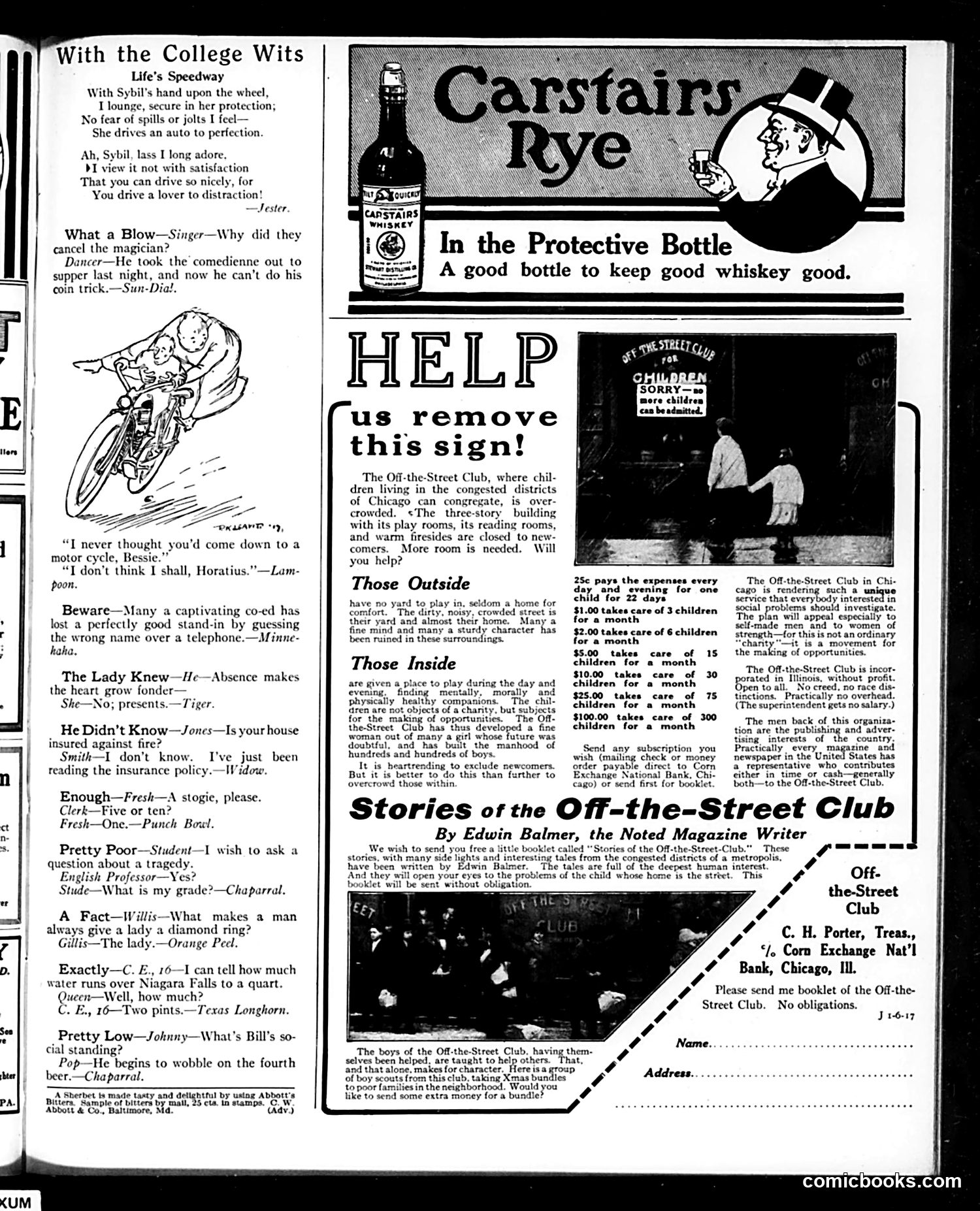
This page combines humor columns with a serious charitable appeal. The top section features "College Wits"—brief jokes from college publications about romantic mishaps, automobile driving, and everyday predicaments. These are light satire targeting young people's romantic pretensions and modern anxieties (cars, phones, insurance). The dominant content is an earnest fundraising appeal for the **Off-the-Street Club**, a real Chicago social service organization providing safe indoor spaces for children in poor neighborhoods. The contrast is stark: frivolous college humor above, urgent social advocacy below. The appeal emphasizes opportunity-building over charity, noting the facility is overcrowded. It lists specific costs for caring for children and notes backing from publishing/media interests—establishing credibility among Judge's educated readership. The juxtaposition itself carries meaning: Judge presents both entertainment and moral responsibility, suggesting educated readers should support such institutions.
📄 Transcribed text from this page (OCR, searchable)
Machine-transcribed from the original scan — historical spelling and the odd misread are preserved.
With the College Wits Life’s Speedway | With Sybil’s hand upon the wheel, I lounge, secure in her protection; No fear of spills or jolts I feel— She drives an auto to perfection. Ah, Sybil, lass I long adore, bI view it not with satisfaction That you can drive so nicely, for You drive a lover to distraction! —Jester What a Blow—Singer—Why did they cancel the magician? Dancer—He took the comedienne out to supper night, and now he can’t do his coin trick.—Sun-Dia!. LED" = “OK LANT “49, “T never thought you’d come down to a motor cycle, Be: “T don’t think I shall, Horatius.”—Lam- poon. Beware—Many a captivating co-ed has lost a perfectly good stand-in by guessing the wrong name over a telephone.—Minne- haha. The Lady Knew—He—Absence makes the heart grow fonde She—No; presents. He Didn’t Know—Jones—Is your house insured against fire? Smith—I don’t know. reading the insurance polic I've just been Widow. Enough—Fresh—A stogie, please. Clerk—Five or ten? Fresh—One.—Punch Bowl. Pretty Poor—Student—I wish to ask a question about a tragedy English Professor—Yes: Stude—What is my grade?—Chaparral. A Fact—Willis—What makes a man always give a lady a diamond ring? Gillis—The lady.—Orange Peel. Exactly—C. E., 16—I can tell how much water runs over Niagara Falls to a quart. Queen—Well, how much? C. E., 16—Two pints.—Texas Longhorn. a9 Pretty Low—Johnny—What’s Bill’s so- cial standing? Pop—He begins to wobble on the fourth beer | beer.—Chaparral. A Sherbet ts made tasty and detightful by using Abbott's PA. Bittera. Sample of bitters by mall, 25 cta. in stamps. C. W. Abbott & Co., Baltimore, Md. avy . \Y \\ i \\\ a us remove this sign! The Off-the-Street Club, where chil- dren living in the congested districts of Chicago can congregate, is over- crowded. sThe three-story building with its play rooms, its reading rooms, and warm firesides are closed to new- comers. More room is needed. Will you help? Those Outside have no yard to play in, seldom a home for comfort. The dirty, no wed street is their yard and almost their home. Many a fine mind and many a sturdy character has been ruined in these surroundings. Those Inside are given a place to play during the day and evening. finding mentally, morally and physically healthy companions. The chil- dren are not objects of a charity, but subjects for the making of opportunities. The Off- the-Strect Club has thus developed a fine woman out of many a gitl whose future was doubtful, and has built, the manhood of hundreds and hundreds of boys. It is heartrending to exclude newcomers. But it is better to do this than further to overcrowd those within. Stories of the Off-the-Street Club By Edwin Balmer, the Noted Magazine Writer ttle boc alled ‘Stories of the Of. Club." These The Off-the-Street Club in Chi- cago is rendering such a unk service that everybody interested in social problems should investigate. The plan will appeal especially to self-made men and to women of strength—for this is not an ordinary wcharity."—it is a movement for the making of opportunities. The Off-the-Street Club is incor- porated in Illinois, without profit. Open to all. No creed, no race dis tinctions. Practically no overhead. (The superintendent gets no salary.) The men back of this organ tion are the publishing and adver tising interests of the country. Practically every magazine and newspaper in the United States has @ representative who contributes either in time or cash—generally both—to the Off-the-Street Club. 2Se pays the expenses every day and evening for one child for 22 days $1.00 takes care of 3 children for a month $2.00 takes care of 6 children for a month $5.00 takes care of 15 children for a month $10.00 takes care of 30 children for a month 00 takes care of 75 children for a month $100.00 takes care of 300 children for a month Send any subscription you wish (mailing check or money direct to Corn ional Bank. Chi- cago) of send first for booklet. geeoc= % oft 7 the-Street Club C. H. Porter, Treas., y ‘/o Corn Exchange Nat’! 7 Bank, Chicago, Ill. Please send me booklet of the Off-the- Street Club. No obligations. ¢ tales are full of the deepest human interest. s of the child whose home is the street. This J 16-17 The boys of the Off-the-Street Club, having them- selves been helped, are taught to help others. That, alone. makes for character, Here isa group from this club. taking Xmas bundles esin theneighborhood. Would you some extra money for a bundle? comicbooks.com