
Judge, 1917-01-06 · page 15 of 32
Judge — January 6, 1917 — page 15: what you’re looking at
What you’re looking at
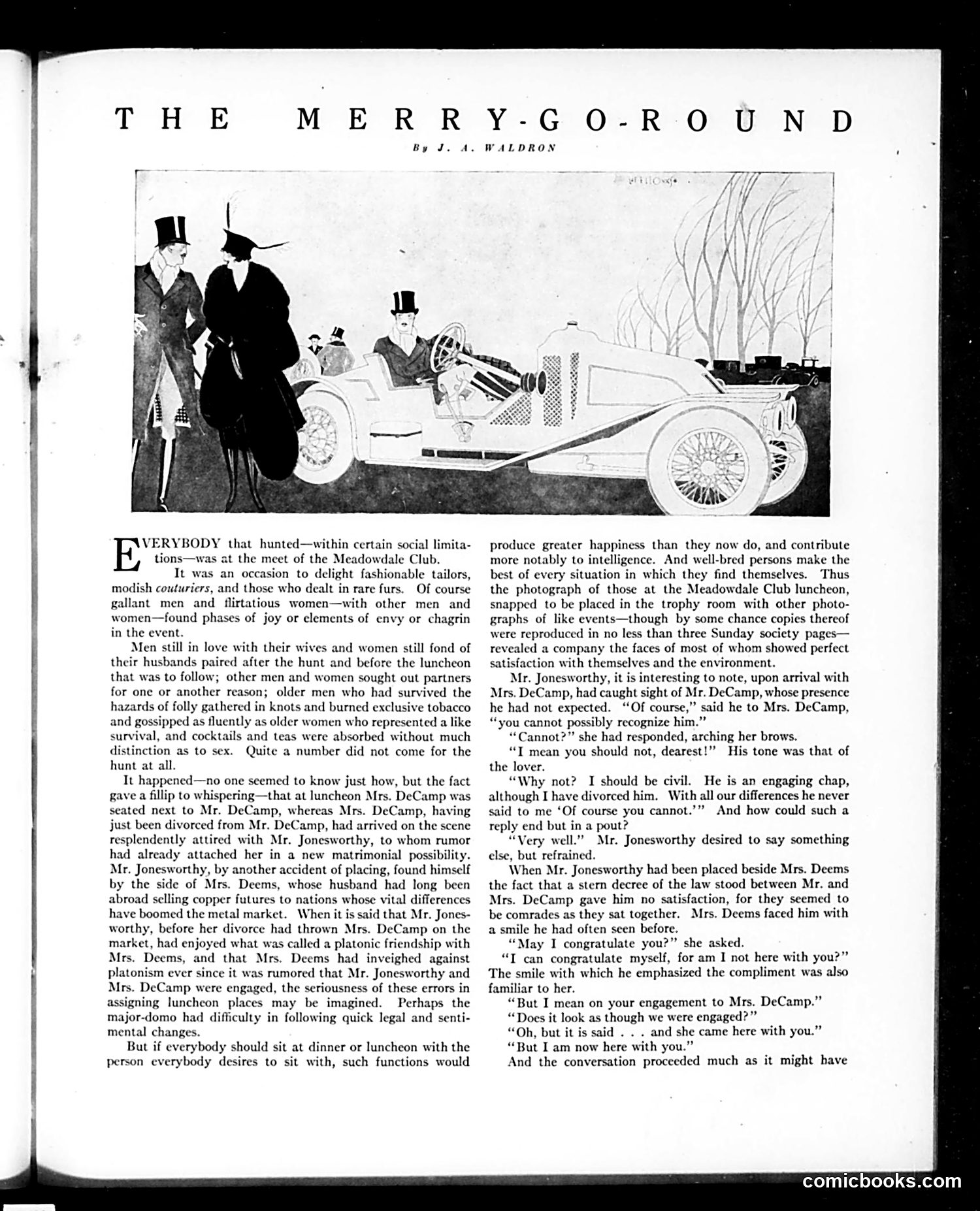
This satirical story depicts the social chaos of a country club hunt luncheon seating arrangement. The humor centers on awkward romantic entanglements among wealthy socialites: Mrs. DeCamp, recently divorced, arrives with her new suitor Mr. Jonesworthy—only to be seated at lunch next to her ex-husband. Jonesworthy himself sits beside Mrs. Deems, with whom he'd previously had a "platonic friendship" that Mrs. Deems resented. The satire mocks the pretense of high society: despite these explosive romantic conflicts, everyone maintains perfect composure for the society photographer. The illustrations show well-dressed figures and racing cars typical of Jazz Age leisure. The story suggests that upper-class people prioritize appearances and propriety over genuine feeling, going through motions of civility while harboring jealousy and desire beneath the surface—hence the "merry-go-round" of romantic musical chairs.
📄 Transcribed text from this page (OCR, searchable)
Machine-transcribed from the original scan — historical spelling and the odd misread are preserved.
a MERR By J. A. tions—was at the meet of the Meadowdale Club. It was an occasion to delight fashionable tailors, modish couturiers, and those who dealt in rare furs. Of course gallant men and flirtatious women—with other men and women—found phases of joy or elements of envy or chagrin in the event. Men still in love with their wives and women still fond of their husbands paired after the hunt and before the luncheon that was to follow; other men and women sought out partners for one or another reason; older men who had survived the hazards of folly gathered in knots and burned exclusive tobacco and gossipped as fluently as older women who represented a like survival, and cocktails and teas were absorbed without much distinction as to sex. Quite a number did not come for the hunt at all. It happened—no one seemed to know just how, but the fact gave a fillip to whispering—that at luncheon Mrs. DeCamp was seated next to Mr. DeCamp, whereas Mrs. DeCamp, having just been divorced from Mr. DeCamp, had arrived on the scene resplendently attired with Mr. Jonesworthy, to whom rumor had already attached her in a new matrimonial possibility. Mr. Jonesworthy, by another accident of placing, found himself by the side of Mrs. Deems, whose husband had long been abroad selling copper futures to nations whose vital differences have boomed the metal market. When it is said that Mr. Jones- worthy, before her divorce had thrown Mrs. DeCamp on the market, had enjoyed what was called a platonic friendship with Mrs, Deems, and that Mrs. Deems had inveighed against platonism ever since it was rumored that Mr. Jonesworthy and Mrs. DeCamp were engaged, the seriousness of these errors in assigning luncheon places may be imagined. Perhaps the major-domo had ulty in following quick legal and senti- mental changes. But if everybody should sit at dinner or luncheon with the person everybody desires to sit with, such functions would | Dees that hunted—within certain social limita- Y-G O-R OUN D WALDRON produce greater happiness than they now do, and contribute more notably to intelligence. And well-bred persons make the best of every situation in which they find themselves. Thus the photograph of those at the Meadowdale Club luncheon, snapped to be placed in the trophy room with other photo- graphs of like events—though by some chance copies thereof were reproduced in no less than three Sunday society pages— revealed a company the fi of most of whom showed perfect satisfaction with themselves and the environment. Mr. Jonesworthy, it is interesting to note, upon arrival with Mrs. DeCamp, had caught sight of Mr. DeCamp, whose presence he had not expected. “Of course,” said he to Mrs. DeCamp, “you cannot possibly recognize him.” “Cannot?” she had responded, arching her brows. “T mean you should not, dearest!” His tone was that of the lover. “Why not? I should be civil. He is an engaging chap, although I have divorced him, With all our differences he never said to me ‘Of course you cannot.’” And how could such a reply end but in a pout? “Very well.” Mr. Jonesworthy desired to say something else, but refrained. When Mr. Jonesworthy had been placed beside Mrs. Deems the fact that a stern decree of the law stood between Mr. and Mrs. DeCamp gave him no satisfaction, for they seemed to be comrades as they sat together. Mrs. Deems faced him with a smile he had often seen before. “May I congratulate you?” she asked. “TI can congratulate myself, for am I not here with yo The smile with which he emphasized the compliment was also familiar to her. “But I mean on your engagement to Mrs. DeCamp.” “Does it look as though we were engaged?” “Oh, but it is said . . . and she came here with you.” “But I am now here with you.” And the conversation proceeded much as it might have comicbooks.com