
Judge, 1917-01-06 · page 8 of 32
Judge — January 6, 1917 — page 8: what you’re looking at
What you’re looking at
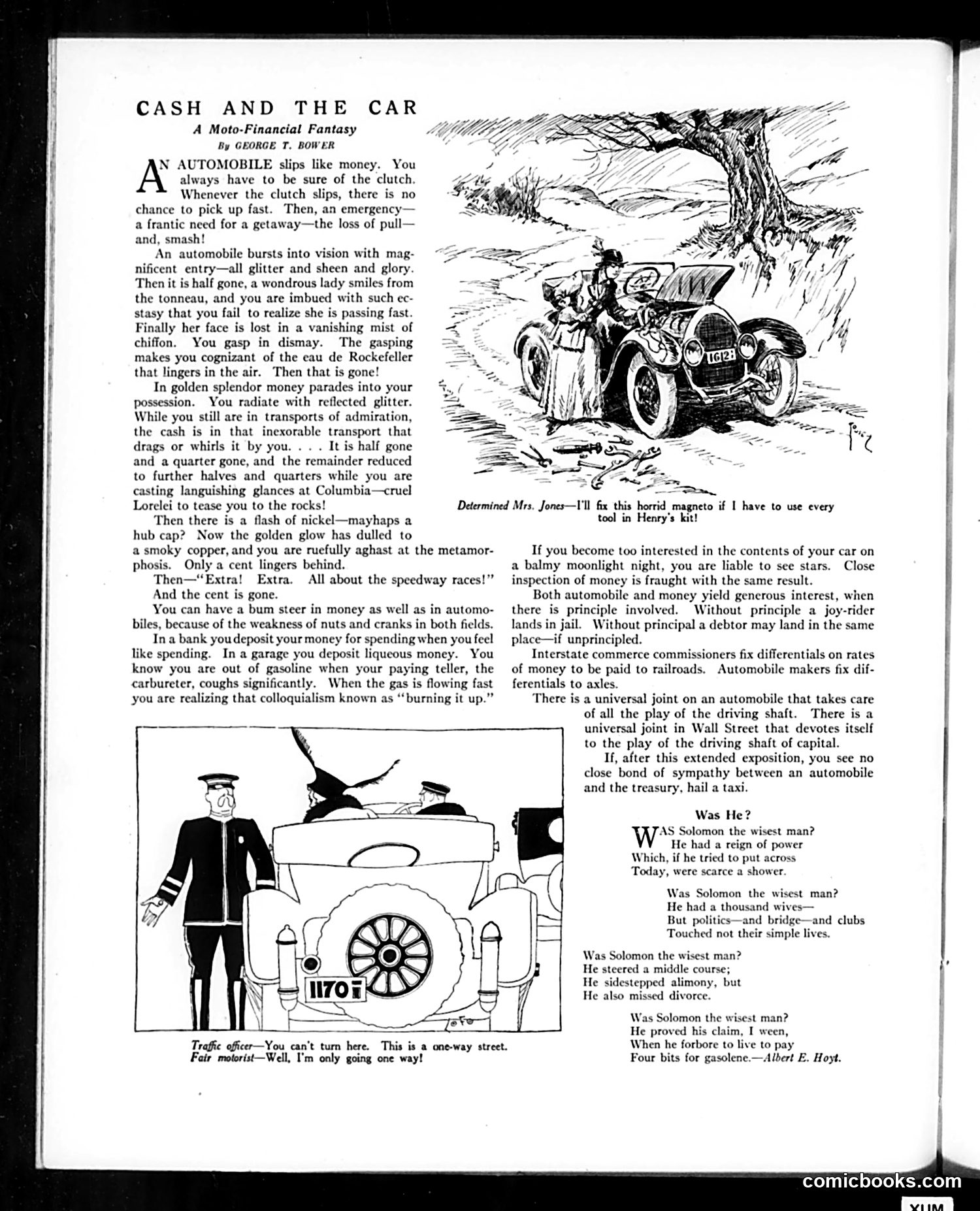
This satirical piece compares money and automobiles as parallel systems of waste and loss. Bower's extended metaphor suggests both are inherently unstable: a car's clutch slips like money slips away; both vanish quickly despite initial glamour. The "wondrous lady" represents temptation; the "eau de Rockefeller" references conspicuous wealth. The cartoon criticizes financial recklessness—money deposited in banks versus "liqueous money" (gasoline) burned in cars. References to "joy-riders" landing in jail and unprincipled debtors suggest moral critique of frivolous spending. The bottom cartoon depicts a motorist arguing with a traffic officer about a one-way street—a simple joke about literal versus directional interpretation. The closing poem mocks Solomon's wisdom as outdated, suggesting modern complications (alimony, bridge clubs, gasoline costs) have made ancient wisdom irrelevant—likely social commentary on changing 1920s America, including references to divorce and modern expenses.
📄 Transcribed text from this page (OCR, searchable)
Machine-transcribed from the original scan — historical spelling and the odd misread are preserved.
CASH AND THE CAR A Moto-Financial Fantasy By GEORGE T. BOWER N AUTOMOBILE slips like money. You A always have to be sure of the clutch. Whenever the clutch slips, there is no chance to pick up fast. Then, an emergency— a frantic need for a getaway—the loss of pull— and, smash! An automobile bursts into vision with mag- nificent entry—all glitter and sheen and glory. Then it is half gone, a wondrous lady smiles from the tonneau, and you are imbued with such ec- y that you fail to realize she is passing fast Finally her face is lost in a vanishing mist of chiffon. You gasp in dismay. The gasping makes you cognizant of the eau de Rockefeller that lingers in the air. Then that is gon In golden splendor money parades into your possession. You radiate with reflected glitter. While you still are in transports of admiration, the cash is in that inexorable transport that drags or whirls it by you. . . . It is half gone and a quarter gone, and the remainder reduced to further halves and quarters while you are casting languishing glances at Columbia—cruel Lorelei to tease you to the rocks! Then there is a flash of nickel—mayhaps a hub cap? Now the golden glow has dulled to a smoky copper, and you are ruefully aghast at the metamor- phosis. Only a cent lingers behind. Then—“Extra! Extra. All about the speedway races!” And the cent is gone. You can have a bum steer in money as well as in automo- biles, because of the weakness of nuts and cranks in both fields. Ina bank youdeposit your money for spending when you feel like spending. In a garage you deposit liqueous money. You know you are out of gasoline when your paying teller, the carbureter, coughs significantly. When the gas is flowing fast you are realizing that colloquialism known as “burning it up.” Determined Mrs. Jones—I'll fix this horrid magneto if I have to use every tool in Henry's kit! If you become too interested in the contents of your car on a balmy moonlight night, you are liable to see stars. Close inspection of money is fraught with the same result. Both automobile and money yield generous interest, when there is principle involved. Without principle a joy-rider lands in jail. Without principal a debtor may land in the same place—if unprincipled. Interstate commerce commissioners fix differentials on rates of money to be paid to railroads. Automobile makers fix dif- ferentials to axles. There is a universal joint on an automobile that takes care of all the play of the driving shaft. There is a universal joint in Wall Street that devotes itself to the play of the driving shaft of capital. If, after this extended exposition, you see no close bond of sympathy between an automobile and the treasury, hail a taxi. Was He? AS Solomon the wisest man? He had a reign of power Which, if he tried to put across Today, were scarce a shower. Was Solomon the wisest man? He had a thousand But politics—and bridge—and clubs Touched not their simple lives. Was Solomon the wisest man? He steered a middle course; He sidestepped alimony, but He also missed divorce. Was Solomon the wisest man? He proved his claim, I ween, Traffic officer—You can't turn here. This is a one-way street. Fair motorist—Well, I'm only going one way! When he forbore to live to pay Four bits for gasolene.—Albert E. Hoyt. comicbooks.com