
Judge, 1917-01-06 · page 14 of 32
Judge — January 6, 1917 — page 14: what you’re looking at
What you’re looking at
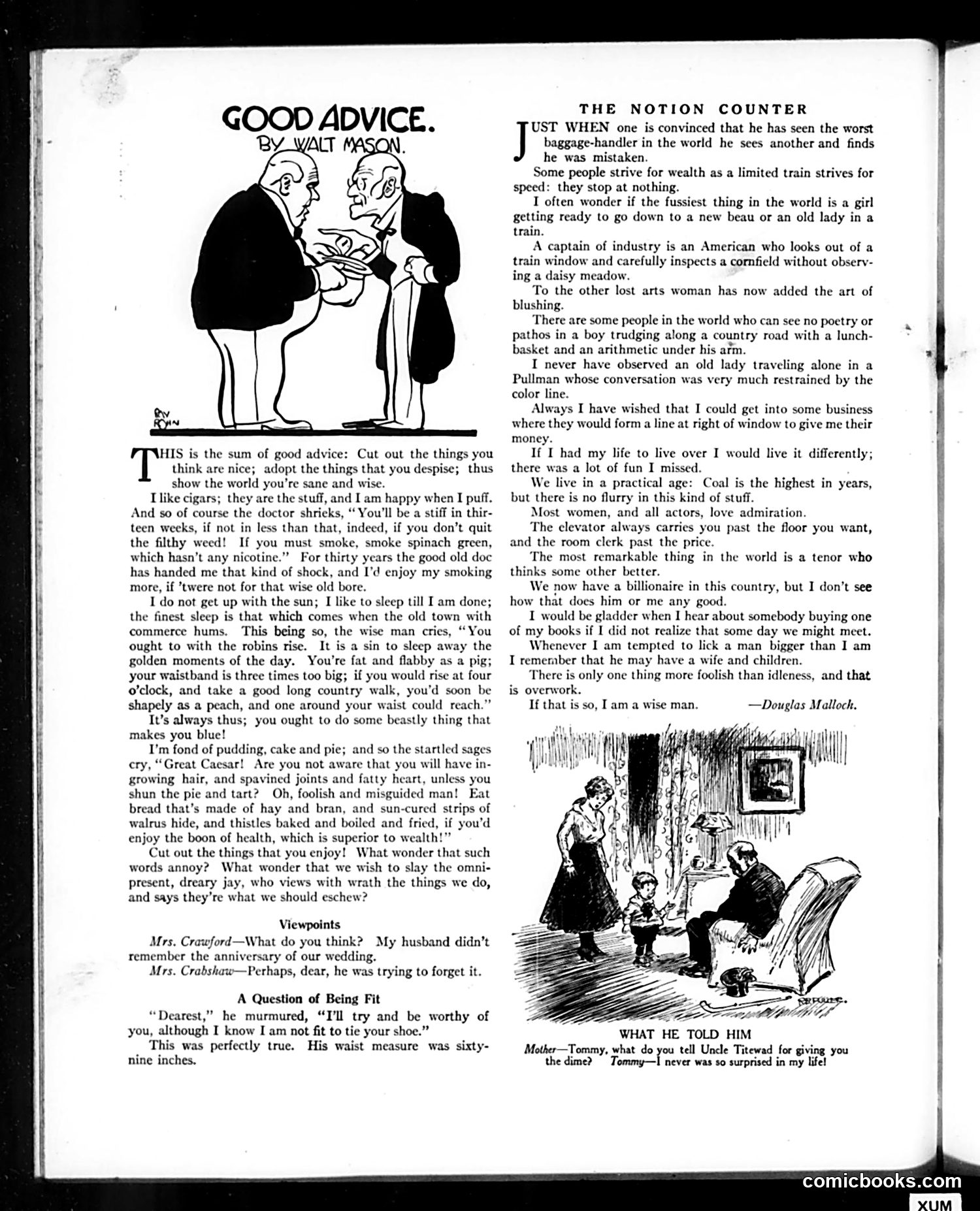
**"Good Advice" by Walt Mason** satirizes the ubiquitous social pressure to abandon pleasure in pursuit of health and morality. The cartoon depicts two men—one offering sanctimonious advice while the other listens resignedly. Mason's accompanying verses mock the relentless hectoring of doctors, reformers, and killjoys who demand people quit smoking, rise early, exercise, and avoid rich foods. The satire targets the gap between preaching virtue and actually living: people are constantly told to eliminate what brings them joy for supposedly greater wellbeing, yet these warnings ring hollow and joyless. **"The Notion Counter"** is a brief humor column offering sardonic observations about contemporary American life—incompetent workers, social pretension, romantic disappointment, and class dynamics. **"What He Told Him"** is a simple domestic joke about a child revealing an uncle's generous gift to his mother, undermining the surprise. The page represents early 20th-century American satirical humor: skeptical of self-improvement rhetoric and social moralizing, with gentle mockery of everyday frustrations.
📄 Transcribed text from this page (OCR, searchable)
Machine-transcribed from the original scan — historical spelling and the odd misread are preserved.
GOOD ADVICE. think are nice; adopt the things that you despise; thus show the world you're sane and wise. I like cigars; they are the stuff, and I am happy when I puff. And so of course the doctor shrieks, “You'll be a stiff in thir- teen weeks, if not in less than that, indeed, if you don’t quit the filthy weed! If you must smoke, smoke spinach green, which hasn’t any nicotine.” For thirty years the good old doc has handed me that kind of shock, and I’d enjoy my smoking more, if ’twere not for that wise old bore. I do not get up with the sun; I like to sleep till I am done; the finest sleep is that which comes when the old town with commerce hums. This being so, the wise man cries, “You ought to with the robins rise. It is a sin to sleep away the golden moments of the day. You're fat and flabby as a pig; your waistband is three times too big; if you would rise at four o’clock, and take a good long country walk, you'd soon be shapely as a peach, and one around your st could reach.” It’s always thus; you ought to do some beastly thing that makes you blue! I’m fond of pudding, cake and pie; and so the startled sages cry, “Great Caesar! Are you not aware that you will hav growing hair, and spavined joints and fatty heart, unless you shun the pie and tart? Oh, foolish and misguided man! Eat bread that’s made of hay and bran, and sun-cured strips of walrus hide, and thistles baked and boiled and fried, if you'd enjoy the boon of health, which is superior to wealth Cut out the things that you enjoy! What wonder that such words annoy? What wonder that we wish to slay the omni- present, dreary jay, who views with wrath the things we do, and says they’re what we should eschew? Te is the sum of good advice: Cut out the things you Viewpoints Mrs. Crawford—What do you think? My husband didn’t remember the anniversary of our wedding. Mrs. Crabshaw—Perhaps, dear, he was trying to forget it. A Question of Being Fit “Dearest,” he murmured, “I'll try and be worthy of you, although I know I am not fit to tie your shoe.” This was perfectly true. His waist measure was sixty- nine inches. THE NOTION COUNTER UST WHEN one is convinced that he has seen the worst baggage-handler in the world he sees another and finds he was mistaken. Some people strive for wealth as a limited train strives for speed: they stop at nothing. I often wonder if the fussiest thing in the world is a girl getting ready to go down to a new beau or an old lady in a train. A captain of industry is an American who looks out of a train window and carefully inspects a cornfield without observ- ing a daisy meadow. To the other lost arts woman has now added the art of blushing. There are some people in the world who can see no poetry or pathos in a boy trudging along a country road with a lunch- basket and an arithmetic under his atm. I never have observed an old lady traveling alone in a Pullman whose conversation was very much restrained by the color line. ys I have wished that I could get into some business where they would form a line at right of window to give me their money. If I had my life to live over I would live it differently; there was a lot of fun I missed. We live in a practical age: Coal is the highest in years, but there is no flurry in this kind of stuff. Most women, and all actors, love admiration. The clevator always carries you past the floor you want, and the room clerk past the price. The most remarkable thing in the world is a tenor who thinks some other better. We now have a billionaire in this country, but I don’t see how that does him or me any good. I would be gladder when I hear about somebody buying one of my books if I did not realize that some day we might meet. Whenever I am tempted to lick a man bigger than I am I remember that he may have a wife and children. There is only one thing more foolish than idleness, and that is overwork. If that is so, I am a wise man. —Douglas Malloch, Z ENE Se ged OLS WHAT HE TOLD HIM Mother—Tommy, wat do pat do Fe tell Uncle Titewad for giving you the dime? never was so surprised in my life! comicbooks.com |