
Judge, 1917-01-06 · page 5 of 32
Judge — January 6, 1917 — page 5: what you’re looking at
What you’re looking at
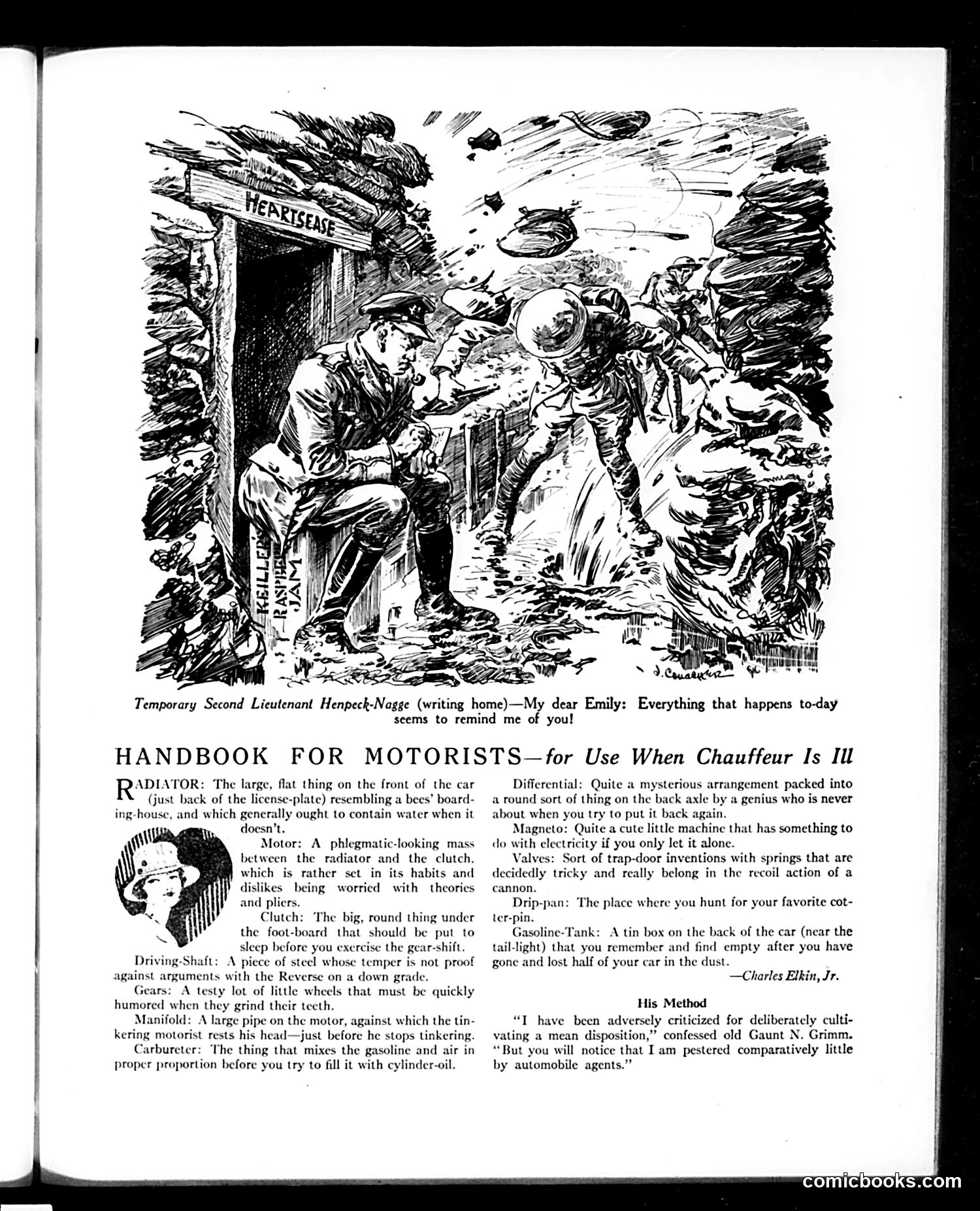
The main illustration depicts a soldier writing home from a WWI trench, captioned "Temporary Second Lieutenant Henpeck-Nagge" writing to "Emily." The cartoon satirizes how wartime experiences make soldiers nostalgic—everything reminds him of his wife back home, even amid combat chaos. Below is a humorous "Handbook for Motorists—for Use When Chauffeur Is Ill," defining car parts with tongue-in-cheek definitions. Terms like "Motor," "Radiator," and "Gasoline-Tank" are explained as if the average driver knows nothing about automobiles, satirizing early 1900s motorists' mechanical ignorance. The final section quotes Gaunt N. Grimm defending his deliberately mean disposition, suggesting satirical commentary on unpleasant personalities or management styles. The overall tone mocks both wartime sentimentality and automobiles' complexity for average users.
📄 Transcribed text from this page (OCR, searchable)
Machine-transcribed from the original scan — historical spelling and the odd misread are preserved.
Temporary Second Lieutenant Henpeck-Nagge (writing home)—My dear Emily: Everything that happens to-day seems to remind me of you! HANDBOOK FOR MOTORISTS—for Use When Chauffeur Is Ill ADIATOR: The large, flat thing on the front of the car (just back of the license-plate) resembling a bees’ board- ing-house, and which generally ought to contain water when it doesn’t. Motor: A. phlegmatic-looking mass between the radiator and the clutch, which is rather set in its habits and dislikes being worried with theories and pliers. Clutch: The big, round thing under the foot-board that should be put to sleep before you exercise the gear-shift. Driving : A piece of steel whose temper is not proof against arguments with the Re > on a down grade. Gears: A testy lot of little wheels that must be quickly humored when they grind their teeth. Manifold: A large pipe on the motor, against which the tin- kering motorist rests his head—just before he stops tinkering. Carbureter: The thing that mixes the gasoline and air in proper proportion before you try to fill it with cylinder-oil. Differential: Quite a mysterious arrangement packed into a round sort of thing on the back axle by a genius who is never about when you try to put it ba i Magneto: Quite a cute little machine that has something to do with electricity if you only let it alone. Valves: Sort of trap-door inventions with springs that are decidedly tricky and really belong in the recoil action of a cannon. Drip-pan; The place where you hunt for your favorite cot- ler-pin. Gasoline-Tank: A tin box on the back of the car (near the ail-light) that you remember and find empty after you have gone and lost half of your car in the dust. —Charles Elkin, Jr. His Method “I have been adversely criticized for deliberately culti- vating a mean disposition,” confessed old Gaunt N. Grimm, “But you will notice that I am pestered comparatively little by automobile agents.”