
Judge, 1917-01-06 · page 28 of 32
Judge — January 6, 1917 — page 28: what you’re looking at
What you’re looking at
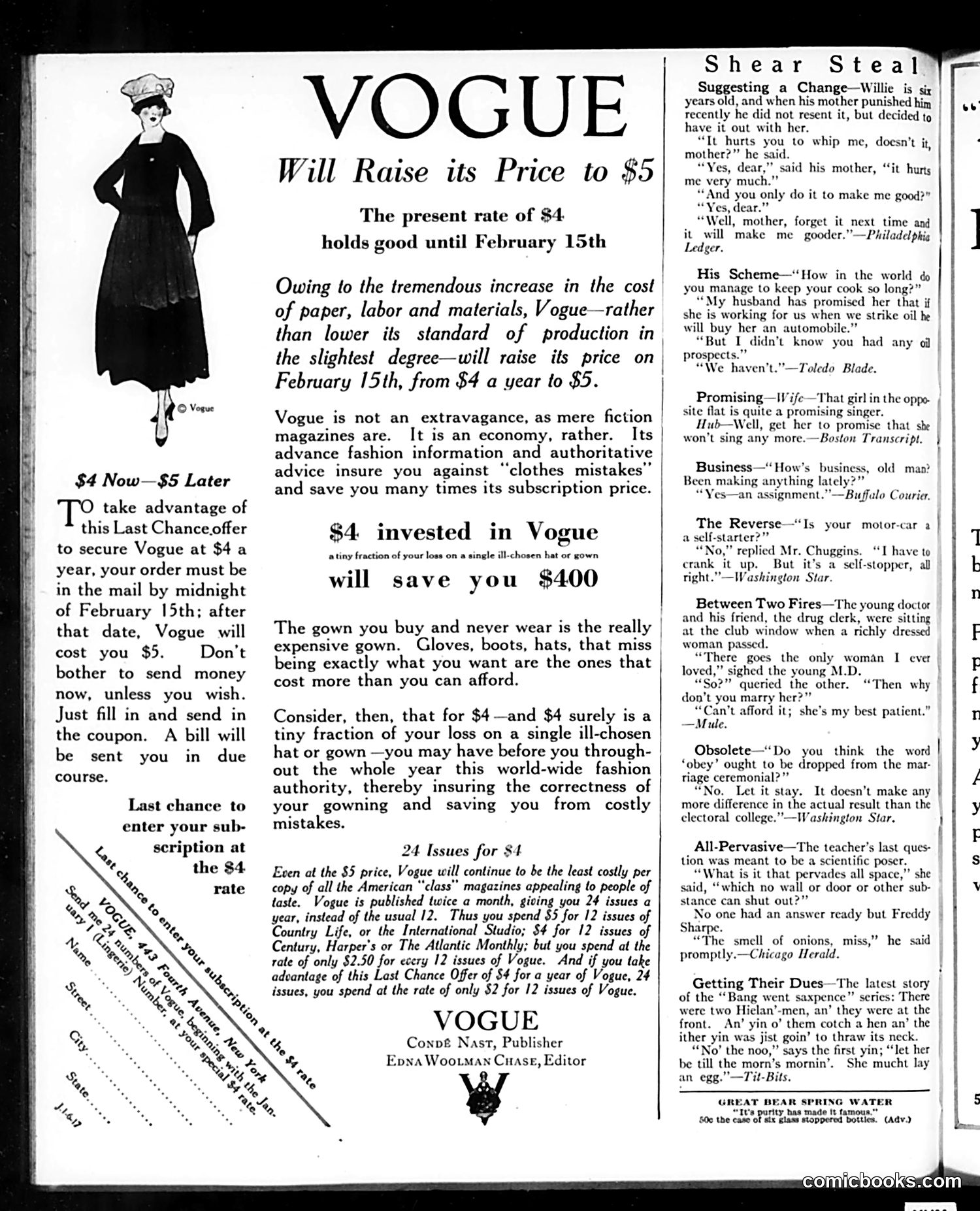
This page is primarily **advertising for Vogue magazine**, not a political cartoon. The bulk of the content announces a subscription price increase from $4 to $5 annually, effective February 15th. The advertisement argues this price hike is justified because Vogue provides fashion authority that saves readers money by preventing costly clothing mistakes—claiming a $4 subscription saves $400 in avoided wardrobe errors. It emphasizes Vogue publishes 24 issues yearly (twice monthly), making it cheaper per-issue than competitors like *Country Life* or *Harper's*. The right column contains brief humor pieces typical of Judge's satirical content—witty anecdotes about everyday life (a child negotiating punishment, a husband's oil-strike fantasy to retain household help, etc.). These are unrelated to the advertisement and represent the magazine's standard comedic filler. **There are no significant political references or caricatures on this page.** It's essentially a vintage advertising specimen combined with period humor content.
📄 Transcribed text from this page (OCR, searchable)
Machine-transcribed from the original scan — historical spelling and the odd misread are preserved.
$4 Now—$5 Later T° take advantage of this Last Chance.offer to secure Vogue at $4 a year, your order must be in the mail by midnight of February 15th; after that date, Vogue will cost you $5. Don't bother to send money now, unless you wish. Just fill in and send in the coupon. A bill will be sent you in due course. Last chance to enter your sub- scription at VOGUE Will Raise its Price to $5 The present rate of $4 holds good until February 15th Owing to the tremendous increase in the cost | of paper, labor and materials, Vogue—rather than lower its standard of production in the slightest degree—will raise its price on | February 15th, from $4 a year to $5. Vogue is not an extravagance, as mere fiction magazines are. It is an economy, rather. Its advance fashion information and authoritative advice insure you against “clothes mistakes” | and save you many times its subscription price. $4 invested in Vogue a tiny fraction of your loss on a single ill-chosen hat or gown will save you $400 The gown you buy and never wear is the really | expensive gown. Gloves, boots, hats, that miss being exactly what you want are the ones that cost more than you can afford. Consider, then, that for $4—and $4 surely is a tiny fraction of your loss on a single ill-chosen hat or gown —you may have before you through- out the whole year this world-wide fashion authority, thereby insuring the correctness of your gowning and saving you from costly mistakes. 24 Issues for $4 Even at the $5 price, Vogue will continue to be the least costly per copy of all the American “class” magazines appealing to people of taste. Vogue is published twice a month, giving you 24 issues a year, instead of the usual 12. Thus you spend $5 for 12 issues of Country Life, or the International Studio; $4 for 12 issues of Century, Harper's or The Atlantic Monthly; but you spend at the rate of only $2.50 for ecery 12 issues of Vogue. And if you take advantage of this Last Chance Offer of 54 for a year of Vogue, 24 issues, you spend at the rate of only $2 for 12 issues of Vogue. VOGUE Conpé Nast, Publisher Epna Wootman Cuase, Editor Shear Steal Suggesting a Change—Willic is six | years old, and when his mother punished him recently he did not resent it, but decided to have it out with her. “It hurts you to whip me, doesn’t it, mother?” he said “Yes, dear, me very much. you only do it to make me good?” dear.” “Well, mother, forget it next time and it will make me gooder.”—Philadel phi Ledger. * said his mother, “it hurts His Scheme—‘How in the world do you manage to keep your cook so long?” “My husband has promised her that if | | sh working for us when we strike oil he will buy her an automobile.” “But I didn’t know you had any oj prospects.” “We haven’t.”—Toledo Blade. Promising—Iife—That girl in the oppo- site flat is quite a promising singer. Hub—Well, get her to promise that she won't sing any more.—Boston Transcript. Business—“ How's busi Been making anything lat “Yes—an assignment.”—Buffalo Courier. ss, old man? The Reverse—‘Is your motor-car a tart d Mr. Chuggins. ‘I have to up. But it’s a self-stopper, all —Washington Star. Between Two Fires—The young doctor and his friend, the drug clerk, were sitting at the club window when a richly dressed woman passed. “Th goes the only woman I ever loved,” sighed the young M.D. “So?” queried the other. don’t you marry her?” “Can't afford it; she’s my best patient.” —Mule. Obsolete—“Do you think the word ‘obey’ ought to be dropped from the mar- riage ceremonial?” “No. Let it ye more difference in the actual result than the electoral college.”—Washington Star, “Then why “What is it that pervade: e's said, “which no wall or door or other sub- stance can shut out?” No one had an answer ready but Freddy Sharpe. “The smell of onions, miss,” he said promptly.—Chicago Herald. Getting Their Dues—The latest st of the “Bang went saxpence y were two Hielan’-men, an’ they front. An’ yin o’ them cotch a hen a ither yin was jist goin’ to thraw its neck. “No’ the noo,” says the first yin; “let her be till the morn’s mornin’. She mucht lay an egg.” —Tit-Bits. SPRING W It's purity has made It famous 0c the case of six glass stoppered bottles. (Adv.) or B It doesn’t make any | Lo i 2 Ome weSe BH S| PO