
Judge, 1917-01-06 · page 10 of 32
Judge — January 6, 1917 — page 10: what you’re looking at
What you’re looking at
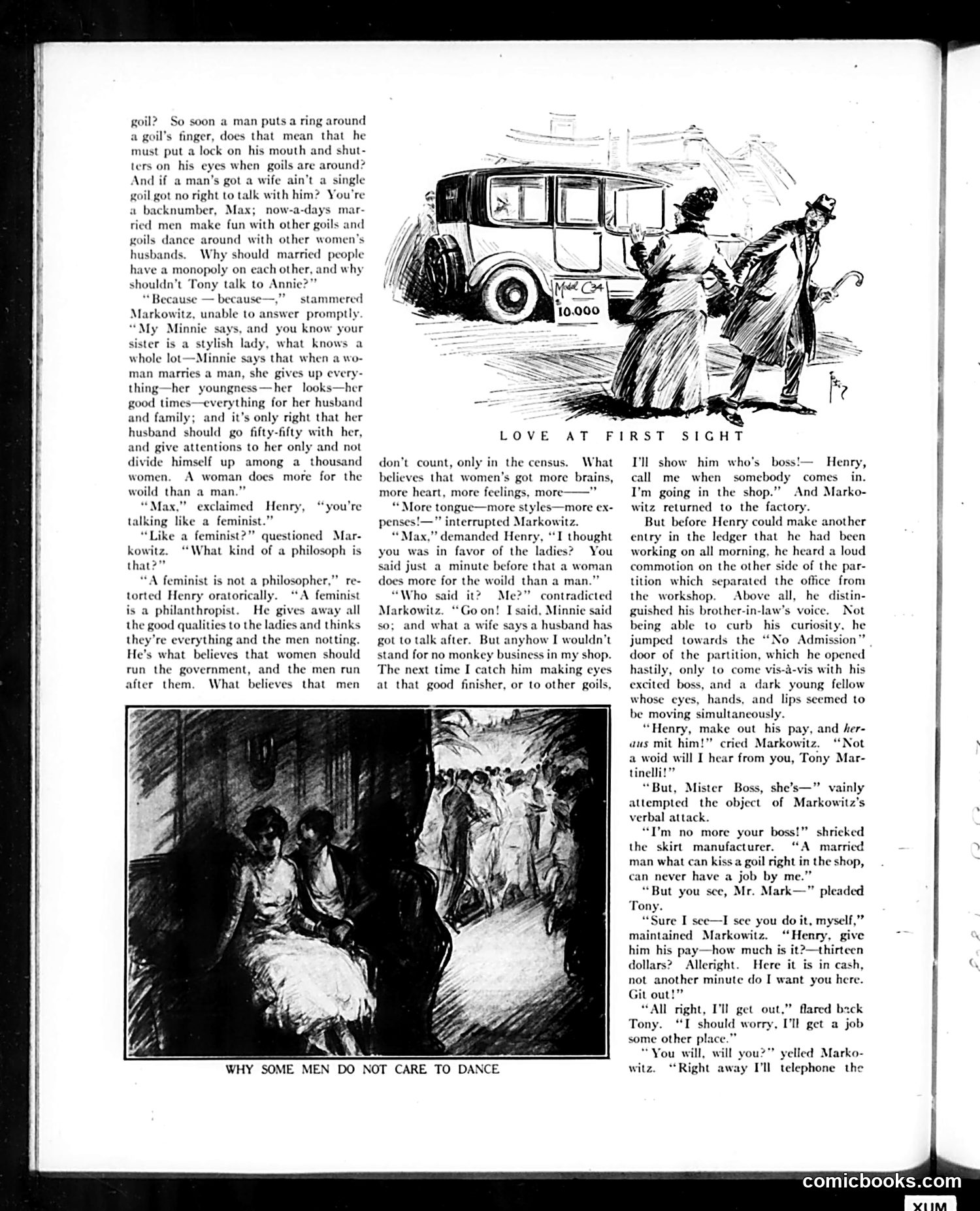
This page satirizes marriage and workplace morality in early 20th-century America through a dialogue between two characters: Henry (a factory owner) and Markowitz (his brother-in-law, a skirt manufacturer). **The Satire:** Henry champions "feminist" ideals—claiming women deserve equality, more brains, more feelings—while Markowitz initially defends traditional marriage exclusivity. However, Markowitz is exposed as a hypocrite: he lectures about wives "giving up everything" for husbands, yet fires his employee Tony for flirting with a female worker in his own shop, contradicting his stated feminist principles. **The Joke:** The cartoon mocks men who espouse progressive ideas about women's rights while enforcing strict, contradictory rules. Markowitz represents the inconsistent modernizer—he celebrates women's superiority in theory but demands control and propriety in practice. His angry reaction to Tony's kiss reveals his true conservative values beneath the rhetorical feminism. The bottom illustration "Why Some Men Do Not Care to Dance" (caption only visible) likely continues this theme of marital constraint.
📄 Transcribed text from this page (OCR, searchable)
Machine-transcribed from the original scan — historical spelling and the odd misread are preserved.
goil? So soon a man puts a ring around a goil’s finger, does that mean that he must put a lock on his mouth and shut- ters on his eyes when goils are around? And if a man’s got a wife ain’t a single goil got no right to talk with him? You're a backnumber, Max; now-a-days mar- ried men make fun with other goils and goils dance around with other women’s husbands. Why should married people have a monopoly on each other, and why shouldn't Tony talk to Annie: “Because — because—,”” stammered Markowitz, unable to answer promptly. “My Minnie says, and you know your sister is a stylish lady, what knows a whole lot—Minnie says that when aw man marries a man, she gives up eve thing—her youngness—her looks—her good times—everything for her husband and family; and it’s only right that her husband should go fifty-fifty with her, and give attentions to her only and not divide himself up among a thousand women. A woman does more for the woild than a man.” “Max,” exclaimed Henry, “you're talking like a femini “Like a feminist?” questioned Mar- kowitz. “What kind of a philosoph is that? “A feminist is not a philosopher,” re- torted Henry oratorically. “A feminist is a philanthropist. He gives away all the good qualities to the ladies and thinks they’re everything and the men notting. He's what believes that women should run the government, and the men run after them. What believes that men LOVE AT FIRST SIGHT don’t count, only in the census. What believes that women’s got more brains, more heart, more feelings, more ” “ More tongue—more styles—more ex- interrupted Markowitz. ”’ demanded Henry, “I thought yor of the ladies? You said just a minute before that a woman does more for the woild than a man.” “Who said it? Me?” contradicted Markowitz. oon! Isaid, Minnie said so; and what a wife says a husband has got to talk after. But anyhow I wouldn't stand for no monkey business in my shop. The next time I catch him making eyes at that good finisher, or to other goils, WHY SOME MEN DO NOT CARE TO DANCE I'll show him who's boss!— Henry, call me when somebody comes in. I’m going in the shop.” And Marko- witz returned to the factory. But before Henry could make another entry in the ledger that he had been working on all morning, he heard a loud commotion on the other side of the par- tition which separated the office from the workshop. Above all, he distin- guished his brother-in-law’s voit being able to curb his curiosit jumped towards the “No Admission” door of the partition, which he opened hastily, only to come vis-a-vis with his cited boss, and a dark young fellow whose eyes, hands, and lips seemed to be moving simultaneousl. “Henry, make out his and her- aus mit him!” cried Marko “Not a woid will I hear from you, Tony Mar- tinelli!” “But, Mister Boss, she’s—" vainly attempted the object of Markowitz’s verbal attack. “I’m no more your boss!” shricked the skirt manufacturer. “A married man what can kiss a goil right in the shop, can never have a job by me.” “But you sce, Mr. Mark—” pleaded Tony “Sure I see—I sce you do it, myself,” maintained Markowitz. “Henry, give him his pay—how much is it?—thirteen dollars? Alleright. Here it is in cash, not another minute do I want you here. Git out!” “All right, I'll get out,” flared back Tony. “I should worry, I'll get a job some other place.” “You will, will you?” yelled Marko- witz. “Right away I'll telephone the comicbooks.com EE ne © ee