
Judge, 1917-01-06 · page 19 of 32
Judge — January 6, 1917 — page 19: what you’re looking at
What you’re looking at
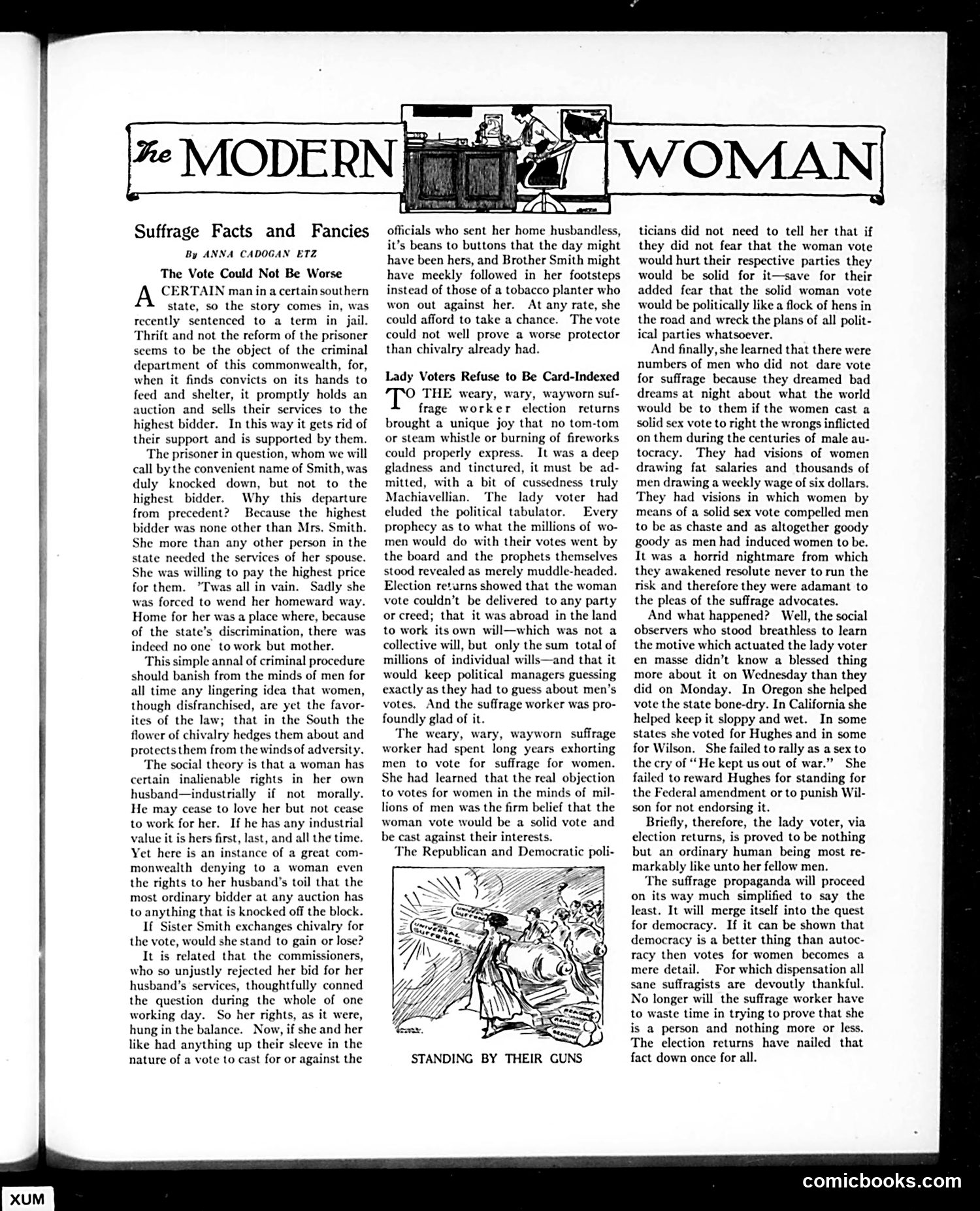
This Judge magazine page presents pro-suffrage arguments through satire. The main article, "Suffrage Facts and Fancies" by Anna Cadogan Etz, uses two anecdotes to counter anti-suffrage claims: **First story**: Mrs. Smith, a prisoner's wife, cannot bid for her husband's labor when the state auctions convict services—despite having the highest offer. The satire argues this proves women lack legal rights and chivalry doesn't protect them, making suffrage a logical necessity rather than a loss. **Second story**: Politicians predicted women voters would form a "solid vote" for one party. Election returns proved women vote individually, like men. The author celebrates this as voters "eluding the political tabulator"—women won't be manipulated as a bloc. The **cartoon caption "Standing By Their Guns"** (image shows armed women) likely reinforces that women are serious political participants. The overall message: suffrage doesn't harm women; lack of suffrage demonstrably does. Women's voting autonomy benefits democracy.
📄 Transcribed text from this page (OCR, searchable)
Machine-transcribed from the original scan — historical spelling and the odd misread are preserved.
Suffrage Facts and Fancies By ANNA CADOGAN ETZ The Vote Could Not Be Worse CERTAIN man ina certain sout state, so the story comes in, was recently sentenced to a term in jail. Thrift and not the reform of the prisoner seems to be the object of the criminal department of this commonwealth, for, when it finds convicts on its hands to feed and shelter, it promptly holds an auction and sells their services to the highest bidder. In this way it gets rid of their support and is supported by them. The prisoner in question, whom we will call by the convenient name of Smith, was duly knocked down, but not to the highest. bidder. Why this departure from precedent? Because the highest bidder was none other than Mrs. Smith. She more than any other person in the state needed the services of her spouse. She was willing to pay the highest price for them. ’Twas all in vain. Sadly she was forced to wend her homeward way. Home for her was a place where, because of the state’s discrimination, there was indeed no one to work but mother. This simple annal of criminal procedure should banish from the minds of men for all time any lingering idea that women, though disfranchised, are yet the favor- ites of the law; that in the South the flower of chivalry hedges them about and protects them from the winds of adversity. The social theory is that a woman has certain inalienable rights in her own husband—industrially if not morally. He may cease to love her but not cease to work for her. If he has any industrial valu hers first, last, and all the time. Yet here is an ance of a great com- monwealth denying to a woman even the rights to her husband’s toil that the most ordinary bidder at any auction has to anything that is knocked off the block. If Sister Smith exchanges chivalry for the vote, would she stand to gain or lose? It is related that the commissioners, who so unjustly rejected her bid for her husband’s services, thoughtfully conned the question during the whole of one working day. So her rights, as it were, hung in the balance. Now, if she and her like had anything up their sleeve in the nature of a vote to cast for or against the officials who sent her home husbandless, it’s beans to buttons that the day might have been hers, and Brother Smith might have meekly followed in her footsteps instead of those of a tobacco planter who won out against her. At any rate, she could afford to take a chance. The vote could not well prove a worse protector than chivalry already had. Lady Voters Refuse to Be Card-Indexed THE weary, wary, wayworn suf- frage worker election returns brought a unique joy that no tom-tom or steam whistle or burning of fireworks could properly express. It was a deep gladness and tinctured, it must be ad- mitted, with a bit of cussedness truly Machiavellian. The lady voter had eluded the political tabulator. Every prophecy as to what the millions of wo- men would do with their votes went by the board and the prophets themselves stood revealed as merely muddle-headed. Election returns showed that the woman vote couldn’t be delivered to any party or creed; that it was abroad in the land to work its own will—which was not a collective will, but only the sum total of millions of individual wills—and that it would keep political managers guessing exactly as they had to guess about men’s votes. And the suffrage worker was pro- foundly glad of it. The weary, wary, wayworn suffrage worker had spent long years exhorting men to vote for suffrage for women. She had learned that the real objection to votes for women in the minds of mil- lions of men was the firm belief that the woman vote would be a solid vote and be cast against their interests. The Republican and Democratic poli- STANDING BY THEIR GUNS ticians did not need to tell her that if they did not fear that the woman vote would hurt their respective parties they would be solid for it—save for their added fear that the solid woman vote would be politically like a flock of hens in the road and wreck the plans of all polit- ical parties whatsoever. And finally, she learned that there were numbers of men who did not dare vote for suffrage because they dreamed bad dreams at night about what the world would be to them if the women cast a solid sex vote to right the wrongs inflicted on them during the centuries of male au- tocracy. They had visions of women drawing fat salaries and thousands of men drawing a weekly wage of six dollars. They had visions in which women by means of a solid sex vote compelled men to be as chaste and as altogether goody goody as men had induced women to be. It was a horrid nightmare from which they awakened resolute never to run the risk and therefore they were adamant to the pleas of the suffrage advocates. And what happened? Well, the social observers who stood breathless to learn the motive which actuated the lady voter en masse didn’t know a blessed thing more about it on Wednesday than they did on Monday. In Oregon she helped vote the state bone-dry. In California she helped keep it sloppy and wet. In some states she voted for Hughes and in some for Wilson. She failed to rally as a sex to the cry of ‘‘He kept us out of war.” She failed to reward Hughes for standing for the Federal amendment or to punish Wil- son for not endorsing it. Briefly, therefore, the lady voter, via election returns, is proved to be nothing but an ordinary human being most re- markably like unto her fellow men. The suffrage propaganda will proceed on its way much simplified to say the least. It will merge itself into the quest for democracy. If it can be shown that democracy is a better thing than autoc- racy then votes for women becomes a mere detail. For which dispensation all sane suffragists are devoutly thankful. No longer will the suffrage worker have to waste time in trying to prove that she is a person and nothing more or less. The election returns have nailed that fact down once for all. comicbooks.com