
Judge, 1917-01-06 · page 21 of 32
Judge — January 6, 1917 — page 21: what you’re looking at
What you’re looking at
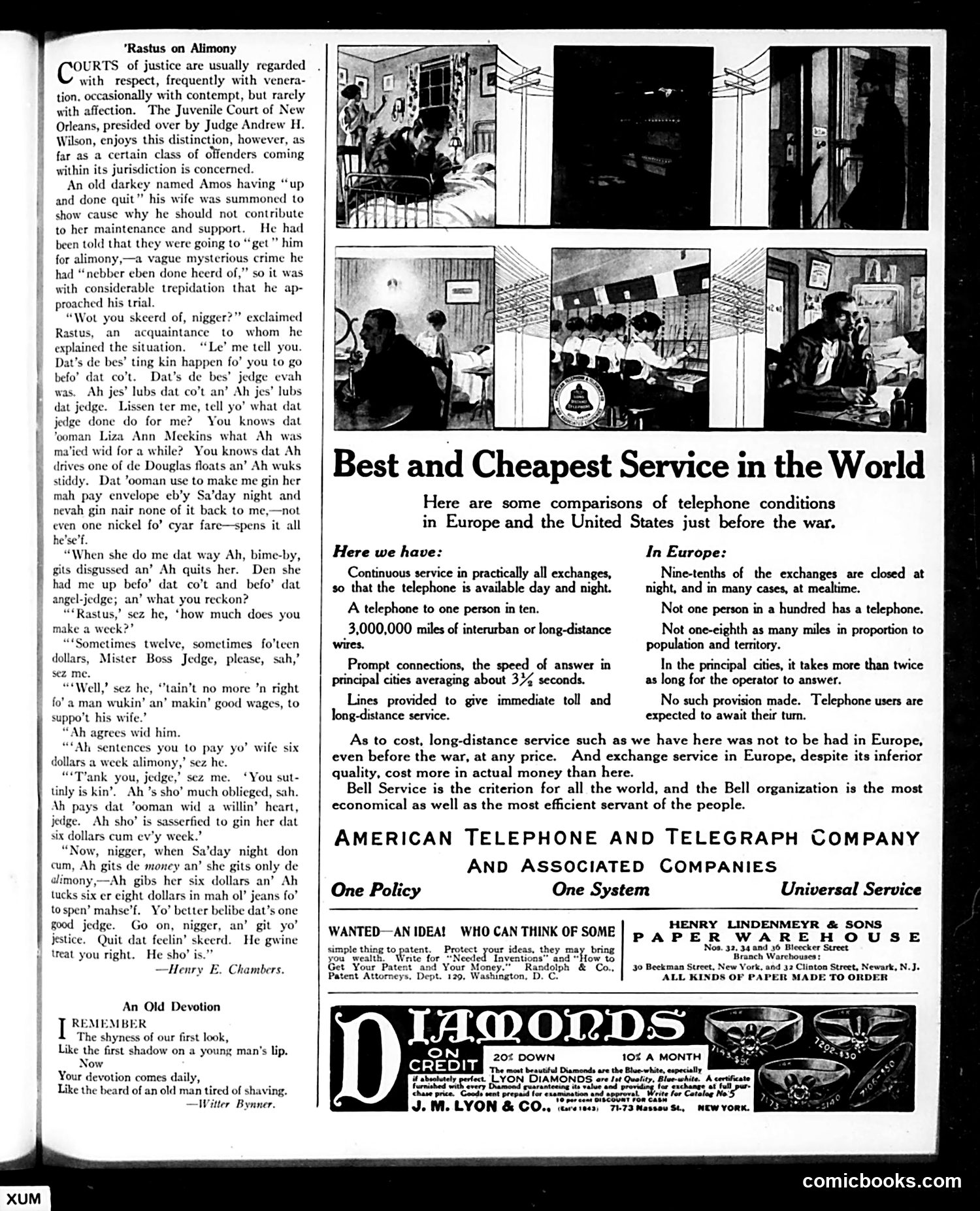
This is a satirical dialect story using deeply offensive racial caricature typical of early 20th-century American humor. The narrative features a Black man named Rastus praising Judge Andrew H. Wilson of New Orleans's Juvenile Court for an alimony ruling. The satire targets not the judge but the situation itself: Rastus celebrates being ordered to pay his ex-wife $6 weekly alimony, then reveals he actually pockets most of his earnings anyway—making the court order functionally useless. The "joke" is that Rastus considers this a victory because it allows him to appear compliant while evading support obligations. The piece also includes advertisements for telephone and jewelry services, and a brief poem "An Old Devotion." The page reflects period attitudes about both race and family law, presenting the protagonist's evasion of spousal support as amusing rather than problematic.
📄 Transcribed text from this page (OCR, searchable)
Machine-transcribed from the original scan — historical spelling and the odd misread are preserved.
| i } suppo’t his w XUM "Rastus on Alimony courts of justice are usually regarded with respect, frequently with venera- tion, occasionally with contempt, but rarely with affection. The Juvenile Court of New Orleans, presided over by Judge Andrew H. Wilson, enjoys: this distinction, however, as far as a certain class of Genders coming within its jurisdiction is concerned. ‘An old darkey named Amos having “up and done quit” his wife was summoned to show cause why he should not contribute to her maintenance and support. He had been told that they were going to “get” him for alimony,—a Vague mysterious crime he had “‘nebber eben done heerd of,” so it was with considerable trepidation that he ap- proached his trial. “Wot you skeerd of, nigger?” exclaimed Rastus, an acquaintance to whom he explained the situation. ‘‘Le’ me tell you. Dat’s de bes’ ting kin happen fo’ you to go befo’ dat co’t. Dat’s de bes’ jedge evah was. Ah jes’ lubs dat co’t an’ Ah jes’ lubs dat jedge. Lissen ter me, tell yo’ what dat jedge done do for me? You knows dat ‘ooman Liza Ann Meekins what Ah was ma'ied wid for a while? You knows dat Ah drives one of de Douglas floats an’ Ah wuks stiddy. Dat ’ooman use to make me gin her mah pay envelope eb’y Sa’day night and nevah gin nair none of it back to me,—not even one nickel fo? cyar fare—spens it all he' “When she do me dat way Ah, bime-by, gits disgussed an’ Ah quits her. Den she had me up befo’ dat co’t and befo’ dat angel-jedge; an’ what you reckon? “*Rastus,’ sez he, ‘how much does you make a week?’ “*Sometimes twelve, sometimes fo’teen dollars, Mister Boss Jedge, please, sah,’ sez me. “Well,’ sez he, fo’ a man wukin’ “tain’t no more ’n right nn’ makin’ good wages, to “Ah agrees wid him. “Ah sentences you to pay yo’ wife six dollars a week alimony,’ sez he. T’ank you, jedge,’ sez me. ‘You sut- tinly is kin’. Ah ’s sho’ much oblieged, sah. Ah pays dat ’ooman wid a willin’ heart, jedge. Ah sho’ is sasserfied to gin her dat six dollars cum ev’y week.’ “Now, nigger, when Sa’day night don cum, Ah sits de money an’ she gits only de x dollars an’ Ah tucks six er + cight dollars in mah ol’ jeans fo" tospen’ mahse’f. Yo’ better belibe dat’s one good jedge. Go on, nigger, an’ git yo’ jestice. Quit dat feelin’ skeerd. He gwine treat you right. He sho’ is.”” —Henry E. Chambers. An Old Devotion REMEMBER ¢ shyness of our first look, the first shadow on a young man’s lip. Now Your devotion comes daily, Like the beard of an old man tired of shaving. —Witter Bynner. Best and Cheapest Service in the World Here are some comparisons of telephone conditions in Europe and the United States just before the war. In Europe: Nine-tenths of the exchanges are closed at night, and in many cases, at mealtime. Not one person in a hundred has a telephone. Not one-eighth as many miles in proportion to population and territory. In the principal cities, it takes more than twice as long for the operator to answer. No such provision made. Telephone users are expected to await their turn. Here we have: Continuous service in practically all exchanges, so that the telephone is available day and night. A telephone to one person in ten. 3,000,000 miles of interurban or long-distance wires, Prompt connections, the speed of answer in principal cities averaging about 34 seconds. Lines provided to give immediate toll and long-distance service. As to cost, long-distance service such as we have here was not to be had in Europe, even before the war, at any price. And exchange service in Europe, despite its inferior quality, cost more in actual money than here. Bell Service is the criterion for all the world, and the Bell organization is the most economical as well as the most efficient servant of the people. AMERICAN TELEPHONE AND TELEGRAPH COMPANY AND ASSOCIATED COMPANIES One Policy One System Universal Service WANTED—AN IDEAL WHO CAN THINK OF SOME | p q B'nt'te “WoANER & SONS oo Nos. 32, 34 and 36 Bleecker Street Branch Warehouses: 2 Clinton Street, Newark, N.J. MADE TO ORDER simple thing to you wealth, Get Your P Patent Attorn atent. Protect t your ideas, they may bring y t “Needed Inventions” and “How to Your Money." | Randolph & Co, . 129, Washington, 30 Beckman Street, New Y: ALL KINDS OF 20% DOWN 10% A MONTH ‘The most beautiful Diamonds are the Blue-white, especially iH sbegltey perfect. LYON DIAMONDS re 1x1 Quolity, Bloc white, A cortfcate te ie fos Cog - chase price. Coode sent prepaad for examination a estonsedeeeay J. M. LYON & CO., tersiees, TUT Nassau St, comicbooks.com