
A complete issue · 36 pages · 1914
Judge — December 5, 1914
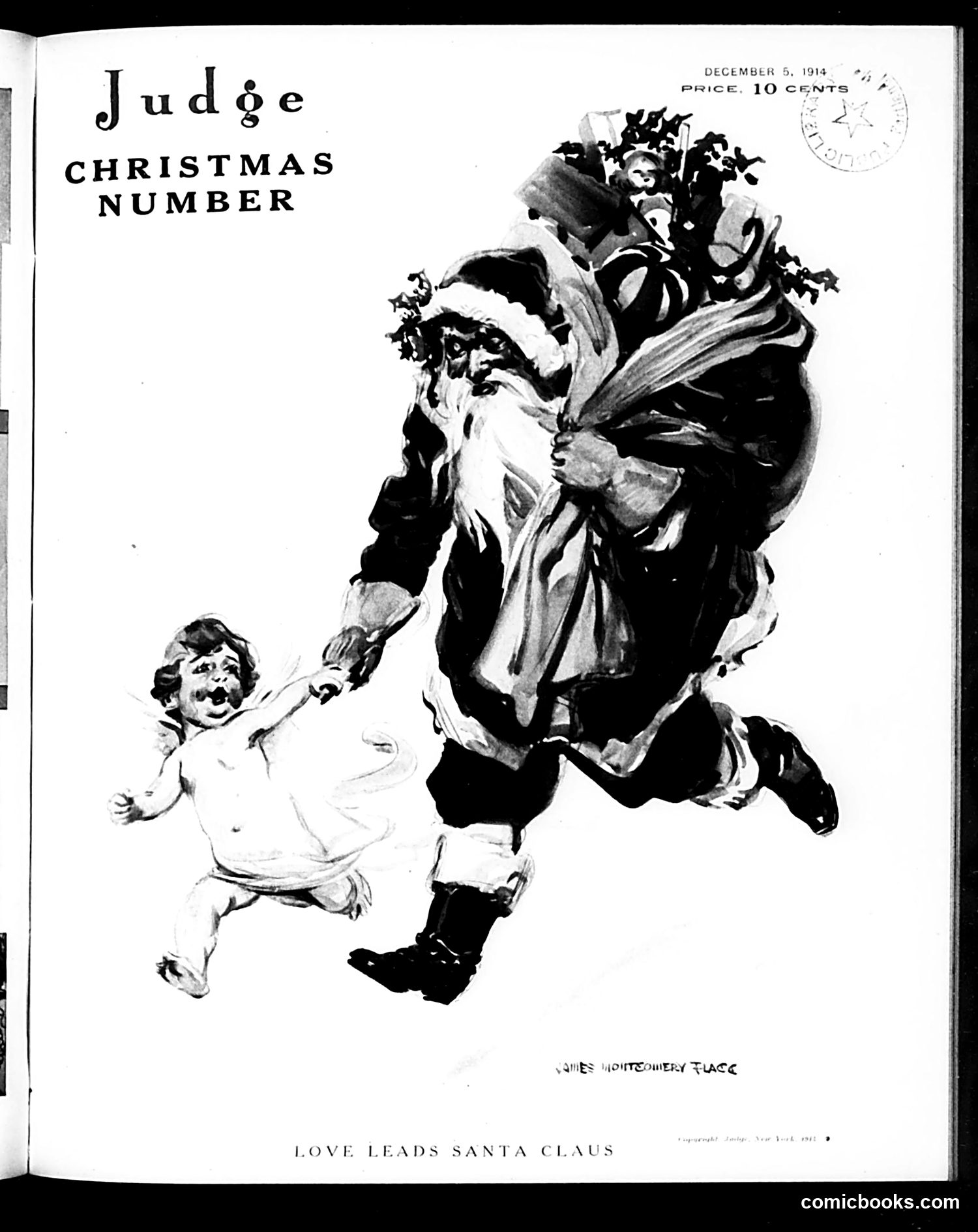
This cover depicts Santa Claus as a benevolent figure leading a cherub or baby by the hand, carrying a full sack of gifts. The caption reads "LOVE LEADS SANTA CLAUS." Given the publication date—December 1914, during World War I's early months—this appears to be sentiment-driven holiday messaging emphasizing peace and generosity during a time of global conflict. The image promotes traditional Christmas values of love and gift-giving as counterweight to the war's destruction. The illustration is credited to James Montgomery Flagg, a prominent American illustrator of the era. Rather than political satire, this functions as an aspirational holiday cover—using Santa to symbolize hope and compassion during wartime.
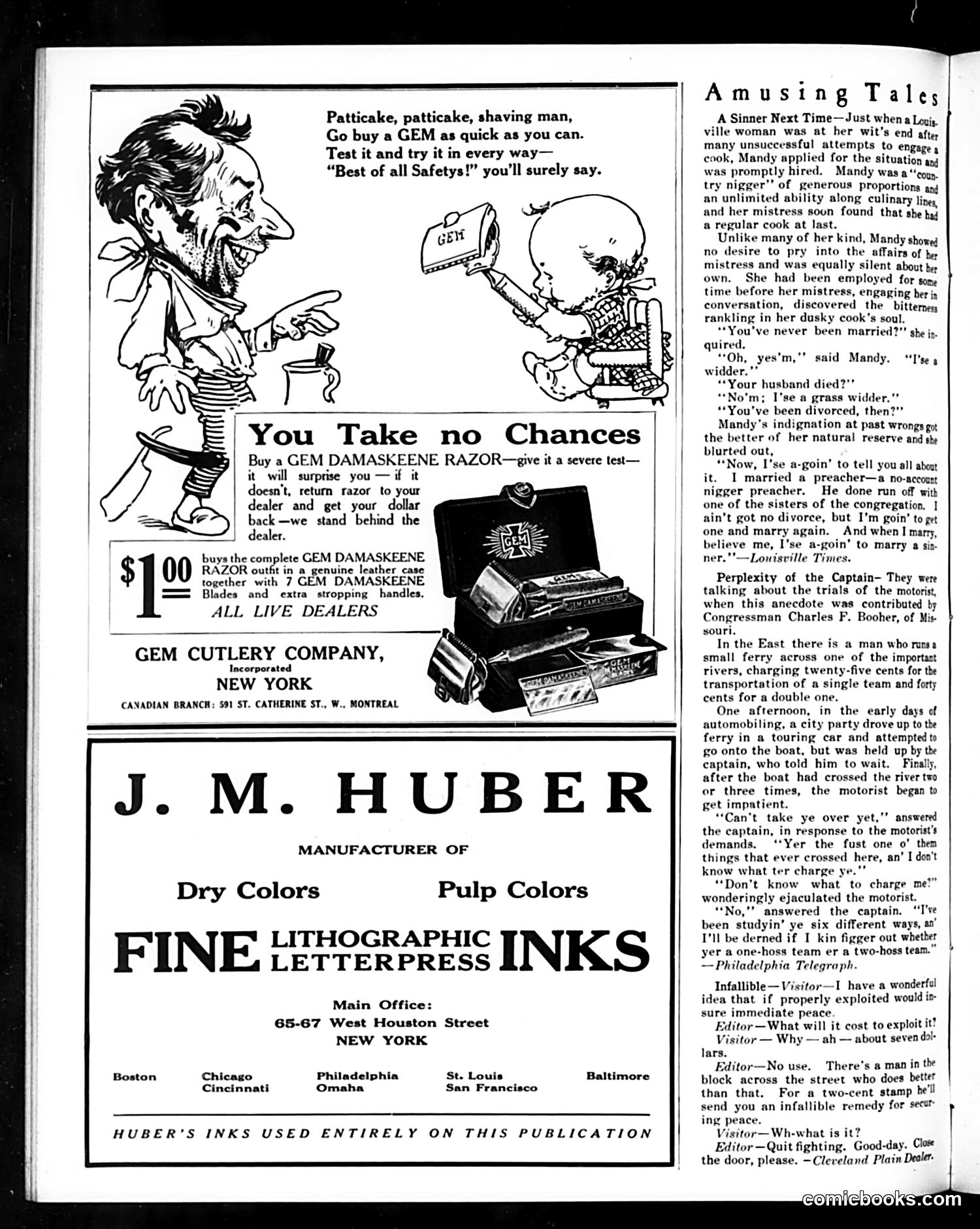
This page is primarily **advertising**, not political satire. The main content features: 1. **Gem Damaskeene Razor advertisement** (top left): A caricatured "shaving man" character promoting safety razors with exaggerated features typical of early 20th-century advertising illustration. The pitch emphasizes reliability and money-back guarantees. 2. **J.M. Huber inks advertisement** (bottom): A manufacturer's notice for lithographic and letterpress inks used in the publication itself. 3. **"Amusing Tales"** (right column): Humorous anecdotes about domestic situations (a widow remarrying, ferry transport challenges, visitor etiquette). These are lighthearted social commentary rather than political satire. The page reflects early 20th-century advertising aesthetics and casual humor rather than pointed political critique.
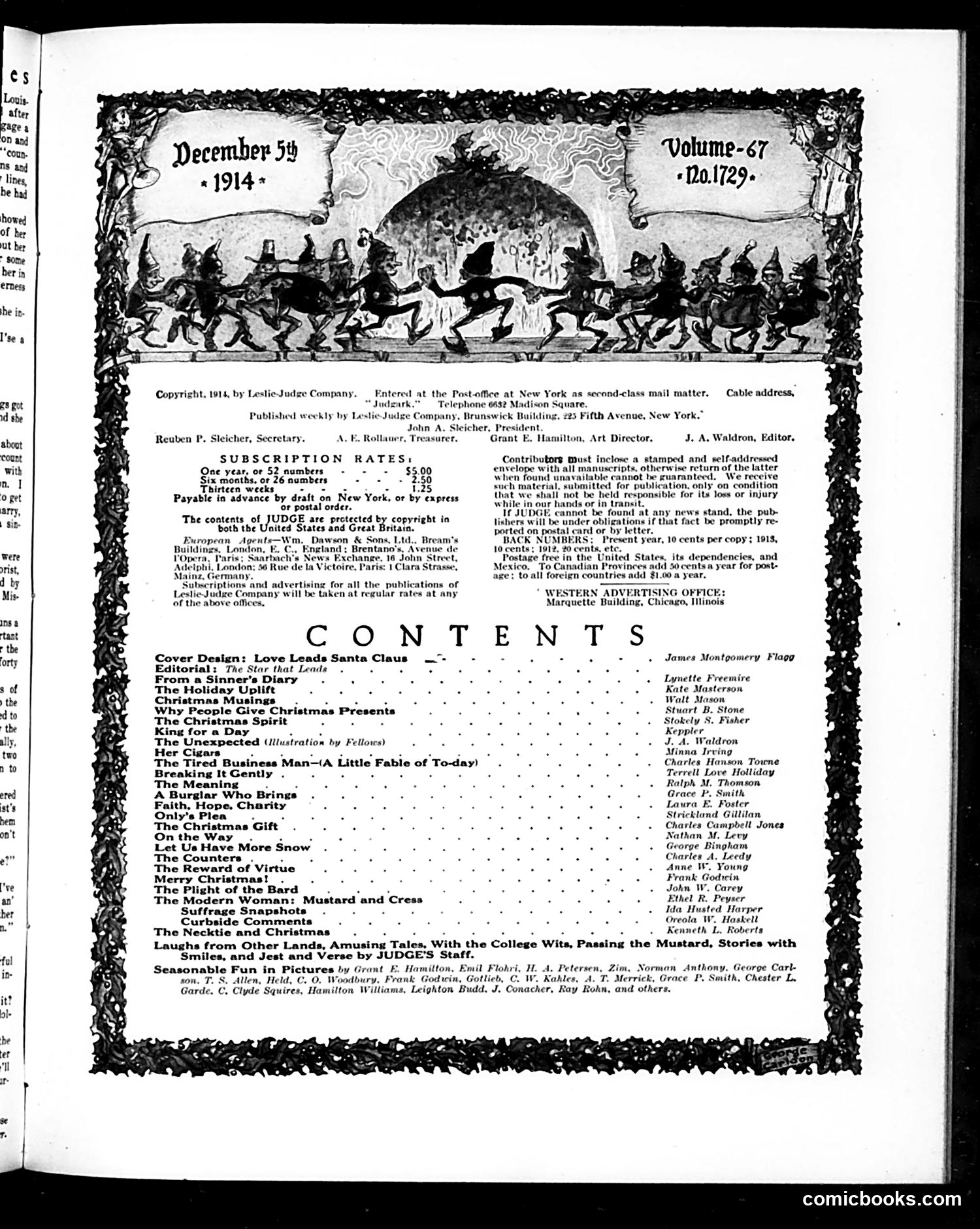
The cover illustration depicts silhouetted figures engaged in a chaotic Christmas celebration—dancing, playing instruments, and general merrymaking beneath a decorated tree. The style is typical of Judge's festive holiday covers. Given the December 1914 date, this appears during World War I's first winter, though the cover itself contains no obvious political commentary. Instead, it celebrates American Christmas traditions with a whimsical, satirical tone characteristic of the magazine. The contents list includes numerous humorous pieces with Christmas themes ("Love Leads Santa Claus," "A Christmas Spirit," "King for a Day"), along with Judge's typical mix of social satire and illustrated stories. Without clearer visual detail, the specific satirical targets remain unclear, though the overall tone reflects Judge's mid-to-upper-class American humor of the era.
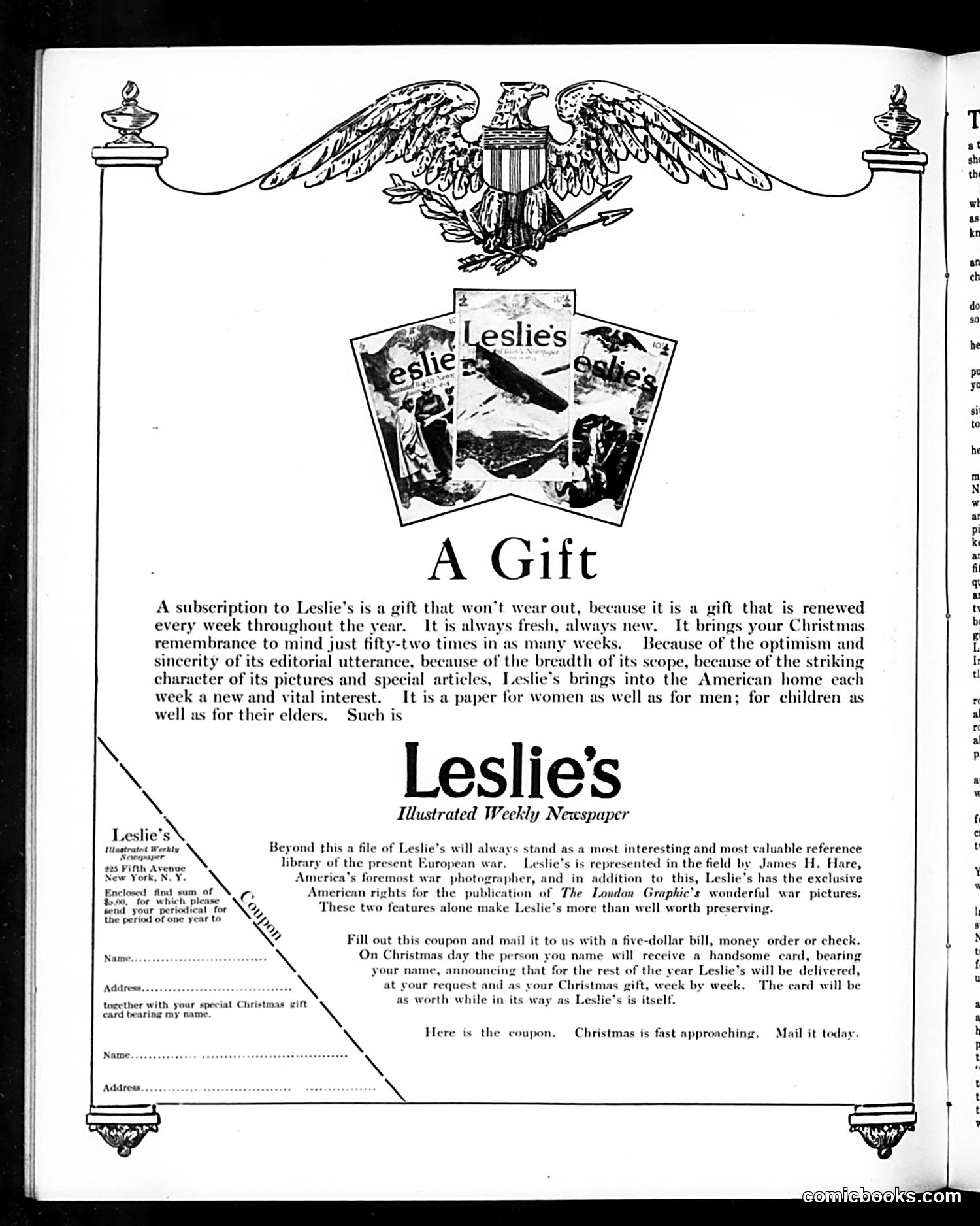
This page is primarily **advertising, not satire or political commentary**. It promotes Leslie's Illustrated Weekly Newspaper as a Christmas gift subscription. The eagle and shield at the top are standard American patriotic emblems used in early 20th-century commercial design—not satirical references. The ad emphasizes that Leslie's is a "gift that won't wear out" since it renews weekly, positioning it as both practical and prestigious. The text mentions Leslie's has "exclusive American rights" to war photographs from "The London Graphic," suggesting this advertisement dates to WWI era when war imagery held particular cultural weight. The coupon allows gift-givers to announce subscriptions with personalized cards. This is straightforward commercial messaging with patriotic framing, not political or social satire.
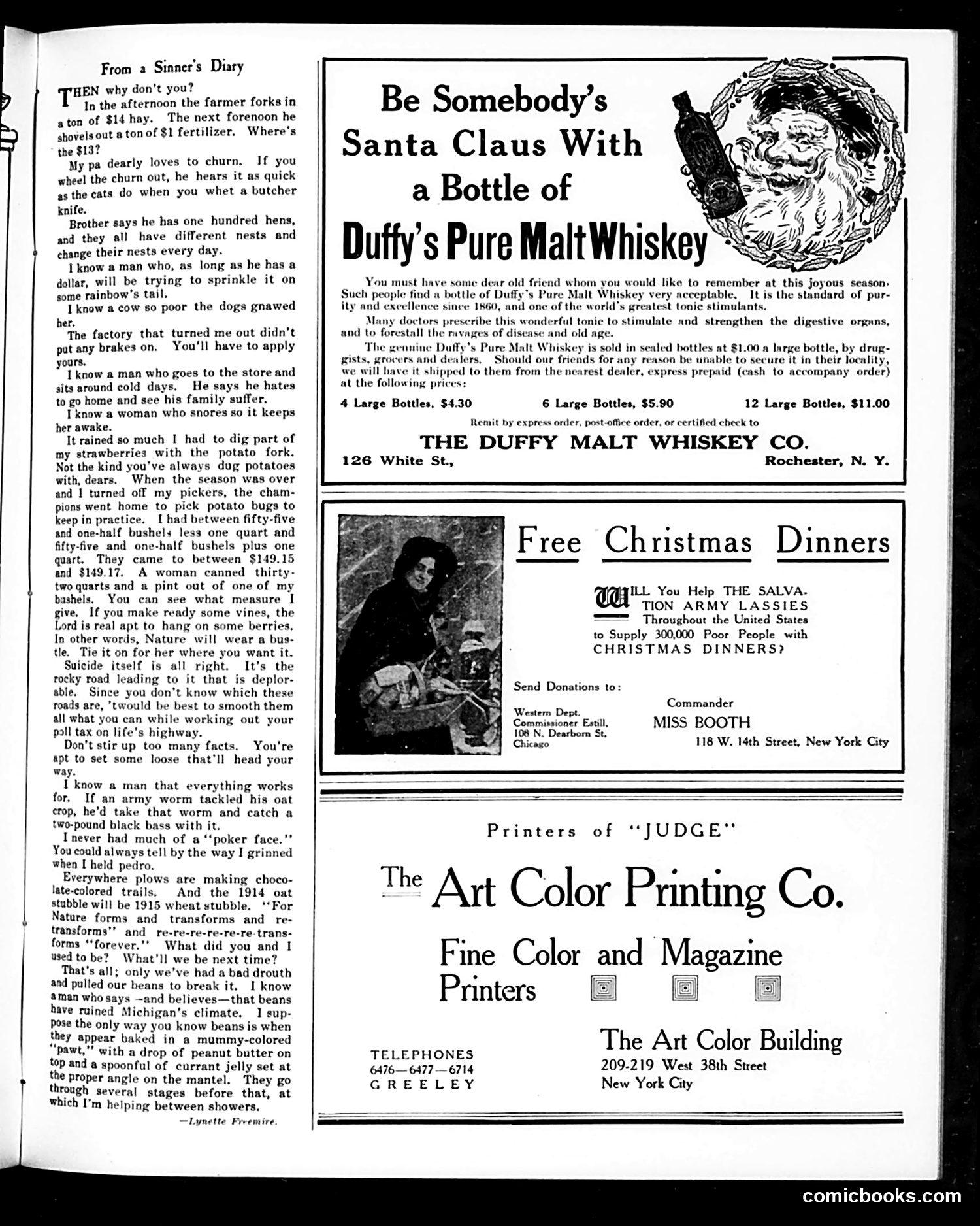
This page is primarily **advertising**, not political satire. The main content features a large advertisement for Duffy's Pure Malt Whiskey, positioned as an ideal Christmas gift ("Be Somebody's Santa Claus"). The ad emphasizes the product's purity and long market presence since 1860, with pricing for bulk orders. Below that is a charitable appeal for the Salvation Army's Christmas dinner program for poor people. The left column contains "From a Sinner's Diary"—personal anecdotes about farm life, potato farming, and rural observations, appearing humorous but not politically satirical. The bottom advertises the Art Color Printing Company's services. **This page lacks notable political cartoons or social satire**—it's a typical magazine page mixing advertorial content with personal-interest writing.
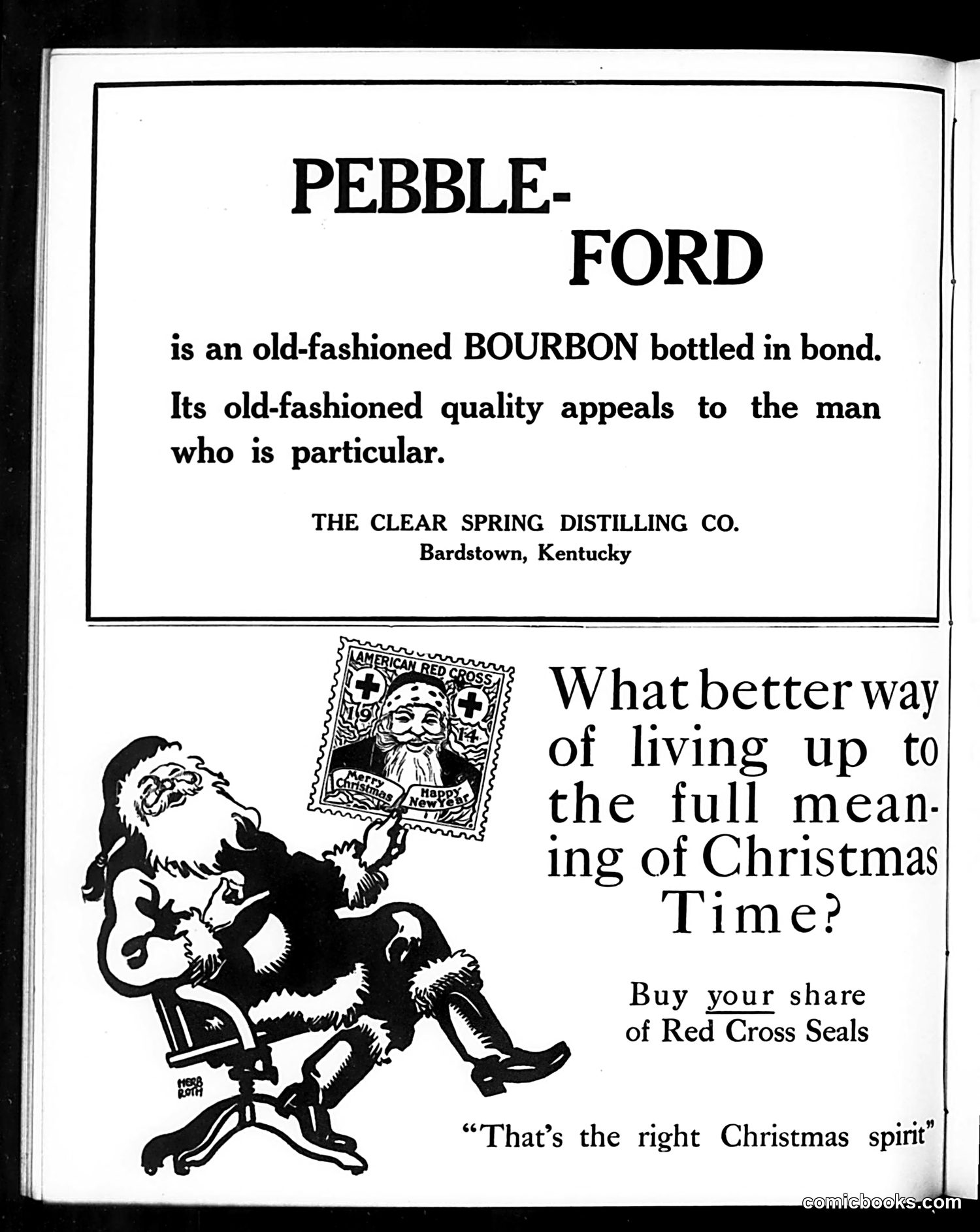
This page combines two advertisements: one for Pebble-Ford bourbon whiskey and another promoting Red Cross Seals for Christmas. The Santa Claus illustration holds a Red Cross Christmas Seal stamp, connecting holiday charitable giving to the festive season. The text "That's the right Christmas spirit" sardonically juxtaposes charity with the bourbon ad above it. The humor appears to be period satire about American consumer culture during Christmas: the page suggests that "living up to the full meaning of Christmas Time" involves both buying quality whiskey and purchasing charity seals—mixing commercialism with benevolence. The absurdity lies in presenting these as equally valid expressions of holiday spirit. This likely dates from the early-to-mid 20th century when Judge magazine frequently satirized advertising, consumerism, and social contradictions through juxtaposition.
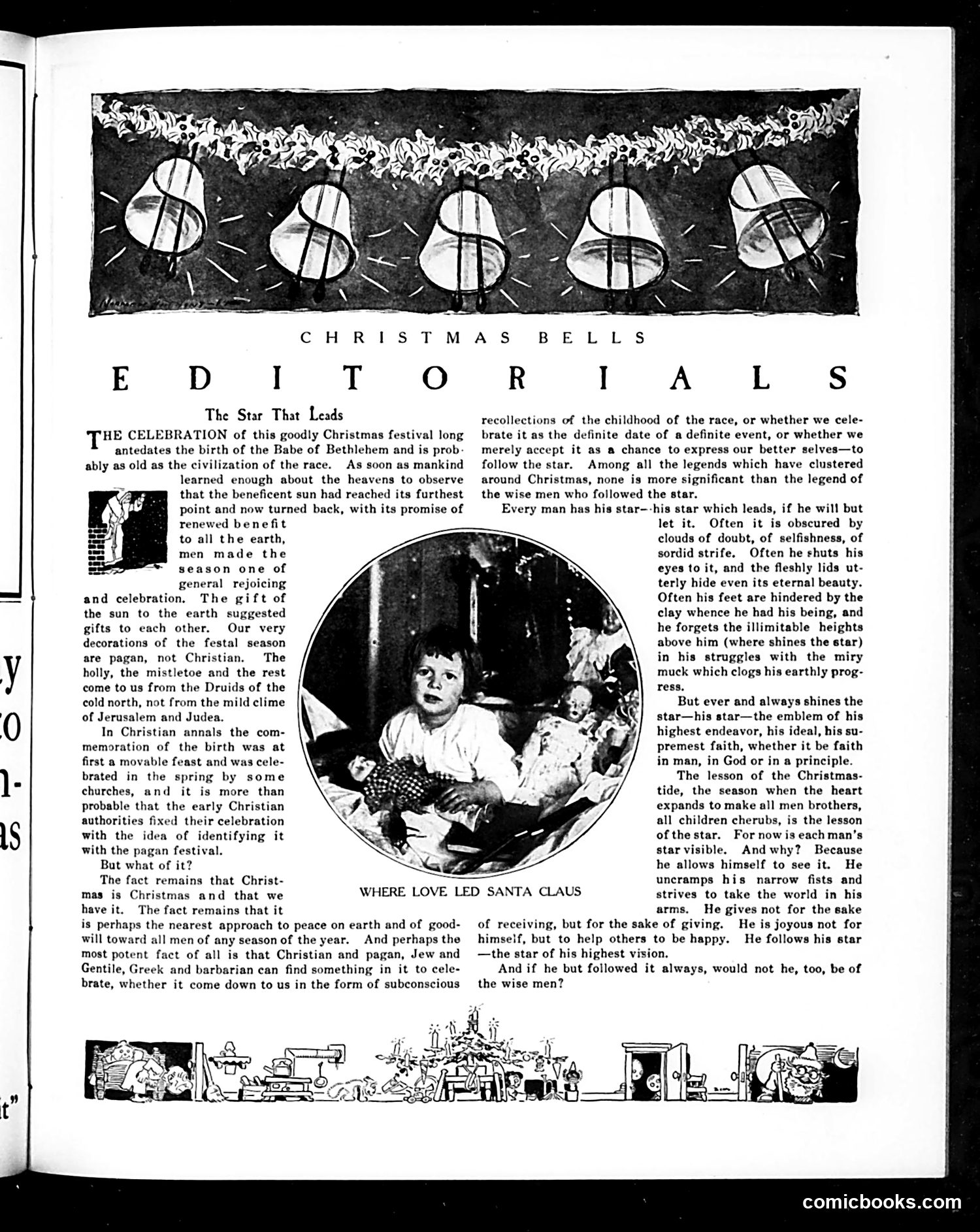
This is a philosophical editorial essay rather than political satire. The piece argues that Christmas represents humanity's universal search for meaning and goodness, transcending religious boundaries. **Key arguments:** - Christmas predates Christianity, rooted in pagan winter solstice celebrations (holly, mistletoe from Druids) - Its true value lies in promoting "peace on earth and good-will toward all men"—uniting "Christian and pagan, Jew and Gentile, Greek and barbarian" **The central metaphor:** Each person has an inner "star"—their highest ideal or principle—that guides them if they choose to follow it. Christmas uniquely allows people to see and pursue this star by expanding their hearts toward others. **The message:** The editorial uses the Nativity's wise men following the star as a template for moral living: genuine giving comes from helping others, not selfish gain. If humanity followed their "star" year-round as they do at Christmas, all would become wise. This reflects early-20th-century secular humanism—emphasizing universal human values over doctrinal religion.
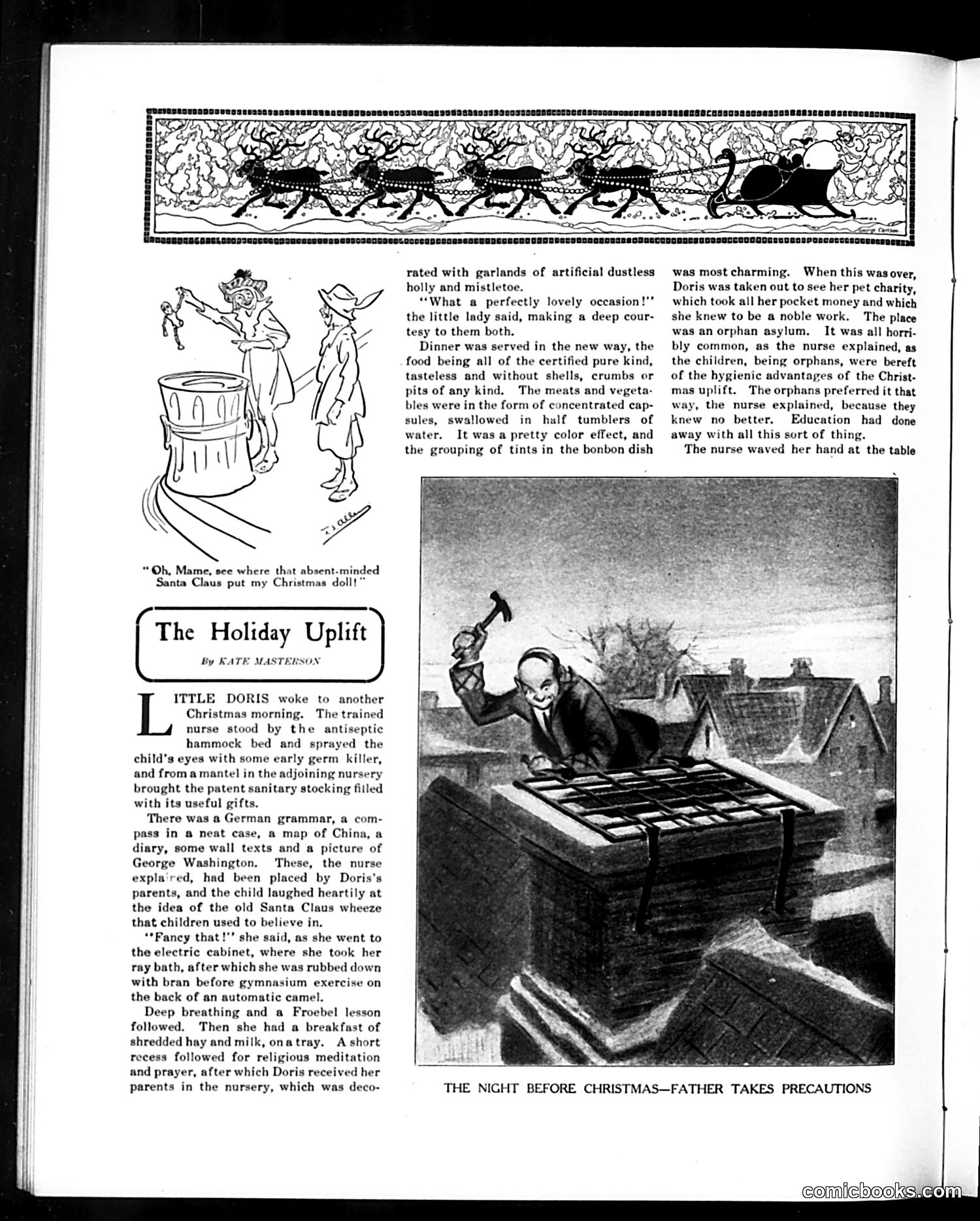
This story satirizes early 20th-century progressive/scientific parenting trends that prioritized hygiene, education, and rationality over tradition and sentiment. Little Doris receives no toys or magic—instead, a German grammar, compass, and "wall texts." Her day involves germ-killing sprays, electric ray baths, gymnasium on an "automatic camel," and food reduced to flavorless capsules. Even Christmas dinner is sterilized and stripped of charm. The satire peaks when Doris visits an orphan asylum as "pet charity"—a fashionable but detached practice. The orphans, lacking "hygienic advantages," are portrayed as happier and more human than the scientifically-optimized Doris. The joke: modern efficiency and education have eliminated childhood wonder, tradition, and genuine human connection. The cartoon mocks how obsessive sanitization and rationalism can destroy what makes life meaningful, even for privileged children.
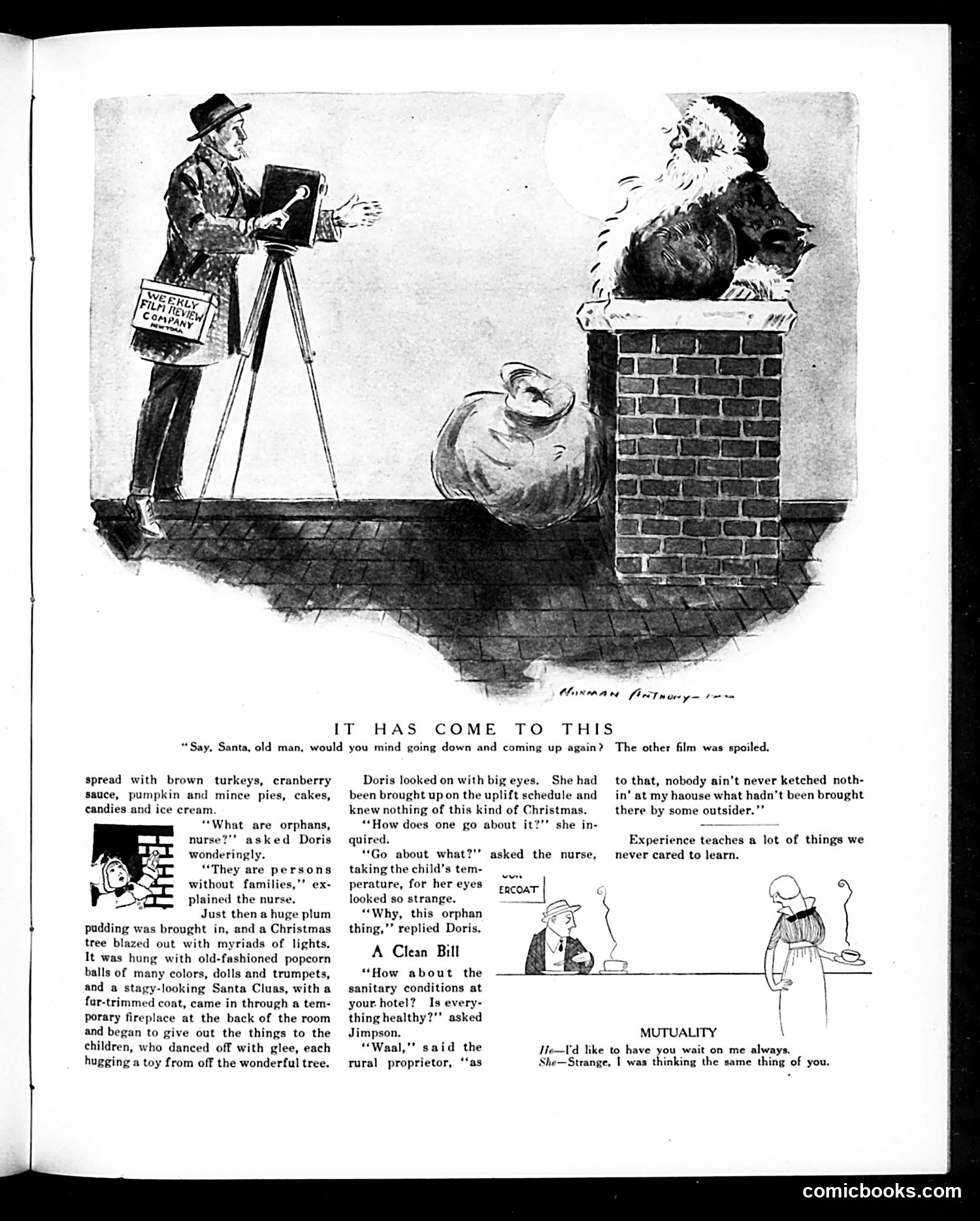
The top cartoon satirizes early cinema's technical limitations. A cameraman films Santa Claus emerging from a chimney for a movie, but must reshoot because "the other film was spoiled." The joke mocks how film production was still primitive and unreliable—multiple takes were necessary because footage could be damaged or defective. The accompanying story features "Doris," an orphan raised on "the uplift schedule" (progressive/reform ideology emphasizing modern efficiency). When she witnesses a traditional, sentimental Christmas celebration—plum pudding, decorated tree, gift-giving Santa—she's bewildered, asking "How does one go about it?" The satire targets early-20th-century social reformers and their earnest but sterile approaches to child welfare. The humor lies in contrasting their joyless "uplift" philosophy with the warm, messy humanity of old-fashioned Christmas traditions. The implication: progressive ideology, however well-intentioned, strips away genuine human experience and wonder.
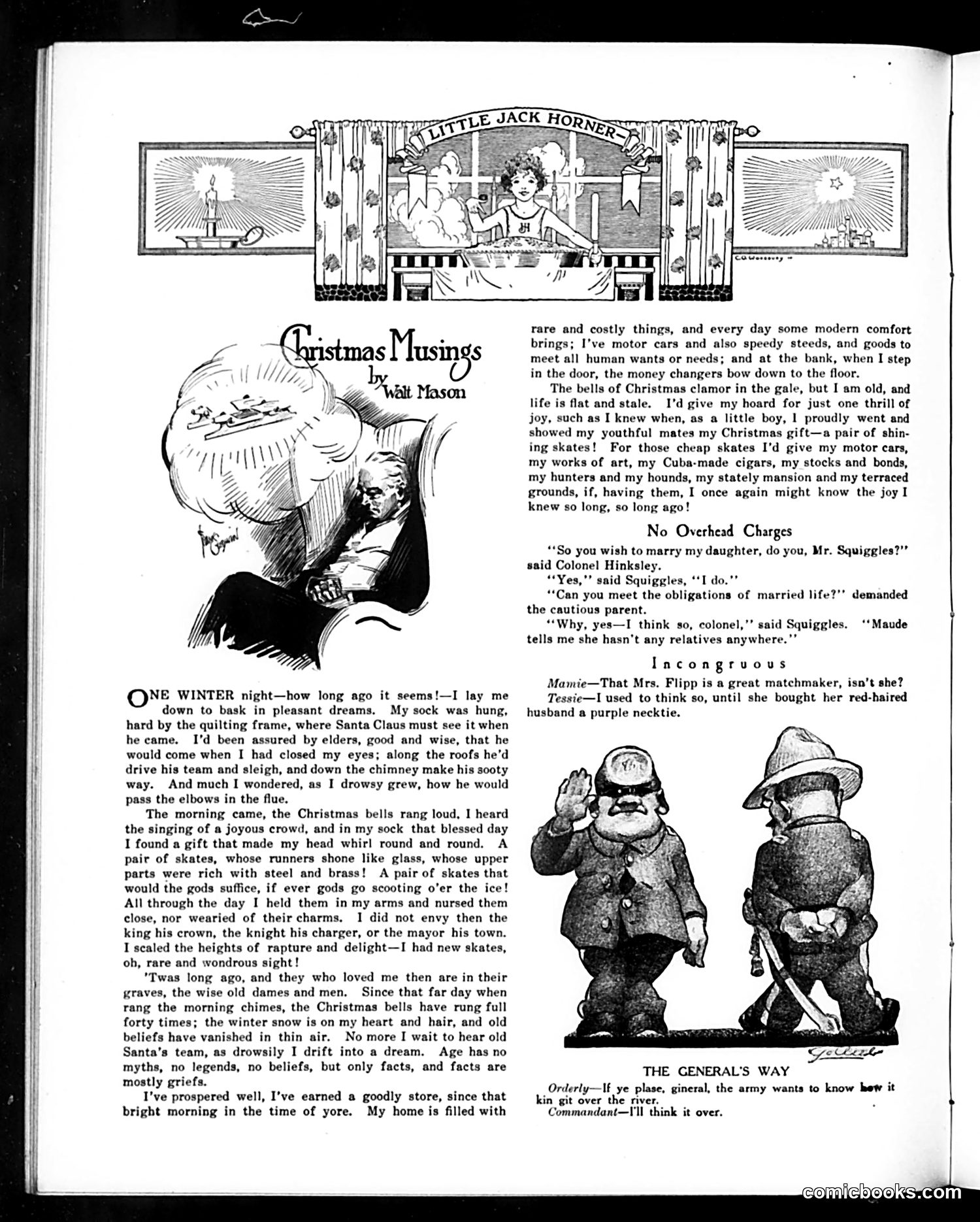
**Main Content: "Christmas Musings" by Walt Mason** This nostalgic poem contrasts childhood wonder with adult materialism. The narrator recalls receiving simple ice skates as a Christmas gift, which brought genuine joy. Now wealthy—with motor cars, stocks, bonds, and a mansion—he finds life "flat and stale" and would trade all his possessions for that one moment of childhood happiness. The satire targets modern consumer culture and the loss of authentic joy through endless accumulation. **Secondary Cartoons:** "No Overhead Charges" jokes about a suitor assuring Colonel Hinksley he can support marriage because his fiancée "hasn't any relatives anywhere"—implying in-laws are financial burdens. "The General's Way" satirizes military indecision: when asked how the army will cross a river, the commandant says he'll "think it over"—mocking bureaucratic delays. Both shorter pieces offer light social satire typical of Judge's humor.
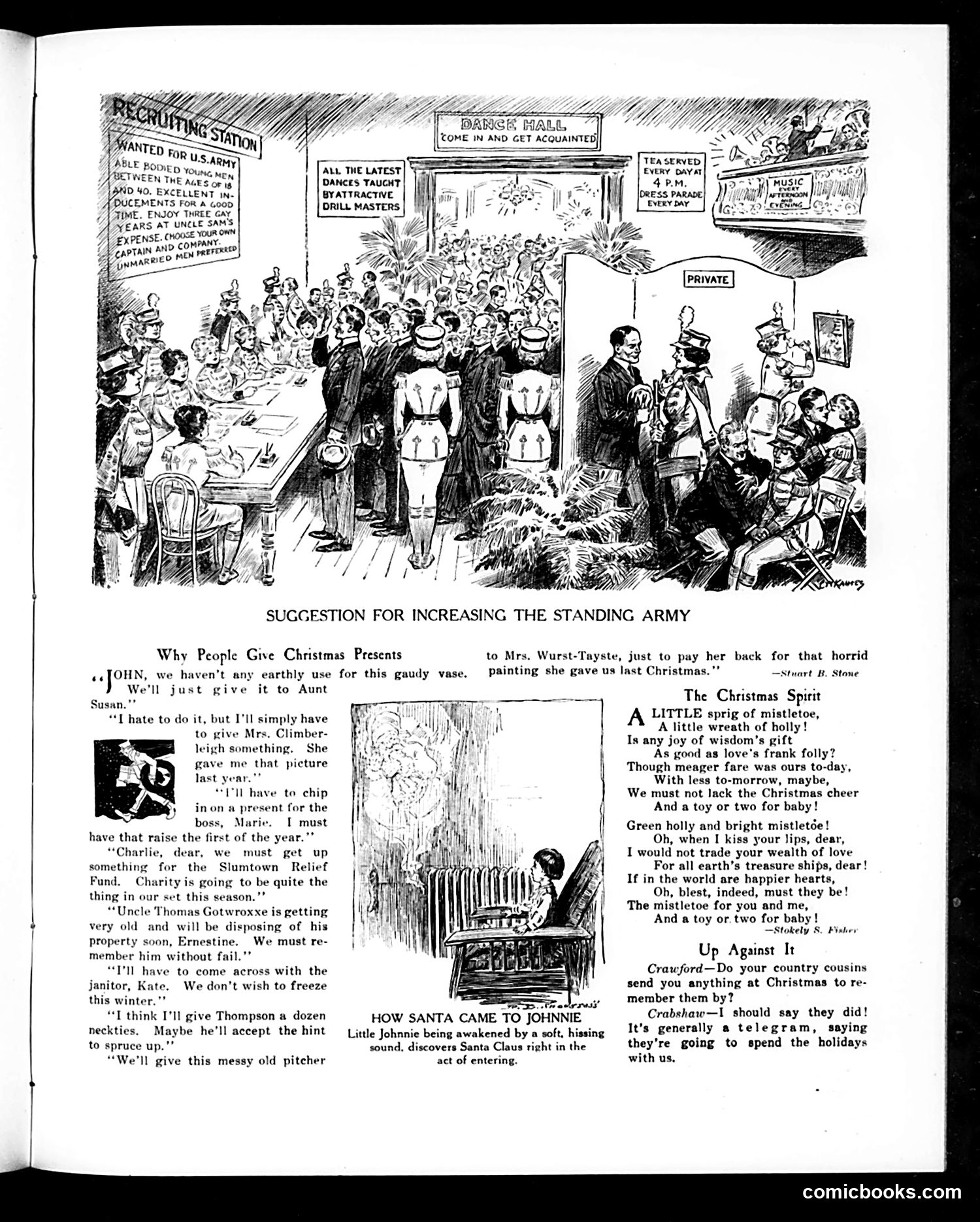
The top cartoon satirizes military recruitment during wartime (likely WWI era, given the "U.S. Army" recruitment station). It mocks the government's strategy to increase enlistment by offering incentives like choosing one's own captain—absurdly suggesting officers can be elected like democracy, when military hierarchy demands strict authority. The lower section, "Why People Give Christmas Presents," is social satire exposing the hypocrisy of gift-giving. The quoted vignettes reveal that people give unwanted presents not from generosity but from obligation: to obligate reciprocal gifts, curry favor with employers for raises, court wealthy relatives for inheritance, maintain social standing, or avoid social consequences (freezing without the janitor's goodwill). The final quote about giving a "messy old pitcher" to Mrs. Wurst-Tayste "to pay her back" for last year's "horrid painting" explicitly acknowledges Christmas gifts as transactional social warfare rather than expressions of authentic affection.
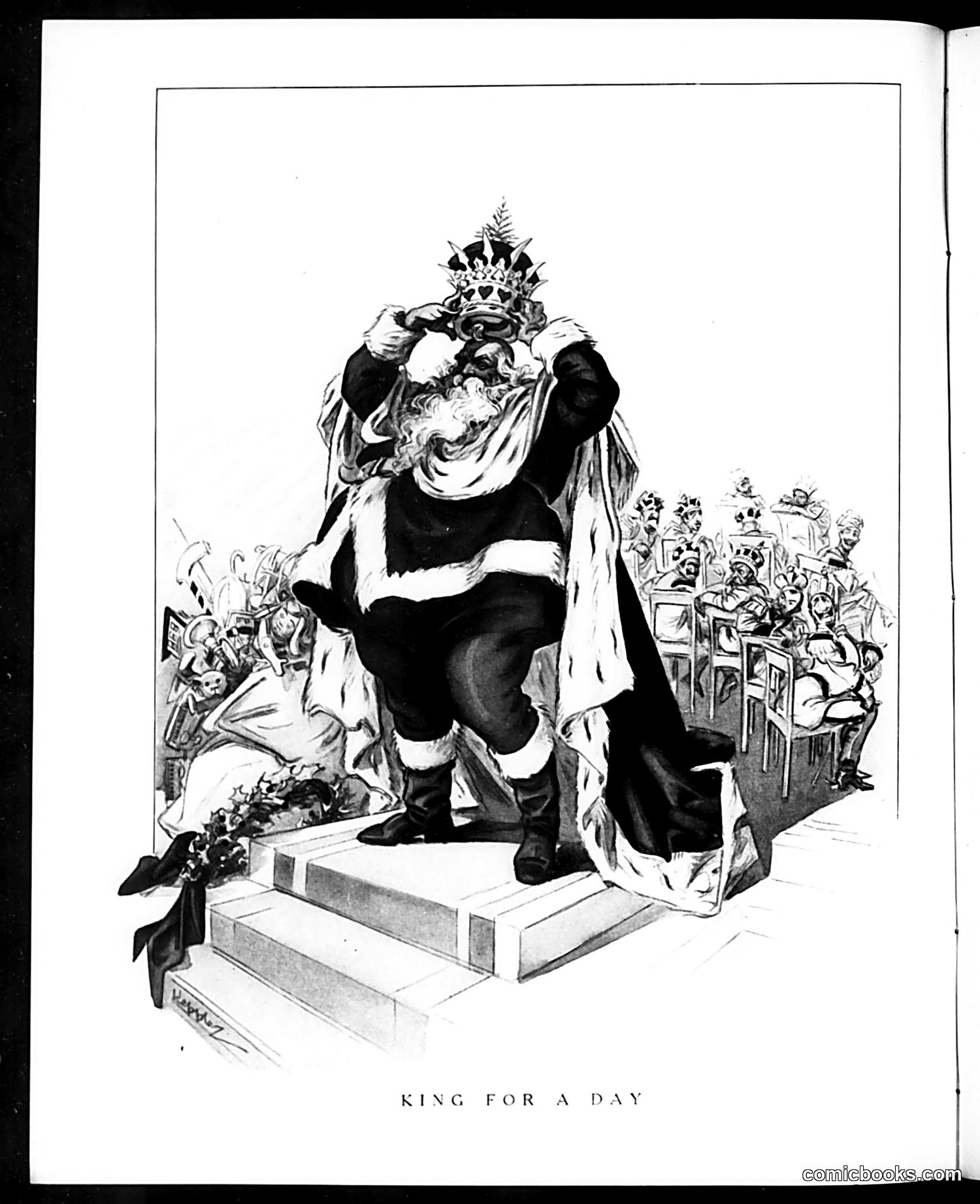
This satirical cartoon depicts a rotund, elaborately dressed figure seated on a throne, wearing an ornate crown and royal robes. The figure adjusts the crown with one hand while crowds of onlookers surround them on either side, seated as if watching a spectacle. The title "King for a Day" suggests temporary, absurd elevation to power—likely mocking someone of humble or questionable status suddenly granted authority or prominence. The exaggerated costume and the theatrical audience imply this is a performance or farce rather than legitimate rule. Without identifying specific individuals or dating information visible on this page, the cartoon appears to satirize the notion of undeserving individuals receiving power, prominence, or public attention through circumstance rather than merit—a common Judge magazine theme ridiculing social pretension and political opportunism.
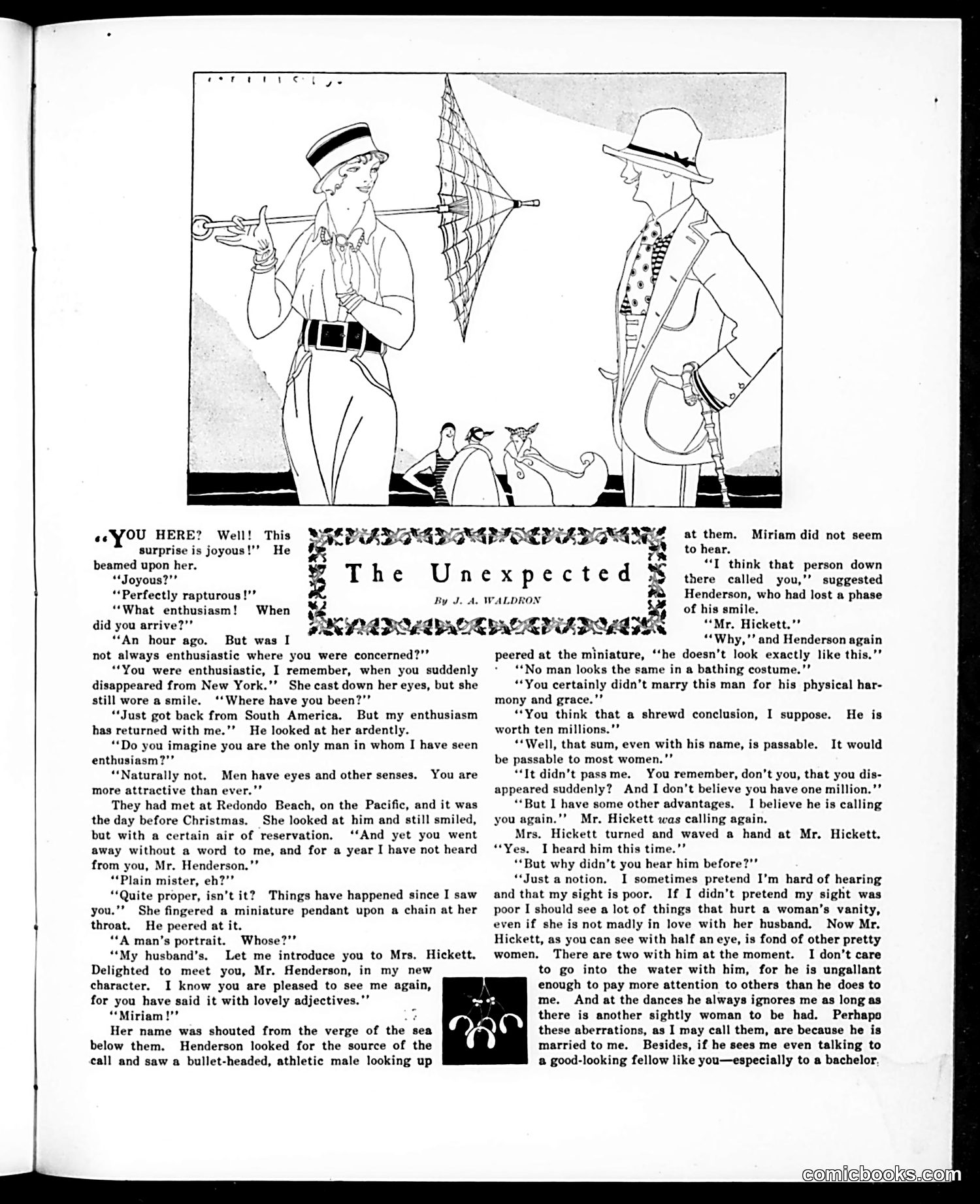
This is a romantic comedy story-illustration, not political satire. It depicts Henderson, a man who abandoned a woman named Miriam a year prior without explanation, encountering her at Redondo Beach. She has since married Mr. Hickett, a wealthy but inattentive husband worth "ten millions" who is currently flirting with other women on the beach below. The humor centers on Miriam's pragmatic marriage: she married for money rather than love or physical attraction. She deliberately ignores her husband's calls and feigns poor hearing/sight to avoid witnessing his flirtations with other women. The "unexpected" element appears to be Henderson's reappearance and her cool reception of his renewed enthusiasm, having moved on to a financially advantageous (if emotionally unsatisfying) marriage. The satire targets women's limited options and marital compromises of the era.
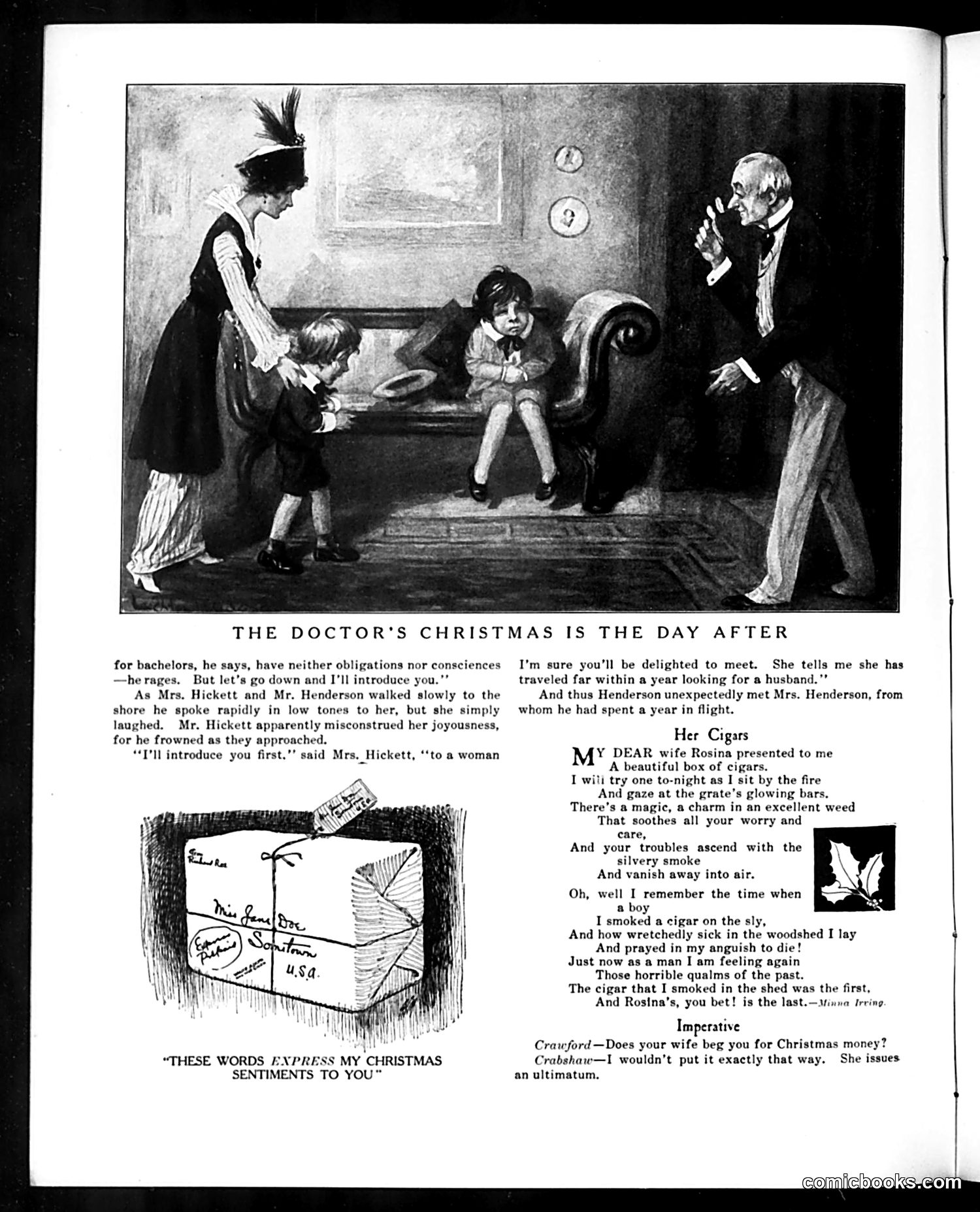
This page contains three distinct pieces of satirical content: **Main Story Illustration** ("The Doctor's Christmas is the Day After"): Shows a domestic comedy where Dr. Henderson, apparently a bachelor, is introduced to a woman by the Hicketts—who turns out to be Mrs. Henderson, a woman he'd spent a year avoiding. The satire mocks the irony of fate forcing together people determined to avoid each other, and possibly critiques bachelor physicians' avoidance of matrimonial responsibility. **"Her Cigars"** (poem): A humorous nostalgic piece about receiving cigars as a Christmas gift. It contrasts youthful cigar-sickness with adult resignation, satirizing both the pretense of enjoying tobacco and marital gift-giving dynamics. **"Imperative"** (joke): A brief exchange mocking wives' financial demands during Christmas season, suggesting spousal requests are forceful rather than polite requests—satire of marriage finances and gender dynamics. Overall, the page satirizes bachelor life, marriage, holiday gift-giving, and domestic power dynamics through gentle, middle-class humor typical of early 20th-century *Judge* magazine.
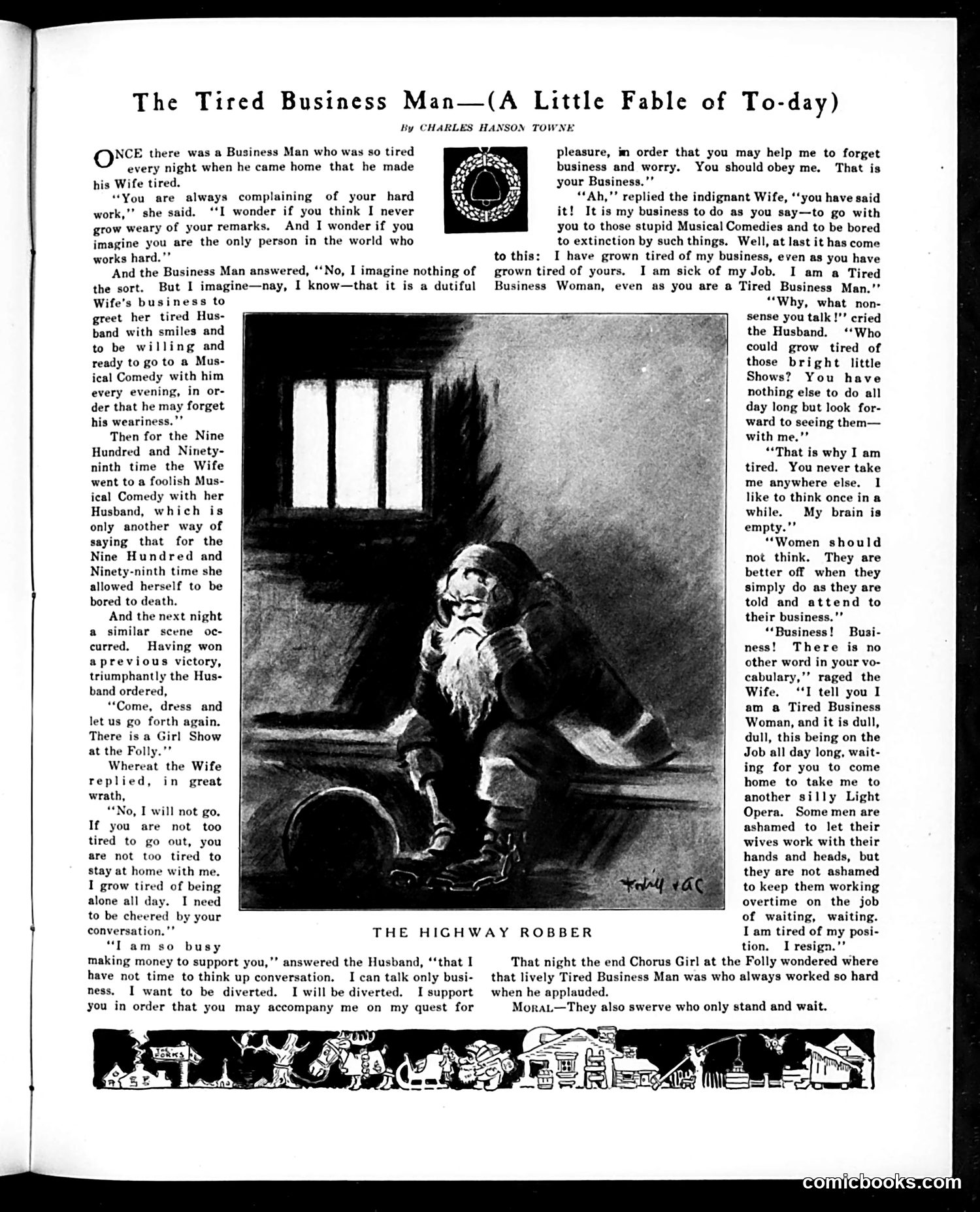
This fable by Charles Hanson Towne critiques early 20th-century marital expectations. The "Tired Business Man" demands his wife accompany him nightly to frivolous musical comedies to entertain him after work, dismissing her exhaustion and intellectual needs. He insists women shouldn't think and must simply obey. The wife eventually rebels, declaring herself equally a "Tired Business Woman"—worn out by endless waiting and entertainment duties while her mind atrophies. The husband disappears (the "Highway Robber" illustration suggests he's stolen away), leaving the chorus girl wondering where he went. The satire targets the hypocrisy: men claim exhaustion from work justifies demanding leisure entertainment, yet dismiss women's unpaid domestic labor as effortless. The moral suggests those who passively accept such arrangements enable the injustice. This reflects Progressive-era debates about women's autonomy and marital equality.
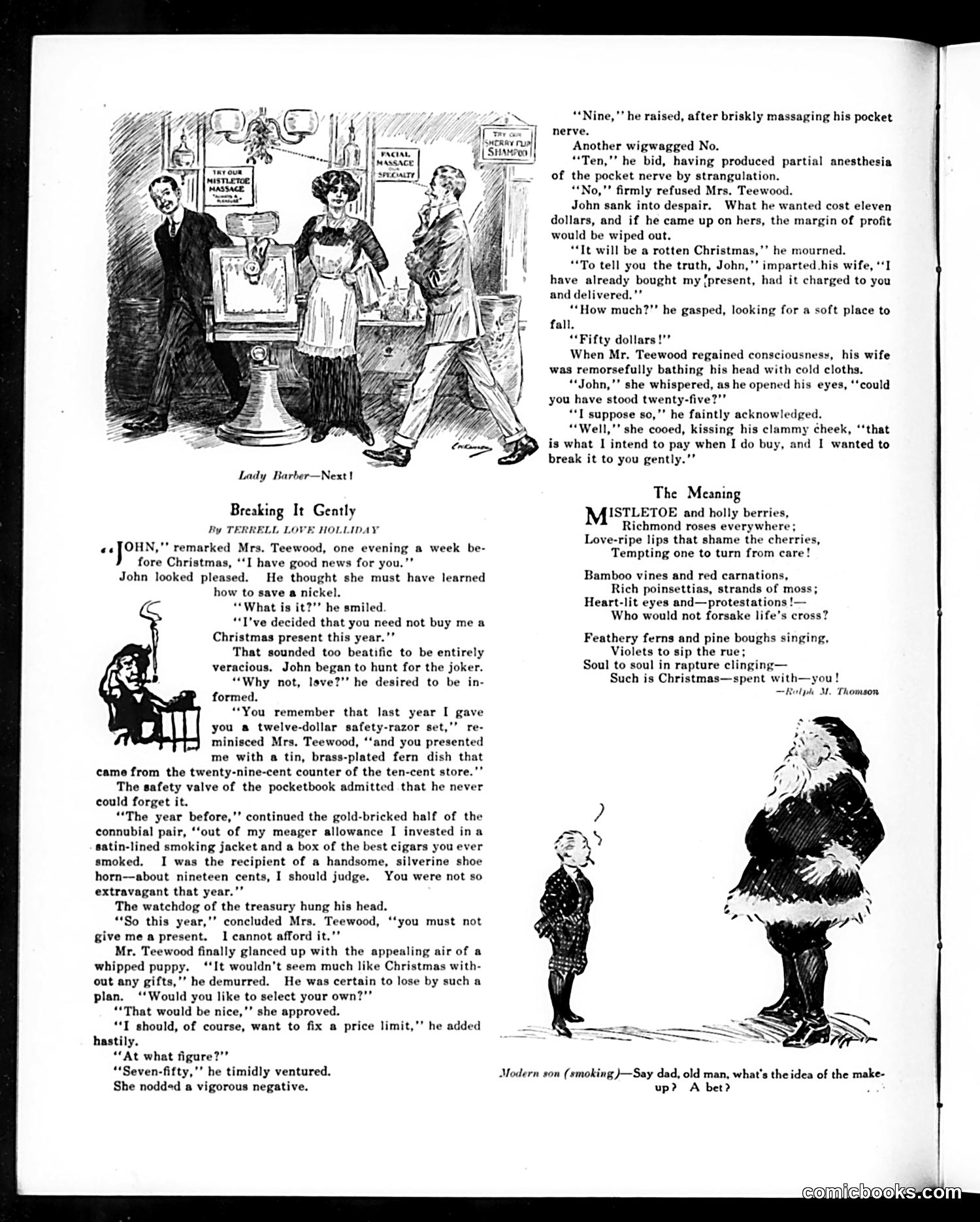
This page contains two distinct pieces of satirical humor typical of early 20th-century American magazines: **"Breaking It Gently"** is a marital comedy about gift-giving economics. Mrs. Teewood manipulates her husband John into believing she's *relieving* him of the burden of buying her a Christmas present—only to reveal she's already charged a fifty-dollar gift to him anyway, which he must pay for. The joke satirizes the futility of male financial resistance in marriage and the clever ways wives circumvent their husbands' budget constraints. John faints upon hearing the price, playing on the era's stereotype of men as helpless against women's spending. **"The Meaning"** is sentimental Christmas poetry celebrating romantic sentiment. **"Lady Barber—Next!"** (top illustration) and **"Modern son"** (bottom) appear to be separate cartoons addressing social changes: the barber cartoon likely comments on women entering traditionally male professions, while the smoking son cartoon jokes about generational differences and modern youth behavior puzzling their elders.
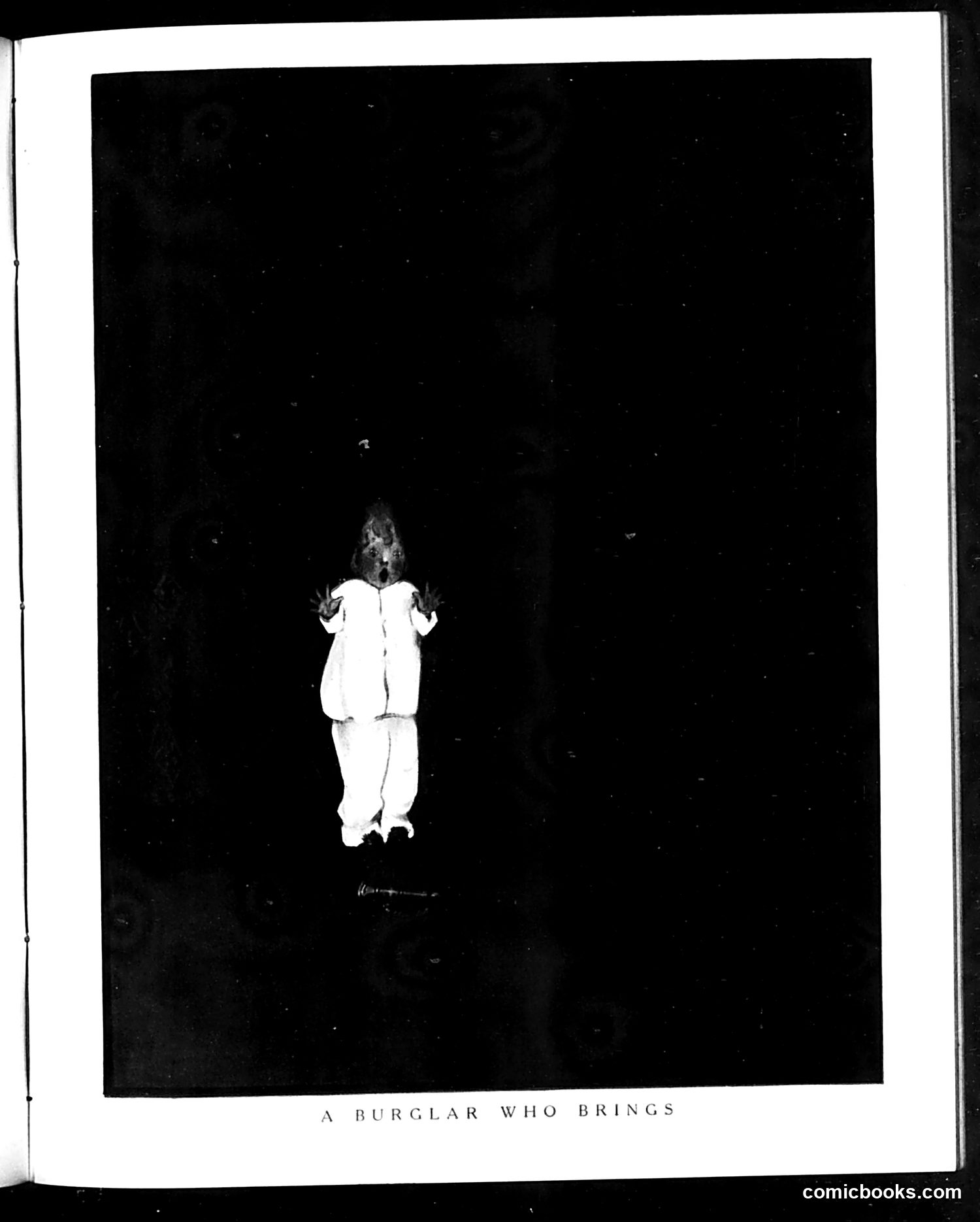
This appears to be a satirical illustration from *Judge* magazine depicting a figure in white clothing against a black background. The caption reads "A Burglar Who Brings," suggesting ironic commentary on a criminal who paradoxically brings something (rather than steals). The image likely satirizes a contemporary political or social figure—possibly a politician or public official characterized as a "burglar" (corrupt, thieving) who nonetheless "brings" some benefit or gift to the public. Without additional context or visible identifying details, the specific target remains unclear, though the stark, dramatic presentation emphasizes the contradiction between the figure's criminal nature and their claimed generosity or positive contribution.
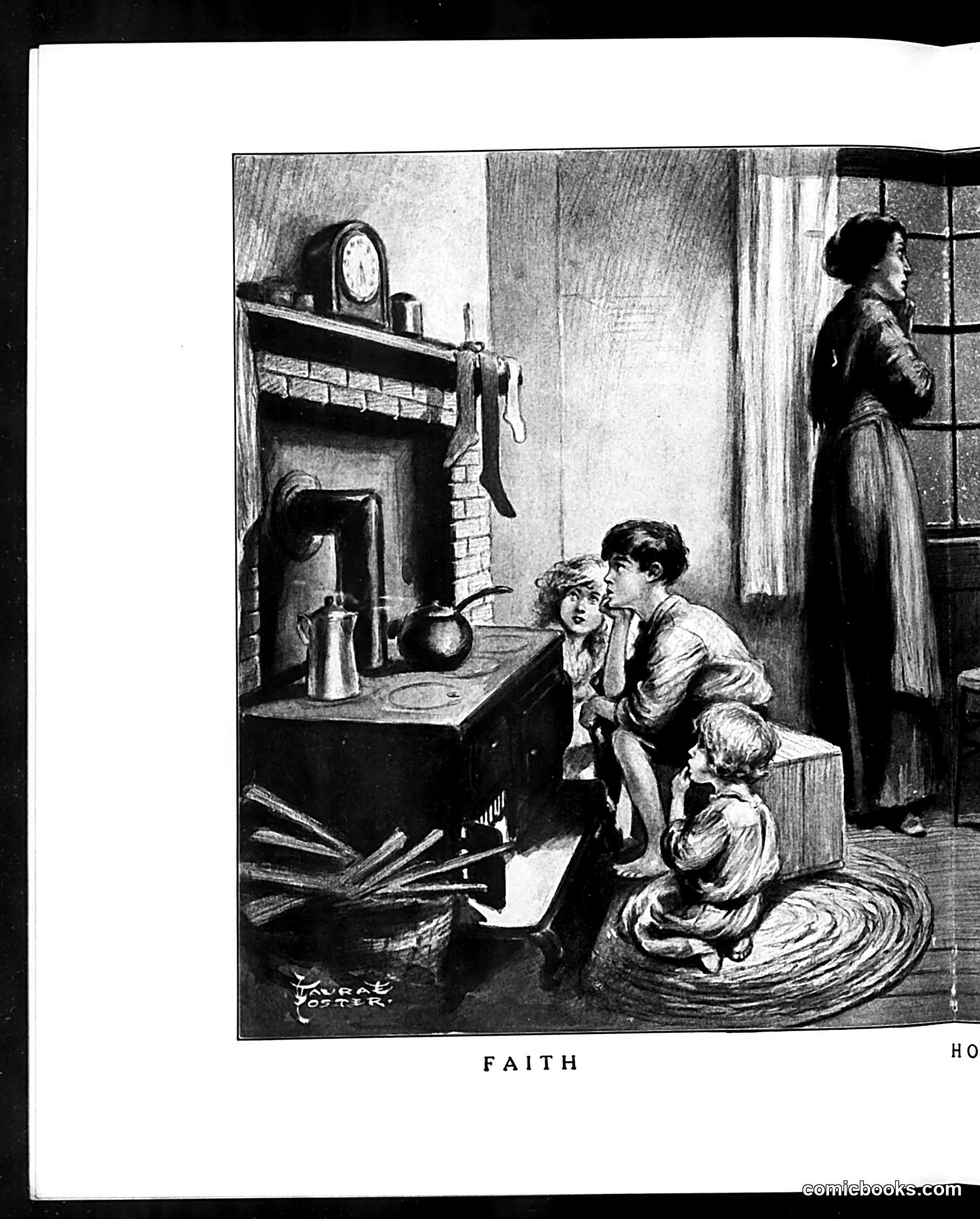
This illustration, titled "FAITH," depicts a domestic scene where a woman and man sit together by a modest fireplace with children present, while another woman stands at a window looking out. The sparse furnishings and humble setting suggest working-class poverty. The cartoon likely satirizes the virtue of "faith" as practiced by the poor—their reliance on religious or spiritual hope despite material hardship. The figures' composition suggests resignation and waiting, possibly commentary on how faith serves as psychological comfort for those in economic distress. The signature appears to read "Vural" or similar. Without additional context about Judge's publication date, the specific social conditions being critiqued remain unclear, though the image appears critical of how faith functions as a substitute for economic assistance.
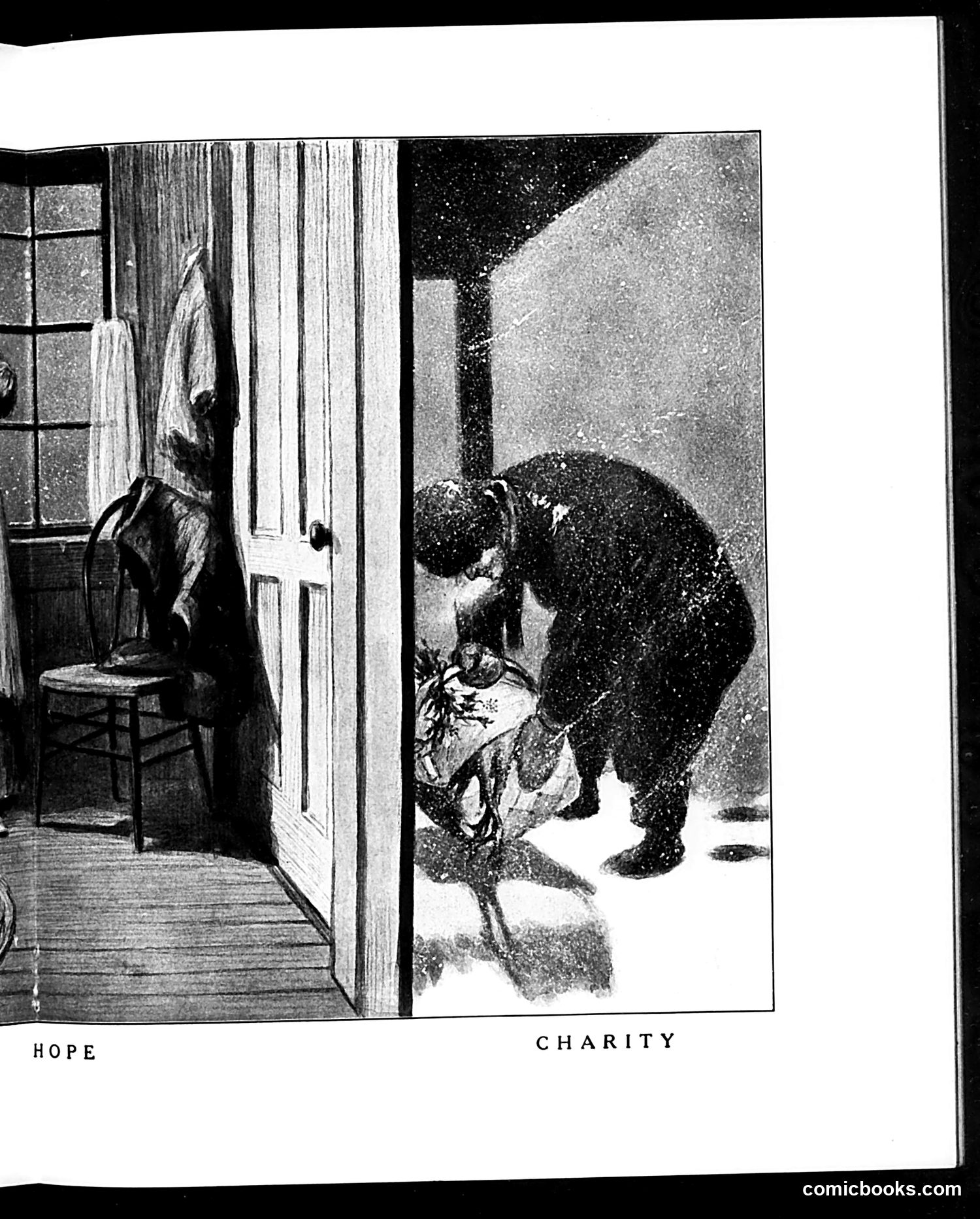
This two-panel Judge magazine cartoon contrasts two Christian virtues through social commentary. The left panel labeled "HOPE" shows a solitary figure seated indoors by a window, suggesting private prayer or contemplation—hope as an internal, individual virtue. The right panel labeled "CHARITY" depicts a figure giving food or aid to a poor person at a doorstep during winter, illustrating charity as active, outward-facing assistance to the needy. The cartoon appears to critique or comment on the distinction between passive religious faith and active social responsibility. The message suggests that true Christian virtue requires concrete action—feeding the hungry, helping the poor—rather than mere hopeful waiting or prayer. This reflects Progressive Era concerns about charitable obligation and social welfare.
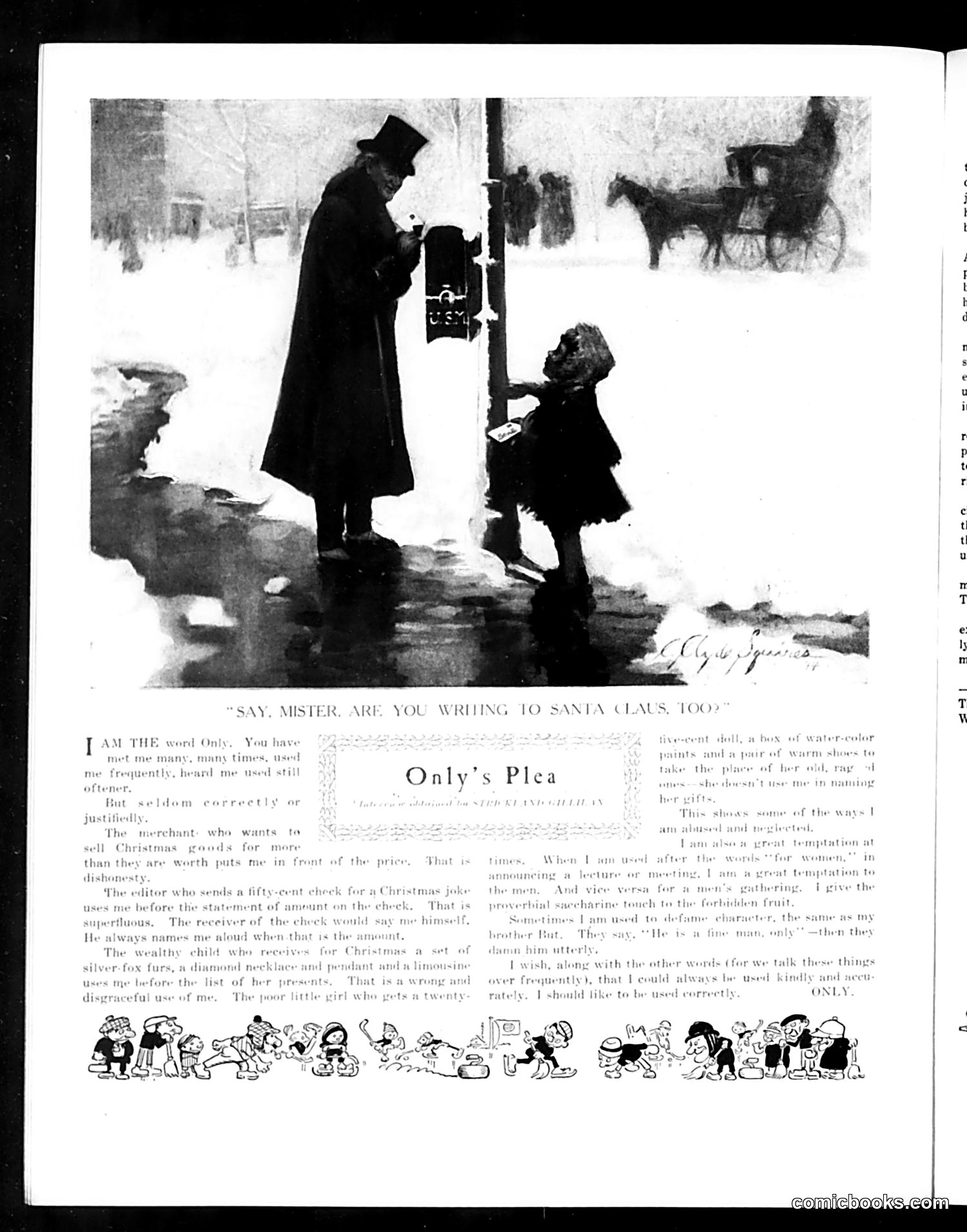
The photograph at top shows an adult and child at a mailbox in winter, with the caption asking if the mister is writing to Santa Claus. Below, an article titled "Only's Plea" satirizes the word "only" itself. The piece complains that "Only" is overused and misused in commerce and speech—merchants place "only" before prices to manipulate customers, checks use it dishonestly, and wealthy people use it to downplay their advantages. The author argues this common word enables hypocrisy and deception across society. The decorative footer shows children in various scenes. This is **not** political satire but rather **social satire** targeting commercial dishonesty and linguistic manipulation of the era—how businesses and the wealthy exploited the word "only" to mislead the public.
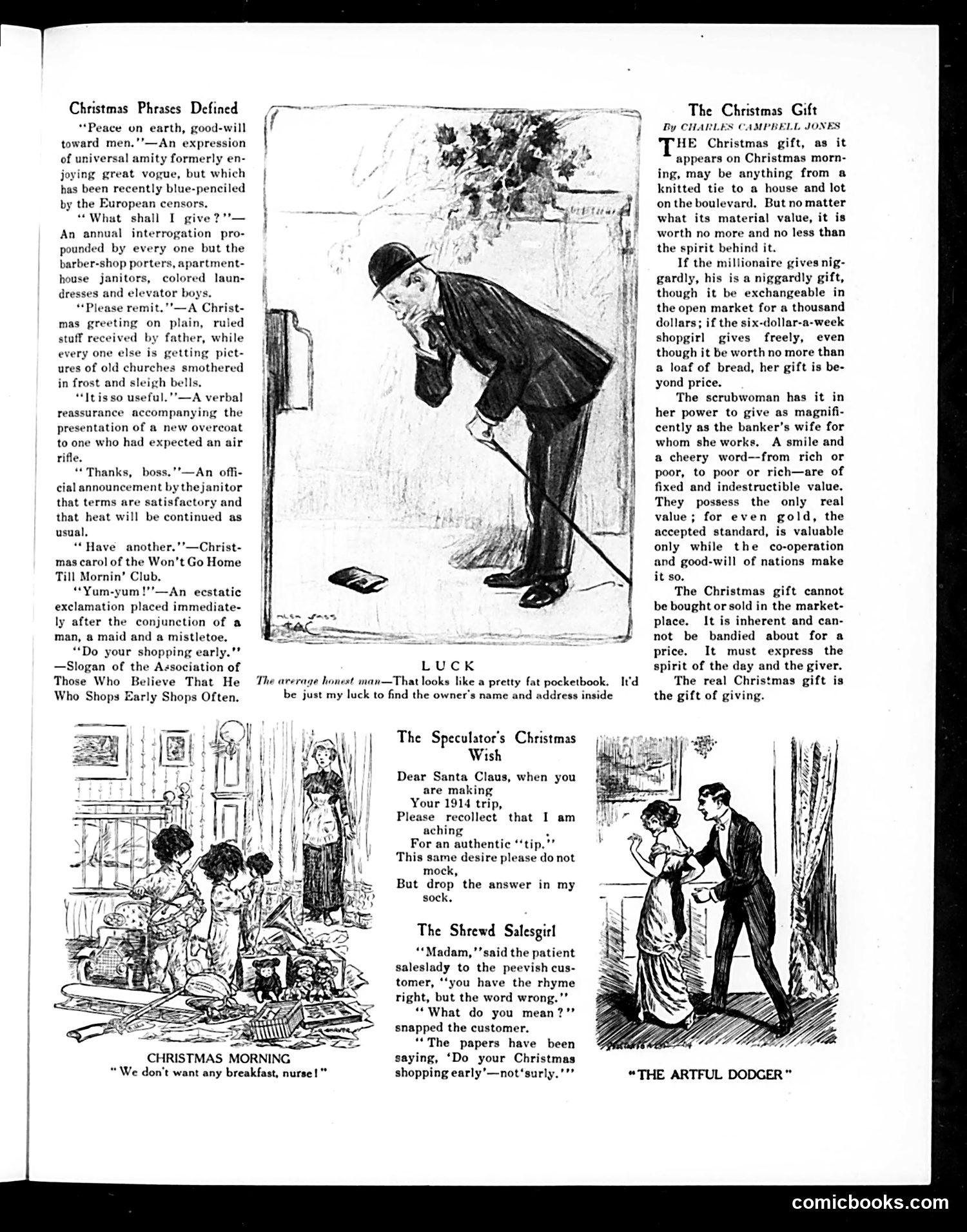
This page from *Judge* magazine contains satirical commentary on American Christmas customs circa 1914. **"Christmas Phrases Defined"** mocks commercialized holiday language—"Peace on earth" has been "blue-penciled by European censors" (likely referring to WWI), while phrases like "Please remit" and "Thanks, boss" reveal the transactional nature of Christmas among working classes (janitors, laundresses, elevator boys). **"Luck"** cartoon depicts an honest working man finding a fat wallet, hoping to locate its owner—ironic commentary on class and morality. **"The Artful Dodger"** shows a man evading a woman, presumably to avoid Christmas gift-giving obligations or romantic entanglements. **"The Shrewd Salesgirl"** puns on newspapers' "Do your Christmas shopping early" slogan, suggesting customers shop "surly" (grumpily) instead. **"The Christmas Gift"** essay argues true gifts transcend monetary value—a scrubwoman's smile equals a banker's wife's expensive present. The piece emphasizes spirit over commerce. The overall theme criticizes Christmas's commercialization while advocating for genuine human kindness.
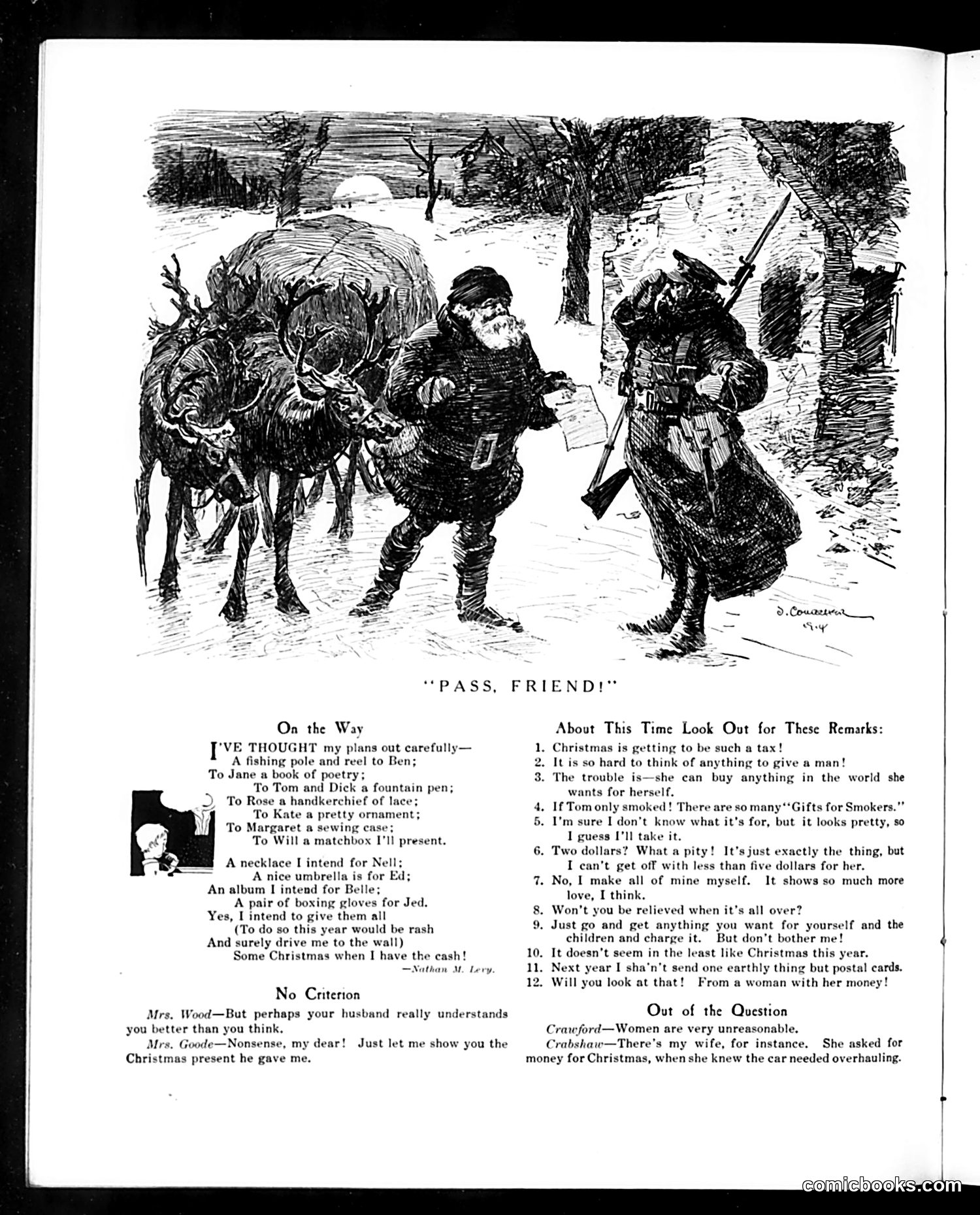
This page satirizes Christmas gift-giving anxieties circa early 1900s. The main cartoon "Pass, Friend!" depicts a soldier or traveler being granted passage, illustrating seasonal charity themes. The column "On the Way" mocks middle-class gift-giving paralysis: the speaker has carefully planned modest gifts for numerous people (fishing poles, poetry books, fountain pens) but admits he can't afford to give them "this year"—he'll wait until he has cash, implying perpetual financial strain. "No Criterion" jokes about gift expectations: Mrs. Goode boasts her husband's gift-giving proves his understanding, while the dialogue suggests women receive expensive items they could buy themselves. "About This Time Look Out" catalogs common Christmas complaints: the expense ("such a tax"), difficulty choosing gifts, and gendered frustrations (wives asking for money when husbands claim other priorities like car repairs). The satire targets widespread middle-class economic anxiety and the commercialization of Christmas—gifts as obligatory social performance despite financial hardship.
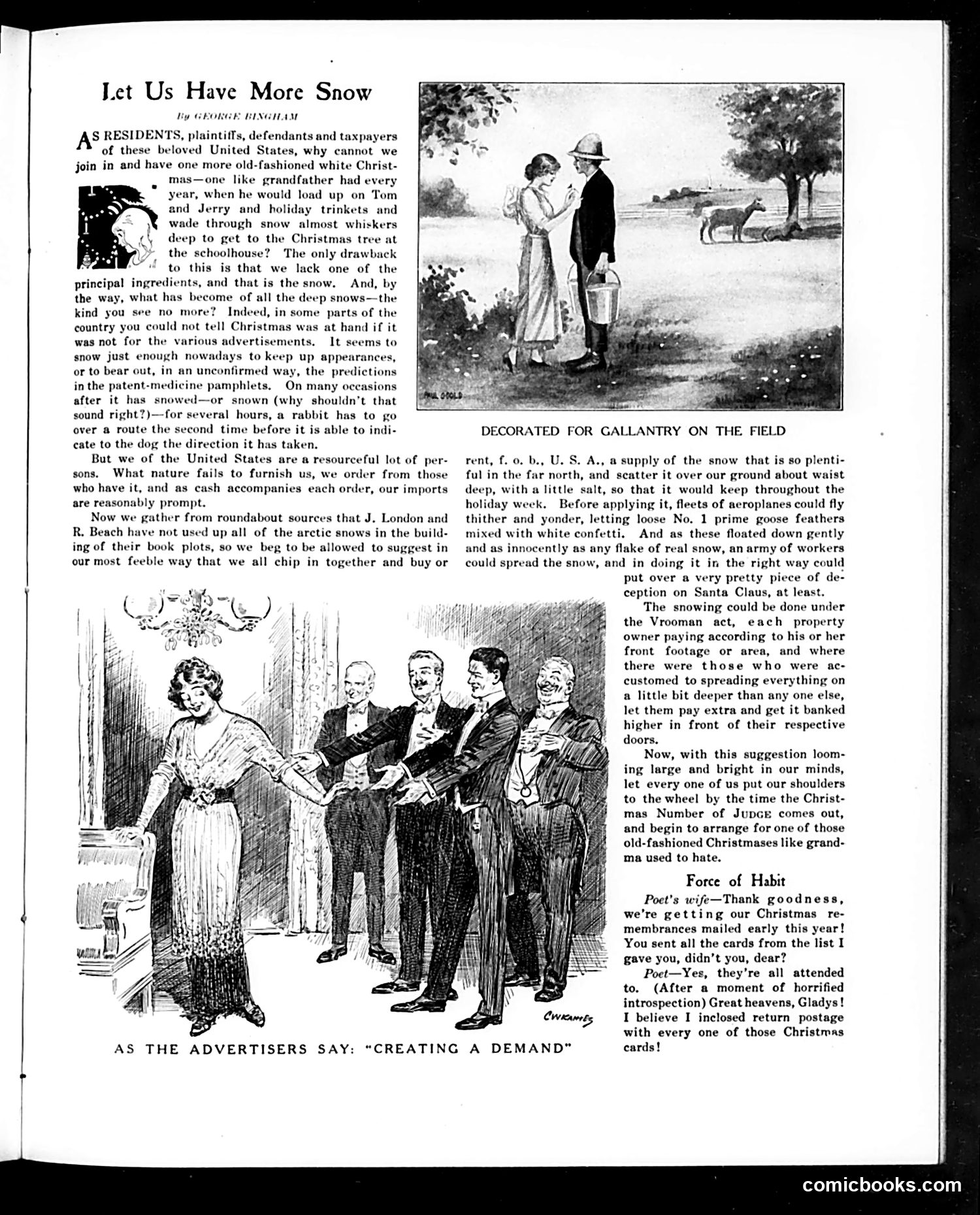
**Main Article (by George Bingham):** A nostalgic complaint that modern Christmases lack adequate snow compared to "grandfather's" era. The author humorously proposes importing arctic snow from authors Jack London and Robert Beach (who wrote adventure novels set in frozen regions), suggesting Americans organize a collective purchase to artificially create a white Christmas. The satire mocks both American consumerism and nostalgia for an idealized past—we've become so disconnected from nature that we'd rather *buy* winter than accept what we're given. **Bottom Cartoon ("Force of Habit"):** A poet's wife thanks him for mailing Christmas cards early. He then horrifies himself realizing he included return postage on every card—a reflexive habit from submitting poems to publishers (who expect return postage). The joke: poets are so accustomed to rejection that even their Christmas greetings anticipate being sent back. **Caption Reference:** "Creating a Demand" mocks advertising strategies that manufacture artificial consumer desire rather than meeting actual needs.
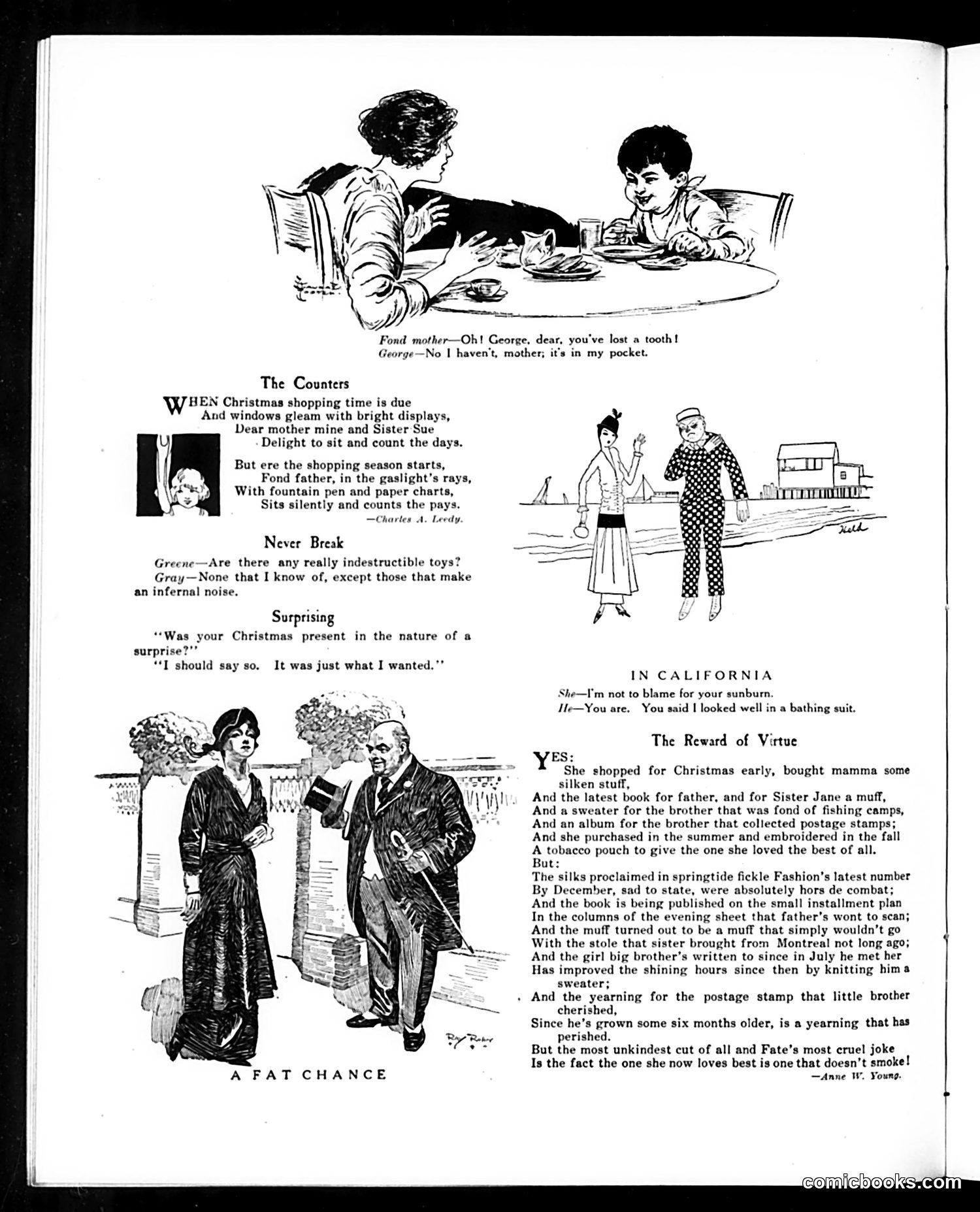
This page contains several humorous vignettes satirizing early 1900s American middle-class life: **"The Counters"**: Mocks gender differences in Christmas anticipation. While mother and sister eagerly await shopping season, father grimly calculates finances—the "pays" (paychecks)—knowing he'll foot the bill. **"Never Break"**: A joke about indestructible toys that make noise, implying parents secretly prefer toys that break. **"In California"**: A mild flirtation joke about a sunburned man blaming his date for suggesting he looked good in a bathing suit. **"The Reward of Virtue"**: The main satire. A woman carefully gives thoughtful Christmas gifts, but by spring, fashion changes render gifts useless, siblings lose interest in theirs, and—the "cruelest joke"—she falls in love with a man who doesn't smoke (making her tobacco pouch gift pointless). It satirizes how women's careful domestic labor and gift-giving efforts prove futile against fickleness and fate.
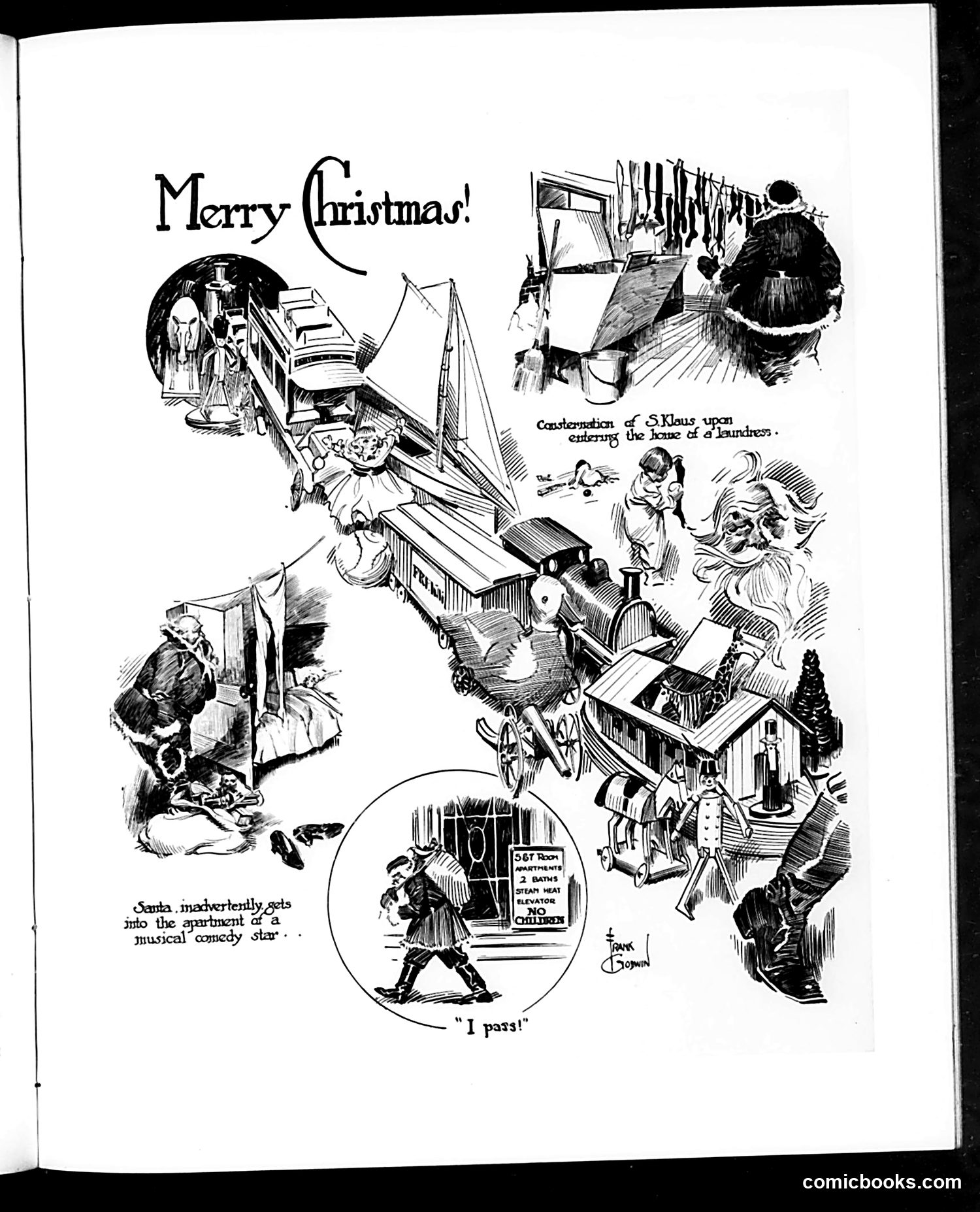
This is a Christmas-themed satirical illustration collection signed by Frank Bowen. The central vignette shows Santa attempting to enter an apartment building, with the caption "I pass!"—likely satirizing how difficult it was for Santa (or gift-givers) to access modern urban apartments with their security systems and locked elevators. Other sketches depict Santa-related holiday scenarios: one shows him entering a tenement building, another illustrates children awaiting Christmas, and various domestic scenes. The overall theme appears to be commentary on how Christmas traditions navigate modern urban living conditions—contrasting the idealized, pastoral Christmas imagery with the practical challenges of apartment-dwelling in contemporary American cities.
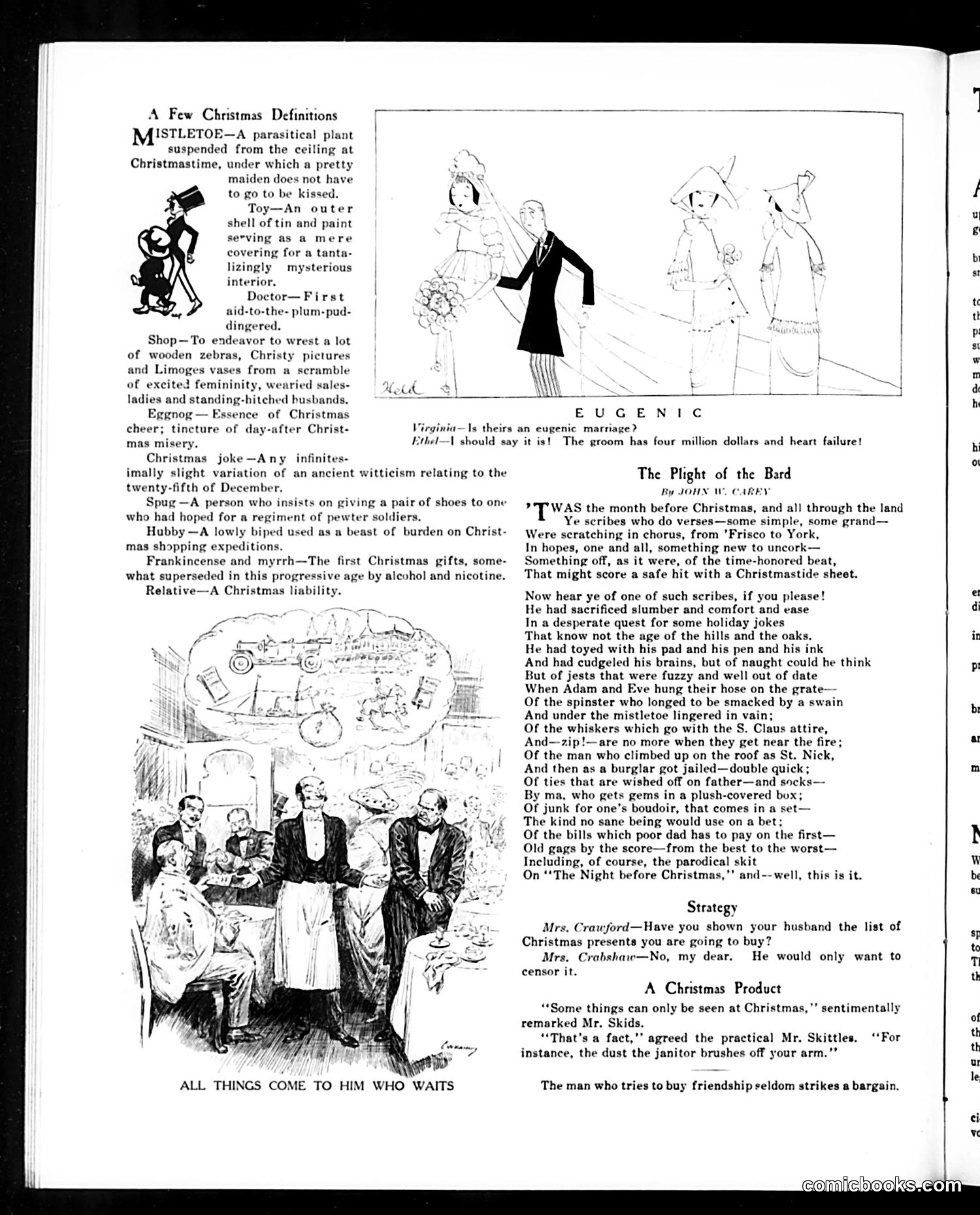
This Judge magazine page from an unspecified date contains satirical Christmas humor targeting early 20th-century domestic life and social conventions. **"A Few Christmas Definitions"** mockingly redefines holiday-related terms. Key targets include: husbands as beasts of burden during Christmas shopping; the hypocrisy of mistletoe etiquette; and stale, recycled Christmas jokes. The definitions reflect frustrations with commercialization, marital dynamics, and tired traditions. **"Eugenic"** cartoon satirizes a marriage where the wealthy groom has heart disease—implying the union prioritizes money over genetic fitness, mocking the era's pseudo-scientific eugenic theories. **"The Plight of the Bard"** by John W. Carey depicts a struggling writer desperate for fresh holiday material, stuck rehashing ancient jokes about mistletoe, St. Nick burglaries, and gift-giving. It reflects anxiety about artistic originality and commercial Christmas publishing demands. The shorter sketches ("Strategy," "A Christmas Product") continue satirizing consumer culture and marital tension—wives strategically hiding shopping lists; husbands resisting expenses. Overall, the page ridicules commercialized Christmas excess and the forced cheerfulness masking domestic frustration.
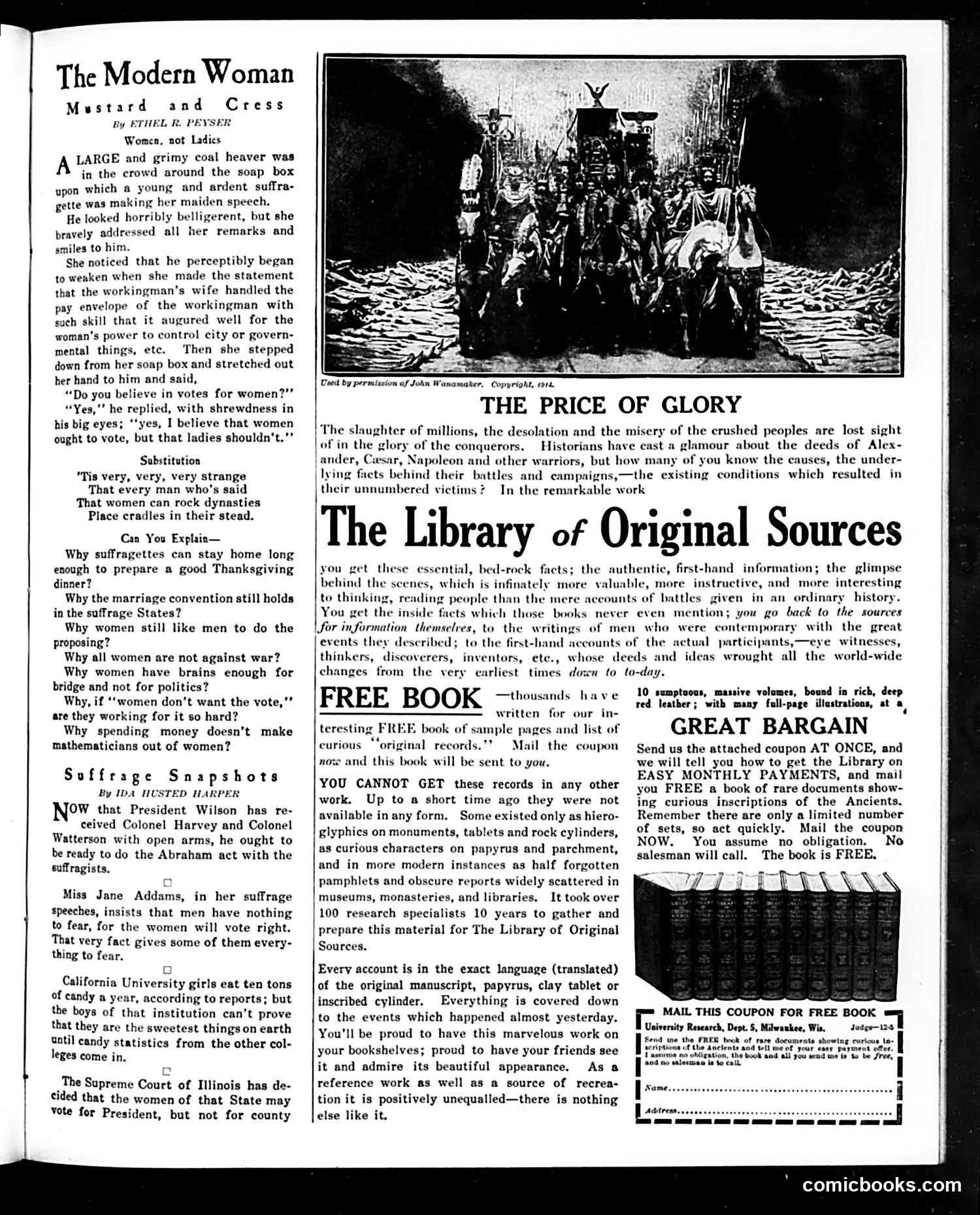
This page combines satirical commentary on early 1900s women's suffrage with period advertising. **The Satire:** "The Modern Woman" section mocks suffragettes through three pieces. The lead anecdote shows a coal heaver ("big grimy" working-class man) initially resistant to women's voting, but swayed by arguments about women's financial competence—then contradicting himself by supporting presidential votes for women but not "ladies." The joke: anti-suffragists used inconsistent reasoning. "Can You Explain" poses rhetorical questions highlighting the hypocrisy of men who simultaneously claimed women were unfit for politics yet trusted them with domestic power and major life decisions. "Suffrage Snapshots" continues this theme, noting men "fear" women voting precisely *because* women will vote responsibly. **Context:** This reflects 1910s-era anti-suffrage arguments portraying voting women as threats to traditional gender roles, while the satire exposes the illogic of those positions. **The Image:** "The Price of Glory" appears to depict historical military conquest, contrasting with suffrage debates about progress and civilization. The page also contains a substantial advertisement for "The Library of Original Sources," a reference book series.
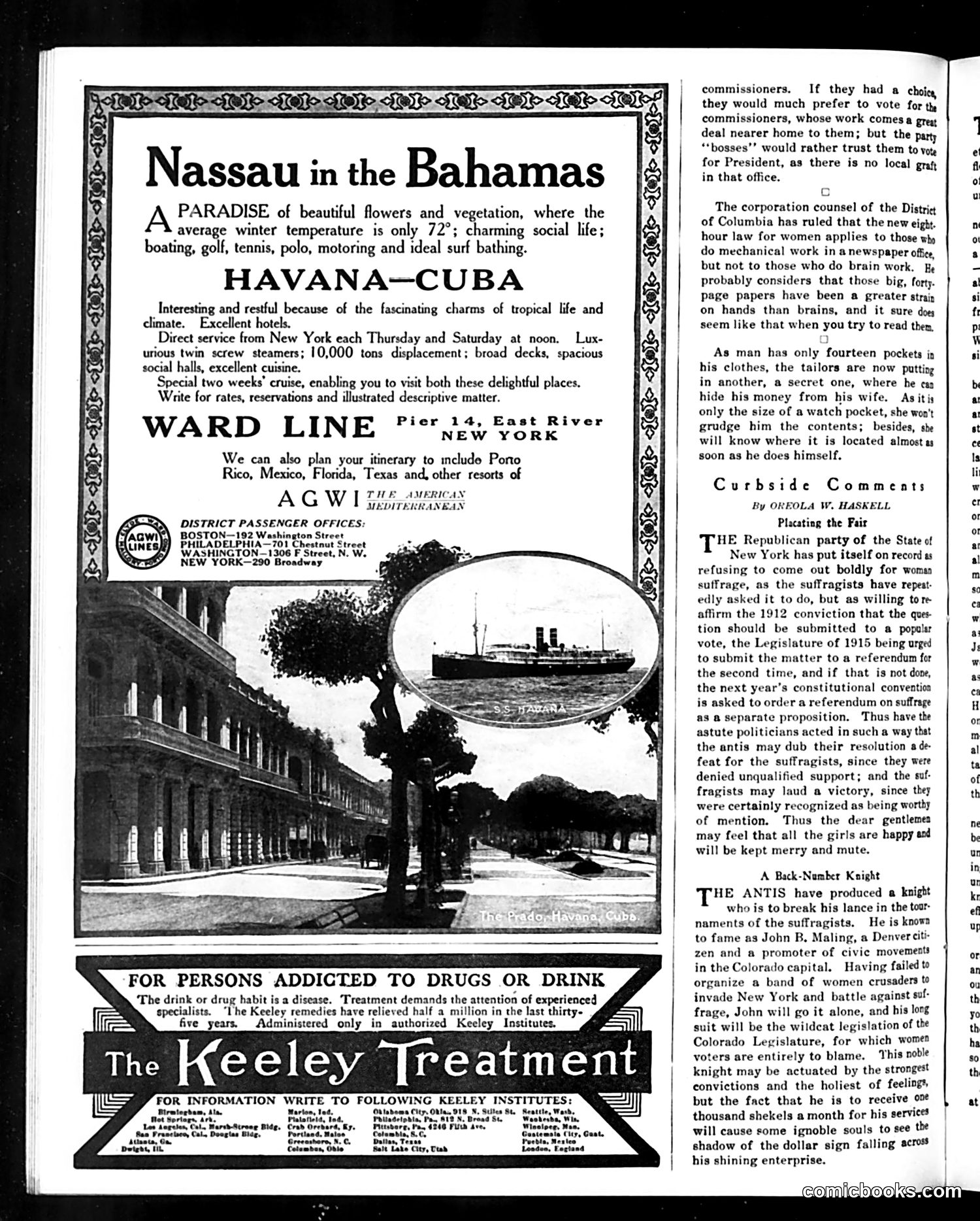
This page is primarily **advertising**, not editorial content or cartoons. The top two-thirds features travel advertisements for Ward Line steamships (Nassau and Havana cruises) and the Keeley Institute (drug and alcohol treatment). The right column contains **"Curbside Comments"** by Oreola W. Haskell—brief satirical political commentary on contemporary issues: 1. **Women's suffrage debate**: Haskell mocks New York Republicans for refusing to explicitly endorse women's voting rights, instead merely supporting a referendum. She satirizes how both suffragists and anti-suffragists can claim victory from this equivocal stance. 2. **Anti-suffrage activist**: She ridicules John B. Maling, a Denver civic leader organizing opposition to women's suffrage, suggesting his efforts are futile and outdated. The humor targets political cowardice on suffrage (a major 1910s issue) and the apparent absurdity of organized anti-suffrage movements.
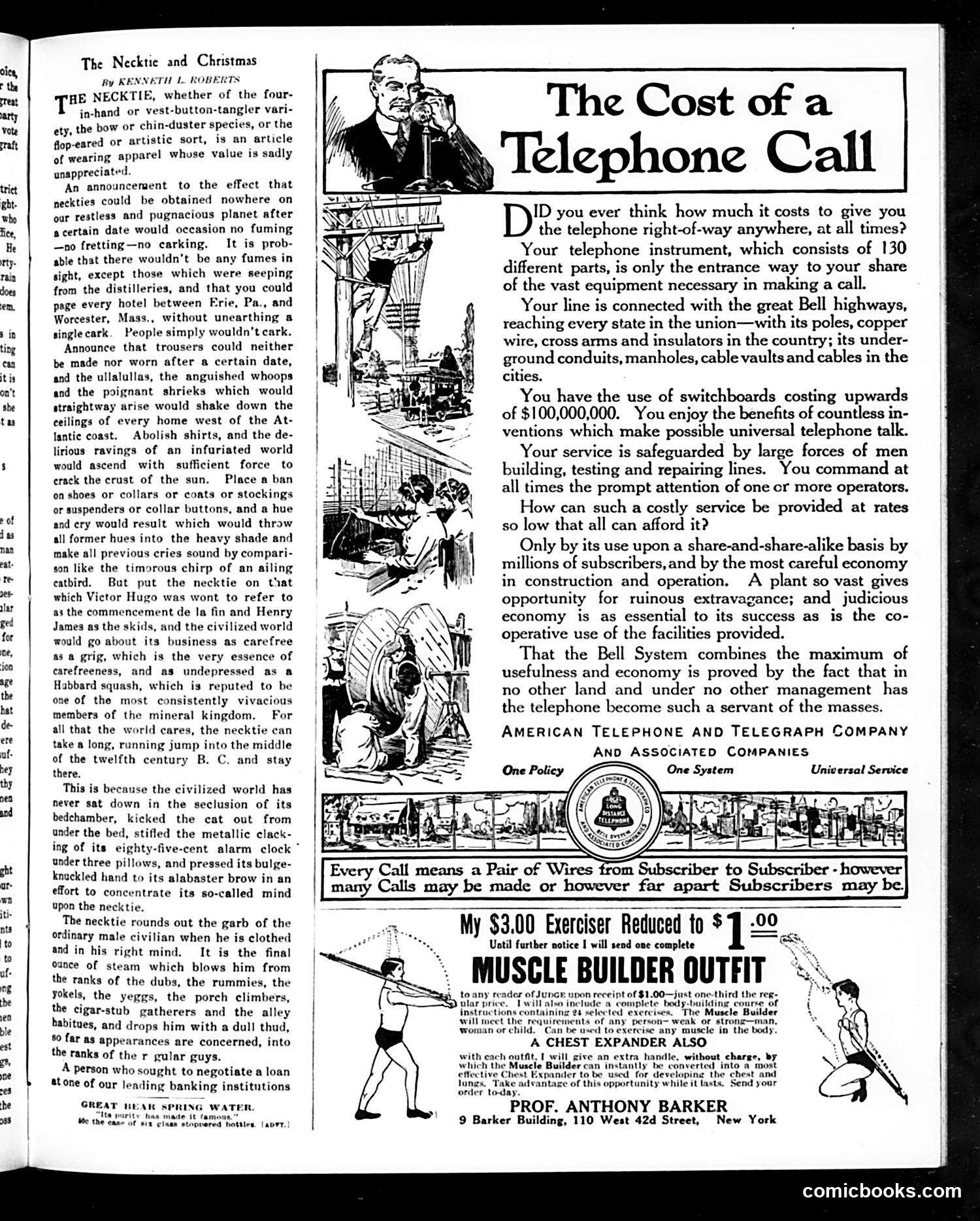
This page contains a lengthy editorial essay by Kenneth L. Roberts defending the necktie's cultural importance, alongside a major advertisement by the American Telephone and Telegraph Company. The **AT&T ad** justifies high telephone rates by detailing infrastructure costs: 130-part instruments, Bell System highways with poles and copper wire, underground conduits, switchboards costing $100 million, and constant operator attention. The ad argues this expensive service is only affordable through "share-and-share-alike basis by millions of subscribers" and careful economy. The **necktie essay** is satirical commentary on what Americans actually value. Roberts argues neckties are underappreciated despite being markers of respectability—banning shoes or shirts would cause outrage, but banning neckties? Nobody would care. He ironically suggests this reveals civilization's misplaced priorities: we obsess over trivial status symbols while ignoring genuinely important things. Both pieces reflect early 20th-century concerns: corporate infrastructure justification and American consumer culture's emphasis on appearance over substance.
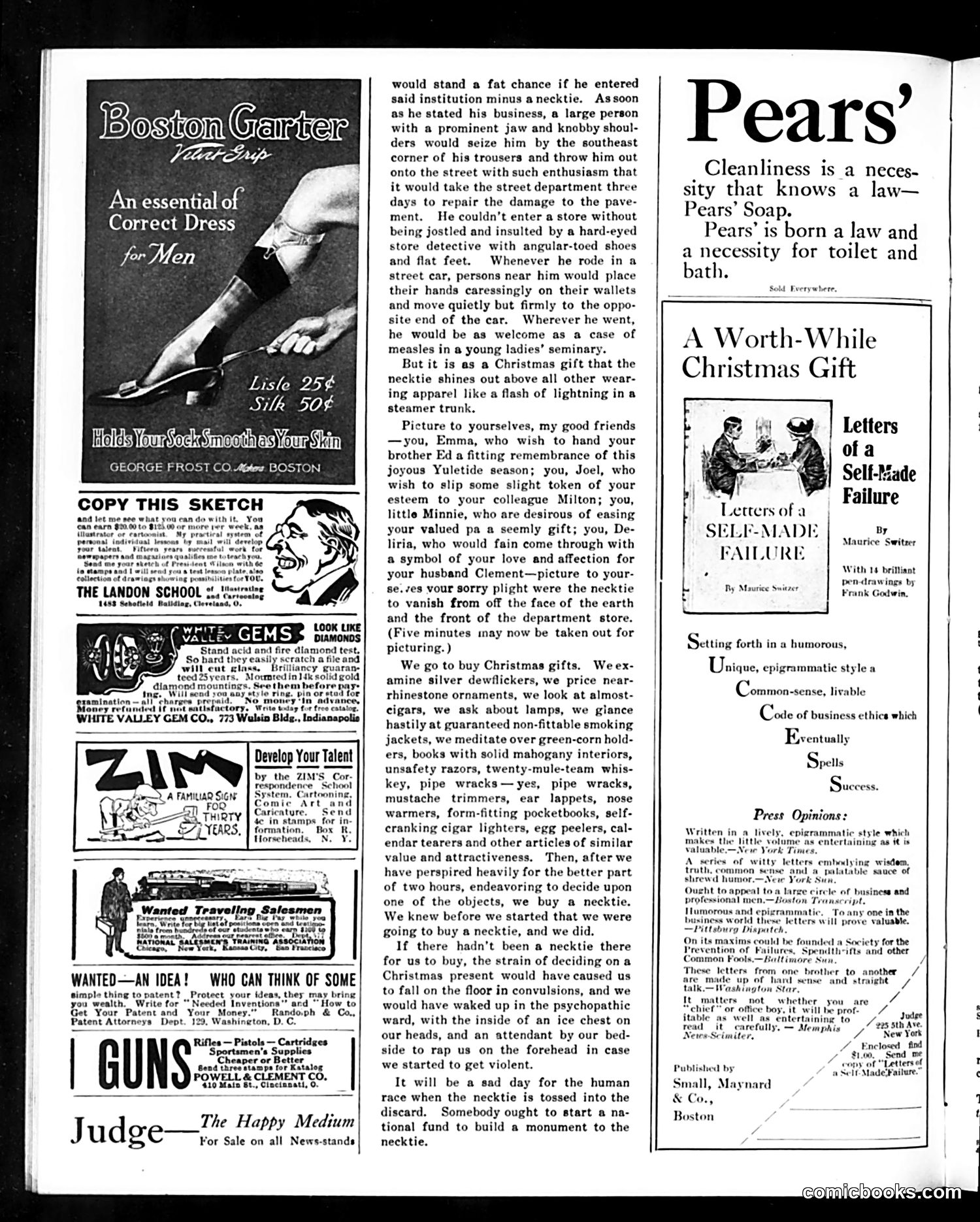
This page is primarily **advertising and humorous commentary**, not political cartoons. The main content is a lengthy satirical essay about neckties as Christmas gifts. The writer humorously argues that neckties, while socially essential for respectful appearance (men without them face ejection from institutions and suspicion in public), paradoxically become the default gift choice when shoppers are overwhelmed by other options. The piece suggests that buying a necktie provides psychological relief from decision-making paralysis—shoppers examine silver items, cigars, books, and novelties for hours, then simply purchase a necktie, having known all along that's what they'd buy. The surrounding content is typical early 20th-century advertising: Boston Garter socks, diamond testing services, cartooning correspondence courses, patent services, and firearms. There are no identifiable political figures or events referenced. This appears to be a general-interest humor magazine page focused on consumer culture and gift-giving anxiety—themes relevant to the Christmas shopping season when this issue was published.
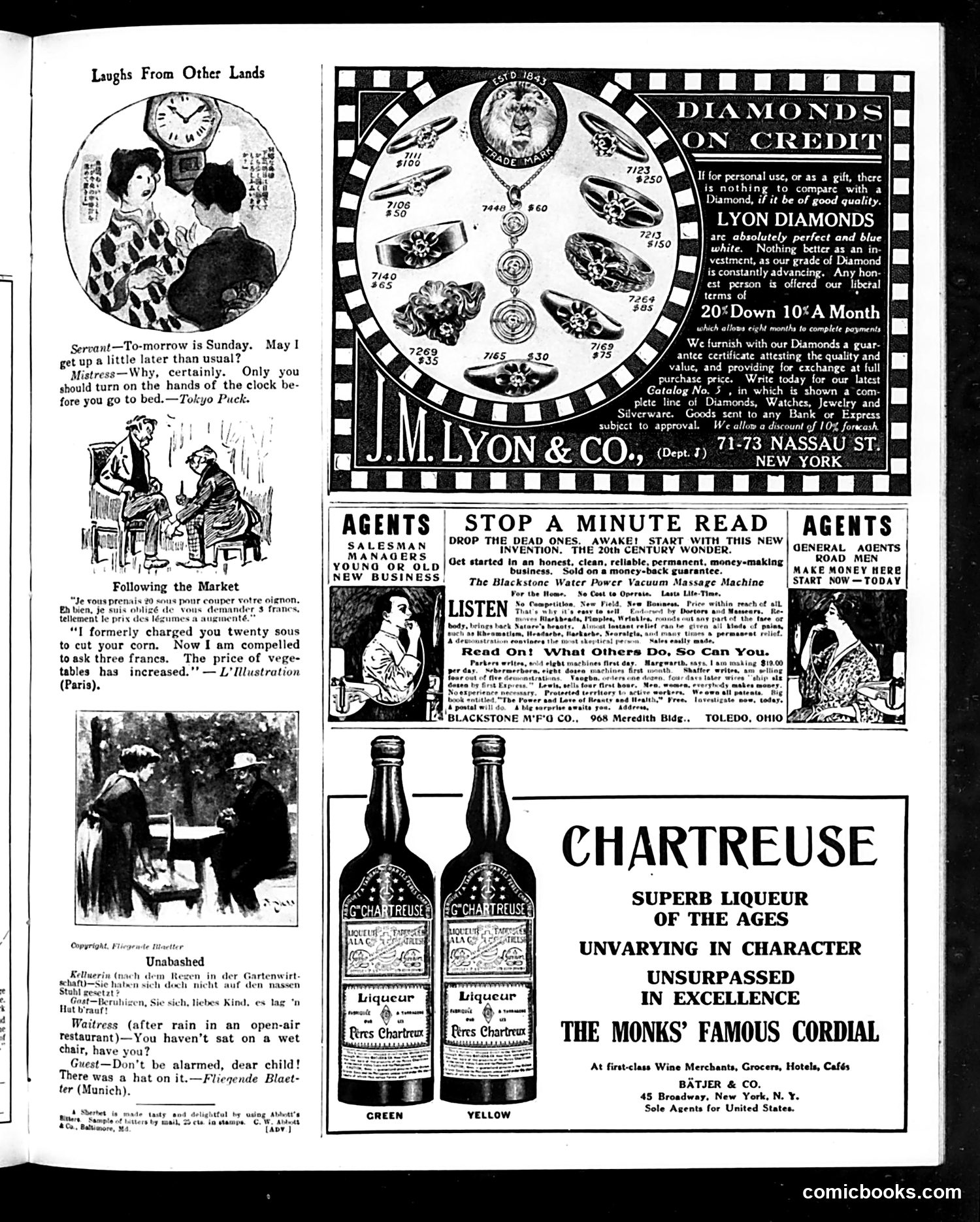
This page consists primarily of **advertisements** with small satirical filler content in the margins. The "Laughs From Other Lands" section reprints brief jokes from international publications (Tokyo Puck, L'Illustration, Fliegende Blätter), showing Judge's cosmopolitan reach. The jokes are domestic observations: a servant requesting later wake-up on Sunday; a Parisian corn-cutter raising prices due to vegetable inflation; a waitress's awkward question about a wet chair. These are gentle, culturally-specific humor with no apparent political significance. The dominant content comprises advertisements: J.M. Lyon & Co. hawking diamonds on installment plans (20 down, 10 monthly); a "Blackstone Water Power Vacuum Massage Machine" promising salesman wealth; and Chartreuse liqueur marketed as a monastic cordial. The page reflects early 20th-century consumer culture and advertising prevalence in American magazines, rather than substantive satirical commentary.
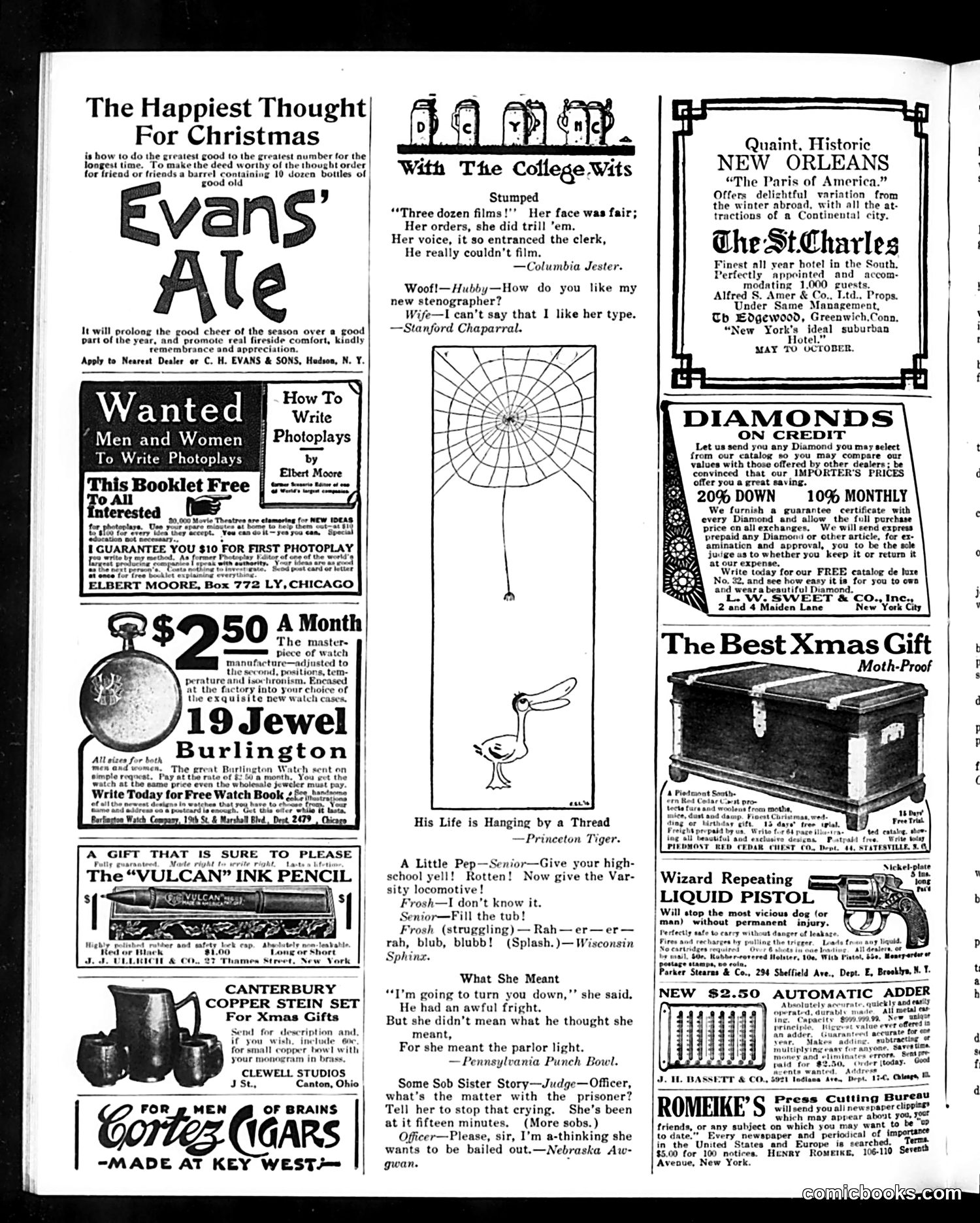
This is primarily an **advertising page** from Judge magazine, with small humor pieces interspersed. The main content consists of Christmas gift advertisements (Evans' Ale, watches, ink pencils, diamonds, coffee sets, cigars) typical of early 20th-century magazine monetization. The humor comes from **college newspaper reprints** (Columbia Jester, Stanford Chaparral, Wisconsin Sphinx, etc.): - A clerk distracted by a beautiful woman customer can't process her film order - A husband misunderstands his wife's rejection ("turn you down") as romantic rather than literal (she means the parlor light) - Freshman hazing jokes about filling bathtubs with enthusiastic yelling These are light, mostly innocuous jokes about courtship confusion, college life, and gender dynamics—reflecting early 1900s campus humor without sharp satirical bite. The cartoon's central image shows a stork hanging by a thread, accompanying a Princeton Tiger joke about life's precariousness. The page demonstrates how Judge blended advertising revenue with mild, collegiate humor for a middle-class audience.
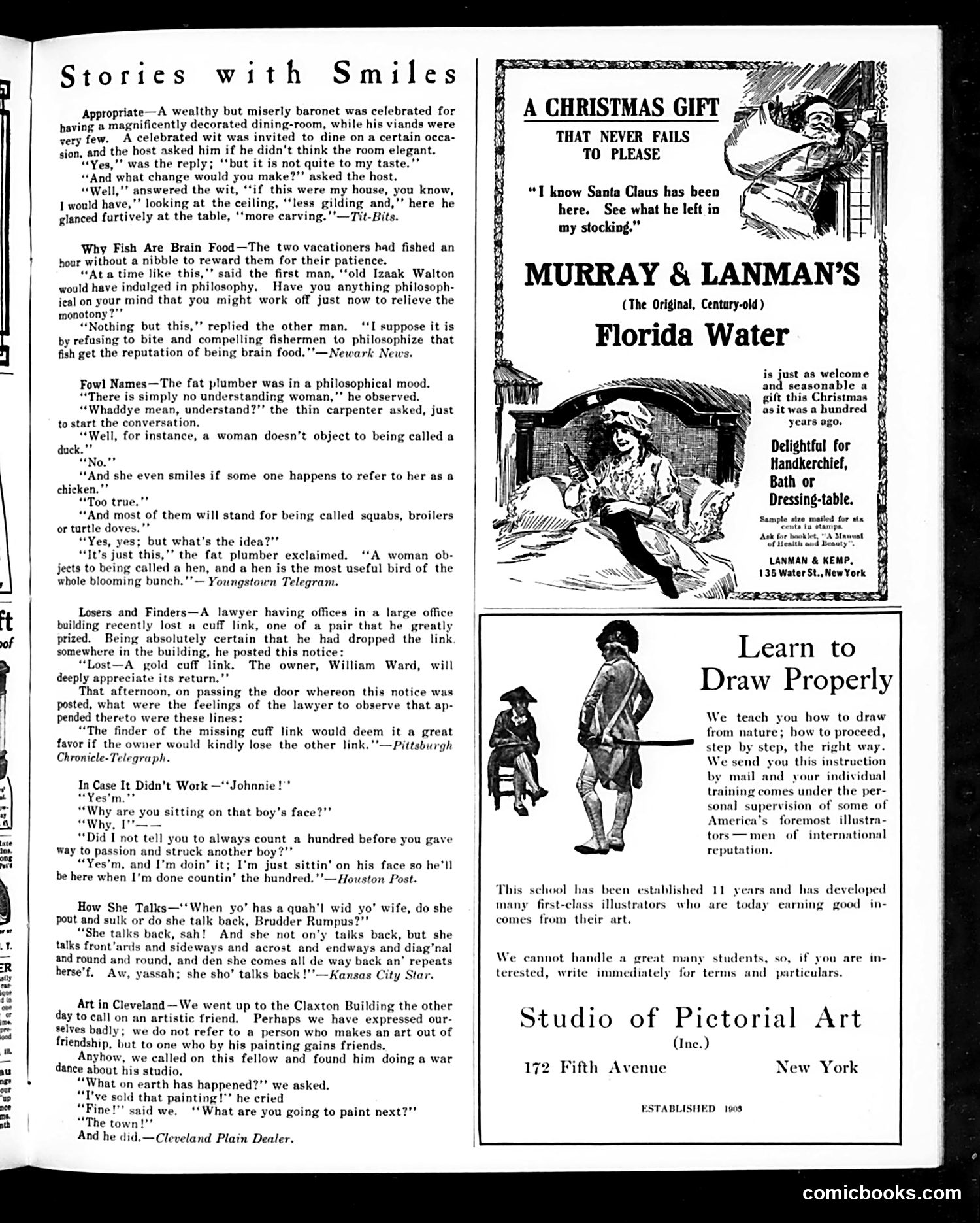
This is primarily a **humor/joke page** with various short comic anecdotes and advertisements—not political satire. The left column contains several brief humorous stories satirizing everyday situations and character types: - **"Appropriate"**: A wit mocks a stingy baron's lavish decorations but meager food - **"Why Fish Are Brain Food"**: A fisherman philosophizes that fish are smart because they refuse to bite - **"Fowl Names"**: Two working-class men joke that women accept being called ducks and chickens but object to "hen"—the most useful bird - **"Losers and Finders"**: A lawyer loses a cuff link; someone responds with witty sarcasm - **"How She Talks"**: Dialect humor about a man's talkative wife The right side features advertisements, including **Murray & Lanman's Florida Water** (a beauty/cologne product) and the **Studio of Pictorial Art** art school. The humor reflects early 20th-century attitudes about class, gender, and domestic life—generally gentle ribbing rather than pointed political commentary.
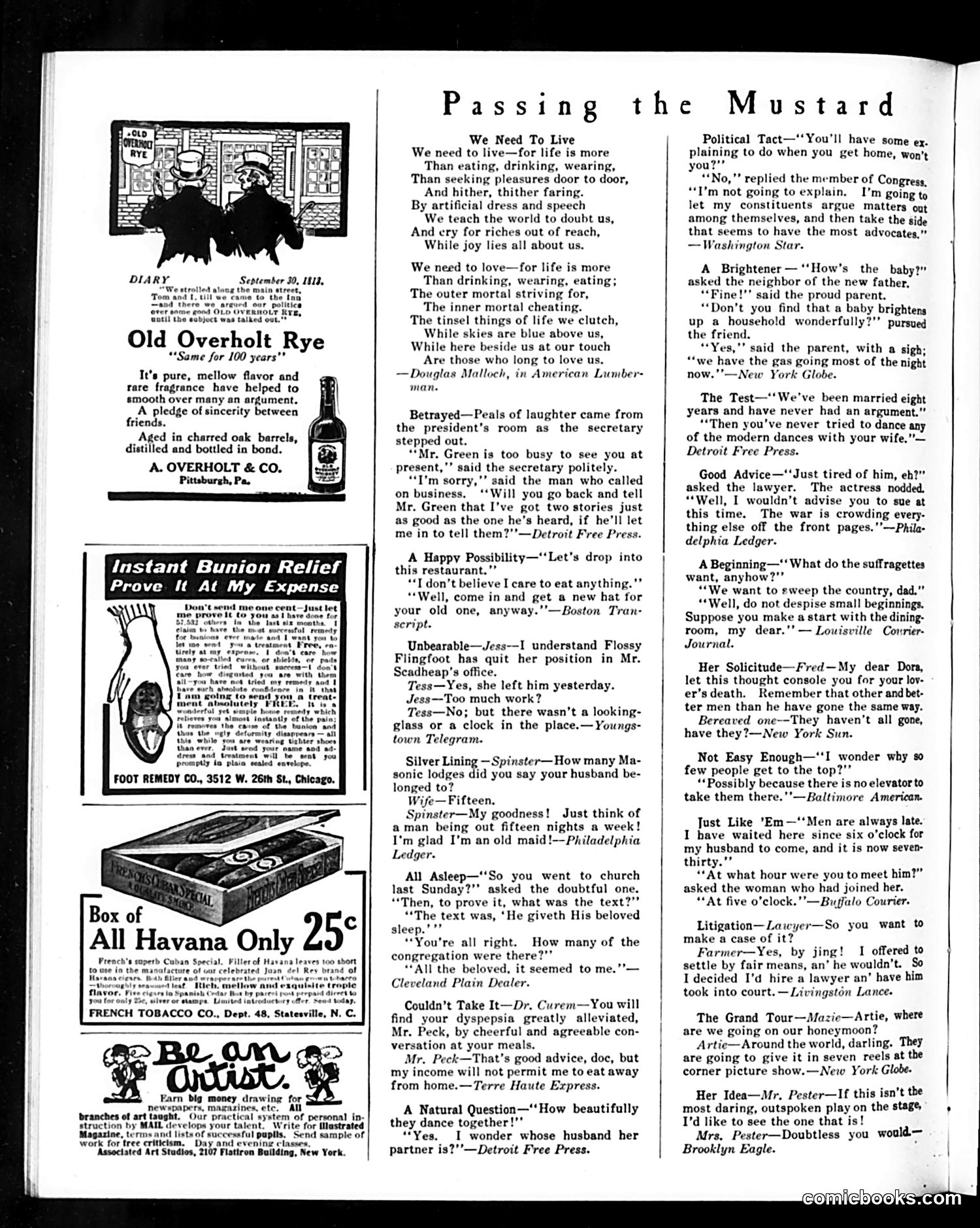
This page is primarily **advertisements and humor columns**, not political cartoons. The small header illustration shows two figures in period dress, but it's decorative rather than satirical commentary. The content consists of: 1. **Ads** for Old Overholt Rye whiskey, bunion relief, and art instruction schools—typical of the era. 2. **Humor columns** with short jokes on domestic/social themes: a congressman avoiding accountability by letting constituents argue among themselves ("Political Tact"), a wife's infidelity implied through dancing partners, and various one-liners about marriage, work, and church attendance. The jokes reflect early 20th-century concerns: marital tension, workplace hierarchy, religious hypocrisy, and economic anxiety (a man too poor to afford sociable meals). The congressman joke is the closest to political satire, mocking evasive legislative behavior. No specific political figures are caricatured or identified on this page.
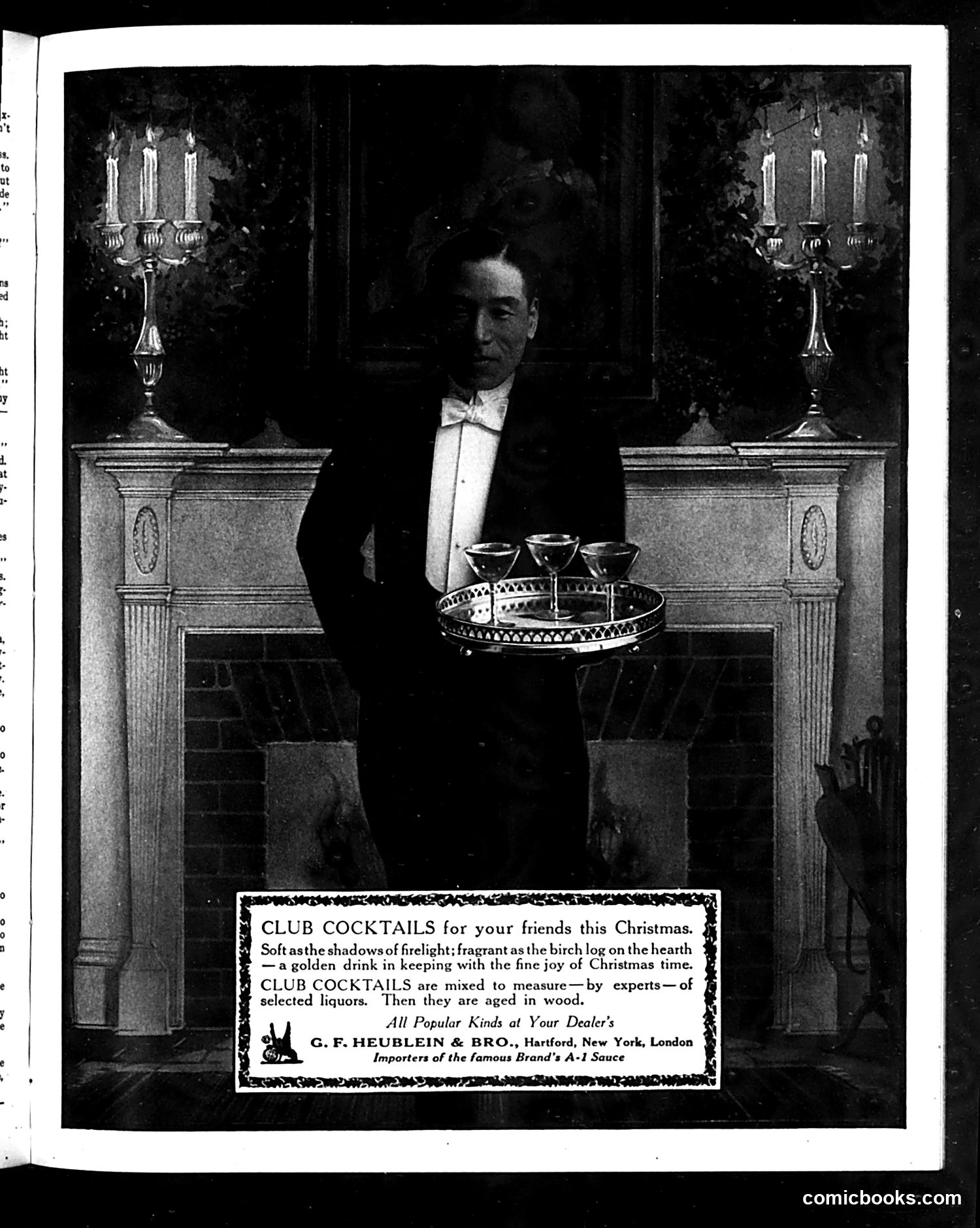
This is primarily a **Christmas advertisement** for Club Cocktails by G.F. Heublein & Bro., not political satire. The image shows a formally-dressed man (likely a bartender or server) holding a tray with three cocktail glasses and a decorative platter, positioned before an elegant fireplace with lit candelabras. The staging suggests sophistication and holiday celebration. The ad copy markets cocktails as an upscale gift choice, using nostalgic language ("soft as the shadows of firelight; fragrant as the birch log on the hearth") to appeal to Christmas sentiment. The **historical context**: This appears to be from the Prohibition era (note the careful, almost coded language about "selected liquors" being "aged in wood"), when advertising alcohol required circumspection. The emphasis on mixing "to measure—by experts" suggests pre-made, legally-distributed cocktail preparations. This is commercial advertising rather than editorial content or satire.
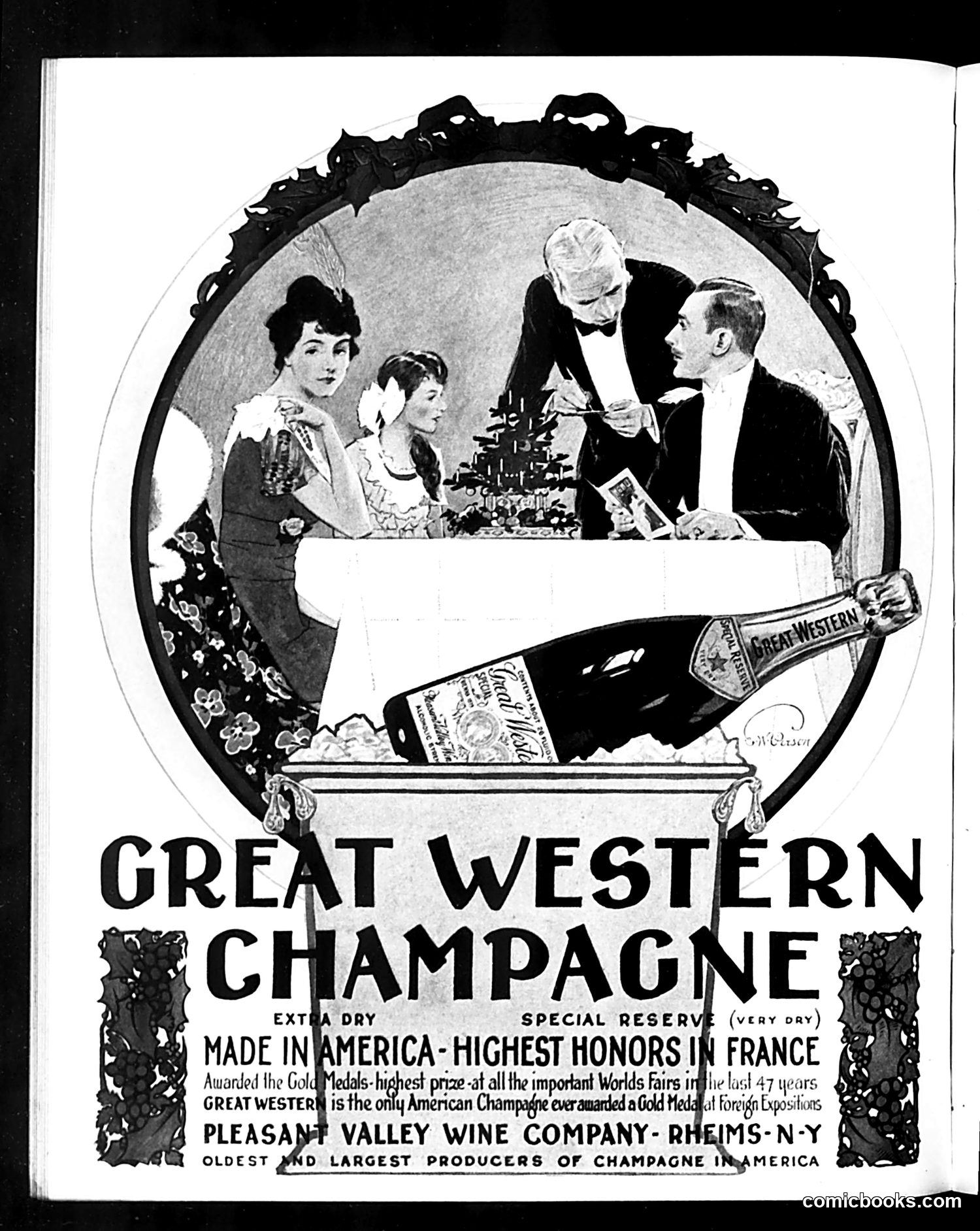
This is primarily a **champagne advertisement**, not political satire. It promotes "Great Western Champagne" by Pleasant Valley Wine Company in Rheims, New York, marketed as "Made in America." The illustration depicts an elegant dinner party scene with well-dressed figures (likely representing wealthy consumers or society figures, though not specific caricatures) examining and serving the champagne. The advertisement's key claim—emphasized in bold text—is that Great Western is the only American champagne awarded gold medals at international World's Fairs over 47 years, establishing its prestige against French competitors. This reflects early 20th-century American commercial pride: promoting domestic products as equal to European imports, particularly champagne, traditionally associated with France. The advertisement appears in *Judge*, a humor magazine, though the content here is straightforward commercial promotion rather than satire.