
Judge, 1914-12-05 · page 15 of 36
Judge — December 5, 1914 — page 15: what you’re looking at
What you’re looking at
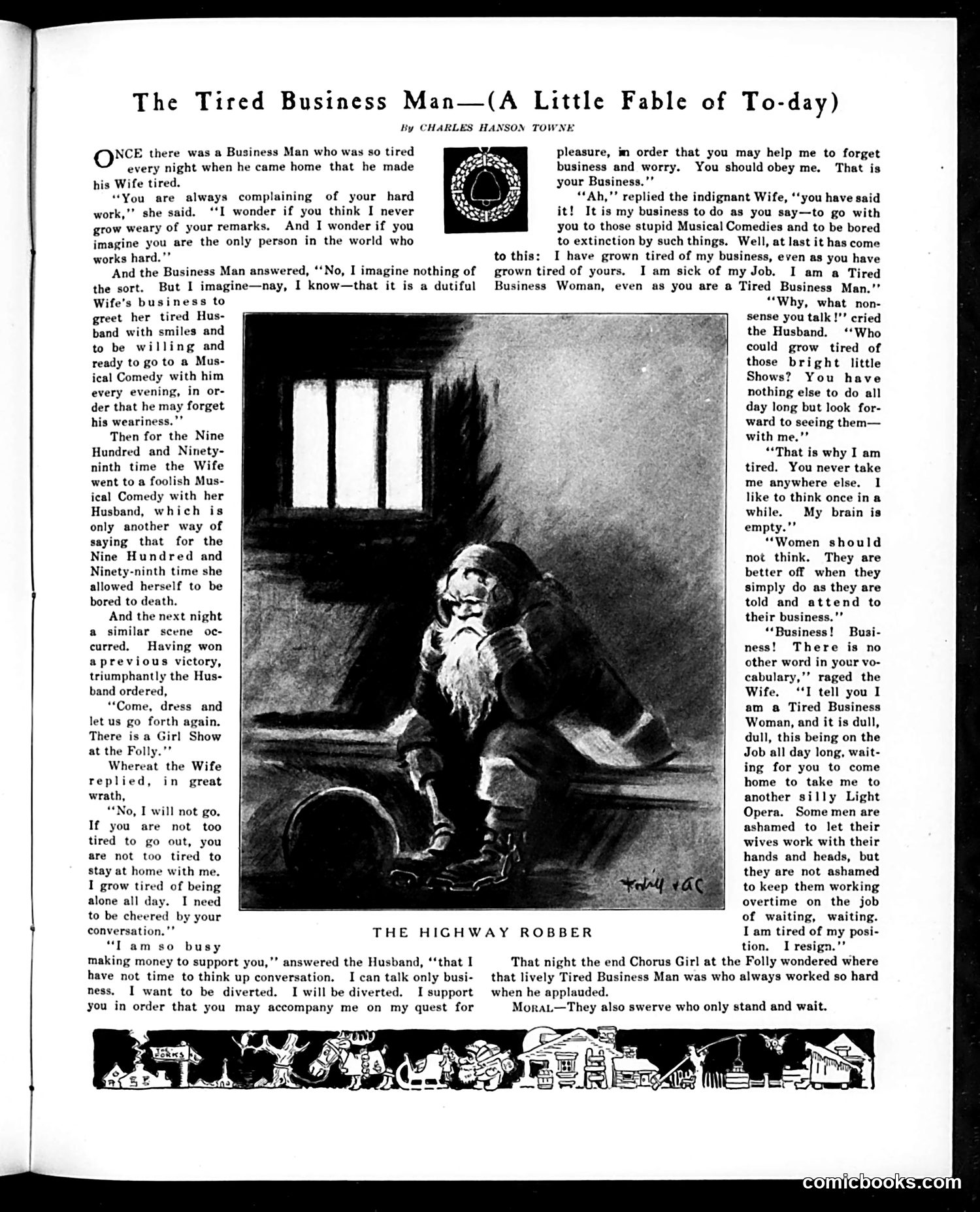
This fable by Charles Hanson Towne critiques early 20th-century marital expectations. The "Tired Business Man" demands his wife accompany him nightly to frivolous musical comedies to entertain him after work, dismissing her exhaustion and intellectual needs. He insists women shouldn't think and must simply obey. The wife eventually rebels, declaring herself equally a "Tired Business Woman"—worn out by endless waiting and entertainment duties while her mind atrophies. The husband disappears (the "Highway Robber" illustration suggests he's stolen away), leaving the chorus girl wondering where he went. The satire targets the hypocrisy: men claim exhaustion from work justifies demanding leisure entertainment, yet dismiss women's unpaid domestic labor as effortless. The moral suggests those who passively accept such arrangements enable the injustice. This reflects Progressive-era debates about women's autonomy and marital equality.
📄 Transcribed text from this page (OCR, searchable)
Machine-transcribed from the original scan — historical spelling and the odd misread are preserved.
ONCE every his Wife tired. “You are always complaining of your hard “I wonder if you think I never work,’” she said. grow weary of your remarks. imagine you are the only person in the world who works hard."” And the Business Man answered, ‘‘No, I imagine nothing of But I imagine—nay, I know—that it is a dutiful the sort. Wife's business to greet her tired Hus- band with smiles and to be willing and ready to go to a Mus- ical Comedy with him every evening, in or- der that he may forget his weariness.”’ Then for the Nine Hundred and Ninety- ninth time the Wife went to a foolish Mus- ical Comedy with her Husband, which is only another way of saying that for the Nine Hundred and Ninety-ninth time she allowed herself to be bored to death. And the next night a similar scene oc- curred. Having won aprevious victory, triumphantly the Hus- band ordered, “Come, dress and let us go forth again. There is a Girl Show at the Folly.’” Whereat the Wife replied, in great wrath, “No, I will not go. If you are not too tired to go out, you are not too tired to stay at home with me. I grow tired of being alone all day. I need to be cheered by your conversation."* “Tam so busy making money to support you,’’ answered the Husband, ‘‘that I have not time to think up conversation. I want to be diverted. you in order that you may accompany me on my quest for ness, there was a Business Man who was so tired night when he came home that he made The Tired Business Man—(A Little Fable of To-day) By CHARLES HANSON TOWNE business and worry. your Business.’’ And I wonder if you to this: grown tired of yours, THE HIGHWAY ROBBER I can talk only busi- I will be diverted. I support when he applauded. MoraL—They also swerve who only stand and wait. pleasure, im order that you may help me to forget You should obey me. That is “‘Ah,”’ replied the indignant Wife, ‘‘you have said it! It is my business todo as you say—to go with you to those stupid Musical Comedies and to be bored to extinction by such things. Well, at last it has come I have grown tired of my business, even as you have I am sick of my Job. Business Woman, even as you are a Tired Business Man.’’ I am a Tired “Why, what non- sense you talk !’’ cried the Husband. ‘Who could grow tired of those bright little Shows? You have nothing else to do all day long but look for- ward to seeing them— with me.” “That is why I am tired. You never take me anywhere else. I like to think once ina while. My brain is empty.’’ “Women should not think. They are better off when they simply do as they are told and attend to their business.’’ “Business! Busi- ness! There is no other word in your vo- cabulary,’’ raged the Wife. ‘I tell you I am a Tired Business Woman, and it is dull, dull, this being on the Job all day long, wait- ing for you to come home to take me to another silly Light Opera. Some men are ashamed to let their wives work with their hands and heads, but they are not ashamed to keep them working overtime on the job of waiting, waiting. I am tired of my pos tion. I resign.” That night the end Chorus Girl at the Folly wondered where that lively Tired Business Man was who always worked so hard