
Judge, 1914-12-05 · page 7 of 36
Judge — December 5, 1914 — page 7: what you’re looking at
What you’re looking at
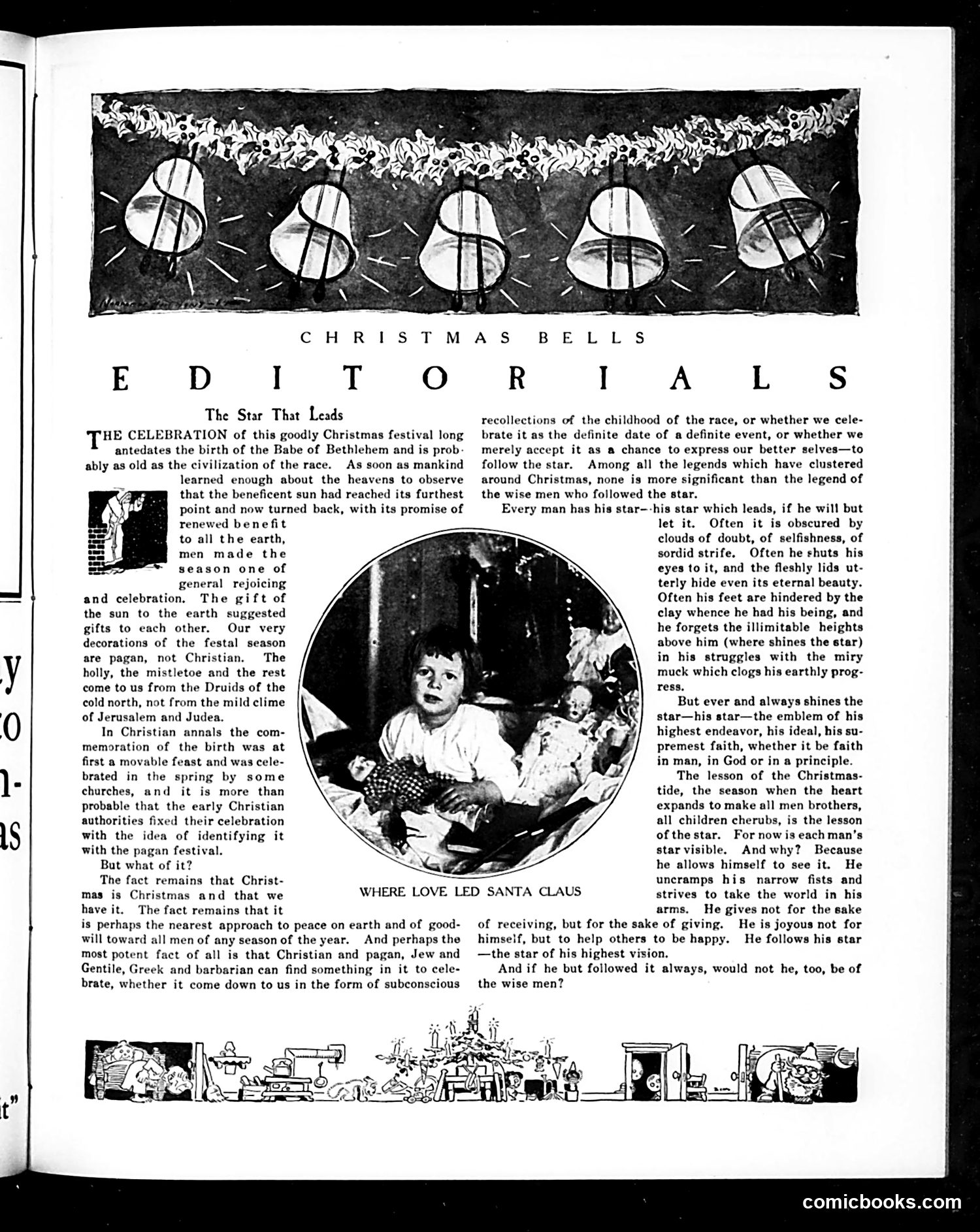
This is a philosophical editorial essay rather than political satire. The piece argues that Christmas represents humanity's universal search for meaning and goodness, transcending religious boundaries. **Key arguments:** - Christmas predates Christianity, rooted in pagan winter solstice celebrations (holly, mistletoe from Druids) - Its true value lies in promoting "peace on earth and good-will toward all men"—uniting "Christian and pagan, Jew and Gentile, Greek and barbarian" **The central metaphor:** Each person has an inner "star"—their highest ideal or principle—that guides them if they choose to follow it. Christmas uniquely allows people to see and pursue this star by expanding their hearts toward others. **The message:** The editorial uses the Nativity's wise men following the star as a template for moral living: genuine giving comes from helping others, not selfish gain. If humanity followed their "star" year-round as they do at Christmas, all would become wise. This reflects early-20th-century secular humanism—emphasizing universal human values over doctrinal religion.
📄 Transcribed text from this page (OCR, searchable)
Machine-transcribed from the original scan — historical spelling and the odd misread are preserved.
s T O The Star That Leads HE CELEBRATION of this goodly Christmas festival long antedates the birth of the Babe of Bethlehem and is prob- ably as old as the civilization of the race. As soon as mankind learned enough about the heavens to observe that the beneficent sun had reached its furthest point and now turned back, with its promise of renewed benefit to all the earth, men made the season one of general rejoicing and celebration. The gift of the sun to the earth suggested gifts to each other. Our very decorations of the festal season are pagan, not Christian. The holly, the mistletoe and the rest come to us from the Druids of the cold north, not from the mild clime of Jerusalem and Judea. In Christian annals the com- memoration of the birth was at first a movable feast and was cele- brated in the spring by some churches, and it is more than probable that the early Christian authorities fixed their celebration with the idea of identifying it with the pagan festival. But what of it? The fact remains that Christ- mas is Christmas and that we have it. The fact remains that it is perhaps the nearest approach to peace on earth and of good- will toward all men of any season of the year. And perhaps the most potent fact of all is that Christian and pagan, Jew and Gentile, Greek and barbarian can find something in it to cele- brate, whether it come down to us in the form of subconscious WHERE LOVE LED SANTA CLAUS MAS R recollections of the childhood of the race, or whether we cele- brate it as the definite date of a definite event, or whether we merely accept it as a chance to express our better selves—to follow the star. Among all the legends which have clustered around Christmas, none is more significant than the legend of the wise men who followed the star. Every man has his star—-his star which leads, if he will but let it. Often it is obscured by clouds of doubt, of selfishness, of sordid strife. Often he shuts his eyes to it, and the fleshly lids ut- terly hide even its eternal beauty. Often his feet are hindered by the clay whence he had his being, and he forgets the illimitable heights above him (where shines the star) in his struggles with the miry muck which clogs his earthly prog- ress. But ever and always shines the star—his star—the emblem of his highest endeavor, his ideal, his su- premest faith, whether it be faith in man, in God or in a principle. The lesson of the Christmas- tide, the season when the heart expands to make all men brothers, all children cherubs, is the lesson ofthe star. For now is each man’s star visible. Andwhy? Because he allows himself to see it. He uncramps his narrow fists and strives to take the world in his arms. He gives not for the sake of receiving, but for the sake of giving. He is joyous not for himself, but to help others to be happy. He follows his star —the star of his highest vision. And if he but followed it always, would not he, too, be of the wise men? comicbooks.com