
A complete issue · 40 pages · 1913
Judge — December 6, 1913
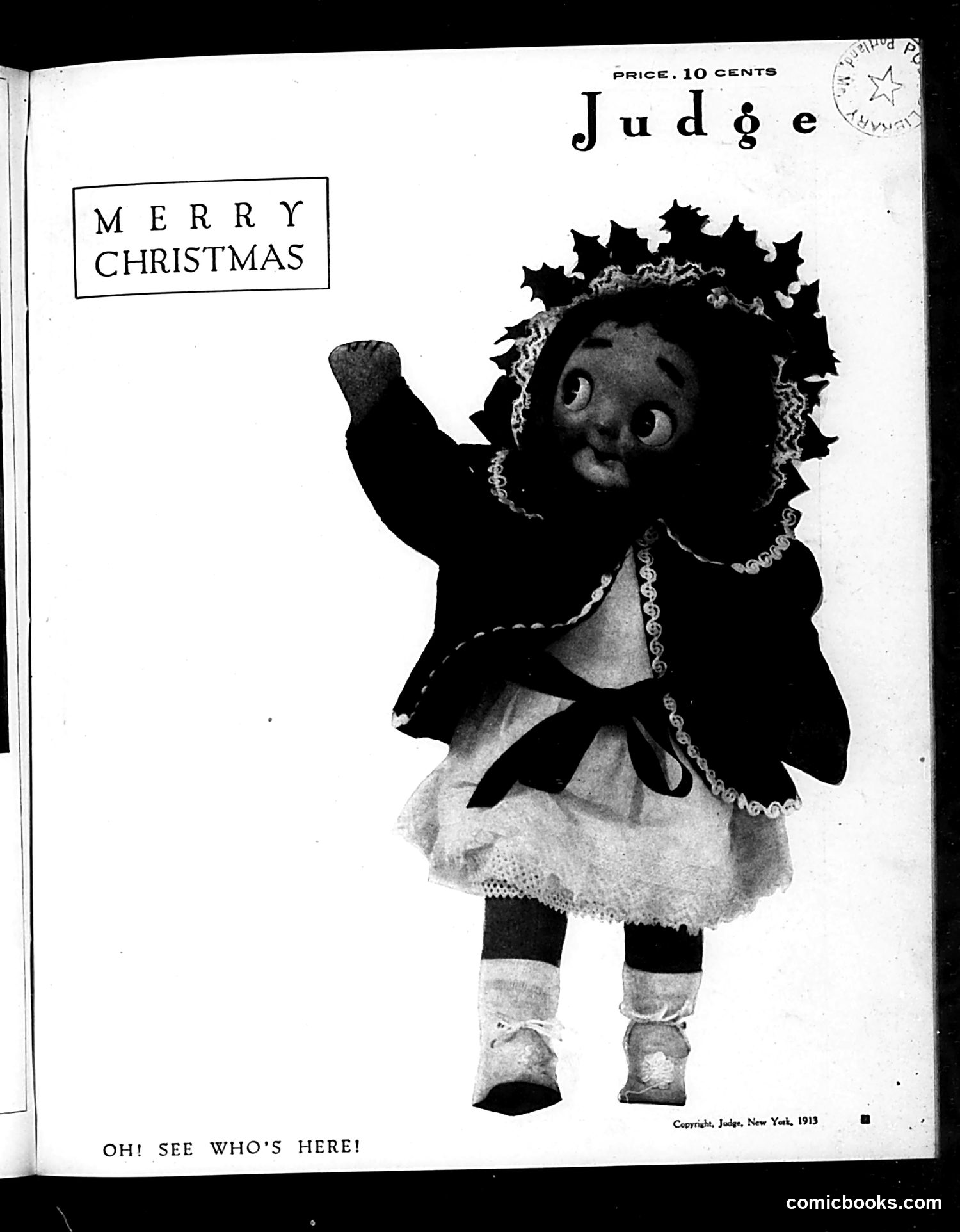
This is a Christmas-themed cover from Judge magazine (priced at 10 cents). The illustration depicts a Black child doll or figure in festive clothing—a white dress with black coat, holly wreath headdress, and jewelry—waving cheerfully. The caption "OH! SEE WHO'S HERE!" and "MERRY CHRISTMAS" frame the image. The cover appears to be advertising or promoting a doll or toy product for the holiday season. However, by modern standards, the imagery reflects the deeply racist caricaturing common in early 20th-century American commercial culture, where exaggerated features and stereotypical depictions of Black people were normalized in mainstream publications and advertising. This represents a significant historical marker of period racism in American media and consumer goods.
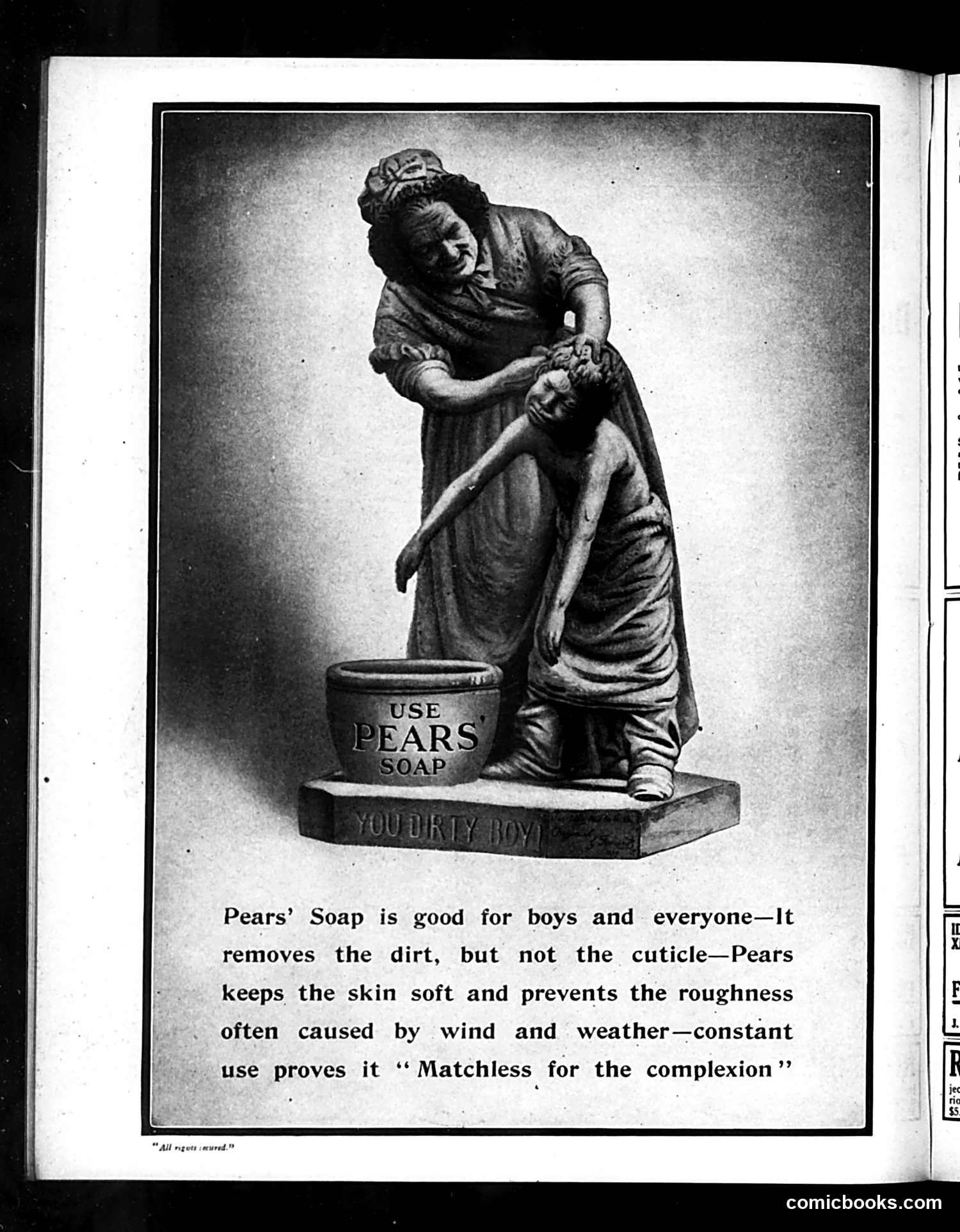
This page is primarily a **Pears' Soap advertisement**, not political satire. The image shows a sculptural relief of an adult washing a child's face, with the child standing in a large soap basin labeled "USE PEARS SOAP" and a platform reading "YOU DIRTY BOY." The advertisement copy claims Pears' Soap removes dirt while preserving skin's natural cuticle layer, keeping skin soft and preventing weather-related roughness. It concludes the soap is "Matchless for the complexion." **What's notable for modern readers**: The phrase "You Dirty Boy" and the paternalistic imagery—an adult scrubbing a child—reflects Victorian-era attitudes toward cleanliness and child-rearing that seem authoritarian today. The advertisement uses shame ("dirty boy") as a marketing tool, a common approach in early 20th-century advertising that would be considered inappropriate now.
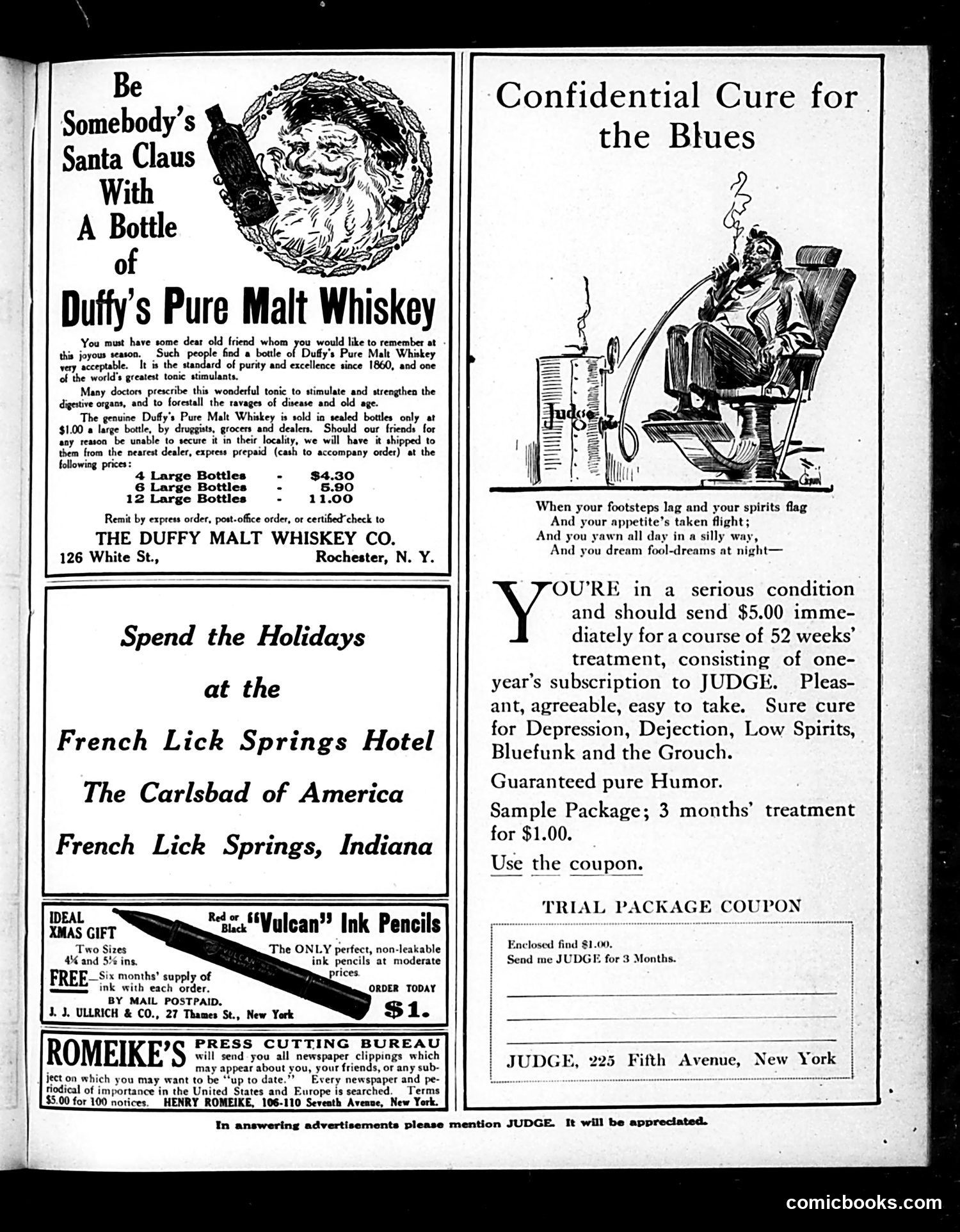
This page is primarily **advertising content** rather than editorial cartoons. The advertisements include: 1. **Duffy's Pure Malt Whiskey** - promoting whiskey as a Christmas gift, with Santa imagery. The ad emphasizes the product's "purity and excellence since 1860." 2. **Judge Magazine subscription** - humorously marketed as a "Confidential Cure for the Blues," claiming to treat depression and low spirits through humor. A figure sits relaxed, presumably enjoying the magazine. 3. **Miscellaneous ads** - for ink pencils, hotel stays, and a press clipping service. The satirical element is minimal here; instead, Judge uses self-promotion and period consumer goods to fill space. The whiskey and humor-as-medicine ads reflect early 1900s advertising styles and attitudes, where alcohol and entertainment were marketed as remedies for emotional states.
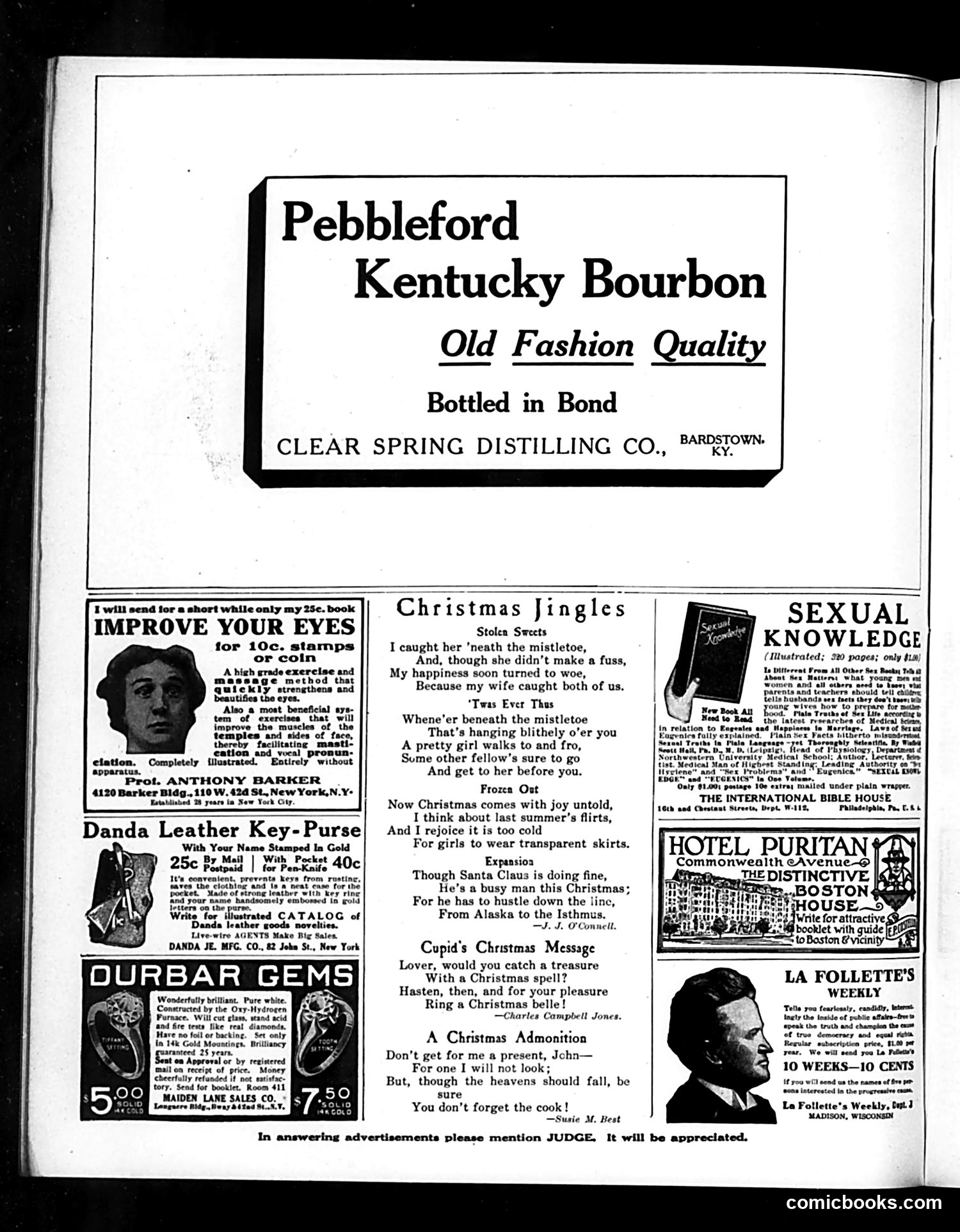
This page is primarily **advertising content** rather than editorial cartoon or satire. The dominant advertisement at the top promotes Pebbleford Kentucky Bourbon ("Old Fashion Quality, Bottled in Bond") from Clear Spring Distilling Co. in Bardstown, Kentucky. The remaining advertisements include personal improvement products (eye exercises), personalized gifts (leather key-purses), jewelry (Durbar Gems), and publications (Sexual Knowledge guide, Hotel Puritan, La Follette's Weekly). The only editorial content is a "Christmas Jingles" poem section with seasonal verses. No political cartoons or satirical commentary appear on this page. This represents a typical Judge magazine page mixing light verse with commercial advertising.
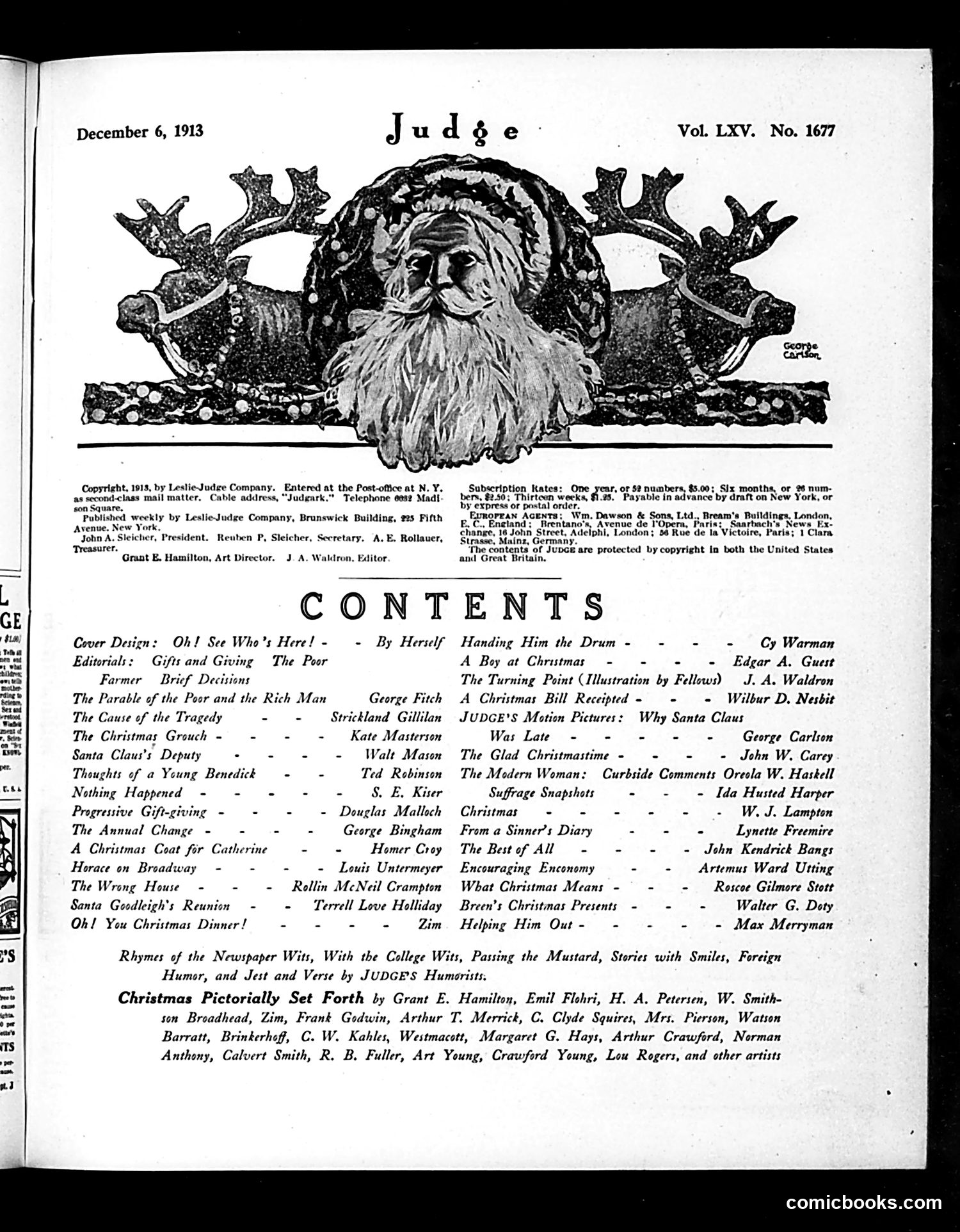
The cover features a bearded Santa Claus head flanked by two reindeer, presented as a decorative Christmas masthead for this holiday issue of Judge magazine. This is a straightforward seasonal illustration rather than political satire—Grant E. Hamilton created festive artwork typical of Judge's December editions. The contents page lists various Christmas-themed articles and stories by contemporary humorists and writers, including pieces titled "The Christmas Grinch," "Santa Claus's Deputy," and "A Christmas Bill Receipted." The layout reflects Judge's role as a family-oriented satirical publication mixing humor with seasonal entertainment during the early 20th century holiday season.
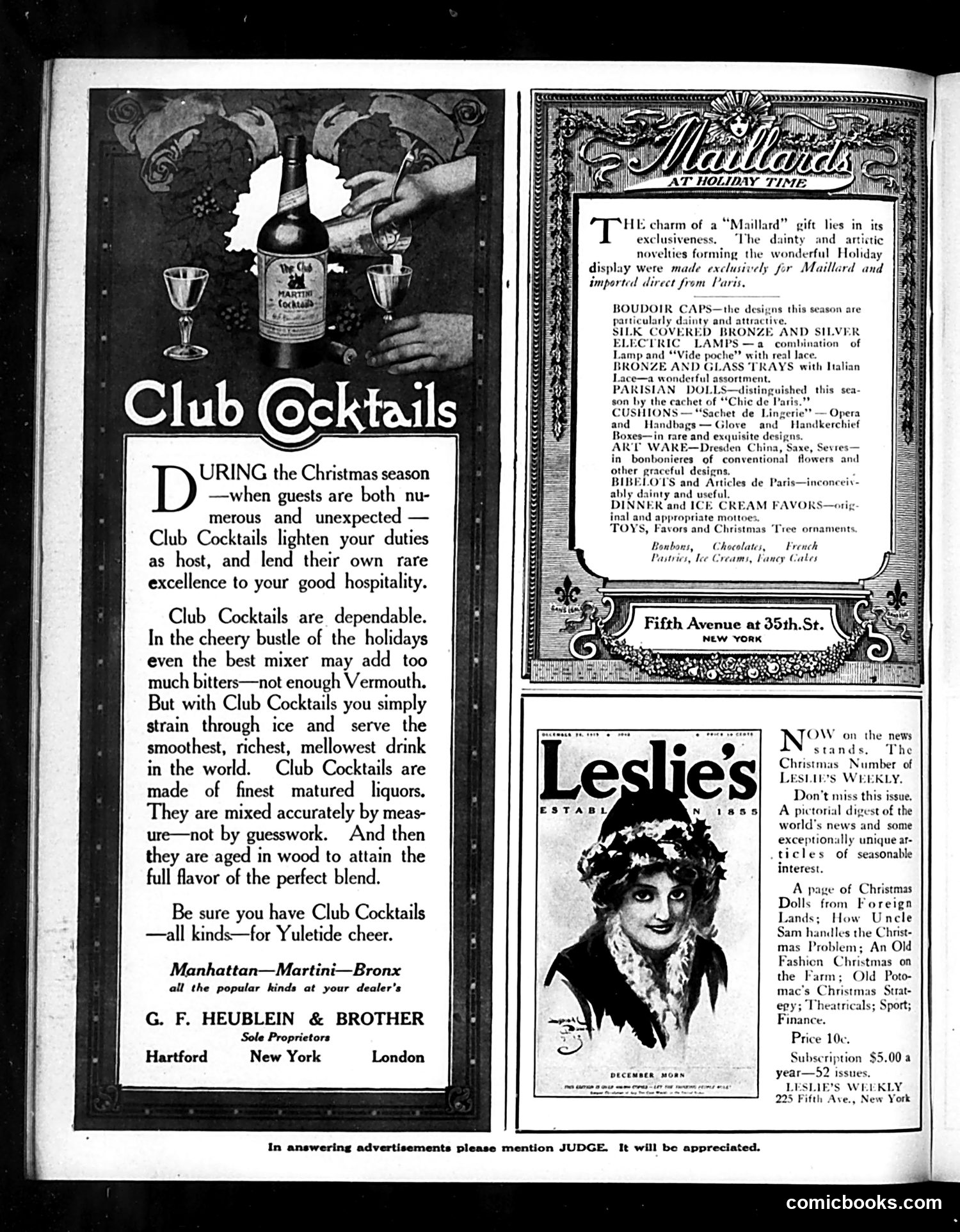
This page contains **no political cartoons or satire**—it's primarily **holiday advertising** from circa 1910s-1920s. The left advertisement promotes **Club Cocktails** by G.F. Heublein & Brother, emphasizing their reliability for holiday entertaining. The copy suggests even inexperienced hosts can serve quality drinks by simply straining pre-mixed cocktails over ice—a convenience pitch for a premium product. The right side advertises **Maillard chocolates and gifts** (imported from Paris) and **Leslie's Weekly** magazine. The Maillard ad highlights luxury holiday novelties: boudoir caps, bronze trays, porcelain figurines, and Christmas favors—targeting affluent gift-buyers. The Leslie's ad promotes their holiday issue featuring Christmas dolls, seasonal stories, and varied editorial content at 10¢ per issue. **No satirical content** is present. This is straightforward commercial messaging aimed at middle-to-upper-class holiday consumers.
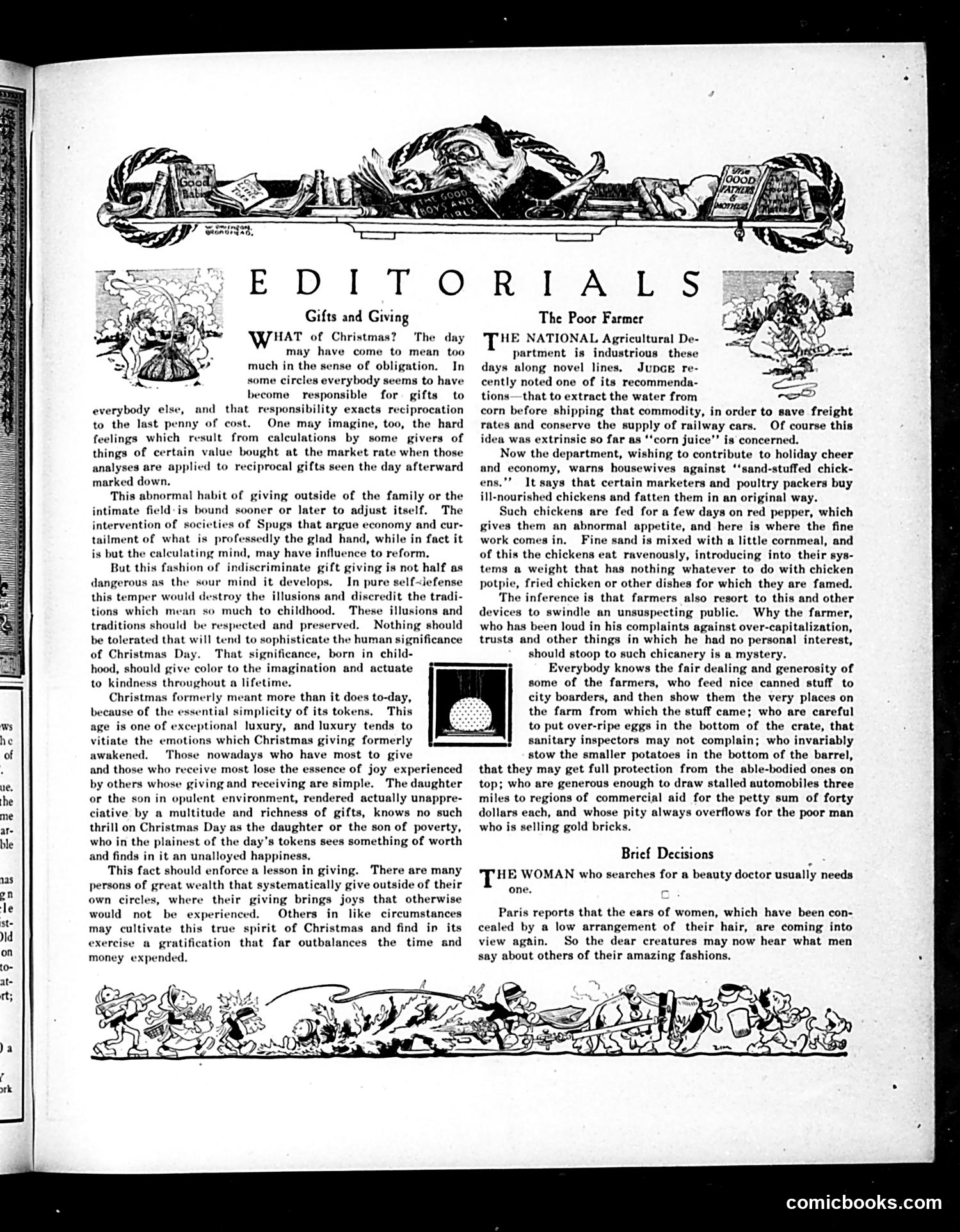
This page contains two satirical editorials critiquing American consumer culture and agricultural fraud. **"Gifts and Giving"** attacks the commercialization of Christmas. The editorial argues that obligatory gift-giving has become a calculating, transactional burden rather than a meaningful gesture of kindness. The author contrasts wealthy recipients who receive lavish gifts (and thus feel no joy) with poor children who treasure simple tokens. The satire targets the wealthy for losing Christmas's spiritual essence through excessive materialism, while praising humble givers for maintaining authentic holiday spirit. **"The Poor Farmer"** exposes a deceptive agricultural practice: unscrupulous poultry dealers feed malnourished chickens red pepper and sand to artificially increase their weight before sale. The satire suggests farmers themselves exploit this con, making them hypocrites who "complain against over-capitalization" while engaging in their own swindles. Both pieces critique greed undermining traditional American values—familial generosity and honest commerce.
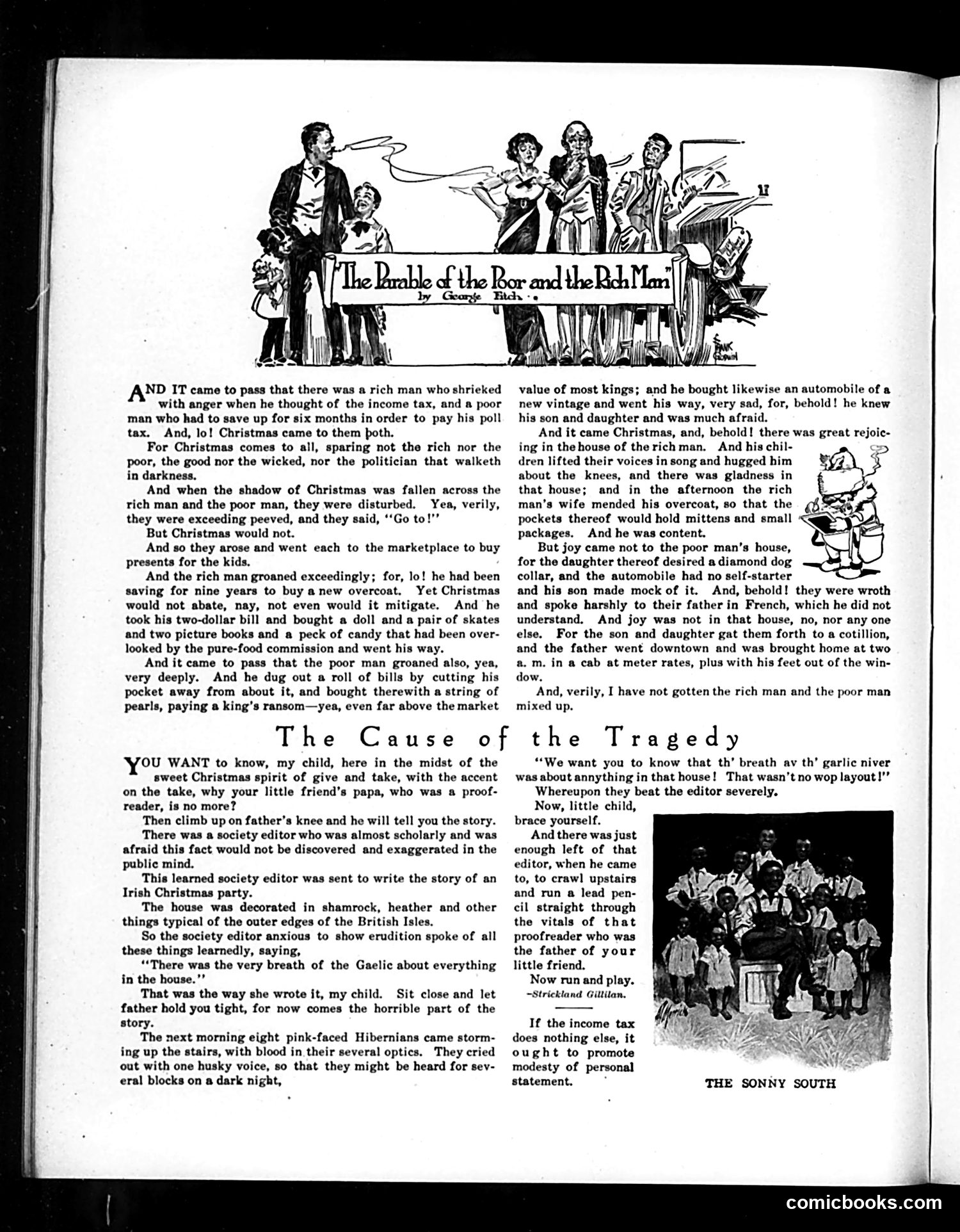
This satirical piece uses biblical language to mock American class divisions and consumerism around Christmas. The parable inverts expectations: the wealthy man sacrifices his savings for modest children's gifts and finds joy, while the poor man bankrupts himself buying luxury items (pearls, automobiles) that his ungrateful, French-speaking children mock and reject. The satire targets several targets: the wealthy's unexpected restraint and contentment; the poor's aspirational excess and resulting misery; and consumerist culture generally, where Christmas spending creates financial ruin regardless of income level. The second story, "The Cause of the Tragedy," mocks a society editor for using the phrase "breath of the Gaelic" in describing an Irish party—a pretentious literary flourish that enrages Irish readers ("pink-faced Hibernians"), leading apparently to violence against the proofread article's author. This satirizes both affected journalism and Irish-American sensitivity to ethnic stereotyping.
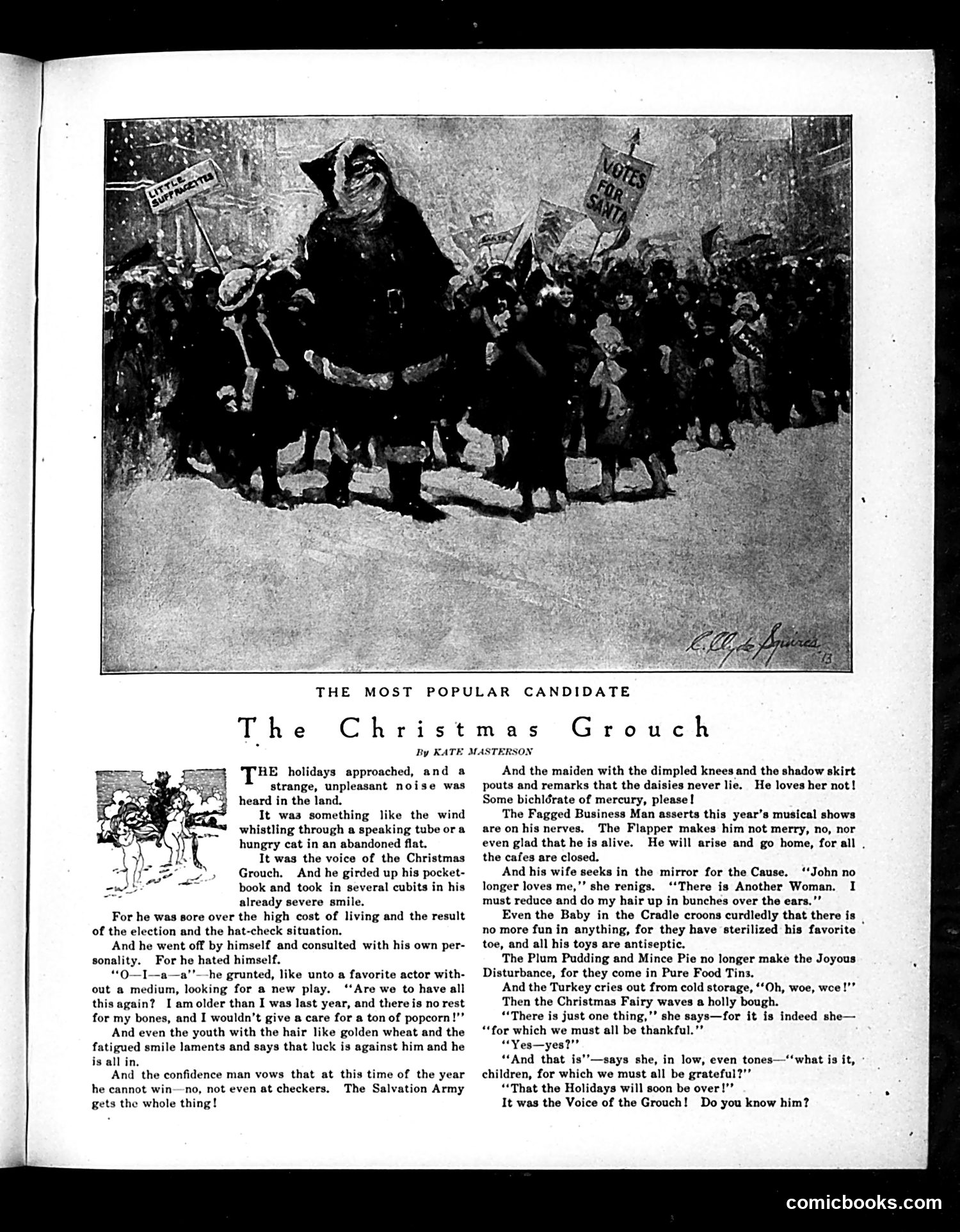
This satirical piece by Kate Masterson uses the personified "Christmas Grouch"—a grotesque figure towering over a crowd—to mock widespread post-holiday depression across American society circa the 1920s. The satire targets multiple grievances: the "high cost of living," election results (appears to reference a recent political outcome), and petty frustrations like "hat-check situation." Masterson catalogs various social types all equally miserable—the fatigued businessman, the flapper, the jilted maiden, even the baby—each complaining despite supposed festive cheer. The joke's punchline: when the "Christmas Fairy" asks what everyone should be grateful for, the collective answer is that "the Holidays will soon be over." It's the Grouch's voice—cynicism and exhaustion—speaking for everyone. The cartoon satirizes American materialism, emotional superficiality, and the gap between holiday expectations and reality. Even children and romance have become joyless in this mechanized, commercialized age.
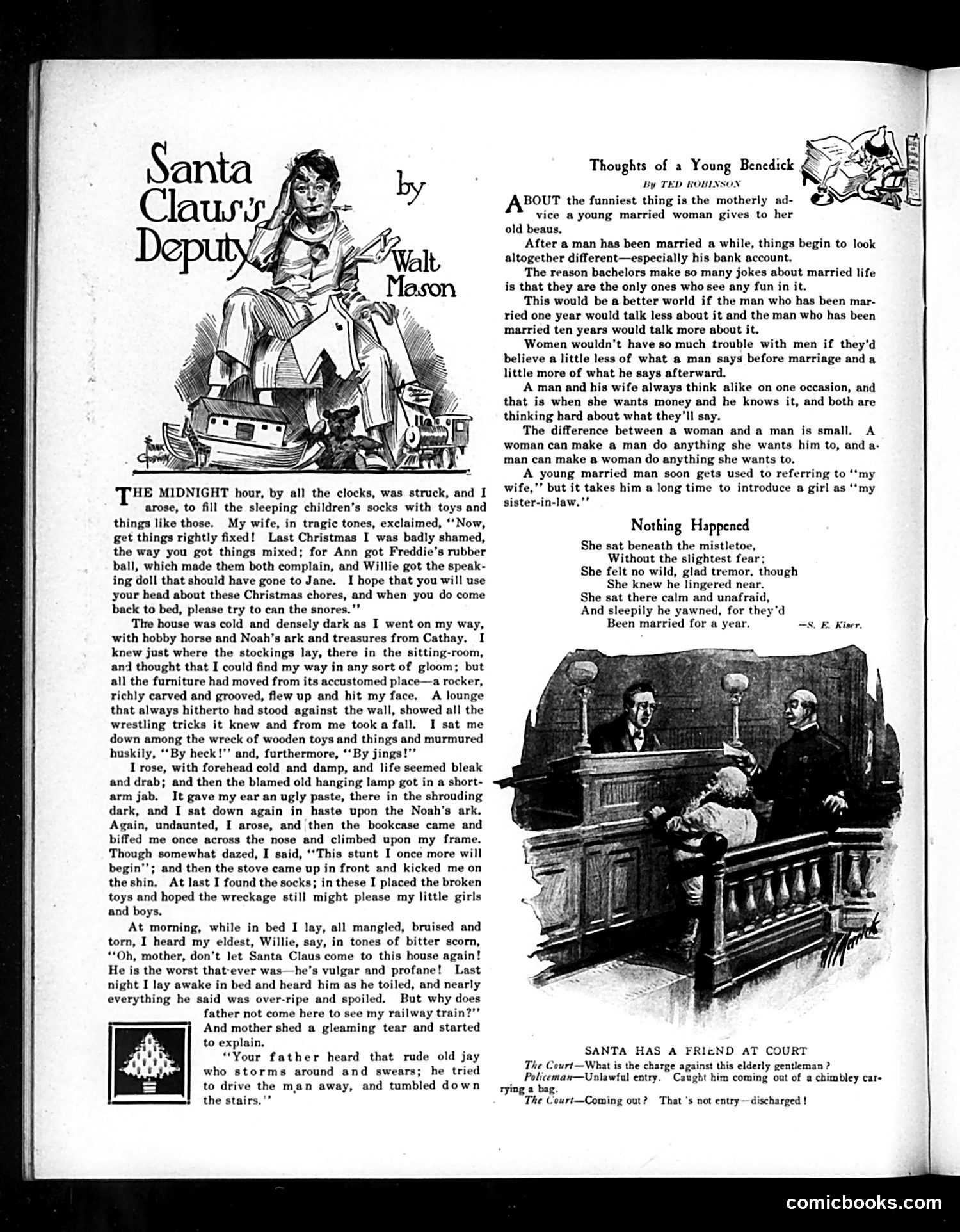
This humorous domestic story satirizes the chaos of Christmas gift-giving and marriage dynamics. A father attempts to fill children's stockings on Christmas Eve but encounters a darkened house where furniture has mysteriously shifted, leading to a slapstick sequence of mishaps—he's hit by a rocking chair, lamp, bookcase, and stove. He manages to place broken toys in the stockings anyway. The joke's punchline reveals the children blame their father, not Santa, for the disaster. The accompanying essay "Thoughts of a Young Benedick" mocks married life generally—bachelors find marriage funny because only they see any humor in it; married men struggle with money and communication. The satire targets both domestic incompetence and the gap between courtship promises and marital reality, using gentle ribaldry typical of Judge magazine's middle-class humor.
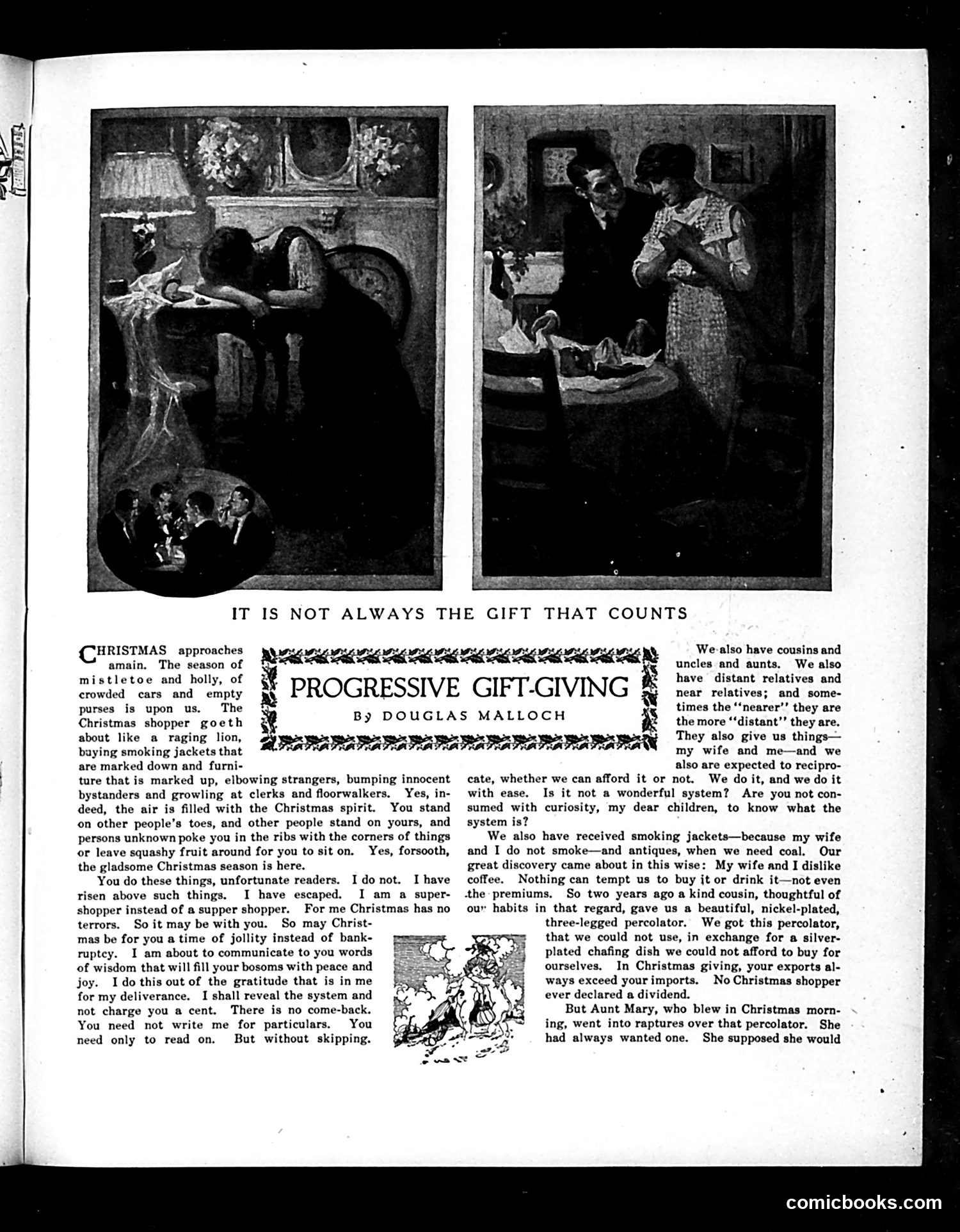
This is a humorous essay-article by Douglas Malloch titled "Progressive Gift-Giving," accompanied by two domestic scenes showing Christmas gift exchanges. **The satire's point:** The author mocks the absurdity of obligatory Christmas gift-giving among extended family. The "system" he reveals is deliberately circular and wasteful—people give unwanted items to relatives who also can't use them (smoking jackets to non-smokers, coffee percolators to people who don't drink coffee, antiques when coal is needed). Yet everyone feels compelled to reciprocate with equally useless gifts. **The social commentary:** This critiques early 20th-century middle-class consumer culture and social obligation. Christmas shopping becomes frantic and exhausting; gift-giving creates financial pressure ("empty purses," "bankruptcy") rather than genuine joy. The "wonderful system" is actually economically irrational—imports never match exports. **The illustrations** show domestic scenes of gift-giving moments, depicting the social awkwardness the text describes. The piece's humor lies in the author positioning himself as having "escaped" this madness through superior shopping strategy, offering satirical "wisdom" to readers—a common Judge magazine format.
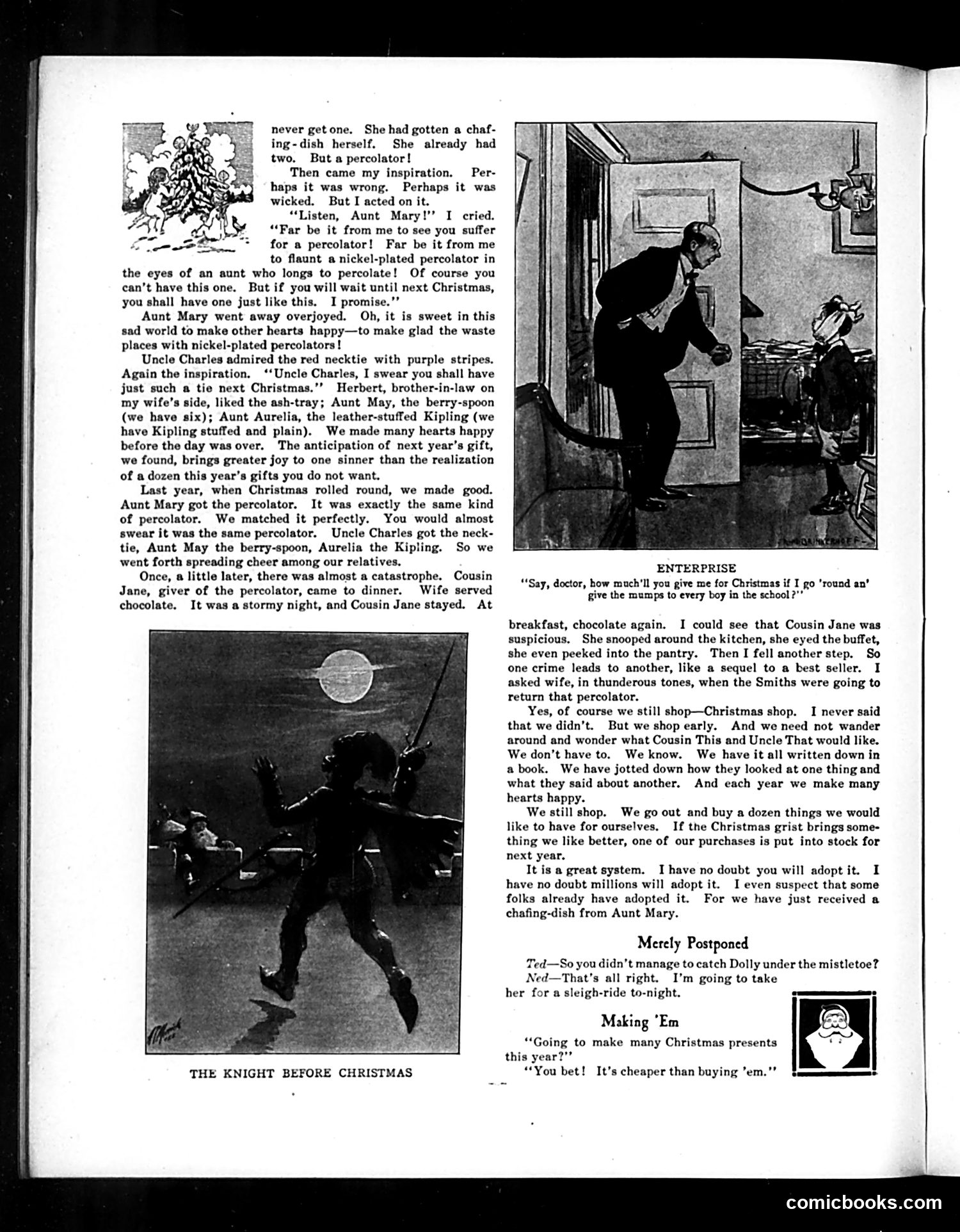
This page presents a satirical Christmas story about gift-giving strategy. The narrator describes a scheme where he promises relatives expensive gifts (a percolator, necktie, etc.) at Christmas, delighting them with *anticipation*. The following year, he delivers identical or nearly identical items, fulfilling his promises while having cost him little emotional investment on the recipients' part. The satire mocks both middle-class materialism and the performative nature of holiday generosity. The joke: anticipation brings more joy than actual possession, so the narrator exploits this psychological gap to appear generous while avoiding genuine expense. The accompanying cartoons extend this theme—"The Knight Before Christmas" (left) shows a figure in winter weather, while "Enterprise" (top right) depicts a cynical boy offering to spread mumps for Christmas money, and "Making 'Em" jokes about homemade gifts as cheaper alternatives to purchased ones. Together, the page satirizes American consumer culture and the commercialization of Christmas during this era.
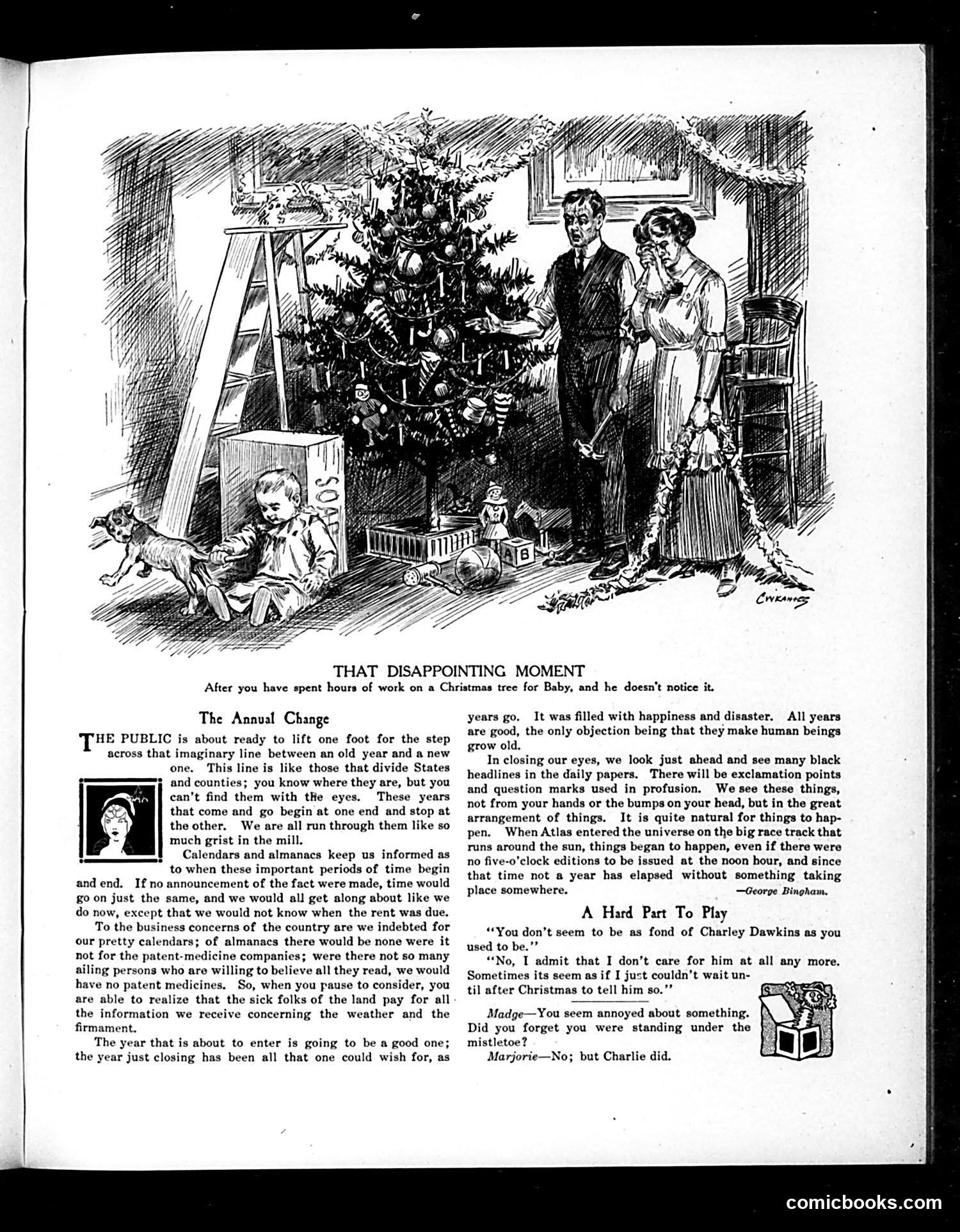
This page from *Judge* magazine contains two separate pieces of holiday humor: **"That Disappointing Moment"** (top cartoon): A satirical illustration showing parents who have elaborately decorated a Christmas tree for their baby, only for the child to ignore it completely and play with simpler toys instead. The joke mocks the gap between parental effort and child indifference—a timeless domestic comedy. **"The Annual Change"** (main article): A philosophical essay about New Year's transitions, arguing that calendar divisions are arbitrary human constructs. The writer notes we only know years have "changed" because businesses and patent-medicine companies distribute calendars to advertise themselves. The piece's gentle satire targets commercial manipulation and the illusion that arbitrary dates matter. **"A Hard Part To Play"** (dialogue): Two brief exchanges about Christmas romance. One woman admits she's waiting until *after* Christmas to break up with her boyfriend. The second joke plays on the mistletoe tradition—a man forgets to kiss a woman standing beneath it, disappointing her. Both highlight awkward holiday social dynamics.
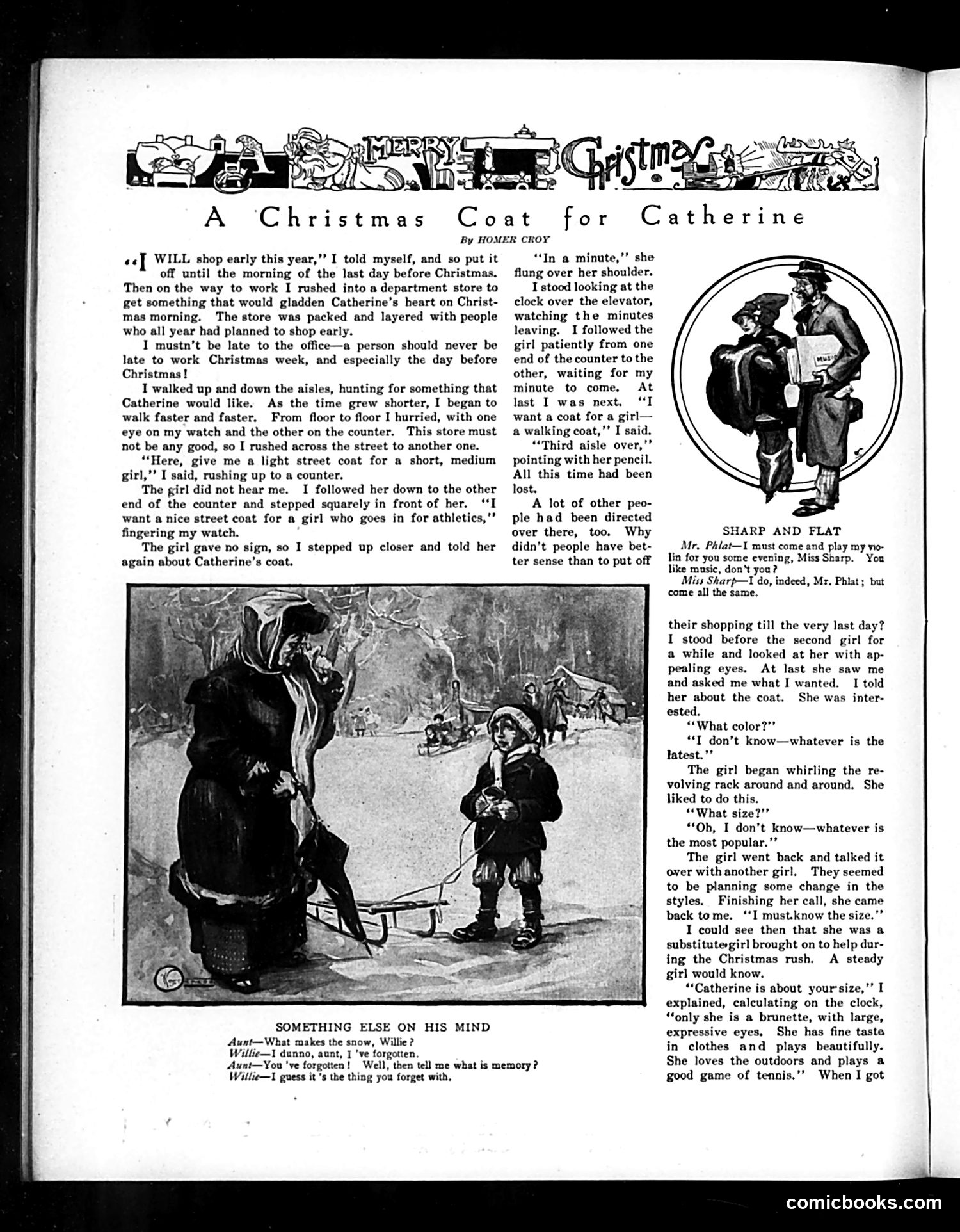
This is a humorous short story about last-minute Christmas shopping, not political satire. The narrator rushes to buy a coat for Catherine on December 24th—despite his earlier vow to shop early—and encounters the chaos of department stores on the final shopping day. The main joke centers on the narrator's inefficiency: he's vague about what he wants ("whatever is latest," "whatever is most popular"), impatient (constantly checking his watch), and oddly verbose when finally asked details, describing Catherine's personality and tennis skills rather than her actual measurements. The small cartoon "Sharp and Flat" at bottom right is a separate pun: Mr. Phlat invites Miss Sharp to hear him play violin, and she accepts—but adds "come all the same," implying his music is so bad she's inviting him anyway (flat = musically off-key). The page reflects early 20th-century consumer culture anxieties: procrastination, retail chaos, and gender dynamics in customer service.
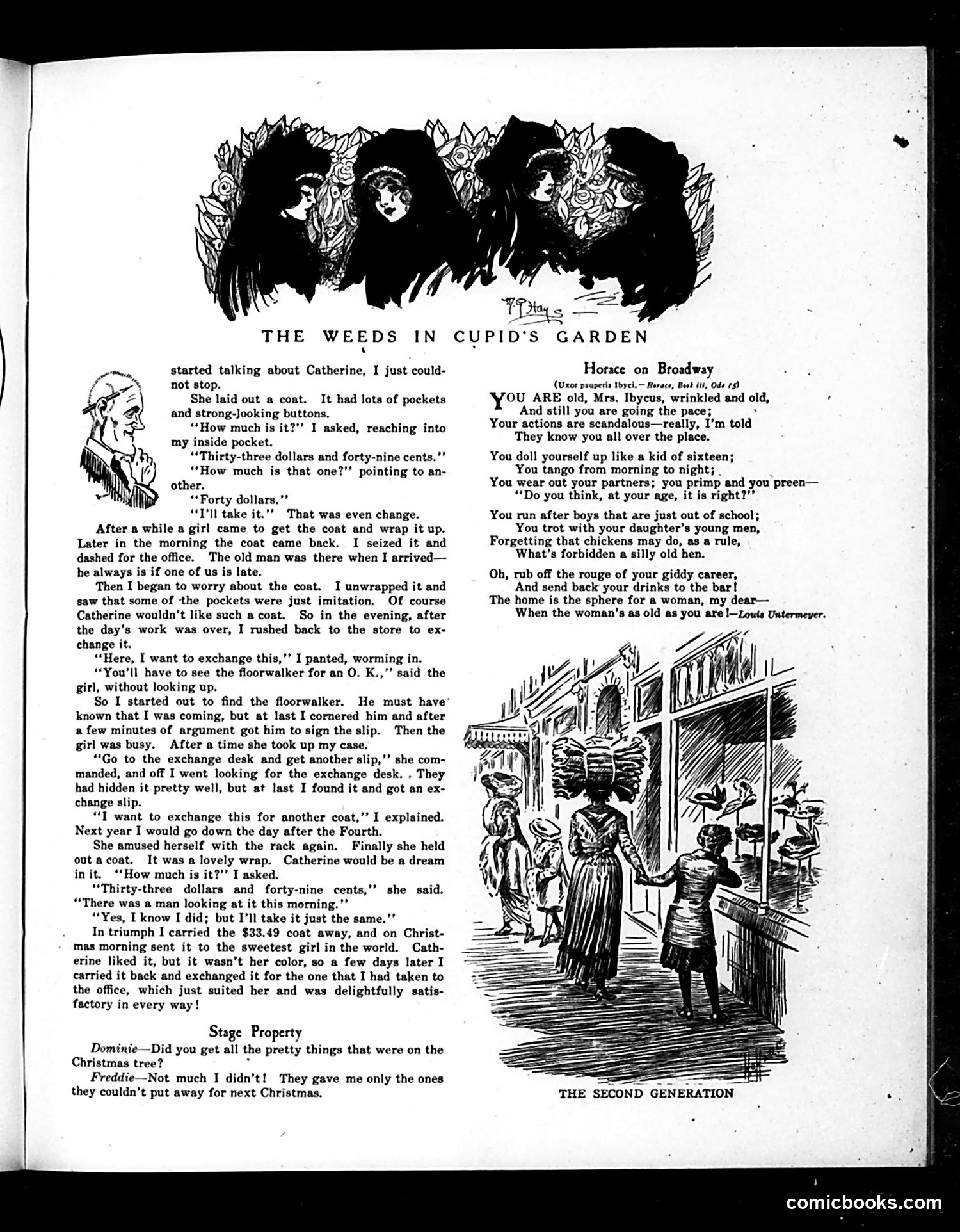
This page contains two distinct pieces of social satire: **Left side:** A humorous short story about a man's frustrating experience exchanging a women's coat, satirizing bureaucratic retail procedures. The joke centers on the absurd runaround—multiple clerks, signatures, and desk locations required for a simple exchange, suggesting department store inefficiency. **Right side:** "Horace on Broadway," a poem mocking an aging woman who behaves like a young person. It references an ancient Horace poem, adapting classical themes to modern Broadway society. The satire targets "scandalous" older women who dress youthfully (using rouge/makeup), go out dancing ("tango"), pursue younger men, and neglect domestic duties. The poem's moral: elderly women should stay home, not act like "silly old hens." **The illustration** "The Second Generation" (bottom right) appears to show a street scene but its specific satirical meaning is unclear from the image alone. The content reflects early 20th-century attitudes about age, gender propriety, and women's social roles.
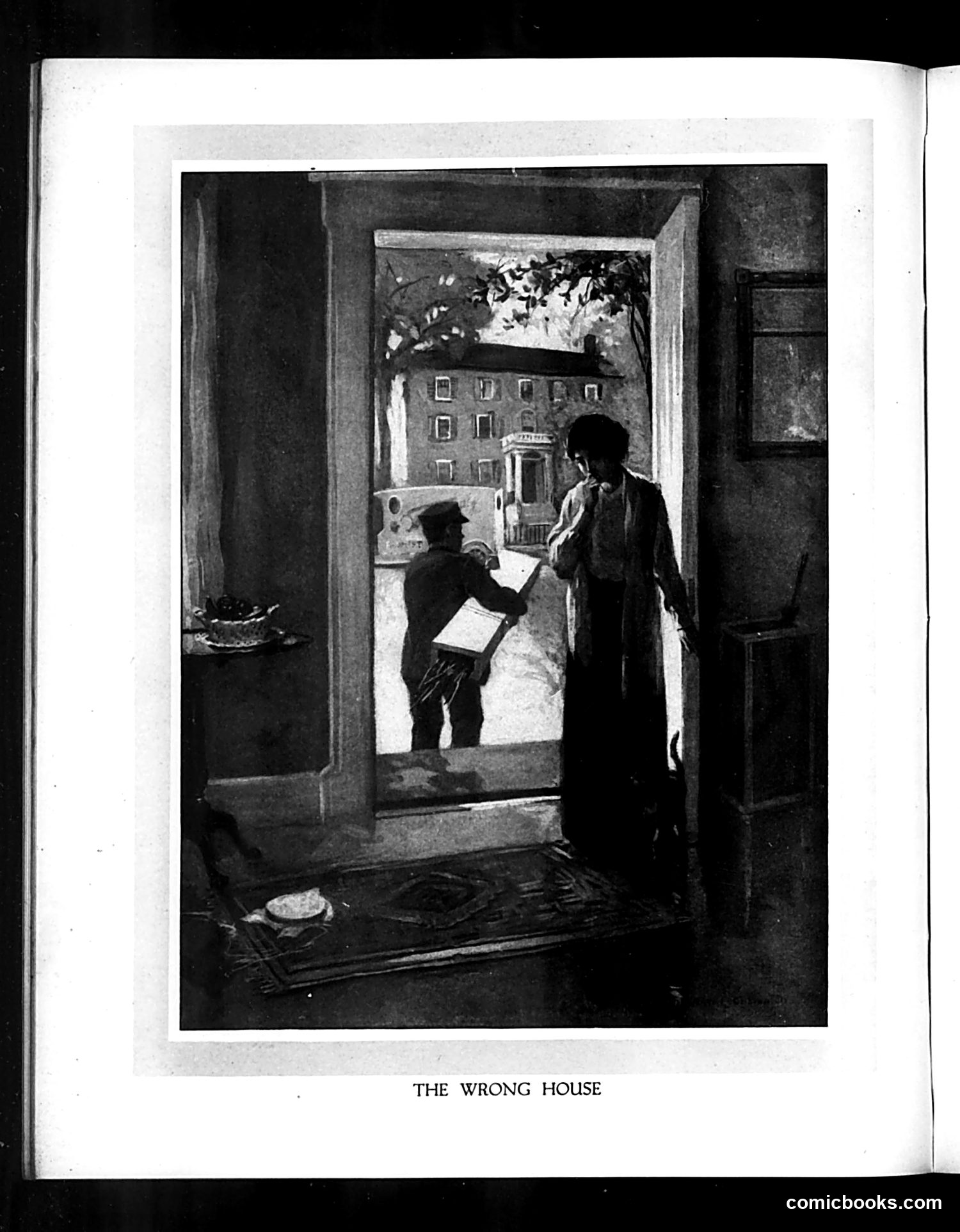
This appears to be a comedic illustration about mistaken identity or a delivery error. The image shows two figures at a doorway: one person standing inside a modest residential interior, and another (appearing to be a delivery person or messenger) at the threshold, holding what looks like documents or packages. Beyond the doorway, an urban street with buildings is visible. The caption "THE WRONG HOUSE" suggests the humor derives from someone arriving at an incorrect address—a common situational comedy theme. Without additional context from the Judge magazine issue, the specific satirical target (if any) remains unclear, though it may reference contemporary social commentary about urban life, class differences, or bureaucratic mishaps that would have resonated with early-to-mid 20th century readers.
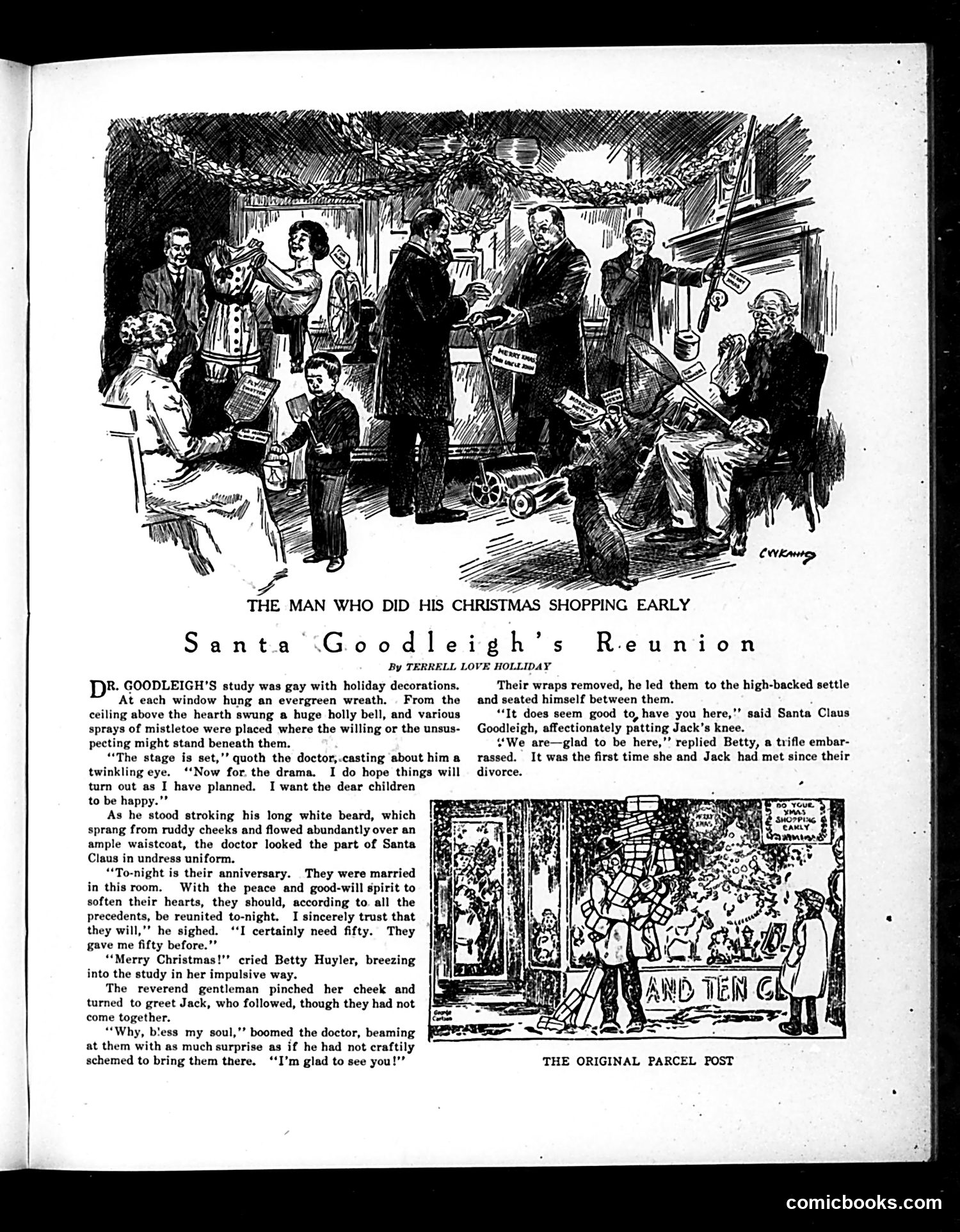
This is a short story illustration titled "Santa Goodleigh's Reunion" by Terrell Love Holliday, not a political cartoon. The narrative depicts Dr. Goodleigh, a benevolent older gentleman dressed as Santa Claus, orchestrating a Christmas Eve reunion between his divorced acquaintances Betty Huyler and Jack. The doctor has secretly arranged for them both to appear at his holiday gathering, hoping that the festive atmosphere, mistletoe, and "peace and good-will spirit" will reconcile them. The satire targets sentimental Victorian-era matchmaking: the doctor admits he "craftily schemed" their meeting and needs "fifty" dollars (apparently his fee for such interventions), having previously earned fifty before. The joke rests on the contrast between his innocent Santa persona and his calculated manipulation—using holiday sentimentality and seasonal props to achieve romantic outcomes for profit. The lower panel, "The Original Parcel Post," appears to be a separate, unrelated holiday illustration.
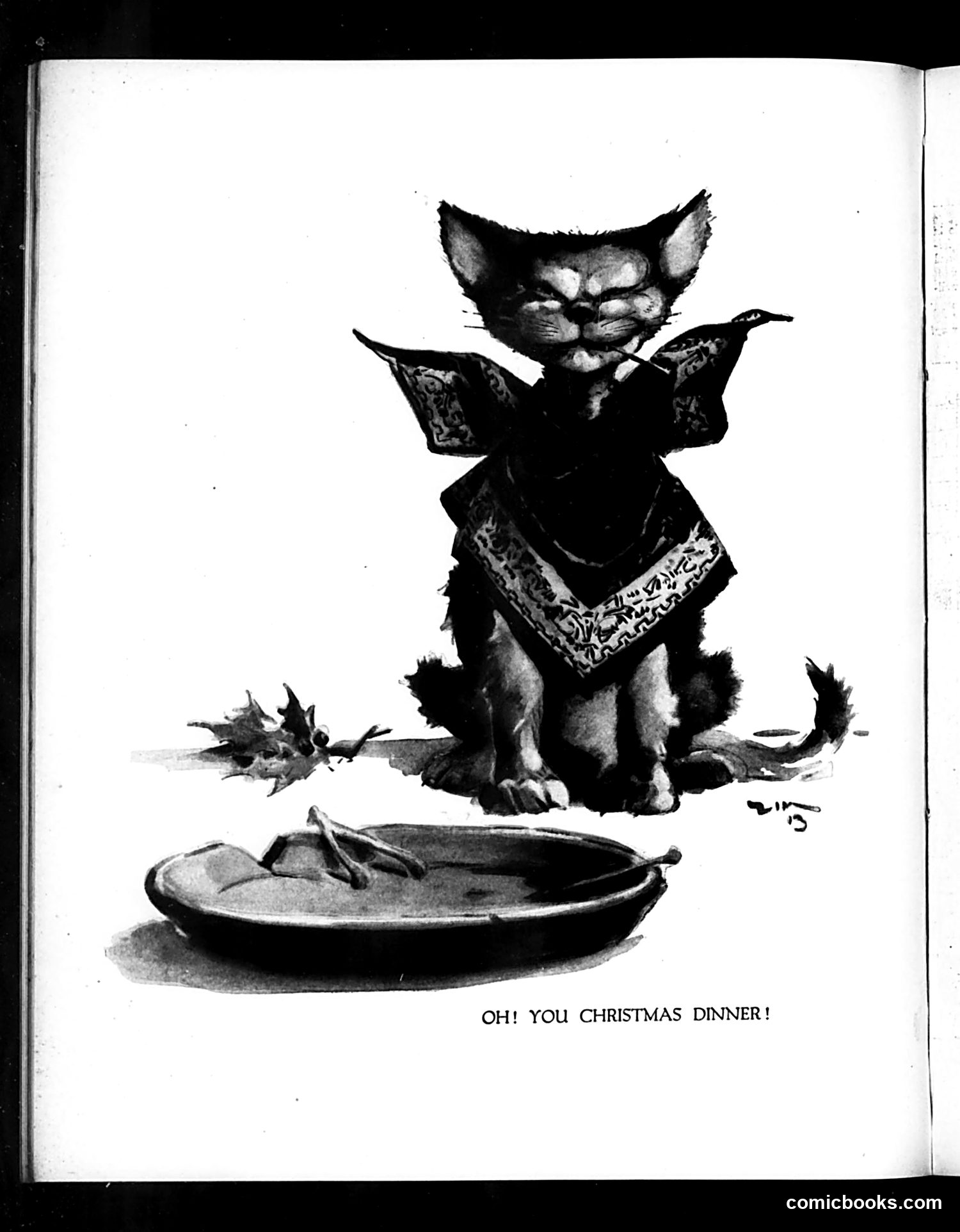
This is a single-panel cartoon from *Judge* magazine featuring a cat dressed in ornate Asian robes, gazing hungrily at an empty plate below it. The caption reads "OH! YOU CHRISTMAS DINNER!" The joke appears to be a straightforward visual pun: the cat is addressing the plate as if speaking to dinner, expressing anticipation or desire for a meal. The elaborate clothing gives the cat an exaggerated, anthropomorphic quality meant to enhance the humor. Without additional context about the publication date, the specific cultural references in the Asian-style robes remain unclear. The cartoon's humor relies primarily on the absurdist image of a dressed-up cat eyeing an empty dinner plate, a fairly timeless comedic trope rather than specific political satire.
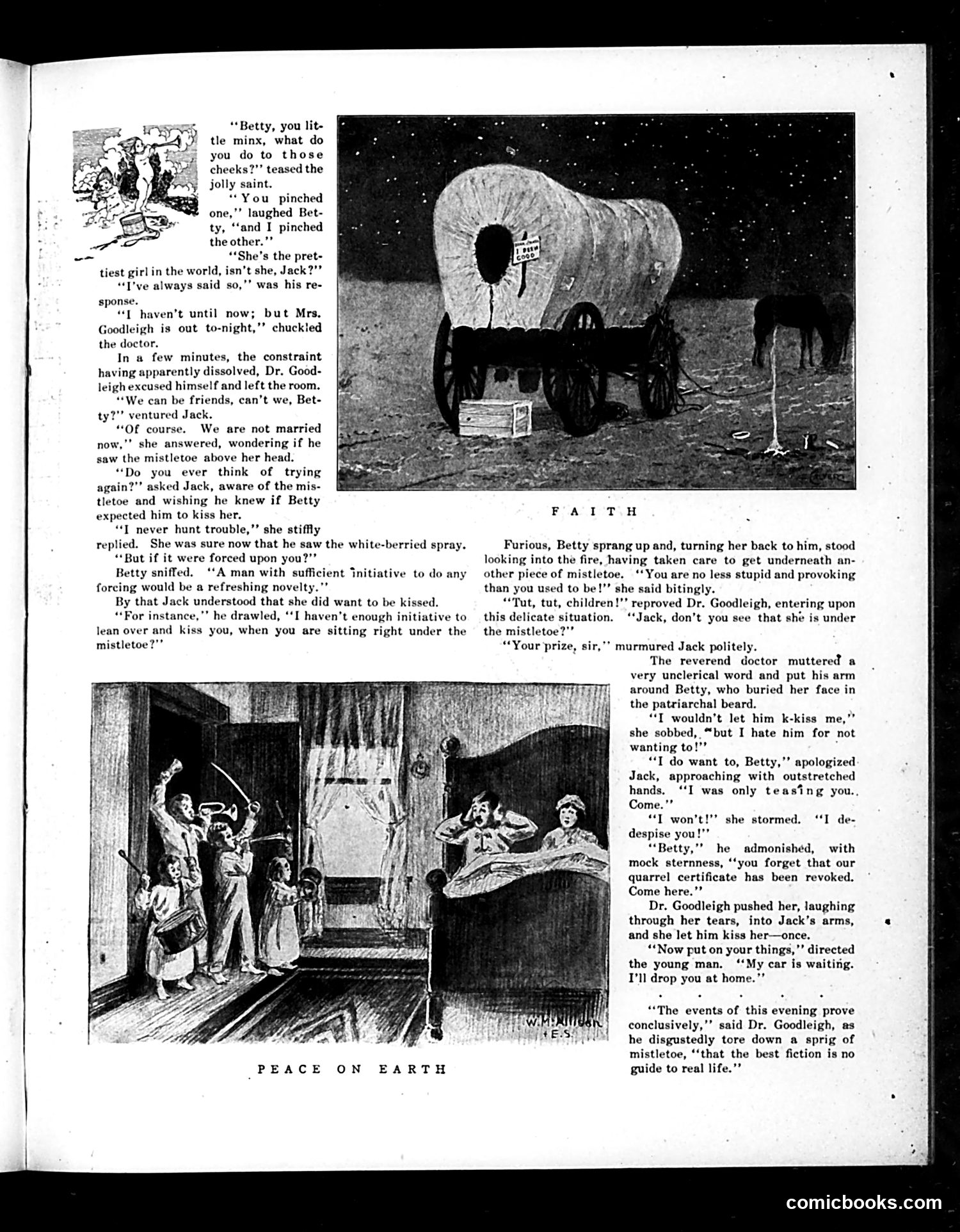
This is a humorous domestic comedy centered on **mistletoe tradition** during Christmas season. The narrative follows Betty and Jack, apparently estranged or formerly engaged ("our quarrel certificate has been revoked"), as they navigate flirtation under the mistletoe while visiting Dr. Goodleigh. The satire targets **romantic fiction conventions**. Betty and Jack engage in coy, indirect courtship—full of misunderstandings and false pride—mimicking Victorian romance novel tropes. The joke culminates when Dr. Goodleigh tearfully removes the mistletoe, lamenting that "the best fiction is no guide to real life." The point: real human relationships are messier and less graceful than sentimental novels suggest. Betty claims to despise Jack while simultaneously positioning herself under mistletoe to be kissed, illustrating the gap between romantic fantasy and actual human behavior. The cartoons depicting the scenes support this romantic comedy narrative visually.
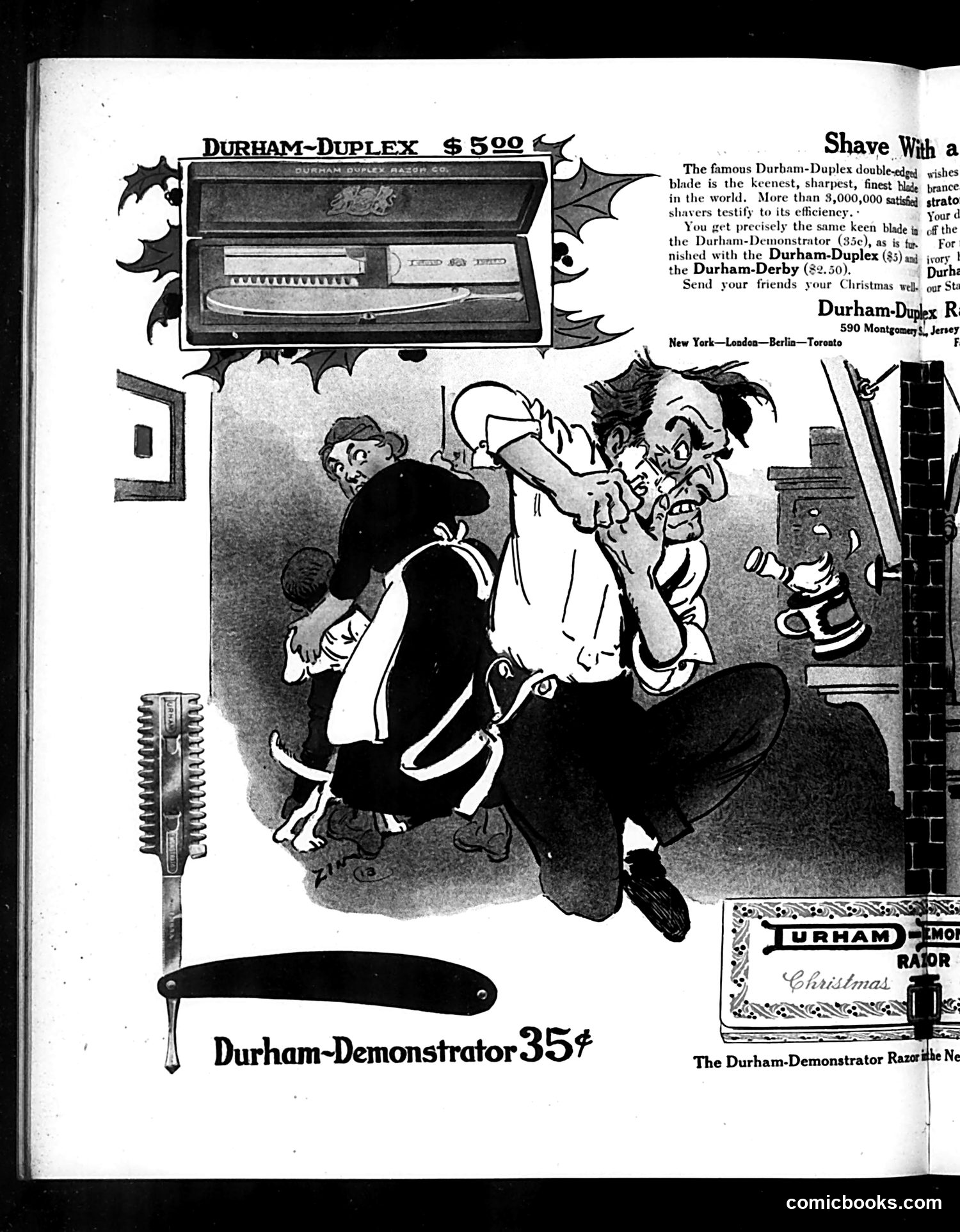
This page is primarily **advertising content** for Durham razor products, not political satire. The top section advertises the Durham-Duplex safety razor ($5.00), highlighting that it has the same sharp blade as the cheaper Durham-Demonstrator model (35¢). The cartoon below depicts a **domestic/slapstick scene**: a man being shaved by what appears to be an aggressive barber or amateur, with exaggerated violence suggested by the flying soap and chaotic composition. The caricatured figures and wild action are typical comedic illustration style of early 20th-century advertising. The joke is straightforward: **quality shaving at different price points**—you don't need to spend more for a good blade. The cartoonish violence humorously emphasizes the sharpness and effectiveness of the razor. This is essentially a **product advertisement masquerading as editorial content**, common in magazines of this era.
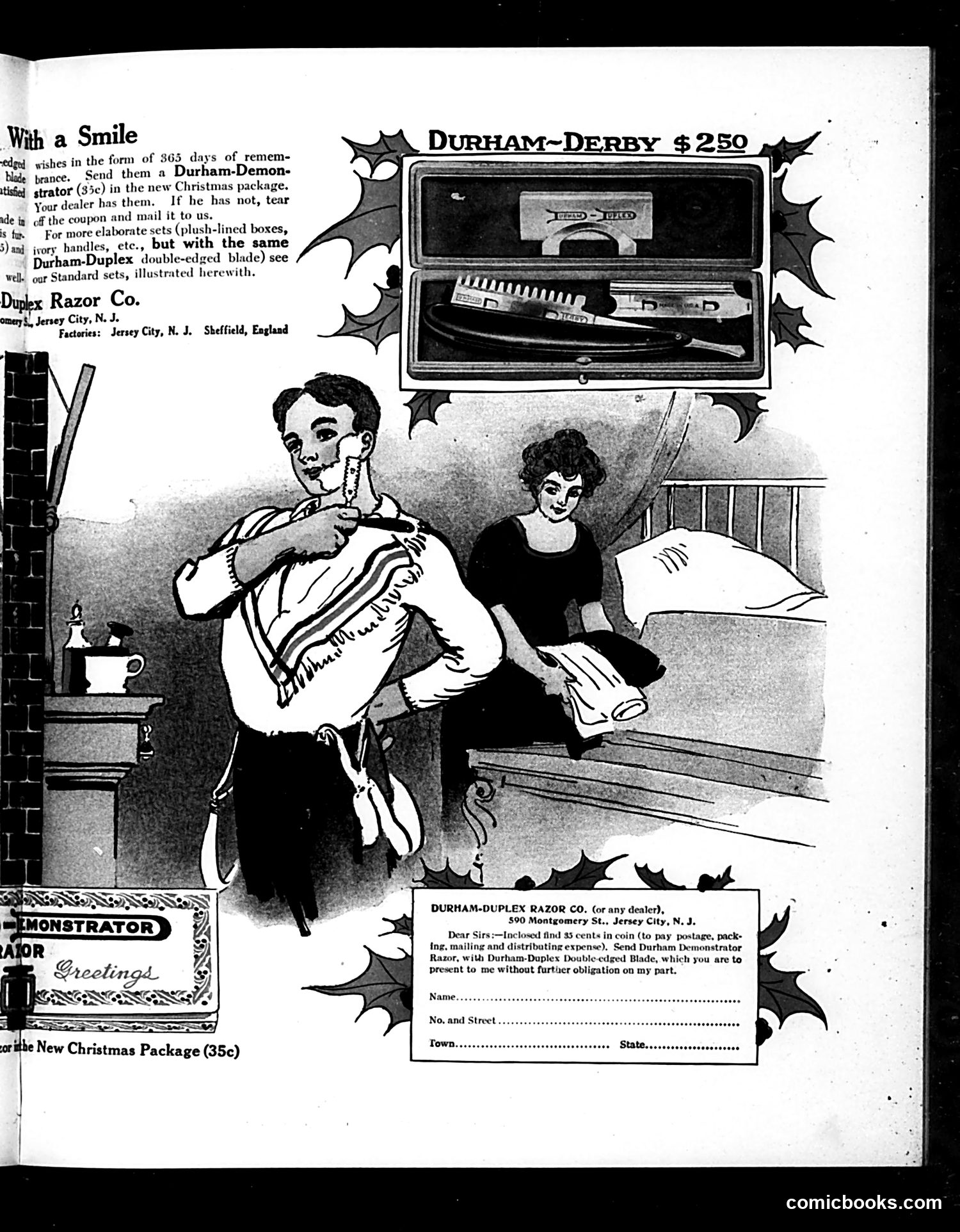
This page is primarily **advertising** for Durham-Duplex razors, not political satire. The illustration depicts a domestic scene where a man is shaving a baby (or infant) while a woman watches from a bed—presenting razor shaving as a humorous, absurd gift idea. The "joke" relies on early 20th-century advertising humor: the impossibility of the scenario creates memorable comedy to promote the product. The text promotes the "Durham Demonstrator" razor as a 35-cent Christmas gift and includes a mail-in coupon. References include: - **Durham-Duplex and Durham-Derby** razor brand names - Factories listed in Jersey City, N.J. and Sheffield, England - Magazine appears to be *Judge* (visible at bottom) The satire, if any exists, is gentle product-promotion humor typical of vintage advertising—not political commentary. The page demonstrates how early commercial ads used absurdist scenarios and visual gags to capture reader attention.
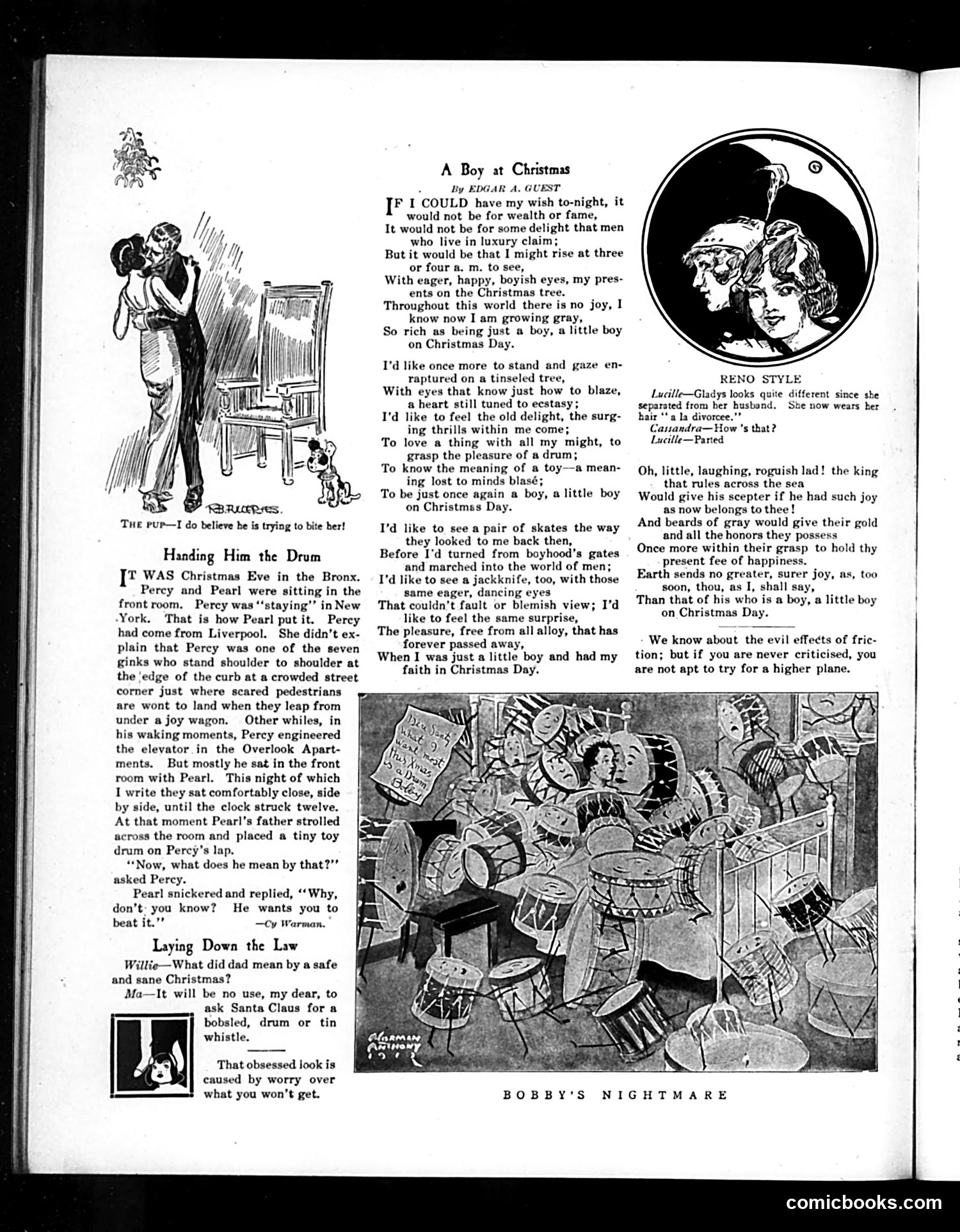
This page contains Christmas-themed humor typical of early 20th-century American satire: **"Handing Him the Drum"**: A working-class comedy about Percy, an immigrant from Liverpool working as an elevator operator, courting Pearl in the Bronx. Her father gives Percy a toy drum—a crude hint to "beat it" (leave). The joke plays on class anxiety and xenophobia toward Irish/British immigrants in New York. **"A Boy at Christmas"**: Edgar A. Guest's sentimental poem romanticizing childhood wonder at Christmas, contrasting youthful joy with adult cynicism. **"Reno Style"**: A brief joke about divorce (Reno, Nevada being a divorce destination), mocking women's hairstyles changing after separation—reflecting period attitudes toward divorce as scandalous. **"Laying Down the Law"**: A parent warns their child not to request toys, implying economic hardship—relevant to the era's economic anxieties. **"Bobby's Nightmare"**: An illustration (caption visible) depicts childhood anxiety about receiving gifts. The page reflects Depression-era concerns: immigration, economic uncertainty, and class distinction.
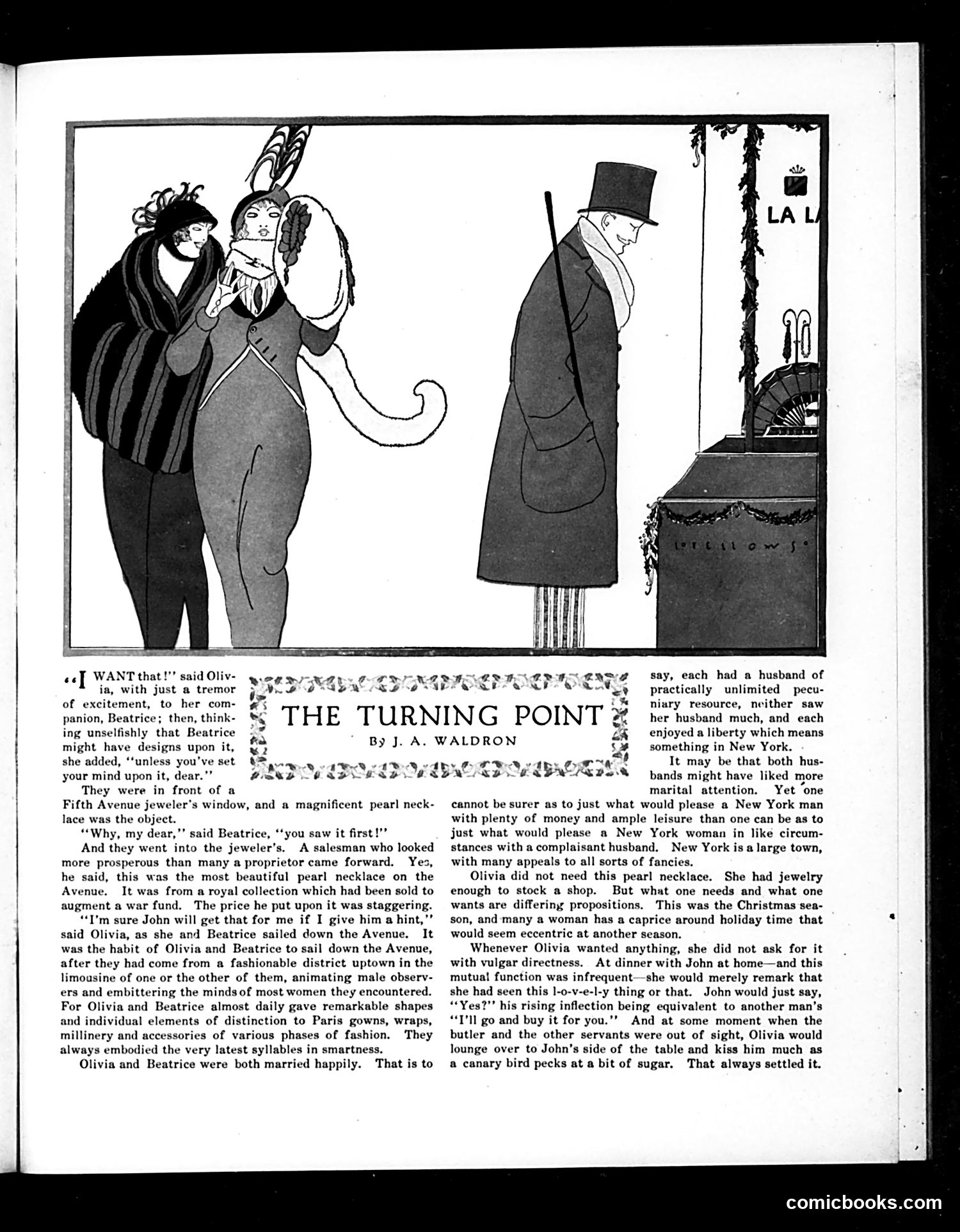
This story-cartoon satirizes wealthy New York society women of the early 20th century. Olivia and Beatrice are fashionable socialites with wealthy but inattentive husbands—men with "practically unlimited pecuniary resource" who are absent and indifferent to their wives' needs. The satire targets the transactional nature of their marriages: Olivia manipulates her husband John by casually mentioning desired luxuries at dinner, then securing his compliance through affection ("kiss him much as a canary bird pecks at a bit of sugar"). The text mocks both the women's superficiality—their obsession with the latest Paris fashions and jewelry—and the men's detachment, suggesting New York's wealthy are so distracted by leisure and "many appeals to all sorts of fancies" that genuine marital connection is impossible. The "turning point" likely refers to some crisis emerging from this hollow arrangement, though the full story would require reading further.
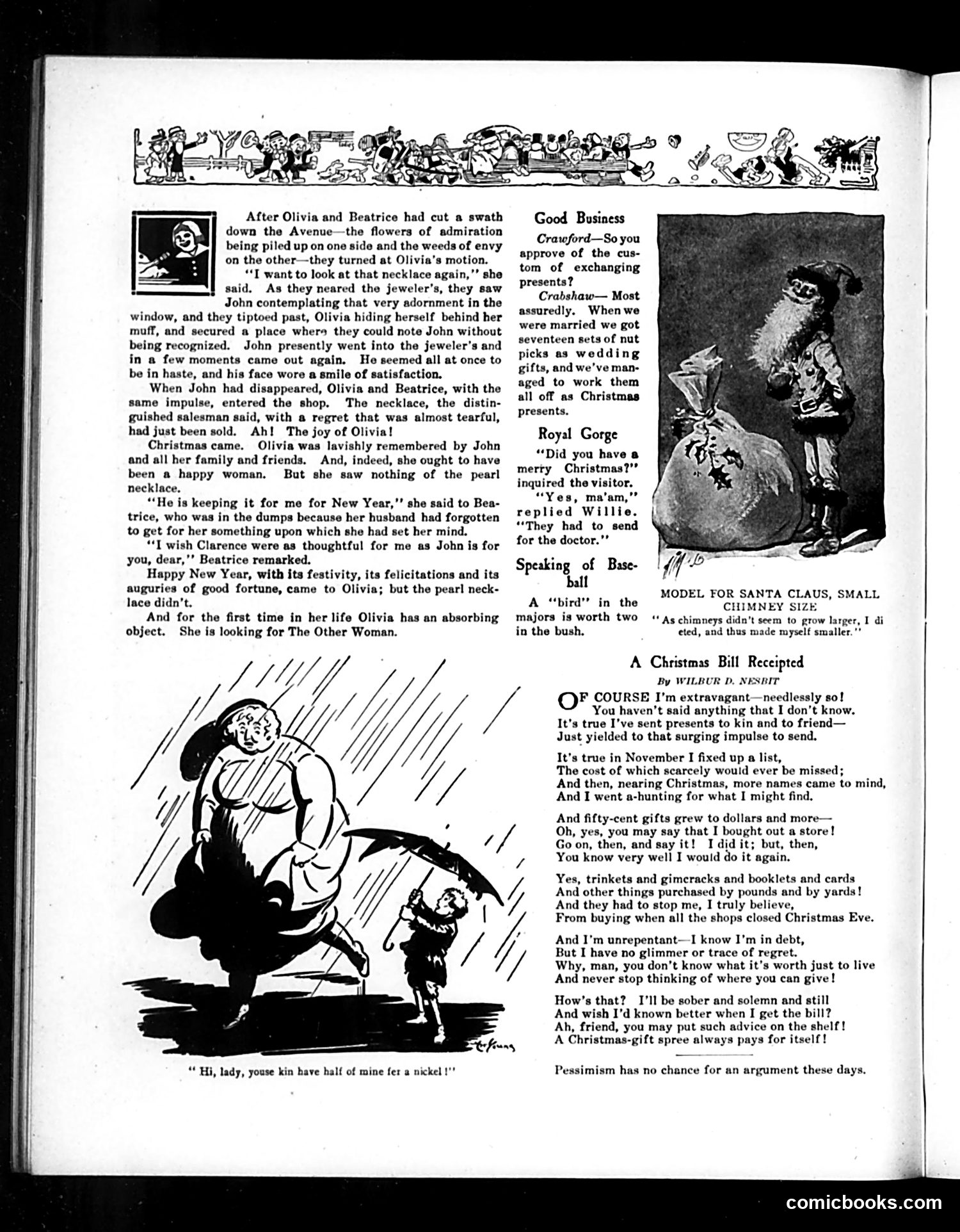
This Judge magazine page contains two distinct pieces satirizing Christmas spending habits circa early 1900s. **Top narrative**: A romantic comedy about Olivia, who spies her suitor John buying an expensive pearl necklace at a jeweler's window. She assumes it's for her. At Christmas, John gives her lavish gifts—but not the necklace. Olivia becomes obsessed with finding "The Other Woman," assuming he kept the necklace for a rival. The joke: her romantic fantasy collapses into jealous suspicion. **Bottom poem "A Christmas Bill Receipted"** by Wilbur D. Nesbit: The speaker admits compulsive holiday overspending—gifts that ballooned from a planned budget to excessive purchases. Rather than expressing regret, he celebrates this impulse as morally worthwhile, concluding "A Christmas-gift spree always pays for itself!" **The satire**: Both pieces mock middle-class Americans' inability to control Christmas spending despite financial anxiety—treating wasteful generosity as virtue rather than vice. The magazine critiques this self-deluding justification of holiday excess.
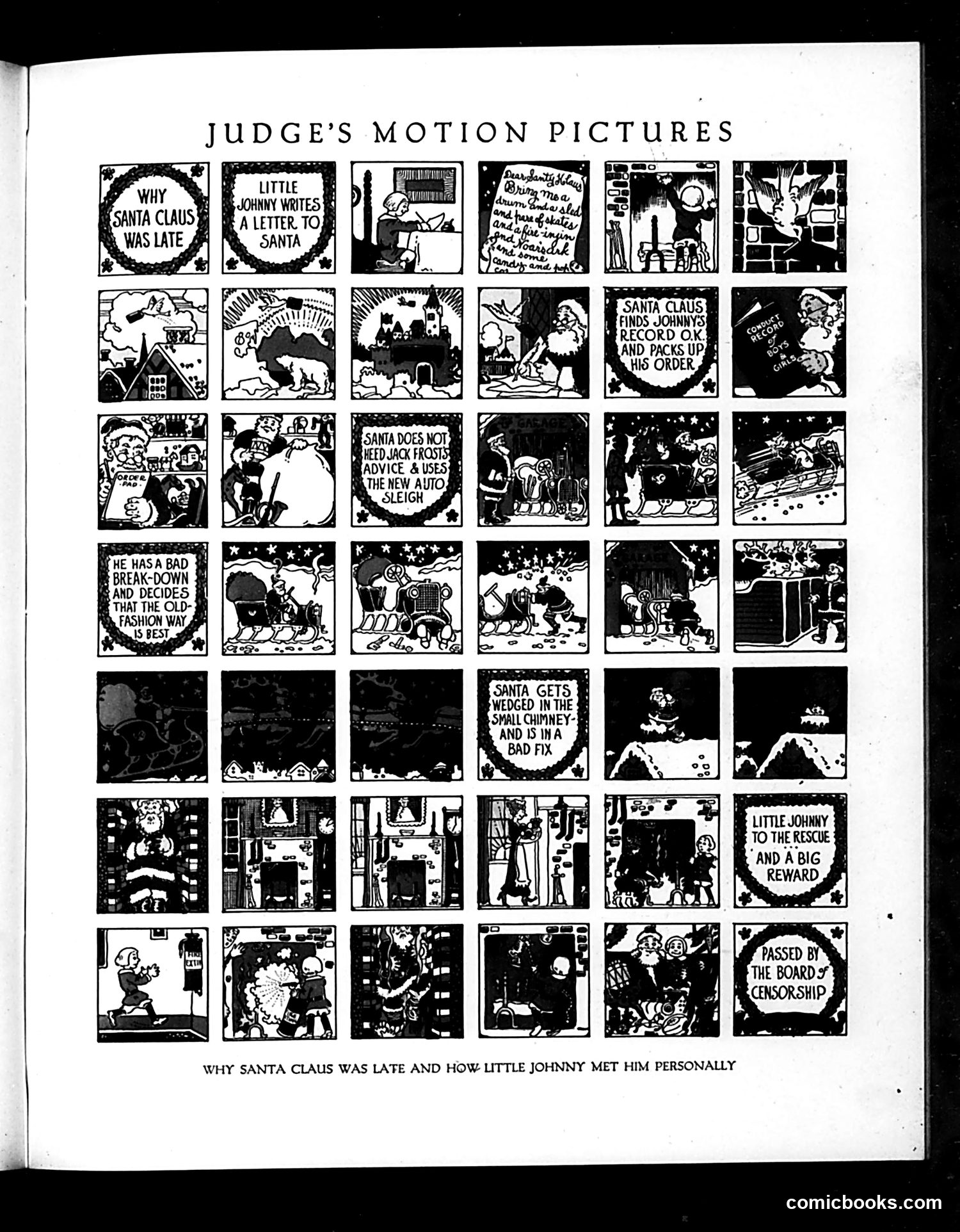
This is a multi-panel comic strip titled "Why Santa Claus Was Late and How Little Johnny Met Him Personally." The narrative follows a child's letter to Santa and the subsequent adventures explaining Santa's delayed Christmas arrival. The strip satirizes early 20th-century concerns: automobiles (Santa abandons his sleigh for a car), modern mishaps (a breakdown), and domestic chaos. One panel references "Jack Frosts" and an "auto sleigh," mocking contemporary technology replacing tradition. The humor derives from Santa's incompetence with modern inventions and the ironic contrast between magical Christmas expectations and mundane mechanical failures. The final caption notes the strip "passed by the board of censorship," suggesting Judge's editors flagged content for approval—likely the irreverent treatment of Santa Claus as fallible. The strip represents vintage American comic satire targeting both childhood nostalgia and industrial-age anxieties.
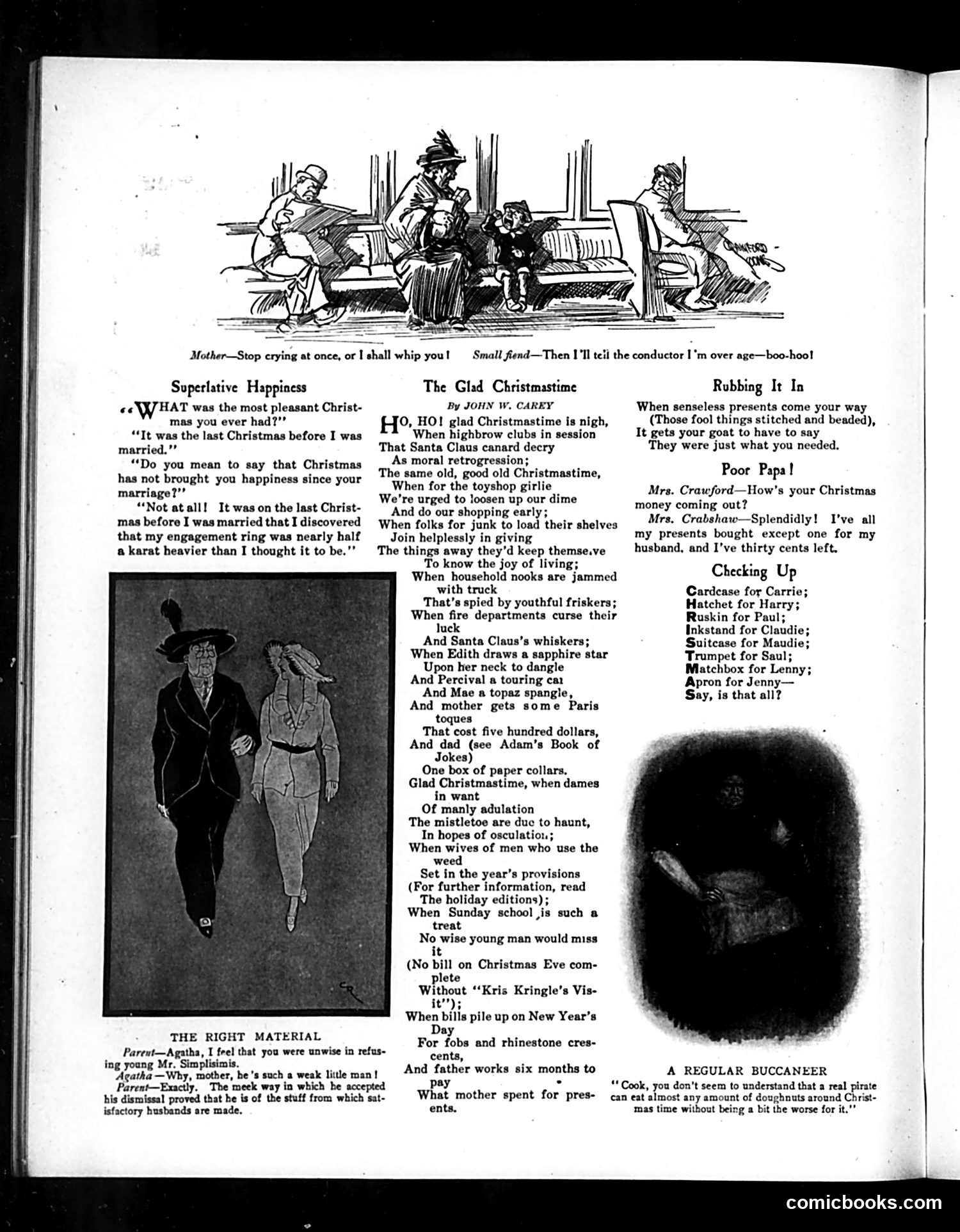
This page contains multiple satirical pieces mocking Christmas commercialism and domestic life in early 20th-century America. **"Superlative Happiness"** jokes that a woman's happiest Christmas was *before* marriage—when she discovered her engagement ring was heavier than expected, suggesting wives value material goods over marital contentment. **"The Right Material"** mocks courtship by suggesting a weak, submissive man makes the best husband because he'll accept dismissal without complaint. **"The Glad Christmastime"** (the long poem) is the page's main satire, cataloging Christmas's commercialism: excessive gift-buying, wasteful spending (mother's $500 Paris hats versus father's paper collars), mistletoe-hunting wives, fire departments overwhelmed by decorations, and—the poem's bitter payoff—fathers working six months to pay for mothers' extravagant presents. The shorter pieces reinforce this theme: the drudgery of obligatory gift-giving, children's misbehavior, and financial strain following the holiday. The satire targets conspicuous consumption and gendered economic inequality—wives spend freely while husbands labor to pay debts.
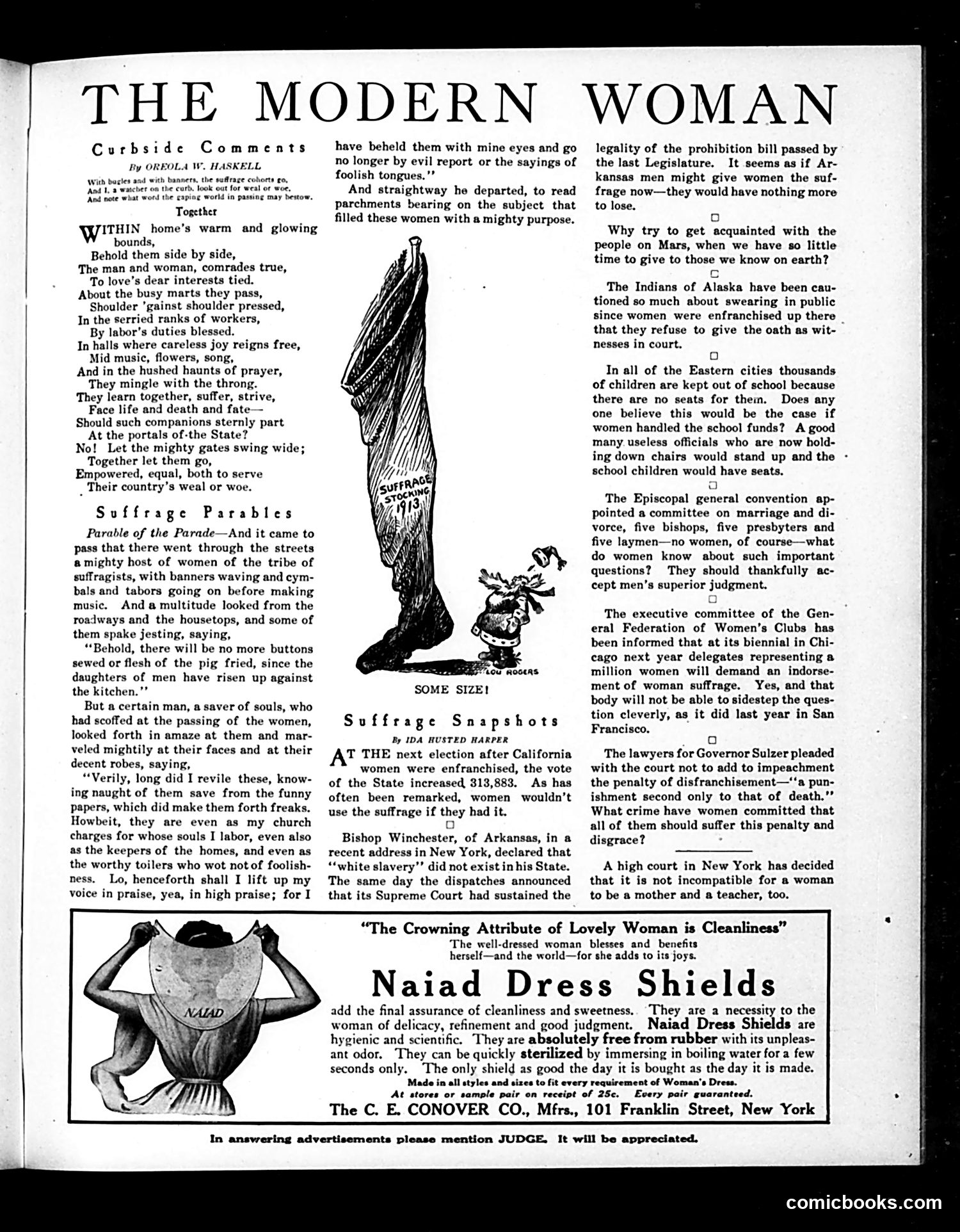
This page advocates for **women's suffrage** through poetry, satirical anecdotes, and commentary. The main cartoon depicts a giant suffragist woman towering over a tiny opposing figure labeled "SOME SIZE!"—visual mockery of anti-suffrage arguments. The "Suffrage Parables" section uses biblical language to mock skeptics who feared enfranchised women would neglect domestic duties. The parable shows a doubter witnessing a suffrage parade and realizing these women are respectable citizens, not "freaks." "Suffrage Snapshots" by Ida Husted Harper presents pro-suffrage arguments: California's voter registration increased after women gained voting rights; women's involvement could improve school funding and reduce corruption; yet male-dominated institutions like the Episcopal Church exclude women from important decisions. The underlying message: **women deserve equal political participation**. The page ridicules opponents' fears while highlighting practical benefits of female enfranchisement—better resource allocation, stronger institutions, and basic justice.
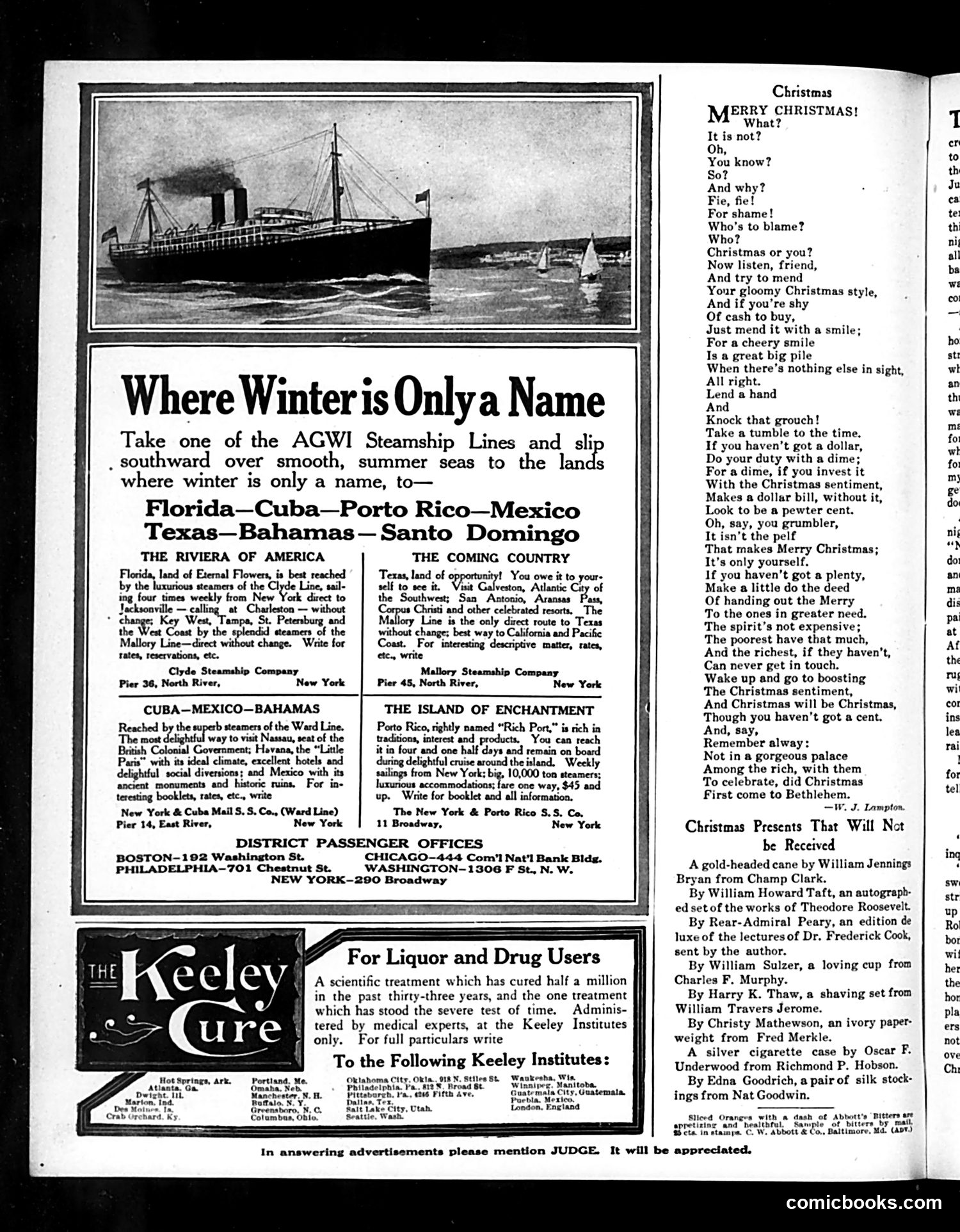
This page contains Christmas-themed advertisements and editorial content from *Judge* magazine. The main visual element is a steamship photograph accompanying cruise line ads promoting winter travel to warm destinations (Florida, Cuba, Mexico) where "winter is only a name." The editorial poem "Merry Christmas!" is a moralistic piece encouraging readers to adopt charitable Christmas spirit despite economic hardship—"mend it with a smile" if lacking cash, share with "the ones in greater need." This reflects early-20th-century genteel sentimentalism about Christmas obligation. The small humor section "Christmas Presents That Will Not be Received" satirizes contemporary political figures: William Jennings Bryan (three-time presidential candidate), Theodore Roosevelt (president), Admiral Peary (explorer), Dr. Frederick Cook (controversial explorer), and William Sulzer (New York politician). The joke implies these figures are so disliked or their reputations so damaged that even as gifts, no one would accept presents from or associated with them. The page is primarily commercial—steamship and medical treatment advertising dominates.
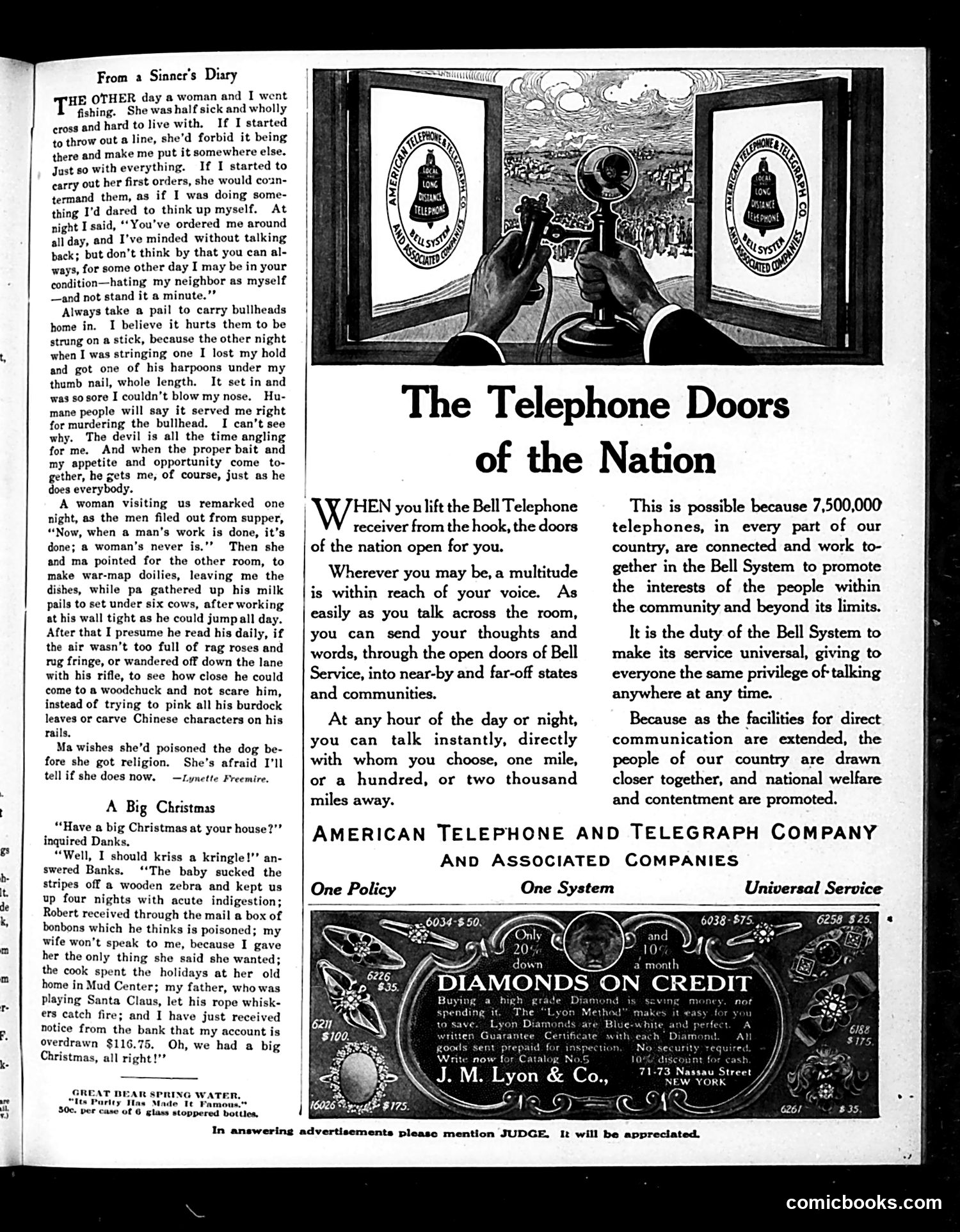
This page contains two distinct elements: **Left side ("From a Sinner's Diary"):** Humorous, seemingly autobiographical sketches by Lynette Freemire about domestic life—a fishing trip with a controlling woman, proper treatment of bullheads, gender role observations, and a comedic account of a disastrous Christmas. The humor relies on relatable domestic situations and mild social commentary about marriage dynamics. **Right side:** A full-page advertisement for American Telephone and Telegraph Company promoting the Bell System's nationwide telephone network. The ad uses idealistic language about connection and national unity, positioning telephones as democratic tools that bring Americans together. **Context for modern readers:** This represents early-20th-century attitudes toward emerging technology as nation-building infrastructure, alongside typical period humor about marital conflict and domestic frustration. The advertisement exemplifies how corporations used patriotic rhetoric to market new technologies. The page is primarily advertising with humor content—typical of Judge's revenue model.
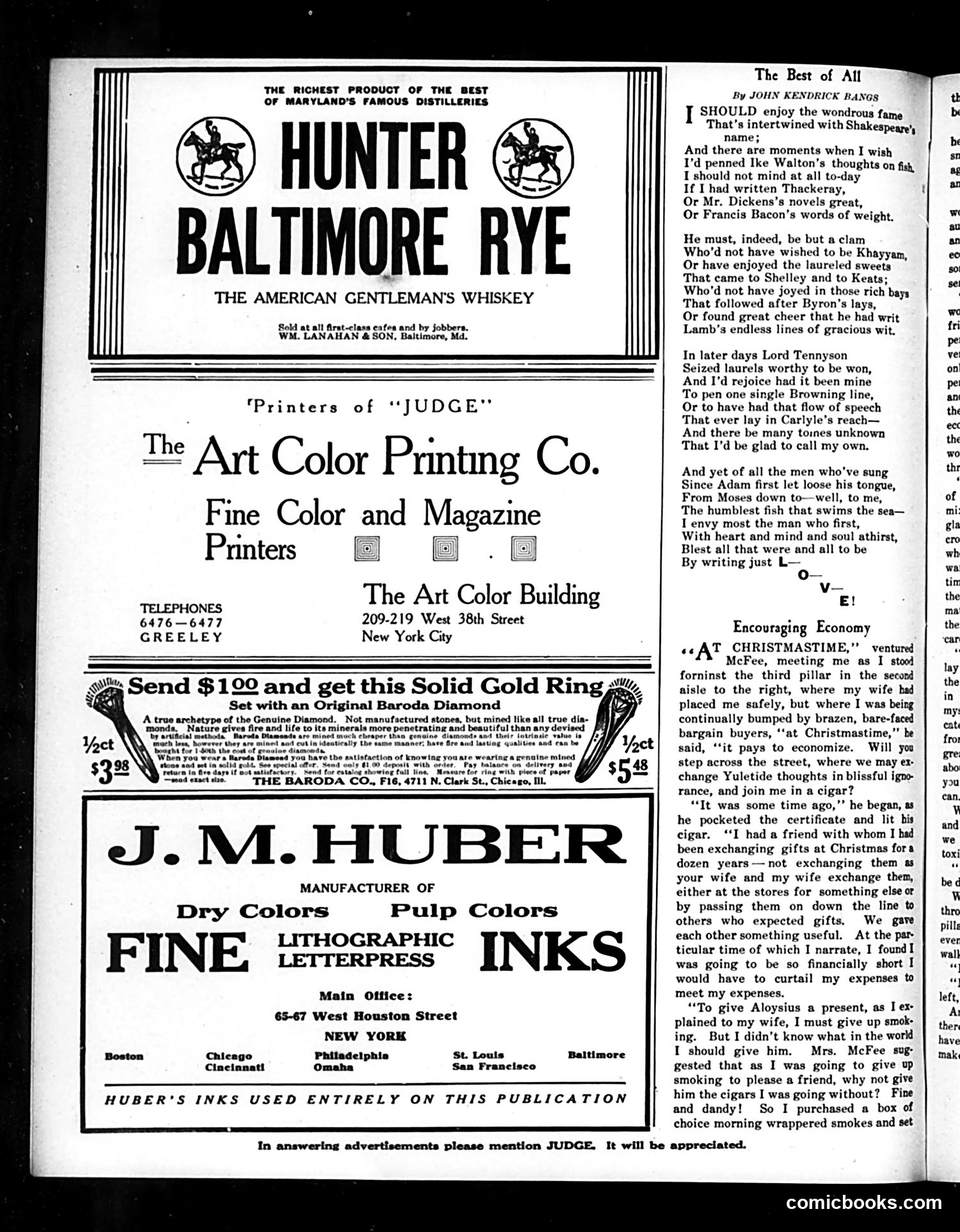
This page is primarily **advertisements and filler content** rather than political satire. The main visual elements are ads for Hunter Baltimore Rye whiskey, printing companies, jewelry, and printing inks. These occupy most of the space. The text content consists of two pieces by John Kendrick Bangs: 1. **"The Best of All"** — a lighthearted poem about literary envy, wishing he'd written works by Shakespeare, Dickens, Byron, etc. The joke concludes that despite admiring famous authors since Adam, he most envies "the man who first" did something (the final word is cut off/unclear). 2. **"Encouraging Economy"** — a humorous anecdote about a man named McFee who decides to give up smoking to afford a Christmas gift for his friend Aloysius, then plans to give Aloysius the cigars he's not smoking instead. It's gentle domestic humor about holiday gift-giving and frugality. There is **no political cartoons or satire** on this page — it's a typical early-20th-century magazine layout mixing literary content with commercial advertisements.
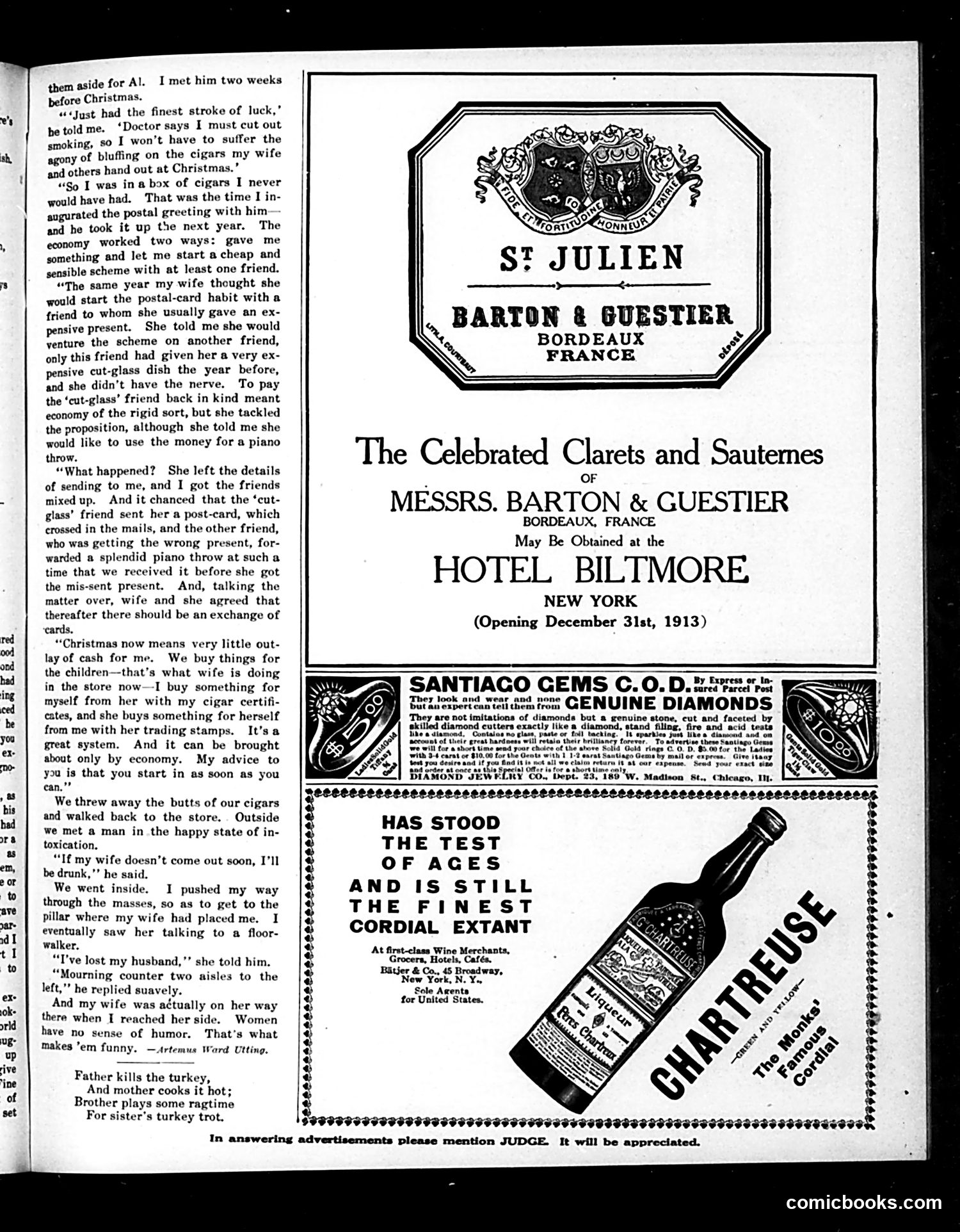
This page is primarily **advertising**, not political satire. It contains a humorous personal essay followed by multiple product advertisements typical of early 1900s magazines. The essay (bylined Artemus Ward Utting) humorously describes Christmas economy schemes—exchanging postal cards and piano throws instead of expensive gifts, and a misdelivered present that accidentally worked out well. The humor derives from domestic mishaps and the narrator's wife lacking a "sense of humor" when he jokes about a drunk man at a store, misinterpreting it as commentary about her. **Advertisements include:** - St. Julien wine (Barton & Guestier, Bordeaux) - Santiago Gems (fake diamonds) - Chartreuse cordial liqueur A short humorous verse about Christmas dinner ends the page. The content reflects 1913 consumer culture and advertising practices rather than political commentary. Modern readers should note the casual advertising of imitation diamonds and the era's different attitudes toward holiday spending and domestic roles.
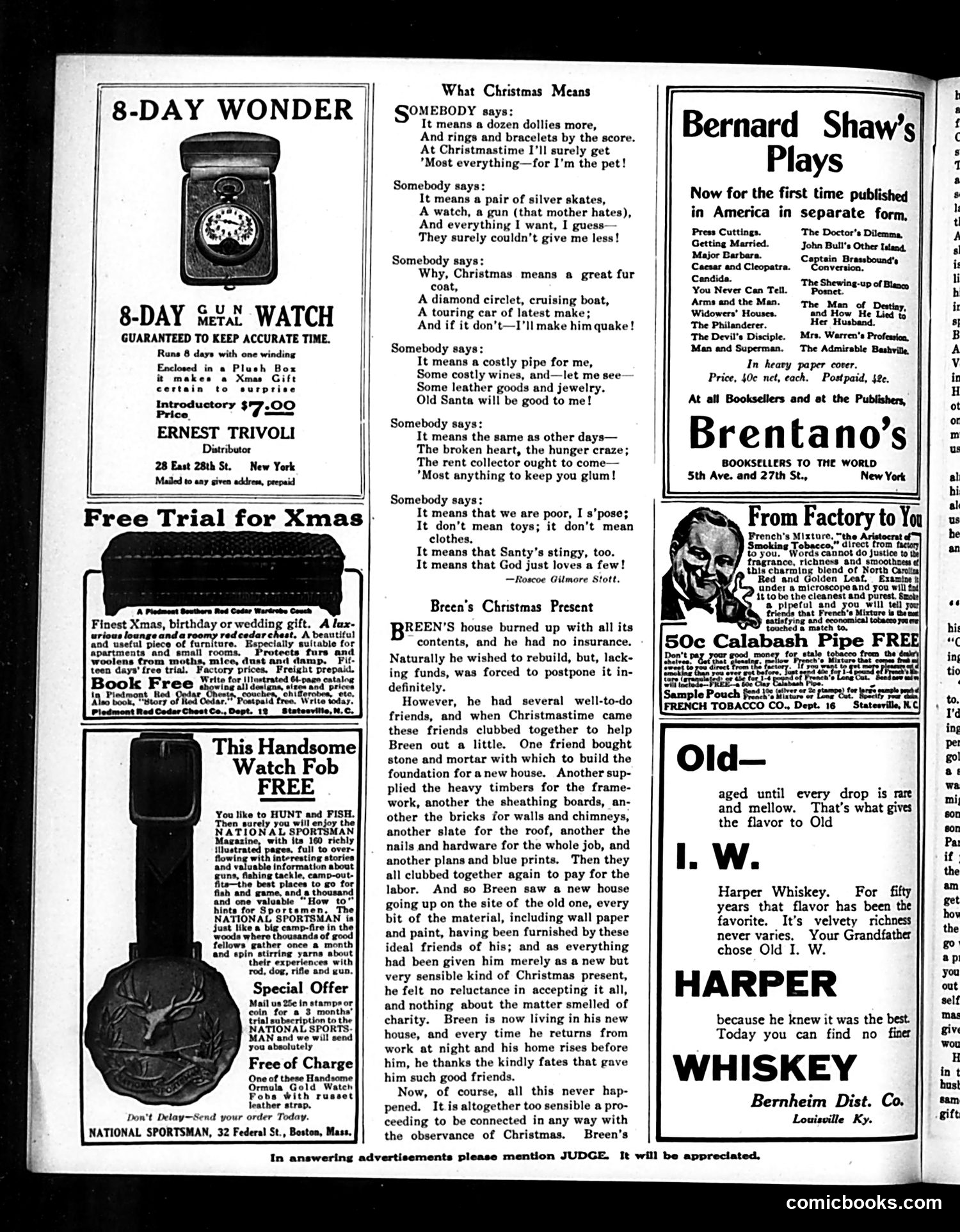
This page is primarily **advertisements and holiday-themed content**, not political satire. The main elements are: **"What Christmas Means"** - A poem by Roscoe Gilmore Stott presenting different perspectives on Christmas across social classes. It contrasts wealthy people's expectations (jewelry, fur coats, luxury goods) with poor people's grim reality ("the broken heart, the hunger craze; The rent collector ought to come"). The final verse acknowledges class inequality: "It means that God just loves a few!" This reflects Progressive-era social criticism of economic disparity during the holiday season. **"Breen's Christmas Present"** - A sentimental story about wealthy friends collectively rebuilding a poor man's burned house as a Christmas gift, emphasizing community charity without humiliating the recipient. The remaining content consists of **period advertisements** for watches, furniture, and other goods marketed as Christmas gifts—typical of Judge's commercial pages. The social commentary here is gentle moralism about wealth inequality and charitable Christmas spirit rather than sharp political satire.
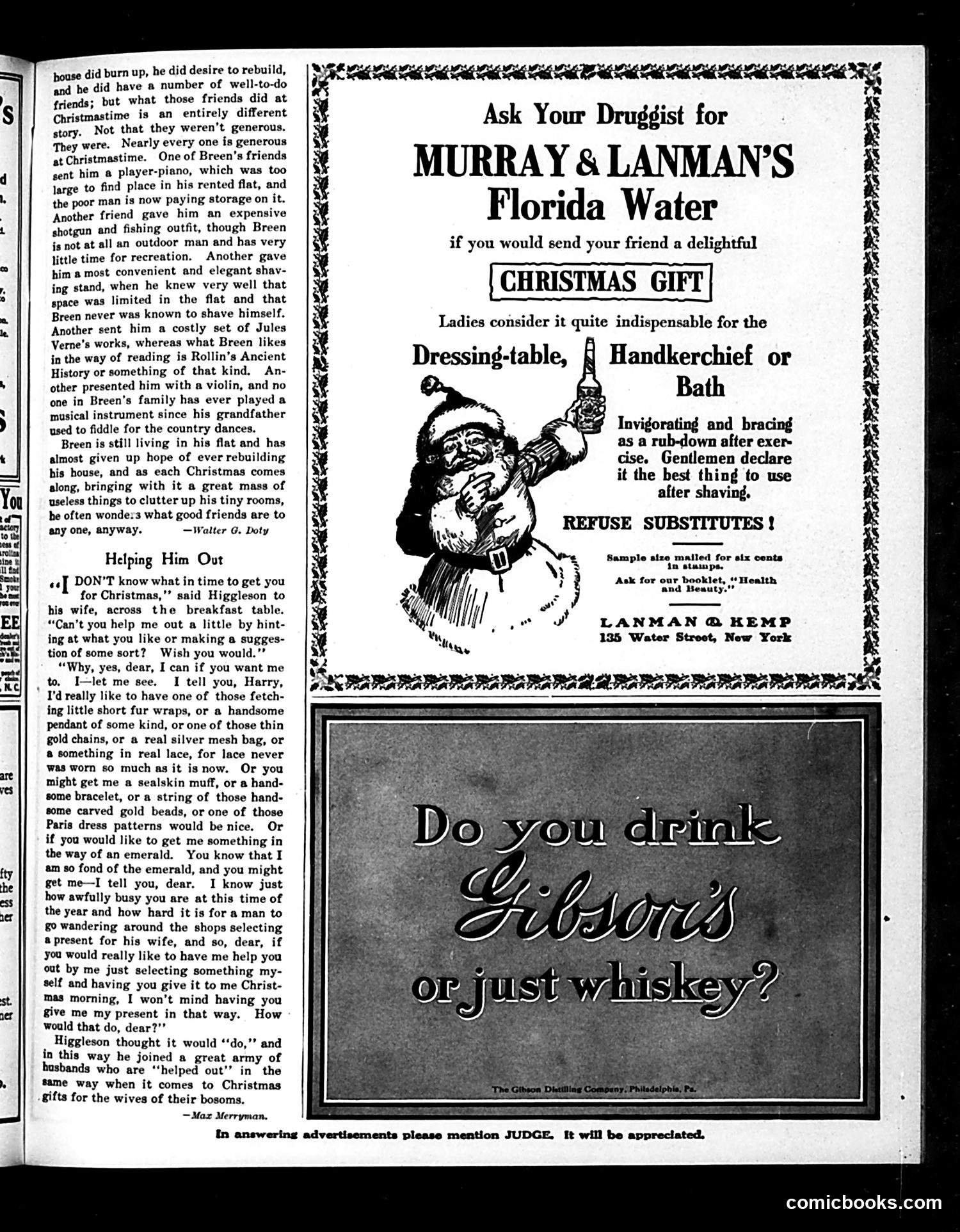
This page contains two humorous stories satirizing Christmas gift-giving, plus period advertisements. **"Helping Him Out"** mocks the futility of spousal gift selection. A husband asks his wife for Christmas suggestions; she responds with an exhausting list of luxuries (fur wraps, jewelry, emerald, lace, muff, beads, dress patterns), then offers to simply choose and buy her own gift herself—which defeats the purpose entirely. The satire targets both wives' materialism and husbands' capitulation: the husband happily accepts this arrangement, joining "a great army of husbands" who've outsourced gift-giving. **"Helping Him Out" (first story)** satirizes thoughtless generosity. A man whose house burned down receives well-intentioned but useless Christmas gifts—a player-piano (too large for his flat), expensive fishing gear (he's indoors), a shaving stand (he doesn't shave), Verne novels (he prefers history), and a violin (no musician in his family). The joke: generous friends give what *they* think appropriate rather than what he needs, leaving him paying storage fees for junk. The advertisements promote Florida Water toiletries and whiskey as holiday gifts.
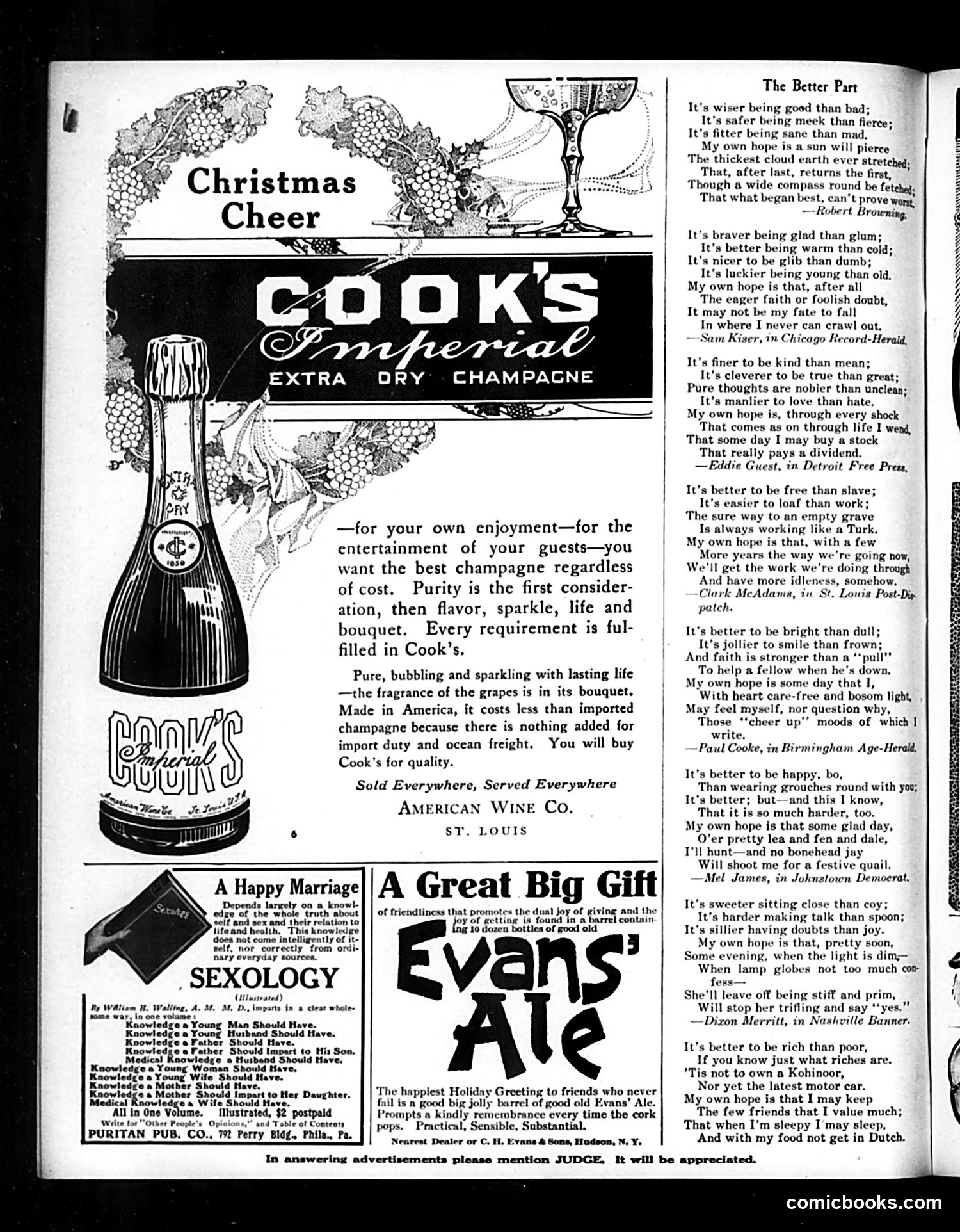
This page is primarily **advertising and light poetry**, not political satire. The main content includes: **Advertisements:** - **Cook's Imperial Champagne** (top): Emphasizes American-made quality at lower cost than imports, appealing to patriotic and economical consumers - **Sexology book**: A self-help guide promising knowledge for husbands, wives, and parents - **Evans' Ale**: Marketed as a holiday gift, positioning alcohol as a "friendly" present **"The Better Part"** (right column): A collection of humorous poems by various contemporary newspaper writers (Robert Browning quote, Sam Kiser, Eddie Guest, Paul Cooke, etc.). Each pairs idealistic sentiments with darkly ironic personal hopes—wanting dividends, idleness, avoiding accidental shooting during hunting season—mocking both optimism and human foibles. The page reflects early-20th-century consumer culture, with light satire in the poetry about materialism and everyday anxieties rather than political commentary.
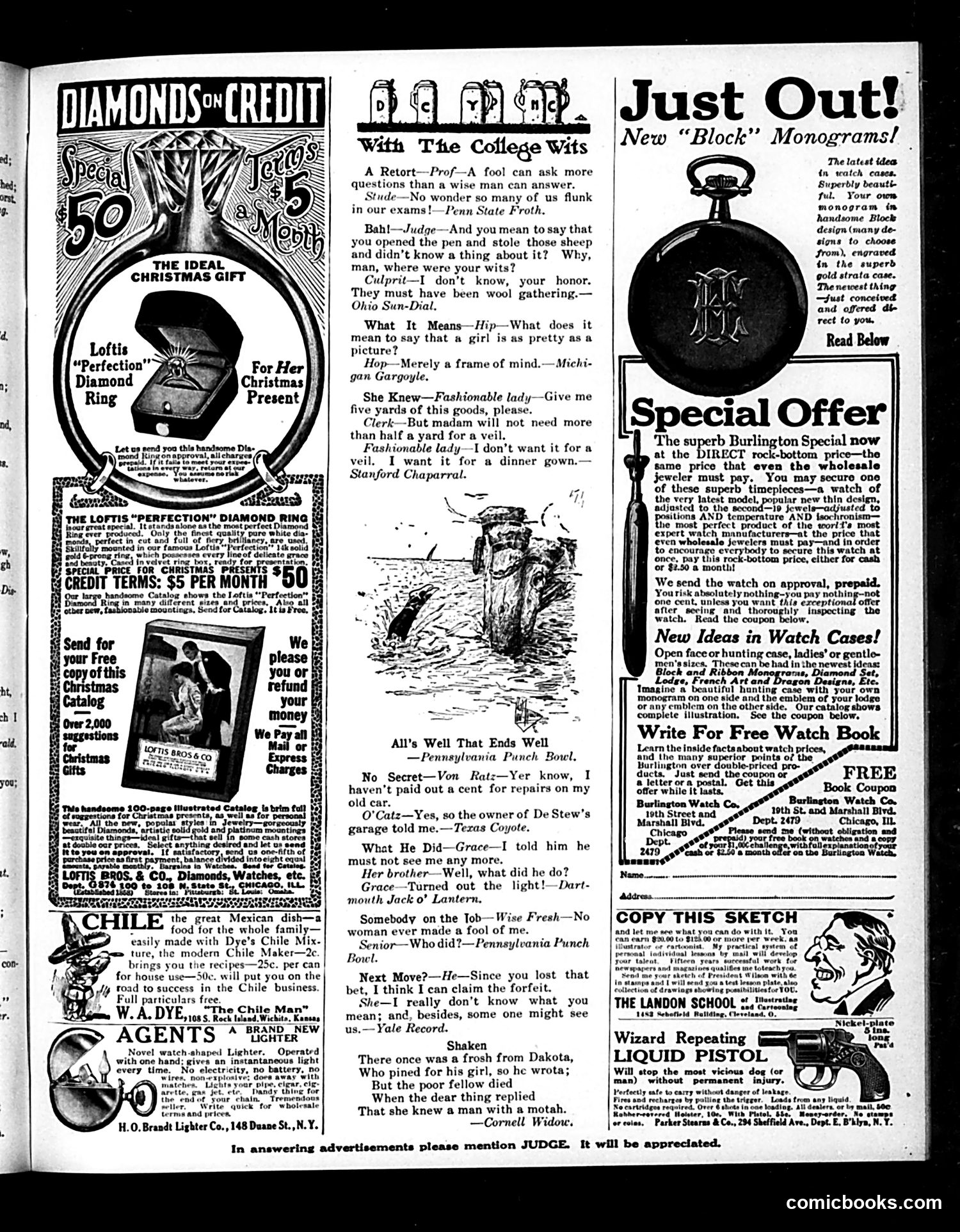
This page is primarily **advertising and humor filler** rather than political satire. It contains: **Main Content:** - Multiple commercial advertisements (diamond rings, chile mix, watch lighters) - A section titled "With The College Wits"—a humor column featuring jokes reprinted from various college newspapers and magazines **The Jokes:** These are gentle collegiate humor pieces about wordplay and romantic situations—puns about "wool gathering" (sheep theft), "frame of mind" (pretty girls), and a poem about a Dakota freshman whose girlfriend prefers a man with a "motor" (car). **Social Context:** The page reflects early 20th-century concerns: courtship anxieties, automobile culture emerging as status symbol, and collegiate wit as entertainment. The "College Wits" section was a popular Judge feature republishing humor from university publications. **No clear political satire or caricatures are present.** This appears to be a typical Judge interior page mixing product advertisements with lightweight humor content.
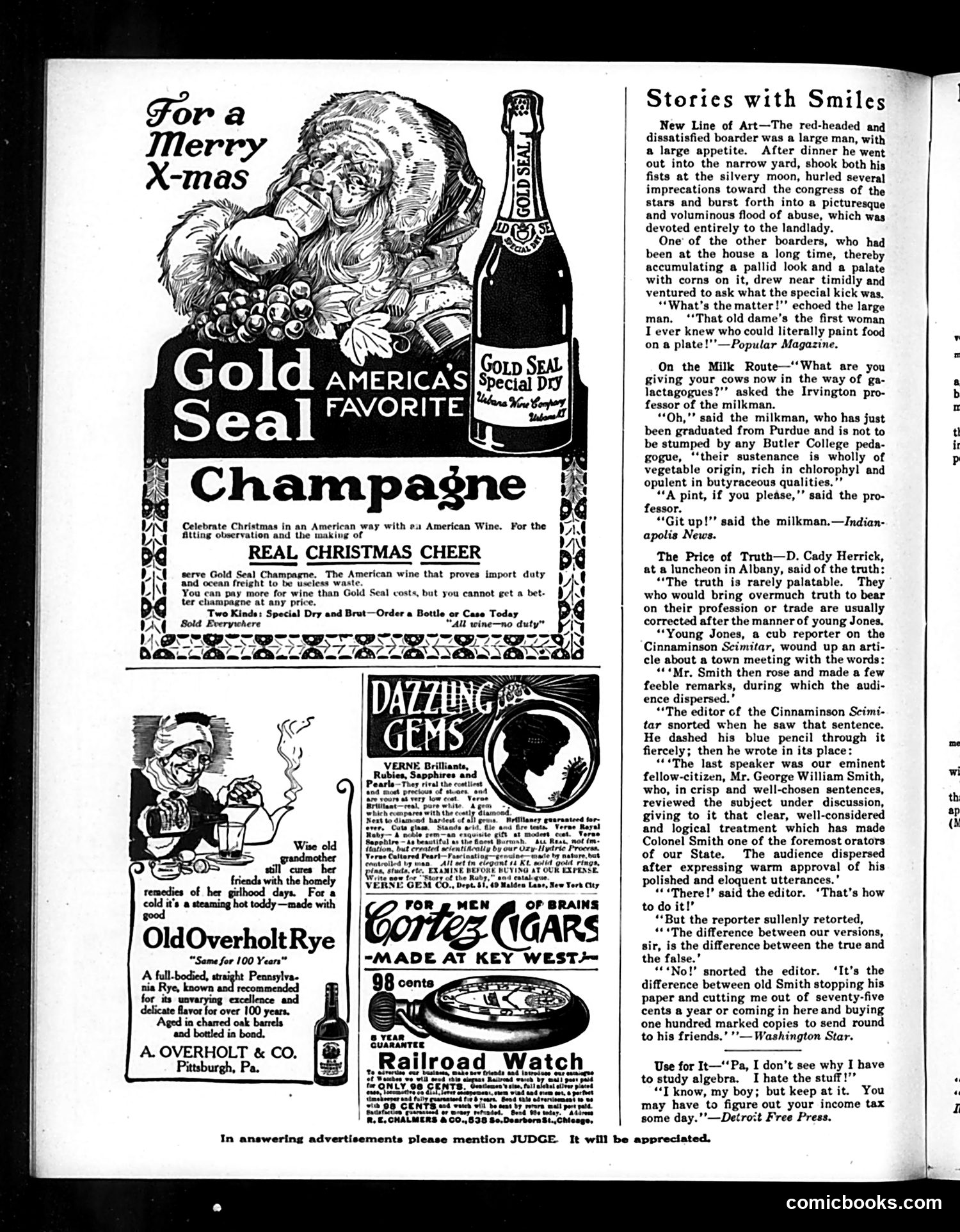
This is primarily an **advertising page** from Judge magazine, dominated by product ads rather than editorial satire. The main content includes: **Advertisements:** - Gold Seal Champagne (promoting American wine as patriotic Christmas choice, emphasizing it avoids import duty) - Old Overholt Rye whiskey - Cortes Cigars - Railroad Watch **"Stories with Smiles" section** (humor column): Four brief anecdotes with light satire: 1. A dissatisfied boarder complains the landlady literally "paints food on a plate" (serves inedible meals) 2. A Purdue-educated milkman uses pretentious vocabulary ("chlorophyl," "butyraceous") to describe cow feed 3. **"The Price of Truth"** — satirizes how newspapers suppress unflattering truths. A young reporter writes honestly that a speech caused the audience to leave; his editor rewrites it with flowery praise, then admits the difference is whether the subject will keep his advertising subscription 4. A father advises his son to study algebra for future tax purposes The satire targets **journalistic dishonesty, pretension, and commercialism** — themes familiar to Judge's educated readership.
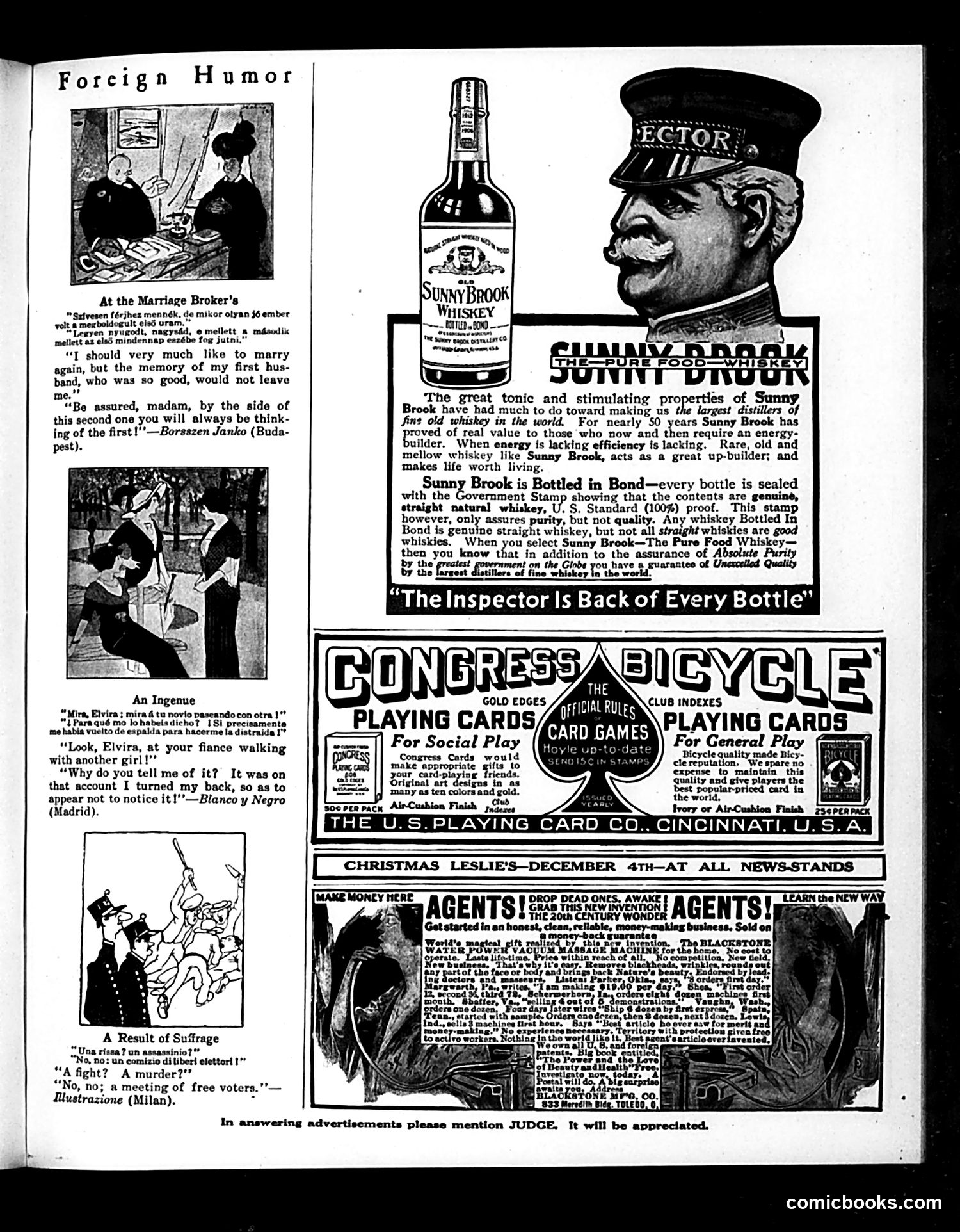
This Judge magazine page contains three European satirical cartoons about marriage and gender relations, plus period advertisements. **The Cartoons:** 1. **"At the Marriage Broker's"** (Hungarian): A widow seeking remarriage is assured that her terrible new husband will make her constantly remember her kind first husband—dark humor about marital misery. 2. **"An Ingenue"** (Spanish): A young woman deliberately turns her back when seeing her fiancé with another woman, feigning ignorance to save face—satirizing willful blindness in romance. 3. **"A Result of Suffrage"** (Italian): Observers witness a chaotic scene and ask if it's a fight or murder; the answer is "a meeting of free voters"—mocking women's suffrage by depicting voting gatherings as disorderly and violent. **The Satire:** These cartoons reflect early-20th-century anxieties about women's changing social roles. The suffrage cartoon particularly expresses anti-feminist sentiment common in that era, equating female political participation with chaos and violence.
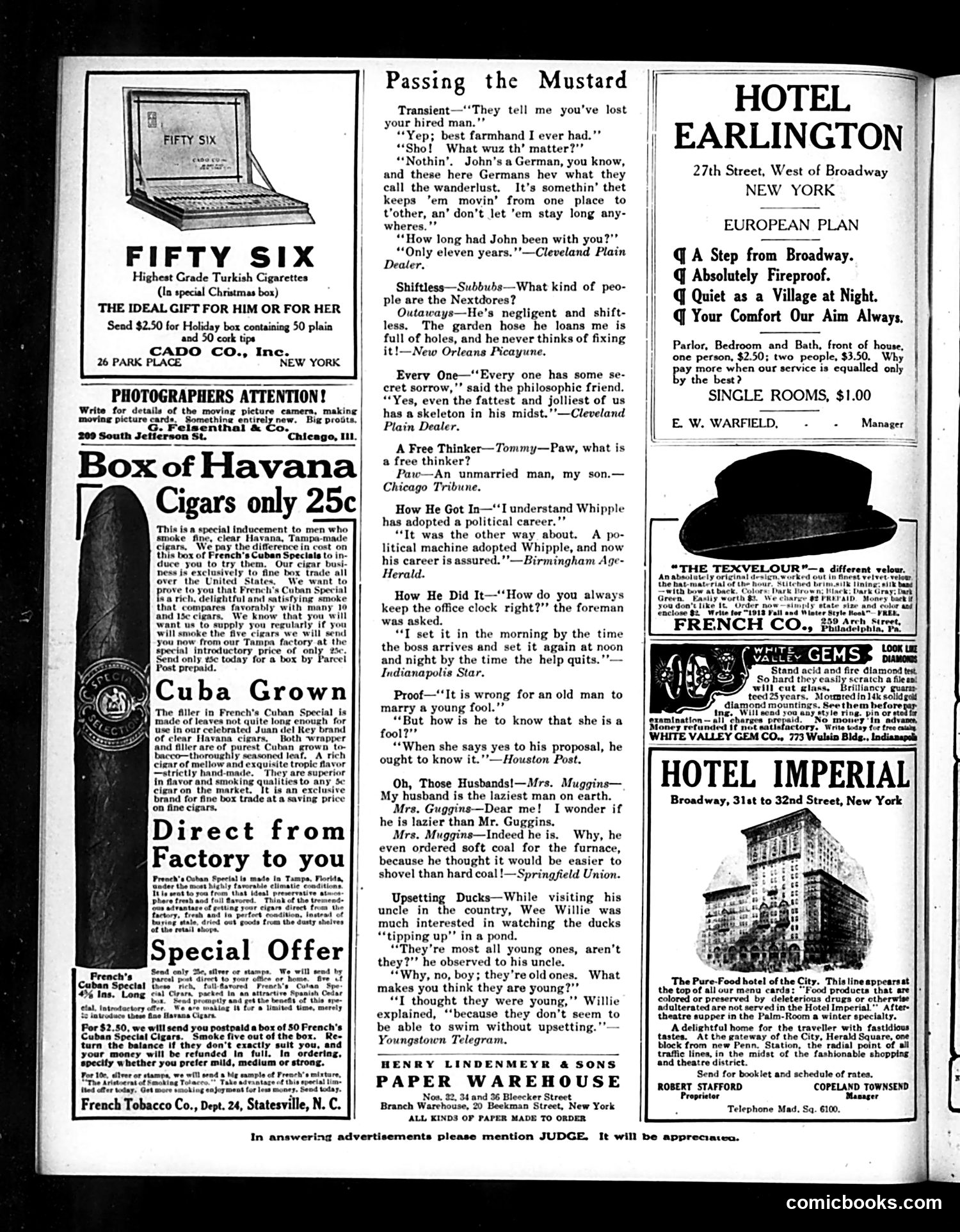
This page is predominantly **advertising** with a secondary section of **short humorous jokes** ("Passing the Mustard"). ## Advertisements The major ads feature **cigars and cigarettes**—Fifty Six Turkish cigarettes, Box of Havana cigars, and French's Cuban Special—along with hotels (Earlington, Imperial) and miscellaneous services (photographers, paper warehouse). ## Humor Section The jokes are brief, domestic satirical pieces typical of early 20th-century American humor. They mock: - **German immigrants' restlessness** ("wanderlust") despite long employment - **Lazy husbands** and negligent neighbors - **Political corruption** (a "political machine" adopting a man into a career) - **Marital foolishness** (old men marrying young women) - **Class dynamics** (workers vs. bosses, laziness) The humor relies on rural/small-town dialect and simple observations about human nature rather than complex political satire. No specific historical figures or events are referenced—these are generic social commentary pieces aimed at middle-class readers.
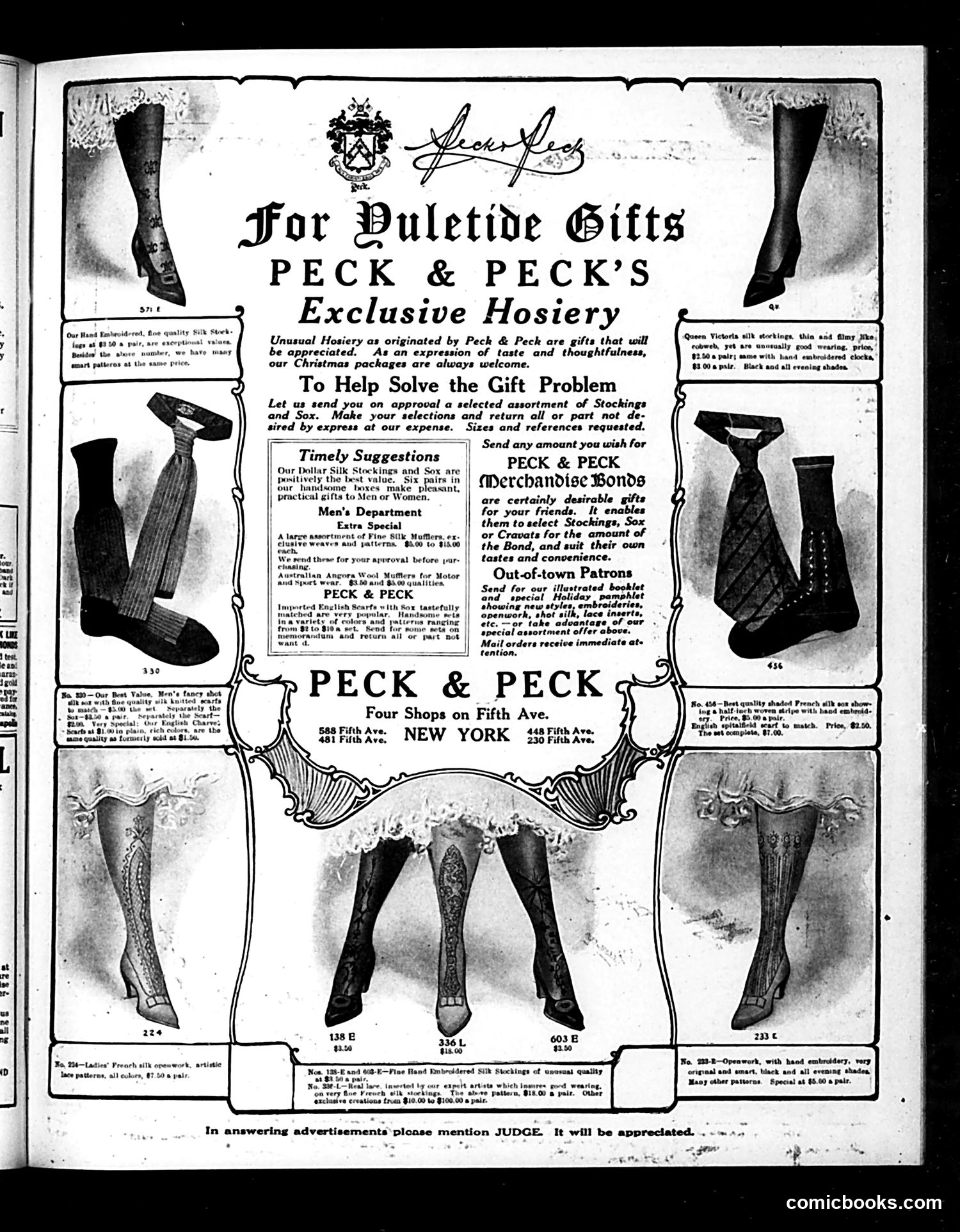
This is **not a cartoon or satirical piece** — it's a full-page advertisement for Peck & Peck, a high-end hosiery retailer with four locations on Fifth Avenue in New York City. The page promotes luxury stockings and socks as Yuletide gifts, featuring product photographs of women's legs modeling various silk stockings with different patterns and embroidery. The ad emphasizes exclusivity and quality, with prices ranging from $2 to $18 per pair — substantial amounts for the era. Notable offerings include merchandise bonds (gift certificates), approval-based mail ordering for out-of-town customers, and specialty items like Australian Angora wool mufflers. The copy appeals to gift-givers seeking to express "taste and thoughtfulness." This represents typical Judge magazine advertising content rather than editorial satire or political commentary.
This is a **Pall Mall cigarette advertisement**, not political satire or comedy. The page promotes "Famous Cigarettes" as a seasonal gift option, decorated with holly and festive imagery typical of holiday marketing. The ad highlights package sizes available: fifty and one hundred cigarettes in "King's Size & Regular" formats. The decorative elements—holly sprigs, wrapped gift box presentation, ornamental border—frame cigarettes as luxury gift items suitable for the holiday season. This reflects early-to-mid 20th century advertising conventions when cigarettes were marketed as respectable, prestigious consumer goods without health warnings. The "Judge" magazine publication context suggests this appeared in a satirical magazine that also carried commercial advertisements to offset editorial costs.