
Judge, 1913-12-06 · page 13 of 40
Judge — December 6, 1913 — page 13: what you’re looking at
What you’re looking at
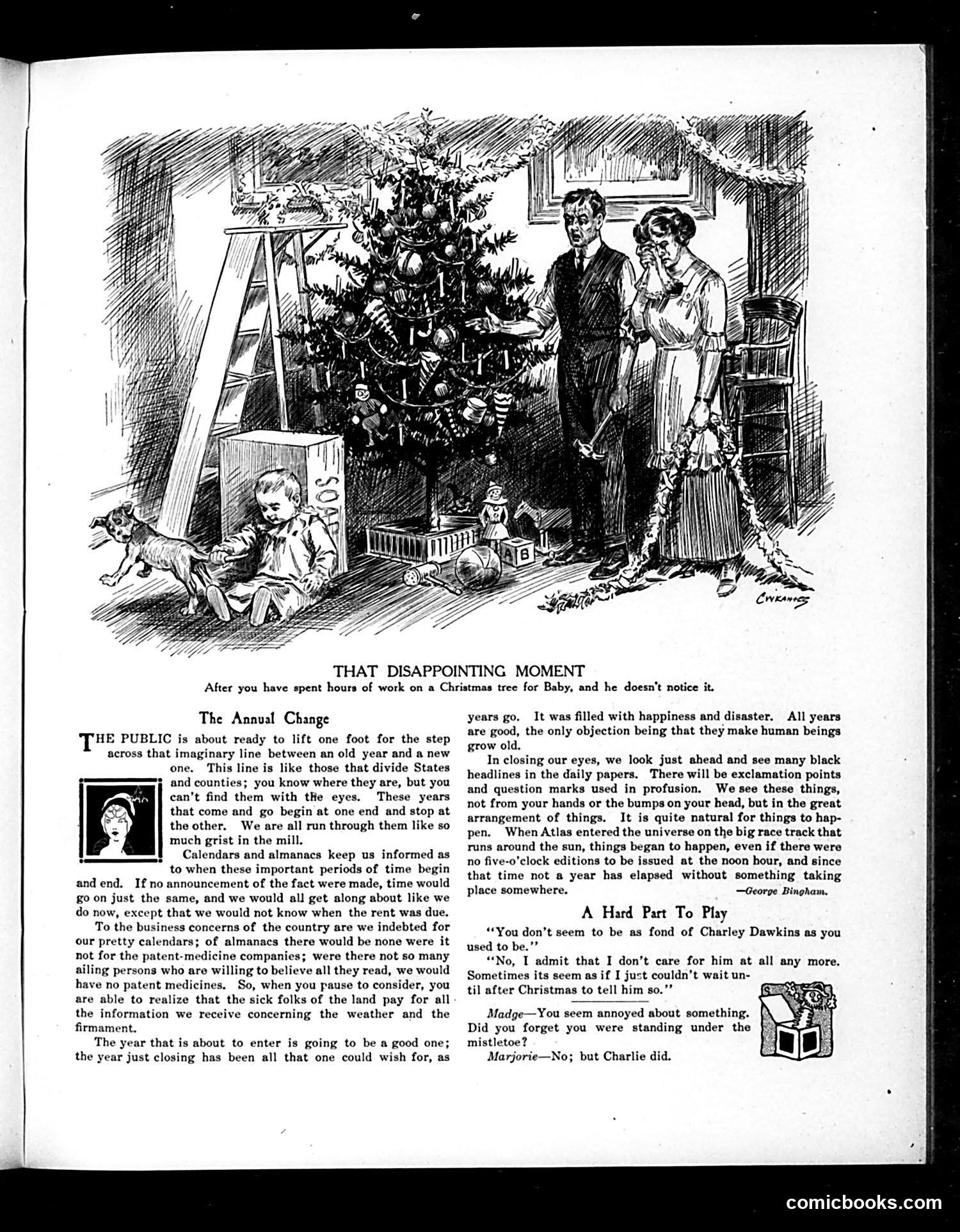
This page from *Judge* magazine contains two separate pieces of holiday humor: **"That Disappointing Moment"** (top cartoon): A satirical illustration showing parents who have elaborately decorated a Christmas tree for their baby, only for the child to ignore it completely and play with simpler toys instead. The joke mocks the gap between parental effort and child indifference—a timeless domestic comedy. **"The Annual Change"** (main article): A philosophical essay about New Year's transitions, arguing that calendar divisions are arbitrary human constructs. The writer notes we only know years have "changed" because businesses and patent-medicine companies distribute calendars to advertise themselves. The piece's gentle satire targets commercial manipulation and the illusion that arbitrary dates matter. **"A Hard Part To Play"** (dialogue): Two brief exchanges about Christmas romance. One woman admits she's waiting until *after* Christmas to break up with her boyfriend. The second joke plays on the mistletoe tradition—a man forgets to kiss a woman standing beneath it, disappointing her. Both highlight awkward holiday social dynamics.
📄 Transcribed text from this page (OCR, searchable)
Machine-transcribed from the original scan — historical spelling and the odd misread are preserved.
THAT DISAPPOINTING MOMENT After you have spent hours of work on a Christmas tree for Baby, and he doesn’t notice it. The Annual Change THE PUBLIC is about ready to lift one foot for the step across that imaginary line between an old year and a new one. This line is like those that divide States 4, and counties; you know where they are, but you can’t find them with tHe eyes. These years that come and go begin at one end and stop at the other. We are all run through them like so much grist in the mill. {Calendars and almanacs keep us informed as to when these important periods of time begin and end. If no announcement of the fact were made, time would goon just the same, and we would all get along about like we do now, except that we would not know when the rent was due. To the business concerns of the country are we indebted for our pretty calendars; of almanacs there would be none were it not for the patent-medicine companies; were there not so many ailing persons who are willing to believe all they read, we would have no patent medicines. So, when you pause to consider, you are able to realize that the sick folks of the land pay for all the information we receive concerning the weather and the firmament. The year that is about to enter is going to be a good one; the year just closing has been all that one could wish for, as years go. It was filled with happiness and disaster. All years are good, the only objection being that they make human beings grow old. In closing our eyes, we look just ahead and see many black headlines in the daily papers. There will be exclamation points and question marks used in profusion. We see these things, not from your hands or the bumps on your head, but in the great arrangement of things. It is quite natural for things to hap- pen. When Atlas entered the universe on the big race track that runs around the sun, things began to happen, even if there were no five-o’clock editions to be issued at the noon hour, and since that time not a year has elapsed without something taking place somewhere. —George Bingham. A Hard Part To Play “You don’t seem to be as fond of Charley Dawkins as you used to be.’’ “No, I admit that I don’t care for him at all any more. Sometimes its seem as if I just couldn’t wait un- til after Christmas to tell him so.”” Madge—You seem annoyed about something. Did you forget you were standing under the mistletoe? Marjorie—No; but Charlie did. comicbooks.com