
Judge, 1913-12-06 · page 7 of 40
Judge — December 6, 1913 — page 7: what you’re looking at
What you’re looking at
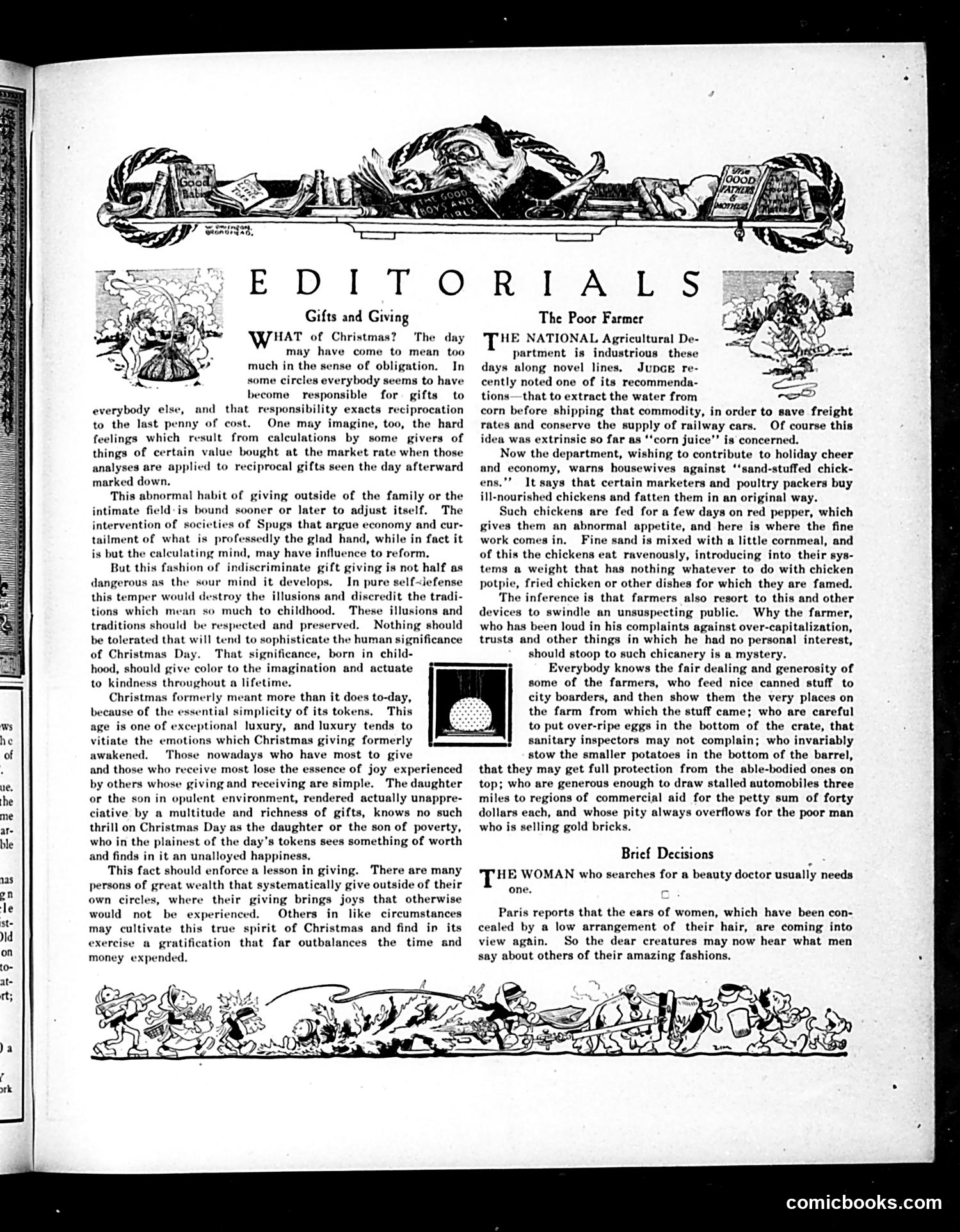
This page contains two satirical editorials critiquing American consumer culture and agricultural fraud. **"Gifts and Giving"** attacks the commercialization of Christmas. The editorial argues that obligatory gift-giving has become a calculating, transactional burden rather than a meaningful gesture of kindness. The author contrasts wealthy recipients who receive lavish gifts (and thus feel no joy) with poor children who treasure simple tokens. The satire targets the wealthy for losing Christmas's spiritual essence through excessive materialism, while praising humble givers for maintaining authentic holiday spirit. **"The Poor Farmer"** exposes a deceptive agricultural practice: unscrupulous poultry dealers feed malnourished chickens red pepper and sand to artificially increase their weight before sale. The satire suggests farmers themselves exploit this con, making them hypocrites who "complain against over-capitalization" while engaging in their own swindles. Both pieces critique greed undermining traditional American values—familial generosity and honest commerce.
📄 Transcribed text from this page (OCR, searchable)
Machine-transcribed from the original scan — historical spelling and the odd misread are preserved.
Gifts and Giving HAT of Christmas? The day may have come to mean too much in the sense of obligation. In some circles everybody seems to have become responsible for gifts to everybody else, and that responsibility exacts reciprocation to the last penny of cost. One may imagine, too, the hard feelings which result from calculations by some givers of things of certain value bought at the market rate when those analyses are applied to reciprocal gifts seen the day afterward marked down, This abnormal habit of giving outside of the family or the intimate field-is bound sooner or later to adjust itself. The intervention of societies of Spugs that argue economy and cur- tailment of what is professedly the glad hand, while in fact it is but the calculating mind, may have influence to reform. But this fashion of indiscriminate gift giving is not half as dangerous as the sour mind it develops. In pure self-defense this temper would destroy the illusions and discredit the tradi- tions which mean so much to childhood. These illusions and traditions should be respected and preserved. Nothing should be tolerated that will tend to sophisticate the human significance of Christmas Day. That significance, born in child- hood, should give color to the imagination and actuate to kindness throughout a lifetime. Christmas formerly meant more than it does to-day, because of the essential simplicity of its tokens. This age is one of exceptional luxury, and luxury tends to vitiate the emotions which Christmas giving formerly awakened. Those nowadays who have most to give and those who receive most lose the essence of joy experienced by others whose giving and receiving are simple. The daughter or the son in opulent environment, rendered actually unappre- ciative by a multitude and richness of gifts, knows no such thrill on Christmas Day as the daughter or the son of poverty, who in the plainest of the day’s tokens sees something of worth and finds in it an unalloyed happiness. This fact should enforce a lesson in giving. There are many persons of great wealth that systematically give outside of their own circles, where their giving brings joys that otherwise would not be experienced. Others in like circumstances may cultivate this true spirit of Christmas and find in its cise a gratification that far outbalances the time and money expended. The Poor Farmer THE NATIONAL Agricultural De- partment is industrious these days along novel lines, Junce re- cently noted one of its recommenda- ae tions—that to extract the water from corn before shipping that commodity, in order to save freight rates and conserve the supply of railway cars. Of course this idea was extrinsic so far as ‘‘corn juice’’ is concerned. Now the department, wishing to contribute to holiday cheer and economy, warns housewives against ‘‘sand-stuffed chick- ens.’ It says that certain marketers and poultry packers buy ill-nourished chickens and fatten them in an original way. Such chickens are fed for a few days on red pepper, which gives them an abnormal appetite, and here is where the fine work comes in, Fine sand is mixed with a little cornmeal, and of this the chickens eat ravenously, introducing into their sys- tems a weight that has nothing whatever to do with chicken ie, fried chicken or other dishes for which they are famed. inference is that farmers also resort to this and other °s to swindle an unsuspecting public. Why the farmer, who has been loud in his complaints against over-capitalization, trusts and other things in which he had no personal interest, should stoop to such chicanery is a mystery. Everybody knows the fair dealing and generosity of some of the farmers, who feed nice canned stuff to city boarders, and then show them the very places on the farm from which the stuff came; who are careful to put over-ripe eggs in the bottom of the crate, that sanitary inspectors may not complain; who invariably stow the smaller potatoes in the bottom of the barrel, that they may get full protection from the able-bodied ones on top; who are generous enough to draw stalled automobiles three miles to regions of commercial aid for the petty sum of forty dollars each, and whose pity always overflows for the poor man who is selling gold bricks. Brief Decisions "THE WOMAN who searches for a beauty doctor usually needs Paris reports that the ears of women, which have been con- cealed by a low arrangement of their hair, are coming into view again. So the dear creatures may now hear what men say about others of their amazing fashions. comicbooks.com