
Judge, 1913-12-06 · page 9 of 40
Judge — December 6, 1913 — page 9: what you’re looking at
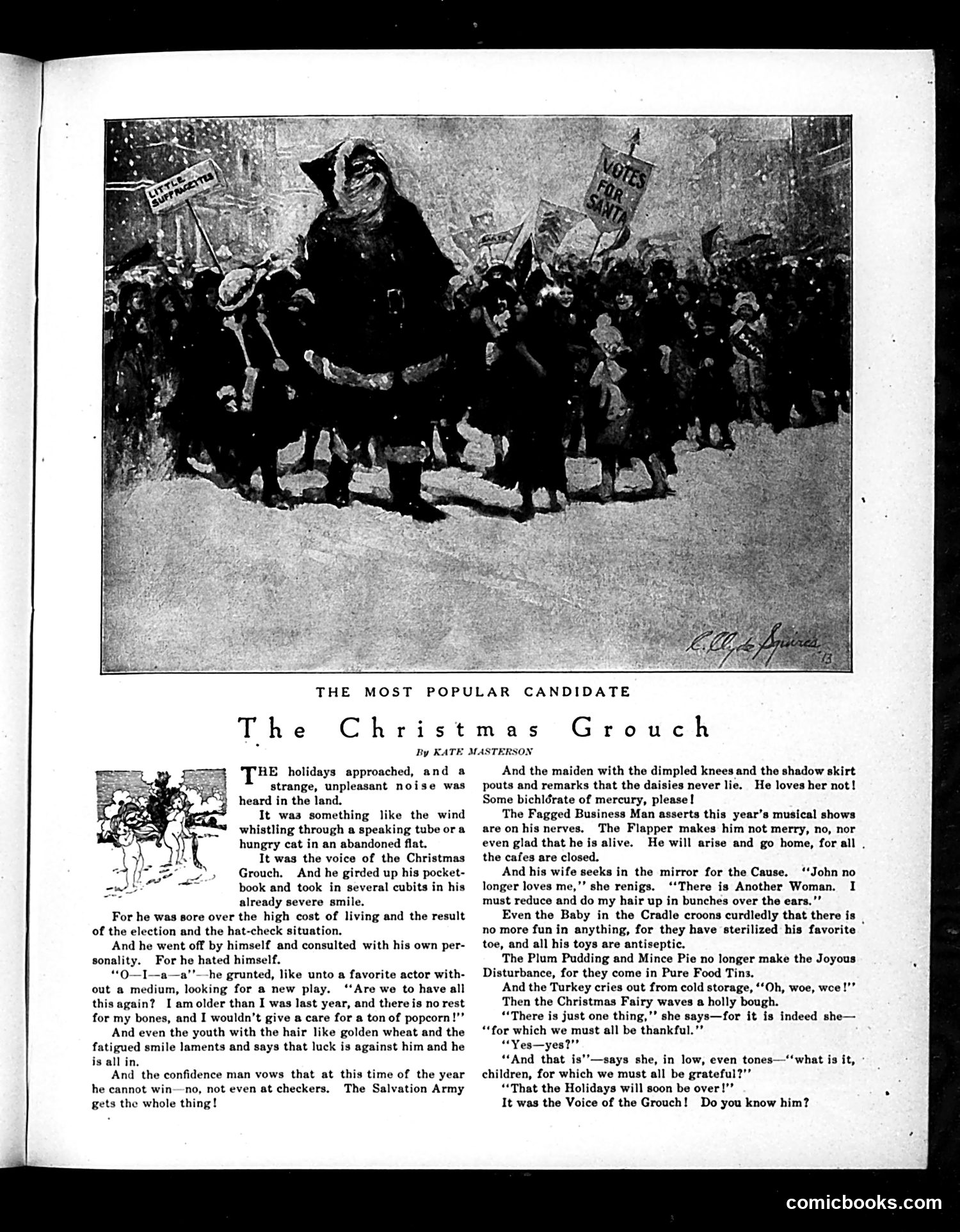
What you’re looking at
This satirical piece by Kate Masterson uses the personified "Christmas Grouch"—a grotesque figure towering over a crowd—to mock widespread post-holiday depression across American society circa the 1920s. The satire targets multiple grievances: the "high cost of living," election results (appears to reference a recent political outcome), and petty frustrations like "hat-check situation." Masterson catalogs various social types all equally miserable—the fatigued businessman, the flapper, the jilted maiden, even the baby—each complaining despite supposed festive cheer. The joke's punchline: when the "Christmas Fairy" asks what everyone should be grateful for, the collective answer is that "the Holidays will soon be over." It's the Grouch's voice—cynicism and exhaustion—speaking for everyone. The cartoon satirizes American materialism, emotional superficiality, and the gap between holiday expectations and reality. Even children and romance have become joyless in this mechanized, commercialized age.
📄 Transcribed text from this page (OCR, searchable)
Machine-transcribed from the original scan — historical spelling and the odd misread are preserved.
THE MOST POPULAR CANDIDATE The Christmas Grouch By KATE MASTERSON THE holidays approached, and a strange, unpleasant noise was heard in the land. It waa something like the wind whistling through a speaking tube ora hungry cat in an abandoned flat. It was the voice of the Christmas Grouch. And he girded up his pocket- book and took in several cubits in his already severe smile. For he was sore over the high cost of living and the result of the election and the hat-check situation. And he went off by himself and consulted with his own per- sonality. For he hated himself. “O—I—a—a’’—-he grunted, like unto a favorite actor with- out a medium, looking for a new play. ‘‘Are we to have all thisagain? I amolder than I was last year, and there is no rest for my bones, and I wouldn’t give a care for a ton of popcorn!”” And even the youth with the hair like golden wheat and the fatigued smile laments and says that luck is against him and he is all in, And the confidence man vows that at this time of the year he cannot win—no, not even at checkers, The Salvation Army gets the whole thing! And the maiden with the dimpled knees and the shadow skirt pouts and remarks that the daisies never lie. He loves her not! Some bichlérate of mercury, please! The Fagged Business Man asserts this year’s musical shows are on his nerves, The Flapper makes him not merry, no, nor even glad that he is alive. He will arise and go home, for all . the cafes are closed. And his wife seeks in the mirror for the Cause. ‘‘John no longer loves me,’’ she renigs. ‘‘There is Another Woman. I must reduce and do my hair up in bunches over the ears,” Even the Baby in the Cradle croons curdledly that there is | no more fun in anything, for they have sterilized his favorite toe, and all his toys are antiseptic. The Plum Pudding and Mince Pie no longer make the Joyous Disturbance, for they come in Pure Food Tins. And the Turkey cries out from cold storage, ‘‘Oh, woe, wee !’’ Then the Christmas Fairy waves a holly bough. “There is just one thing,’’ she says—for it is indeed she— “for which we must all be thankful.’’ “Yes—yes?’’ “And that is’’—says she, in low, even tones—‘‘what is it, « children, for which we must all be grateful?’ “That the Holidays will soon be over!’’ It was the Voice of the Grouch! Do you know him? comicbooks.com