
Judge, 1913-12-06 · page 8 of 40
Judge — December 6, 1913 — page 8: what you’re looking at
What you’re looking at
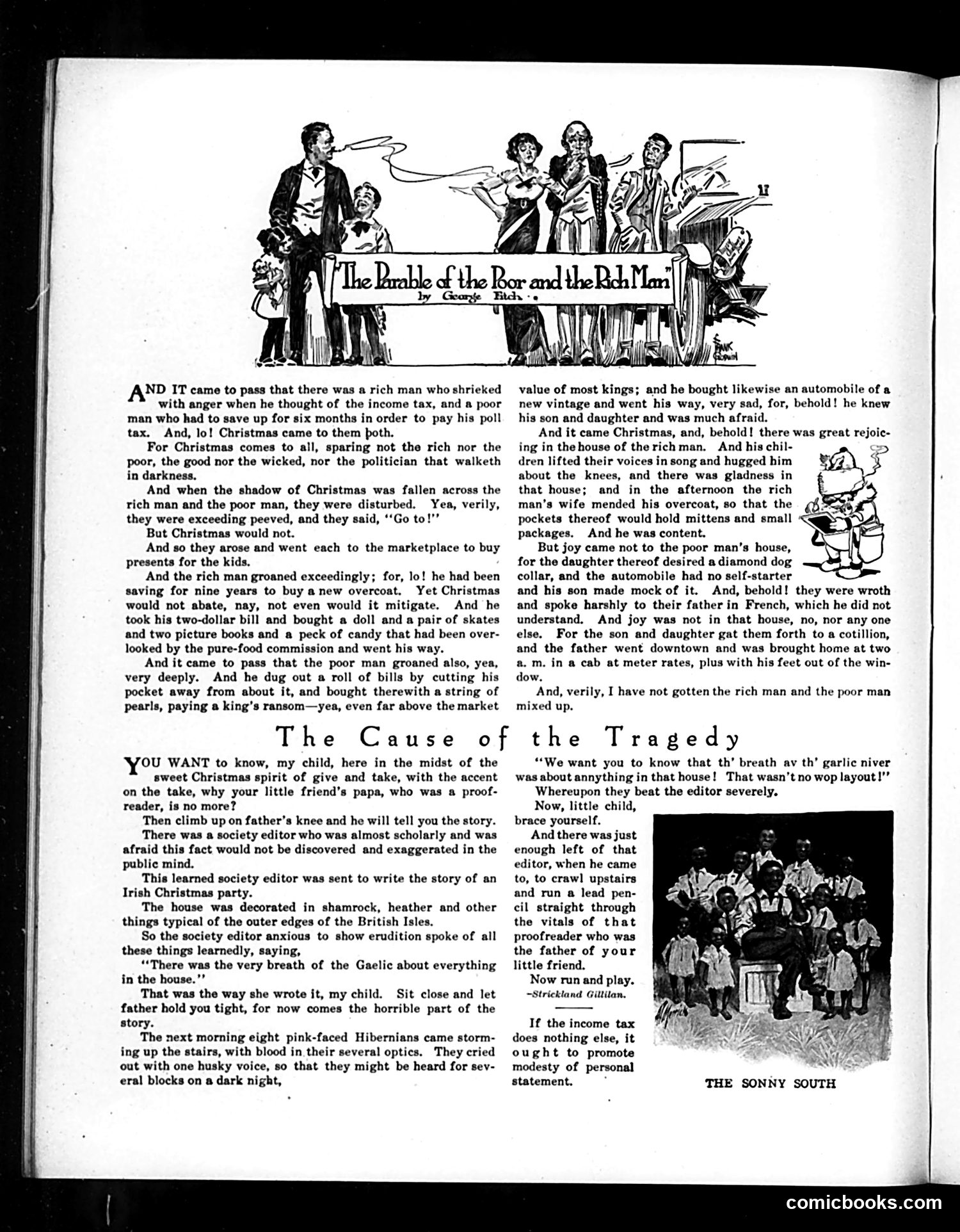
This satirical piece uses biblical language to mock American class divisions and consumerism around Christmas. The parable inverts expectations: the wealthy man sacrifices his savings for modest children's gifts and finds joy, while the poor man bankrupts himself buying luxury items (pearls, automobiles) that his ungrateful, French-speaking children mock and reject. The satire targets several targets: the wealthy's unexpected restraint and contentment; the poor's aspirational excess and resulting misery; and consumerist culture generally, where Christmas spending creates financial ruin regardless of income level. The second story, "The Cause of the Tragedy," mocks a society editor for using the phrase "breath of the Gaelic" in describing an Irish party—a pretentious literary flourish that enrages Irish readers ("pink-faced Hibernians"), leading apparently to violence against the proofread article's author. This satirizes both affected journalism and Irish-American sensitivity to ethnic stereotyping.
📄 Transcribed text from this page (OCR, searchable)
Machine-transcribed from the original scan — historical spelling and the odd misread are preserved.
ND IT came to pass that there was a rich man who shrieked with anger when he thought of the income tax, and a poor man who had to save up for six months in order to pay his poll tax. And, lo! Christmas came to them both. For Christmas comes to all, sparing not the rich nor the poor, the good nor the wicked, nor the politician that walketh in darkness. And when the shadow of Christmas was fallen across the rich man and the poor man, they were disturbed. Yea, verily, they were exceeding peeved, and they said, ‘‘Go to!’’ But Christmas would not. And so they arose and went each to the marketplace to buy presents for the kids. And the rich man groaned exceedingly; for, lo! he had been saving for nine years to buy anew overcoat. Yet Christmas would not abate, nay, not even would it mitigate. And he took his two-dollar bill and bought a doll and a pair of skates and two picture books and a peck of candy that had been over- looked by the pure-food commission and went his way. And it came to pass that the poor man groaned also, yea, very deeply. And he dug out a roll of bills by cutting his pocket away from about it, and bought therewith a string of pearls, paying a king’s ransom—yea, even far above the market The ‘OU WANT to know, my child, here in the midst of the sweet Christmas spirit of give and take, with the accent on the take, why your little friend’s papa, who was a proof- reader, is no more? Then climb up on father’s knee and he will tell you the story. There was a society editor who was almost scholarly and was afraid this fact would not be discovered and exaggerated in the public mind. This learned society editor was sent to write the story of an Irish Christmas party. The house was decorated in shamrock, heather and other things typical of the outer edges of the British Isles. So the society editor anxious to show erudition spoke of all these things learnedly, saying, “There was the very breath of the Gaelic about everything in the house.’’ That was the way she wrote it, my child. Sit close and let father hold you tight, for now comes the horrible part of the story. The next morning eight pink-faced Hibernians came storm- ing up the stairs, with blood in their several optics. They cried out with one husky voice, so that they might be heard for sev- eral blocks on a dark night, value of most kings; and he bought likewise an automobile of a new vintage and went his way, very sad, for, behold! he knew his son and daughter and was much afraid. And it came Christmas, and, behold! there was great rejoic- ing in the house of the rich man. And his chil- dren lifted their voices in song and hugged him about the knees, and there was gladness in that house; and in the afternoon the rich man’s wife mended his overcoat, so that the pockets thereof would hold mittens and small packages. And he was content. But joy came not to the poor man’s house, for the daughter thereof desired a diamond dog collar, and the automobile had no self-starter and his son made mock of it. And, behold! they were wroth and spoke harshly to their father in French, which he did not understand. And joy was not in that house, no, nor any one else. For the son and daughter gat them forth to a cotillion, and the father went downtown and was brought home at two a.m. in a cab at meter rates, plus with his feet out of the win- dow. And, verily, I have not gotten the rich man and the poor man mixed up. € Cause of the Tragedy “*We want you to know that th’ breath av th’ garlic niver was about annything in that house! That wasn’t no wop layout!” Whereupon they beat the editor severely. Now, little child, brace yourself. And there was just enough left of that editor, when he came to, to crawl upstairs and run a lead pen- cil straight through the vitals of that proofreader who was the father of your little friend. Now runand play. ~Strickland Giltitan. If the income tax does nothing else, it ought to promote modesty of personal statement. THE SONNY SOUTH comicbooks.com