
A complete issue · 24 pages · 1912
Judge — August 31, 1912
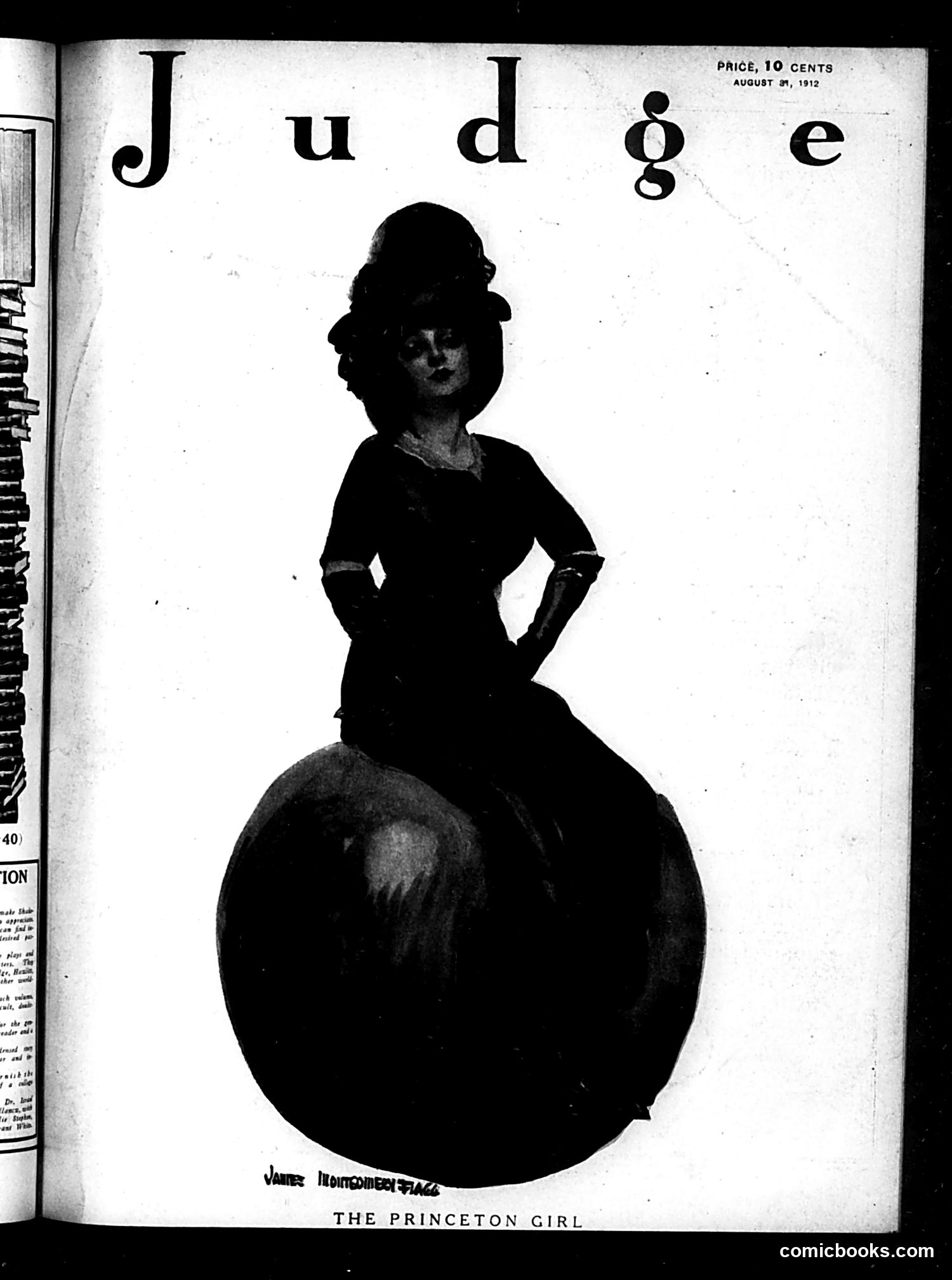
This cover illustrates a satirical commentary on women attending Princeton University. The silhouetted figure depicts a woman perched atop a large sphere or globe, wearing a hat and dark dress typical of the 1912 era, with one hand on her hip in a confident pose. The joke likely mocks the novelty or absurdity of female students at Princeton—which did not actually admit women until 1969. The "Princeton Girl" appears to be portrayed as precariously balanced and somewhat ridiculous, reflecting early-20th-century skepticism about women's higher education at prestigious institutions. The satirical tone suggests Judge magazine viewed this concept as laughable or socially inappropriate for the period.
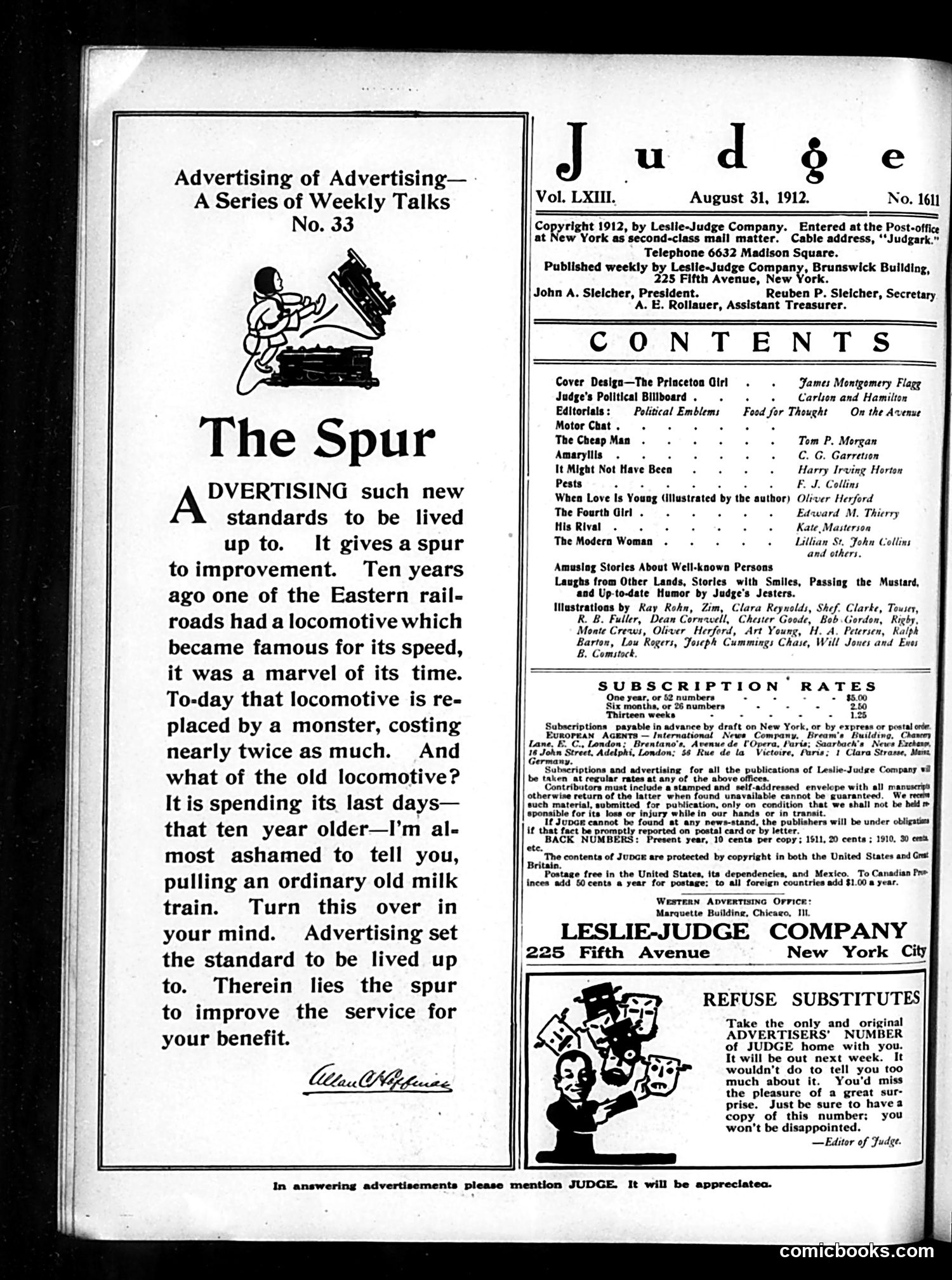
This page is primarily **advertising and editorial content** rather than political satire. The main article, "The Spur," argues that advertising establishes high standards and spurs improvement—using a railroad locomotive as metaphor. The piece claims that a ten-year-old Eastern railroad locomotive, once marveled at, is now obsolete and replaced by a superior model, illustrating how competition (driven by advertising) motivates progress. The "Refuse Substitutes" cartoon at bottom right is a **promotional ad** encouraging readers to buy the original Judge magazine rather than competitor publications. The page contains a table of contents listing various articles and illustrations but lacks overt political commentary or identifiable caricatured figures. It reflects early-20th-century advertising philosophy celebrating commercial competition and modernization.
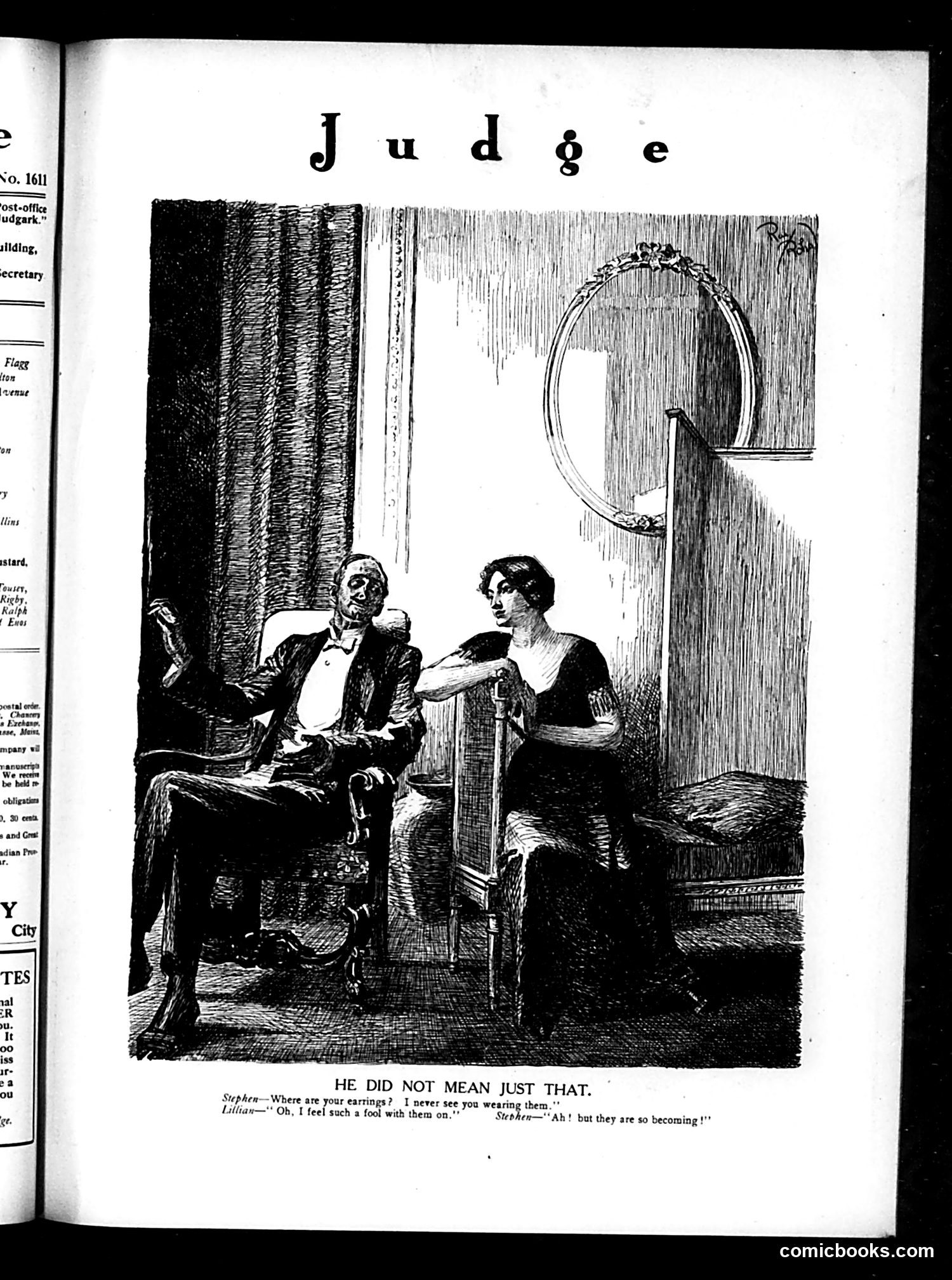
This cartoon depicts a domestic disagreement between a man and woman, likely from the early 20th century based on the style and dress. The man (Stephen) questions where his wife's (Lilian's) earrings are, noting he's "never seen you wearing them." She responds she feels foolish wearing them, but he protests "they are so becoming!" The humor appears satirical commentary on marital dynamics and changing fashion—likely mocking either men's obliviousness to women's appearance or the tension between husbands' opinions and wives' self-perception regarding jewelry and beauty standards. The title suggests he didn't intend mere flattery but something deeper, though the exact social critique remains unclear without additional context.
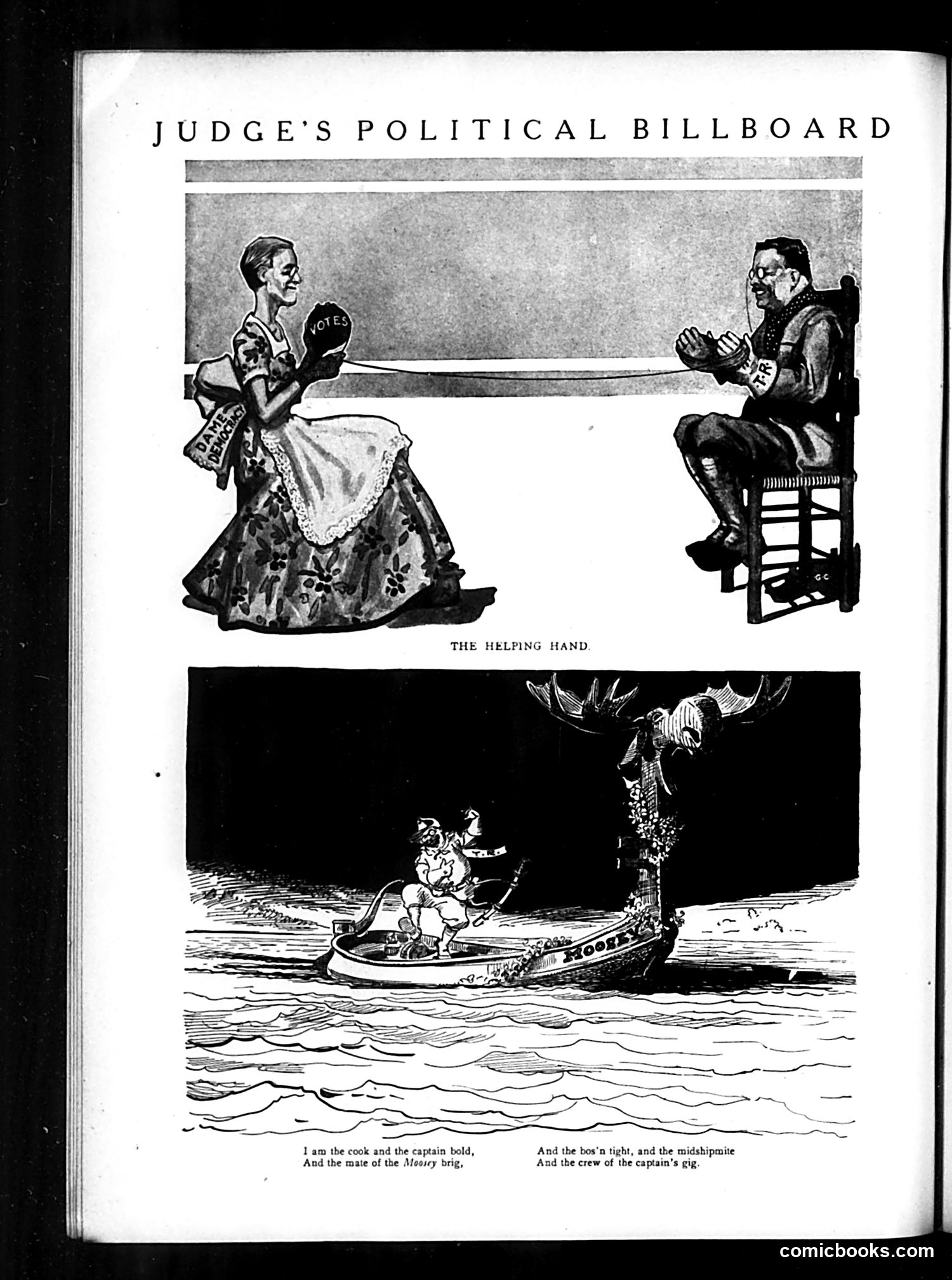
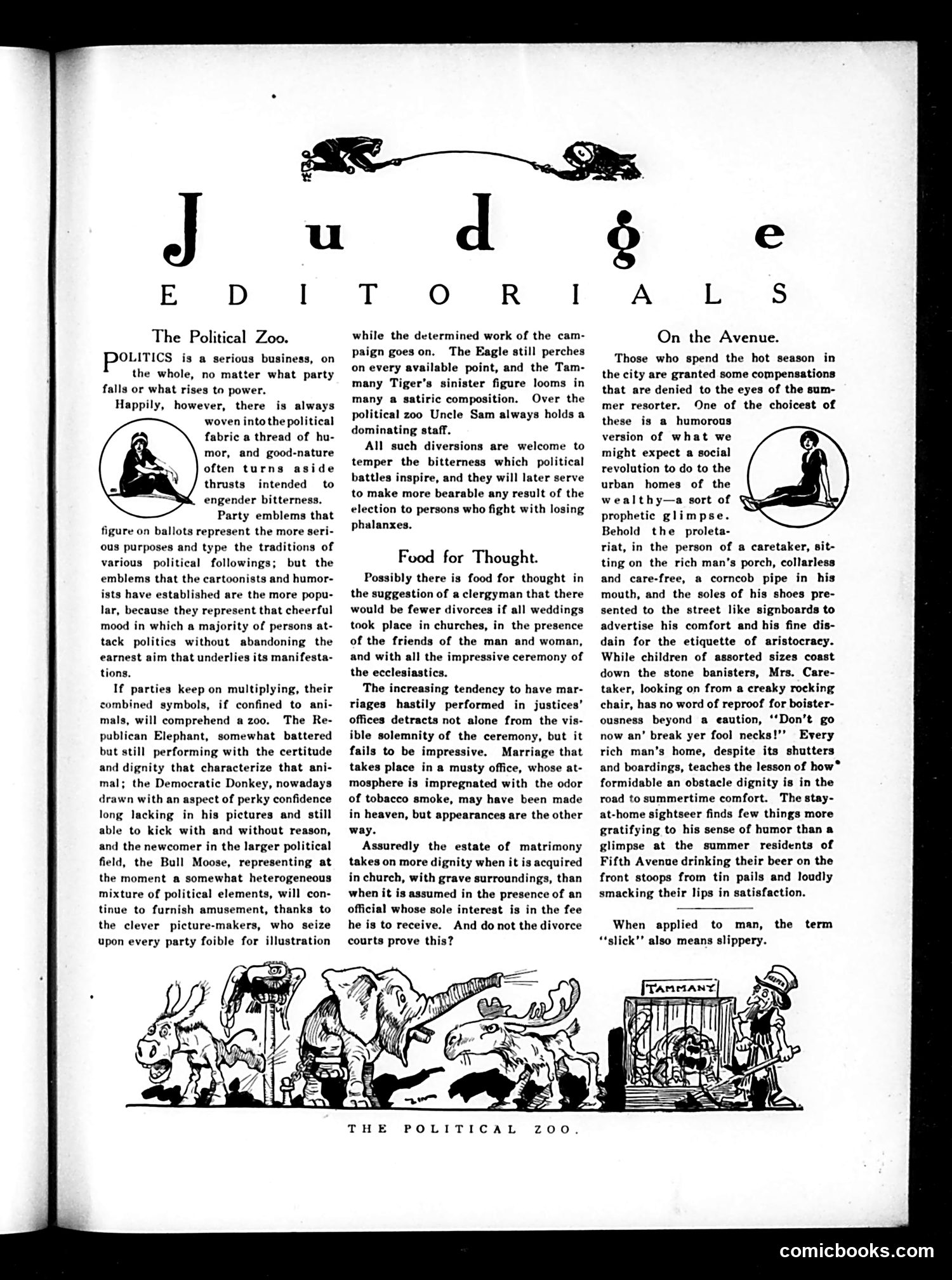
This page satirizes American political parties as a "Political Zoo." The left column uses animal metaphors—the Republican Elephant and Democratic Donkey—to mock how party symbols represent different political temperaments and factions. The text argues these emblems reflect parties' actual characteristics: the Elephant's "criticisms and dignity" versus the Donkey's "lack in pictures." The right section, "On the Avenue," offers social satire about urban etiquette, particularly mocking wealthy residents who flaunt their comfort while pretending to maintain aristocratic standards. The bottom cartoon illustrates "The Political Zoo" with caricatured animals representing various political figures and factions. The overall thrust mocks both partisan politics as theatrical spectacle and upper-class hypocrisy regarding propriety and social status.
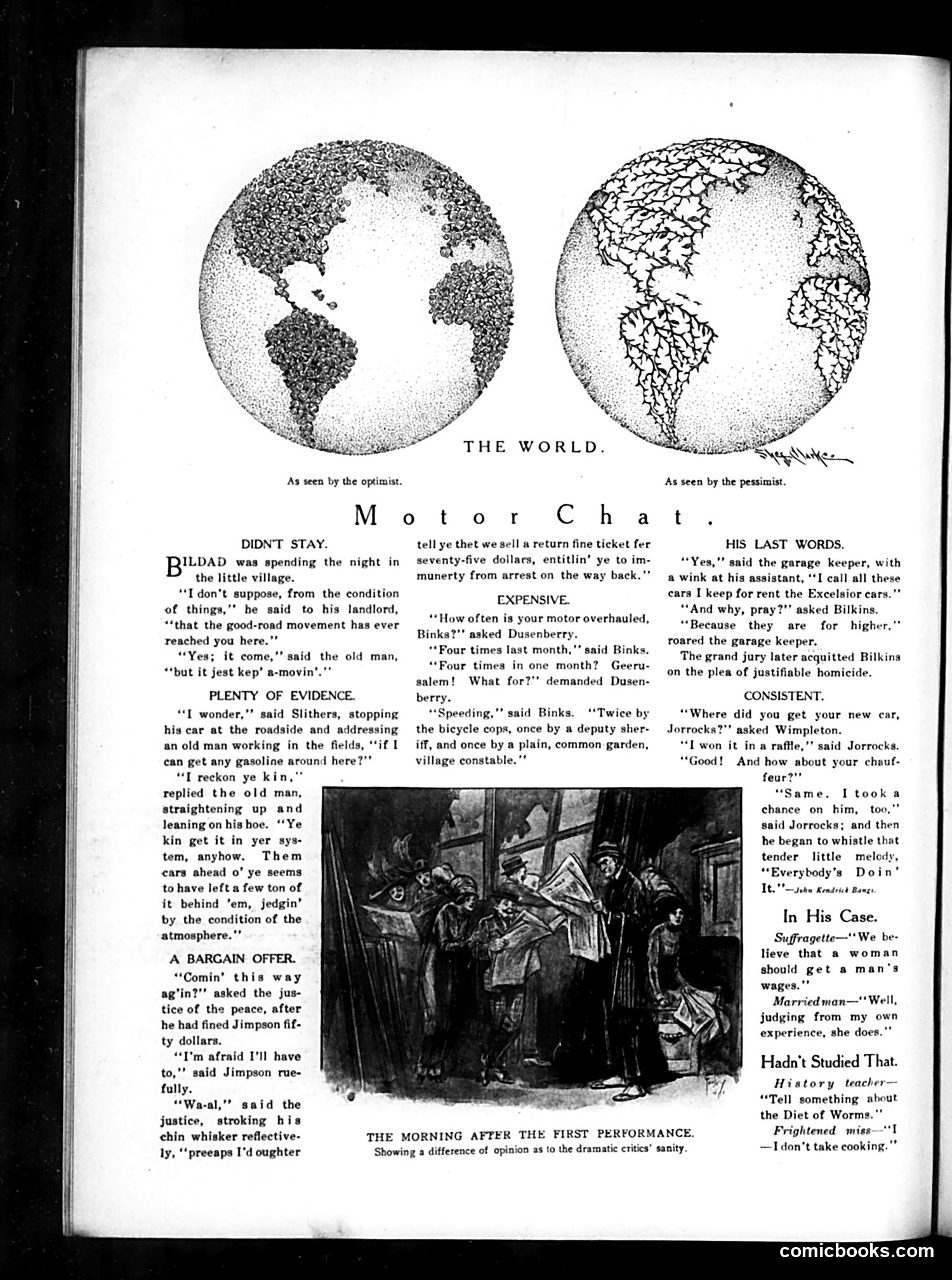
This page collects humorous short pieces mocking early motorcar culture and rural America's adjustment to automobiles. **The top cartoons** present contrasting worldviews—optimism vs. pessimism—likely satirizing broader social attitudes of the era. **The stories mock**: - Rural indifference to "good roads" infrastructure - Air pollution from cars ("left a few ton of it behind 'em") - Constant speeding fines (the protagonist fined repeatedly by different authorities) - Automobile maintenance costs and unreliability - Predatory mechanics charging exorbitant repair fees **The finale** jokes about a suffragette demanding equal wages, with a married man sardonically agreeing women already receive them—contemporary satire of both women's rights movements and domestic financial dynamics. The humor targets automobile enthusiasm, rural dialect, municipal enforcement, and social change, typical of Judge's satirical approach to early 1900s American life.
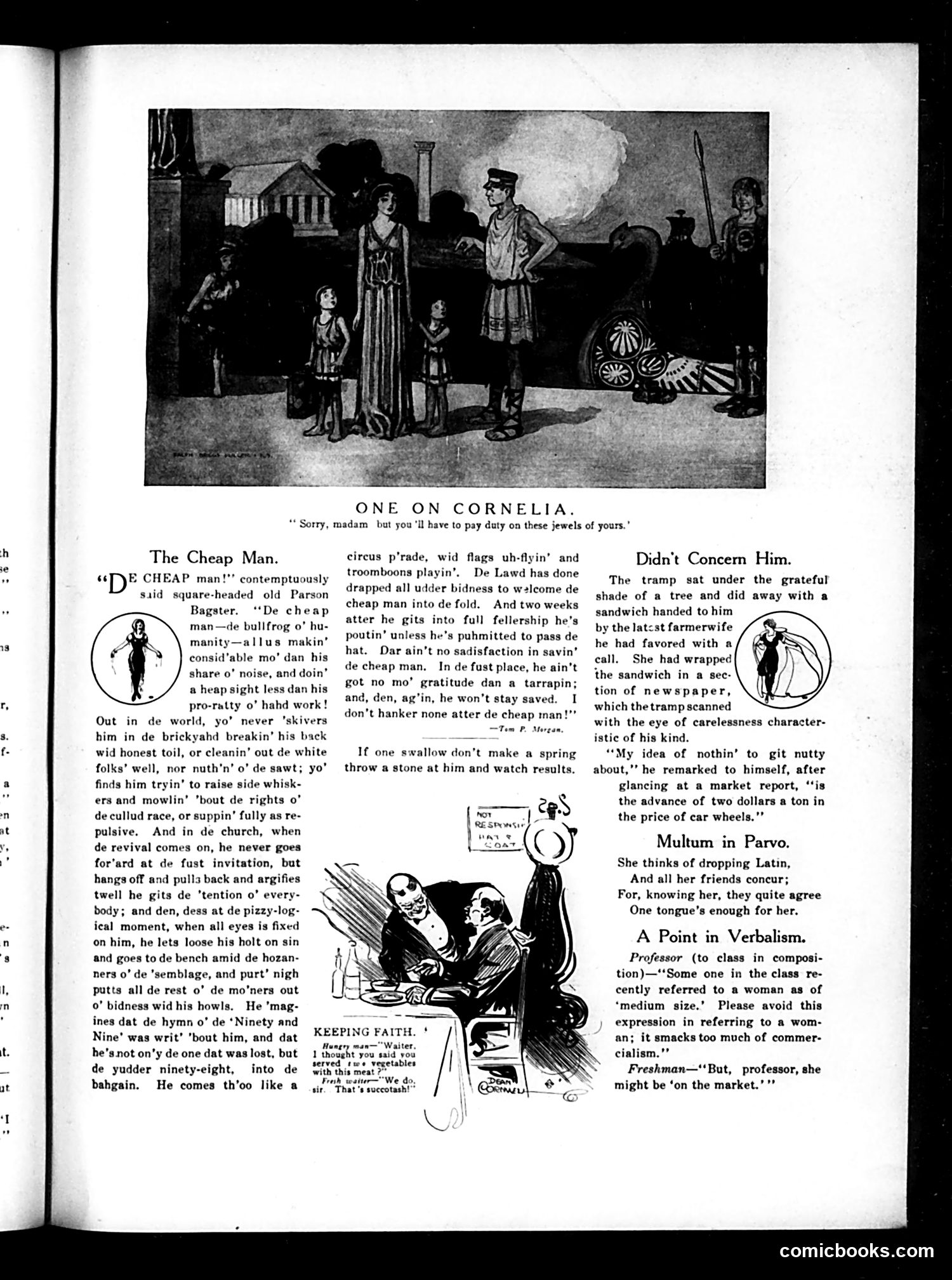
This page contains several satirical pieces typical of Judge's social commentary: **"The Cheap Man"** is a dialect monologue by Parson Bagster criticizing a lazy, self-aggrandizing Black man who avoids honest labor, makes noise about racial rights, and manipulates church revivals for attention while remaining ungrateful and unreliable. This reflects the racist stereotypes common in early 20th-century American humor. **"One on Cornelia"** (top illustration) shows a customs official demanding duty payment on jewelry—likely satirizing either tariff policy or wealthy women's extravagance. The remaining brief jokes mock: a cheapskate diner complaining about vegetables; an indifferent tramp unconcerned with market reports; a woman considering abandoning Latin; and a professor objecting to calling women "medium size" as too commercial—the freshman's quip suggesting the woman is "on the market" (marriageable). The humor targets working-class pretension, bourgeois affectation, and social climbing, typical of Judge's satirical approach to American manners and class dynamics.
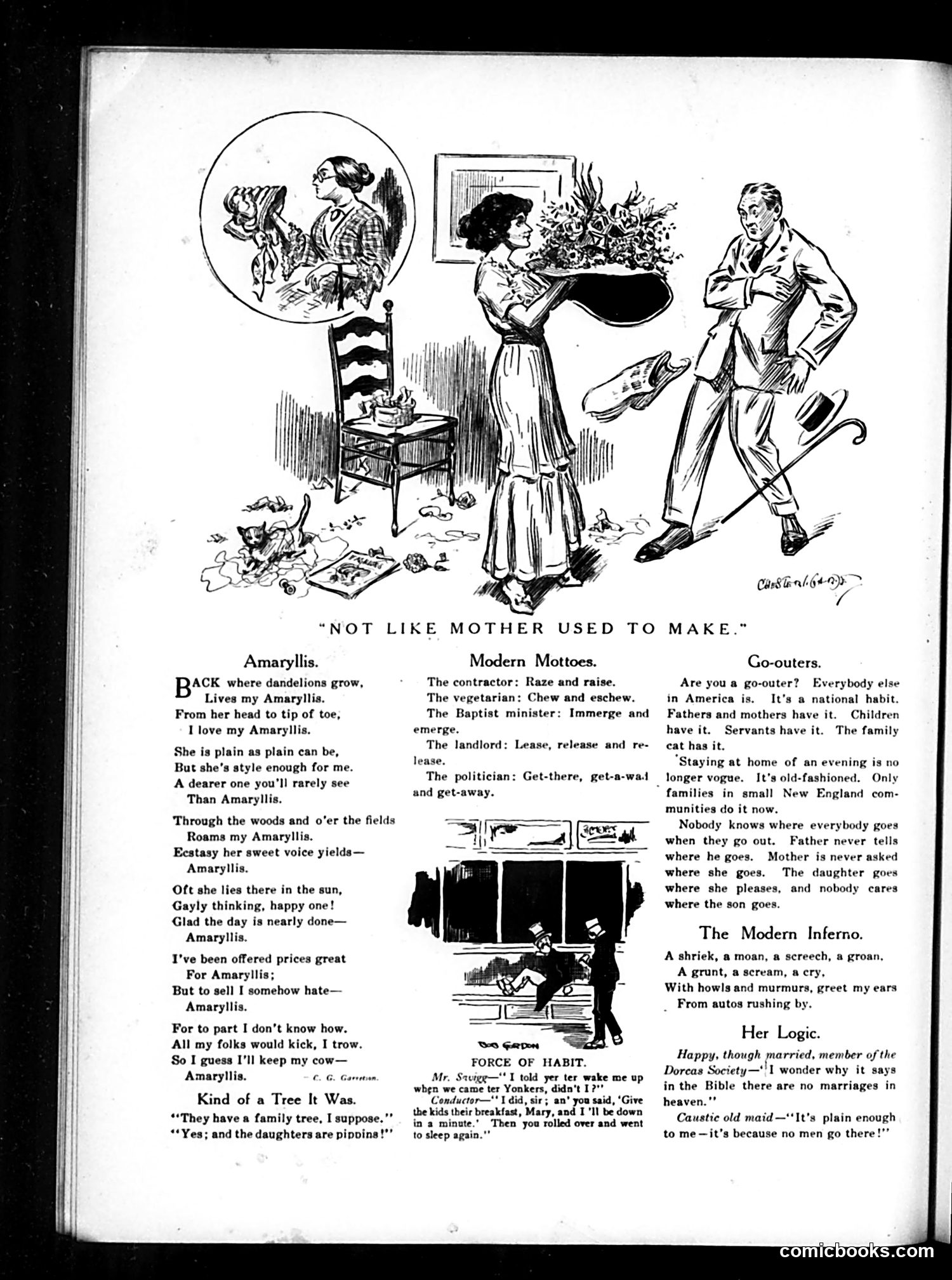
This page contains multiple short satirical pieces typical of early 20th-century American humor: **"Modern Mottoes"** mocks professional stereotypes through clever wordplay—politicians "get-there, get-a-wad and get-away" (suggesting corruption and self-interest), landlords endlessly "lease, release and re-lease" (exploiting tenants). **"Go-outers"** satirizes a contemporary social trend where Americans compulsively go out rather than stay home, treating it as a status marker. The piece observes that families no longer know where each other goes—a critique of modern social fragmentation and lack of domestic cohesion. **"Her Logic"** is a joke about unmarried women (the "caustic old maid") sarcastically suggesting heaven has no marriages because "no men go there"—implying both male damnation and female cynicism about marriage. **"Amaryllis"** is sentimental verse about a beloved cow, humorously playing with romantic language typically reserved for women. The cartoon shows domestic chaos—cooking, cleaning, child-rearing—emphasizing how modern life differs from "mother used to make" (presumably simpler, more orderly).
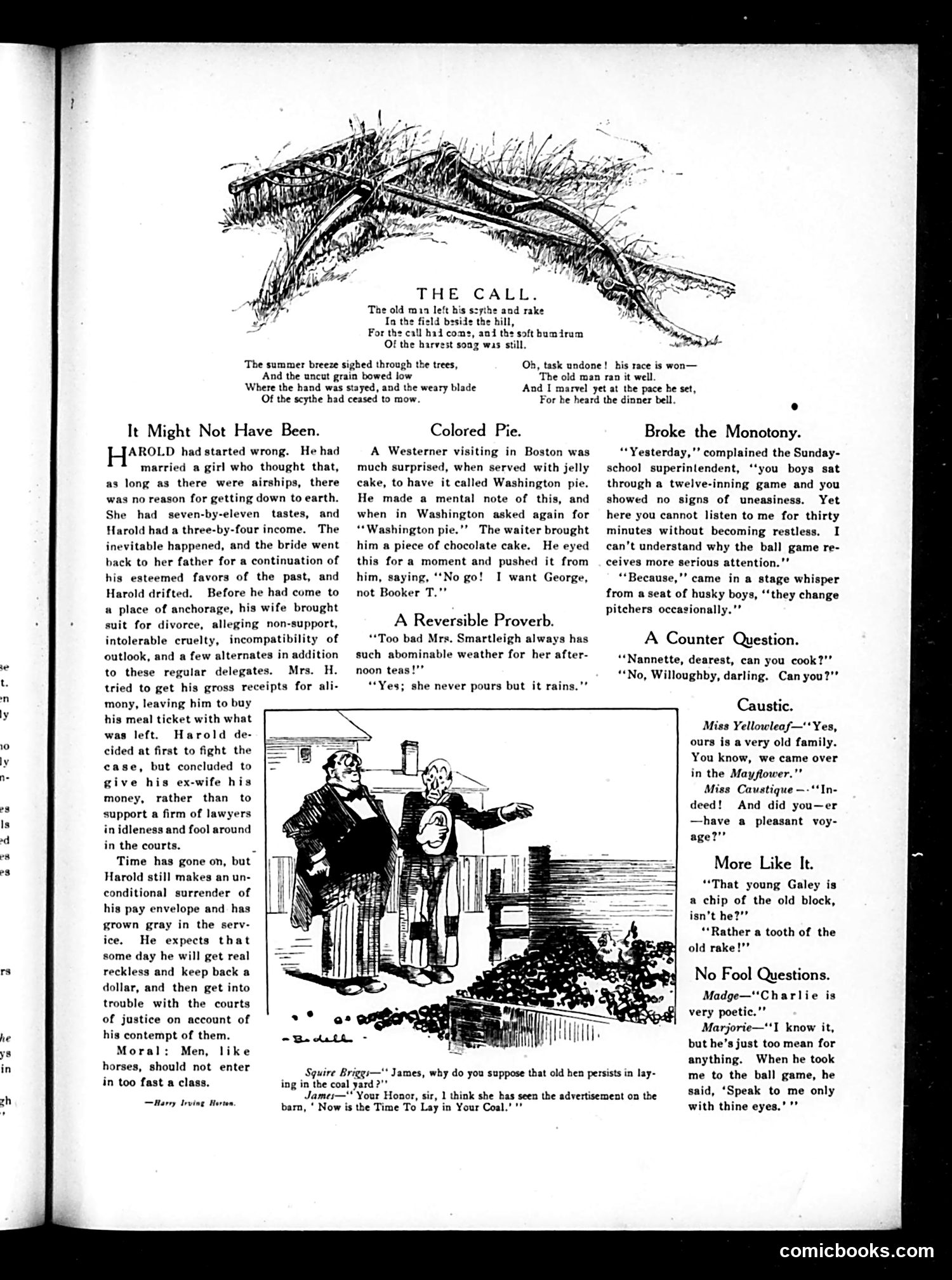
This page from the satirical magazine Judge contains multiple short humorous pieces typical of early 20th-century American periodicals. The main cartoon depicts two figures in what appears to be a domestic scene, illustrating one of the page's joke sections. The specific cartoon shown relates to one of the brief comedic vignettes printed alongside it. **Key satirical content includes:** - "It Might Not Have Been": A cautionary tale about Harold, whose marriage to an extravagant woman ends in divorce and alimony obligations—satirizing incompatible class matches and the financial burdens of divorce law. - "Colored Pie" and "Washington Pie" joke: A racial jab at Booker T. Washington, a prominent Black educator of the era, contrasting him unfavorably with George Washington. - Various one-liner jokes mocking women's cooking abilities, old family lineage claims, and overly romantic young men—reflecting period gender stereotypes. The page represents Judge's blend of social commentary, domestic humor, and period prejudices aimed at middle-class readers.
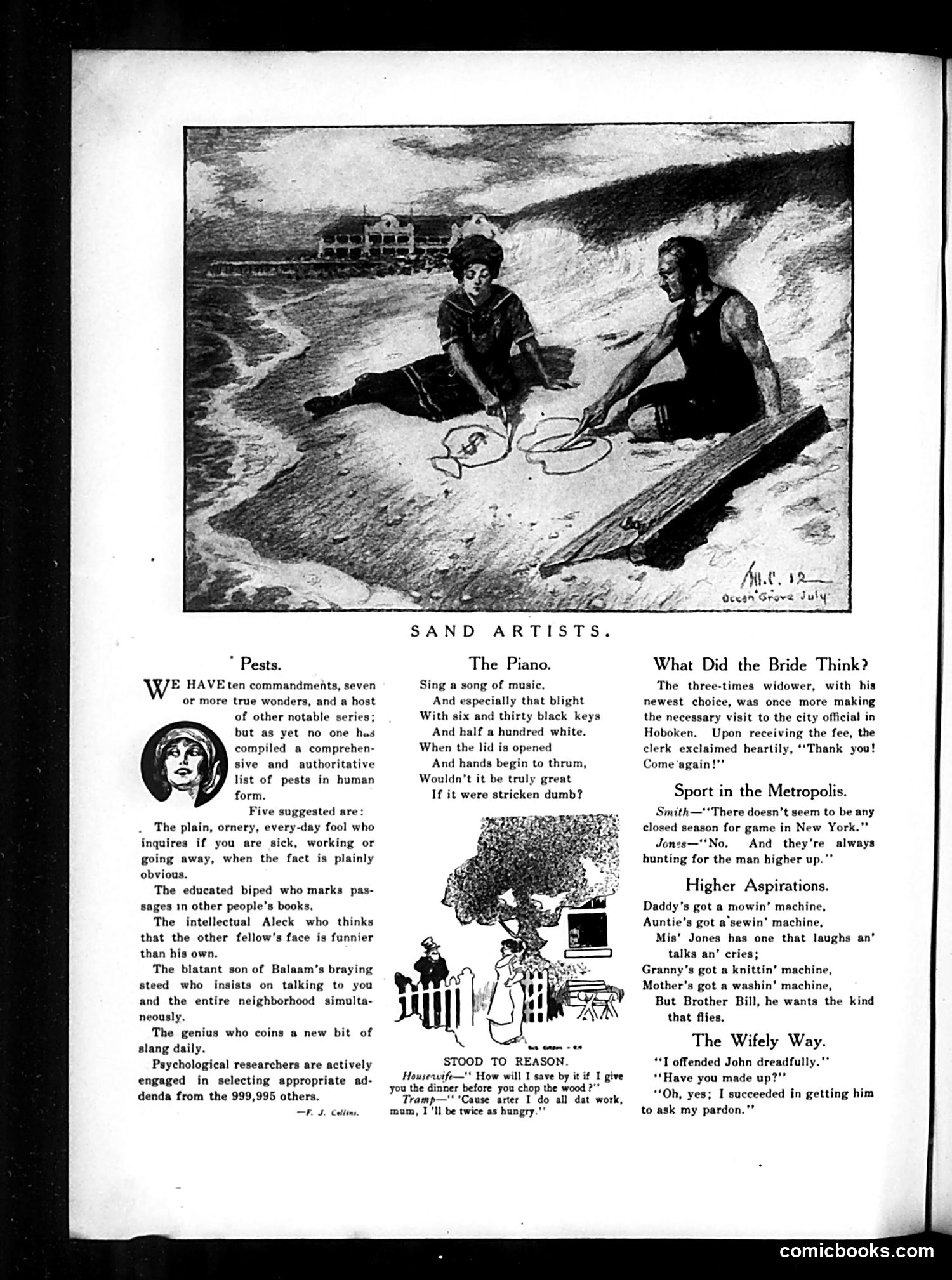
This page from Judge presents satirical humor across multiple pieces: **"Sand Artists"** (top photo): Two women create drawings in sand at Ocean Grove beach—a lighthearted visual gag about amateur artistic endeavors. **"Pests"** (left column): A catalog of annoying human types: the oblivious questioner, the book-defacer, the self-deprecating wit, the loud neighbor, and the slang inventor. This reflects early-20th-century urban frustrations with common social irritants. **"The Piano"**: Mocks the cacophony of amateur piano playing—a common Victorian/Edwardian household "accomplishment." **"What Did the Bride Think?"**: Dark humor about a serial groom (thrice-married) getting married again in Hoboken, mocking both quick marriages and the transactional nature of fees. **"Sport in the Metropolis"**: A pun suggesting "game" (hunted animals) metaphorically refers to criminals hunted by police. **Other verses**: Humorous takes on machines, marital apologies, and children's aspirations to modern technology. The overall tone reflects Judge's satirical approach to contemporary middle-class life and modern conveniences.
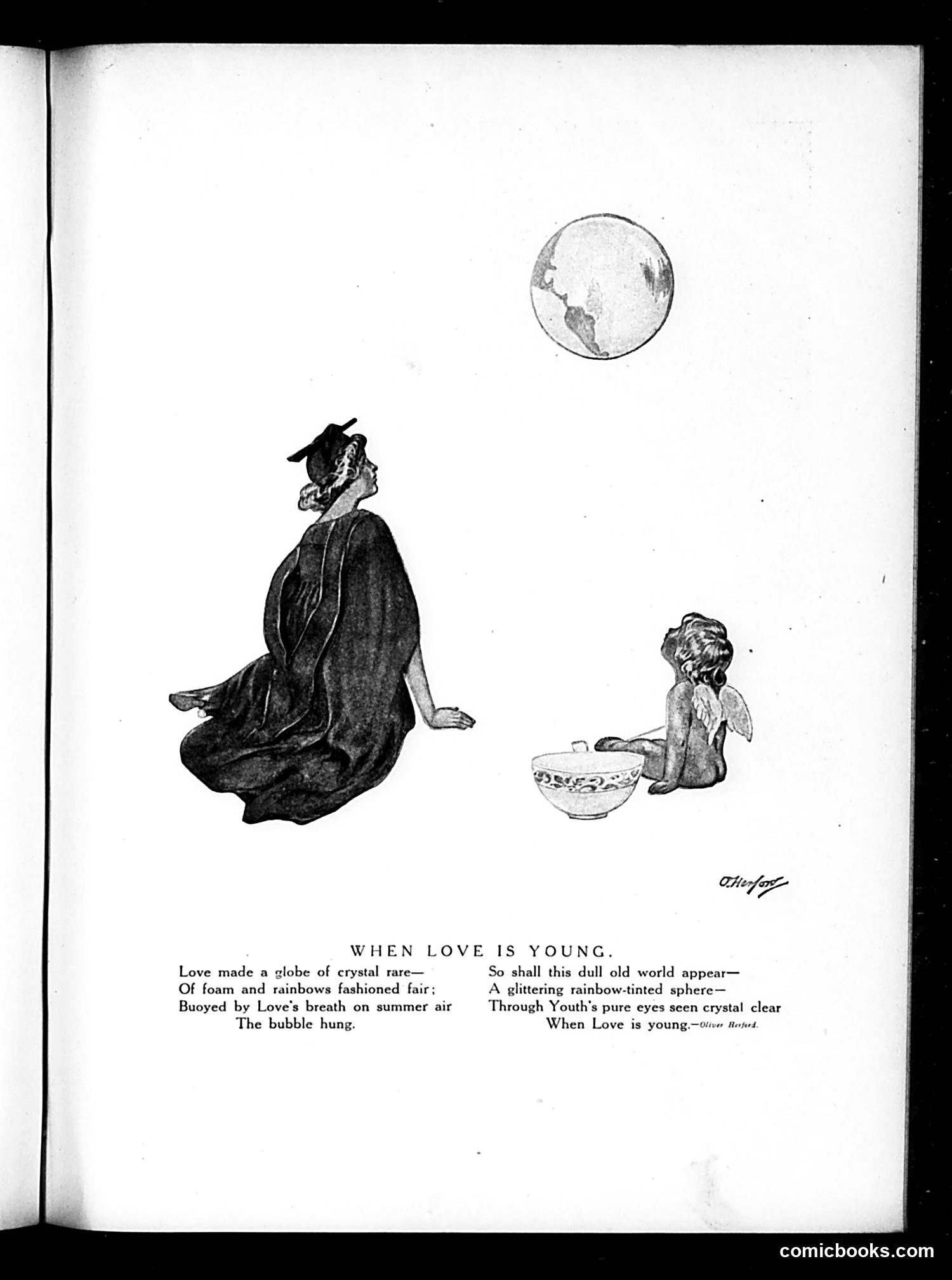
This is a sentimental illustration rather than political satire. It depicts an adult (likely a mother or caregiver) showing a young child a soap bubble floating against a globe of the world above. The accompanying poem, attributed to Oliver Herford, uses the bubble as a metaphor for youthful idealism. The "crystal rare" bubble represents how young love and youth perceive the world through rose-tinted optimism—as beautiful and magical ("glittering rainbow-tinted sphere"). The contrast between the fragile bubble and the solid globe suggests the vulnerability of youthful illusions when confronted with adult reality. This reflects early-20th-century *Judge* magazine's occasional turn toward romantic, whimsical content alongside its typical satirical commentary.
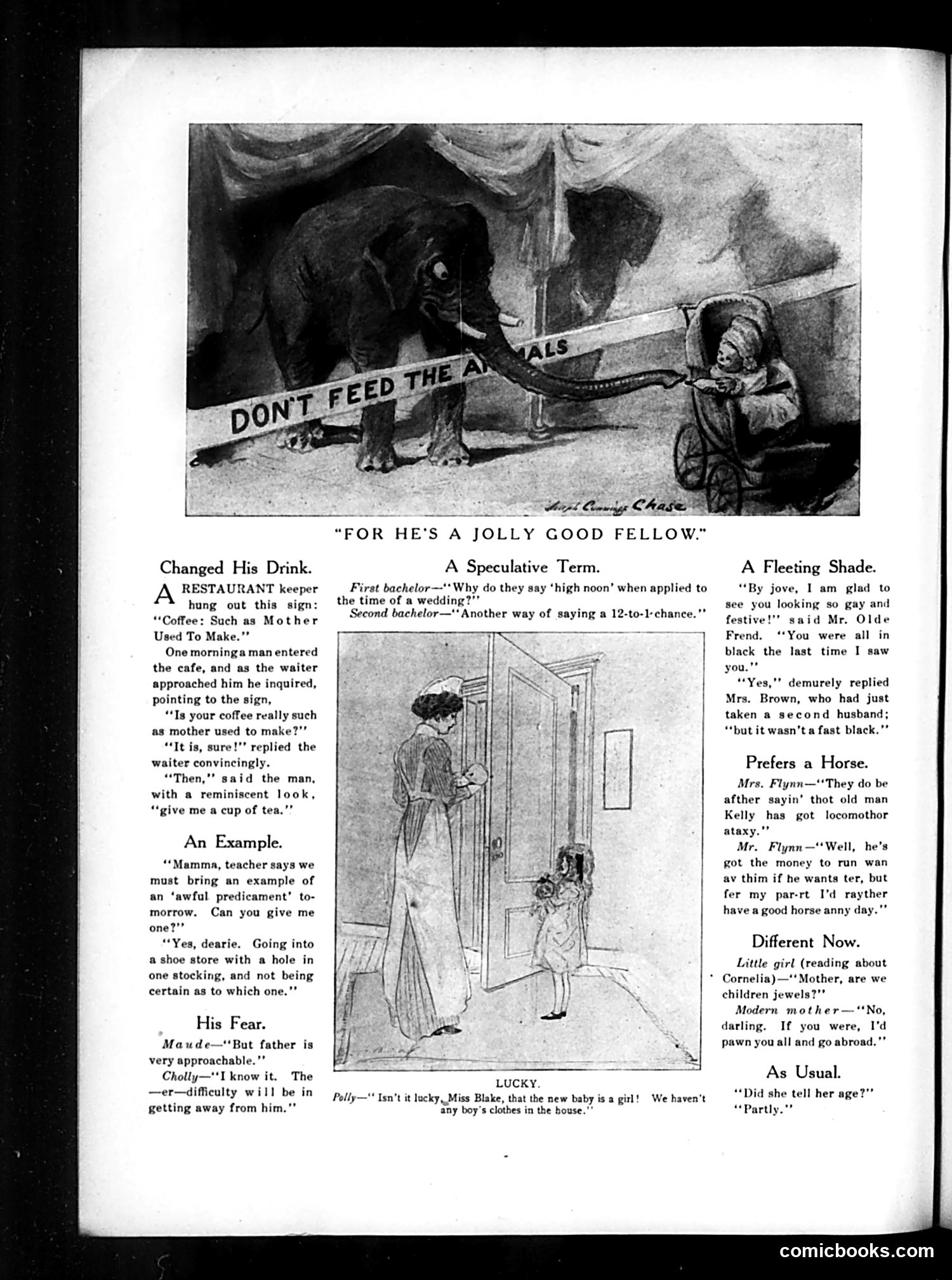
This page contains multiple short humorous anecdotes typical of early-20th-century satirical magazines, plus one editorial cartoon at top. **The Cartoon:** Shows a child feeding an elephant marked "DON'T FEED THE ANIMALS" — a straightforward visual gag about rule-breaking. **The Jokes' Themes:** The anecdotes mock contemporary attitudes toward gender, class, and marriage. "Changed His Drink" plays on nostalgia marketing. "An Example" jokes about women's social embarrassment over clothing. "His Fear" references courtship anxiety around wealthy fathers. "A Speculative Term" contains cynicism about marriage success (12-to-1 odds). "Lucky" satirizes women's narrow domestic concerns. "A Fleeting Shade" makes dark humor about rapid remarriage after mourning. The dialect pieces mock Irish immigrants' speech patterns while joking about their financial priorities and old age. These reflect period attitudes: skepticism toward advertising, anxiety about female propriety, mockery of immigrants, and cynicism about marriage as economic transaction rather than romantic ideal.
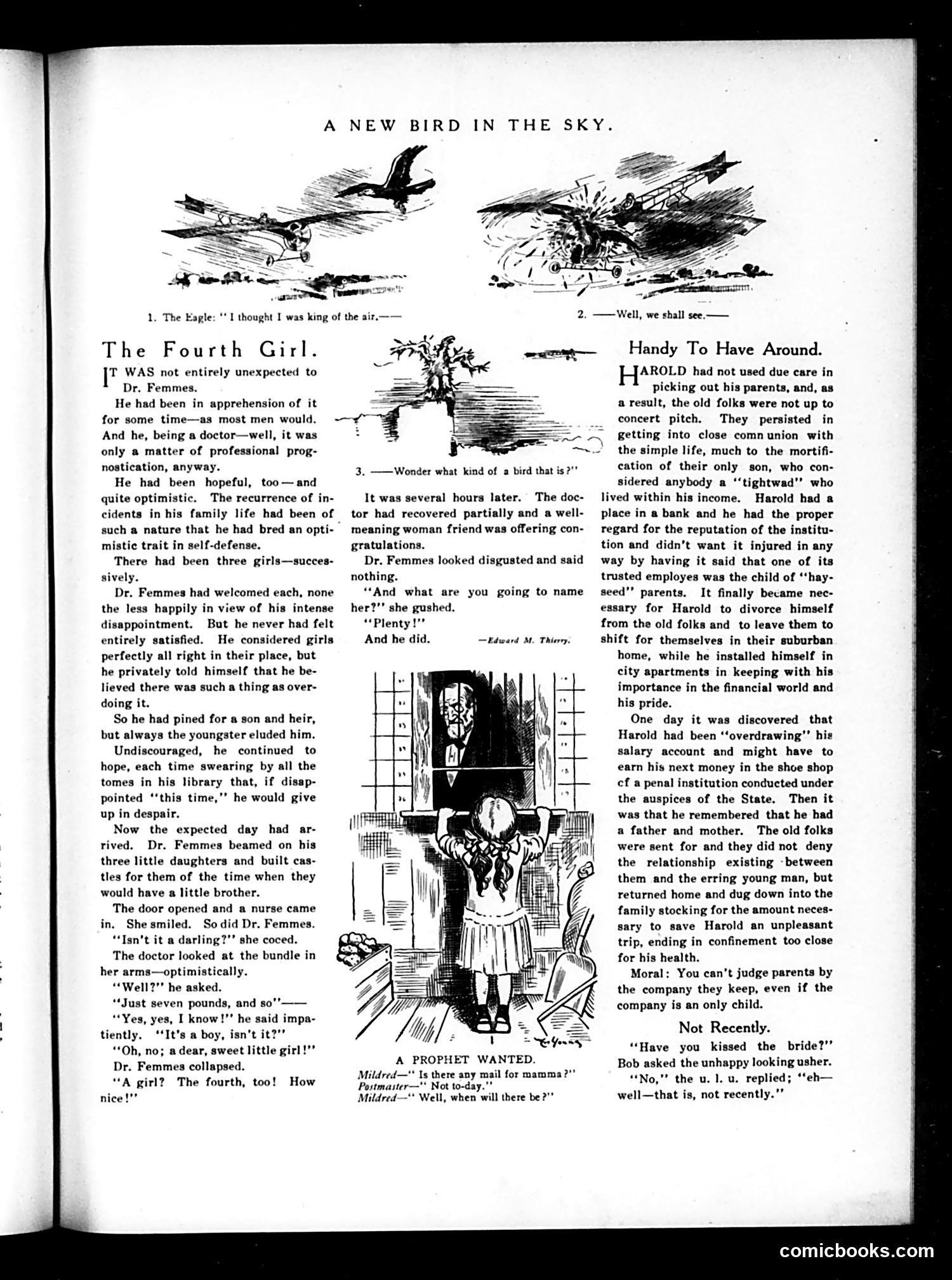
This page contains three satirical stories typical of early 20th-century Judge magazine, mocking middle-class anxieties: **"The Fourth Girl"**: Dr. Femmes desperately wants a son but keeps having daughters. The joke is his repeated disappointment—he's optimistic each time, swears he'll accept whatever comes, then collapses when another girl arrives. The airplane cartoons above ("A New Bird in the Sky") appear unrelated, likely from another piece. **"A Prophet Wanted"**: A child asks when mail will arrive; the humor plays on parental uncertainty and incompetence. **"Handy to Have Around"**: Harold, embarrassed by his rural "hayseeds" parents, abandons them for city apartments to maintain his bank reputation. When he embezzles and faces prison, they bail him out. The moral: you can't judge people by their children. All three stories satirize American social pretension and generational conflict—particularly the shame middle-class sons felt toward working-class or rural parents, and the irony that such parents often rescue their ungrateful children.
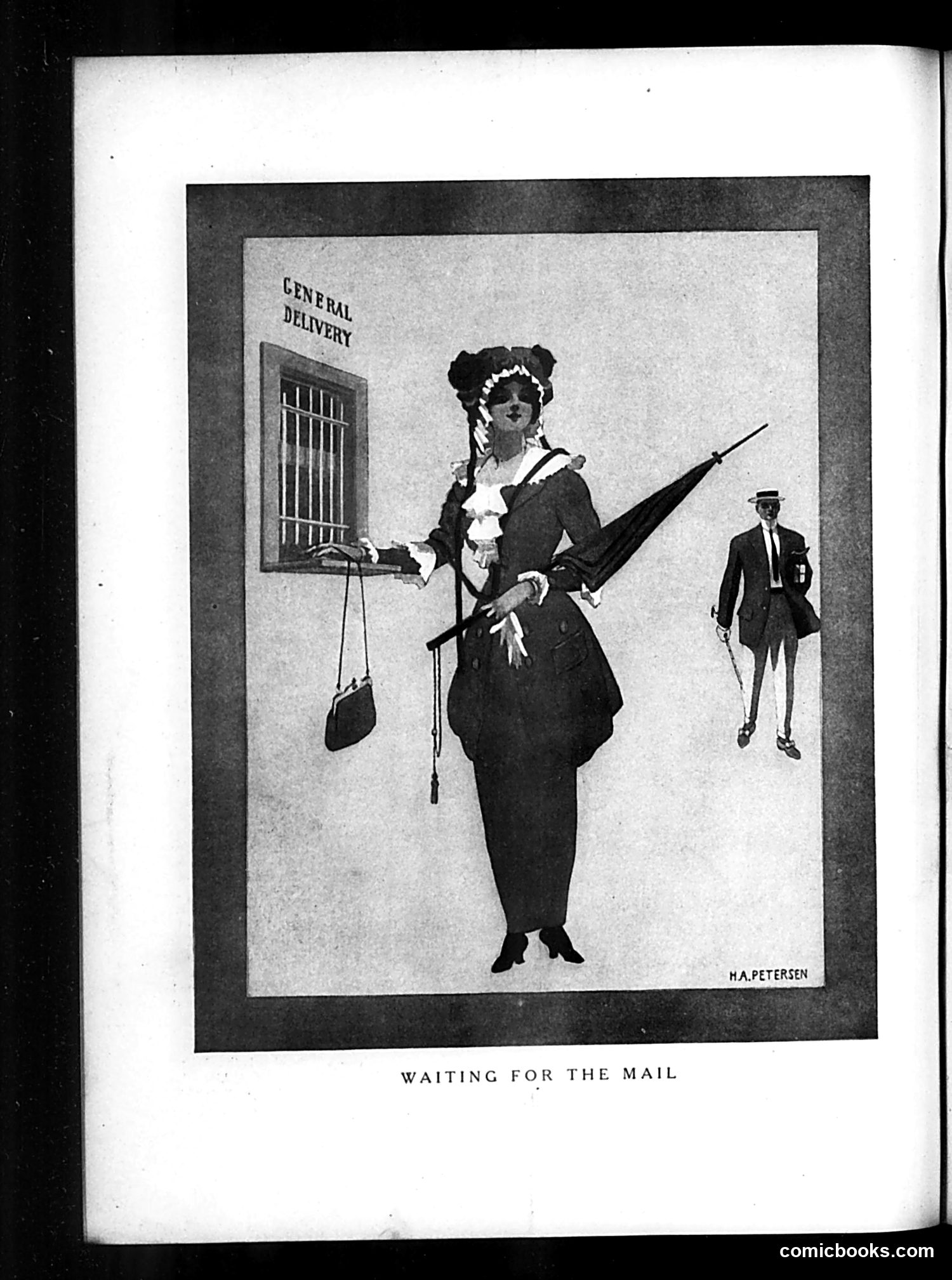
This satirical cartoon by H.A. Petersen depicts a fashionably dressed woman standing outside a "General Delivery" postal window, holding an enormous rifle or harpoon-like object alongside a handbag. A uniformed postal worker observes from the right. The satire appears to comment on women's impatience or aggressive pursuit of romantic correspondence—"waiting for the mail" likely refers to awaiting letters from suitors. The absurdly oversized weapon suggests exaggerated, almost violent eagerness. The woman's elaborate hat and fashionable attire indicate she represents a particular social type, possibly satirizing the "new woman" or dating customs of the era. The joke relies on the visual incongruity of a genteel woman wielding weapons while engaged in the domestic act of mail-checking, mocking feminine behavior or expectations around romantic pursuit.
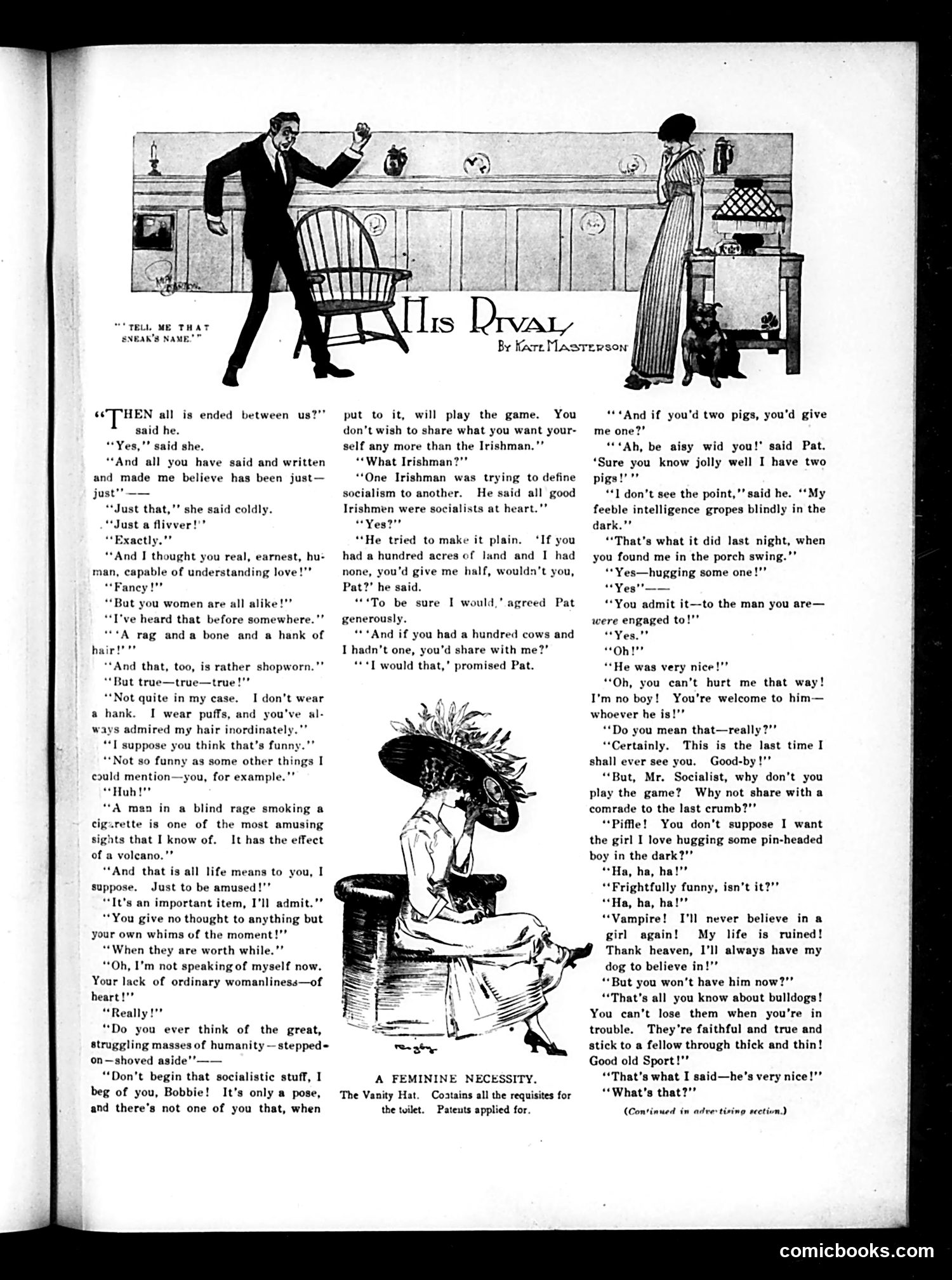
This story satirizes romantic hypocrisy and socialist posturing. A man and woman are breaking up; he accuses her of lacking "ordinary womanliness" and concern for "struggling masses of humanity," adopting socialist rhetoric. She counters by mocking his socialism as mere pose—using his own logic against him: he claims socialists share everything, yet refuses to "share" her with another man. The man's indignation reveals the satire's point: his professed socialist ideals collapse when personal jealousy emerges. He condemns her affair passionately, contradicting his earlier claim that sharing is socialistic duty. The ending—swearing fidelity to his dog instead of women—mocks male emotional immaturity. The accompanying advertisement for "The Vanity Hat" reinforces the era's gender stereotyping, suggesting women's primary concern is appearance rather than genuine values.
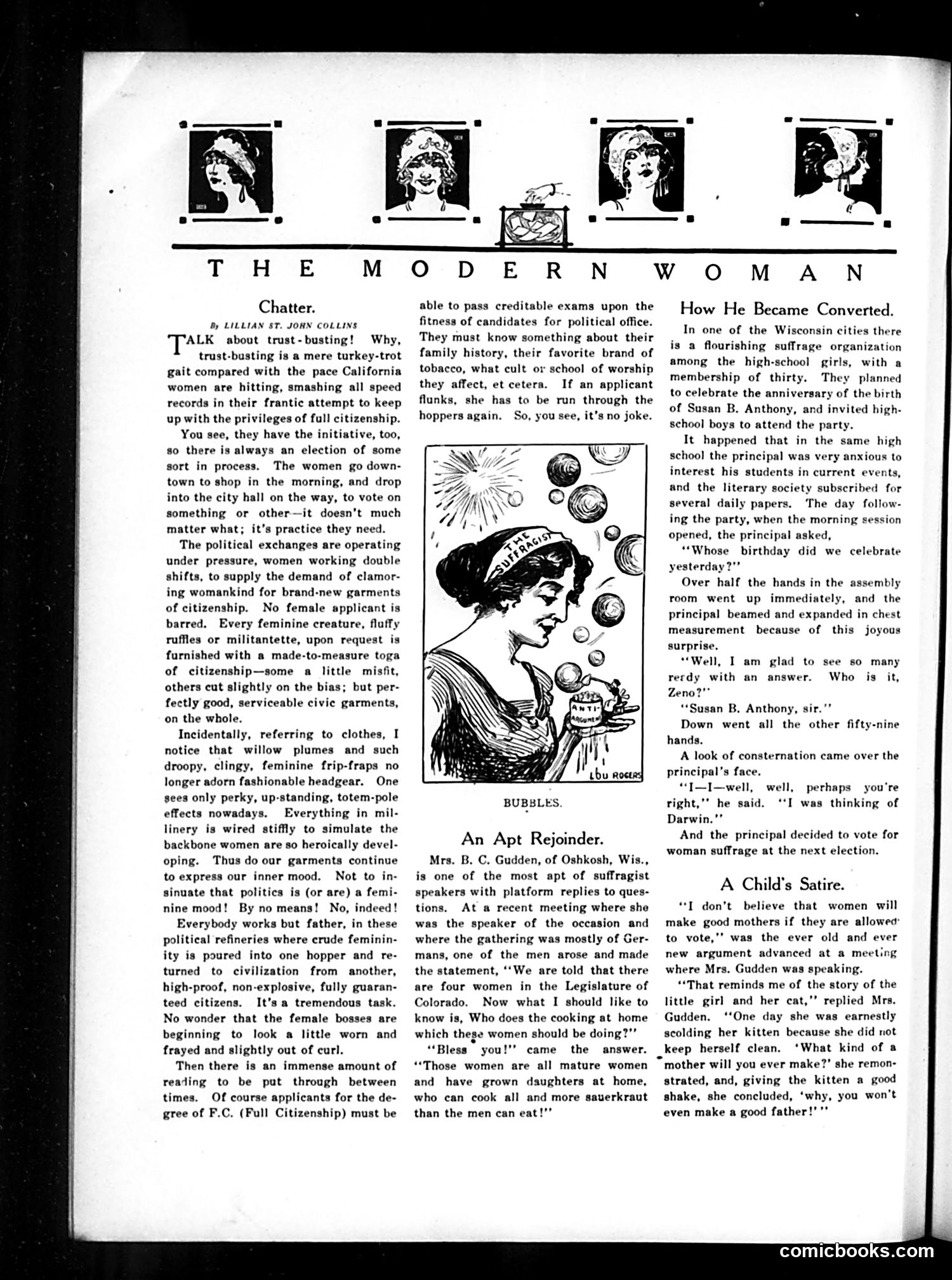
This Judge magazine page satirizes women's suffrage activism in early 20th-century America through three pieces: **"Chatter"** mocks California women newly granted voting rights, depicting them frantically juggling shopping, voting, and civic education as exhausting "double shifts." The author sarcastically compares women's political organizing to an industrial process manufacturing "citizenship" like factory goods—some "misfits," all requiring examination on tobacco preferences and religious beliefs. The joke: women are so overwhelmed by newfound voting privileges they're physically deteriorating (note the hairstyle commentary about "backbone" development). **"An Apt Rejoinder"** presents Mrs. B.C. Gudden's witty response to a German-American heckler who challenged four female Colorado legislators: "Who does the cooking?" Her answer—that grown daughters handle cooking better than men—cleverly disarms the "women belong in kitchens" argument. **"A Child's Satire"** depicts a principal surprised that high schoolers named Susan B. Anthony as the previous day's birthday honoree, having expected they'd learned nothing from their suffragist schoolmates' party. The overall tone is mixed: gentle mockery of suffrage enthusiasm alongside grudging acknowledgment of women's wit and determination.
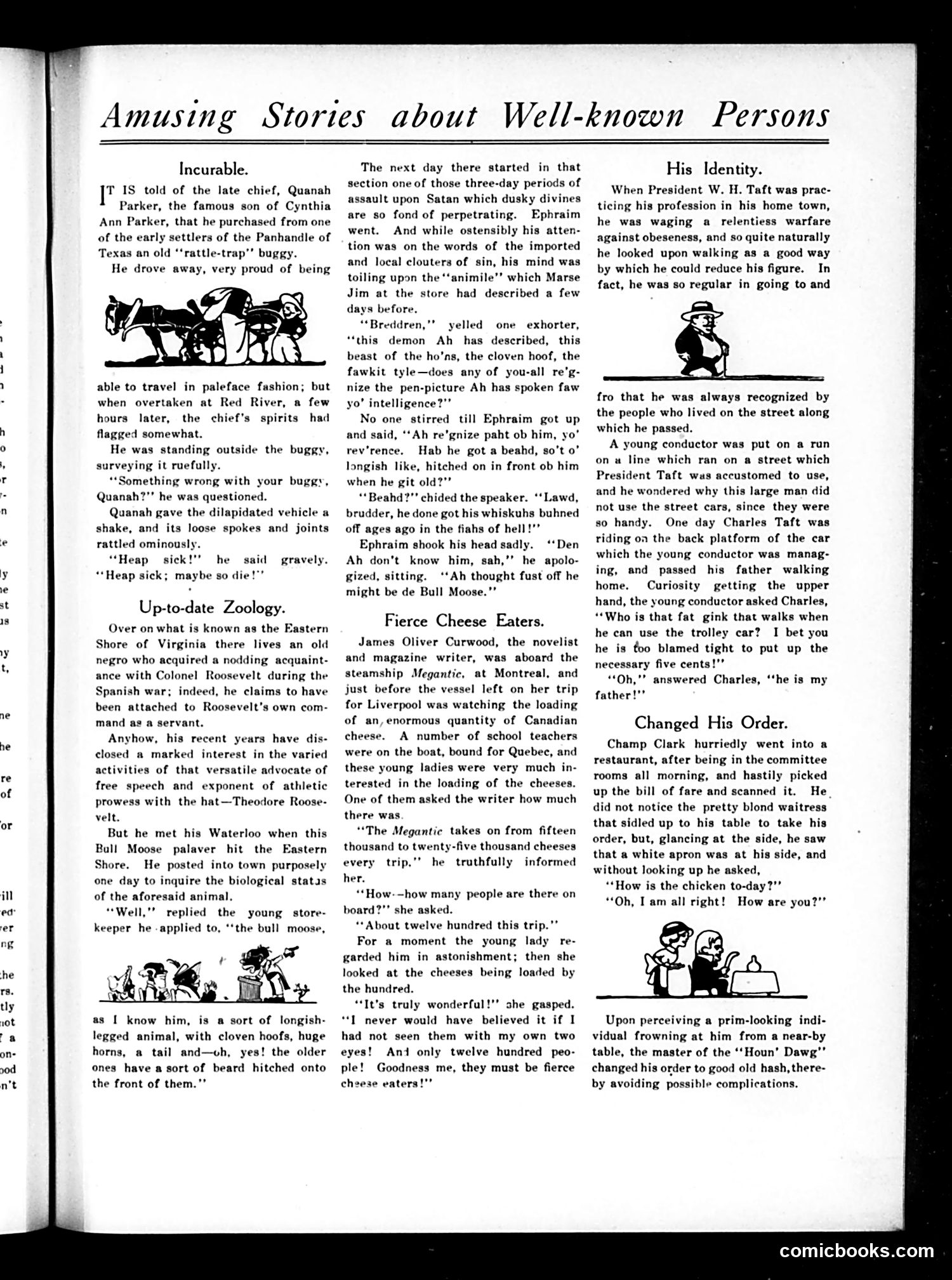
This page contains three humorous anecdotes about "well-known persons": 1. **Quanah Parker story**: Mocks a Native American chief's attempt to adopt white civilization. The joke relies on stereotypical dialect and the implication that Parker cannot properly maintain "paleface" technology—the buggy falls apart, and he compares it to illness using broken English ("Heap sick"). 2. **Theodore Roosevelt/"Bull Moose" story**: References Roosevelt's 1912 Progressive "Bull Moose" party campaign. An elderly Black man, formerly a Roosevelt servant, confuses Satan (described in a sermon with "horns" and "cloven hoof") with an actual bull moose. The humor derives from dialect comedy and the man's literal misunderstanding. 3. **Cheese eaters story**: A novelist tells schoolteachers a ship carries 15,000-25,000 cheeses for 1,200 passengers. The women assume passengers will eat all the cheese, leading to exaggerated wonderment at the quantity. All three rely on period-typical stereotypes and dialect humor common to early-20th-century American comedy publications.
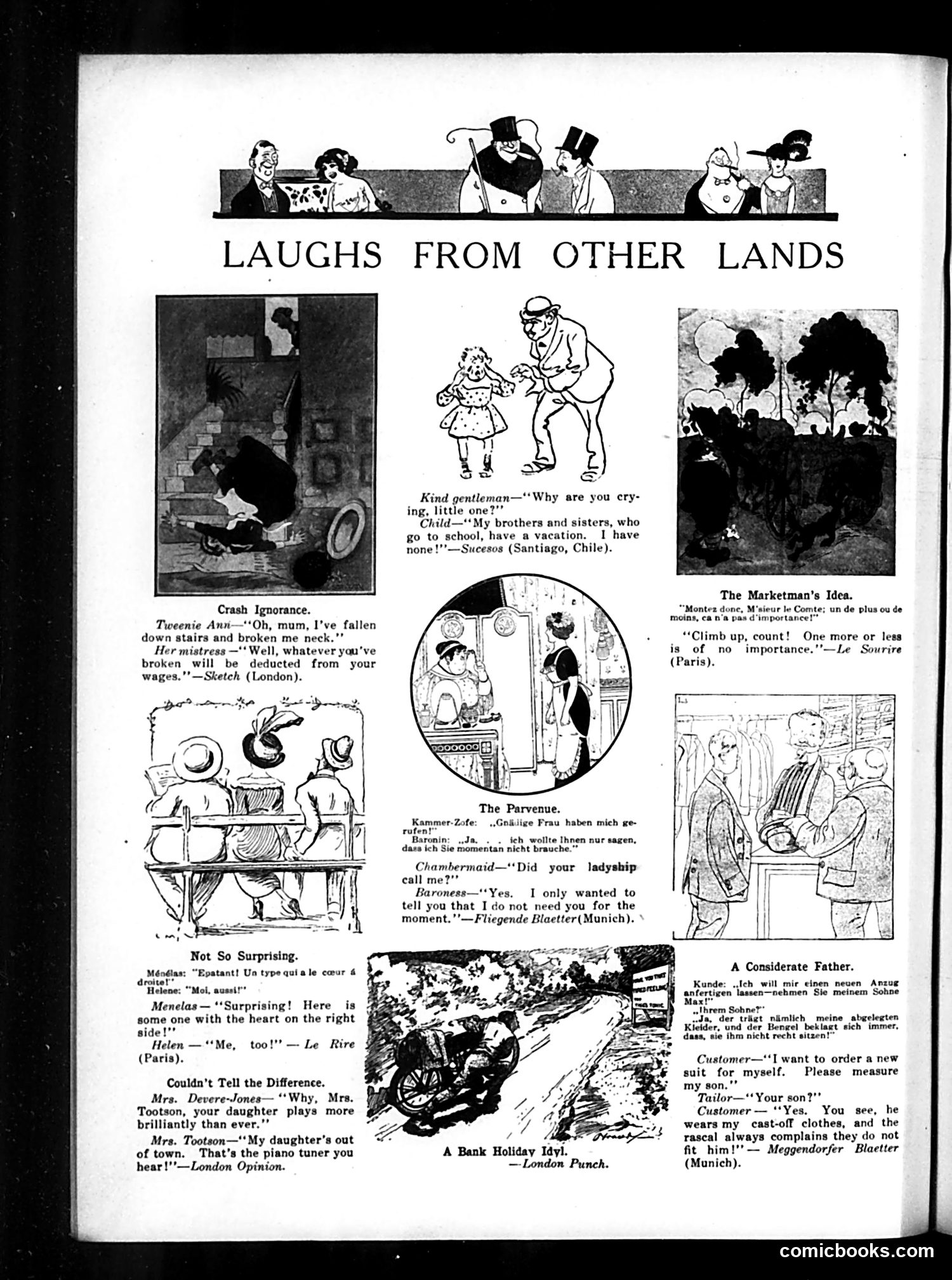
This page collects brief humorous anecdotes translated from European satirical publications (London, Paris, Munich, Santiago). Each cartoon satirizes social class attitudes and domestic hierarchies of the early 20th century. Key themes include: servants' mistreatment ("broken will be deducted from your wages"), class pretension (a newly wealthy woman rudely dismissing her chambermaid), parental cheapness (measuring a son for a suit because he wears the father's castoffs), and economic inequality (a street vendor elevated so a count can climb higher, implying nobility is replaceable). The humor relies on exposing hypocrisy and cruelty among the upper classes toward servants and subordinates. The international sourcing emphasizes these attitudes transcend borders—a commentary on universal class-based social dysfunction among Judge's American readership.
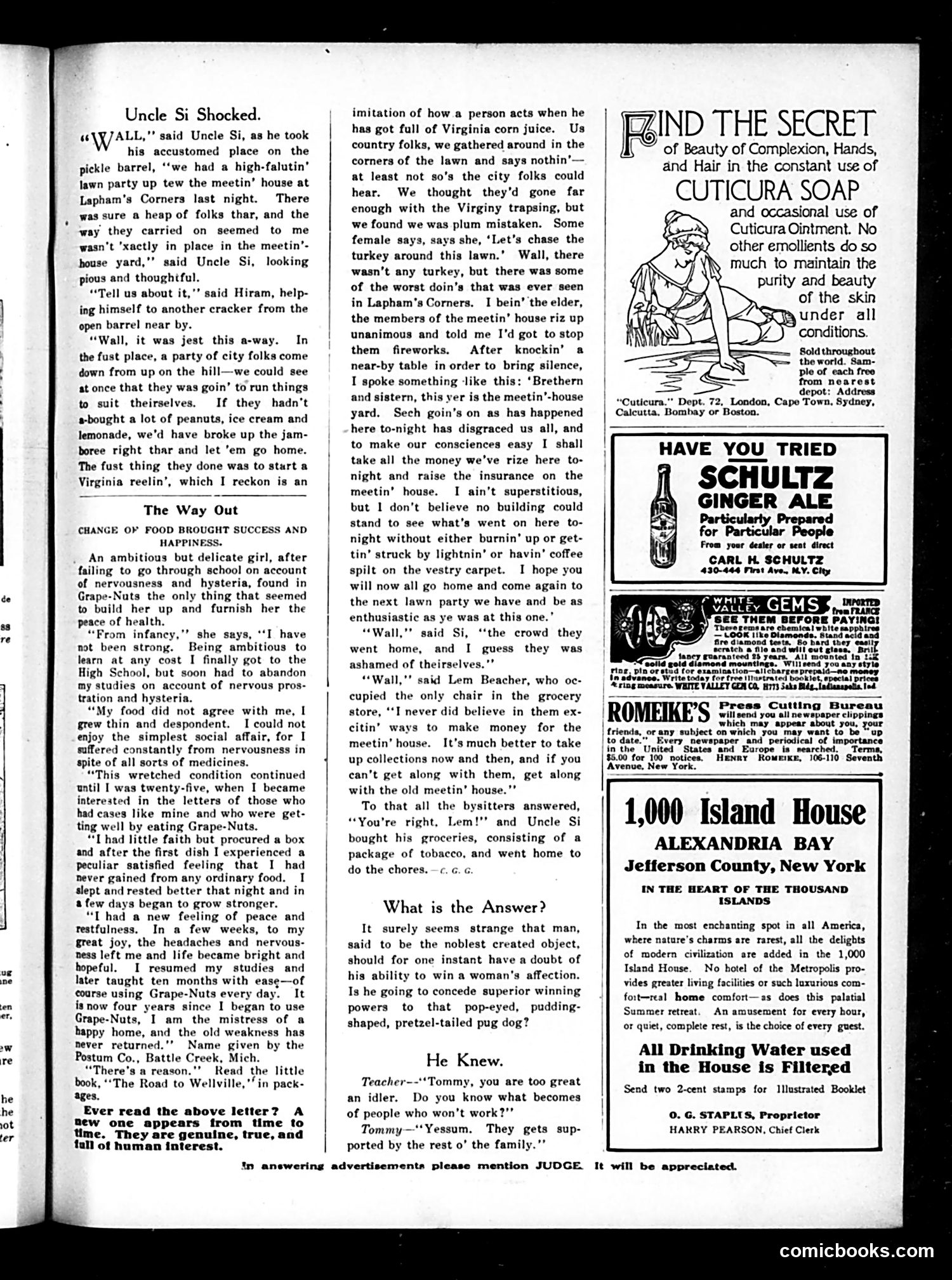
This page features a humorous rural dialect story where Uncle Si, a pious country elder, scandalized by city visitors' behavior at a church lawn party. The satire mocks both groups: the citified guests who arrive from "up on the hill" and behave wildly (doing a "Virginia reel" and chasing an imaginary turkey), and Uncle Si's sanctimonious response—confiscating the party's proceeds to raise church insurance rather than genuinely addressing misconduct. The joke targets class tensions between urban sophistication and rural propriety, while poking fun at Uncle Si's hypocrisy: he claims moral outrage but actually covets the collected money. The dialect humor was typical of *Judge* magazine's appeals to middle-class readers who enjoyed looking down on both crude country folk and frivolous city people. The remaining page contains period advertisements (Cuticura, Schultz Ginger Ale, real estate) unrelated to the satire.
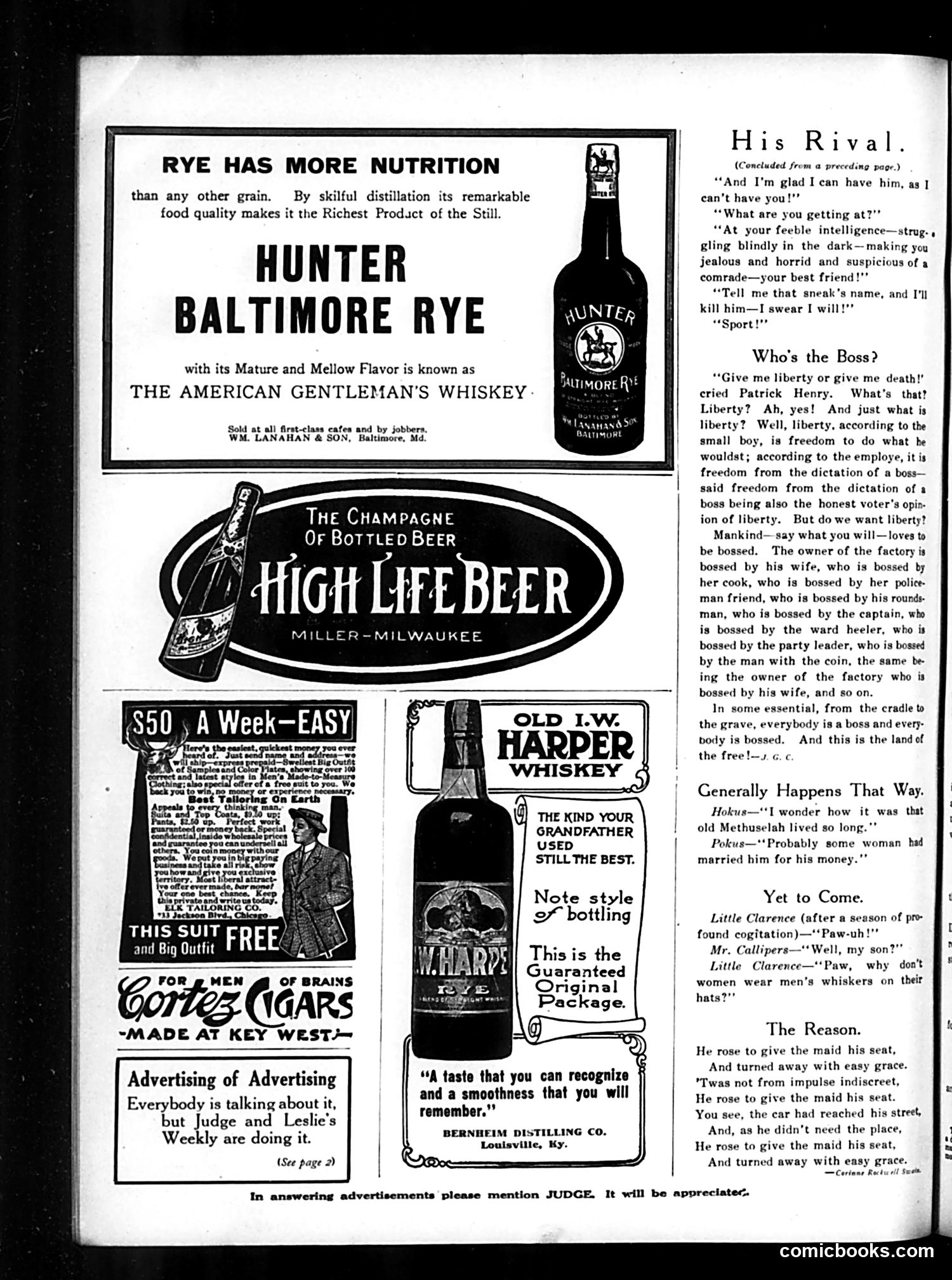
This page consists primarily of **period advertisements** for alcohol (whiskey and beer) mixed with short humorous pieces typical of Judge magazine's satirical format. The ads employ common early 20th-century marketing tactics, claiming nutritional benefits for rye whiskey and emphasizing brand prestige ("American Gentleman's Whiskey"). One ad offers a free suit to promote Cortez Cigars. The text content includes several **brief satirical sketches**: - "His Rival": A dramatic dialogue about jealousy and betrayal - "Who's the Boss?": A philosophical piece satirizing how hierarchy pervades all social levels—factory owners, employees, voters—creating an ironic cycle where everyone answers to someone - Short humorous vignettes mocking human nature (longevity, gender roles, chivalry) The page's joke about "Advertising of Advertising" suggests Judge and its competitor *Leslie's Weekly* were engaged in promoting their own advertising reach—a meta-commentary on media competition. The content reflects early 1900s American middle-class concerns: social hierarchy, courtship dynamics, and commercial aspirations.
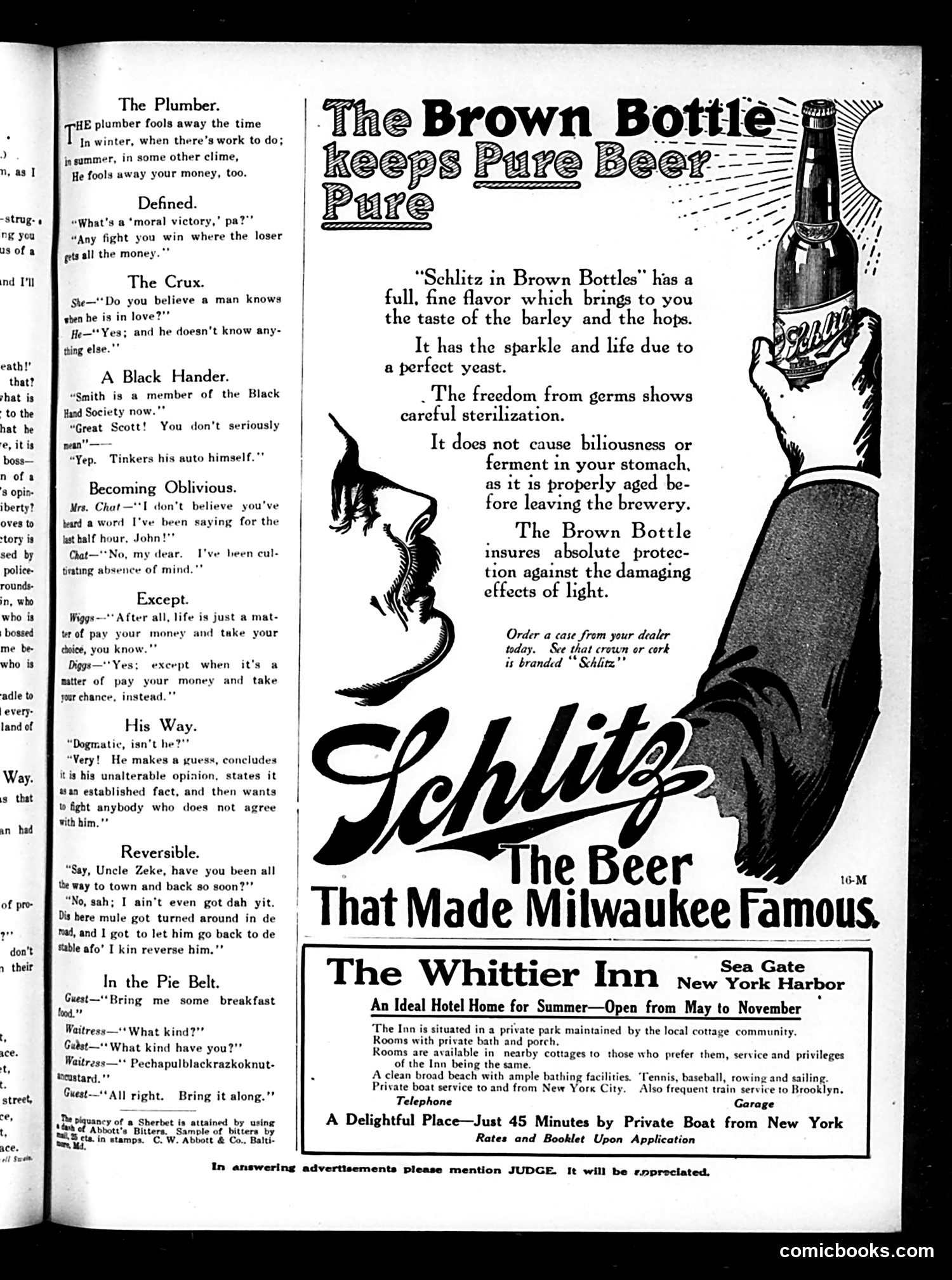
This page contains **short humor jokes** in the left column and **advertisements** dominating the right side. The jokes satirize common annoyances of early 20th-century American life: plumbers who waste time and money, the vagaries of love and relationships, the "Black Hand" (Italian organized crime), absent-mindedness, life's unpredictability, dogmatic personalities, and dialect humor (the "Reversible" joke uses racist stereotypes about a Black man and a mule). The major content is a **Schlitz beer advertisement** promoting brown bottles as protection against light damage to beer quality, emphasizing purity and sterilization. Below it sits an advertisement for **The Whittier Inn**, a seasonal resort hotel near New York City offering beach access and boat service. These ads reflect the pre-Prohibition era when beer advertising was prominent in mainstream magazines. The dialect humor reflects period attitudes toward race that modern readers would find offensive.
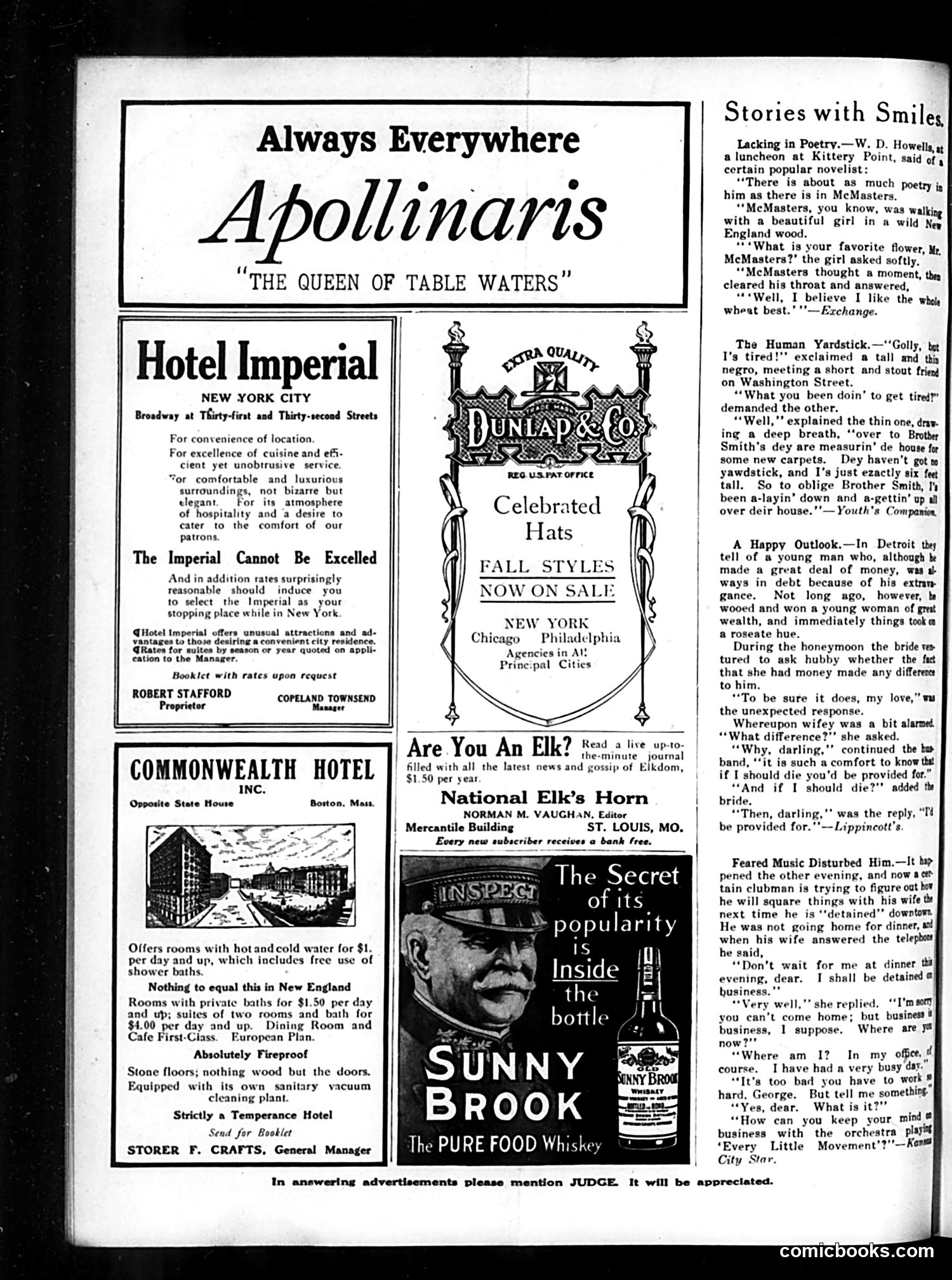
This is primarily an **advertising page** from Judge magazine, a satirical publication. The page contains no political cartoons—instead, it features commercial advertisements for hotels (Imperial in New York, Commonwealth in Boston), Dunlap & Co. celebrated hats, Apollinaris water, Sunny Brook whiskey, and the National Elk's Horn magazine. The right column contains "Stories with Smiles"—brief humorous anecdotes typical of early 20th-century American humor magazines. These include jokes about a novelist lacking eloquence, a tall Black man used as a "human yardstick," and a newlywed husband concerned about his wife's wealth only for inheritance purposes. The humor reflects period attitudes and dialect conventions. The page serves primarily as revenue through advertising rather than editorial satire.
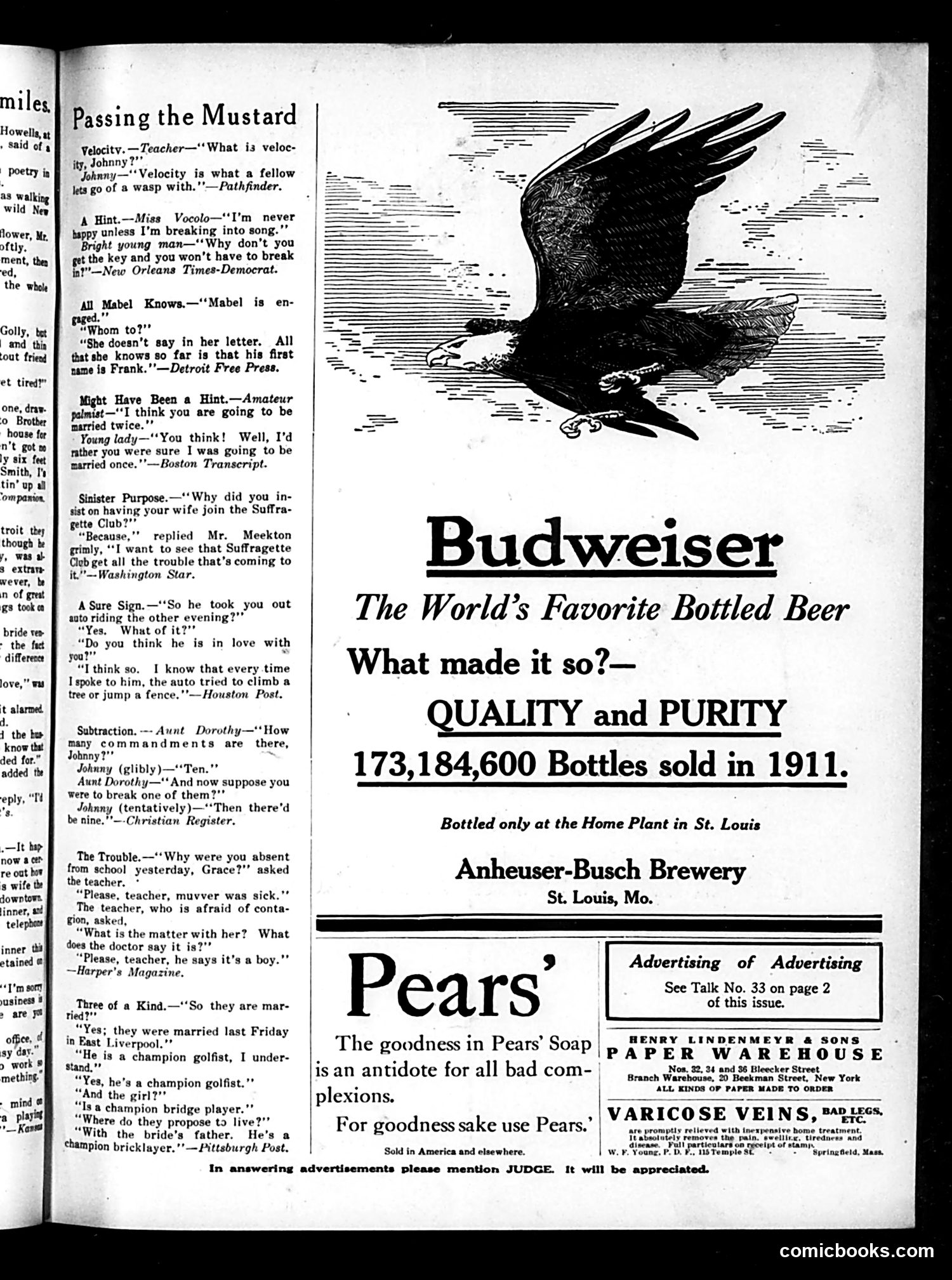
This page from *Judge* magazine contains primarily **short humorous anecdotes** on the left side and **advertisements** on the right. The anecdotes are simple, pun-based jokes about everyday situations: a student's malapropism about velocity, a woman who won't sing unless breaking into melody, a woman engaged but unsure of her fiancé's first name, and various other domestic quips. These reflect early 1900s middle-class concerns: education, courtship, marriage, and domestic life. The large **eagle illustration** accompanies a **Budweiser beer advertisement** claiming it's "The World's Favorite Bottled Beer" with sales figures (173+ million bottles in 1911). This represents period advertising hyperbole. Below are ads for **Pears' Soap** (claiming it cures "bad complexions") and **Varicose Veins treatment**—typical patent-medicine-era advertising making dubious health claims. The page is primarily **advertising and filler humor**, not political satire. The jokes represent gentle, mainstream American humor of the era rather than sharp social criticism.
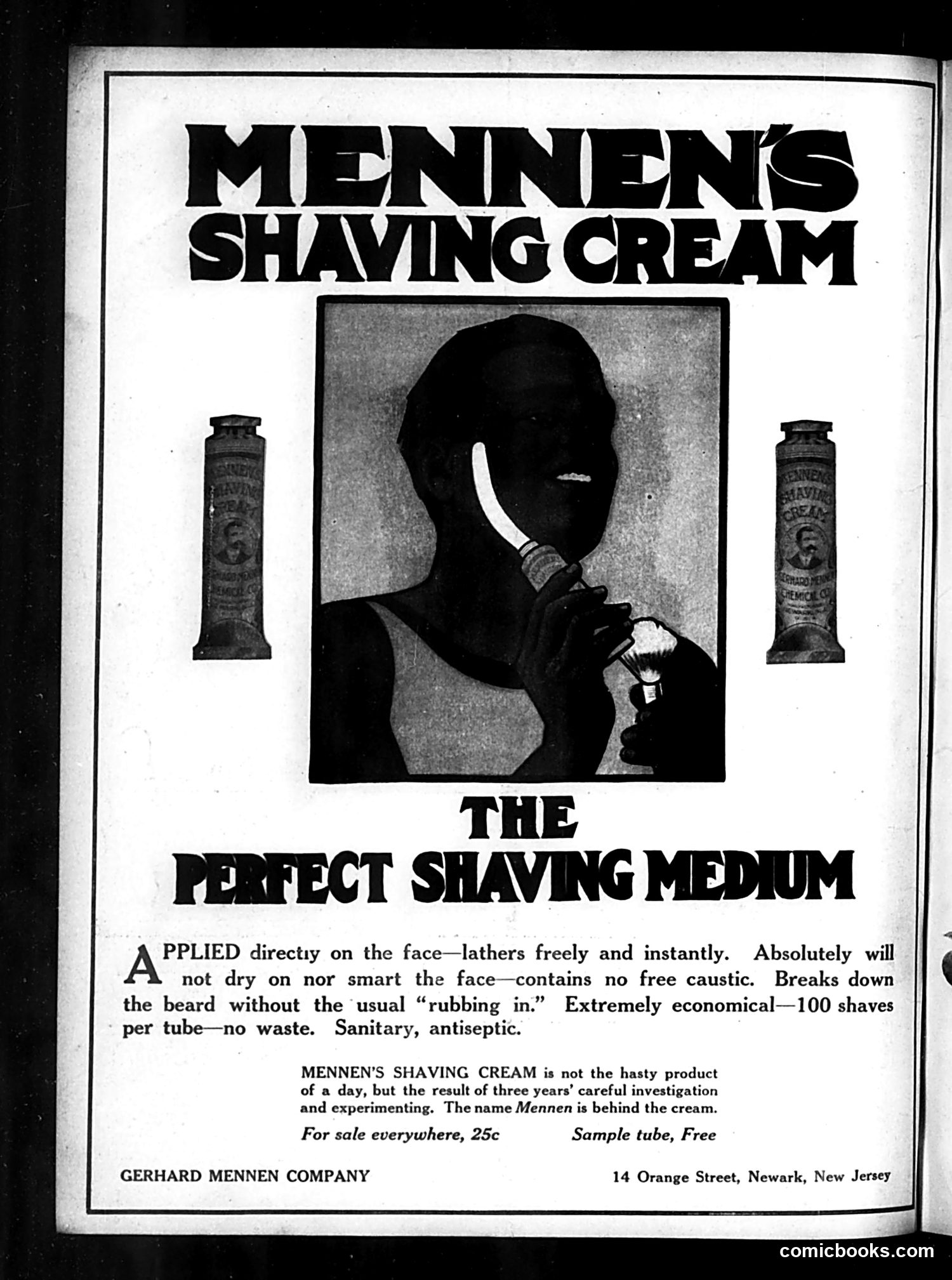
This is a **full-page advertisement**, not editorial content or satire. It promotes Mennen's Shaving Cream, a real product from the Gerhard Mennen Company of Newark, New Jersey. The central image shows a silhouetted man's profile applying shaving cream with a brush—a straightforward product demonstration. The advertisement emphasizes practical benefits: easy application, quick lathering, no caustic chemicals, and economy (100 shaves per tube). The marketing pitch claims the product results from "three years' careful investigation," positioning it as scientifically developed rather than hastily made. The price point of 25 cents and the offer of a free sample tube were typical early-20th-century sales tactics. There is no political or social satire here—this is simply vintage advertising designed to appeal to men's grooming needs and budgetary concerns.