
Judge, 1912-08-31 · page 17 of 24
Judge — August 31, 1912 — page 17: what you’re looking at
What you’re looking at
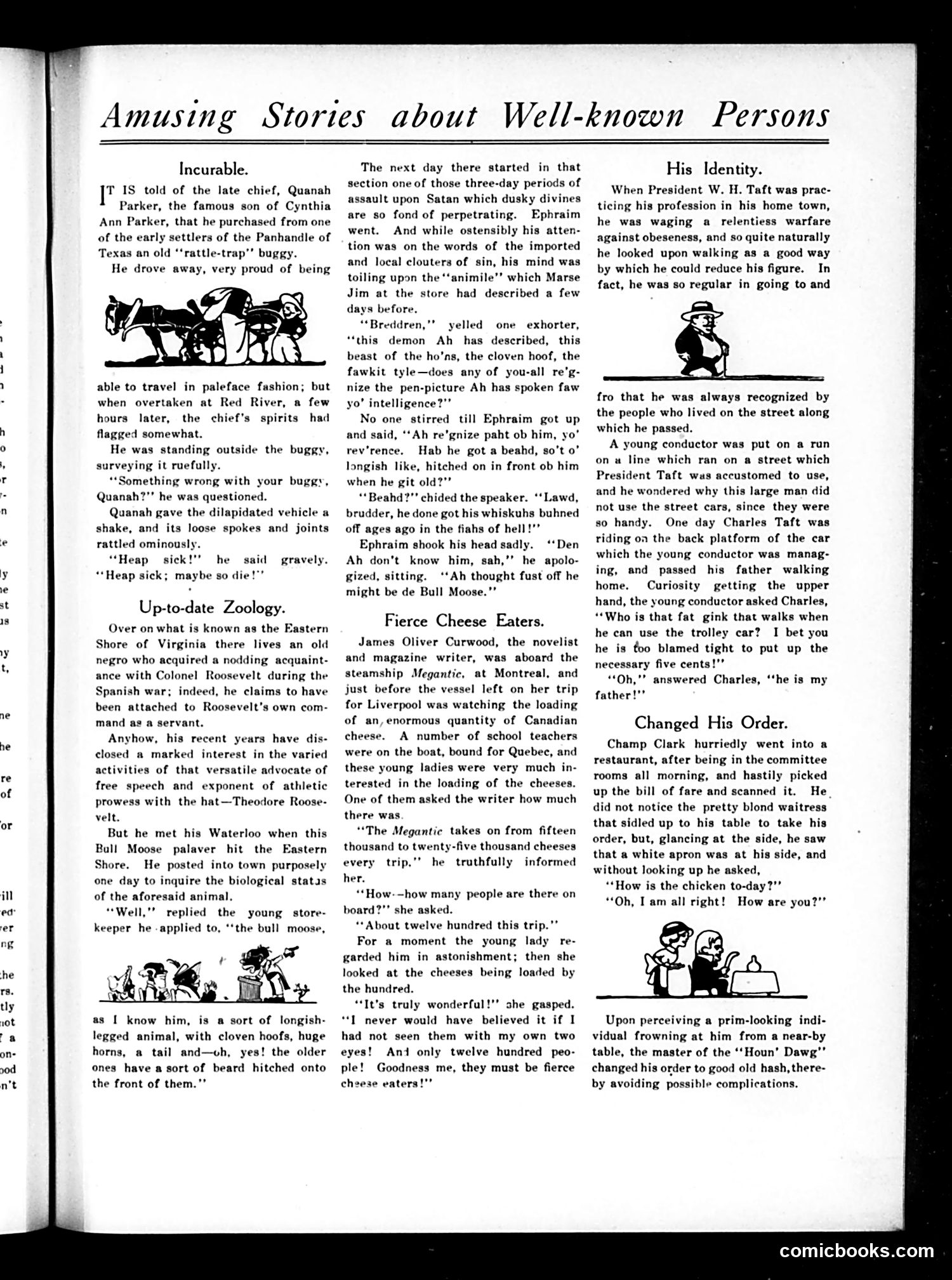
This page contains three humorous anecdotes about "well-known persons": 1. **Quanah Parker story**: Mocks a Native American chief's attempt to adopt white civilization. The joke relies on stereotypical dialect and the implication that Parker cannot properly maintain "paleface" technology—the buggy falls apart, and he compares it to illness using broken English ("Heap sick"). 2. **Theodore Roosevelt/"Bull Moose" story**: References Roosevelt's 1912 Progressive "Bull Moose" party campaign. An elderly Black man, formerly a Roosevelt servant, confuses Satan (described in a sermon with "horns" and "cloven hoof") with an actual bull moose. The humor derives from dialect comedy and the man's literal misunderstanding. 3. **Cheese eaters story**: A novelist tells schoolteachers a ship carries 15,000-25,000 cheeses for 1,200 passengers. The women assume passengers will eat all the cheese, leading to exaggerated wonderment at the quantity. All three rely on period-typical stereotypes and dialect humor common to early-20th-century American comedy publications.
📄 Transcribed text from this page (OCR, searchable)
Machine-transcribed from the original scan — historical spelling and the odd misread are preserved.
Amusing Stories about Well-known Persons Incurable. I" IS told of the late chief, Quanah Parker, the famous son of Cynthia Ann Parker, that he purchased from one of the early settlers of the Panhandle of Texas an old ‘‘rattle-trap’’ buggy. He drove away, very proud of being able to travel in paleface fashion; but when overtaken at Red River, a few hours later, the chief's spirits had flagged somewhat. He was standing outside the buggy, surveying it ruefully. “Something wrong with your buggy, Quanah?"’ he was questioned. Quanah gave the dilapidated vehicle a shake, and its loose spokes and joints rattled ominous!} “Heap sick!" he “Heap sick; maybe so die!’ said gravely. Up-to-date Zoology. Over on what is known as the Eastern Shore of Virginia there lives an old negro who acquired a nodding acquaint- ance with Colonel Roosevelt during the Spanish war; indeed, he claims to have been attached to Roosevelt's own com- mand as a servant. Anyhow, his recent years have dis- closed a marked interest in the varied activities of that versatile advocate of free speech and exponent of athletic prowess with the hat—Theodore Roose- velt. But he met his Waterloo when this Bull Moose palaver hit the Eastern Shore. He posted into town purposely one day to inquire the biological statas of the aforesaid animal, “Well,"” replied the young store- keeper he -applied to, ‘the bull moose, as I know him, is a sort of longish- legged animal, with cloven hoofs, huge horns, a tail and—oh, yes! the older ones have a sort of beard hitched onto the front of them."’ The next day there started in that section one of those three-day periods of assault upon Satan which dusky div are so fond of perpetrating. Ephraim went. And while ostensibly his atten- tion was on the words of the imported and local clouters of sin, his mind was toiling upon the ‘‘animile’’ which Marse Jim at the store had described a few days before. “‘Breddren,’? yelled one exhorter, “this demon Ah has described, this beast of the ho’ns, the cloven hoof, the fawkit tyle—does any of you-all re’g- nize the pen-picture Ah has spoken faw yo’ intelligence?”’ No one stirred till Ephraim got up and said, ‘‘Ah re’gnize paht ob him, yo’ rev’rence. Hab he got a beahd, so’t 0’ longish like, hitched on in front ob him when he git old?” ‘*Beahd?"' chided the speaker. ‘‘Lawd, brudder, he done got his whiskuhs buhned off ages ago in the fiahs of hell!’” Ephraim shook his head sadly. ‘*Den Ah don't know him, sah,’’ he apolo- gized, sitting. ‘‘Ah thought fust off he might be de Bull Moose.’’ Fierce Cheese Eaters. James Oliver Curwood, the novelist and magazine writer, was aboard the steamship Megantic, at Montreal, and just before the vessel left on her trip for Liverpool was watching the loading of an,enormous quantity of Canadian cheese. A number of school teachers were on the boat, bound for Quebec, and these young ladies were very much in- terested in the loading of the cheeses. One of them asked the writer how much there was. “The Megantic takes on from fifteen thousand to twenty-five thousand cheeses every trip,”’ he truthfully informed her. “How-—how many people are there on board?’’ she asked. ‘About twelve hundred this trip."” For a moment the young lady re- garded him in astonishment; then she looked at the cheeses being loaded by the hundred. “It’s truly wonderful!’ she gasped. “IT never would have believed it if I had not seen them with my own two eyes! Ani only twelve hundred peo- ple! Goodness me, they must be fierce cheese eaters!"' His Identity. When President W. H. Taft was prac- ticing his profession in his home town, he was waging a relentiess warfare against obeseness, and so quite naturally he looked upon walking as a good way by which he could reduce his figure. In fact, he was so regular in going to and fro that he was always recognized by the people who lived on the street along which he passed. A young conductor was put on a run on # line which ran on a street which President Taft was accustomed to use, and he wondered why this large man did not use the street cars, since they were so handy. One day Charles Taft was riding oa the back platform of the car which the young conductor was manag- ing, and passed his father walking home. Curiosity getting the upper hand, the young conductor asked Charles, ‘Who is that fat gink that walks when he can use the trolley car? I bet you he is foo blamed tight to put up the necessary five cents!"" “‘Oh,’’ answered Charles, ‘‘he is my father!"" Changed His Order. Champ Clark hurriedly went into a restaurant, after being in the committee rooms all morning, and hastily picked up the bill of fare and scanned it. He did not notice the pretty blond waitress that sidled up to his table to take his order, but, glancing at the side, he saw that a white apron was at his side, and without looking up he asked, ‘*How is the chicken to-day ?’’ “Oh, Iam all right! How are you?"’ Upon perceiving a prim-looking indi- vidual frowning at him from a near-by table, the master of the ‘‘Houn’ Dawg”’ changed his order to good old hash, there- by avoiding possible complications. comicbooks.com