
Judge, 1912-08-31 · page 6 of 24
Judge — August 31, 1912 — page 6: what you’re looking at
What you’re looking at
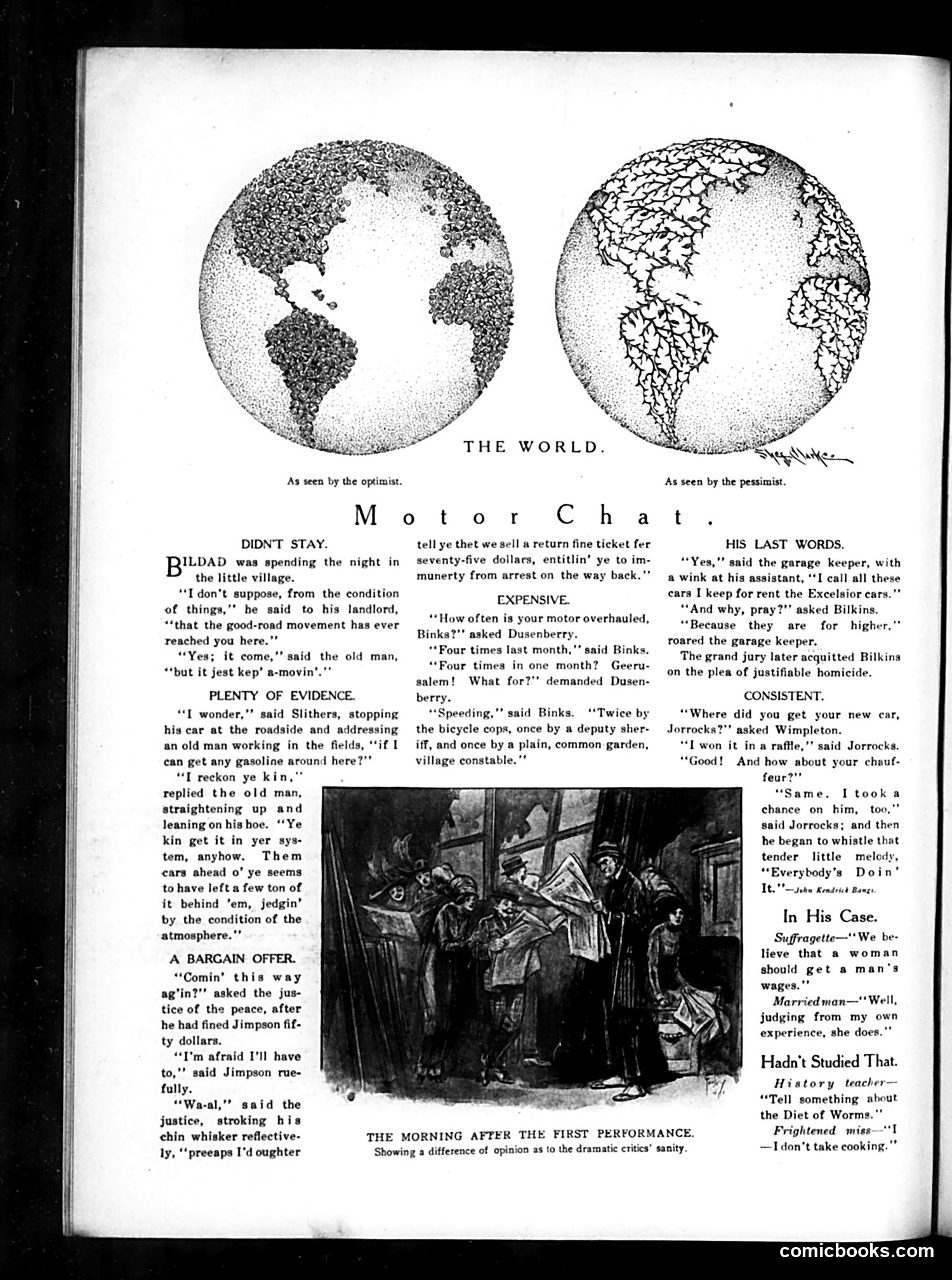
This page collects humorous short pieces mocking early motorcar culture and rural America's adjustment to automobiles. **The top cartoons** present contrasting worldviews—optimism vs. pessimism—likely satirizing broader social attitudes of the era. **The stories mock**: - Rural indifference to "good roads" infrastructure - Air pollution from cars ("left a few ton of it behind 'em") - Constant speeding fines (the protagonist fined repeatedly by different authorities) - Automobile maintenance costs and unreliability - Predatory mechanics charging exorbitant repair fees **The finale** jokes about a suffragette demanding equal wages, with a married man sardonically agreeing women already receive them—contemporary satire of both women's rights movements and domestic financial dynamics. The humor targets automobile enthusiasm, rural dialect, municipal enforcement, and social change, typical of Judge's satirical approach to early 1900s American life.
📄 Transcribed text from this page (OCR, searchable)
Machine-transcribed from the original scan — historical spelling and the odd misread are preserved.
As seen by the optimist, M o DIDN'T STAY. Bupa was spending the night in the little village. “I don’t suppose, from the condition of things,’’ he said to his landlord, **that the good-road movement has ever reached you here."’ “Yes; it come,’’ said the old man, “but it jest kep’ a-movin’."’ PLENTY OF EVIDENCE. “I wonder,” said Slithers, stopping his car at the roadside and addressing an old man working in the fields, can get any gasoline around here?’’ “T reckon ye kin,” replied the old man, straightening up and leaning on his hoe. ‘Ye kin get it in yer sys- tem, anyhow. Them cars ahead o’ ye seems to have left a few ton of it behind '’em, jedgin’ by the condition of the atmosphere.”’ A BARGAIN OFFER. Comin’ this way ag’in?’’ asked the jus- tice of the peace, after he had fined Jimpson fif- ty dollars. “I'm afraid I'll have to,’’ said Jimpson rue- fully. “Wa-al,’? said the justice, stroking his chin whisker reflective- ly, ‘‘preeaps I'd oughter tor Cha tell ye thet we sell a return fine ticket fer seventy-five dollaes, entitlin’ ye to im- munerty from arrest on the way back." EXPENSIVE. **How often is your motor overhauled, Binks?"’ asked Dusenberry. ‘Four times last month,”’ said Binks, “Four times in one month? Geeru- salem! What for?’ demanded Dusen- berry. “Speeding,” said Binks. ‘Twice by the bicycle cops, once by a deputy sher- iff, and once by a plain, common garden, village constable.’? THE MORNING AFPER THE FIRST PERFORMANCE. Showing a difference of opinion as to the dramatic critics’ sanity As seen by the pessimist. t HIS LAST WORDS. “*Yes,"’ said the garage keeper, with a wink at his assistant, ‘‘I call all these cars I keep for rent the Excelsior cars." “And why, pray?" asked Bilkins. “‘Because they are for higher,’’ roared the garage keeper. The grand jury later acquitted Bilkins on the plea of justifiable homicide. CONSISTENT. “Where did you get your new car, Jorrocks?"’ asked Wimpleton. “IT won it ina raffle,’ said Jorrocks. “Good! And how about your chauf- feur?”’ “Same. chance on * said Jorrocks he began to whistle that tender little melody, “Everybody’s Doin’ Tt." John Kendricd Banes In His Case. Suffragette—‘* We be- lieve that a woman should get a man's wages.’" Married man—"‘ Well, judging from my own experience, she does."’ Hadn't Studied That. teacher— Itooka too,’ and then History “Tell something about the Diet of Worm Frightened miss—‘'I —Idon’t take cooking."” comicbooks.com