
Judge, 1912-08-31 · page 9 of 24
Judge — August 31, 1912 — page 9: what you’re looking at
What you’re looking at
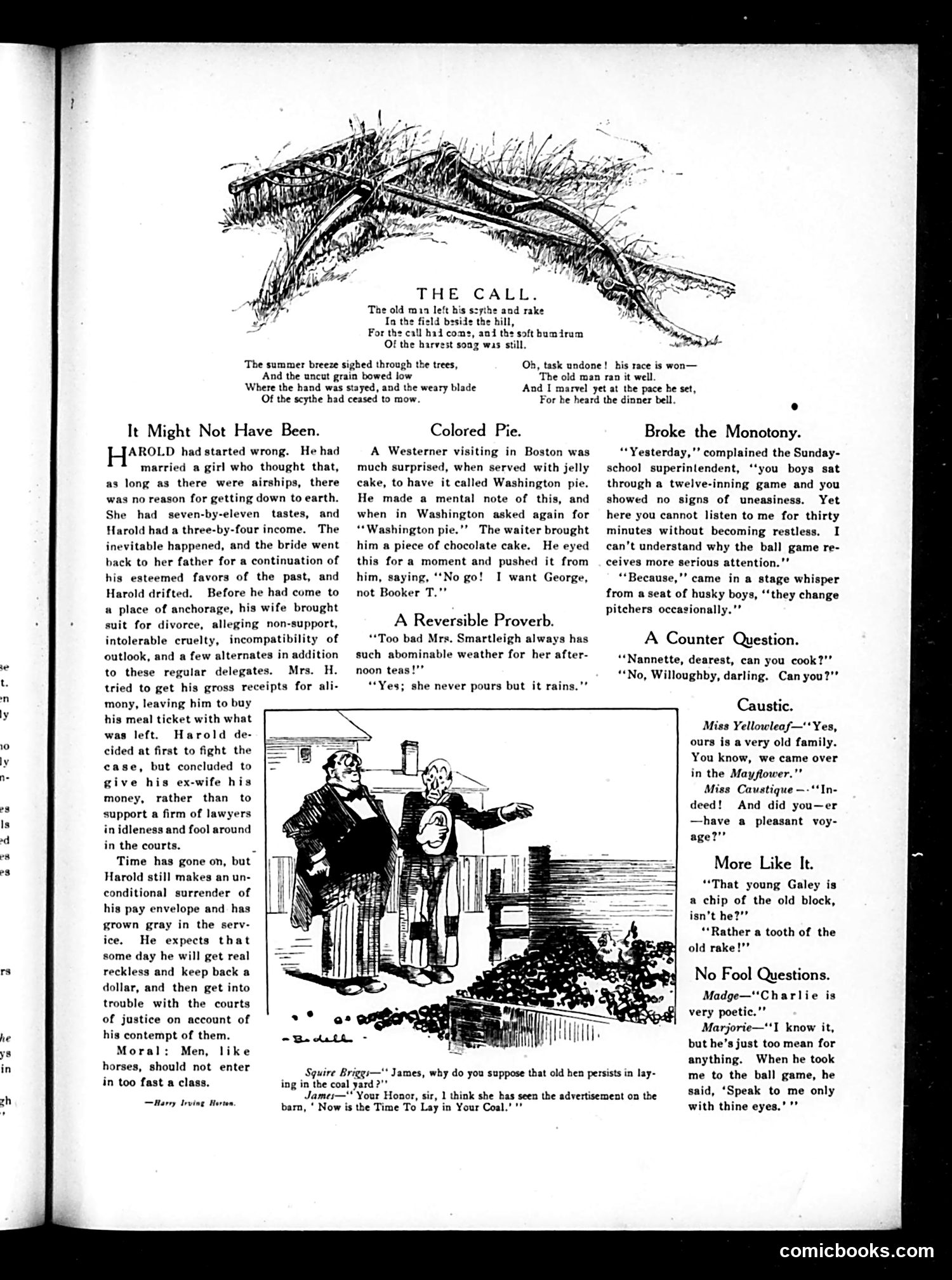
This page from the satirical magazine Judge contains multiple short humorous pieces typical of early 20th-century American periodicals. The main cartoon depicts two figures in what appears to be a domestic scene, illustrating one of the page's joke sections. The specific cartoon shown relates to one of the brief comedic vignettes printed alongside it. **Key satirical content includes:** - "It Might Not Have Been": A cautionary tale about Harold, whose marriage to an extravagant woman ends in divorce and alimony obligations—satirizing incompatible class matches and the financial burdens of divorce law. - "Colored Pie" and "Washington Pie" joke: A racial jab at Booker T. Washington, a prominent Black educator of the era, contrasting him unfavorably with George Washington. - Various one-liner jokes mocking women's cooking abilities, old family lineage claims, and overly romantic young men—reflecting period gender stereotypes. The page represents Judge's blend of social commentary, domestic humor, and period prejudices aimed at middle-class readers.
📄 Transcribed text from this page (OCR, searchable)
Machine-transcribed from the original scan — historical spelling and the odd misread are preserved.
THE CALL. The old man left his s: and rake field beside the hill, hadcome, and the soft bumirum Of the harvest song was still. Oh, task undone! his race is won— ‘The old man ran it well And I marvel yet at the pace he set, The summer breeze sighed through the trees, And the uncut grain bowed low Where the hand was stayed, and the weary blade Of the scythe had ceased to mow. For he heard the dinner bell. It Might Not Have Been. AROLD had started wrong. He had married a girl who thought that, as long as there were airships, there was no reason for getting down to earth. She had seven-by-eleven tastes, and Harold had a three-by-four income. The inevitable happened, and the bride went back to her father for a continuation of his esteemed favors of the past, and Harold drifted. Before he had come to a place of anchorage, his wife brought suit for divorce, alleging non-support, intolerable cruelty, incompatibility of outlook, and a few alternates in addition to these regular delegates. Mrs. H. tried to get his gross receipts for ali- mony, leaving him to buy his meal ticket with what was left. Harold de- cided at first to fight the ease, but concluded to give his ex-wife his money, rather than to support a firm of lawyers in idleness and fool around in the courts. . Time has gone on, but Harold still makes an un- conditional surrender of his pay envelope and has frown gray in the serv- ice. He expects that some day he will get real reckless and keep back a dollar, and then get into trouble with the courts of justice on account of his contempt of them. Moral: Men, like horses, should not enter in too fast a class. James Harry Irving Horton, Colored Pie. A Westerner visiting in Boston was much surprised, when served with jelly cake, to have it called Washington pie. He made a mental note of this, and when in Washington asked again for **Washington pie.’’ The waiter brought him a piece of chocolate cake. He eyed this for a moment and pushed it from him, saying, ‘‘No go! I want George, not Booker T."’ A Reversible Proverb. “Too bad Mra. Smartleigh always has such abominable weather for her after- noon teas!'" “Yes; she never pours but it rains.'’ Squire Briggs—'* James, why do you suppose that old hen persists in lay- ing in the coal yard ?"" Your Honor, sir, 1 think she has seen the advertisement on the Broke the Monotony. “*Yesterday,’’ complained the Sunday- school superintendent, ‘‘you boys sat through a twelve-inning game and you showed no signs of uneasiness. Yet here you cannot listen to me for thirty minutes without becoming restless. I can’t understand why the ball game re- ceives more serious attention.” ‘*Because,”’ came in a stage whisper from a seat of husky boys, ‘‘they change pitchers occasionally." A Counter Question. ‘‘Nannette, dearest, can you cook?” “No, Willoughby, darling. Can you?” Caustic. Miss Yellowleaf—''Yes, ours is a very old family. You know, we came over in the Mayflower."* Miss Caustique —-‘In- deed! And did you—er —have a pleasant voy- age?"’ More Like It. “That young Galey is a chip of the old block, isn’t he?’’ “Rather a tooth of the old rake!" No Fool Questions. Madge—"'Charlie is very poetic."” Marjorie—‘‘I know it, but he’s just too mean for anything. When he took me to the ball game, he said, ‘Speak to me only with thine eyes.’ "’ barn, ‘ Now is the Time To Lay in Your Coal.’"’ comicbooks.com