
Judge, 1912-08-31 · page 13 of 24
Judge — August 31, 1912 — page 13: what you’re looking at
What you’re looking at
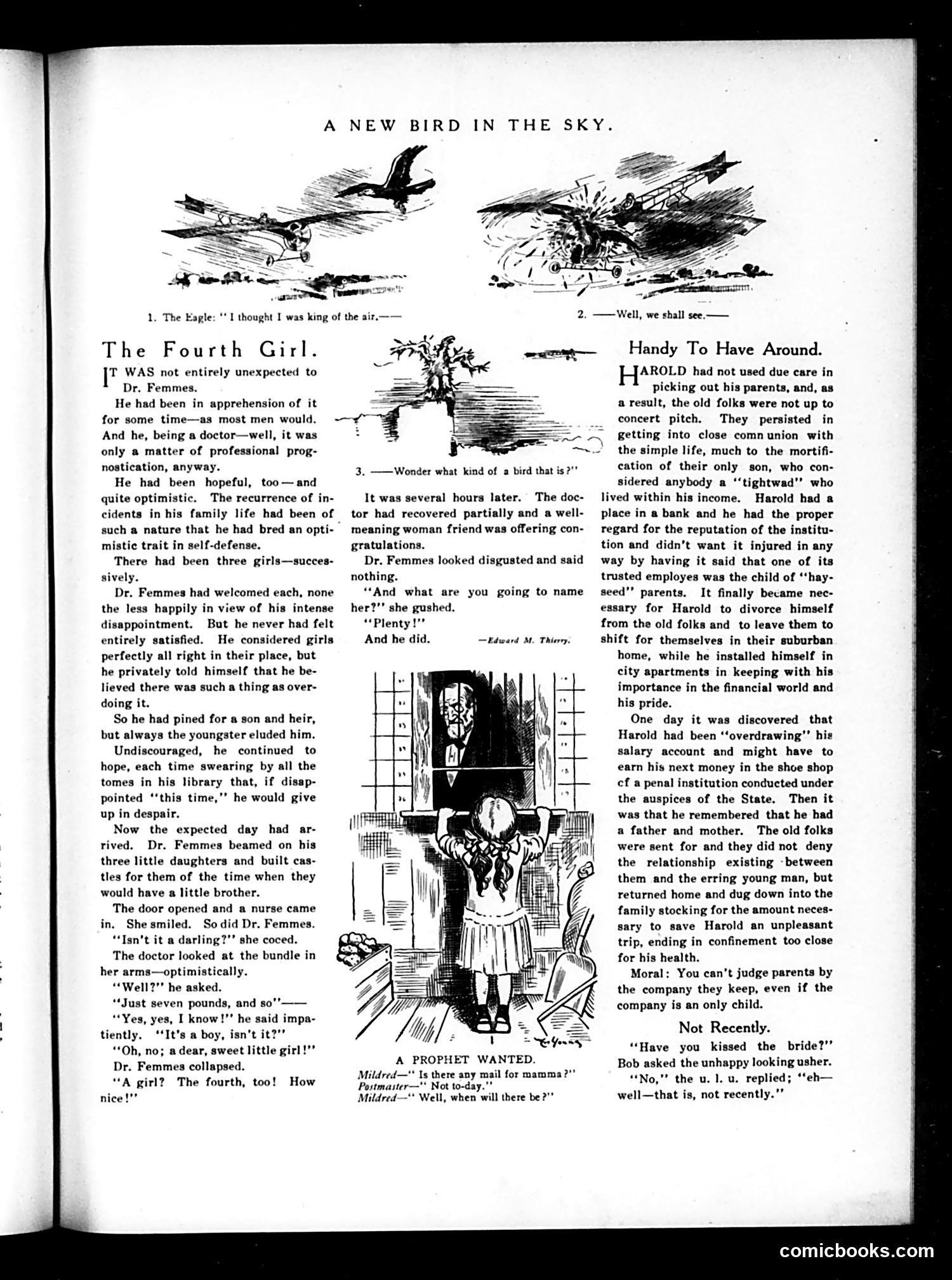
This page contains three satirical stories typical of early 20th-century Judge magazine, mocking middle-class anxieties: **"The Fourth Girl"**: Dr. Femmes desperately wants a son but keeps having daughters. The joke is his repeated disappointment—he's optimistic each time, swears he'll accept whatever comes, then collapses when another girl arrives. The airplane cartoons above ("A New Bird in the Sky") appear unrelated, likely from another piece. **"A Prophet Wanted"**: A child asks when mail will arrive; the humor plays on parental uncertainty and incompetence. **"Handy to Have Around"**: Harold, embarrassed by his rural "hayseeds" parents, abandons them for city apartments to maintain his bank reputation. When he embezzles and faces prison, they bail him out. The moral: you can't judge people by their children. All three stories satirize American social pretension and generational conflict—particularly the shame middle-class sons felt toward working-class or rural parents, and the irony that such parents often rescue their ungrateful children.
📄 Transcribed text from this page (OCR, searchable)
Machine-transcribed from the original scan — historical spelling and the odd misread are preserved.
A NEW BIRD IN THE SKY. The Fourth Girl. T WAS not entirely unexpected to Dr. Femmes. He had been in apprehension of it for some time—as most men would. And he, being a doctor—well, it was only a matter of professional prog- nostication, anyway. He had been hopeful, too— and quite optimistic. The recurrence of in- cidents in his family life had been of such a nature that he had bred an opti- mistic trait in self-defense. There had been three girls—succes- sively. Dr. Femmes had welcomed each, none the less happily in view of his intense disappointment. But he never had felt entirely satisfied. He considered girls perfectly all right in their place, but he privately told himself that he be- lieved there was such a thing as over- doing it. So he had pined for a son and heir, but always the youngster eluded him. Undiscouraged, he continued to hope, each time swearing by all the tomes in his library that, if disap- pointed ‘‘this time,’’ he would give up in despair. Now the expected day had ar- rived. Dr. Femmes beamed on his three little daughters and built cas- tles for them of the time when they would have a little brother. The door opened and a nurse came in, She smiled. So did Dr. Femmes. “Isn't it a darling?’’ she coced. The doctor looked at the bundle in her arms—optimistically. “Well?” he asked. ‘Just seven pounds, and so’’—— “Yes, yes, I know!’ he said impa- tiently. “It's a boy, isn’t it?” “Oh, no; a dear, sweet little girl!” Dr. Femmes collapsed. “A girl? The fourth, too! nice!"" How 2. ——Well, we shall see.—— ce aa 3. ——Wonder what kind of a bird that is?’ It was several hours later. The doc- tor had recovered partially and a well- meaning woman friend was offering con- gratulations, Dr. Femmes looked disgusted and said nothing. nd what are you going to name her?’’ she gushed. “Plenty !"” And he did. Edward M. Thierry. A PROPHET WANTED. “ Ts there any mail for mamma?" “* Not to-day."" Mildred—‘* Well, when will there be ?"" Handy To Have Around. AROLD had not used due care in picking out his parents, and, as a result, the old folks were not up to concert pitch. They persisted in getting into close comnunion with the simple life, much to the mortifi- cation of their only son, who con- sidered anybody a ‘‘tightwad’’ who lived within his income. Harold had a place in a bank and he had the proper regard for the reputation of the institu- tion and didn’t want it injured in any way by having it said that one of its trusted employes was the child of ‘‘hay- seed’’ parents. It finally became nec- essary for Harold to divorce himself from the old folks and to leave them to shift for themselves in their suburban home, while he installed himself in city apartments in keeping with his importance in the financial world and his pride. One day it was discovered that Harold had been ‘‘overdrawing’’ his salary account and might have to earn his next money in the shoe shop cf a penal institution conducted under the auspices of the State. Then it was that he remembered that he had a father and mother. The old folks were sent for and they did not deny the relationship existing -between them and the erring young man, but returned home and dug down into the family stocking for the amount neces- sary to save Harold an unpleasant trip, ending in confinement too close for his health. Moral: You can’t judge parents by the company they keep, even if the company is an only child. Not Recently. “Have you kissed the bride?’’ Bob asked the unhappy looking usher. “No,’’ the u. 1. u. replied; ‘‘eh— well—that is, not recently.’” comicbooks.com