
Judge, 1912-08-31 · page 5 of 24
Judge — August 31, 1912 — page 5: what you’re looking at
What you’re looking at
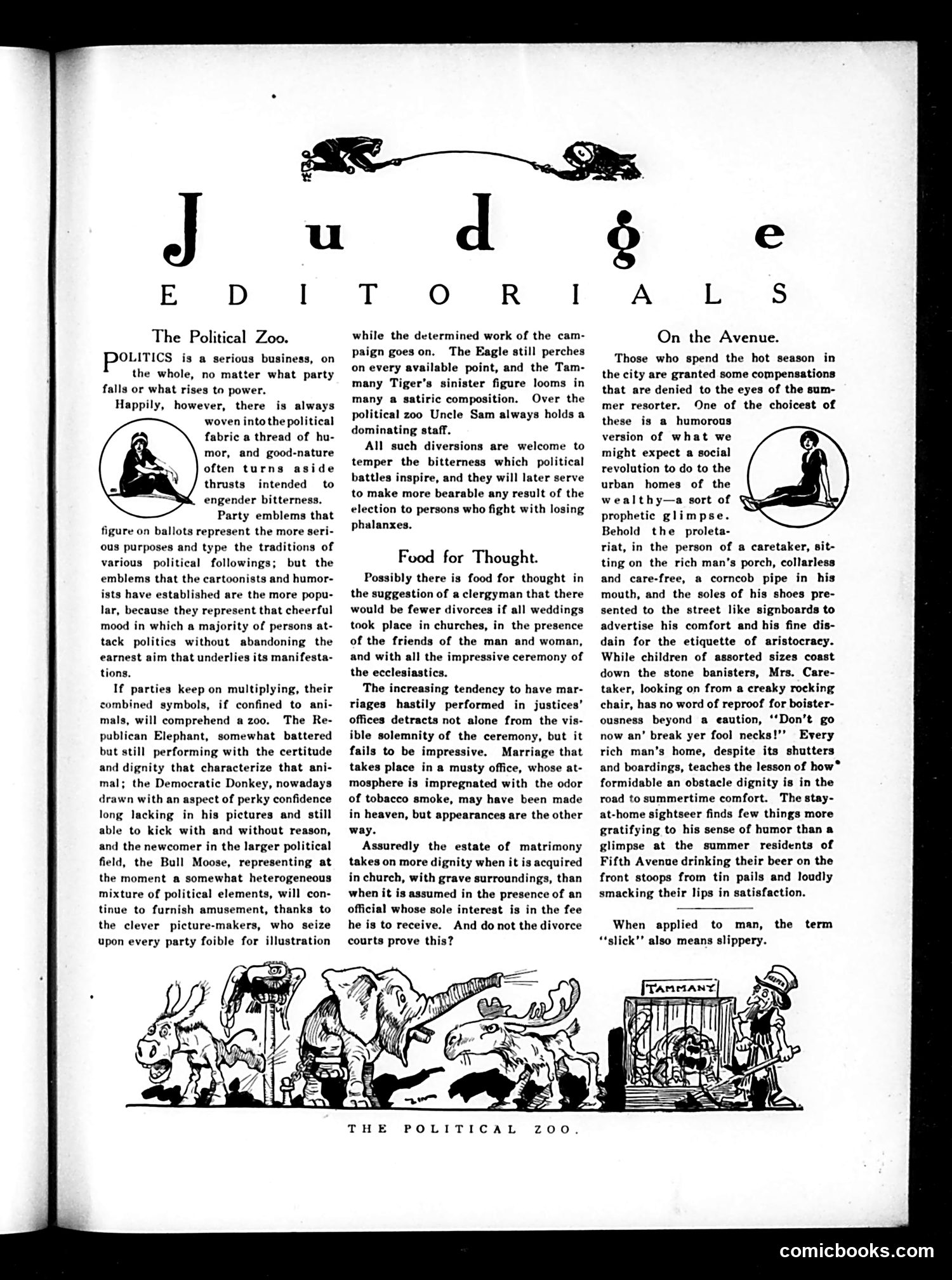
This page satirizes American political parties as a "Political Zoo." The left column uses animal metaphors—the Republican Elephant and Democratic Donkey—to mock how party symbols represent different political temperaments and factions. The text argues these emblems reflect parties' actual characteristics: the Elephant's "criticisms and dignity" versus the Donkey's "lack in pictures." The right section, "On the Avenue," offers social satire about urban etiquette, particularly mocking wealthy residents who flaunt their comfort while pretending to maintain aristocratic standards. The bottom cartoon illustrates "The Political Zoo" with caricatured animals representing various political figures and factions. The overall thrust mocks both partisan politics as theatrical spectacle and upper-class hypocrisy regarding propriety and social status.
📄 Transcribed text from this page (OCR, searchable)
Machine-transcribed from the original scan — historical spelling and the odd misread are preserved.
u E D The Political Zoo. OLITICS is a serious business, on the whole, no matter what party falls or what rises to power. Happily, however, there is always woven into the political fabric a thread of hu- mor, and good-nature often turns aside thrusts intended to engender bitterness. Party emblems that figure on ballots represent the more seri- ous purposes and type the traditions of various political followings; but the emblems that the cartoonists and humor- ists have established are the more popu- Jar, because they represent that cheerful mood in which a majority of persons at- tack politics without abandoning the earnest aim that underlies its manifesta- tions. If parties keep on multiplying, their combined symbols, if confined to ani- mals, will comprehend a zoo. The Re- publican Elephant, somewhat battered but still performing with the certitude and dignity that characterize that ani- mal; the Democratic Donkey, nowadays drawn with an aspect of perky confidence long lacking in his pictures and still able to kick with and without reason, and the newcomer in the larger political field, the Bull Moose, representing at the moment a somewhat heterogeneous mixture of political elements, will con- tinue to furnish amusement, thanks to the clever picture-makers, who seize upon every party foible for illustration T O R while the determined work of the cam- paign goes on. The Eagle still perches on every available point, and the Tam- many Tiger's sinister figure looms in many a satiric composition. Over the political zoo Uncle Sam always holds a dominating staff. All such diversions are welcome to temper the bitterness which political battles inspire, and they will later serve to make more bearable any result of the election to persons who fight with losing phalanxes. Food for Thought. Possibly there is food for thought in the suggestion of a clergyman that there would be fewer divorces if all weddings took place in churches, in the presence of the friends of the man and woman, and with all the impressive ceremony of the ecclesiastics. The increasing tendency to have mar- riages hastily performed in justices’ offices detracts not alone from the vis- ible solemnity of the ceremony, but it fails to be impressive. Marriage that takes place in a musty office, whose at- mosphere is impregnated with the odor of tobacco smoke, may have been made in heaven, but appearances are the other way. Assuredly the estate of matrimony takes on more dignity when it is acquired in church, with grave surroundings, than when it is assumed in the presence of an official whose sole interest is in the fee he is to receive. And do not the divorce courts prove this? THE POLITICAL A. ERS On the Avenue. Those who spend the hot season in the city are granted some compensations that are denied to the eyes of the sum- mer resorter. One of the choicest of these is a humorous version of what we might expect a social revolution to do to the urban homes of the wealthy—a sort of prophetic glimpse. Behold the proleta- riat, in the person of a caretaker, sit- ting on the rich man’s porch, collarless and care-free, a corncob pipe in his mouth, and the soles of his shoes pre- sented to the street like signboards to advertise his comfort and his fine dis- dain for the etiquette of aristocracy. While children of assorted sizes coast down the stone banisters, Mrs. Care- taker, looking on from a creaky rocking chair, has no word of reproof for boister- ousness beyond a eaution, ‘‘Don’t go now an’ break yer fool necks!"’ Every rich man’s home, despite its shutters and boardings, teaches the lesson of how® formidable an obstacle dignity is in the road to summertime comfort. The stay- at-home sightseer finds few things more gratifying to his sense of humor than a glimpse at the summer residents of Fifth Avenue drinking their beer on the front stoops from tin pails and loudly smacking their lips in satisfaction. When applied to man, the term “*slick’’ also means slippery. comicbooks.com