
A complete issue · 68 pages · 1922
Captain Billy's Whiz Bang #33
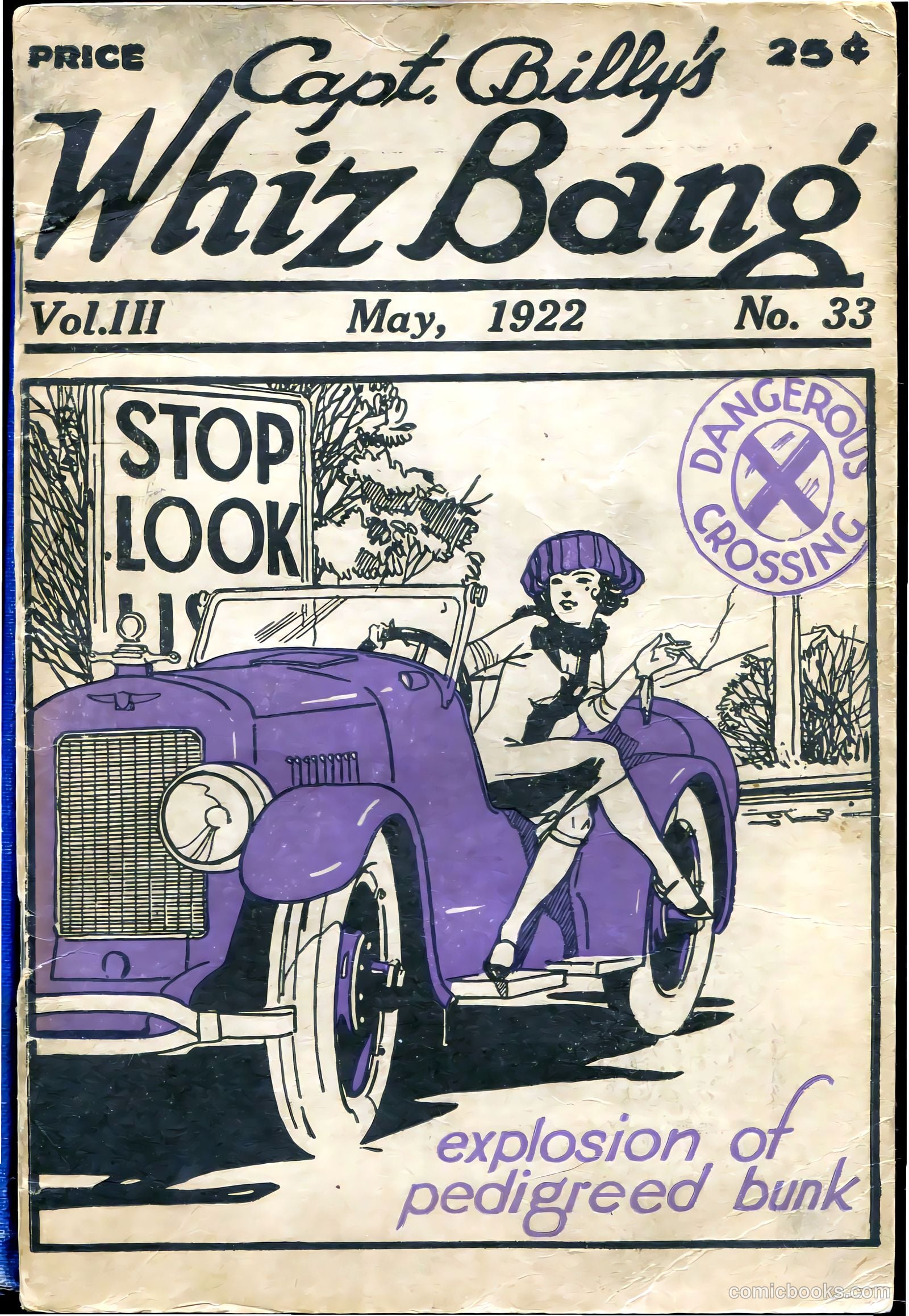
This cover satirizes reckless driving and automobile safety. The central image shows a woman at a "Dangerous Crossing" railroad crossing, ignoring a "Stop Look" warning sign while driving a purple convertible. She appears fashionably dressed in 1920s style, suggesting she represents a careless modern woman driver. The phrase "explosion of pedigreed bunk" at the bottom appears to mock pretentious or false claims—possibly suggesting the woman's confident driving despite obvious dangers represents empty bravado. The railroad crossing stamp emphasizes the genuine hazard she's ignoring. The satire targets both automotive safety negligence and the era's anxieties about women drivers during the automobile's rapid adoption in American society.
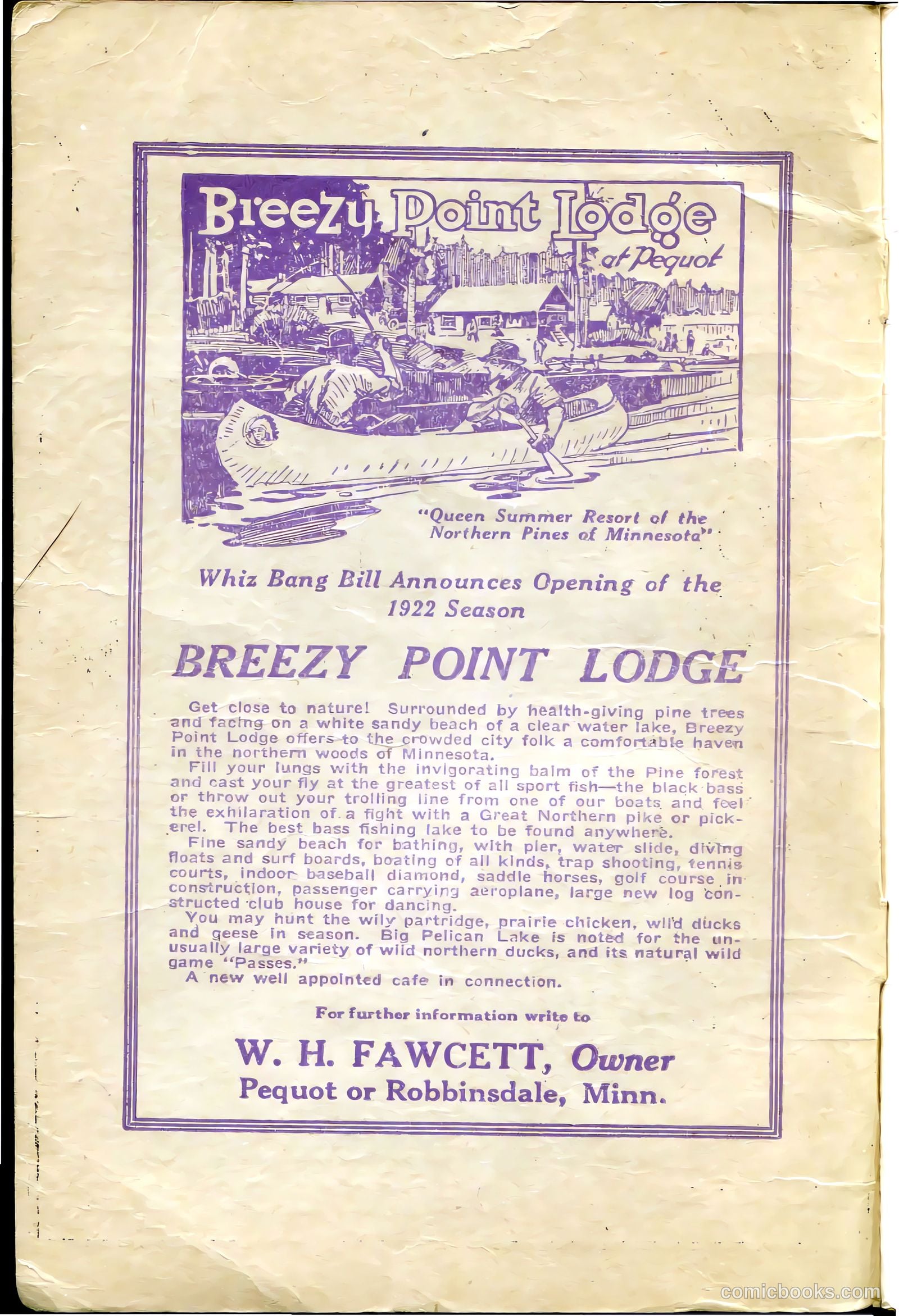
This page is **not a cartoon or satire** but rather a **1922 resort advertisement** for Breezy Point Lodge in Minnesota. "Whiz Bang Bill" was the fictional mascot/spokesperson used by *Whiz Bang* magazine to announce commercial sponsors and their products. The ad promotes a vacation destination emphasizing nature escape—fishing for bass and pike, hunting, bathing, sports (golf, tennis, trap shooting), and entertainment (dancing, aeroplane rides). The illustration shows guests engaged in outdoor recreation. The reference to an "aeroplane" is notable as passenger aviation was still novel in 1922. The lodge appeals to urban dwellers seeking respite in Minnesota's northern wilderness. This is essentially a paid advertisement disguised as editorial content, using the magazine's popular character to lend credibility and draw reader attention.
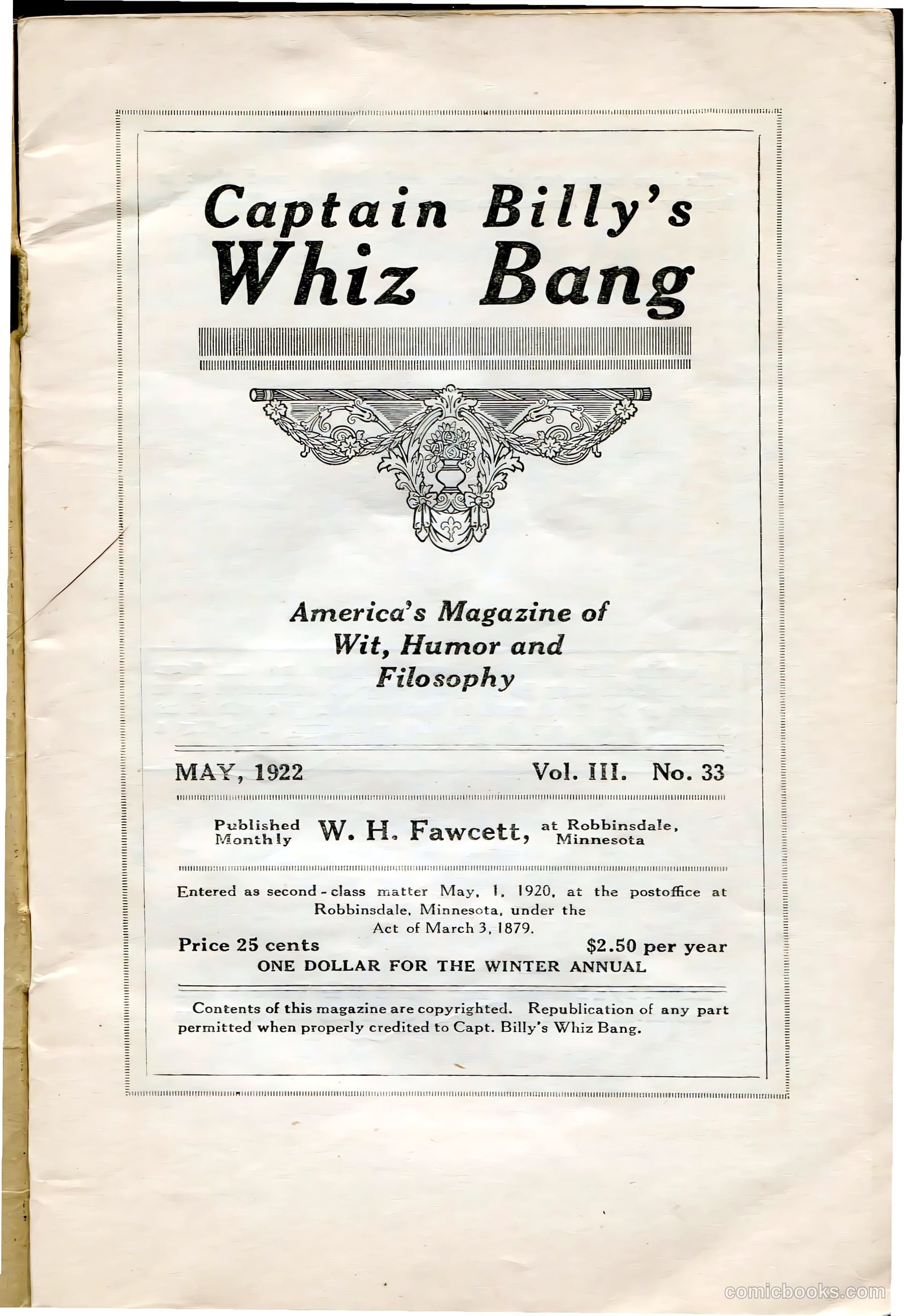
This is a **title page**, not a cartoon or editorial content page. It announces *Captain Billy's Whiz Bang*, "America's Magazine of Wit, Humor and Philosophy," published May 1922 by W.H. Fawcett in Robbinsdale, Minnesota. The page provides publication details (25 cents per issue, $2.50 yearly subscription) and copyright information. The decorative ornament is purely stylistic. Without seeing the magazine's interior content, I cannot identify specific cartoons, political figures, or satire targets. To analyze the actual satirical material, we would need pages showing the jokes, illustrations, or articles inside this issue.
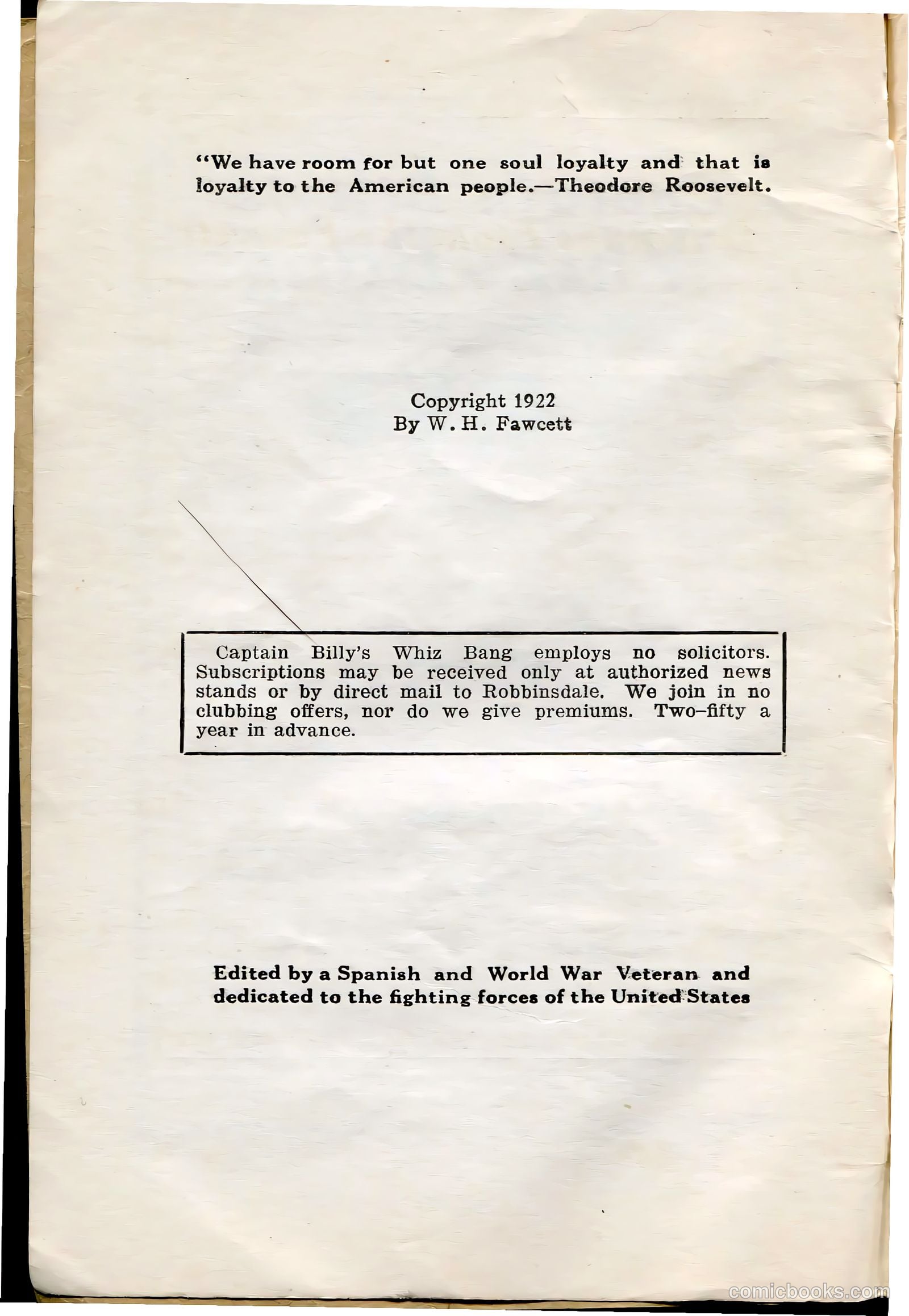
This is a title/masthead page from *Captain Billy's Whiz Bang*, a 1922 satirical publication. The page contains no cartoons—it displays: 1. **A Theodore Roosevelt quote** about singular American loyalty, establishing the magazine's patriotic editorial stance 2. **Copyright and publication information** for W.H. Fawcett 3. **Subscription details**: Two dollars fifty cents yearly, sold only at authorized newsstands, no premiums or club offers 4. **Dedication statement**: The magazine was edited by a Spanish-American War and World War I veteran and dedicated to U.S. fighting forces The page establishes *Whiz Bang* as a patriotic, American-focused humor publication from the post-WWI era, positioning itself against cheap subscription schemes while appealing to military service members and veterans.
This is primarily an **editorial/administrative page** rather than a satirical cartoon page. It contains no visible illustrations or political satire. The content consists of: 1. **Editor's Note** from "Skipper Bill" (the magazine's editor) describing his recent return from Cuba, where he visited race tracks in Havana with associates Frank Bruen and Horace Stoneham. He updates readers on the farm's operations and seeks to reconnect with a former hired man named Gus now in Los Angeles, hoping readers might alert him that Minnesota's fishing season is opening. 2. **Preamble to Reader Letters**: The editor explains that the magazine receives hundreds of fan letters but lacks space to publish them, so he'll share sample correspondence from readers. This appears to be a housekeeping/community-building page typical of early 20th-century magazines, establishing direct connection with the rural readership and creating an intimate, folksy tone characteristic of *Whiz Bang's* editorial voice.
This is a reader's letter praising Captain Billy's satirical magazine. The writer jokes about receiving the "Winter Annual" and thanks the editor for "Bull and Bullets" — likely humorous content. The letter is a **satire on Prohibition**. The writer repeatedly references alcohol ("Memory Eraser," "liquid gargle," "snootful") while nominally praising the magazine. He mocks Prohibition reformers as hypocritical — they claim New York is "dry" while ignoring that working-class districts like "Hell's Kitchen" still drink openly. The writer suggests reformers wouldn't dare advocate temperance alternatives (like "nut sundae") in rough neighborhoods, fearing violence. The humor relies on the writer's intoxicated voice — he admits "the stuff has begun to work, 'cause I'm skipping words" — making his drunken rambling the joke itself. This reflects *Whiz Bang's* irreverent stance toward Prohibition enforcement during the 1920s-30s era.
This page from the satirical magazine features a humorous letter-column piece rather than a cartoon. The unnamed writer (signed "Adam Sourguy") complains about his office porter who became useless after reading *Whiz Bang* itself—the magazine's self-referential humor about its own popularity and corrupting influence. The satire mocks the porter's sudden literary pretensions: the writer resorts to physical violence to force him to work, then discovers him writing amateurish poetry. The included sample poem, "Hot Corn Kid," is intentionally crude doggerel about a girl named Dorothy who loves hot corn bread. The joke targets working-class aspiration and the magazine's own appeal: reading *Whiz Bang* transforms a practical laborer into a would-be poet, rendering him useless. The postscript references Prohibition-era difficulty obtaining alcohol, adding topical humor. The tone is rough, self-deprecating comedy typical of 1920s working-class satirical magazines.
This is a humorous letter column entry, not a political cartoon. "Captain Billy's Whiz Bang" was an early 20th-century American humor magazine. The joke centers on **Gus**, a former farmhand who aspired to become a silent film star (referencing Douglas Fairbanks and Tom Mix, popular actors of that era). He moved to Los Angeles to work in movie studios but has returned to manual labor—painting houses—a comedown from his ambitions. The satire mocks Gus's failed Hollywood dreams while poking fun at rural attitudes: he complains about working without food ("No Indian guide for me on an empty stomach") and gossips about a neighbor's daughter's scandalous "coming out" dress, suggesting small-town prudishness. The editor's note about the "X" being "not a kiss" is a cheeky joke about Gus signing off his letter—playing on the common practice of X representing kisses in correspondence. The piece gently satirizes both Hollywood aspirations and rural simplicity.
This page from *Captain Billy's Whiz Bang* (a 1920s humor magazine) contains three brief comedic pieces: 1. **"The Effects of Pedro"**: A rustic poem by a farm character named Gus, humorous for its rural dialect and mundane subject matter—a cow giving birth. The joke is that Gus treats this ordinary farm incident as dramatic poetry. 2. **Honeymoon anecdote**: A newlywed bride discovers her husband reading *Whiz Bang* instead of paying attention to her. She jokingly calls him a "bookworm"—the humor lies in the husband being absorbed in a *magazine* rather than romance. 3. **Robbinsdale bachelor item**: A brief rural gossip note about a local farmer arrested for illegally making "sour mash" (moonshine, during Prohibition). The joke's punchline—that he subsequently fell in love—appears incomplete or relies on missing context. The overall tone is small-town Americana humor, typical of the era's popular magazines.
This is primarily **editorial/promotional content**, not a cartoon page. The humor is textual rather than visual. The main joke plays on **brand-name confusion**: when the Deacon asks a drug store clerk for competing publications ("Whizz, Skat, or Jack Rabbit"), she mistakenly thinks he's asking for soap brands and offers "Whiz Bang"—the magazine itself. This is self-promotional humor advertising the magazine's widespread recognition. The second section announces a new sister publication, *True Confessions*, and a $10,000 story contest. The final quote from "Brother F.M. Hubbell" of the *Robbinsdale Weekly Review* appears to be **satirical social commentary** on post-Prohibition America: with speakeasies closed ("no longer faces on the barroom floor") and curfew laws ending, respectable workers have abandoned legitimate jobs to become jazz musicians. It mocks the cultural shift toward entertainment and away from traditional employment during the 1920s.
This page from the satirical magazine *Captain Billy's Whiz Bang* contains several humorous short pieces typical of 1920s American humor: **"Barbers, Read This One"** jokes about a rural, unsophisticated man unfamiliar with barbershop etiquette—he doesn't understand the question and lies on his stomach instead of sitting properly. **"Chapter I"** opens a crime fiction parody featuring "Faro Phil," a stereotypical gambling character shot dead at a card table with five aces—suggesting cheating. **"Look Me Over, Sister"** presents a cocky man's boastful pickup line, mocking narcissistic seduction attempts. **"Who Can Finish This One?"** is a bawdy verse about Prohibition-era bootlegging and loose morality—a woman faints outside a speakeasy, and men revive her with gin, eventually recognizing her as someone's discarded lover ("old broad labeled Maud"). The final aphorism about maternal beauty provides ironic contrast to the preceding risqué content. These pieces reflect 1920s working-class humor and anxieties about Prohibition, modern dating, and social propriety.
This satirical piece uses dark humor to mock sectarian violence in Ireland. The story depicts an Irish Catholic ferryman ("Pat") forcibly converting a Jewish passenger ("Isaac"/"Ikey") through repeated drowning—a grotesque parody of baptism. Each submersion is accompanied by demands for religious conversion ("Do ye belave?"). When the terrified Jew finally agrees under duress, the Irishman drowns him anyway, declaring "Then die in the faith!" The satire targets Irish Catholic religious fanaticism during a period of documented sectarian conflict. By literalizing forced conversion as murder, it highlights the absurdity and violence of religious coercion. The piece appears in *Captain Billy's Whiz Bang*, a satirical magazine known for irreverent humor. The unrelated anecdote about "Maggie" at the page's end is typical filler humor—a cook avoiding math education—with no connection to the main story.
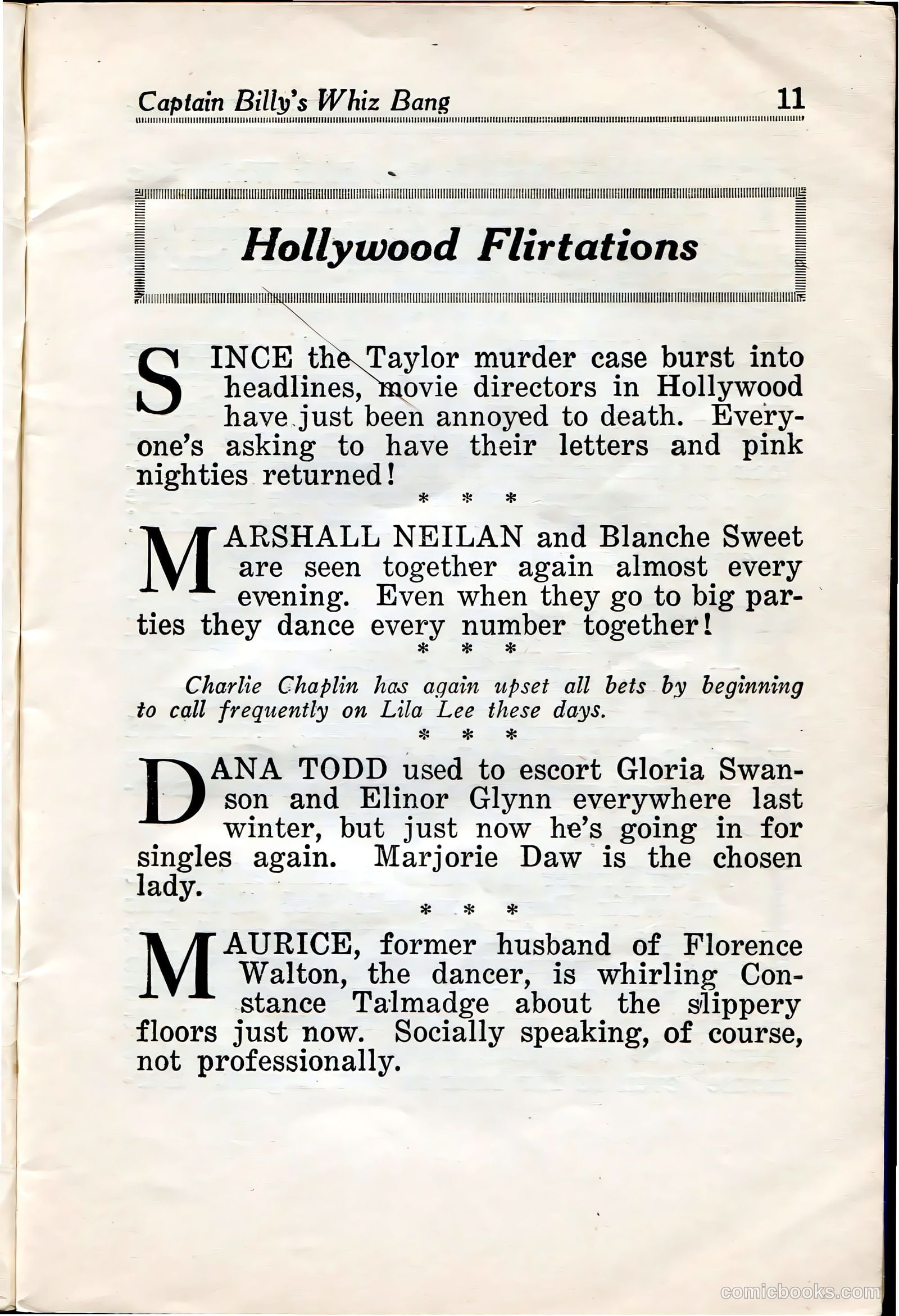
This is a celebrity gossip section from *Captain Billy's Whiz Bang*, a satirical magazine popular in the 1920s. It consists entirely of Hollywood rumor and innuendo—not a cartoon. The "Taylor murder case" reference concerns director William Desmond Taylor's 1922 unsolved murder, which scandalized Hollywood and prompted calls for returned intimate letters and garments from various actresses, suggesting widespread affairs. The remaining items are brief gossip tidbits about silent-film stars' dating lives: Marshall Neilan and Blanche Sweet's constant pairing, Charlie Chaplin's pursuit of Lila Lee, Dana Todd's romantic switches, and Maurice's dancing partner swaps with Constance Talmadge (the final barb—"socially speaking, of course, not professionally"—implies scandalous professional conduct). The satire mocks both Hollywood's moral reputation and the public's appetite for celebrity scandal during the industry's early era.
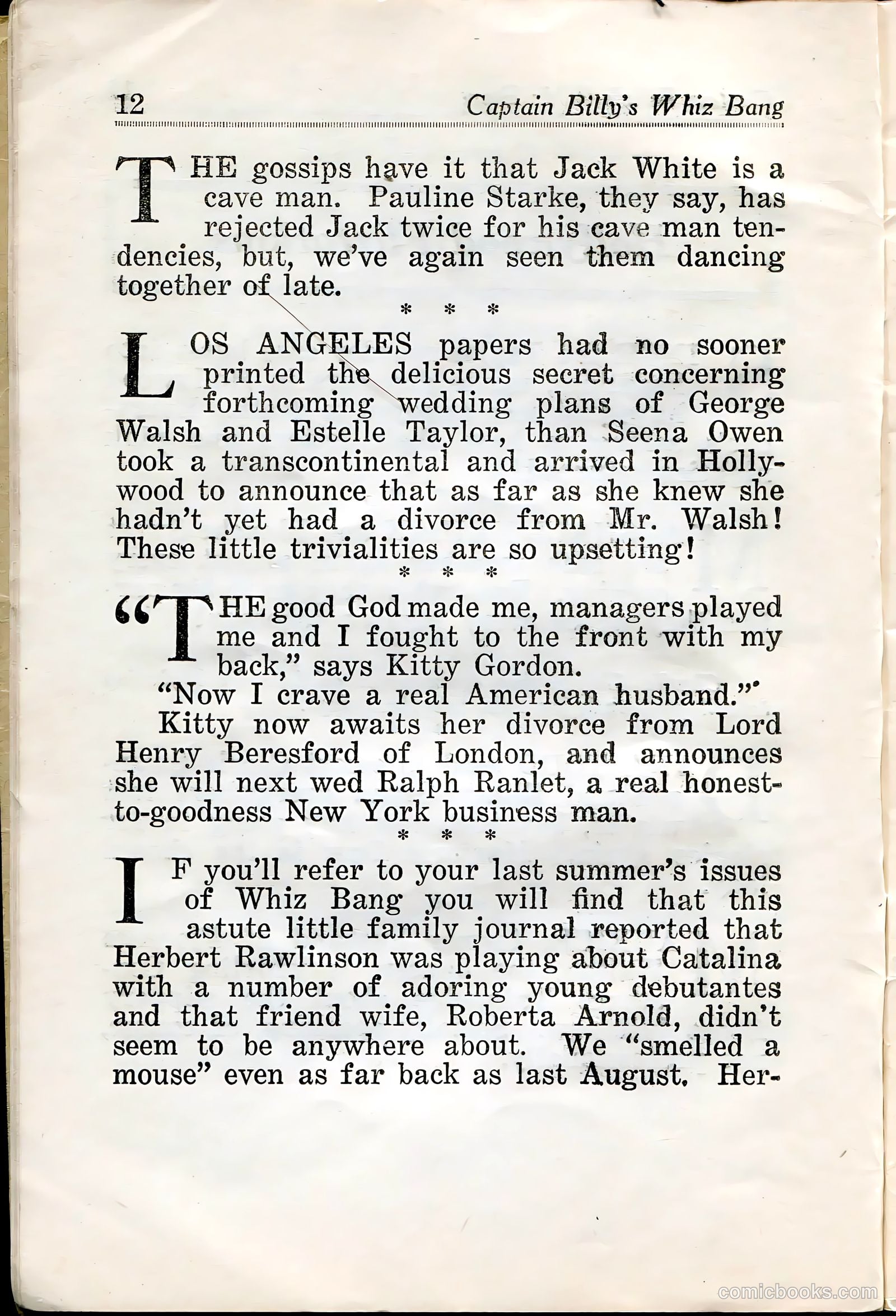
This is a gossip column from *Captain Billy's Whiz Bang*, a satirical magazine, mocking early 1920s Hollywood celebrities. The page reports on several scandals involving silent film stars: Jack White's allegedly crude behavior toward actress Pauline Starke; George Walsh's complicated marital status (his ex Seena Owen arrives claiming she's still married); actress Kitty Gordon divorcing a British nobleman to marry an "honest" American businessman; and actor Herbert Rawlinson's affair on Catalina Island while his wife (Roberta Arnold) was absent—which the magazine claims to have predicted months earlier. The satire targets both the celebrities' moral failings and the breathless, gossipy nature of celebrity journalism itself. The tone is amused, condescending mockery of the entertainment industry's romantic chaos and the public's appetite for such scandal.
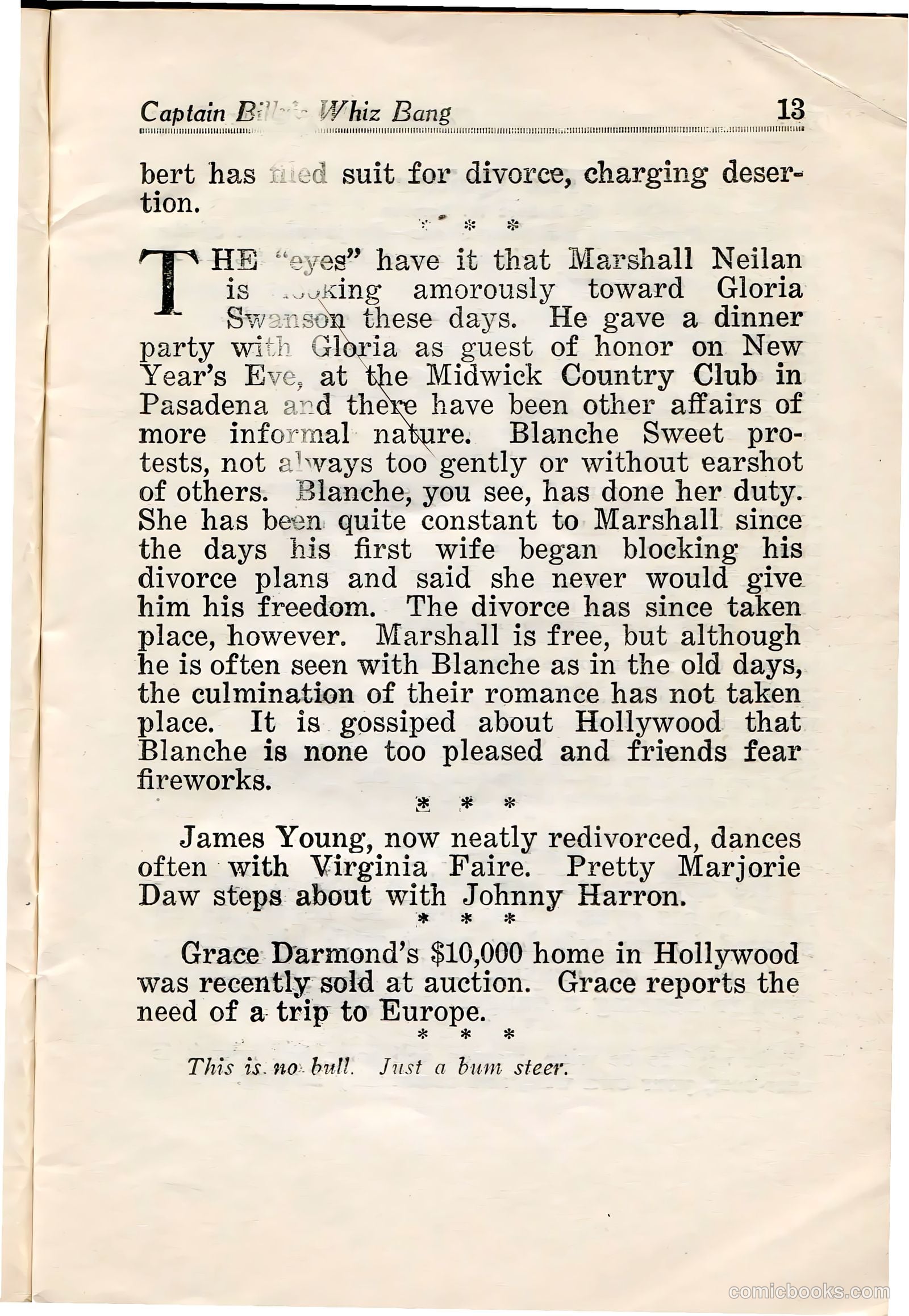
This is a Hollywood gossip column from an early 20th-century satirical magazine. The content tracks romantic entanglements among silent film stars: **Main story**: Director Marshall Neilan is romantically pursuing actress Gloria Swanson, causing distress to actress Blanche Sweet (his former romantic interest who supported him during his first divorce). The column suggests Blanche is upset but the romance hasn't fully "culminated." **Other items**: Brief mentions of actor James Young's recent divorce and new dancing partner Virginia Faire; actress Grace Darmond selling her home, supposedly for a European trip. **The satire**: The final line ("This is no bull. Just a bum steer") appears self-aware mockery—the columnist admits these are unverified rumors, not facts. The column traffics in Hollywood scandal while acknowledging its own unreliability. The page reflects early 1920s celebrity gossip culture and the magazine's humorous, irreverent approach to tinseltown drama.
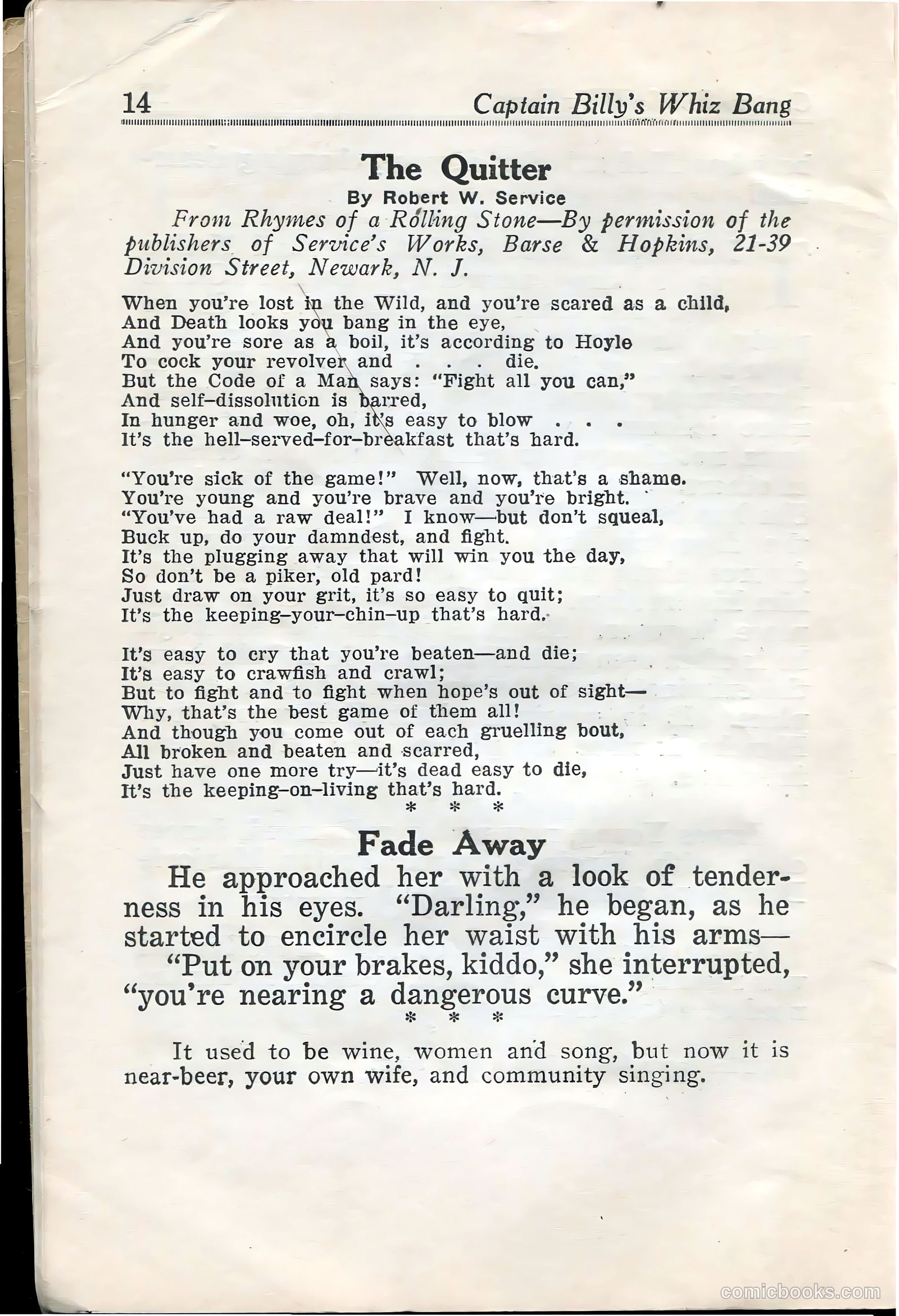
This page contains two pieces of humor typical of 1920s American satire: **"The Quitter"** is a serious poem by Robert W. Service about perseverance and not giving up during hardship. It encourages enduring struggle rather than surrendering to despair or death, with the central message that "it's the keeping-your-chin-up that's hard"—implying survival requires mental fortitude more than physical action. **"Fade Away"** is a brief comedic sketch mocking romantic advances. A man attempts seduction, but the woman deflects with a car-driving metaphor ("brakes," "dangerous curve"), suggesting he's moving too fast. The humor relies on automobile culture references—likely contemporary given the 1920s dating. **The closing joke** satirizes Prohibition-era social decline: pre-Prohibition life featured "wine, women and song" (classical indulgences), but now offers only "near-beer" (weak substitute alcohol), "your own wife" (domestic duty), and "community singing" (wholesome but dull). This reflects widespread frustration with Prohibition's restrictions on entertainment and personal freedom.
This page from the satirical magazine contains several short humor pieces typical of 1920s American comedy: **"A Lovely Program"** jokes about courtship at a dance—the woman cleverly implies intimate expectations by noting that "Nights of Gladness" follows "A Thousand Kisses" on the dance card, suggesting romantic progression. **"His Only Weakness"** plays on Scottish stereotypes, with a Scotsman dismissing interest in a woman's exposed legs by claiming whisky (not women) is his only vice—a joke about Scottish drinking habits. **"Our Monthly Motto"** appears to warn against mixing alcohol ("moonshine") with romance or decision-making. The remaining items are brief quips: one about Noah's hyenas being "laughing-stock" (an animal pun), and another contrasting feminine purity with the indignity of getting splashed by automobiles—mocking social pretense about female virtue. The humor reflects 1920s attitudes toward flirtation, drinking, and gender stereotypes.
This piece satirizes religious objections to fundraising through entertainment. An African American preacher defends organizing a baseball game to repair his church by creatively mapping biblical figures onto baseball terminology—Eve "stealing" first base, Ruth excelling in the field, David striking out Goliath, Noah "giving out checks for rain" (likely a play on baseball terminology). The humor lies in the preacher's ingenious, tongue-in-cheek biblical reinterpretation to overcome deacons' objections that profit-making via sports is sacrilegious. The piece gently mocks both rigid religious conservatism and the preacher's clever rhetorical workaround. The casual use of "Negro" and "colored sky pilot" reflects the publication's early 20th-century vernacular and racial attitudes.
This is a humor column featuring crude jokes typical of 1920s American satirical magazines. The format presents readers' questions to "Captain Billy" with punchy punchline answers. The jokes rely on wordplay and cynical observations: a man marrying for money discovers his wife invested it in oil stocks (ironic reversal); a marriage is compared to a "stew" (implying chaos); a boy on Christmas morning will be happier in September (suggesting disappointment); "stage robbers" (highwaymen) are compared to expensive chorus girls; and an "undertaker" is redefined as someone following medicine (darkly implying doctors cause death). These jokes reflect 1920s anxieties about marriage, financial speculation (oil stocks were a contemporary investment craze), entertainment expenses, and cynicism toward authority figures. The humor is deliberately crude and cynical—hallmarks of the magazine's irreverent style.
This is a humor advice column from *Whiz Bang*, a post-WWI satirical magazine known for irreverent, crude jokes. The page contains mock "Dear Captain Billy" letters with deliberately absurd answers: **Key jokes:** - **Nanny's goat**: Dark humor about feeding a goat nails and a tomato can—the twist is the tomato can (not the nails) will harm it. - **Gertie's kiss dilemma**: Crude sexual innuendo ("Hold still"). - **Chicken crossing road**: Early version of this now-classic joke format. - **Mysterious mailman**: A joke conflating a mail carrier with a Civil War Confederate soldier, with a reference to the war being a "frame-up"—reflecting post-war revisionism sentiment. - **Pe'o the bull pun**: A simple pun on "pen" and the bull's name. The humor is deliberately lowbrow, relying on puns, misdirection, and sexual/violent innuendo typical of 1920s working-class American humor magazines.
This page from the satirical magazine contains short joke vignettes typical of early 20th-century American humor. The opening joke plays on post-WWI social anxieties: a drunk man holding a lamppost is reinterpreted by a policeman as "rehearsing memories of the past"—euphemistically suggesting shell shock or war trauma rather than intoxication. The remaining jokes are light domestic humor: an absentminded professor confuses a hairbrush for a mirror; a man feigns surprise at being offered rolls; a woman questions her boyfriend's health before he's "started" drinking (implying he plans to drink); and the final song references ("Peggy's Oatmeal," "one born every minute") appear to be topical jabs at popular culture or well-known figures, though the specific references are now unclear. The overall tone is cynical, favoring wordplay and double meanings over warmth—characteristic of this magazine's irreverent style.
This page contains no cartoons—it's purely text: two sections of satirical aphorisms and a tribute poem. **"Wisest He"** reprints a Joaquin Miller poem honoring Peter Cooper, a 19th-century philanthropist. The poem's central message: true wisdom lies in *giving away* wealth rather than hoarding it—a gentle critique of materialism. **"Philosophy of the Bat"** offers six brief satirical observations on modern life (circa 1920s): - Men lead double lives; women adopt fashions casually - Doctors spread gossip - Women are natural investigators - Economic chaos (bank robbery, income tax, Bolshevism) makes spending money safer than saving it - A crude sexual joke about women saying "prunes" to signal romantic interest The "Bolsheviki" reference reflects post-WWI American anxiety about communism. The income tax jab targets 1920s tax burden complaints. These cynical one-liners typify *Whiz Bang's* humorous, worldly-wise tone for adult male readers.
This page contains a travel essay rather than a cartoon. Written by Rev. "Golightly" Morrill, it's a satirical travelogue mocking Spain and Spanish culture. The humor targets Spanish character through stereotypes: Spaniards are portrayed as natural liars and blasphemers (hence Toledo's need for prohibition signs). Morrill jokes about a crude fountain statue that would shock American reformers, comparing it to Brussels's famous Manneken Pis. The essay references historical anecdotes—King Roderick's lust for Count Julian's daughter, paralleling the Biblical David and Bathsheba story—to illustrate Spanish moral failings. The train journey to Burgos becomes a metaphor for Inquisitorial torture. Headless statues along the river are blamed on Spanish negligence or climate, humorously suggesting Spanish carelessness. The satire reflects early 20th-century American attitudes: European decadence, Spanish backwardness, and religious hypocrisy are all fair game for ridicule in this populist humor magazine.
This page from *Captain Billy's Whiz Bang* contains no cartoon—it's prose travel commentary, likely satirical editorial content typical of the magazine. The author describes Spanish cities (Burgos and Barcelona) with deliberately exaggerated, moralistic language. The satire works through **contrast and excess**: descriptions of Barcelona's cultural achievements (cathedral, theater, art) immediately pivot to its "vice and crime," slums, and sex work. References to "Comprachicos" (historical child mutilators) and detailed descriptions of brothels, cabarets, and sexual establishments create deliberately lurid, sensationalized travel writing. The implied joke targets both: (1) **preachy travel writers** who moralize about foreign cities, and (2) **readers' prudish hypocrisy**—the detailed cataloging of "bad houses" and sexual venues appeals to the very vice being condemned. The tone suggests cynical amusement at European decadence and American moral posturing about it.
This page contains a first-person travel account (not a cartoon) describing Spanish vice industries, likely from the 1920s. The anonymous narrator recounts visiting Barcelona's Paralelo district and Valencia's dance halls, where he observed exploitative conditions: poorly-paid female performers who supplemented meager wages (15 pesetas monthly) through sexual solicitation with patrons in gallery boxes. The text uses cynical, dehumanizing language—comparing Spanish society to "ancient Alexandria and Rome," invoking Aristotle's dismissive categorization of women as animals. The narrator presents casual moral judgment of sex work and female poverty while simultaneously patronizing these establishments. The passage exemplifies the magazine's satirical approach: exposing social hypocrisy and moral corruption through sardonic travel narrative rather than illustrated humor. The crude misogyny and colonial attitude toward Spain reflect period attitudes Captain Billy's typically mocked.
This page contains three satirical anecdotes from an early 20th-century American humor magazine: 1. **The opening fragment** contrasts a poor Spanish laborer's contentment with American materialism—he refuses money yet appears happier than wealthy Americans. 2. **"There Was An Old Geezer"** is a humorous folk poem about tobacco hoarding and self-reliance, likely mocking Depression-era scarcity mentality. 3. **"Yiddish Salesmanship"** uses ethnic stereotyping common to the era, depicting Jewish merchants Cohen and his son Abie employing deceptive sales tactics. Cohen invents a lie about dying silkworms to justify high prices; Abie quickly learns the trick, absurdly claiming "tape worms" are dying out. The joke relies on period anti-Semitic tropes portraying Jews as dishonest traders, while also satirizing American consumerism and gullible customers.
This page contains three humor pieces typical of 1920s American satirical magazines: **"Fable of the Silly Ass"** is a straightforward animal fable. When a hunting horn sounds, the Fox (Reynard) and Bear (Bruin) flee—they fear being hunted or beaten. The Ass, however, stays behind, reasoning that a horn means music and dancing, therefore "flirting." The satire mocks naive optimism: while smarter animals recognize danger, the Ass's foolish assumption of pleasure leads him to remain—presumably to his harm. **"Beautiful if True"** is sentimental verse about loyalty despite universal rejection and abandonment. **The Johnny anecdote** is a schoolboy humor piece: Little Johnny forges an absence note claiming he skipped school on Wednesday for Good Friday church—when Good Friday typically *is* a religious holiday, making his excuse nonsensical. The humor lies in the child's transparently illogical deception. None appears to reference specific political figures or events.
This is a satirical magazine page from the Prohibition era (likely 1920s-early 1930s), mocking alcohol prohibition through humor. **"The Song of the Moonshiners"** parodies the patriotic hymn "My Country, 'Tis of Thee," celebrating illegal alcohol production instead of American virtues. The joke: Senator Stanley of Kentucky read this into Congress, highlighting the absurdity of prohibition—a law so widely flouted that even lawmakers mock it. **"Oh, Farmer, Farmer Sit On Your Fence"** contains sexual innuendo: "propagate" suggests breeding/reproduction; the farmer "couldn't" after his fences fell—a crude joke about lost virility. **"A Boozehound's Lament"** plays on words: "Jimjams" (delirium tremens, alcohol withdrawal symptoms) sounds like the name "Jim," while "wetgoods" is slang for illegal alcohol. **"Whiz Bang Health Hint"** and the Roman punch joke are standard ribald humor common to the magazine. Overall, the page satirizes Prohibition's failure and widespread public contempt for the law.
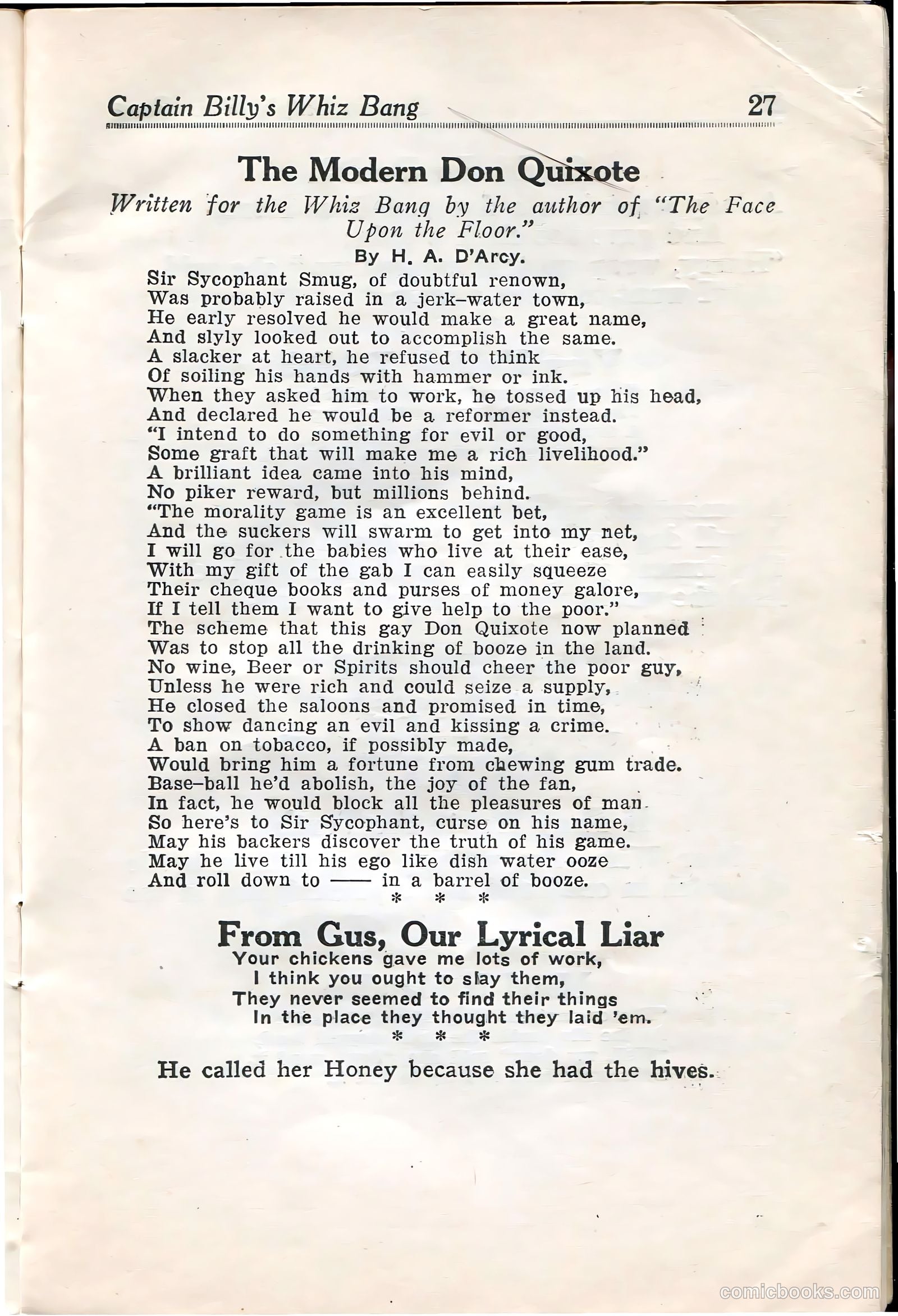
This poem satirizes self-righteous moral reformers, particularly those pushing Prohibition. "Sir Sycophant Smug" represents a hypocritical do-gooder who claims to champion the poor while actually seeking personal wealth through moral crusades. The satire targets the reformer's agenda: banning alcohol, closing saloons, outlawing dancing and tobacco, even abolishing baseball—all presented as schemes to manipulate "suckers" into supporting his movement while he profits (notably from the chewing gum industry, which would benefit from tobacco prohibition). The poem mocks the contradiction between reformers' claimed benevolence and their actual greed and contempt for ordinary people's pleasures. It reflects 1920s-era skepticism toward Prohibition advocates, portraying them as sanctimonious frauds imposing joyless morality on working people. The crude jokes below ("From Gus, Our Lyrical Liar" and the "Honey/hives" pun) are typical Whiz Bang filler humor.
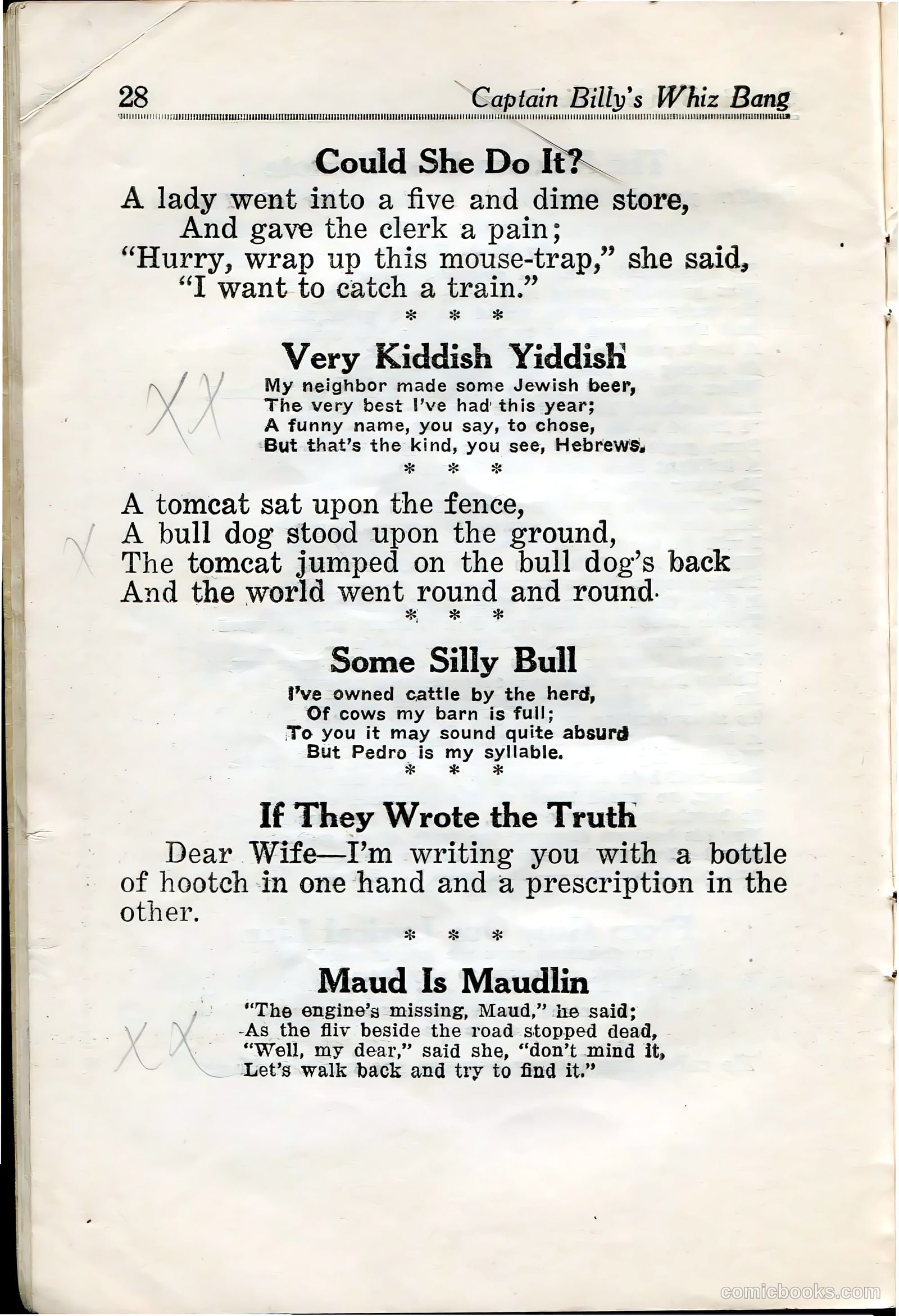
This page collects six brief jokes typical of 1920s American humor magazines: **"Could She Do It?"** - A pun joke: a woman asks a clerk to rush wrapping a mousetrap because she wants to "catch a train"—conflating catching rodents with catching transportation. **"Very Kiddish Yiddish"** - Ethnic humor playing on Jewish/Yiddish speech patterns. The joke hinges on "Hebrews" sounding like "he brews" (beer), relying on stereotypes about Jewish immigrants and alcohol. **Animal jokes** - Absurdist humor about a cat jumping on a dog's back making "the world went round." **"Some Silly Bull"** - A pun: owning cattle with a man named Pedro makes him the owner's "syllable" (sounds like "cattle"). **"If They Wrote the Truth"** - References Prohibition-era drinking ("hootch") and medicinal alcohol prescriptions, satirizing hypocrisy around alcohol laws. **"Maud Is Maudlin"** - A pun on "maudlin" (emotional/sentimental); Maud misunderstands "missing engine" as a lost object to find, rather than a mechanical failure. The humor is simple wordplay and ethnic stereotyping typical of the era.
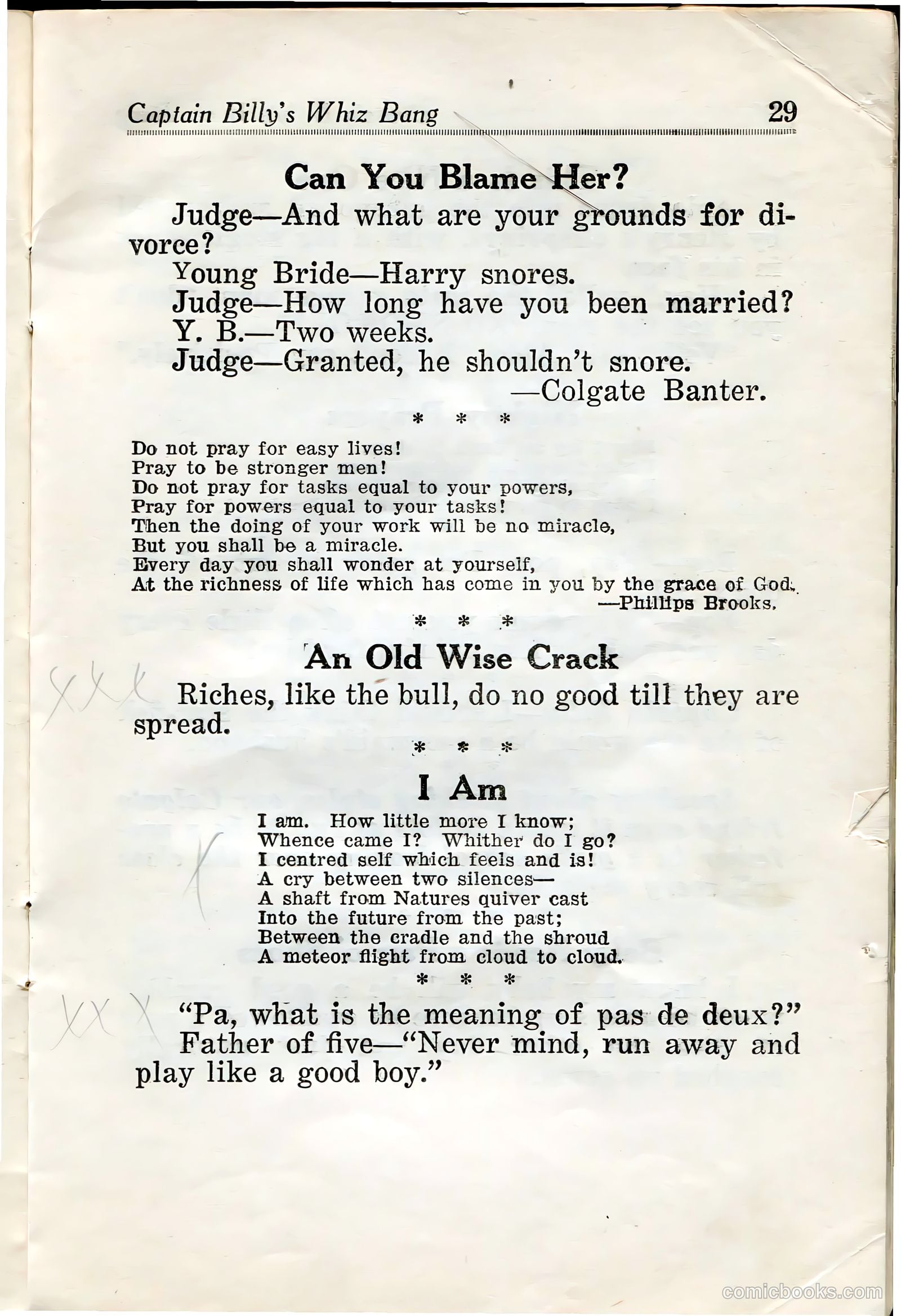
This page collects humor and inspirational content typical of this satirical magazine. The main joke, "Can You Blame Her?," mocks hasty marriages and incompatibility: a bride seeks divorce after two weeks solely because her husband snores—a trivial complaint that the judge ironically grants anyway, suggesting even minor annoyances justify ending marriages. The satire targets both the frivolousness of young newlyweds and lenient divorce laws. The remaining sections shift tone, offering an inspirational prayer by Phillips Brooks, a philosophical poem titled "I Am" about human existence, and a final joke where a father deflects his child's question about the French ballet term "pas de deux" with a dismissive non-answer—likely suggesting the father either doesn't know or finds the topic inappropriate for children.
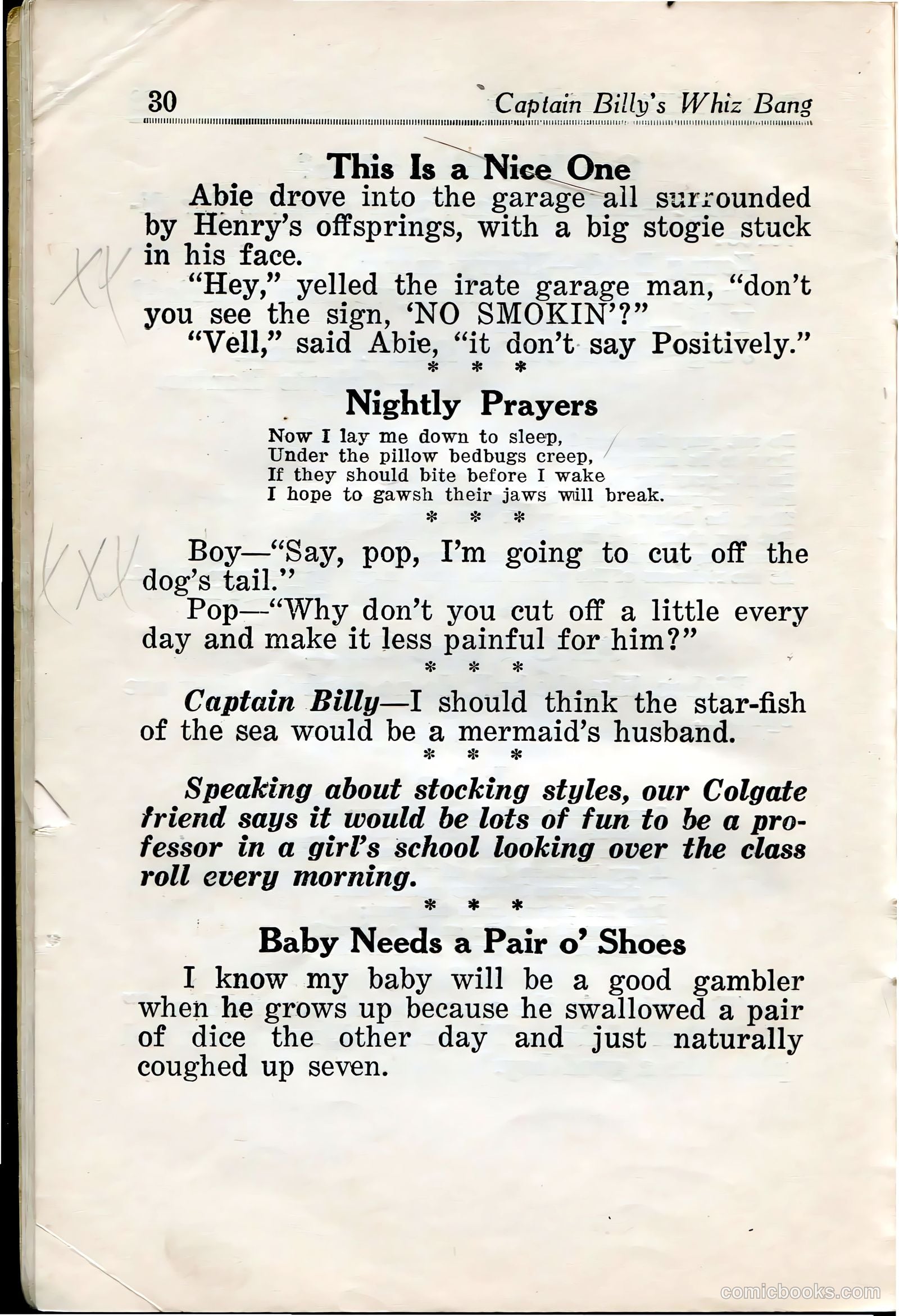
This page from *Captain Billy's Whiz Bang* (a 1920s-era humor magazine) contains several brief jokes typical of the era: **"This Is a Nice One"**: A joke playing on Jewish immigrant dialect humor. "Abie" (a stereotypical Jewish name) smokes in a "No Smoking" garage. When confronted, he responds that the sign doesn't say "Positively"—a quibble about precise wording reflecting period ethnic stereotyping. **"Nightly Prayers"**: Dark humor about bedbugs, common household pests of the era, rewritten as a child's prayer wishing them injury. **Boy/Pop exchange**: Absurdist humor about gradual cruelty. **Captain Billy quip**: A pun about starfish being a mermaid's "husband" (star + fish). **"Speaking about stocking styles"**: An innuendo joke about a professor admiring girls' legs/stockings via a class roster—reflecting period attitudes toward women. **"Baby Needs Shoes"**: Joke about a baby swallowing dice and coughing up "seven"—wordplay on gambling outcomes. The magazine emphasizes crude ethnic humor and slapstick sensibilities typical of early 20th-century American comedy.
This page from *Captain Billy's Whiz Bang* contains several short humorous pieces rather than cartoons. The content includes: 1. **"More Truth Than Poultry"** — A quip comparing women to eggs, suggesting inner qualities can't be judged by appearance. 2. **"Here's Ho, Ham"** — A poem describing drunkenness, where someone is "cuckooed" (intoxicated). 3. **"S'Deep Stuff"** — A brief observation contrasting gamblers with thrill-seekers. 4. **"They're Hard to Please"** — Anecdotes about disappointing romantic relationships. 5. **"Strict Interpretation"** — A joke about railroad regulations, where a conductor misinterprets a porter's actions based on literal rule-reading. The magazine specialized in risqué humor and quick gags. These pieces reflect 1920s-era attitudes toward alcohol, romance, and workplace absurdity—typical content for this popular but now-obscure satirical publication.
This editorial is a sentimental origin story for the famous song "Home, Sweet Home," attributed to John Howard Payne. The narrative depicts Payne as a poor, displaced man in Paris who, witnessing a happy family through an open doorway, is overcome with homesickness and grief for his dead parents and lost youth. Inspired by this poignant moment, he supposedly composed the beloved song. The headline "The Bull is Mightier Than the Bullet" appears disconnected from this text—it's unclear what satirical point it makes or what "bull" references. The page contains no visible cartoons, only this prose editorial. For a modern reader, the significance lies in recognizing this as a romanticized, likely apocryphal biographical anecdote—the kind of sentimental "great artist origin story" that magazines circulated to give cultural resonance to popular music.
This page contains sentimental editorial content and the beginning of a sermon, with no visible cartoons. The first section eulogizes someone named "Payne," likely John Howard Payne, who wrote the song "Home! Sweet Home!" Despite being homeless thirty years, he's celebrated for creating art that comforted working people—sailors, miners, herders, travelers. The passage sentimentalizes "home" as essential to human meaning and spirituality. The second section introduces Rev. John Wesley Holland's sermon on "Hot Boxes" (overheated train bearing systems), published in *The Crescent*, the Shriners' magazine. It begins with an impatient businessman frustrated by a stalled locomotive, setting up what appears to be a moral lesson about patience or industrial progress versus human values—likely continuing on the next page. The tone is earnest rather than satirical; no specific satire is evident here.
This page from the satirical magazine uses a mechanical failure as an extended metaphor for human weakness. A "hot box" (overheated bearing) strands a luxury train, illustrating how small negligence ruins grand achievements—"one HOT BOX will put it out of commission." The text then applies this lesson moralistically to three human "hot boxes": **overindulgence** (overeating destroys vigor—"As HE GAINED PAUNCH he lost PUNCH"), and **sensuality** (citing Caesar and Antony ruined by women). The satire targets 1920s middle-class anxieties about modernity, excess, and moral decay. The "Limited" train represents civilization's achievements, while personal failings are mechanical defects threatening everything. The moralistic tone—warning against gluttony and sexual weakness—reflects period Victorian-influenced values clashing with Jazz Age excess. The piece concludes with a platitude about perseverance earning success.
This page contains **no cartoon or illustration**—it's purely text content: poetry and prose. The material contrasts two work philosophies: the "genius" who works in bursts versus the steady "plugger" who works consistently. The poem uses railroad metaphors ("HOT BOX" refers to overheated wheel bearings from friction) to argue that **steady, sustainable effort beats sporadic brilliance**. The second section shifts to prose describing an elderly man with white hair supported by an elderly woman—likely his daughter. The narrator reflects on female virtue, praising women as stable sources of love and moral support ("like Gibraltar") compared to men's inconstant affection. The text honors women as **Neighbors** (helping the poor), **Christian Workers** (prayer and faith), and moral anchors in society—reflecting early 20th-century sentimental idealization of women's domestic and spiritual roles, common in *Whiz Bang's* moralistic content. No specific political figures or dated references are visible.
This page from *Captain Billy's Whiz Bang* contains no cartoon—it's a sentimental prose piece idealizing women across life stages. The text presents four archetypal female roles: "Sweetheart" (virtuous, inspiring), "Sister" (selfless, supportive), "Wife" (devoted, self-sacrificing), and "Mother" (supreme nurturer). The satire lies in the contrast between what women *should be* versus implied social reality. The passage mocks superficial "painted" sweethearts concerned only with movies and dances, while glorifying women confined to domestic servitude ("caged" in home). The religious language elevating motherhood ("Mother heart of God") alongside descriptions of endless labor and exhaustion suggests the author is critiquing—or possibly endorsing—the unrealistic pedestal placing women on while denying them autonomy or rest. The passage reflects early 20th-century anxieties about women's proper roles during a period of feminist activism.
This page contains no cartoon or satire—it's a sentimental prose narrative from *Captain Billy's Whiz Bang*, a humor magazine. The text describes a visit to an elderly, impoverished mother caring for her adult son, who is disabled from an accident and dependent on her. The narrative traces her life's arc from youth through sacrifice, emphasizing her selfless, unrewarded maternal love despite poverty and grief. The piece celebrates traditional maternal devotion—a common sentimental theme in early 20th-century popular literature. *Whiz Bang* was known for mixing crude humor with earnest sentiment. This passage represents the magazine's earnest side, appealing to readers' emotions about family duty and maternal sacrifice rather than offering satire or political commentary.
This page from **Captain Billy's Whiz Bang** (a 1920s satirical magazine) contains no cartoon—it's sentimental prose followed by an aphorism. The main text is a nostalgic, emotionally manipulative piece contrasting an aging mother's decline with the bustling urban activity surrounding her. She's sustained only by love for her son ("my boy"), positioned as more noble than worldly success. The passage explicitly demands readers treat elderly mothers with reverence, invoking religious imagery ("mother heart of God"). This reflects 1920s sentimental values about motherhood and aging, when such idealization was common cultural currency. The closing line is a humorous aphorism: happiness requires effort ("cranked up," evoking Model T Fords), while trouble starts effortlessly—a wry observation typical of the magazine's satirical tone, contrasting sharply with the earnest sentimentality above it.
This page contains **poetry, not a cartoon**—it's from *Captain Billy's Whiz Bang*, a satirical magazine known for humor and social commentary. **"Who Is a Christian?"** by Ella Wheeler Wilcox is a scathing critique of **Christian hypocrisy**, likely written during or after World War I. Wilcox attacks wealthy churchgoers who sit in expensive pews (funded by exploitation), make false prayers, exploit workers with low wages while raising rents, and preach salvation while supporting war. True Christianity, she argues, belongs to those practicing love and justice—regardless of formal religion. **"Thou Art Gone"** is sentimental verse mourning a daughter's death. **The final line—"Fools rush in where husbands fear to tread"**—is a humorous non-sequitur, likely a standalone joke playing on the proverb "fools rush in where angels fear to tread," recontextualized for domestic comedy. The page is primarily **serious social criticism wrapped in poetry**, not visual satire.
This page collects short jokes and humorous verses typical of 1920s-era satirical magazines. The humor relies on wordplay and domestic situations: **"A New Way to Do It"**: A pun on "chew the rag" (complain/talk endlessly). A bound-and-gagged man claims he spent the night doing just that—literally chewing his gag. **Book Agent joke**: Satirizes both aggressive door-to-door salesmen and marital discord. The premise is that boring books about women will keep husbands occupied at home. **"Marvelous Missouri Blues"**: Rural folk humor about a farmer (Small Paul) hitting his mule, which retaliates by kicking where the farmer eats—a crude punchline playing on the double meaning of "meals." **Church attendance joke**: Mocks hypocrisy: elderly attend to sleep, young women attend to show off clothing rather than for piety. **"Spank On, Macduff"**: Puns on children's names ("Wennis"/"Weinie") to create a rhyme scheme about disciplining mischievous kids. **Final line**: A dark quip suggesting the undertaker is someone you'd prefer never to do business with (implying death).
This page from *Captain Billy's Whiz Bang* (a satirical/humor magazine) contains two poems rather than cartoons. The first section reprints a recitation by performer Ed. E. Ford that celebrates interfaith tolerance. A Jewish chaplain and rabbi perform last rites for a Christian soldier, suggesting moral decency transcends religious difference—a progressive message for the era (appears to be 1920s-30s based on publication style). The second section, titled "'Ostler Joe," republishes a classic poem about a woman buried in a grave who "lured men's souls to the shores of sin" with her beauty and songs. The poem trades in romantic melodrama common to the period—treating a seductive woman as a tragic, morally corrupting figure. Both texts reflect early 20th-century popular verse: one promoting interfaith unity, the other indulging in sentimental tragedy and moral judgment of women's sexuality. The page preserves established literary content rather than creating original satire.
This page contains no political cartoon—it's a serialized morality tale in verse, typical of *Captain Billy's Whiz Bang*, a humor/satirical magazine popular in the 1920s-30s. The story follows Joe the ostler (stable worker) and his wife Annie. Though unattractive, Joe wins "the winsome lassie," and they have a beloved son, little Joe. Years of happiness follow until a mysterious gentleman begins visiting Annie's cottage. The child, innocent and trusting, inadvertently facilitates the man's seduction of Annie—the "mother's sin." The narrative invokes the biblical reference to Phryne (an ancient Greek courtesan) in the opening, establishing a cautionary morality narrative about female virtue, temptation, and moral corruption. The tale emphasizes the contrast between Annie's outward respectability and her inner weakness, using melodramatic language ("woman weak and wanton") typical of period morality literature meant to warn readers about sin's consequences and the fragility of domestic virtue.
This page contains no cartoon but rather a narrative poem—a morality tale popular in early 20th-century satirical magazines. The story contrasts two characters: "Ostler Joe," a humble, virtuous stable worker, and an unnamed woman who abandons him. The narrative follows a classic Victorian morality framework: the woman leaves Joe (pregnant, implied), he loses their baby to winter, yet forgives her completely. Meanwhile, she becomes a London actress/courtesan, achieving fame through beauty and "shame," performing nearly nude and corrupting public morals. Her wealthy suitors literally purchase the affection she once gave Joe freely. Eventually, poverty and disease claim her. A dying woman in "humble lodgings" turns out to be her—and Joe, reading the news in his "far-off country place," still harbors only forgiveness. The satire targets urban vice, theatrical immorality, and aristocratic decadence while celebrating rural virtue and Christian forgiveness. It reflects period anxieties about actresses, female sexuality, and urbanization.
This page contains two sentimental poems with moralizing themes typical of early 20th-century American magazines. The first poem tells of a man who finds redemption through loving a "fallen woman" (named Phryne, a reference to an ancient Greek courtesan). Despite her "base unhallowed life," his faithful love grants her dignity—she receives an honorable burial and the title of "wife." The second poem, "The Straight and Narrow Path," is a working-class morality lesson. It cynically observes that life is a "riddle" and "joke," that fair-weather friends abandon you when poor, and that wealth cannot buy respectability or maternal approval. The remedy: maintain moral rectitude through hardship. The final lines invoke divine judgment—God will judge you fairly, so endure poverty with integrity. Both poems reflect *Whiz Bang's* blend of sexual frankness (discussing "fallen women") with conventional moral messaging—characteristic of this satirical magazine's approach to American social hypocrisy.
This page contains two poems with no visible cartoons or illustrations—it appears to be a text-only content page from the satirical magazine. **"What Is Life to You?"** is a social satire using parallel structure to mock different professions and character types. Each line contrasts how different social figures perceive life's meaning: preachers see sermons, misers see money, grafters thrive while fools fail. The poem gently ridicules human nature and occupational obsession, concluding by asking readers to reflect on their own values. It's lighthearted social commentary typical of 1920s-era humor. **"The Man That's In Tune"** is inspirational verse celebrating spiritual and emotional harmony—being aligned with nature, community, duty, and the divine. It suggests that the person who maintains inner peace and moral balance will be rewarded in the afterlife ("gates wide open"). Together, these poems represent *Whiz Bang*'s mix of irreverent social observation and earnest moral reflection—characteristic of this period's American satirical magazines balancing cynicism with sentimentality.
This page contains three humorous pieces from an American satirical magazine: **"No Time to Quit"** is inspirational doggerel celebrating persistence through life's ups and downs—typical motivational verse for a working-class audience. **"The Old Time Runaway Train"** is a novelty folk song about a derailed locomotive, with repetitive comic verses about various characters caught in the chaos (a fireman, a newsboy, a porter named "Ebony Jones," a switchman). The humor relies on the absurdist repetition and the rhyming scheme. **"Diplomacy?"** is a brief joke playing on the double meaning of "made up"—the woman is applying cosmetics, and the man insults her by suggesting she's wearing too much makeup while refusing her reconciliation. It's mild, domestic humor about marital conflict. The page contains no political cartoons or identifiable caricatures—it's primarily text-based humor aimed at ordinary readers, reflecting early 20th-century popular entertainment sensibilities.
This page contains three poems reflecting post-WWI social attitudes, circa 1920s. **"To the Underdog"** — Written by a Multnomah County jail inmate, this addresses unemployed or struggling men during the economically difficult 1920s. It's motivational verse encouraging perseverance through poverty and hardship, with the grim reminder that incarcerated men would "gladly take your place"—reflecting Depression-era desperation. **"Ho! Jackie"** — Appears to address a sailor, romanticizing transient romantic encounters in port cities—likely reflecting post-WWI demobilization when many servicemen returned home. **"Cock-a-Doodle-Do"** — A satirical poem by established humorist John Kendrick Bangs mocking boastful men who lack genuine accomplishments. The rooster metaphor suggests masculine posturing and empty braggadocio—possibly critiquing business leaders or politicians of the era who promoted prosperity they hadn't actually delivered. The page reflects 1920s working-class anxieties and satirical deflation of false authority.
This page contains four poems with contrasting tones. The dominant piece, "The Girl With the Broken Wing," is a serious social critique addressing sexual double standards. It describes a young woman seduced and abandoned by a man of higher social standing who faces no consequences ("high up in the councils"), while she bears all shame and social ruin alone. The poem poses a rhetorical question about the unfairness of this disparity. The other three poems—"No Chance, No Gain," an untitled romantic piece, and "Well, What of It?"—appear unrelated. The last is comedic, describing a girl dancing the "shimmy" (a popular 1920s dance) to cure a cough, likely satirizing both the dance's popularity and folk remedies. The juxtaposition suggests *Whiz Bang* mixed serious social commentary with light humor, reflecting Jazz Age attitudes toward morality and gender.
This satirical column from *Captain Billy's Whiz Bang* (a 1920s humor magazine) attacks Hollywood's Lasky Studio for multiple scandals: the Arbuckle case (likely Roscoe "Fatty" Arbuckle, involved in a actress's death), an unsolved poisoning of a female screenwriter, director Paul Kramer's murder (his mother-in-law arrested), and an unnamed "Taylor's death" (possibly director William Desmond Taylor, famously murdered in 1922). The second section mocks director Erich von Stroheim and Universal Studios over censored footage from *Foolish Wives*—scenes of von Stroheim giving a woman a massage and "oriental abandon" in another film. A showman allegedly offered $50,000 for these cut sequences, suggesting audiences valued the scandalous content. The satire's point: Hollywood's production quality couldn't offset its real-life scandals and exploitative sensationalism. "Better clean up the backyard" urges genuine reform over maintaining appearances.
This gossip column satirizes Hollywood production conflicts and romantic entanglements. The Omar Khayyam segment mocks a dispute between producer Ferdinand Penney Earle and his female financial backer ("Queenie"), a wealthy Los Angeles woman. The joke centers on her attempting to control the film's final cut, forcing Earle to hide film reels to retain creative authority. The satire suggests women should not interfere in professional filmmaking—Earle ultimately edits from his hospital bed rather than yield to her. The second item ridicules young producer Myron Selznick for his romantic infatuation with British dancer Evelyn Laye, imagining her as a Broadway star in Selznick productions. The humor targets his starry-eyed ambitions driven by romance. Both items exemplify the magazine's sardonic commentary on early Hollywood's chaotic production practices and personal drama.
This page discusses Hollywood gossip and scandal, primarily referencing the famous **Taylor murder case** (1922). The text mocks how the unsolved killing of film director William Desmond Taylor frightened movie celebrities into public propriety. The satire targets: 1. **Louis J. Selznick and his son Myron** — Hollywood producers/executives. Myron wants to promote an actress (Miss Laye, likely Evelyn Laye), but his father opposes the plan. 2. **Mary Miles Minter** — a flapper actress involved in the Taylor scandal. The columnist sarcastically notes she's finally acknowledged as nineteen (implying studios had lied about her age for years). 3. **Hollywood hypocrisy** — The piece mocks how the murder scared celebrities into behaving respectfully with their parents in public, only to resume normal behavior once scandal subsides. The joke: only murder makes movie fathers actually supervise their daughters. The overall tone satirizes Hollywood's moral flexibility and the industry's use of scandal for publicity.
This is a page of "Classified Ads" reprinted from various American newspapers, presented as humor in Captain Billy's Whiz Bang—a satirical magazine popular in the 1920s. The humor derives from unintentional double meanings and awkward phrasing in the original newspaper classifieds: - **"A Mysterious Case"**: Lost silk bloomers (women's underwear) - amusing because of the implied impropriety - **"Either Sex"**: A matrimony ad seeking a partner "either sex" with "little capital required" - the phrasing creates ambiguity about whether the person wants any gender or is being deliberately coy - **"Congratulations All Around"**: A birth announcement oddly crediting "all in any way responsible" - satirizing awkward newspaper language - **"Toot, Toot, Here Comes the Handcar"**: Quoted journalistic purple prose about mundane events - **"A Psychology Patient"**: A hiring ad for domestic work that sounds vaguely unethical The satire targets newspapers' unintentional comedy—how their stiff, formal conventions create accidentally suggestive or absurd meanings.
This page from *Whiz Bang* (a humor magazine) collects short comedic items from various newspapers. Rather than cartoons, it's primarily humorous classified ads and brief jokes: **The satire** mocks personal advertisements and social mishaps through exaggeration and double meaning. "Gus, Look Her Up" plays on a refined woman's desperation for any employment. "Breaking the News Gently" satirizes wealthy bachelors seeking paid companionship in their homes—the "accommodation" payment suggests something improper. "Beg Your Pardon" lampoons small-town gossip by "correcting" implied infidelity. "Babies, Dogs, Horses and Cows" absurdly conflates human suffering with animal disease. The Adam and Eve joke plays on fig leaves versus poison ivy—a crude reference to female anatomy. "A La Follywood" appears to mock Hollywood's superficiality while expressing desire to be a ladies' tailor—likely implying voyeuristic interest rather than genuine tailoring skill. The humor is lowbrow, often relying on innuendo and cynicism about relationships and social pretension.
This satirical piece mocks self-appointed moral reformers attempting to regulate dancing in New York State. The text ridicules a proposed bill banning "jazz dancing, hugging and cheek-to-cheek dancing" and other "suggestive" moves, replacing them with rigidly formal, distanced dancing where partners must keep "bodies or faces apart." The satire targets Prohibition-era moral panic and censorship movements. The absurdly specific regulations—banning dim lighting, requiring arm positions—are presented to highlight the absurdity of government micromanaging social behavior and personal expression. The second section shifts to mocking New York's film censorship board, suggesting these same moral crusaders are also "very, very active" in censoring cinema. The piece criticizes the paternalistic mindset of moralists imposing their values on the public, presenting their efforts as both laughably restrictive and dangerously intrusive into private life.
This page satirizes film and theater censorship in the 1920s. The first section mocks the film censorship board's absurd logic: they banned a scene from "Sappho" where a man carries a woman upstairs (implying sexual activity), but would permit it if she walked upstairs instead—the same action, merely viewed differently. The second section ridicules religious moralists, particularly Rev. Dr. Straton and Rev. John Haynes Holmes, who were campaigning against "immoral" stage productions. The author mocks their hypocrisy by describing "The Rubicon," a French play about a wife who refuses her lover until her husband convinces her that marital duty comes first—whereupon she abandons the lover anyway. The satire suggests these moral crusaders miss the play's actual message about marital obligation. The piece concludes dismissing the British revue "Pins and Needles" as terrible, implying even without moral objections it fails artistically.
This page contains two gossip column items from a 1920s satirical magazine, with **no visible cartoon**. The first item mocks the Broadway revue "Pins and Needles," claiming the Shubert brothers blamed delayed costumes from Europe, but the writer suspects they're simply using inadequate makeshift costumes. The criticism extends to performers Harry Pilcer and Edith Kelly Gould, whose skimpy stage attire is compared unfavorably to burlesque—implying the show is cheap and poorly produced. The second item ridicules actress Mae Murray for her self-aggrandizing behavior. She claims to design her own minimal costumes and guards her "ideas" jealously, but the writer dismisses her outfit choices sarcastically. The satire targets her vanity and calculated publicity-seeking: her signature white cloak and perfectly-timed "just-before-proceedings-start" arrivals with her husband (director Robert Leonard) are portrayed as transparent attention-grabbing theatrics. The humor relies on readers' familiarity with these entertainment figures and Broadway scandals.
This page contains joke collections rather than traditional cartoons. The humor reflects 1920s American attitudes: **"Tony" joke**: Satirizes modern, legally-educated women ("modern miss") by showing a woman charging a man with "petty larceny" for stealing a kiss—absurdly legalistic about romance. His response reframes it as "grand" (felony-level), a playful reversal. **"Speaking of Knees"**: References the then-scandalous exposure of women's knees as hemlines rose during the 1920s. Wind revealing legs was considered risqué. **"King George/Olaf" joke**: Appears to mock a hired man named Olaf (likely Scandinavian immigrant), with "Order of the Bath" being a British honor. The joke seems to suggest Olaf is dirty or undeserving—playing on ethnic stereotypes common to the era. **Overall tone**: Lighthearted, somewhat risqué for the period, with casual sexism and ethnic humor typical of 1920s American magazines targeting male readers.
This page from the satirical magazine presents several short humorous pieces targeting early 1920s social anxieties. **"Frugality Personified"** mocks extreme thriftiness through Olaf, a Scandinavian farm worker (suggested by the name). The joke exaggerates immigrant stereotypes—particularly Scots and Scandinavians—as obsessively stingy, depicting absurd recycling of tobacco and bodily materials. The cranberry/prune quip adds nonsensical humor. **"Health Hint"** and the **alimony joke** target marriage and divorce—contemporary social concerns as divorce rates rose. The alimony reference invokes the American Revolution slogan "no taxation without representation" to mock spousal support payments. **"Song of the Green Table"** is a pool hall boast—a self-deluding claim of skill that became stock humor during Prohibition, when speakeasies and gambling dens proliferated. Overall, the page reflects 1920s anxieties about immigrants, changing marriage dynamics, and urban vice culture through quick satirical zingers typical of the magazine's style.
This page from the satirical magazine *Captain Billy's Whiz Bang* collects humorous poems and quips typical of 1920s American humor. The content reflects post-WWI social anxieties and changing morality: **Key themes:** - **"Only a Milkman's Daughter"** and **"Never Walk, Girls, Unless"**: Mock warnings about women's behavior and modernity—girls walking alone or riding in automobiles were controversial. The "tack in your sock" joke suggests discomfort/consequences. - **"Morals and wine and jass music"**: References Jazz Age excess; personifying "morals" as corrupted by modern pleasures reflects conservative anxiety about Prohibition-era behavior. - **"With the Lips Only"**: A cautionary poem about romantic restraint disguised as practical advice—likely references anxieties about changing courtship norms. - **"Switchman" anecdote**: Dark humor about utilitarian tragedy (killing eighty to save one child). - **Eve/liquor closing**: A Prohibition-era joke implying women pose moral dangers comparable to alcohol—both seen as corrupting influences. The overall tone: irreverent, sexually suggestive, anti-moralist satire aimed at adult male readers.
This is a humor column featuring short jokes submitted by readers under pseudonymous names. It's not a political cartoon but rather a satirical advice column typical of 1920s American magazines. The jokes target recognizable social types: overweight people ("Fatty Felix"), cynical men, gold-diggers who marry for security then divorce for alimony ("Naughty Nellie"), and the absurdly naive. The humor is crude and direct—a pun confusing pneumonia/ammonia, fat-shaming, marital cynicism, and fabricated "Indian words" used as punchlines. The column reflects period attitudes: casual misogyny regarding women's financial motivations in marriage, dismissal of Native Americans (via the fake "Ohwhatanassiam"), and working-class masculine banter. These were mainstream "funny" to contemporary readers but reveal attitudes most modern readers would find offensive.
This page from *Captain Billy's Whiz Bang* contains humorous advice-column responses and short jokes typical of 1920s American satirical magazines. **Key References:** - **Prohibition joke**: References the 18th Amendment (1920), playing on "bars" (musical measures vs. drinking establishments) - **"Carrie Paper"**: Likely a pun on Carrie Nation, the famous temperance crusader - **"Worried Seventeen"**: A lovelorn teenager receiving romantic advice - **"Mathematical Minnie"**: A recurring character offering humorous formulas about romance and consequences **Satirical Points:** The jokes mock contemporary concerns: Prohibition's effects, parenting anxieties, dating customs, and courtship leading to "correctional court wedding ceremony" (shotgun weddings). The humor is mild, focusing on wordplay and social absurdities rather than sharp political critique. These brief items represent the magazine's formula of reader submissions and editorial responses—populist, domestic humor aimed at ordinary Americans.
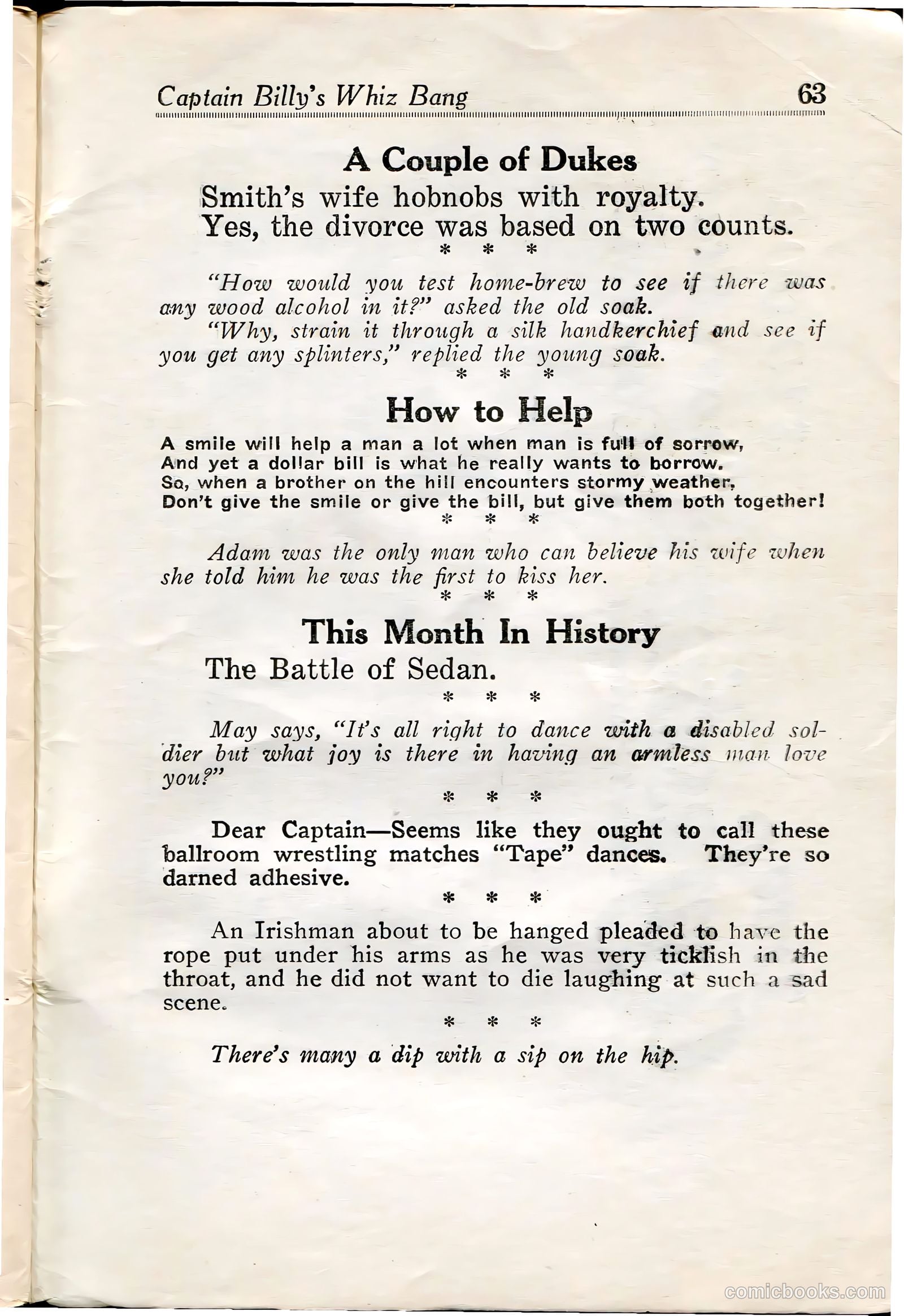
This page from a 1920s satirical magazine contains brief jokes and quips typical of the era. Key references include: **"A Couple of Dukes"**: A joke mocking social climbers—Smith's wife associates with royalty, leading to divorce on "two counts" (likely a pun on "county" courts). **Prohibition-era humor**: The home-brew alcohol test joke references the illegal liquor production during Prohibition (1920-1933), a major contemporary concern. **WWI references**: "This Month In History" mentions the Battle of Sedan (1940, though likely referring to an earlier conflict). The disabled soldier joke appears to reference WWI veterans, some of whom lost limbs. **General social satire**: Other jokes mock materialism (the "smile vs. dollar bill" piece), marital skepticism (Adam and Eve), and physical comedy (the Irishman's hanging, the "dip with a sip"—referring to hip flasks). The humor is crude and occasionally dark by modern standards, reflecting 1920s comedy sensibilities.
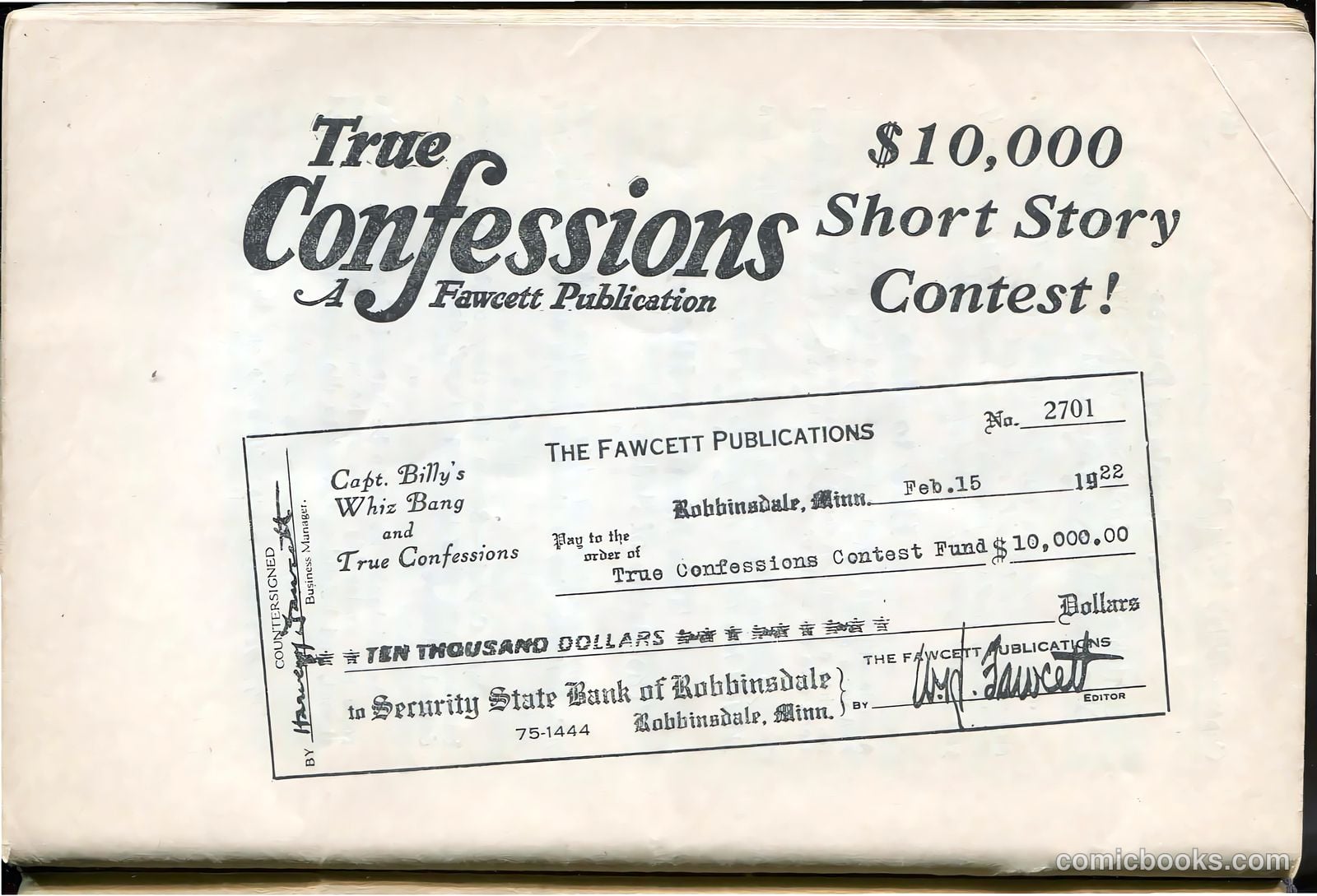
This is a **title page or announcement**, not a cartoon. It displays a promotional check for a $10,000 short story writing contest sponsored by True Confessions magazine, a Fawcett Publication, dated February 15, 1922. The check is payable to the contest fund and drawn on Security State Bank of Robbinsdale, Minnesota. For modern readers: This illustrates how magazines competed for reader engagement through substantial cash prizes. The "True Confessions" genre—featuring sensational, often morally instructive personal narratives—was hugely popular in the 1920s. The public display of such a large check was marketing: it advertised the contest's legitimacy and the publisher's confidence, encouraging submissions and boosting magazine sales.
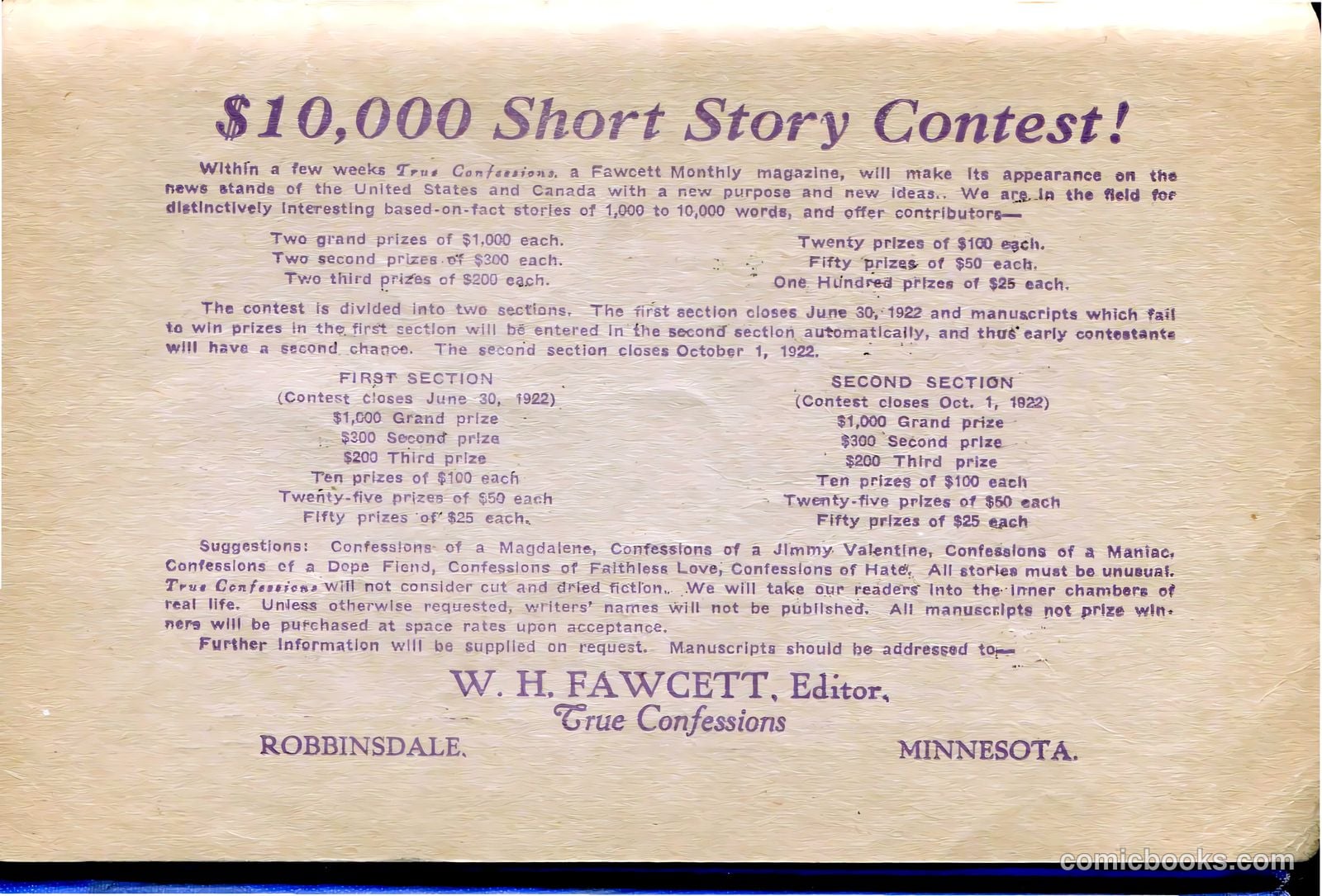
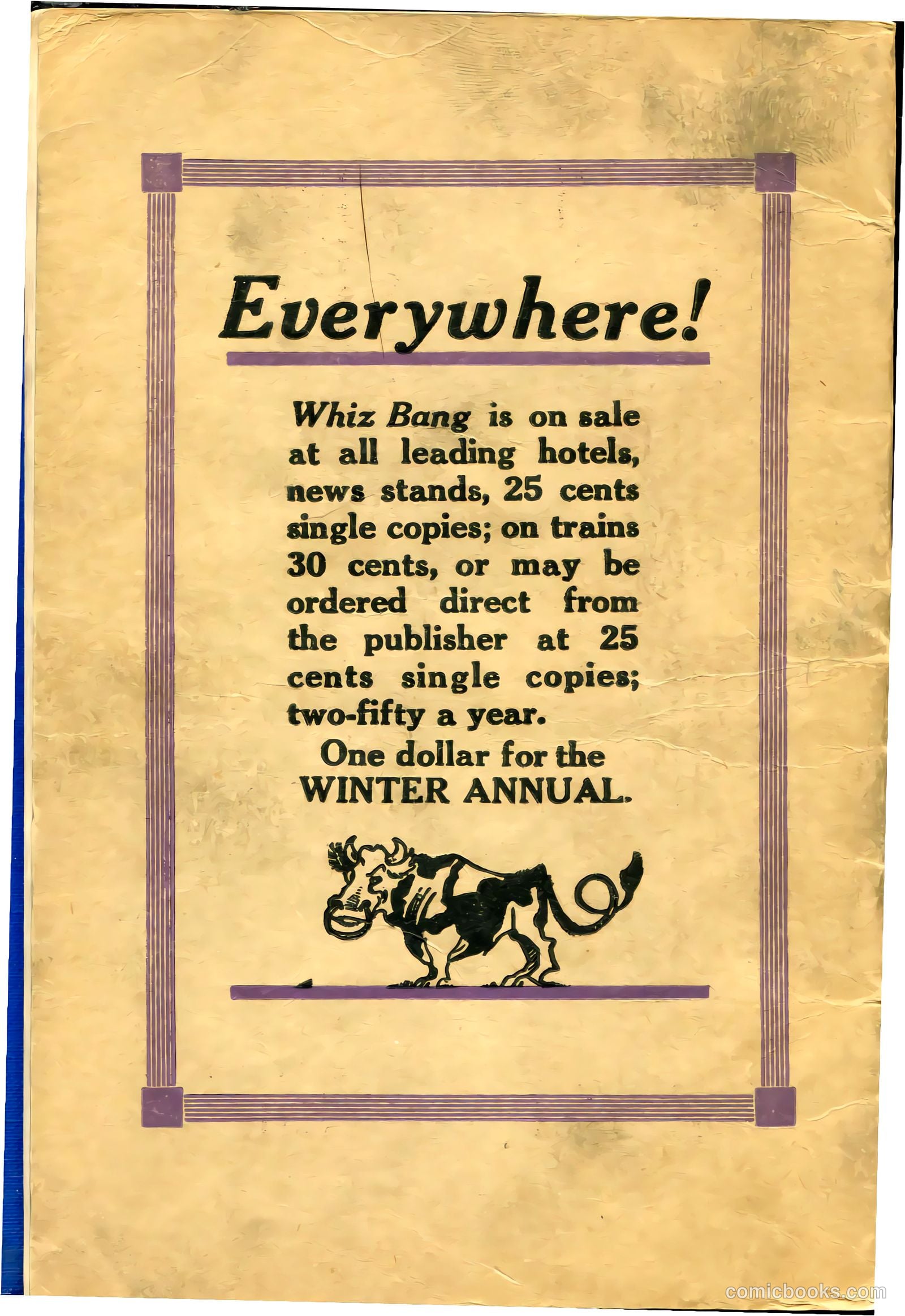
This is a **title/advertisement page** for *Whiz Bang*, a satirical magazine. The page announces distribution and pricing information rather than presenting political or social satire itself. The image shows a cartoon cow (the magazine's mascot) at the bottom, which serves as a recognizable brand identifier. The decorative art deco border frames the text in the magazine's house style. The advertisement emphasizes broad availability—hotels, newsstands, and trains—suggesting *Whiz Bang* was a popular, mass-market publication. Pricing details indicate it was affordable entertainment for average Americans: 25 cents per issue or $2.50 yearly. The "Winter Annual" at one dollar represented a premium special edition. This page demonstrates how early 20th-century magazines promoted themselves and their distribution networks to potential readers.