
Captain Billy's Whiz Bang, May 1922 · page 40 of 68
Captain Billy's Whiz Bang #33 — page 40: what you’re looking at
What you’re looking at
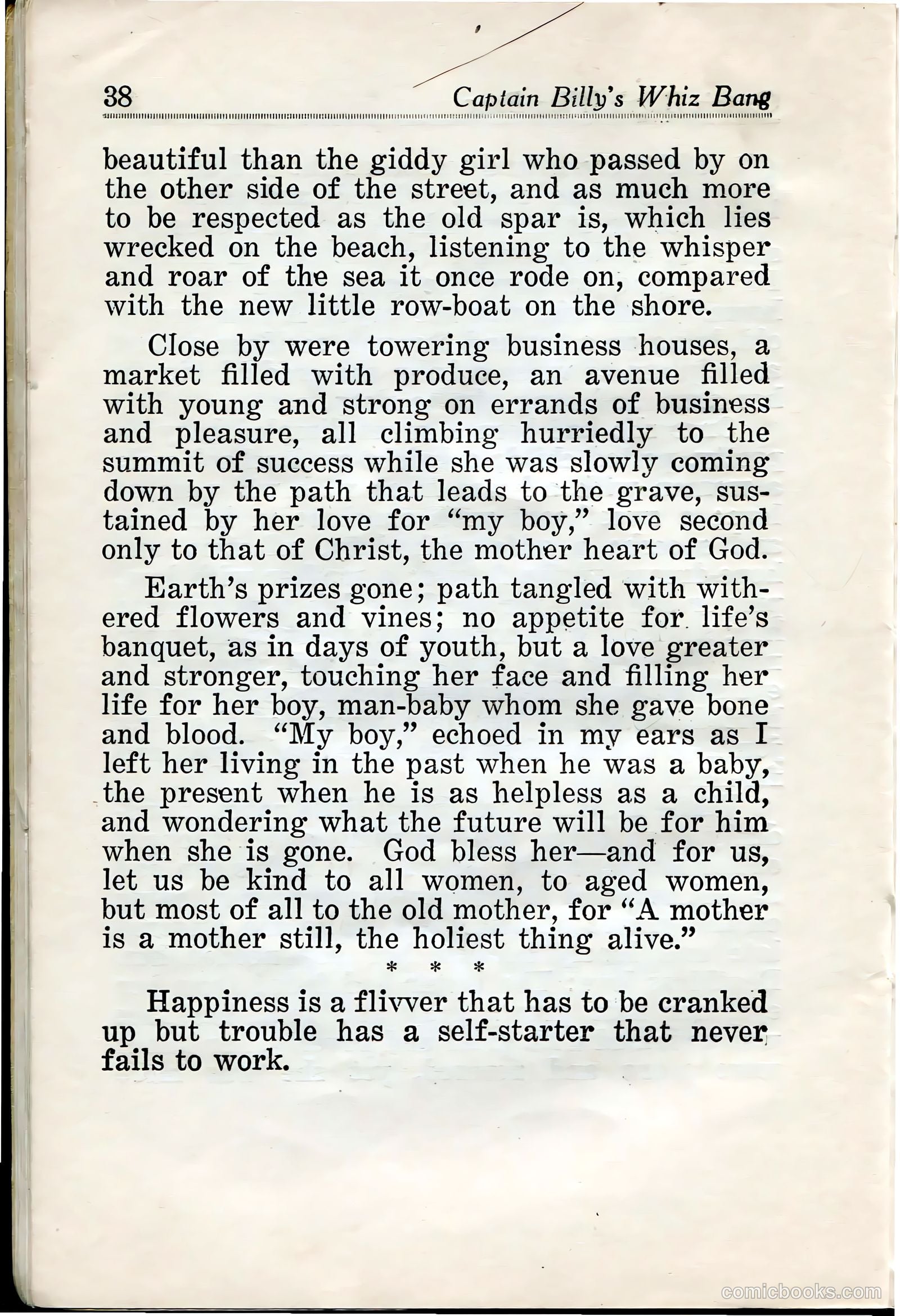
This page from **Captain Billy's Whiz Bang** (a 1920s satirical magazine) contains no cartoon—it's sentimental prose followed by an aphorism. The main text is a nostalgic, emotionally manipulative piece contrasting an aging mother's decline with the bustling urban activity surrounding her. She's sustained only by love for her son ("my boy"), positioned as more noble than worldly success. The passage explicitly demands readers treat elderly mothers with reverence, invoking religious imagery ("mother heart of God"). This reflects 1920s sentimental values about motherhood and aging, when such idealization was common cultural currency. The closing line is a humorous aphorism: happiness requires effort ("cranked up," evoking Model T Fords), while trouble starts effortlessly—a wry observation typical of the magazine's satirical tone, contrasting sharply with the earnest sentimentality above it.
📄 Transcribed text from this page (OCR, searchable)
Machine-transcribed from the original scan — historical spelling and the odd misread are preserved.
38 Captain Billy's Whiz Bang beautiful than the giddy girl who passed by on the other side of the street, and as much more to be respected as the old spar is, which lies wrecked on the beach, listening to the whisper and roar of the sea it once rode on, compared with the new little row-boat on the shore. Close by were towering business houses, a market filled with produce, an avenue filled with young and strong on errands of business and pleasure, all climbing hurriedly to the summit of success while she was slowly coming down by the path that leads to the grave, sustained by her love for “my boy,” love second only to that of Christ, the mother heart of God. Earth’s prizes gone; path tangled with withered flowers and vines; no appetite for life’s banquet, as in days of youth, but a love greater and stronger, touching her face and filling her life for her boy, man-baby whom she gave bone and blood. “My boy,” echoed in my ears as I left her living in the past when he was a baby, the present when he is as helpless as a child, and wondering what the future will be for him when she is gone. God bless her—and for us, let us be kind to all women, to aged women, but most of all to the old mother, for “A mother is a mother still, the holiest thing alive.” * * * Happiness is a flivver that has to be cranked up but trouble has a self-starter that never fails to work.