
Captain Billy's Whiz Bang, May 1922 · page 44 of 68
Captain Billy's Whiz Bang #33 — page 44: what you’re looking at
What you’re looking at
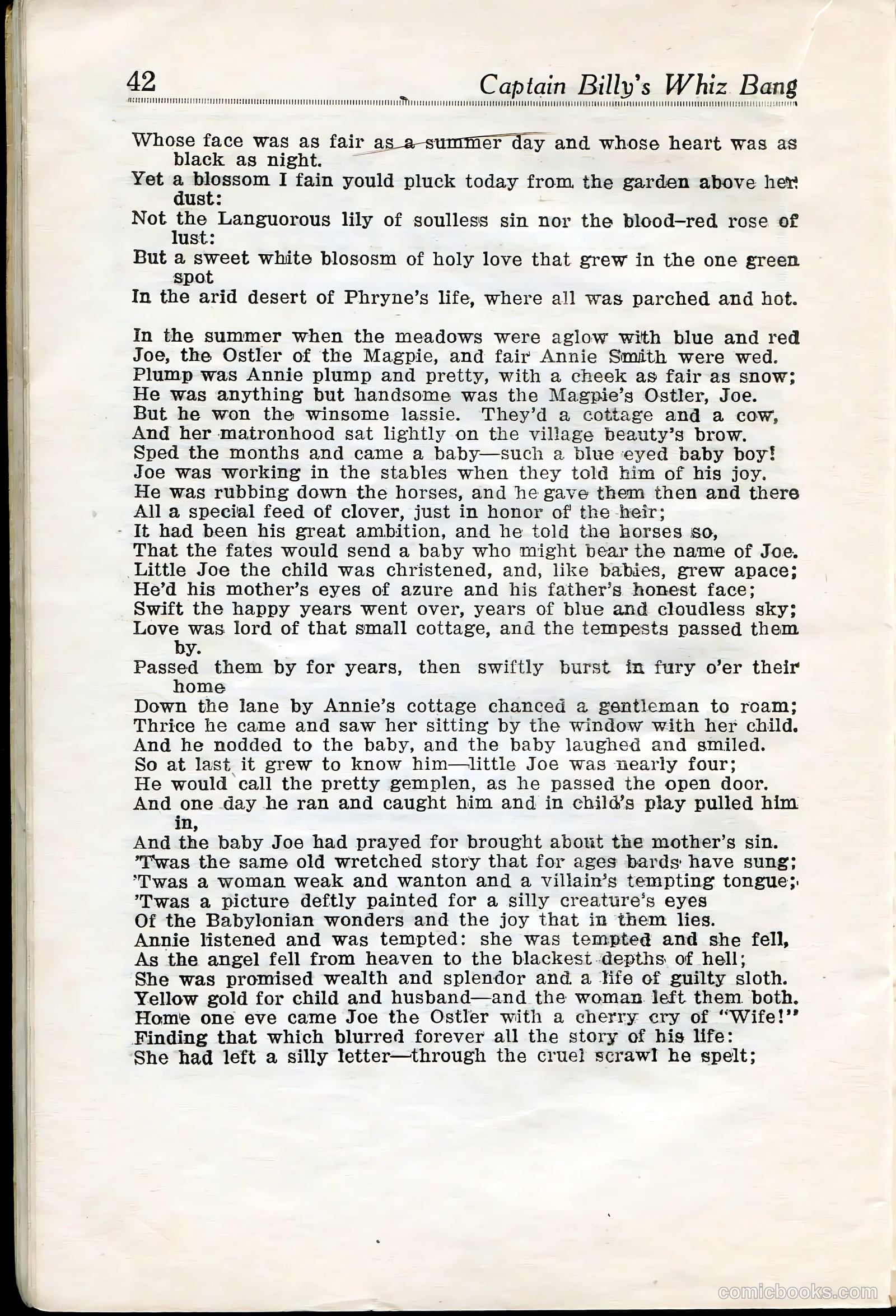
This page contains no political cartoon—it's a serialized morality tale in verse, typical of *Captain Billy's Whiz Bang*, a humor/satirical magazine popular in the 1920s-30s. The story follows Joe the ostler (stable worker) and his wife Annie. Though unattractive, Joe wins "the winsome lassie," and they have a beloved son, little Joe. Years of happiness follow until a mysterious gentleman begins visiting Annie's cottage. The child, innocent and trusting, inadvertently facilitates the man's seduction of Annie—the "mother's sin." The narrative invokes the biblical reference to Phryne (an ancient Greek courtesan) in the opening, establishing a cautionary morality narrative about female virtue, temptation, and moral corruption. The tale emphasizes the contrast between Annie's outward respectability and her inner weakness, using melodramatic language ("woman weak and wanton") typical of period morality literature meant to warn readers about sin's consequences and the fragility of domestic virtue.
📄 Transcribed text from this page (OCR, searchable)
Machine-transcribed from the original scan — historical spelling and the odd misread are preserved.
42 Captain Billy's Whiz Bang Whose face was as fair as a summer day and whose heart was as black as night. Yet a blossom I fain yould pluck today from the garden above her dust: Not the Languorous lily of soulless sin nor the blood-red rose of lust: But a sweet white blososm of holy love that grew in the one green spot In the arid desert of Phryne's life, where all was parched and hot. In the summer when the meadows were aglow with blue and red Joe, the Ostler of the Magpie, and fair Annie Smith were wed. Plump was Annie plump and pretty, with a cheek as fair as snow; He was anything but handsome was the Magpie's Ostler, Joe. But he won the winsome lassie. They'd a cottage and a cow, And her matronhood sat lightly on the village beauty's brow. Sped the months and came a baby—such a blue eyed baby boy! Joe was working in the stables when they told him of his joy. He was rubbing down the horses, and he gave them then and there All a special feed of clover, just in honor of the heir; It had been his great ambition, and he told the horses so, That the fates would send a baby who might bear the name of Joe. Little Joe the child was christened, and, like babies, grew apace; He'd his mother's eyes of azure and his father's honest face; Swift the happy years went over, years of blue and cloudless sky; Love was lord of that small cottage, and the tempests passed them by. Passed them by for years, then swiftly burst in fury o'er their home Down the lane by Annie's cottage chanced a gentleman to roam; Thrice he came and saw her sitting by the window with her child. And he nodded to the baby, and the baby laughed and smiled. So at last it grew to know him—little Joe was nearly four; He would call the pretty gemplen, as he passed the open door. And one day he ran and caught him and in child's play pulled him in, And the baby Joe had prayed for brought about the mother's sin. 'Twas the same old wretched story that for ages bards have sung; 'Twas a woman weak and wanton and a villain's tempting tongue; 'Twas a picture deftly painted for a silly creature's eyes Of the Babylonian wonders and the joy that in them lies. Annie listened and was tempted: she was tempted and she fell