
Captain Billy's Whiz Bang, May 1922 · page 58 of 68
Captain Billy's Whiz Bang #33 — page 58: what you’re looking at
What you’re looking at
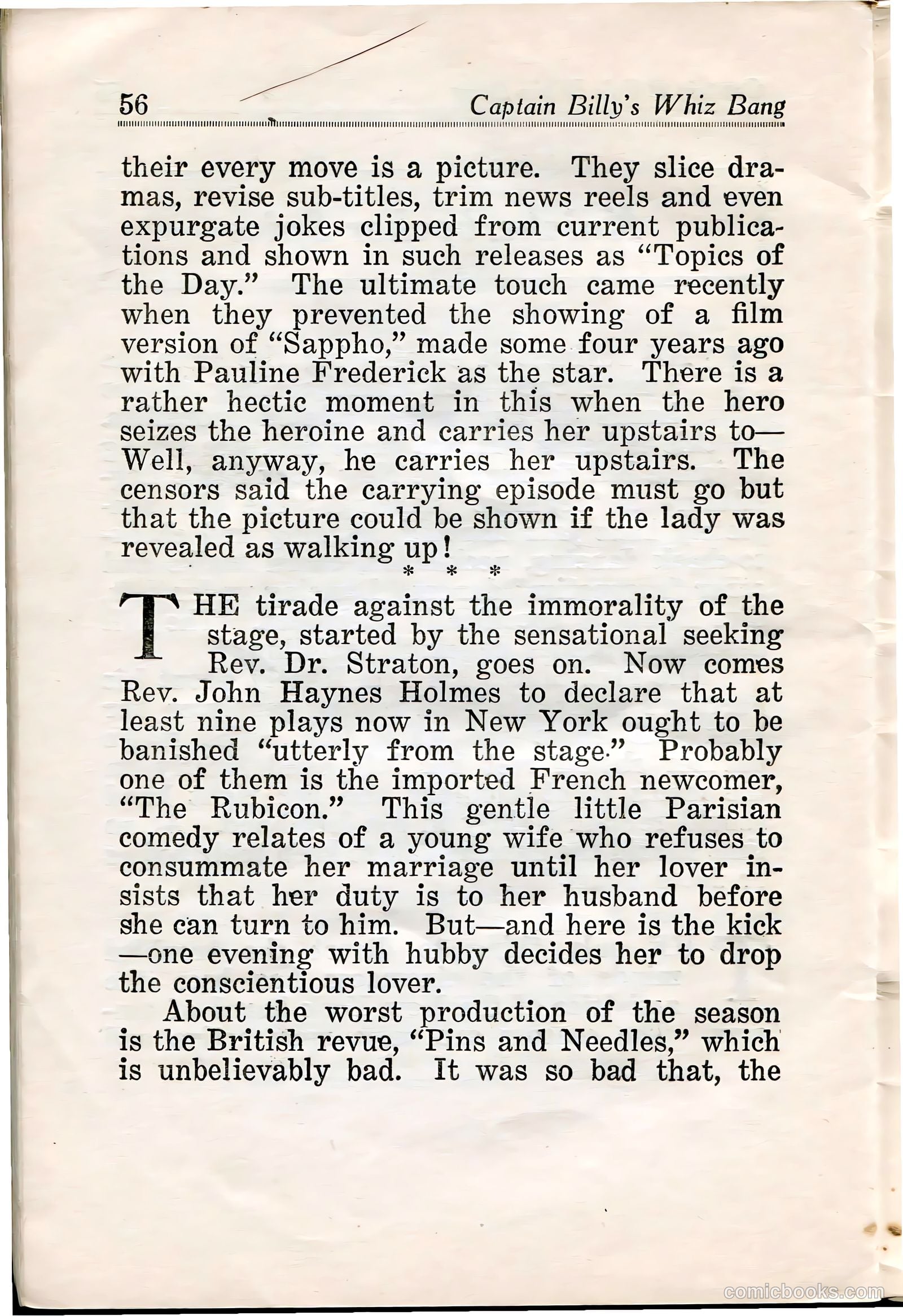
This page satirizes film and theater censorship in the 1920s. The first section mocks the film censorship board's absurd logic: they banned a scene from "Sappho" where a man carries a woman upstairs (implying sexual activity), but would permit it if she walked upstairs instead—the same action, merely viewed differently. The second section ridicules religious moralists, particularly Rev. Dr. Straton and Rev. John Haynes Holmes, who were campaigning against "immoral" stage productions. The author mocks their hypocrisy by describing "The Rubicon," a French play about a wife who refuses her lover until her husband convinces her that marital duty comes first—whereupon she abandons the lover anyway. The satire suggests these moral crusaders miss the play's actual message about marital obligation. The piece concludes dismissing the British revue "Pins and Needles" as terrible, implying even without moral objections it fails artistically.
📄 Transcribed text from this page (OCR, searchable)
Machine-transcribed from the original scan — historical spelling and the odd misread are preserved.
56 Captain Billy's Whiz Bang their every move is a picture. They slice dra- mas, revise sub-titles, trim news reels and even expurgate jokes clipped from current publica- tions and shown in such releases as “Topics of the Day.” The ultimate touch came recently when they prevented the showing of a film version of “Sappho,” made some four years ago with Pauline Frederick as the star. There is a rather hectic moment in this when the hero seizes the heroine and carries her upstairs to— Well, anyway, he carries her upstairs. The censors said the carrying episode must go but that the picture could be shown if the lady was revealed as walking up! * * * THE tirade against the immorality of the stage, started by the sensational seeking Rev. Dr. Straton, goes on. Now comes Rev. John Haynes Holmes to declare that at least nine plays now in New York ought to be banished “utterly from the stage.” Probably one of them is the imported French newcomer, “The Rubicon.” This gentle little Parisian comedy relates of a young wife who refuses to consummate her marriage until her lover in- sists that her duty is to her husband before she can turn to him. But—and here is the kick —one evening with hubby decides her to drop the conscientious lover. About the worst production of the season is the British revue, “Pins and Needles,” which is unbelievably bad. It was so bad that, the