
Captain Billy's Whiz Bang, May 1922 · page 23 of 68
Captain Billy's Whiz Bang #33 — page 23: what you’re looking at
What you’re looking at
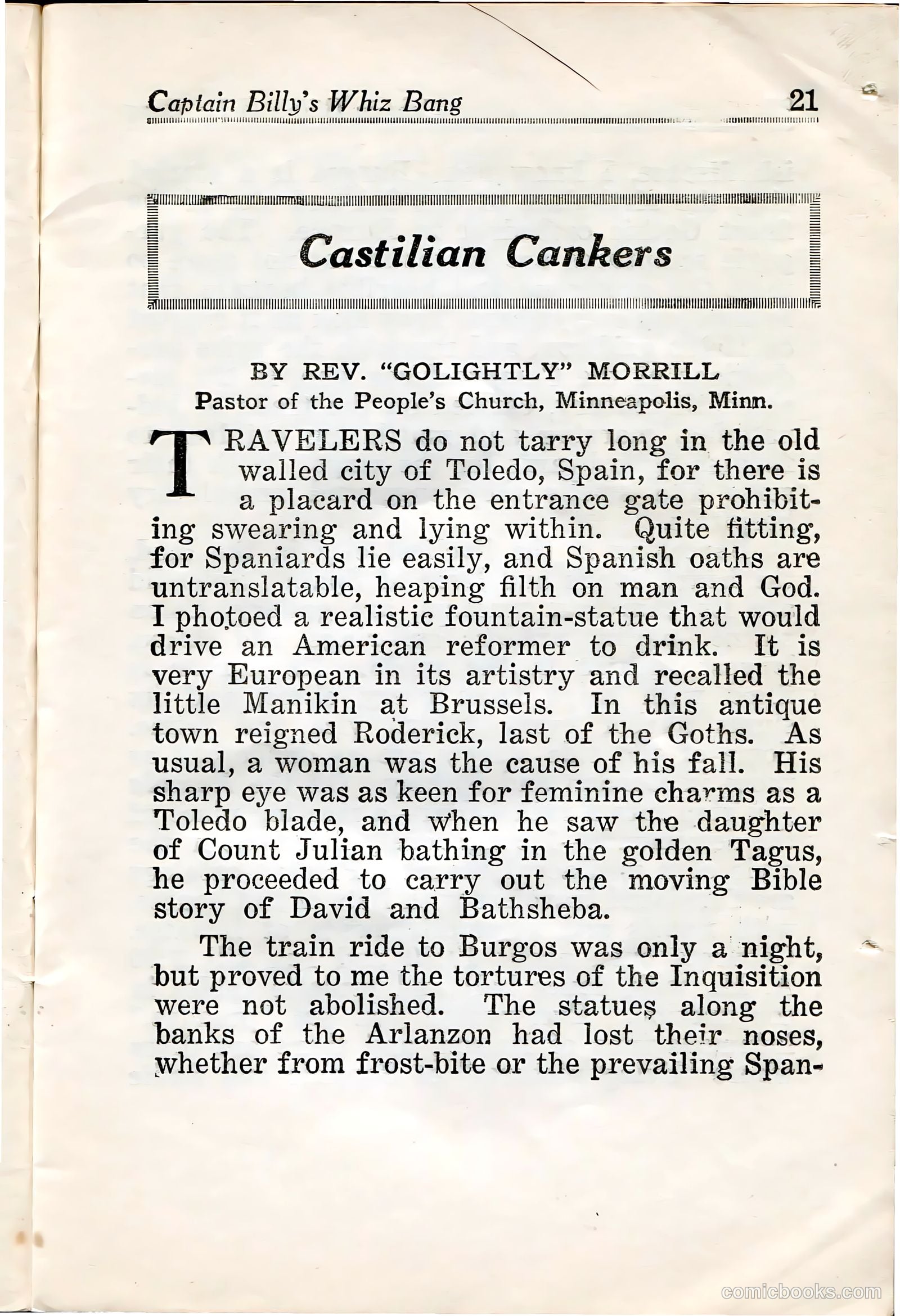
This page contains a travel essay rather than a cartoon. Written by Rev. "Golightly" Morrill, it's a satirical travelogue mocking Spain and Spanish culture. The humor targets Spanish character through stereotypes: Spaniards are portrayed as natural liars and blasphemers (hence Toledo's need for prohibition signs). Morrill jokes about a crude fountain statue that would shock American reformers, comparing it to Brussels's famous Manneken Pis. The essay references historical anecdotes—King Roderick's lust for Count Julian's daughter, paralleling the Biblical David and Bathsheba story—to illustrate Spanish moral failings. The train journey to Burgos becomes a metaphor for Inquisitorial torture. Headless statues along the river are blamed on Spanish negligence or climate, humorously suggesting Spanish carelessness. The satire reflects early 20th-century American attitudes: European decadence, Spanish backwardness, and religious hypocrisy are all fair game for ridicule in this populist humor magazine.
📄 Transcribed text from this page (OCR, searchable)
Machine-transcribed from the original scan — historical spelling and the odd misread are preserved.
Captain Billy's Whiz Bang 21 Castilian Cankers BY REV. “GOLIGHTLY” MORRILL Pastor of the People's Church, Minneapolis, Minn. TRAVELERS do not tarry long in the old walled city of Toledo, Spain, for there is a placard on the entrance gate prohibit- ing swearing and lying within. Quite fitting, for Spaniards lie easily, and Spanish oaths are untranslatable, heaping filth on man and God. I photoed a realistic fountain-statue that would drive an American reformer to drink. It is very European in its artistry and recalled the little Manikin at Brussels. In this antique town reigned Roderick, last of the Goths. As usual, a woman was the cause of his fall. His sharp eye was as keen for feminine charms as a Toledo blade, and when he saw the daughter of Count Julian bathing in the golden Tagus, he proceeded to carry out the moving Bible story of David and Bathsheba. The train ride to Burgos was only a night, but proved to me the tortures of the Inquisition were not abolished. The statues along the banks of the Arlanzon had lost their noses, whether from frost-bite or the prevailing Span-