
Captain Billy's Whiz Bang, May 1922 · page 34 of 68
Captain Billy's Whiz Bang #33 — page 34: what you’re looking at
What you’re looking at
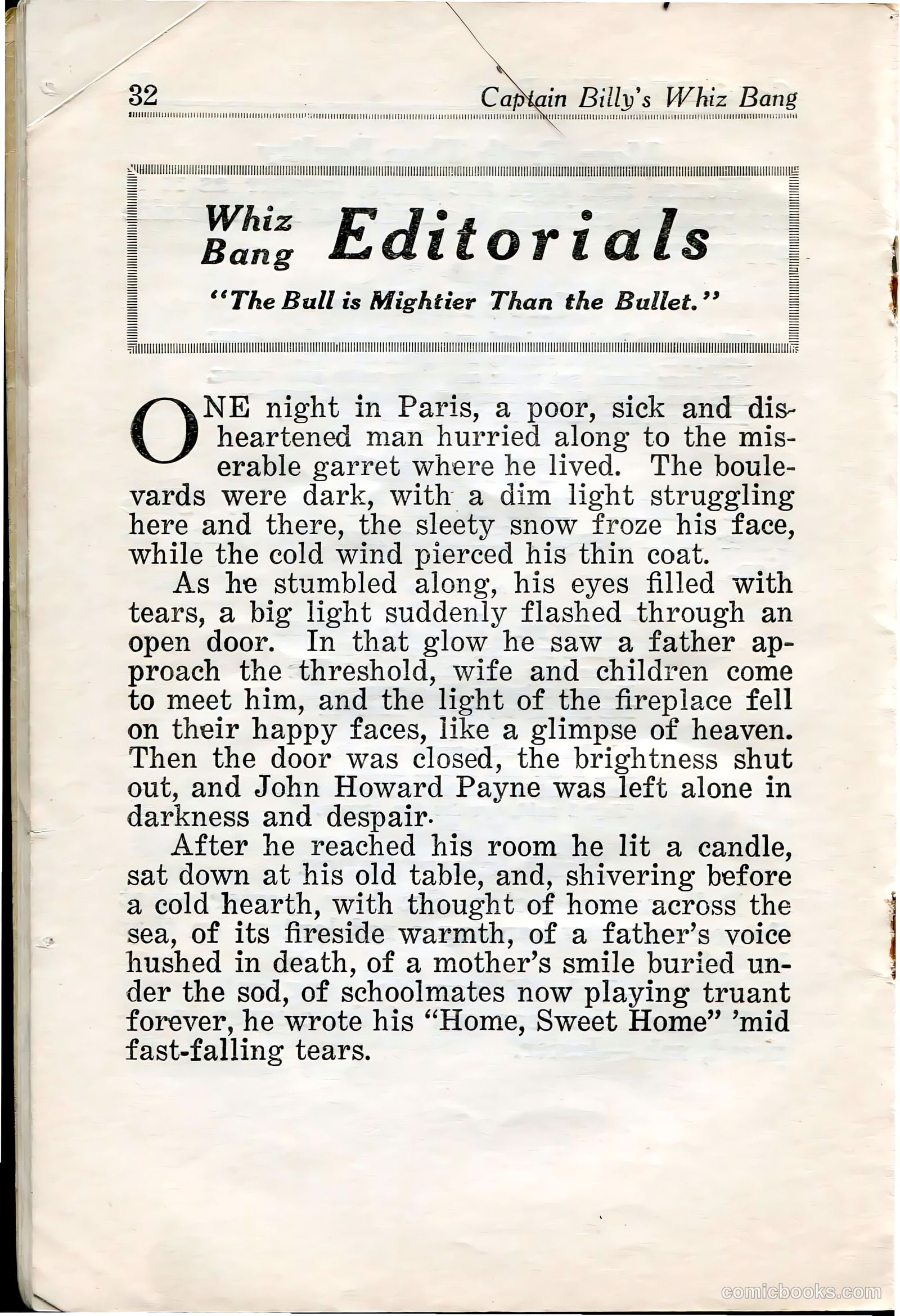
This editorial is a sentimental origin story for the famous song "Home, Sweet Home," attributed to John Howard Payne. The narrative depicts Payne as a poor, displaced man in Paris who, witnessing a happy family through an open doorway, is overcome with homesickness and grief for his dead parents and lost youth. Inspired by this poignant moment, he supposedly composed the beloved song. The headline "The Bull is Mightier Than the Bullet" appears disconnected from this text—it's unclear what satirical point it makes or what "bull" references. The page contains no visible cartoons, only this prose editorial. For a modern reader, the significance lies in recognizing this as a romanticized, likely apocryphal biographical anecdote—the kind of sentimental "great artist origin story" that magazines circulated to give cultural resonance to popular music.
📄 Transcribed text from this page (OCR, searchable)
Machine-transcribed from the original scan — historical spelling and the odd misread are preserved.
32 Captain Billy's Whiz Bang Whiz Bang Editorials “The Bull is Mightier Than the Bullet.” ONE night in Paris, a poor, sick and dis-heartened man hurried along to the mis-erable garret where he lived. The boule-vards were dark, with a dim light struggling here and there, the sleety snow froze his face, while the cold wind pierced his thin coat. As he stumbled along, his eyes filled with tears, a big light suddenly flashed through an open door. In that glow he saw a father ap-proach the threshold, wife and children come to meet him, and the light of the fireplace fell on their happy faces, like a glimpse of heaven. Then the door was closed, the brightness shut out, and John Howard Payne was left alone in darkness and despair. After he reached his room he lit a candle, sat down at his old table, and, shivering before a cold hearth, with thought of home across the sea, of its fireside warmth, of a father’s voice hushed in death, of a mother’s smile buried un-der the sod, of schoolmates now playing truant forever, he wrote his “Home, Sweet Home” ’mid fast-falling tears.